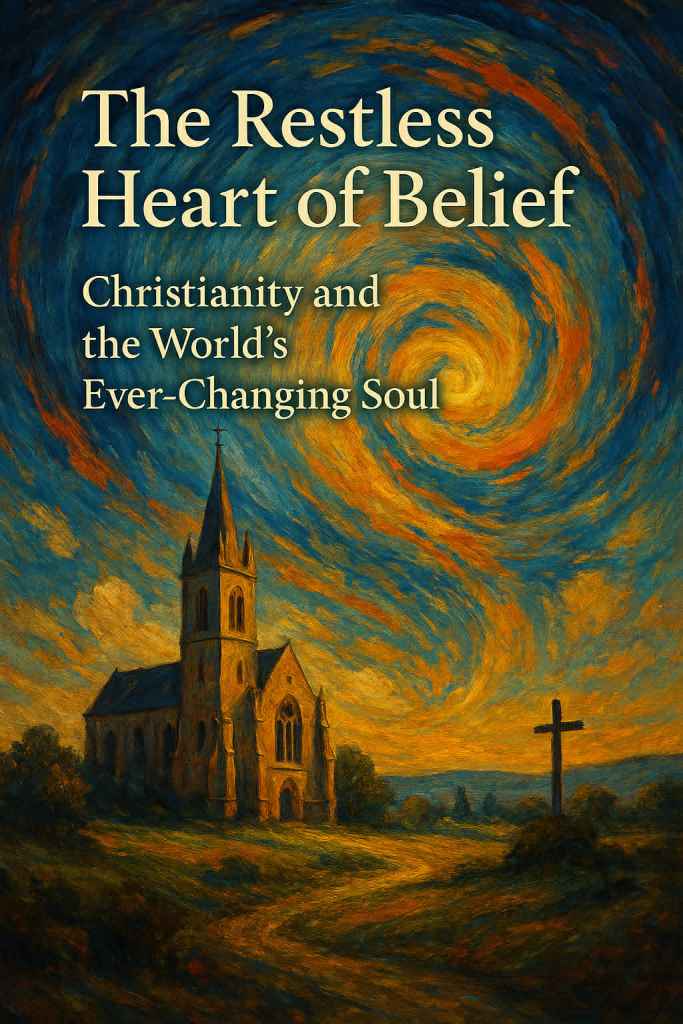
Religion has always been humanity’s great mirror, catching our trembling questions and reflecting them back in stories, rituals and rebellishments of hope. Across continents and centuries, belief has bent and bloomed like wild vines, sometimes orderly and pruned by empire, sometimes sprawling in ecstatic rebellion. To follow its path is to wander through the inner chambers of human longing, fear, power, and love.
Christianity, of course, enters this story like a quiet whisper that eventually learned to speak in the thunderous cadence of kings. It began beneath Roman stones and in the hushed rooms of persecuted minorities who believed that a gentle, radical teacher had undone death itself. Those early followers gathered around tables rather than thrones, sharing bread and trembling expectation. Yet time has a curious talent for shifting the texture of faith, what once belonged to the margins stepped boldly into the halls of emperors. When Constantine lifted the cross above imperial banners, Christianity became both sanctuary and statecraft, an odd marriage of compassion and coercion, of charity and political calculus. The faith that preached love for the least of these often found itself entangled in the grand machinery of nations, where salvation mingled uncomfortably with taxation and territorial ambition.
Still, Christianity kept changing, breathing in the winds of each era. Monasteries sprouted like islands of order amid medieval chaos, offering literacy, medicinal gardens, and the persistent humming of prayer. Later came the fiery reformers who tore at the ornate garments of the Church, insisting that faith did not require gilded towers nor Latin tongues. Printing presses spilled scripture into the hands of commoners, and suddenly belief was not only inherited but contested. Even today Christianity keeps remaking itself, rising in the global south with dances and drums, softening into contemplative practices in the West, broadening debates about justice, identity, and the moral responsibilities of power.
Yet the Christian story is only one path in humanity’s great forest of seeking.
Long before the prophets of Galilee walked dusty roads, Hindu sages were crafting poems of cosmic cycles, Brahman, and the self that flickers like a lamp within the ribcage. Their faith unfolded not through conquest but through centuries of philosophical meditation and ritual colour, rangolis underfoot, lamps floating across rivers, the eternal dance of Shiva marking time itself.
In the Middle East, Judaism carried its own long melody of covenant and exile, threading devotion through centuries of displacement and renewal. Out of its ancient roots blossomed Islam, a faith swept along by caravans and caliphs, by poets who stitched verses into the night sky and scholars who built libraries that dazzled the medieval world. Islam reimagined empire just as empire reshaped Islam, each influencing the other with the complicated intimacy of lovers and rivals.
Farther east, the Buddha’s quiet revolution unfolded with the gentleness of a lotus opening. His answer to suffering was neither sword nor law but mindfulness, compassion, and the radical notion that freedom begins in the mind’s own small rebellions. Buddhism traveled light, carried by monks, traders, storytellers, shaping itself to each culture it touched, whether nestled in the mountain monasteries of Tibet or drifting through Zen gardens in Japan.
And beyond these well-known rivers of belief lay countless springs, the ancestral rhythms of African spirituality, Indigenous cosmologies speaking to wind and stone, the earth-bound reverence of animist traditions. Many of these were suppressed by colonial ambitions that preached salvation while taking land and silencing voices. Yet their songs endure, resurfacing now with new confidence as societies begin to reclaim what generations were told to forget.
Looking across this whole sweeping tapestry, religion appears less like a fixed monument and more like a living creature, a thing that curls toward the warmth of human need. Sometimes it comforts the lonely, sometimes it crowns the powerful. It has justified wars and inspired revolutions, absolved cruelty and ignited compassion. It has shaped laws, toppled them, resurrected them in more hopeful forms. At its best, religion opens the heart, at its worst, it is used to close it.
Perhaps that is why, even today, belief continues to evolve. In a world of satellites and social upheavals, faith becomes a conversation rather than a commandment. It is whispered in meditation circles, shouted in protests for the oppressed, sung in cathedrals that echo with centuries of longing. Religion changes because we change, because we are always re-negotiating what it means to be human, fragile, yearning, angry, hopeful creatures who keep looking for meaning in the night sky.
And maybe that is the most romantic truth of all, despite our wars, our doubts, and our endlessly shifting empires, we never stop telling stories about the sacred. We never stop reaching for something larger than ourselves, hoping that somewhere in the great swirling mystery, the divine is reaching back.
The story of faith has always wandered,
never content to stand still,
drifting like a pilgrim across centuries,
caught between the pull of heaven
and the stubborn weight of earth.

Christianity began as a whisper in the dust,
a kindness spoken softly in occupied streets,
a promise carried by fishermen
who believed that love could outlive death.
From those fragile beginnings rose empires draped in gold and gospel,
their banners fluttering with both mercy and ambition.
How strange it is,
that something born in tenderness,
could grow powerful enough to shape nations
and gentle enough to heal a single broken heart.

But Christianity is only one thread
in the great fabric of our seeking.
Around it weave the old songs,
Hindu chants that swirl with cosmic fire,
Buddhist breaths that quiet the storm,
Islamic verses unfolding like evening light,
Indigenous prayers spoken to rivers
that remember us more faithfully than we remember them.
Every faith a different doorway,
every doorway leading to the same trembling question,
Who are we,
and what love made us?

Belief has always been a restless thing,
a creature with wings,
pacing inside the chambers of humanity’s chest.
It reshapes itself with every revolution,
every heartbreak,
every new dawn that startles us
into imagining a kinder world.

And still it beats,
this wandering heart of ours,
in the shadow of cathedrals,
in the hush of temples,
in the wild open spaces where no building stands
but the soul feels held all the same.

Perhaps the secret is this,
that the divine has never asked us to be perfect,
only curious,
only brave enough to keep reaching.
For even as religions change their forms,
their theologies,
their politics and their promises,
something constant rises from the dust,
a longing older than any scripture,
a hope stubborn enough to survive us.

So we keep searching,
year after uncertain year,
trusting that our small lights matter,
that our prayers however faltering,
stitch us to something infinite.

The heart of belief is restless, yes,
but it is also resilient,
romantic in the way it refuses
to let darkness have the final word.

And maybe that is the soul of the world itself
ever-changing, ever-reaching,
forever learning to love again.