There is a quiet reverence in the act of uncovering one’s ancestry, a deep, almost spiritual connection that binds us to those who walked before. When we trace the lives of our forebears, we do more than record history; we awaken it. We breathe life into faded ink and forgotten names, and in doing so, we rediscover a part of ourselves.
The story of George Hatcher, my second great-grandfather, is more than a collection of dates, places, and records. It is a testament to endurance, the story of a man who lived, loved, and labored in an era far removed from our own, yet whose spirit continues to echo quietly through the generations. Through the documents he left behind, census lines, marriage entries, and fragments of correspondence, a picture begins to form, fragile yet profound, revealing the human heartbeat behind the historical record.
To explore his early years is to enter a sacred space between past and present. It is to recognize that our family’s story is not only written in archives and ledgers, but also in the invisible thread that ties our souls together across time. This work, then, is both an offering and an act of gratitude, for in knowing where we come from, we come to know ourselves more deeply. And in honoring George Hatcher’s life, we honor the countless lives that converged to make our own possible.
Welcome back to the year 1855, Butler’s Wood, Newtown, Lockerley, Hampshire, England. The air is clear and earthy, scented with woodsmoke, damp moss, and the faint sweetness of wild honeysuckle. Life here moves to the slow rhythm of the countryside, where the days are measured by the toll of the church bell and the turning of the seasons rather than the ticking of the clock. Britain stands under the reign of Queen Victoria, who has already ruled for eighteen years. Her face, serene and solemn, gazes from coins and portraits across the nation, while her Prime Minister, Lord Palmerston, leads the government through a time of empire, progress, and conflict. The Crimean War rages far from these quiet Hampshire lanes, casting long shadows of patriotism and grief across England’s green fields, as letters and newspaper dispatches bring word of battles, bravery, and loss.
Here in Butler’s Wood and the small cottages scattered through Newtown and Lockerley, life is both simpler and harder than that of the distant cities. The wealthy landowners and gentlemen farmers, live in comfortable houses warmed by coal fires and adorned with fine drapery, silver tea services, and the new fashion of wallpapered parlours. They travel in carriages or on horseback, their days filled with estate matters, social calls, and reading the latest instalments of Dickens or Thackeray by lamplight. The working class, by contrast, live in modest cottages with uneven floors and small hearths. Many men labour in the fields or forests, cutting timber, tending livestock, or repairing hedgerows, while women spin, sew, or take on laundry for the nearby gentry. Their lives are tied to the land, the hum of bees in summer, the crackle of frost on winter mornings, the rhythm of work and prayer. The poor, however, endure harsher realities still. Some live in overcrowded cottages or converted barns, their roofs patched with thatch or tarred cloth, their meals sparse and their days long. Charity, or the parish relief, keeps them from ruin, though pride often prevents them from seeking it.
Fashion tells the tale of class as sharply as coin ever could. Ladies of comfort wear full crinoline skirts, silk gowns with tight bodices, and lace gloves, while their rural counterparts make do with homespun cotton and simple shawls. Men of means sport tailored frock coats and top hats, but in the Hampshire countryside, a worn waistcoat and sturdy boots suffice. Life’s pace is slower here, the sound of the new railways little more than a rumour, though in nearby towns the trains have begun to change the world, shortening distances, carrying letters, goods, and soldiers alike. Closer to home, horse-drawn carts rattle down muddy lanes, and the main routes are lined with hedgerows thick with blackthorn and hazel.
Homes in 1855 are lit by candle or oil lamp, their glow soft and golden against the rough plaster walls. Heat comes from the hearth, where coal or wood burns low, the heart of every house both literally and symbolically. In cottages, smoke curls upward through chimneys that need regular sweeping, and in grander homes, kitchen ranges and cast-iron stoves have begun to appear. Hygiene, however, remains rudimentary. Water is drawn from wells or pumps, often shared by several households. Bathing is a luxury for most, reserved for special occasions or Sundays, and soap, when available, is precious. Sanitation is little better. Privies stand at the edge of gardens, and waste disposal is a matter of burying or burning. In the cities, the smell of sewage and soot fills the air, but even in rural Hampshire, dampness and decay are constant foes.
Food depends greatly on class and season. The rich dine on roast meats, puddings, game, and wine, while the working class live on bread, cheese, potatoes, and whatever vegetables or small game they can manage. A stew cooked slowly over the fire is a staple in most homes, shared with family and neighbours alike. Tea, increasingly affordable, is a comfort to many, a small luxury that brings warmth to weary hands. Entertainment, too, is modest but meaningful. There are country fairs, harvest suppers, church gatherings, and the occasional travelling show or storyteller passing through nearby Romsey or Salisbury. Evenings are often spent by the fire, with songs, simple games, or quiet conversation filling the hours before bed.
Illness is ever-present. Diseases such as cholera, typhus, and tuberculosis haunt both cities and villages, claiming lives swiftly. Medical care is limited and expensive, and many turn to herbal remedies, passed down through generations of rural wisdom. Yet the countryside air, fresh and open, spares many of the worst afflictions of the industrial towns. Religion remains the guiding thread of life. The church stands at the heart of the community, its bell calling the faithful each Sunday, its rector a figure of both spiritual and social authority. Sermons remind parishioners of duty, humility, and the promise of salvation.
The environment around Butler’s Wood is rich and alive, oak and beech trees rising high, meadows bursting with wildflowers, and streams glinting through the undergrowth. Gossip drifts like smoke among the cottages, tales of marriages, births, and perhaps a scandal or two but it is gentle and familiar, part of the fabric of village life. Schooling is limited for the poor, though Sunday schools and charity efforts have begun to teach children their letters and scripture. For most, education comes from experience, from the soil, from family, and from faith.
In this year, 1855, England stands between two worlds, one old and rooted in tradition, the other reaching toward progress and industry. Yet here in the quiet heart of Hampshire, beneath the boughs of Butler’s Wood, life remains timeless. The smoke rises from cottage chimneys, the church bell tolls across the fields, and the rhythm of human life continues, tender, toiling, enduring, as it has for generations before.
In the gentle warmth of an English summer, on Sunday, the 8th day of July 1855, the quiet village of Lockerley lay bathed in golden light. Morning mist clung to the meadows, and the fields of Hampshire stirred softly in the breath of dawn. Within a modest cottage, Susan Hatcher, wife of Charles Hatcher, brought forth new life, a son.
He was named George Hatcher, a name that would travel through generations like a whispered prayer carried on the wind. His father, Charles, then forty-one years of age, worked faithfully as an Agricultural Labourer, his days spent tending the soil and shaping his family’s future with calloused, steadfast hands. His mother, Susan, aged thirty-five, formerly Susan Luke, welcomed her child with quiet reverence, her heart full of love, humility, and the deep knowing that life’s simplest moments often hold the most enduring grace.
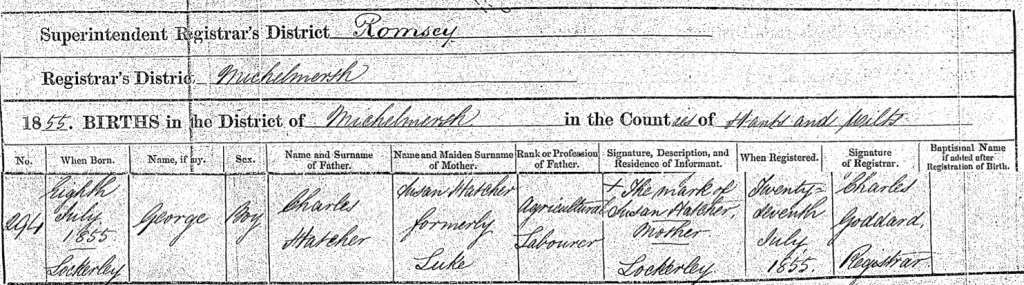
His arrival was carefully recorded under No. 294 in the 1855 Births in the District of Mitchelmersh in the Counties of Hants and Wilts, on Friday, the 27th day of July 1855.
1855. Births in the District of Mitchelmersh in the Counties of Hants and Wilts

No.: 294

When Born: Eighth of July 1855 at Lockerly

Name, if any: George

Sex: Boy

Name and Surname of Father: Charles Hatcher

Name and Maiden Surname of Mother: Susan Hatcher formerly Luke

Rank or Profession of Father: Agricultural Labourer

Signature, Description, and Residence of Informant: The mark of Susan Hatcher, Mother, Lockerly

When Registered: Twenty-seventh of July 1855

Signature of Registrar: Charles Goddard, Registrar

Baptismal Name, if added after Registration of Birth: —
When the time came to record his birth, Susan marked the register simply yet meaningfully “The mark of Susan Hatcher, Mother, Lockerley.” It was not just ink upon paper, but a mother’s silent vow, her love sealed in a trembling hand. Registrar Charles Goddard signed his name below hers, unknowingly preserving one of life’s most tender moments, the humble, beautiful beginning of a life that would ripple quietly through time.
Thus began the story of my second great-grandfather, George Hatcher, a child born beneath the summer sky, rooted in the steadfast grace of his family and the enduring soil of Lockerley.
George was the fifth child of Charles and Susan. His brothers and sisters, Ellen, Fanny, Mary Ann, John, and Rosa(known fondly as Rose), formed a lively circle around him. Ellen, Fanny, and Mary Ann had been born out of wedlock, the illegitimate children of Susan, their births registered in her maiden name,  Luke, with no father named upon their certificates. Yet, life often speaks in subtler truths, both Fanny and Mary Ann’s baptisms name Charles Hatcher as their father, a quiet testimony that love, though sometimes unrecorded, had long taken root between Charles and Susan.
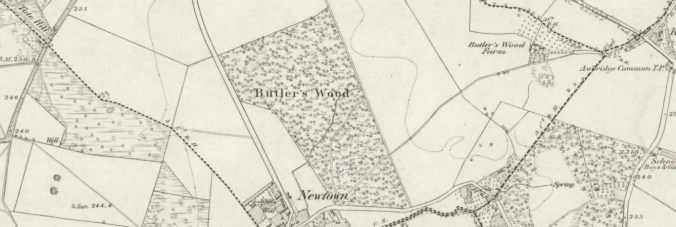
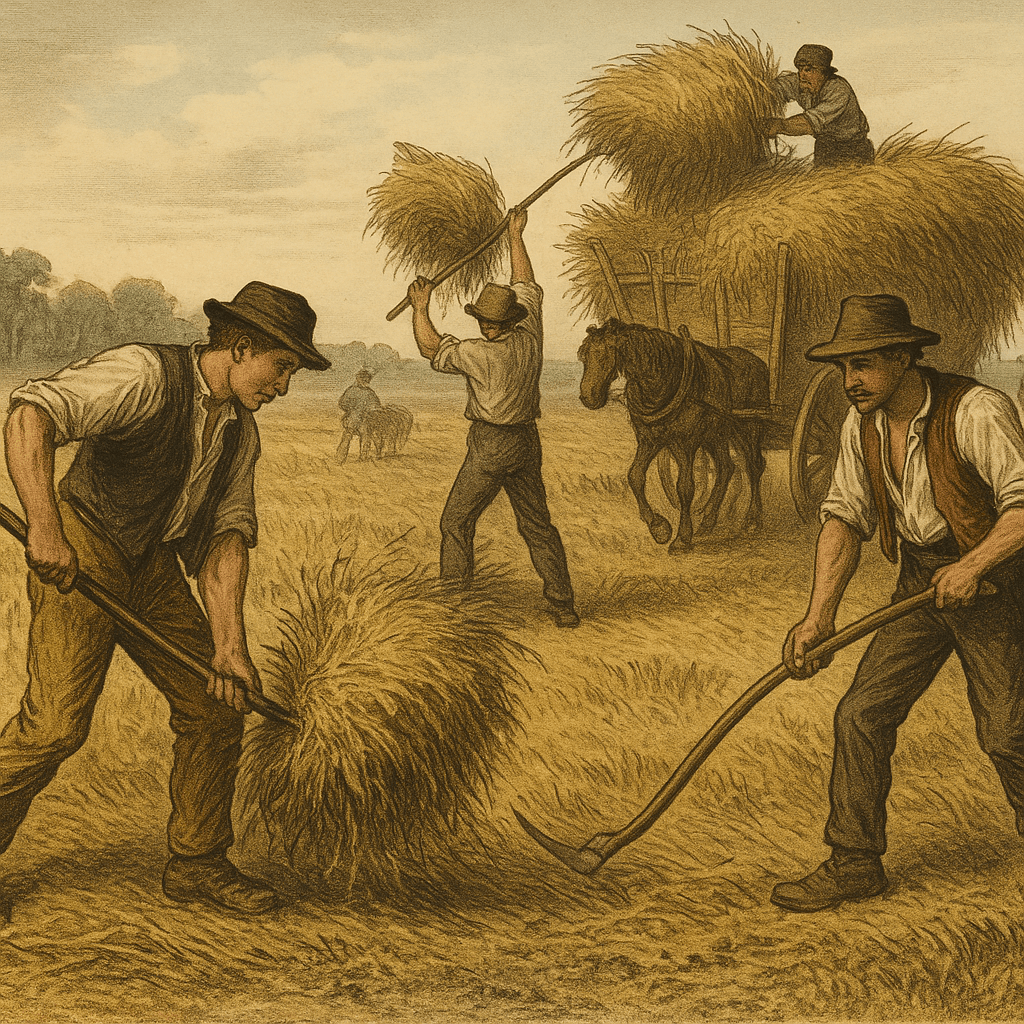
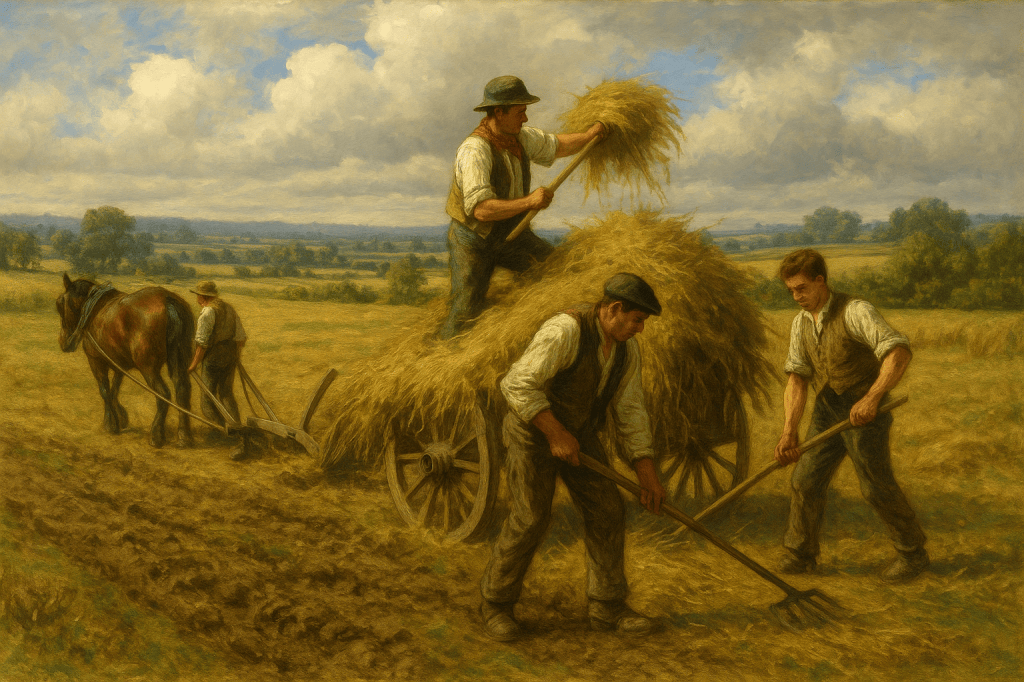
Though George’s birth was officially registered at Lockerley, the family resided amidst the greenery of Butler’s Wood, Newtown, a rustic corner of Hampshire, England, where birdsong and the rhythm of labor filled each passing day. It was here, in this pastoral haven of humble means, that George first opened his eyes to the world, a world of hayfields and hearthlight, of honest toil and tender beginnings.
And so, beneath the soft folds of English summer, among the whispering trees of Newtown, Lockerley, began the life of George Hatcher, a life grounded in faith, shaped by labor, and carried forward through the generations by those who still remember.
Butler’s Wood, situated near Newtown in Lockerley, Hampshire, is a historic woodland with deep roots in the region's agricultural and social history. The wood was enclosed in July 1815 under the Inclosure Act of 1811, which aimed to consolidate and privatize common lands for more efficient farming practices. This enclosure marked a significant shift in land use and ownership in the area.
The landscape surrounding Butler’s Wood was predominantly agricultural, with crops like wheat, barley, oats, and turnips being cultivated. The subsoil consisted of gravel, and the soil was a mix of chalk and clay, which influenced the types of crops that could be grown and the farming methods employed.
In the 19th century, the area experienced significant changes. The construction of the railway line through Lockerley in the mid-1800s facilitated the transport of goods and people, leading to increased development and urbanisation in the region. This development included the establishment of new farms, residential areas, and infrastructure, transforming the rural landscape.
On a warm and golden Sunday, the 12th day of August 1855, the little village of Lockerley awoke to the peal of the church bell. It was a sound the villagers knew by heart, clear and steady, calling all who toiled upon the land to gather for the Sabbath. Along the quiet lanes, lined with hawthorn and wild rose, the people of the parish made their way toward St John’s Church, a modest flint-stone chapel that had long watched over their baptisms, weddings, and farewells.
Inside, the air was cool and fragrant with beeswax, damp stone, and the faint sweetness of meadow flowers left upon the altar. Shafts of morning sunlight streamed through the leaded windows, dancing upon the old wooden pews and the ancient font of carved stone that had baptized generations of Lockerley’s children.
It was here that Charles and Susan Hatcher, husband and wife of the parish, came with their infant son George, born the month before on the 8th day of July 1855, to dedicate him to God. Charles, a humble agricultural labourer, stood quietly near the chancel rail, his Sunday coat brushed and worn. Beside him, Susan held her baby close, her bonnet tipped back just enough to see his tiny face, flushed with the warmth of summer.
The Curate, H. A. Wakes, opened the Book of Common Prayer, its pages softened from years of use. The baptism followed the Order for the Publick Baptism of Infants, the same words spoken in English churches since the seventeenth century, words as familiar to the villagers as the sound of their own fields.
The service began with the reading of scripture, “Suffer the little children to come unto Me, and forbid them not; for of such is the Kingdom of God.” Then came the prayers of thanksgiving, spoken in the stately, rhythmic language of the old Prayer Book:
“We yield thee hearty thanks, most merciful Father, that it hath pleased thee to regenerate this Infant with thy Holy Spirit, to receive him for thine own Child by adoption, and to incorporate him into thy holy Church.”
The congregation, neighbours and kin, many of whom had known the Hatchers all their lives, joined softly in the familiar responses. From the small organ loft drifted the notes of a hymn long beloved in country parishes, perhaps “All Praise to Thee, My God, This Night” or “There is a Green Hill Far Away,” both common in the mid-Victorian hymnals. The psalm appointed for that day might well have been Psalm 23, its words murmured with simple faith: “The Lord is my shepherd; I shall not want.”
Then, as silence fell, Curate Wakes lifted the silver shell and poured cool water three times upon the child’s brow. The drops glistened like glass in the sunlight as he spoke the sacred words that had echoed through the centuries:
“I baptise thee in the Name of the Father, and of the Son, and of the Holy Ghost. Amen.”
A hush lingered in the small church. The mother smiled through tears; the father bowed his head. The curate marked the sign of the Cross upon the baby’s forehead, saying, “We receive this Child into the congregation of Christ’s flock.” The bells outside rang faintly again, as though the whole village joined in welcome.
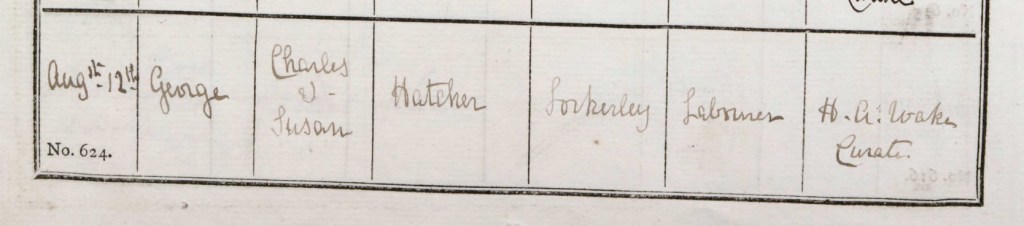
When the prayers were ended, the entry was made carefully in the great register that rested upon the vestry table, its pages heavy with the names of the parish’s sons and daughters. The record reads:
BAPTISMS solemnized in the Parish of Lockerley in the County of Southampton in the Year 1855

No. 624

When Baptized: August 12th

Child’s Christian Name: George

Parents’ Names: Charles & Susan Hatcher

Abode: Lockerley
Quality, Trade, or Profession: Labourer

By whom the Ceremony was performed: H. A. Wakes, Curate.
And thus, with ink and blessing, George Hatcher was received into the fellowship of the Church of England, into the faith that would anchor his family through hardship and harvest alike. The Hatchers stepped out once more into the sunlight, the bells still chiming, the scent of hay and honeysuckle drifting on the air. In that small act, a handful of water, a few quiet prayers, a life had been set upon its course, and a memory written not only upon parchment, but upon the heart of a family and the soul of a village.
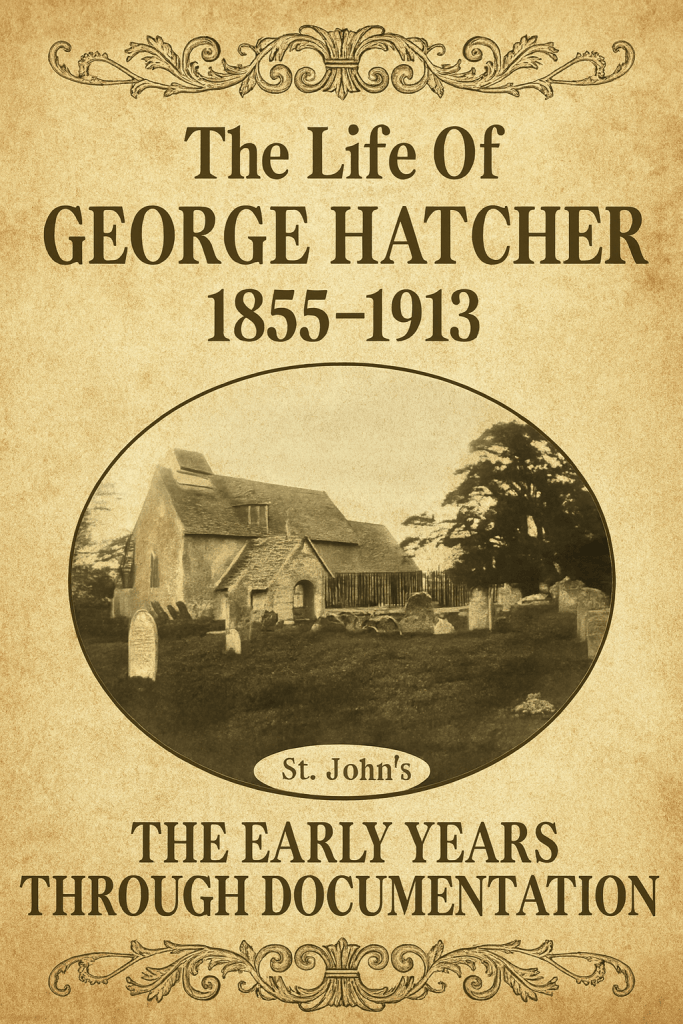
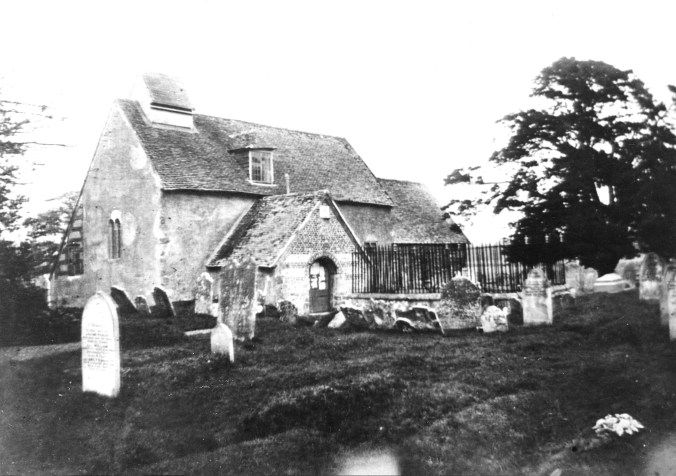
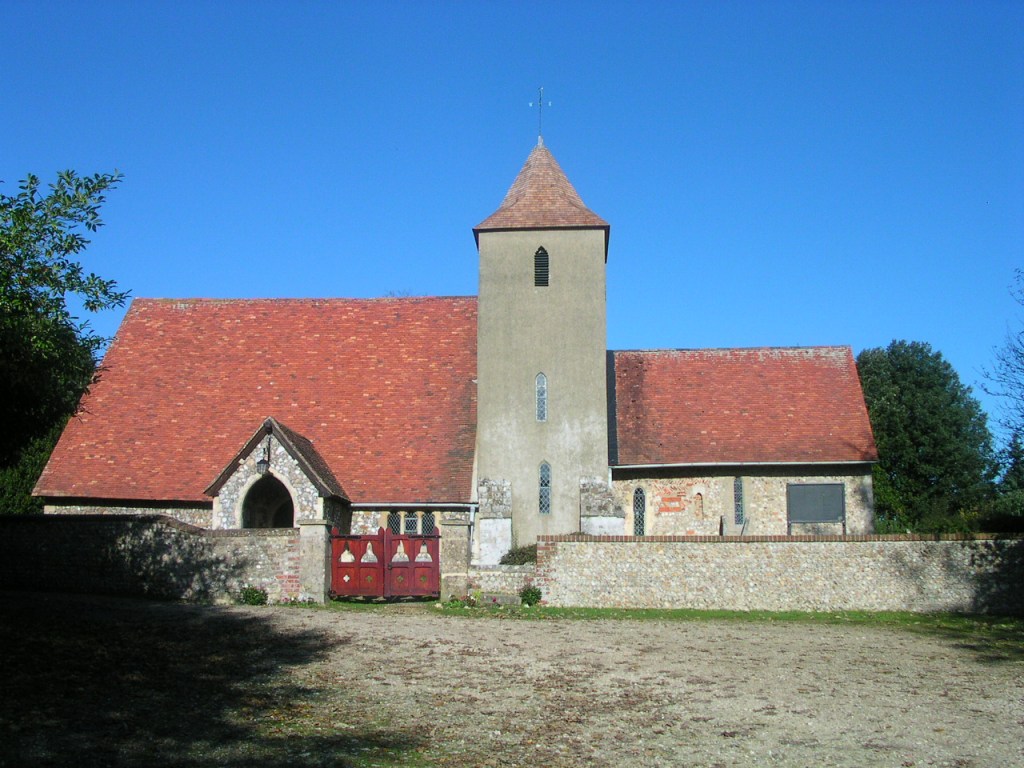
St. John’s Church in Lockerley, Hampshire, is a charming and historic church that has served the local community for centuries. Located in the heart of the picturesque village of Lockerley, which lies in the Test Valley, the church is an important part of the area’s history, culture, and spiritual life.
The history of St. John’s Church dates back to the medieval period, though the current structure reflects several stages of development over the centuries. The original church was likely built around the 12th century, though records from that time are sparse. The church’s dedication to St. John the Evangelist indicates its religious association with the Christian tradition, particularly with the apostle John, one of the most prominent figures in the New Testament. The church’s early history is tied to the broader religious and agricultural practices of the village, which has been a rural community for much of its existence.
Over the centuries, St. John’s Church was subject to several expansions and renovations. The original Norman structure would have been relatively simple, reflecting the needs of a small rural community. However, as Lockerley grew and developed, particularly during the medieval and post-medieval periods, the church was modified to accommodate a larger congregation and to reflect the changing architectural styles of the time. One of the most notable periods of change came in the 19th century, when the church was rebuilt in the Victorian era.
The current building of St. John’s Church was constructed in 1889–90 under the direction of the architect J. Colson, in a style that blends both Gothic and Perpendicular Gothic elements. This period saw significant growth in the Test Valley, and Lockerley, with its proximity to the town of Romsey, benefitted from an expanding population and increased prosperity. The design of the church reflects the period's architectural tastes, with soaring arches, intricate stained-glass windows, and the use of local materials that give the church a distinctive character.
St. John’s Church is a relatively large and impressive building for a rural village church. The structure features a chancel with an outshot, a nave with transepts, and a southwest tower that adds a sense of grandeur to the village’s skyline. The church’s stained-glass windows, depicting various scenes from the Bible, are particularly beautiful, and they provide a striking contrast to the stonework of the building. The wooden roof of the nave, designed with king-post trusses on arch-braces, is another notable feature of the interior, displaying the craftsmanship of the period.
Over the years, St. John’s Church has been at the center of life in Lockerley, hosting regular religious services, weddings, baptisms, and funerals. The churchyard is the final resting place for many of the village’s residents, with gravestones marking the passage of time and offering a sense of continuity to the village’s history. The church continues to play an important role in the spiritual life of the community, offering a space for worship, reflection, and prayer.
In addition to its role as a place of worship, St. John’s Church has also served as a venue for significant community events. The church is a place where people come together to mark important milestones, both religious and personal. Many of the village’s residents, both past and present, have been married, baptized, or buried in the church, giving it a special place in the collective memory of Lockerley.
The churchyard itself is a peaceful and tranquil space, with the graves of local families dotting the landscape. These graves serve as a reminder of the long history of Lockerley, and they provide a connection to the past. The churchyard is not only a site of historical importance but also a beautiful setting for reflection, surrounded by the natural beauty of the Hampshire countryside.
As for rumors of hauntings, like many historic churches, St. John’s has been the subject of local legends and ghost stories. However, there are no widely documented or substantiated paranormal occurrences associated with the church. Given the long history of the building and the village, it is not unusual for local folklore to suggest the presence of spirits or supernatural events. In many cases, such stories are passed down through generations, often becoming part of the cultural fabric of a place. While there may be occasional whispers or tales shared by the community about unexplained occurrences, there is no firm evidence to suggest that the church is haunted.
The name George carries with it a timeless dignity, a sense of quiet strength, and a history that reaches back through centuries of kings, saints, and ordinary men who bore it with pride. Its roots lie in ancient Greece, derived from Georgios, which itself comes from georgos, meaning “earth-worker” or “farmer.” The word is built from ge (earth) and ergon (work), giving George the beautiful and humble meaning of “one who works the land.” It evokes images of steadiness, of honest labour and connection to the soil, a name both noble and grounded, reflecting the deep relationship between humanity and the earth that sustains it.
The name became widely known across Christendom through Saint George, the legendary soldier-saint who, according to medieval tales, slew a dragon and rescued a princess. In truth, Saint George was a Roman soldier martyred for his Christian faith around the 4th century, but over time his story grew into a symbol of courage, faith, and chivalry. By the Middle Ages, he was one of the most venerated saints in Europe, and in England his name held special reverence. King Edward III made Saint George the patron saint of England in the 14th century, and his emblem, the red cross on a white field, became the national flag, still fluttering proudly today as the Cross of Saint George.
Because of this association, the name George became a steadfast favourite among the English, a name that carried both patriotic and moral weight. By the 18th and 19th centuries, it was one of the most common forenames in Britain, worn by men across all walks of life, from kings to carpenters, scholars to shepherds. The Georgian era itself (1714–1830), ruled by four successive King Georges, cemented the name in the national consciousness, giving it an air of stability and tradition. To name a child George in those years was to root him firmly in the familiar virtues of strength, loyalty, and decency.
Throughout history, the name has travelled far beyond England’s shores. It spread across Europe and into the New World, adapted into countless forms: Jorge in Spanish and Portuguese, Georges in French, Giorgio in Italian, and György in Hungarian. Each culture embraced it, and yet it retained its essential simplicity and grace.
In character, George feels timeless, neither boastful nor delicate, but strong in its quietness. It is a name that belongs equally to farmers and poets, sailors and statesmen. It evokes trust and kindness, a steady hand and a thoughtful heart. In the 19th century, especially in rural England, George was a name given with warmth and hope, a name for sons who would grow into good men, workers of the land, husbands, and fathers. It carried an echo of both the saint’s courage and the honest toil of everyday life.
Even now, George retains that same enduring quality. It is simple yet elegant, traditional yet always fresh. From Saint George the martyr to King George VI who led Britain through war, from countless village Georges who tilled the fields to the young Prince George of today, the name continues to bridge centuries with quiet constancy.
To be called George is to bear a name rooted in earth and faith, touched by myth and monarchy alike. It is a name that has stood the test of time, a name that, wherever it is spoken, carries with it the calm assurance of strength, steadiness, and the enduring spirit of England itself.
The surname Hatcher is of English origin and carries with it a long and fascinating history that dates back to the Middle Ages. It is primarily an occupational or locational name, deriving from the Old English word “hæcc” or “hacca,” meaning a gate, hatch, or wicket, combined with the suffix “-er,” which denotes a person associated with a place or occupation. In this case, a Hatcher would likely have been a keeper of a gate or someone who lived near a hatch gate, often a type of gate across a river or drainage channel used to control water flow. This origin ties the name to the rural and agricultural life of medieval England, when land, water, and farming shaped both livelihoods and identities.
The earliest recorded forms of the surname appear in southern England, particularly in counties such as Wiltshire, Hampshire, and Somerset. One of the earliest known references to the name is found in the 13th century, when individuals bearing the name “le Hatcher” were recorded in various tax and manorial rolls. The name appears in several forms through history, including Haccher, Hatchar, and Hachere, before settling into the modern spelling of Hatcher. It is possible that some bearers of the name also came from villages with “Hatch” in their names, such as West Hatch in Somerset or Hatch in Wiltshire, making it partly locational as well.
As families began to establish themselves, the Hatchers became more prominent in Hampshire and neighboring counties. During the 16th and 17th centuries, records show Hatcher families involved in farming, trade, and later in parish and civic roles. By the time of the 19th century, the name had spread more widely across England and beyond, particularly to the United States, where several early settlers named Hatcher arrived in Virginia and New England during the colonial period. Many of these emigrants were from southern English counties, carrying their family name and traditions across the Atlantic.
The English Hatcher family crest and coat of arms reflect the symbolism common in heraldry of the gentry and freeholders of the late medieval and early modern periods. The most widely recognized Hatcher coat of arms depicts a shield featuring three hatches or bars arranged across its surface, often rendered in silver and black or red, representing strength, protection, and steadfastness. Some versions of the arms include a chevron, symbolizing protection and faithful service, or a lion, representing courage and loyalty. Above the shield, the crest commonly features a bird, often a falcon or dove, denoting peace and resolve. The family motto associated with certain branches of the Hatcher family is sometimes given as “Ad Finem Fidelis,” which translates as “Faithful to the end,” a phrase that encapsulates the steadfast nature of the family’s heritage.
Heraldic designs varied slightly depending on branch and region, as coats of arms were often granted to specific individuals rather than to entire surnames. However, all versions of the Hatcher arms share a sense of dignity and craftsmanship typical of English heraldry of the period.
In summary, the surname Hatcher is an old English name rooted in agricultural and rural traditions, likely born from the role of gatekeepers or those living near hatch gates. It has been present in southern England for over seven centuries, particularly in Hampshire, Wiltshire, and Somerset. The Hatcher coat of arms, with its heraldic imagery of strength and loyalty, stands as a visual symbol of an enduring English lineage tied closely to the land and its communities.
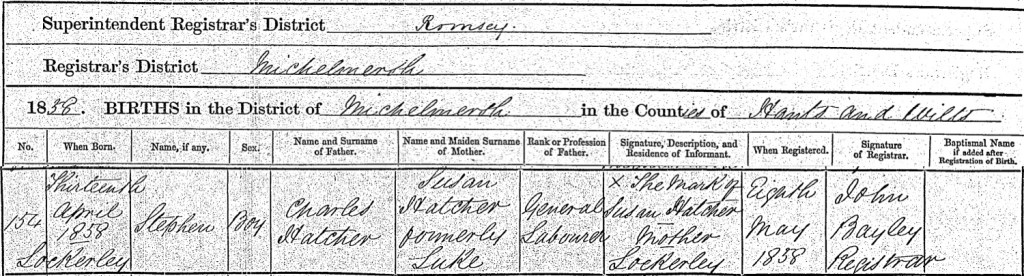
On Tuesday, the 13th day of April, 1858, in the tranquil Hampshire village of Lockerley, the world turned softly toward spring. The air carried the scent of damp earth and new blossom, and beyond the fields, larks rose in song above freshly tilled soil. Within a modest cottage nestled near Butler’s Wood, George’s mother, Susan, wife of Charles Hatcher, brought forth another child into the gentle rhythm of rural life, a son, who would be named Stephen.
Charles, now forty-three years of age, worked faithfully as a general labourer, his days bound to the turning of the seasons and the honest weight of the land. His hands, roughened by toil, carried the quiet pride of a man who measured time not by wealth, but by the life he tended, his fields, his family, his faith. Susan, aged thirty-eight and formerly Susan Luke, greeted her newborn son with all the warmth, love, and tenderness a mother’s heart can hold. The room glowed with the fragile peace that follows birth, that sacred stillness between one heartbeat and the next, when the world seems to pause in reverence for new life.
His birth was lovingly recorded in the District of Mitchelmersh, within the Counties of Hants and Wilts, under No. 154, on Saturday, the 8th of May, 1858:
When Born: Thirteenth of April 1858 at Lockerley

Name, if any: Stephen

Sex: Boy

Name and Surname of Father: Charles Hatcher

Name and Maiden Surname of Mother: Susan Hatcher formerly Luke

Rank or Profession of Father: General Labourer

Signature, Description, and Residence of Informant: The mark of Susan Hatcher, Mother, Lockerley

When Registered: Eighth of May 1858

Signature of Registrar: John Bayley, Registrar

Baptismal Name, if added after Registration of Birth: —
When the time came to register his arrival, Susan pressed her humble mark upon the page, “The mark of Susan Hatcher, Mother, Lockerley.” Her cross of ink was simple, yet it held the weight of a mother’s love, a truth deeper than language, stronger than parchment. Registrar John Bayley added his signature, sealing forever the record of that April morning when life unfurled once more within the Hatcher home.
Though the record lists Lockerley as Stephen’s place of birth, it is most likely that he first drew breath within the family’s small dwelling at Butler’s Wood, Newtown, a quiet corner of the Hampshire countryside where the Hatchers lived and worked among the whispering trees. There, amid the soft hum of bees and the distant call of the cuckoo, another voice was added to the song of their household.
Spring lay tender upon the land, the hedgerows budding, the fields alive with promise, and within that humble cottage, a mother’s lullaby mingled with the sigh of the wind. Thus began the life of Stephen Hatcher, a child of the earth and sky, born to parents of steadfast spirit and gentle heart, his story rooted deeply in the soil of Lockerley and nourished by the quiet grace of its people.
In the stillness of that April dawn, while the world outside bloomed anew, the Hatchers’ family circle widened, another soul added to the unbroken chain of love and labor that bound their lives together beneath the ever-turning English sky.
On a gentle spring Sunday, the 23rd day of May, 1858, the bells of St John’s Church in Lockerley pealed softly across the Hampshire fields. Their mellow tones drifted through the tender green of hedgerows, over the meadows speckled with daisies and buttercups, summoning the faithful to gather beneath the church’s old stone walls for worship and baptism. The air carried the fragrance of lilac and fresh earth, and within the little parish, hearts were light with the warmth of spring.
Among the families who answered that sacred call were Charles and Susan Hatcher of Newtown, Lockerley, bringing with them their infant son, Stephen. The child, born on the 13th of April that same year, was to be baptised into faith and community, his name spoken aloud within those holy walls for the very first time. His father, a humble labourer of steady hands and steadfast heart, stood with quiet dignity beside his wife, Susan, whose gentle spirit seemed to fill the space around her with calm devotion. She held her son close, his small fingers curling at her shawl, unaware of the solemn beauty of the moment unfolding.
Curate H. A. Wakes, the same kindly minister who had once baptised George, opened the Book of Common Prayer, its well-worn pages steeped in the voices of generations. As sunlight filtered through the stained-glass window, scattering jewels of colour across the stone floor, the curate poured the baptismal water and spoke softly, “I baptize thee in the name of the Father, and of the Son, and of the Holy Ghost.” The cool water touched the child’s brow, and a hush settled over the gathered congregation, that sacred silence that follows divine words.
Stephen was not alone that day. Two other infants were also brought before the font: Ellen Carr, daughter of George and Emma Carr of Lockerley, her father a local sawyer, and Jacob William Peach, son of Jacob and Eliza Peach, another labouring family from the same village. The three children, each from humble but honest homes, shared the same font, the same prayers, the same blessing of new beginnings. Their parents stood side by side, united in faith and in the shared rhythm of rural life, where each christening, marriage, and burial stitched the community ever closer together.
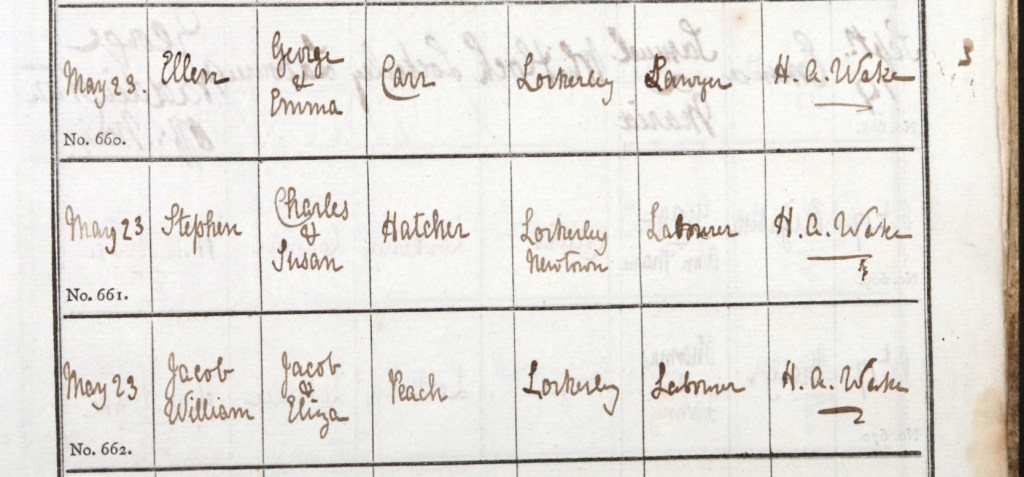
The old wooden beams of St John’s bore silent witness as Curate Wakes recorded their names in the parish register, his neat handwriting capturing a moment both ordinary and eternal:
BAPTISMS solemnized in the Parish of Lockerley in the County of Southampton in the Year 1858.

No. 661

When Baptized: May 23

Child’s Christian Name: Stephen

Parents’ Names: Charles & Susan Hatcher

Abode: Lockerley Newtown

Quality, Trade, or Profession: Labourer

By whom the Ceremony was performed: H. A. Wakes.
No. 660

When Baptized: May 23

Child’s Christian Name: Ellen

Parents’ Names: George & Emma Carr

Abode: Lockerley

Quality, Trade, or Profession: Sawyer

By whom the Ceremony was performed: H. A. Wakes
No. 662

When Baptized: May 23

Child’s Christian Name: Jacob William

Parents’ Names: Jacob & Eliza Peach

Abode: Lockerley

Quality, Trade, or Profession: Labourer

By whom the Ceremony was performed: H. A. Wakes.
Those lines of ink told more than just the details of a ceremony; they preserved a tender moment of faith and hope in the heart of a small Hampshire village. Beyond the stone walls, the fields shimmered beneath the gentle sun, and the scent of lilac drifted through the open door. Within the church, the candles flickered softly, their light mingling with whispered prayers and the faint creak of pews as neighbours bowed their heads together.
For the Hatchers, for Charles and Susan, for their sons George and Stephen, it was a moment of belonging, of grace, of quiet endurance that would echo through the years. In that sacred place, on that bright spring morning, the world seemed to pause, and three small souls, Stephen, Ellen, and Jacob, were welcomed into both the fellowship of the Church and the tender embrace of their village, beneath the watchful beams of St John’s and the eternal sky above Lockerley.
On a cold November Wednesday, the 23rd day of the year 1858, sorrow fell upon the Hatcher home like an early frost. In the quiet village of Lockerley, beneath a sky heavy with cloud, George’s father Charles Hatcher, woodman and labourer, breathed his last. He was only forty-six years old, a man of the fields and forests, whose strength had been shaped by the rhythm of Hampshire’s seasons. For years he had lived among the trees, felling oak and ash, his hands roughened by honest toil, his heart steady in its devotion to his family. Yet no skill, nor strength, nor faith could turn the tide that November brought.
For a week he had battled the cruel weight of pneumonia and bronchitis, each breath a labour, each hour dimmer than the last. The small cottage at Butler’s Wood, Newtown, once filled with the laughter of children and the scent of Susan’s hearth fire, grew hushed and solemn. The chill of illness clung to the air; the ticking of the clock marked the fragile passage of time.
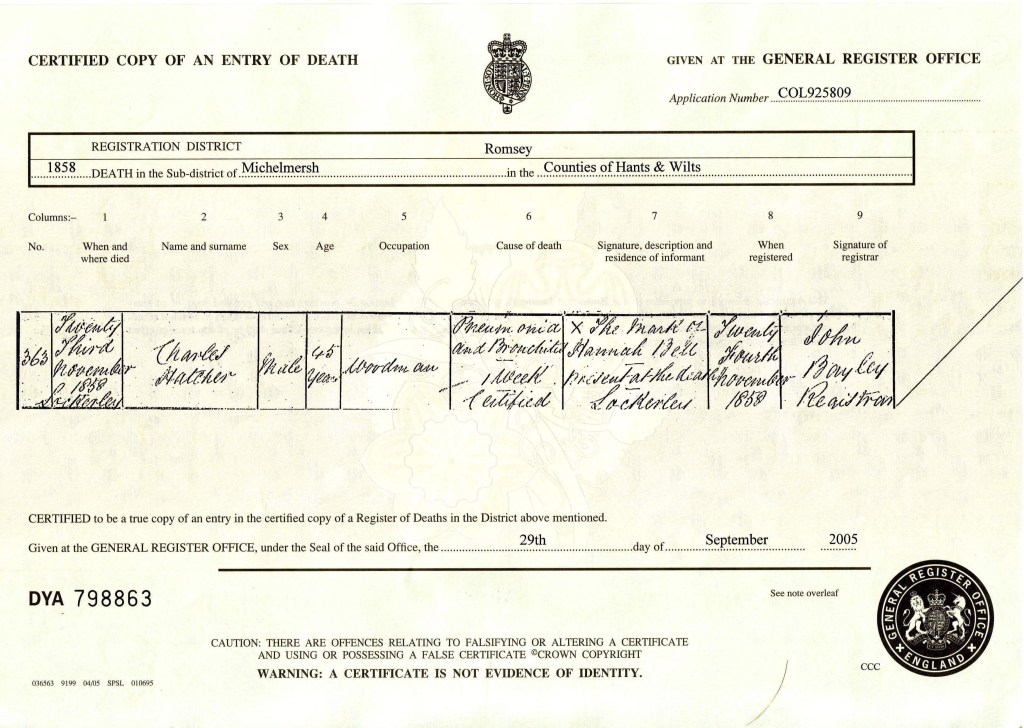
Beside his bed, Susan, his beloved wife, kept her vigil, tender, faithful, and unyielding. She had walked beside him through every harvest and hardship, and now she would not leave his side. She held his hand through the final night, whispering soft prayers as the lamp burned low. Hannah Bell, a neighbour and friend, was also present, offering gentle care in those last hours of struggle. When the time came, Hannah bore witness, her grief trembling upon her lips as she marked the register with a simple cross, “X, The mark of Hannah Bell, present at the death, Lockerley.”
The record was made the next day, Thursday, the 24th day of November, 1858, in the District of Romsey, Sub-district of Michelmersh, by Registrar John Bayley. The ink told the facts with cold precision:
When and where died: Twenty-third November 1858, Lockerley

Name and surname: Charles Hatcher

Sex: Male

Age: 46 years

Occupation: Woodman

Cause of death: Pneumonia and Bronchitis, 1 week, Certified

Signature, description, and residence of informant: X The mark of Hannah Bell, present at the death, Lockerley

When registered: Twenty-fourth November 1858

Signature of registrar: John Bayley, Registrar.
Even though the record states that Charles died at Lockerley, it is most likely that he passed away within the family’s own cottage at Butler’s Wood, Newtown, Lockerley, Hampshire, the place that had held his life, his labour, and his love. There, in the humble room where his children had been born and his days had begun and ended in work and devotion, his spirit found its rest.
But the register, though true, could not capture the soul of the man it named. It could not tell of the way Charles’s laughter filled their home, nor how his children, George, still a boy, and his younger brother Stephen, just a babe, would look for him in vain in the days that followed. It could not speak of the tenderness in Susan’s heart as she sat in the dim light of dawn, his still hand clasped in hers, listening to the final silence that follows a life once full of sound.
When his last breath left him, Susan did what many country women believed to be an act of mercy and love, she rose quietly, crossed the small room, and opened the window. The cold air drifted in, carrying with it the scent of woodsmoke and winter earth. It was her way of setting his soul free, letting it rise from the confines of suffering to the wide expanse of heaven. Outside, the first frost glittered faintly upon the hedges, and somewhere in the distance, a rook called out, a solemn note over the still fields Charles had once worked with such care.
For George, just three years old, the memory of that day would not be one of words, but of feeling, the change in the house, the quiet weeping of his mother, the absence where his father’s voice had been. His father’s passing became the first great sorrow of his life, though he could not yet name it.
Thus ended the earthly journey of Charles Hatcher of Lockerley, woodman, husband, and father. His life was written not only in the parish records but in the soil he tilled, the trees he felled, and the hearts of those who loved him. His death left a silence that lingered, a silence through which the Hatchers would learn to endure, to remember, and to keep moving forward beneath the same Hampshire sky he once laboured under, his spirit forever part of the land he called home.
On a grey autumn morning, Thursday, the 25th day of November, 1858, the little village of Lockerley lay wrapped in a soft hush of mourning. A thin veil of mist hung over the hedgerows, and the last of the golden leaves clung stubbornly to the trees. Across the fields, the solemn tolling of the church bell broke the quiet, slow, measured, and heavy with sorrow, calling the villagers to gather at St John’s Churchyard for the burial of one of their own.
Within the modest cottage at Butler’s Wood, Newtown, the Hatcher family had kept their final vigil. The coffin, simple, hand-hewn pine, polished with oil and lined with linen, had rested in the main room for a night and a day before the funeral, as was the custom of the time. Candles burned low beside it, their flickering light casting long shadows on the walls, and the scent of beeswax mingled with the damp chill of November air. The coffin was open for a time, that neighbours and kin might come to pay their last respects. Each entered in silence, some crossing themselves, others whispering a quiet prayer.
George’s father, Charles lay peacefully, his face softened by the stillness of death, a faint trace of the man who had once laughed among the trees and laboured upon the land. His wife Susan, hollow-eyed with grief yet resolute in dignity, sat close by, her hand resting upon the wood as if to hold him one last time. Around her, their children, George, barely three years old, and little Stephen, not yet walking, clung to her skirts, too young to understand but sensing the heaviness that filled the room. Older siblings watched in silence, their tears falling quietly onto their clasped hands.
When the appointed hour came, the coffin was borne from the house by neighbours, men who had worked beside Charles in the fields and woods, their shoulders bowed not just from the weight of the wood, but from the sorrow of parting. The family followed behind, walking the short distance to St John’s Church, their breath pale in the cold air. It was a familiar path, one they had walked for baptisms, for worship, and now, heartbreakingly, for farewell.
The churchyard was still save for the rustle of wind through yew and ash. The Reverend H. A. Wake, curate of Lockerley, awaited them at the lychgate, his voice steady and solemn as he began the Order for the Burial of the Dead from the Book of Common Prayer. The ancient words carried across the frosted grass: “I am the resurrection and the life, saith the Lord: he that believeth in me, though he were dead, yet shall he live.”
The service unfolded with the gentle dignity of tradition. The coffin was set before the open grave, its edges rimmed with freshly dug earth dark against the pale ground. The Reverend read from the Psalms, most likely the familiar lines of the Twenty-Third Psalm “The Lord is my shepherd; I shall not want…” words that comforted rich and poor alike. The villagers, gathered close in their shawls and work coats, murmured the responses, their breath rising in soft clouds.
A hymn was sung, unaccompanied save for the trembling voices of those who loved him, perhaps “Abide With Me” or “Rock of Ages,” both newly published and already finding their way into parish life. The melody rose and faltered, carried by sorrow, yet warmed by faith. Then came the moment all hearts dreaded: as the curate spoke the final words, “Earth to earth, ashes to ashes, dust to dust” a shovel of soil fell upon the coffin lid with a dull, hollow sound, the last tender gesture of farewell.
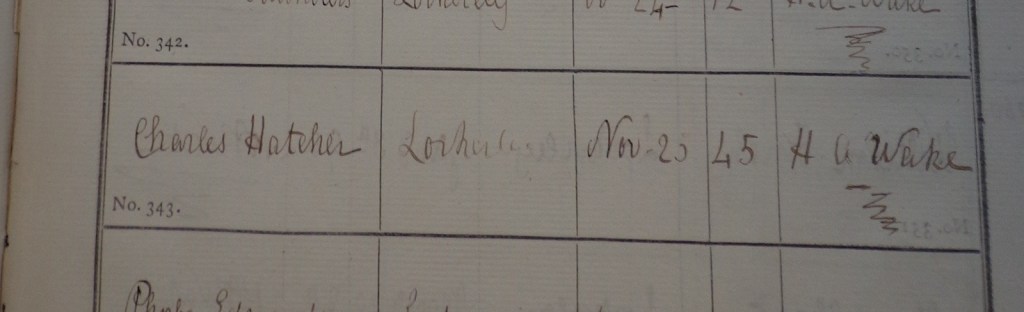
Charles Hatcher, son of William and Mary Hatcher, husband of Susan, father of seven, a man who had given his years to honest labour, was returned to the same soil that had sustained his life. The parish register tells us the rest, recorded in Reverend Wake’s careful hand, not just a bureaucratic entry, but a memorial in ink:
Name: Charles Hatcher

Abode: Lockerley

When Buried: November 25th

Age: 45

By whom the Ceremony was performed: H. A. Wake

Burial No.: 343.
When the final prayers were spoken and the congregation dispersed, Susan lingered by the grave. The wind moved through the churchyard trees, lifting the hem of her black shawl as she stood in silent communion with the man who had been her steadfast companion. It was said among the old villagers that when a soul departs, the spirit lingers until it hears the sound of home once more. That evening, returning to their cottage at Butler’s Wood, Susan quietly reopened the window she had shut against the November chill. She looked out across the darkening fields and let the cold air flow into the empty room. It was her way of setting his soul free, letting it travel from the house they had shared, out into the world he had loved, and upward to the peace he had earned.
For George, who was only a small boy, the memory of that week remained faint but everlasting, not of words or ceremony, but of feeling, the heavy quiet of the house, the scent of earth and candlewax, the way his mother’s hands trembled as she lifted him to her. He would grow up without his father’s voice, yet his life, unknowingly, would be shaped by that man’s strength, the same resilience that had once turned soil and felled trees, now carried forward through him.
And so, beneath the cold November sky, Charles Hatcher was laid to rest in the earth of Lockerley, a man of humble means, but of steadfast heart, his spirit joined with the whispering woods and quiet fields he had long called home. His grave, simple yet sacred, became a part of the landscape, a reminder to all who passed that even the most ordinary life, lived with love and labour, leaves behind a beauty that does not fade.
Winter had settled deeply over Sherfield English, a season of stillness and soft sorrow. Frost clung like lace to the bare branches, and every hedgerow shimmered under a pale morning light that seemed to belong to another world. The air itself held its breath, thin and sharp as glass, while wisps of chimney smoke drifted upward to meet the dim December sky. Beneath that quiet canopy, in a small cottage where the smell of woodsmoke lingered against the cold, life for the Hatcher family was about to change forever.
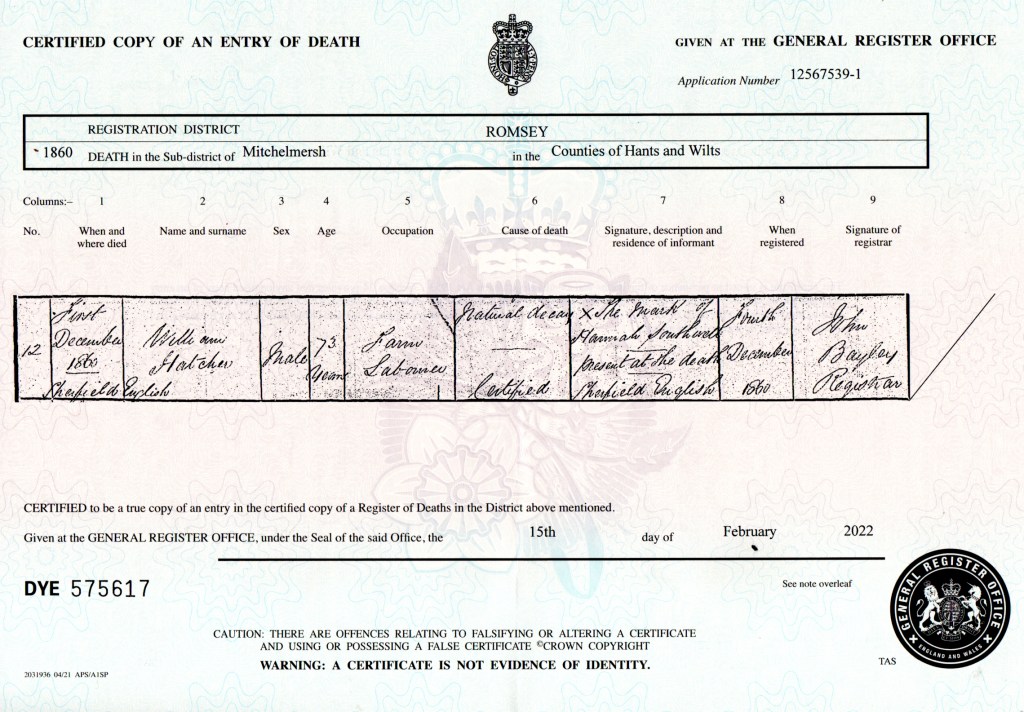
It was Saturday, the 1st day of December, 1860, when the rhythm of their days fell silent. Within the humble walls of his home at Sherfield English, William Hatcher, George’s grandfather, breathed his last. He was seventy-three years old. His heart, which had carried him through births and burials, through harvests and storms, slowed to stillness, like the fading notes of an old, beloved hymn. For decades, William had been the quiet anchor of the Hatchers, a man whose strength had steadied the generations beneath him, whose very presence seemed as constant as the rising sun over the Hampshire fields.
A farm labourer all his life, William’s story was written not in ink, but in furrows of earth and the rhythm of the plough. His hands were gnarled and browned by years of toil, his back bent from the weight of seasons. From dawn to dusk he worked the land, sowing seed, turning soil, binding sheaves, his breath visible in the cold air of winter and his sweat mingling with the dust of summer. He owned little, but his wealth was of a truer kind, his word, his labour, and the deep, unspoken love he bore his family. There was honour in his every gesture, quiet pride in his endurance, and a serenity that only those who live close to the earth ever truly know.
At his bedside, through those final hours, sat his devoted daughter, Hannah Southwell, George’s aunt. The flicker of the fire cast gentle light upon her face as she kept her vigil, her hand resting over her father’s. She watched as his breath grew thin and shallow, her heart knowing she was witnessing the turning of an age, the fading of a man whose strength had shaped her very being. When at last his eyes closed for the final time, Hannah bowed her head and whispered a prayer, her tears falling upon his work-worn hand. It was she who bore witness to his departure, marking her grief in the death register with the simple cross of an unlettered hand “the mark of Hannah Southwell, present at the death, Sherfield English.”
Though the official record states his death occurred in the village of Sherfield English, it is almost certain that William passed within the small family home itself, surrounded by the familiar comforts of his own hearth. There, where the scent of the fields still clung to his clothes and the echoes of laughter from his grandchildren had once filled the room, his spirit slipped quietly into eternity.
On Tuesday, the 4th day of December, the death was formally recorded by Registrar John Bayley, who filled out the great leather-bound volume of the Romsey Registration District, Sub-district of Michelmersh, Counties of Hants and Wilts. His pen scratched steadily over the page, noting the details with mechanical precision:
No. 12

When and where died: 1st December 1860, Sherfield English

Name and surname: William Hatcher

Sex: Male

Age: 73 years

Occupation: Farm Labourer

Cause of death: Gradual decay, Certified

Signature, description, and residence of informant: The mark of Hannah Southwell, present at the death, Sherfield English

When registered: 5th December 1860

Signature of registrar: John .
Those words “gradual decay” were the gentle euphemism of the time, a Victorian acknowledgment that the body had simply worn itself out after a lifetime of honest work. His passing had not been sudden, but rather a slow yielding, the quiet surrender of flesh and breath after years spent giving everything he had to the land he loved.
For George’s grandmother, Mary Hatcher, the moment was more than loss, it was the breaking of a bond that had endured for more than half a century. William had been her laughter and her labour, her strength and her home. Together they had raised children beneath the ringing bells of Saint Leonard’s Church, had known the rhythm of want and plenty, sickness and health, and through it all had stood side by side. To lose him now was to feel half her soul carried away with the winter wind.
Yet even in her grief, there was peace. William had lived as he had loved, steadily, humbly, and with quiet grace. His life was a sermon written upon the soil, his faith not in words but in deeds. The fields of Sherfield English would go on turning beneath the plough, the seasons cycling endlessly, and in each breath of wind across the meadows, something of him would remain.
For young George, who was only six years old when his grandfather died, the memory of that winter would linger like a half-remembered dream, the hush that fell over his mother’s voice when she spoke of it, the solemn talk of adults around the fire, the faint toll of the bell that carried through the cold air. Though he could not yet grasp the full weight of death, something in his child’s heart understood that the world had shifted. A great and steady presence had gone, and yet, in some mysterious way, it had also stayed.
In the years that followed, when George walked the same fields his grandfather had once tended, he would feel it, the quiet legacy of William Hatcher, husband, father, labourer, and man of the soil. His story lived on in the strength of his descendants, in the rhythm of their days, and in the enduring truth that a good man’s life, though it ends, never truly disappears. It lingers in the wind over the hedgerows, in the hush before dawn, and in the gentle hum of the earth itself, where the memory of love and labour are never lost, but only transformed.
The winter of 1860 lay heavy upon Sherfield English, wrapping the village in a hush of frost and sorrow. The fields lay bare and glittering, their edges sharp beneath a sky the colour of pewter, and the hedgerows stood like dark skeletons against the pale horizon. Smoke curled thinly from cottage chimneys, rising straight into the still, cold air, and from the tower of Saint Leonard’s came the slow, deliberate toll of the church bell. Its sound spread across the frozen fields, solemn, measured, and full of ache, summoning neighbours and kin to gather and say farewell to William Hatcher, the quiet heart of a family whose roots ran deep in Hampshire soil.
It was Friday, the 7th day of December, when Curate J. Barton stood before the open grave. His breath hung in the air like a pale mist as he lifted his voice, low and steady, to deliver the words that had echoed across generations of English burials: “Earth to earth, ashes to ashes, dust to dust.” The syllables carried over the still churchyard, mingling with the faint sigh of the winter wind. Then came the soft thud of earth against the coffin lid, steady, unhurried, final, each sound a quiet heartbeat in the rhythm of farewell. The air held a fragile reverence; even the rooks circling above seemed to cry more softly, their dark wings gliding over the fields William had walked every day of his life, bent but never broken by labour.
He had seen seventy-three winters, and each one had left its mark. His life was not one of grandeur, but of quiet constancy, a life measured not in years, but in the turning of the soil, in the steady ploughing of fields, in the rising and setting of the same faithful sun. A farm labourer by trade, William’s work began before dawn, when frost still silvered the hedgerows and the breath of cattle rose in clouds. He was a man who knew the language of the earth, its patience, its trials, its promise. His hands were strong and roughened, the kind that carried generations, that cradled new life, that bore the marks of duty and devotion. He owned no land, yet he belonged to it utterly; his life and labour were stitched into the very fabric of Sherfield English.
For Mary, his wife of more than fifty years, the loss was immeasurable. She stood that morning wrapped in a dark shawl, the cold biting through the fabric, her breath trembling as she looked upon the resting place of the man who had been her constant companion through every joy and sorrow. Their love had not been made of grand gestures but of shared burdens, of bread divided when times were lean, of laughter echoing through the same small rooms, of children’s voices rising and fading until only the two of them remained. Now, as she stood beside his grave, the world seemed suddenly vast and empty, her heart echoing with the silence left behind. Theirs had been a bond woven of work, of tenderness, of faith, and now, as the soil closed over him, she felt as though part of her own soul had gone with him into the earth.
When the mourners drifted away, their footsteps fading on the frost-hardened ground, the churchyard returned to its stillness. The only sounds were the whisper of wind through the yews and the distant toll of the final bell. Inside the vestry, Curate Barton sat by candlelight at his small wooden desk, the flicker of the flame casting long shadows across the room. With quiet care, he opened the great leather-bound register and dipped his pen into the inkwell. His hand moved steadily, the nib scratching softly across the page, committing to record what hearts already carried in sorrow:
BURIALS in the Parish of Sherfield English in the County of Southampton in the Year 1860

Name: William Hatcher

Abode: Sherfield English

When Buried: December 7th

Age: 73 years

By whom the ceremony was performed: J. Barton, Curate
Entry
No.: 221.
When he lifted his pen, the ink glistened for a moment before it dried. The entry was complete, and yet the room seemed to hold its breath, as though the parchment itself still carried the warmth of the man whose name it bore. For that single line, so neatly written, held the story of a life that could not truly be contained in words, a life of quiet faith, of love and labour, of endurance beneath the changing skies of Hampshire.
Outside, the frost deepened as twilight descended. The churchyard grew still again, save for the whispering wind and the slow settling of the earth over William’s grave. But though his body lay beneath the soil he had long tended, his presence lingered, in the fields that would bloom again come spring, in the faith of the wife who mourned him, in the hearts of his children and grandchildren who bore his name with pride.
For young George, barely six years old, the passing of his grandfather was his second encounter with the great mystery of life and death. He could not yet understand the meaning of the prayers or the solemn faces around him, but he felt the weight of it, the hush, the stillness, the way the air itself seemed to bow. Years later, when he stood as a man and worked his own stretch of earth, he would remember the winter when the bell tolled for William Hatcher. And he would know, deep within him, that he too was part of the same unbroken chain, the same soil, the same love, the same quiet grace that endures even when all else fades.
William Hatcher, husband, father, and man of the land, was gone from sight, yet not from the heart. His story, like the fields of Sherfield English, remained, enduring, steadfast, and eternal beneath the changing skies.
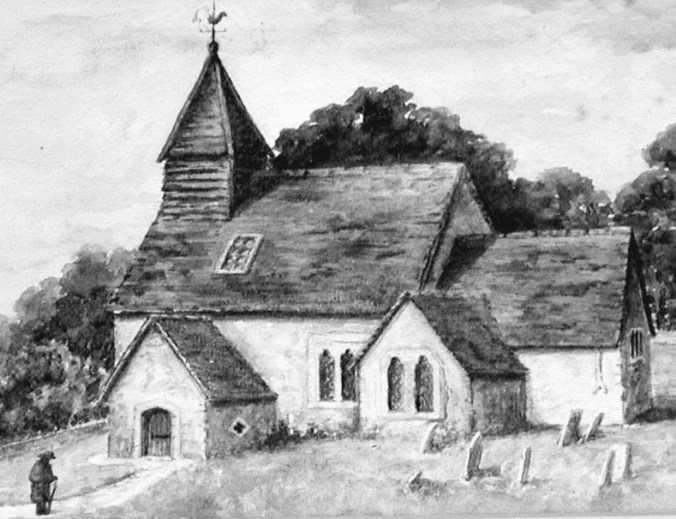
Saint Leonard’s Church in Sherfield English, Hampshire, has a rich history that stretches back over many centuries. The church has been a central part of the village’s religious and community life, and its history reflects the broader development of the area from medieval times to the present. The original Saint Leonard’s Church is believed to have been built in the early medieval period, likely during the Norman era, around the 12th century. The church would have been a simple structure, typical of rural churches of the time. As was common with churches in small villages, it was likely constructed with local materials such as stone and timber, with a simple design reflecting the needs of the local community. The church was dedicated to Saint Leonard, a popular saint during the medieval period who was often invoked for protection and for his association with prisoners and captives. Saint Leonard’s cult was widespread across England, and many churches were named in his honor. The original church at Sherfield English served as a focal point for the small agricultural community, providing a place for worship, social gatherings, and important life events such as baptisms, marriages, and funerals. The church would have also been a place where the villagers came together for communal activities, and it played an essential role in maintaining the spiritual and social fabric of the community. Over time, the church likely underwent several modifications and additions, particularly in the 14th and 15th centuries, as the village expanded and the needs of the local population grew. These changes were likely driven by the growing wealth of the parish as the agricultural economy strengthened. In the 19th century, however, the old church began to show signs of wear and was no longer able to adequately serve the growing population of Sherfield English. By the early 1800s, the church building had become dilapidated and was deemed inadequate for the needs of the parish. At this point, the decision was made to construct a new church to better serve the community. The new Saint Leonard’s Church was built in 1840, a year that saw the completion of many church restoration projects across rural England, driven in part by the Victorian era’s focus on reviving medieval architectural styles. The new church was built on a site adjacent to the old church, though some sources suggest that it may have been on the same footprint or nearby. The architect responsible for the design of the new church was likely influenced by the popular Gothic Revival style of the time, which was characterized by pointed arches, stained-glass windows, and spires. The new church was intended to accommodate the needs of the growing population of Sherfield English, and it was designed to be larger and more architecturally impressive than its predecessor. The construction of the new church was part of a broader trend of church building and restoration during the Victorian period, a time when many rural churches were being rebuilt or restored to reflect the prosperity of the period. The old Saint Leonard’s Church, after the new one was completed, was demolished, as was often the case with churches that were deemed structurally unsound or inadequate for modern use. It is common for older church buildings to be torn down when a new structure is built, particularly if the old building no longer meets the needs of the local population or has fallen into disrepair. It is likely that the materials from the old church were repurposed for the new construction, as was the custom at the time, though no records have definitively confirmed this. Today, Saint Leonard’s Church stands as a beautiful example of Victorian church architecture, with its stained-glass windows, pointed arches, and graceful tower. The church continues to serve the community, offering regular worship services, community events, and providing a space for reflection and connection. The church is also known for its picturesque setting within the village, surrounded by well-kept churchyards and the rolling countryside of Hampshire. The new church, while a product of the 19th century, retains the essence of the old church’s purpose to serve as a spiritual hub for the village of Sherfield English.
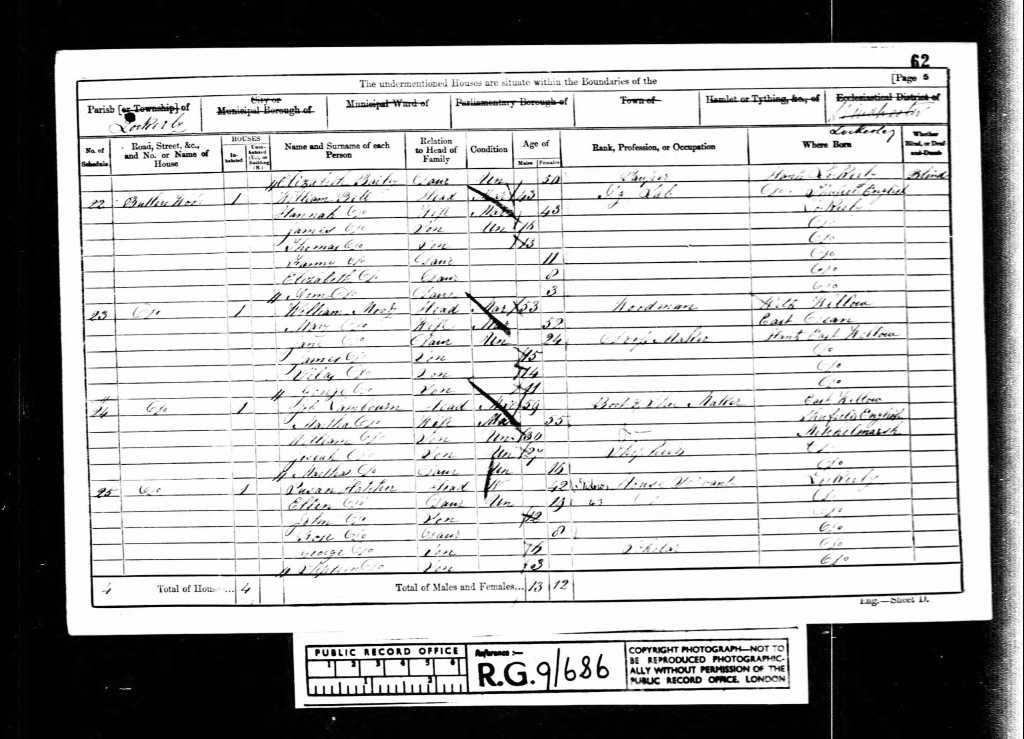
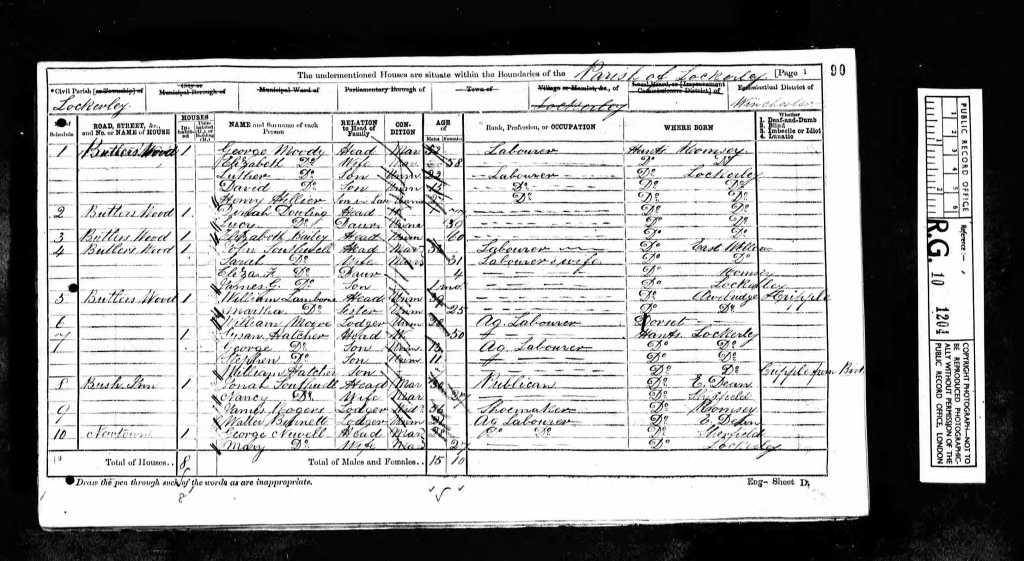
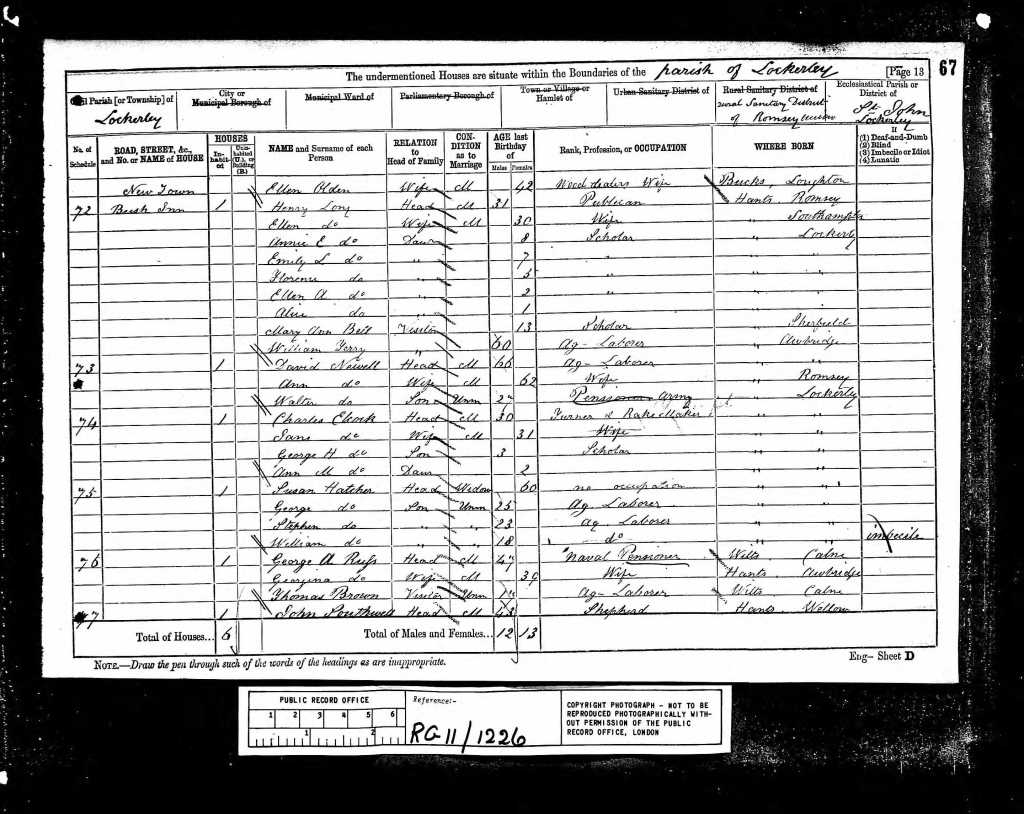
On the cool spring evening of Sunday, the 7th day of April, 1861, the light over Lockerley faded gently into dusk, and a soft stillness settled over the Hampshire fields. The cottages of Butler’s Wood, Newtown glowed faintly with the orange warmth of hearth fires, smoke rising in pale ribbons into the quiet sky. Within one such cottage, humble but full of life, lived six-year-old George Hatcher, his widowed mother Susan, aged forty-two, and his brothers and sisters, Ellen, nineteen, John, twelve, Rose, eight, and little Stephen, just three years old.
Three years had passed since the death of his father Charles. His absence lingered in the corners of the home, in the worn tools by the door, in the silence that came after evening prayers. Yet the Hatcher family endured. Their cottage, small but sturdy, was their whole world, one they inhabited entirely, body and spirit. The hearth glowed with the smell of woodsmoke and bread, and though their means were meagre, there was a quiet pride in the life Susan kept.
Susan, now bore the title “widow” a word heavy with both loss and strength. At forty-two, her hands were lined from work, but her gaze remained steady. She and her eldest daughter, Ellen, worked as widow’s house servants, their days spent tending to the homes of others in Lockerley, dusting, scrubbing, and mending for pay that barely kept hunger from the door. Yet each evening they returned to their own small hearth, where laughter sometimes found its way through the tiredness, and hope, though faint, still lived.
George, now a slender boy with watchful eyes, was listed in the census as “attending school.” He would have walked the lane each morning with a slate and chalk in hand, the sound of crows overhead and the smell of damp earth rising from the fields. Perhaps he sat by the window in class, dreaming of his father’s woods, of the rustle of leaves and the rhythm of axe against bark, memories his young heart kept without understanding why.
On that April night, the Census of 1861 was being taken across all of England, Wales, and the islands beyond. In towns and hamlets, in grand houses and poor cottages alike, the appointed enumerators made their rounds. In Lockerley, the census would have been carried out under the authority of the Registrar and local parish overseers, who divided the village into small districts. An enumerator, often a literate tradesman or clerk, would have walked from house to house, ledger in hand, knocking gently on each door.
When he arrived at Butler’s Wood, the evening was cool and the fire burned low. He was welcomed by Susan, her apron dusted with flour, her children peering curiously from behind her skirt. The enumerator would have stood just inside the doorway, dipping his pen into the small inkwell he carried, asking questions in a low, practiced voice. “Name and surname?” “Relation to head?” “Age?” “Occupation?” One by one, the family’s details were spoken aloud, the scratch of his pen recording them forever in the quiet history of the parish.
By the time he closed his ledger and tipped his hat, the room was darkening into night. The children returned to their places by the hearth, the sound of the pen and the questions fading into the hum of the wind outside. What had felt to the enumerator like a simple duty, one household among many, would one day become a bridge through time, carrying George’s small name and the truth of that evening into distant generations.
Their neighbours, the Lambourn family, lived close by, Job Lambourn, a boot and shoemaker, his wife Martha, and their children William, Josiah, and Martha, whose laughter often drifted through the hedges between their homes. The smell of leather and polish from Job’s small workshop mingled with the scent of woodsmoke from the Hatcher’s chimney, a reminder that even in hardship, life went on, steady and ordinary, yet full of quiet grace.
That night, after the enumerator’s footsteps had faded down the lane, Susan tucked her youngest children into bed and sat for a moment by the fire, listening to the stillness. George, already half-asleep, stirred beneath the worn blanket, the glow of the embers reflecting in his eyes. Around them, the world kept its rhythm, the sigh of wind in the trees, the rustle of the thatch, the distant hoot of an owl.
In that small home at Butler’s Wood, the Hatchers belonged not just to their time, but to the enduring story of love and survival written in the language of ordinary lives. The census, with its tidy columns of ink, could capture their names, but only memory could capture their hearts. And for George, though he did not yet know it, those humble beginnings would shape the man he was destined to become.
In the year 1861, little George Hatcher, six years old, attended the village school in or near Lockerley, a modest institution born of both charity and faith. These were years before schooling became compulsory in England, the Education Act of 1870 was still a decade away, yet many small villages had National Schools, built under the guidance of the Church of England, where lessons were given to the children of labourers and tradesmen alike. Lockerley, like most Hampshire parishes of the time, likely had a parish school closely tied to St John’s Church, where the curate himself or a local schoolmistress oversaw the children’s instruction.
The schoolhouse itself would have been simple, a single stone or brick room with a slate roof, small leaded windows, and a cold flagstone floor. Inside, rows of wooden benches and desks filled the space, the air tinged with chalk dust, smoke from the small iron stove, and the faint scent of damp wool from coats hung by the door. The walls might have held a single map of the British Isles, a copy of the Lord’s Prayer, and a slate board for sums.
George’s day began early. After helping his mother with small chores at Butler’s Wood, perhaps fetching water, feeding hens, or gathering kindling, he would walk the narrow lane toward the school, his boots scuffing the ruts of the dirt path. School began at nine o’clock, and attendance was expected every weekday except Sunday. Yet, for many working families like the Hatchers, a child’s schooling was often interrupted by the needs of the household or the harvest. In the busy seasons, some children stayed home to help their parents, and the school register would note simply “absent, required for work.”
In George’s classroom, boys and girls of all ages sat together, from toddlers barely four years old to sturdy farm boys of twelve or thirteen. The youngest would sit nearest the front, their small fingers tracing letters on slates, while the older pupils practiced copying Bible verses or working out simple arithmetic. There might have been thirty to fifty children in the room, all under the watch of one teacher, often a young unmarried woman, assisted by one or two of the older pupils known as monitors.
The lessons were plain but earnest: reading, writing, arithmetic, and scripture. Each morning began with prayers, the teacher reading from the Book of Common Prayer or the Psalms, followed by the class repeating the Lord’s Prayer in unison. Then came reading aloud from the Bible or the New London Primer, spelling drills, and simple arithmetic done on slates with chalk. Geography, needlework, or moral instruction might follow in the afternoon.
Discipline in the Victorian classroom was stern, for order was prized above comfort. A mispronounced word, a blot of ink, or a moment’s whisper could bring the sharp tap of a ruler across knuckles or a scolding from the teacher’s cane. Some schools kept a tawse, a split leather strap used on the hand, though in small parish schools, punishment was often more moral than physical: being made to stand on a stool in shame, to wear a dunce cap, or to copy a verse of scripture about obedience. Yet, despite the strictness, there was kindness, too. Many teachers saw themselves as guardians of the poor, offering knowledge as a form of mercy.
Lessons ended around four in the afternoon, when the sun was already beginning its descent over the fields. George would walk home through the hedgerows, the air full of woodsmoke and birdsong, his slate tucked under his arm. Sometimes he’d recite his lessons aloud, the alphabet or a psalm, his voice mingling with the hum of bees and the sound of distant church bells. His mother, Susan, proud of her children’s schooling, would ask him to read from his Bible primer by the firelight, her tired eyes softening as she listened.
The children who sat beside George in that classroom would have been much like him, sons and daughters of agricultural labourers, carpenters, blacksmiths, and shoemakers. His neighbours, the Lambourn children, William, Josiah, and Martha, may well have shared his bench. The eldest boys would soon leave school for work in the fields or workshops, while the youngest struggled to form their first letters. For all of them, education was both a privilege and a fleeting grace, a brief pause before the long demands of labour began.
In winter, the classroom was cold, the ink stiff in its bottle and breath misting in the air. In summer, the windows were opened wide, and the scent of cut hay drifted inside, distracting the children from their sums. Yet whatever the season, the sound of recitation, the murmured chant of letters, numbers, and verses, filled the air like a hymn of hope for the poor.
For George, school was a small window into a wider world, a chance to see beyond the hedgerows of Lockerley, to dream beyond his father’s fields. Though he did not yet know it, those hours spent hunched over his slate by the dim light of morning would sow the seeds of resilience and curiosity that would stay with him all his life.
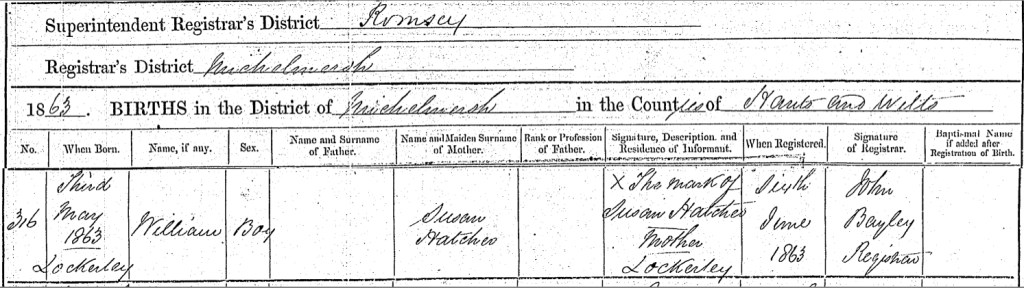
In the soft heart of the Hampshire countryside, where the green fields rolled gently toward the horizon and the whisper of leaves drifted through the stillness of Butler’s Wood, a new chapter unfolded in the story of the Hatcher family. It was Sunday, the 3rd day of May, 1863, when a child was born into their modest home at Butler’s Wood, Newtown, Lockerley, a baby boy who would be named William, younger brother to George. His arrival, though quiet and unassuming, carried the weight of love, endurance, and the unbroken thread of family that bound generations together.
Outside, spring was at its tenderest. The air was cool and clean, filled with the scent of damp earth and new blossom. The hedgerows shimmered with the pale green of fresh growth, and beyond them, the fields were alive with birdsong and the distant call of the ploughman. But inside the small labourer’s cottage, the world was reduced to the rhythm of breath and heartbeat, the ancient, sacred labour of a mother bringing forth new life.
There, in the flickering firelight, Susan Hatcher, now forty-three years old and long widowed, brought her son safely into the world. Her life had known both joy and hardship, she had borne seven children, buried one, and weathered years of work and widowhood. Her hands, worn from endless labour, now held the fragile weight of her newborn son, their touch as gentle as a prayer. The crackle of the hearth and the faint smell of woodsmoke filled the air as she gazed upon him, this small, perfect proof of life’s persistence.
The official record, written weeks later in the steady hand of Registrar John Bayley, captures only the bare facts:
When Born: Third May 1863.

Where Born: Lockerley.

Name, if any: William.

Sex: Boy.

Name and Surname of Father: —.

Name and Maiden Surname of Mother: Susan Hatcher.

Rank or Profession of Father: —.

Signature, Description, and Residence of Informant: X The mark of Susan Hatcher, Mother, Lockerley.

When Registered: Sixth June 1863.

Signature of Registrar: John Bayley, Registrar.
The blank space beside “Father” spoke quietly of truth and strength. For William was the fourth of Susan’s children to be born out of wedlock, a mark that, in the stern eyes of Victorian society, carried the sting of judgment. Yet within the walls of that little cottage, there was no shame, only love. The ink may have recorded absence, but in that absence lived devotion, the courage of a woman who had known loss and kept loving still.
Though the register states that William was born at Lockerley, it was almost certainly here, in the humble home at Butler’s Wood, that his first cry rose into the air, a sound mingling with the sigh of wind through the branches and the soft murmur of the countryside that had long cradled the Hatcher name.
For George, then eight years old, the birth of his baby brother must have seemed both a mystery and a wonder. He would have watched as neighbours came to call, as his mother bathed the infant by the hearth and hummed quiet lullabies in the fading light. Perhaps he crept close to the cradle, his eyes wide with curiosity, reaching out to touch the tiny hand that would one day clasp his own. In that moment, though he could not yet know it, the roots of a lifelong bond were planted, two brothers joined not just by blood, but by circumstance, by hardship, by the deep, unspoken love of a mother who had given them everything she had.
Life at Butler’s Wood was modest, but it pulsed with warmth. Each morning, smoke curled from the chimney into the pale sky, and the cottage filled with the familiar sounds of living, the low murmur of voices, the hiss of the kettle, the rhythm of footsteps on the flagstone floor. Beyond its small windows stretched a world of simple wonders, the silver gleam of dew on the meadow grass, the chatter of sparrows in the hedgerow, the steady toll of St John’s Church bell marking the passage of each hour.
In that tiny world, the Hatchers found their peace. Their days were ruled not by the grand affairs of the Victorian age but by the turning of the seasons, the constancy of work, and the quiet faith that life, however humble, was sacred. To the outside world, theirs might have seemed an ordinary story, a widow, her children, a cottage in the wood, but to George, those moments were the tapestry of his childhood, the beginning of the man he would become.
And so, William’s birth was not only the start of his own journey, but a tender turning point in George’s as well. For in that spring of 1863, amid the soft green fields of Hampshire and the gentle hum of life around Butler’s Wood, another thread was woven into the family’s story, a story of love that endured beyond judgment, beyond hardship, beyond time itself. Though the registrar’s ink captured only names and dates, the truer record was written in the air that day: in the whisper of the wind, in the cry of a newborn, and in the steadfast heart of a mother who faced the world alone, yet never unloved.
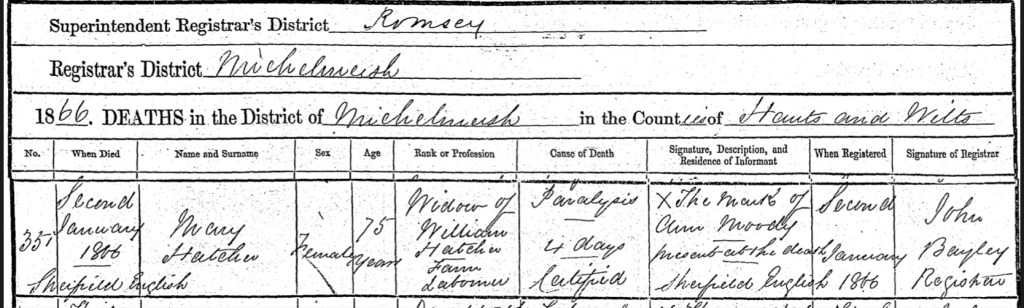
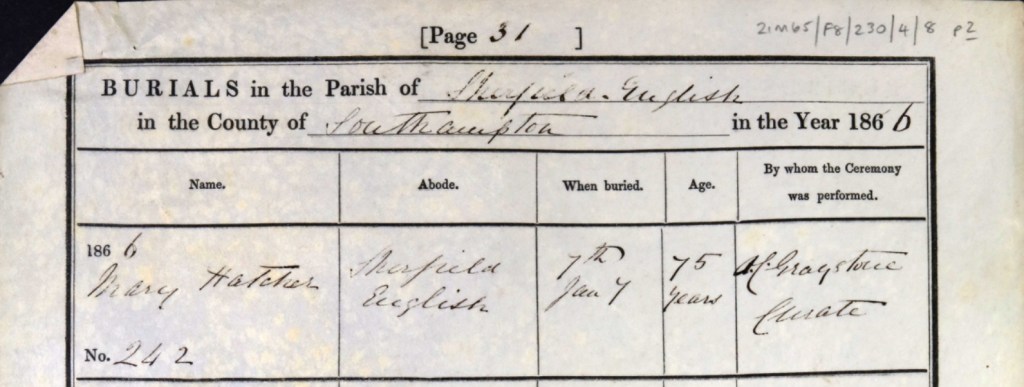
Winter settled heavily over Sherfield English that year, pressing its silence against the windows and cloaking the fields in frost. The hedgerows stood brittle and bare, the sky a dull pewter grey that seemed to hold the world in stillness. It was in this hush, on Tuesday, the 2nd day of January, 1866, that ten-year-old George Hatcher lost one of the most constant presences in his young life. His grandmother, Mary Hatcher, née Roude, at the age of seventy-five, took her final breath in the small cottage she had shared for more than half a century with her late husband William.
For George, the passing of his grandmother marked the quiet closing of an era. The world he knew, of fields, family, and faith, felt suddenly smaller, dimmed by her absence. He had known her as a figure of quiet endurance, her presence as familiar as the tolling of St Leonard’s Church bell across the Hampshire fields. To him, she was the warm scent of baking bread, the soft murmur of prayer by the firelight, the weathered hands that smoothed his hair when he sat beside her chair. She had outlived storms, seasons, and sorrows, her love carrying their family through every hardship.
Mary had been the heart of the Hatchers, strong, humble, and unyielding in her devotion to those she loved. She had survived poverty and loss, yet never lost her tenderness. When her husband William had died six winters before, the laughter had gone out of her voice, but not the light from her eyes. She kept his memory alive in small ways, the mending of his old coat still hanging by the door, the quiet visits to his grave in the churchyard, where the yews whispered above the resting place of the man who had shared her life.
In her final days, it was her own body that betrayed her. Paralysis crept upon her, slow and merciless, until she could neither walk nor speak. For two long weeks she lay in her small bedroom, the walls close around her, her mind still bright though her limbs refused her. Yet even in her suffering, she remained composed, dignified, her courage unspoken but palpable. Her daughter, George’s aunt, Ann Moody, steadfast and loving, tended to her through every hour, refusing to leave her side. When the end came, it came softly. The room was still, save for the faint crackle of the fire and the sound of Ann’s quiet weeping as she felt her mother’s last breath slip away.
That same day, heartbroken but resolute, Ann walked through the cold to the registrar’s office to record her mother’s death. Her grief must have felt almost too heavy to bear, yet she did what duty required. There, at the desk of Registrar John Bayley, her trembling hand made the mark that would fix her mother’s passing into history:
No.: 351

When Died: 2nd January 1866

Name and Surname: Mary Hatcher

Sex: Female

Age: 75 years

Rank or Profession: Widow of William Hatcher, Farm Labourer

Cause of Death: Paralysis, 14 days, Certified

Signature, Description, and Residence of Informant: X The mark of Ann Moody, present at the death, Sherfield English

When Registered: 2nd January 1866

Signature of Registrar: John Bayley, Registrar.
The words on the page were spare and clinical, yet behind them lay the breadth of an entire life, of motherhood, marriage, endurance, and love. To the registrar, it was an entry among many, but to George and his family, it was the loss of the matriarch who had been the keeper of their memories and the strength beneath their days.
Mary’s passing sent ripples of quiet grief through the Hatcher family. For Susan, her widowed daughter-in-law and George’s mother, it was the loss of not only a parent but of the last living link to her husband. For George, who was just beginning to understand the world’s vastness, it was the first time he felt the weight of its impermanence. He had seen death before, in the loss of his father, Grandfather and younger kin, but this was different. This was the fading of a gentle, familiar light, one that had warmed the early years of his life.
He would remember her cottage, the way the winter sun slanted through its small window onto the worn table, the smell of woodsmoke and herbs drying by the hearth, the rhythm of her voice reciting the evening prayers that had steadied the family for generations. He would remember how she spoke of the land, of the patience of soil and seed, the turning of seasons, the beauty in endurance. Those lessons would take root in him, deep and quiet, growing unseen until manhood, when he too would learn what it meant to love, to lose, and to endure.
The people of Sherfield English mourned her as one of their own, a familiar face at the church door, a neighbour who offered kindness without measure. Her absence was felt not only by those who bore her name but by the village itself, as though the earth that had sustained her now sighed with her passing.
And so, though Mary Hatcher’s earthly days had ended, her spirit lived on, in the steady hands of her Children and daughter-in-law Susan, in the quiet resilience of her grandson George, and in the unbroken hum of the Hampshire countryside she had called home. Her story did not fade with winter. It lingered, soft and enduring, like the whisper of wind through the hedgerows, a love that outlasted death, carried forever in the heart of her family.
The winter morning of Sunday, the 7th day of January, 1866, dawned pale and heavy over Sherfield English, the frost lying thick upon the meadows and the bare trees bowing gently under its weight. The world seemed hushed, as if holding its breath for what the day would bring. Beneath that still, pewter sky, the village gathered to bid farewell to Mary Hatcher, grandmother to young George, a woman whose quiet strength and unwavering love had shaped the lives of all who knew her. She was seventy-five years old, and with her passing, the rhythm of life in the village faltered, for it was not only a mother, grandmother, and neighbour they mourned, but the very heart of a family whose roots reached deep into the Hampshire soil.
Mary’s life had been as constant as the tolling of the church bell that morning. She had lived all her days in this small village, its lanes, cottages, and fields as familiar to her as her own hands. Her years had been spent in service, to her home, her husband, her children, and her God. With her beloved William, she had raised a family, endured poverty and loss, and built a life from the humblest beginnings. When William’s heart had stopped six winters before, something inside her had quieted too, though she bore her grief with grace. She carried on, her faith and her family her steady companions. To those who knew her, she was a pillar of constancy, a gentle soul whose love did not speak loudly, but whose presence filled every silence with warmth.
Now, on that cold January morning, her body lay in the small coffin her sons and neighbours had carried to Saint Leonard’s Church, the same place where she had once walked as a young bride beside William, where her children had been baptised, where she had knelt to pray for strength during long, hard years. George, only ten years old, stood among the mourners with his mother Susan, his small gloved hand curled tightly in hers. He understood only that something precious had ended. The adults spoke in hushed tones, their faces drawn with grief, while he stared at the church door and remembered his grandmother’s voice reading softly from her Bible, the smell of the herbs that always hung drying by her fire, the way she had smiled even when her eyes were tired.
The air in the church was cold, yet it trembled with tenderness. Curate A. Fragstone stood before the gathered crowd, his breath clouding faintly as he spoke the words that had bound generations to the earth before them: “I am the resurrection and the life…” His voice echoed against the stone, steady and kind, as though even heaven itself leaned close to listen. He spoke not only of Mary’s death, but of her life, of the love she had given freely, the hardships she had borne without complaint, the steadfastness that had sustained her family.
When the time came to carry her to the churchyard, the mourners followed slowly, the crunch of snow beneath their boots the only sound in the stillness. Around them, the yews stood dark and solemn, the ancient sentinels of the parish. The coffin was lowered into the ground beside William, beneath the same patch of earth they had both once tended and called their own. The curate’s voice trembled slightly as he spoke the final words “Earth to earth, ashes to ashes, dust to dust” and the sound of falling soil mingled with the faint sobs of those who loved her.
Among them stood Mary’s children, Sarah, James, Hannah, Ann, and daughter-in-law Susan, their grief held close, their faces pale against the winter air. Each carried within them the echo of her love, the lessons she had taught through labour and patience, the faith she had lived quietly every day. To George, watching from his mother’s side, the moment felt eternal. He did not fully understand the ritual, but he knew that something sacred was taking place, that the world was saying goodbye to a love that had shaped his own small life. Later, when he would return home to Butler’s Wood, he would remember the stillness, the way the wind had whispered through the grass, the sound of snow brushing softly against his coat, and he would feel, even in his sorrow, that his grandmother was still near.
After the mourners had gone and the last prayers had been whispered, Curate Fragstone returned to the vestry to complete his duty. By candlelight, he opened the great leather-bound register and, with slow and deliberate care, recorded her passing. His pen moved steadily, the ink glistening as he wrote the words that would preserve her name for generations to come:
Name: Mary Hatcher

No.: 242

Abode: Sherfield English

When Buried: 7th January 1866

Age: 75 years

By whom the Ceremony was Performed: A. Fragstone, Curate.
When the entry was done, he closed the book, yet the warmth of her memory lingered there, as though her gentle spirit had left its imprint upon the page.
As the sun sank low beyond the hedgerows, a pale light touched the churchyard stones. The cold air shimmered faintly, and for a moment it seemed that the whole village stood in reverent stillness. Mary Hatcher had gone, but she was not alone. She was reunited with William, her steadfast husband, with her daughter Mary, whose loss had once broken her heart, and with her son Charles, taken too soon, although he was laid to rest at St John’s Church, it Lockerley. Now, in the sacred earth of Sherfield English, beneath the same sky that had witnessed their love and labour, they rested together once more.
For George, her passing became part of the fabric of his being, a memory that would endure long after childhood faded. He would grow to remember her not in sadness, but in the quiet strength she had left behind, the faith she carried, the resilience she taught, the love she gave without end. And though the years would carry him far from that winter day, in his heart the sound of the church bell and the whisper of the cold wind through the yews would forever recall the woman who had loved him first, and whose spirit, gentle and steadfast, would follow him always.
On a pale February morning, when winter still clung to the fields of Sussex and a thin frost lingered upon the hedgerows, the bells of St Peter’s Church, Westhampnett, began to toll. Their sound carried softly over the rooftops and down the winding lanes, calling the faithful to witness a union both humble and profound. It was Thursday, the 18th day of February, 1870, when George’s sister, Mary Ann Hatcher, daughter of the late Charles Hatcher of Lockerley, took the hand of John Petter, a thirty-one-year-old coachman from nearby Goodwood, and bound her life to his beneath the quiet arches of that ancient church.
Within the stone walls, the air was cool and faintly perfumed with candle wax and evergreen from the winter wreaths that still adorned the nave. The light through the windows was muted and silvered, falling gently upon the worn wooden pews and the simple beauty of the altar. The Reverend Richard E. Innes, Vicar of the parish, stood before them, his voice solemn yet tender as he led the couple through the rites of the Church of England. The register, neatly written in his hand, recorded the moment with its usual precision:
1870. Marriage solemnized in the Parish Church in the Parish of Westhampnett in the County of Sussex.

No. 64.

When Married: February 18th 1870.

Name and Surname: John Petter, Mary Ann Hatcher.

Age: 31, 22.

Condition: Bachelor, Spinster.

Rank or Profession: Coachman, —.

Residence at the Time of Marriage: Goodwood, Westhampnett; East Lavant, Westhampnett.

Father’s Name and Surname: William Petter, Charles Hatcher.

Rank or Profession of Father: Labourer, Gamekeeper.

Married in the Parish Church according to the Rites and Ceremonies of the Church of England by me, Richard E. Innes, Vicar.

This Marriage was solemnized between us:
John Petter,
Mary Ann Hatcher.

In the presence of us:
Charles Pigott,
Ann Howell.
The ink upon the page was still fresh when the vicar closed the register, sealing the beginning of a new chapter in Mary Ann’s life. Outside, the bells rang out across the winter fields, their notes bright and hopeful against the chill air, and the villagers who lingered at the church gate offered quiet smiles as the newlyweds emerged into the cold light of day.
Whether George, her brother, stood among them will never be known. Nearly forty miles separated the woods and winding paths of Lockerley from the manicured lawns and carriages of Goodwood, and the journey would have been no easy thing for a young working man in the depth of February. The roads were long and rutted, the cost of travel high, and the world, though bound by family, was far less connected by road or rail. And yet, one might imagine him there in spirit, thinking of his sister as he made his way through the Hampshire lanes that morning, his breath misting in the cold air. Perhaps he paused in the woodlands near Butler’s Wood, the frost crunching beneath his boots, and thought of her standing before the altar, her voice soft as she spoke the words that would bind her life to another’s.
For George, now a young man of sixteen, Mary Ann had always been a figure of gentle constancy, a sister whose laughter had once filled their small cottage, who had comforted him through childhood sorrows and shared his dreams of a better life. In her he had seen the same steadfast kindness that lived in their mother’s hands and their grandmother’s heart. Though distance and duty may have kept them apart that day, love, as ever in the Hatcher family, was a thread that neither miles nor circumstance could break.
Inside the church, the vows were spoken with the simple sincerity of working people, no grandeur, no spectacle, only the quiet promise of two souls determined to build a life together. The flickering of candles cast long shadows upon the stone floor as Curate Innes blessed the union, and the witnesses, Charles Pigott and Ann Howell, stepped forward to sign their names, their penstrokes linking them forever to that sacred moment.
Perhaps as Mary Ann placed her hand in John’s, her thoughts wandered homeward for a heartbeat, to her mother Susan, to the Hampshire woods where she had once gathered flowers as a girl, to the small hearth where George might now be tending the fire. She would have remembered the scent of damp earth after rain, the sound of the church bells of Lockerley, and the feel of home that lingered in her heart even as she began a new life far from it.
When the final hymn was sung and the couple stepped out into the cold light, the bells pealed once more, bright and clear across the frosted fields. The vicar, returning to his desk, entered her name carefully into the parish ledger, and with that, Mary Ann Hatcher became Mary Ann Petter, wife of a coachman in the parish of Westhampnett.
Far away in Lockerley, as dusk fell over the Hampshire countryside, perhaps George stood for a while by the cottage door, the glow of the hearth behind him, and looked out toward the horizon. He could not see his sister, but in his heart he felt her happiness. The same moon that rose over Goodwood that night would have risen over Butler’s Wood, silvering the branches and the quiet lanes between them. Though the distance was great, the bond between them, woven from childhood laughter, shared sorrows, and the unspoken love of kin, remained unbroken.
And so, as the parish book closed softly and the church fell silent once more, a new chapter began not only for Mary Ann, but for the Hatchers themselves, a family whose lives, though scattered across counties and seasons, were forever bound by the same enduring thread of love, faith, and remembrance.
St Peter’s Church at Westhampnett stands beside the line of the old Roman road to London, Stane Street, and it has guarded this corner of Sussex since the early Anglo-Saxon period. A stone church is thought to have been on the site from about the year 710, soon after St Wilfrid’s mission evangelised the South Saxons, and the present fabric still preserves that deep antiquity. In the chancel you can see Saxon herring-bone masonry and a blocked Saxon window, and the builders even recycled Roman material from nearby Chichester, the old city of Regnum, so that courses of Roman brick run through the flintwork like a memory of an older world.
Through the centuries the church was altered and enlarged. It is recorded in the Domesday Book, and medieval work of the thirteenth century joined the earlier chancel; later restorations followed the usual Victorian zeal for repair, with major nineteenth-century work giving the nave and fittings much of their present character. The church is now listed Grade II* for its special interest, with Historic England noting the medieval fabric and later phases in the surviving building.
Step inside and the layered history comes into focus. Slender lancets light the small interior; the quiet nave leads the eye to the chancel arch, and monuments tell parish stories in stone. On the north side is a fine sixteenth-century memorial to Richard Sackville and his wife Elizabeth Thetcher of Westhampnett Place, their effigies dressed in Tudor finery, a reminder that this was once a parish of some wealth and standing. In the churchyard the headstones are unusually elaborate for a rural place, plain and Celtic crosses among them, reflecting prosperous congregations in past centuries. The bells have long called the village to worship, with two of them dated 1581 and 1632.
The parish around the church has its own deep past. Westhampnett lay within a Saxon settlement that passed to Norman lords after 1066. Medieval hospitals once stood nearby, including a leper house founded in Henry I’s reign, and the wider parish later became the centre of a Poor Law Union. In the twentieth century the airfield at RAF Westhampnett, now part of Goodwood, added a modern chapter of wartime service to the parish story.
As for tales of haunting, St Peter’s does not have a well-attested body of ghost stories in the way that some ancient churches do. Parish and heritage sources emphasise the building’s archaeology and monuments rather than apparitions. Any whispers of spectral presence seem to live at the level of village lore rather than documented tradition, and there are no widely reported investigations or accounts tied specifically to this church. That quietness is part of its character: the place feels old and watchful, more a keeper of memory than a stage for drama.
If you visit, stand by the south wall and look closely at the masonry, where the Roman bricks lie among the flints and the herring-bone courses catch the light; you are looking at more than a thousand years of worship layered into a few square feet of stone. The building still serves its parish with regular services and shares its ministry with St Paul’s, Chichester, a living church whose story began before England itself had taken shape.
The morning of Thursday, the 10th day of November, 1870, broke cool and bright over the quiet Hampshire village of Lockerley, where autumn lingered like a wistful sigh upon the hedgerows. The fields shimmered with the last traces of frost, and the air was alive with the scent of damp leaves and woodsmoke. As the bells of St John’s Church began to chime, their sound carried through the crisp air, calling family and neighbours to witness a moment of joy. Inside those ancient stone walls, George’s sister, nineteen-year-old Rose Hatcher stood before the altar, her hands trembling slightly as she prepared to take her vows. Among those gathered in the pews sat her brother, George, his heart full to the brim with love, pride, and a quiet ache that only such days can bring.
The record of that morning, now preserved in neat black ink, reads with calm precision, stripped of the tenderness that filled the church that day:
1870. Marriage solemnized in the Church in the Parish of Lockerley in the County of Southampton.

No. 121.

When Married: November 10th 1870.

Name and Surname: Charles Arthur, Rose Hatcher.

Age: 22, 19.

Condition: Bachelor, Spinster.

Rank or Profession: Miller, —.

Residence at the Time of Marriage: Lockerley, Lockerley.

Father’s Name and Surname: James Arthur, Charles Hatcher.

Rank or Profession of Father: Labourer, Keeper.

Married in the Parish Church according to the Rites and Ceremonies of the Church of England by me, Heathcote A. Wake, M.A.

This Marriage was solemnized between us:
Charles Arthur,
Rose Hatcher.

In the presence of us:
William Arthur,
Fanny Hatcher.
But what the ink could never hold was the warmth that filled that November day, the breath of family gathered together, the soft murmur of prayers, and the stillness of hearts united in love and remembrance.
George had travelled from Butler’s Wood, along the winding lanes that he and Rose had once walked as children. The trees along the way were half-bare now, their leaves scattered like gold upon the path, and the air carried the hush of early winter. When he reached the church, its familiar tower rising above the yews, he felt both joy and a quiet sorrow stirring in him. It had been years since the death of their father, Charles, and as he watched Rose, radiant in her modest gown, he felt his absence deeply, yet he also felt him there, as though unseen hands were resting gently on their shoulders.
Inside, Reverend Heathcote A. Wake, the same kind voice that had baptised Rose not so many years before, led the ceremony with solemn grace. The flicker of candlelight caught upon the stone walls and the worn pews where generations of Hatchers had knelt. Fanny, another of George’s sisters, stood close by as witness, her eyes shining with quiet pride. When Charles Arthur, a young miller of twenty-two, took Rose’s hand and spoke his vows, the church seemed to hold its breath, even the old wooden beams seemed to listen.
From his seat, George watched in silence, his heart swelling with emotion. He remembered Rose as the little girl who once danced barefoot through the meadows behind their home, her laughter bright against the hum of summer bees. He remembered her gentle ways, her kindness to every creature, her hopefulness even in hard times. Now she stood before him a woman, her voice steady and sure as she spoke her vows, a living testament to the love and endurance their family had carried through the years.
When the couple signed their names, and Fanny Hatcher and William Arthur stepped forward to witness, the vicar closed the great parish register with care, the sound of its leather binding soft but final. Then the bells rang out once more, joyous and full, their echo carrying across the fields and up into the clear November sky.
Outside, the light had softened to gold. The last leaves fell in slow spirals from the elms, and the smell of the mill by the river drifted faintly on the breeze. Villagers gathered near the gate, offering smiles and blessings, while Rose and Charles stood arm in arm, their faces glowing with shy happiness. George approached them quietly, his hat in hand, his eyes bright with unshed tears.
“Well, Rosie,” he might have said softly, “our father would have been proud today.”
And she, smiling through her own tears, might have reached for his hand, that same hand that had once steadied her on childhood walks through the woods. For a long moment, they stood together, saying nothing more, the bond between them deep and wordless, built upon years of shared love, loss, and memory.
That evening, as the village returned to its quiet rhythm and the last of the daylight faded from the sky, George made his way home through the fields. The air was cold, the stars beginning to prick through the darkening blue, and the world seemed both vast and tender. He could still hear, faintly, the echo of the church bells, and he carried their sound in his heart all the way back to Butler’s Wood.
There, as the fire burned low and the night wrapped the house in silence, George thought of his sister, of Rose Arthur now, with her husband and her future ahead. He smiled to himself, feeling both joy and longing intertwined. For though life had carried them down different paths, the bond between them, like the roots of the old Hampshire oaks, would remain unbroken, deep beneath the soil of time and memory.
And in that moment, George understood that this, too, was the way of family, to love, to part, to remember, and to carry, always, the quiet music of one another’s hearts.
The evening of Sunday, the 2nd day of April, 1871, settled gently over the Hampshire countryside, drawing a hush across the fields and the little cottages scattered among the woods of Newtown, Lockerley. The faint scent of damp earth and smoke hung in the still air as twilight deepened into the quiet blue of early night. Inside one such cottage, the humble dwelling at Butler’s Wood, the Hatcher family gathered close, the glow of the hearth flickering across tired faces that had long known both labour and love.
That night, as the 1871 Census was taken across England, the record-keeper’s careful hand captured in ink what life looked like for thirteen-year-old George and those dearest to him. He was listed as an agricultural labourer, already old beyond his years, his small hands and slender frame shaped by the daily demands of the land. His mother, Susan, fifty years old and a widow, presided over the household with quiet strength, a woman who had known more sorrow than comfort, yet met each day with unshaken resolve. With her were George’s two younger brothers, Stephen, eleven years old, and little William, seven, whose frail body bore the cruel mark of fate, crippled from birth.
The home they shared was modest, perhaps with low beams blackened by years of smoke and a floor of packed earth worn smooth by the passing of time. The sounds of the countryside drifted through the open window, the distant hoot of an owl, the rustle of leaves, and the faint creak of the mill far off in the valley. It was a simple life, one defined by work and endurance, yet bound together by love that needed no words. Susan’s hands, though worn, moved gently as she tended the fire or smoothed William’s hair, and George, though barely a boy, carried the quiet burden of manhood, helping where he could, earning what he must.
Outside their door, the small community of Lockerley was alive in its own quiet rhythm. Their neighbours were Job Lambourn, a boot and shoe maker, his wife Martha, and their lodger, William Moore, an agricultural labourer much like George himself. From their workshop, the soft tap-tap of hammer on leather often echoed through the still mornings, a familiar and comforting sound to those who lived nearby.
Not far beyond them stood the Bush Inn, its windows glowing warmly against the dusk. The innkeeper, Johan Southwell, and his wife Nanny, tended to travellers and locals alike, the air within thick with the smell of ale and the hum of talk. Two lodgers lived there as well, James Rogers, a shoemaker, and Walter Burnett, an agricultural labourer, men whose lives, like George’s, were measured in days of toil and evenings of quiet rest.
And so the census taker came, carrying his ledger through the narrow lanes and across the soft earth paths of Lockerley, pausing at each cottage door. When he reached the Hatchers’ home, Susan likely stood in the doorway, her shawl drawn close against the chill.
By the dim firelight, as the night wore on, George may have looked across the small room to where William slept, his fragile chest rising and falling in the stillness. Perhaps he thought of the life that stretched ahead, of fields yet to be ploughed, of years yet to come, of the faces that would remain with him long after the seasons turned. Outside, the wind whispered softly through the trees of Butler’s Wood, carrying with it the faint promise of spring.
Though the census record would one day be nothing more than faded ink upon paper, it had, for a brief moment, captured something real and eternal, a glimpse of the Hatcher family’s quiet endurance. A widowed mother, three sons, a small cottage among the trees, and the steadfast hum of life continuing, even in the face of hardship.
For George, those days would leave an imprint that time could never erase. The rhythm of his youth, the call of the fields at dawn, the comfort of his mother’s voice, the sight of his little brother’s brave smile, would follow him always, echoing softly through the long years ahead, as enduring as the Hampshire hills that had first known his name.
Life in 1871, for a humble family like the Hatchers, was marked by endurance, a steady rhythm of work, faith, and quiet perseverance against the weight of circumstance. For George’s mother Susan, a widow of fifty, and her sons living in their modest cottage at Butler’s Wood, Newtown, Lockerley, the days were long and often hard, yet filled with a kind of love that clings fiercely to the small mercies of life.
But within that little household, love had taken on a deeper meaning, for among her children, Susan bore a burden both tender and heavy, her youngest boy, William, just seven years old, had been crippled from birth. In an age when medicine was still bound by superstition and the poor had little access to proper care, such a condition could seem almost otherworldly, a mystery of God’s will, something to be endured with faith rather than understood.
William’s world would have been small, confined mostly to the cottage and the patch of yard beyond it. His legs, likely twisted or weakened, would not carry him far, and so the hearth became his domain, a circle of warmth and light in which he learned to make his own quiet joys. A wooden stool might have been his perch, or perhaps a crude chair his brother George had helped fashion from old timber. The rough floorboards were worn smooth where his small hands dragged him from one corner to another, his movements slow but determined, his spirit bright despite the frailty of his body.
In those times, there were no crutches easily given, no braces fitted, no kindly doctors visiting from the parish. Care fell upon the family, and it was Susan, his mother, who bore it all with quiet strength. Her hands, already hardened from washing linen, tending fires, and tilling small patches of earth, now learned a gentler labour. Each morning she would lift William from his straw bed, cradling him in the crook of her arms as she might have done when he was a babe. She would set him near the window where the light streamed in, giving him something of the outside world, the flutter of sparrows, the sway of trees, the glint of the morning sun on the dew-soaked fields.
For a mother like Susan, love and worry were constant companions. The fear of illness was ever near, the damp of the walls and the cold of winter posed dangers enough for any child, but for one so delicate as William, they were dire indeed. She would have wrapped him in old wool or spare shawls to keep the chill at bay, her own comfort a distant concern. Nights, she might have sat awake by the dying fire, listening for his breath, smoothing his hair when pain or fever troubled his sleep.
Yet even hardship carries its small lights. William’s brothers, George, then thirteen, and Stephen, eleven, would have grown up knowing that their mother’s care was sacred work, and they would have helped where they could. George, tall now and already weathered by the fields, would have carried his little brother out on fine days, setting him down on the grass where he could feel the wind upon his face and watch the clouds drift lazily across the Hampshire sky. Perhaps George carved for him a small wooden toy, a horse, or a wheel, or a whistle, shaped carefully by the firelight in the evenings when his own labour was done.
To the villagers, William would have been a familiar sight, the “poor crippled boy at Butler’s Wood,” as people might have said, their voices tinged with pity but also respect for the family who bore their lot with quiet grace. In small communities like Lockerley, compassion was often measured in small acts, a neighbour leaving a loaf of bread at the door, a passing cobbler stopping to mend a worn shoe for nothing, a kindly word from the parish curate on his rounds.
The Bush Inn, not far away, was a place of laughter and noise, but for Susan, such gatherings were a world apart. Her evenings were spent not in company but in care, mending clothes, stoking the fire, and preparing what little they had for supper. Her faith, though, would have been her greatest comfort. In the stillness of the night, she would have whispered prayers for her children, for strength for George and Stephen, for peace for William, and for guidance from the husband she had buried too soon.
To have a crippled child in the 19th century was often to live beneath the shadow of sorrow and worry, yet within that shadow grew extraordinary tenderness. For though society offered little understanding or help, families like the Hatchers forged their own kind of sanctuary. They found holiness not in grandeur or ceremony, but in the simplest acts, a shared meal, a mother’s touch, a brother’s laughter.
And for George, those years left a mark deeper than any scar. The sight of his brother’s quiet courage, his mother’s tireless care, and the small daily victories that made up their lives would have shaped his soul. He would learn that strength was not the absence of struggle, but the grace to endure it. He would learn that love, even when silent, even when burdened, could be as steadfast and unyielding as the old oaks that surrounded their home.
Thus life in Butler’s Wood went on, not easily, but earnestly, honestly, and with a kind of beauty that only hardship can polish into being. And though time would move forward, and the years would carry George far from that cottage and those days of youth, he would never forget the warmth of that small hearth, the sound of his brother’s laughter mingling with the crackle of the fire, nor the sight of his mother, steadfast, weary, and radiant with the quiet light of love.
For young George Hatcher, only thirteen years old in the spring of 1871, life as an agricultural labourer in the Hampshire countryside was one of early mornings, aching limbs, and quiet endurance. The days unfolded not by clock or calendar, but by the turning of the seasons, the eternal rhythm of the earth that governed the lives of those who worked upon it. His world stretched from the dim dawn over Butler’s Wood to the far edges of the fields, where the horizon met the trees and the scent of soil filled the air.
Each morning began before sunrise. The cockerel’s crow would sound through the mist, and George, still little more than a boy, would pull on his coarse woollen clothes, patched and worn, stiff from yesterday’s labour, and step out into the chill. A crust of bread or a small bowl of porridge might serve as breakfast before he set off down the narrow lane, the ground damp beneath his boots, his breath visible in the pale light. His workday stretched from first light until dusk, often twelve hours or more in the height of summer, and shorter but no less demanding days in the winter months when darkness came early.
His tasks were as changeable as the sky above him, for farm work was ruled by the seasons. In spring, the days were filled with ploughing and sowing, long hours following the ploughman’s furrow, guiding the heavy horses through the thick, wet earth, or scattering seed by hand, the wind tugging at his hair as he worked. In summer, came the haymaking and the harvest, when every able body was needed in the fields. It was backbreaking work, cutting, binding, stacking, from dawn until the light began to fade and the air grew cool again. George would have returned home weary, his muscles aching, his hands blistered, yet his heart steady with the quiet satisfaction of honest toil.
Autumn brought threshing, the separation of grain from straw, often done with heavy flails or by feeding the harvest through rattling machines powered by horses or steam. The air was filled with dust and chaff, and the constant rhythm of beating echoed across the valley. By winter, the fields lay bare, and the labourers turned to hedging, ditching, and mending fences, hard, cold work that bit at the fingers and stiffened the back. Frost would often cling to the branches, and George’s breath would cloud before him as he worked, his boots caked in mud, his clothes damp from mist or drizzle.
For all his effort, the reward was meagre. Agricultural labourers in Hampshire in 1871 earned little, a man might bring home ten to twelve shillings a week, while a boy like George earned far less, perhaps three or four shillings, or even only food and lodging if he worked directly for a farmer. In times of poor harvest or illness, wages could drop still further, and many families survived on little more than bread, broth, and potatoes. Yet for those who had lost a husband and father, as the Hatchers had, every penny counted. George’s small earnings would have gone directly into his mother Susan’s hands, helping to keep the fire burning and the family fed.
The work itself was not without danger. Farm machinery was crude and often unguarded, and the new threshing machines that had begun to appear could maim or kill in an instant if one was careless or weary. Horses, too, could lash out without warning, and sharp tools, scythes, sickles, pitchforks, turned deadly in tired hands. There were no laws to protect the labourer, no doctor close at hand, and injuries often meant not rest, but ruin. Many men carried scars from years in the fields, missing fingers, twisted backs, or the slow stiffness of joints worn down before their time.
As for the employers, treatment varied as widely as the fields themselves. Some farmers were fair and paternal, offering food or kind words when work was hard. Others were harsh, demanding, and unyielding, their labourers seen as little more than extensions of the tools they wielded. George, with his youth and slight frame, would have been at the bottom of the hierarchy, taking orders from older men, learning quickly when to speak and when to stay silent. A missed hour, a mistake, or even illness could mean dismissal, and there were always others ready to take one’s place. The labourers learned to bow their heads, to endure, and to take pride in what little dignity their work allowed.
Yet, amid the hardship, there was a strange and quiet beauty to the life of the land. George would have known the smell of freshly turned earth in spring, the golden hum of bees among the hay in summer, the red glow of sunsets that lingered long after the day’s work was done. He would have felt the rhythm of the plough, the weight of the harvest, the sound of rain against his cap. The seasons, for all their demands, gave life shape and meaning, they told him when to rise, when to rest, when to hope.
On Sundays, when the work ceased and the bells of St John’s Church called across the valley, George might have walked with his mother and brothers into the village, their boots cleaned as best they could, their clothes brushed and mended. For a few hours, the burdens of labour lifted, replaced by the peace of prayer and the comfort of community. Then, as the sun sank behind the woods, he would return home to the smell of stew simmering over the hearth, the sound of his little brother William’s laughter, and the flickering firelight that made the small cottage feel like the whole world.
Such was the life of an agricultural labourer in 1871, a life of endurance and simplicity, of hardship tempered by faith and love. For George, each dawn brought both toil and purpose. The land took much, yet it gave something in return, a deep, unspoken bond with the soil, the seasons, and the steady pulse of life itself. It was a bond he would carry all his days, etched into his hands, his heart, and the memory of the Hampshire fields that had shaped the man he would become.
It was in the early months of 1873, when the air over Southampton still carried the quiet chill of winter, that a new chapter began in the story of George Hatcher’s sister, Fanny Luke Hatcher. She was twenty-nine years old, a woman of steady spirit and gentle heart, whose life until then had been woven of duty, endurance, and the quiet strength inherited from her mother, Susan.
In that first quarter of the year, between the pale days of January and the promise of March, Fanny stood before the altar and took the hand of Henry Bound, a widower whose own life bore the marks of love and loss. Theirs was a union not of youthful fancy, but of mature understanding, two souls finding solace and companionship in one another after years of labour and heartache. Though the record of their marriage rests only in the quiet precision of official ink, it marks a moment of warmth and hope amidst the long, sometimes weary rhythm of the Hatcher family’s days.
The formal entry lies within the registers of the Southampton District, set down with all the calm finality of civil record:
GRO Reference – Event Type: Marriage. Name and Surname: Fanny Luke Hatcher. Date: March Quarter, 1873. District: Southampton. Spouse: Henry Bound. Volume: 2c. Page: 56.
Though the certificate itself has not been brought to light, its details hidden for now behind the veil of cost and circumstance, the heart of the story can still be imagined. One may picture the scene as it must have been: the low winter sun glancing through the windows of a parish church, catching on dust motes that drifted like gold in the still air. Fanny, dressed in her best shawl and bonnet, her hair smoothed neatly beneath, stood calm but thoughtful beside Henry, a man older, perhaps, and tempered by life’s long road.
Her heart must have carried both joy and remembrance that day. Behind her stretched the years of hardship in Lockerley, the loss of her father Charles, the quiet fortitude of her mother, the laughter and struggles of her brothers and sisters, George, Rose, Stephen, and William. Ahead lay a new beginning, a chance for comfort and companionship, for a home of her own at last.
For George, who by then had grown into a young man of quiet resolve, his sister’s marriage would have stirred a mixture of pride and wistful affection. He would have remembered her as the girl who once hummed to herself as she helped their mother by the fire, who soothed little William when his pain grew too much, who had always carried a gentleness that softened the edges of their hard, rural life. Now, she had found her own place in the world, and though miles might soon lie between them, the bond of family, shaped by love and loss, would remain unbroken.
The ink on the parish register has long since dried, the exact words of their vows lost to time, but the essence of that day still lingers, a quiet story of two hearts finding peace in one another’s company. It stands as another thread in the tapestry of the Hatcher family’s long history, not grand, nor loud, but deeply human, woven with tenderness, perseverance, and the quiet hope that life, even after hardship, could still offer moments of joy.
Owing to the ever-rising cost of family history research and official certificates, I have, with some reluctance, made the difficult decision not to obtain a copy of this particular marriage record. It saddens me not to be able to share every detail of their union as I would wish, but for those who desire to uncover the full account, a copy of their marriage certificate may be purchased using the following GRO reference:
Event Type: Marriage.
Name and Surname: Fanny Luke Hatcher.
Spouse: Henry Bound.
Date: March Quarter.
Year: 1873.
District: Southampton.
Volume: 2c.
Page: 56.
It was on a soft spring morning, Saturday, the 12th day of April, 1873, that Ellen Luke Hatcher, George’s beloved sister, stood beneath the vaulted roof of St Mildred’s Church in Whippingham, upon the gentle Isle of Wight. The church, with its stone walls brushed by ivy and its windows glowing with pale April light, looked out across fields just awakening from winter’s sleep. That morning, the air itself seemed hushed in reverence as thirty-year-old Ellen, steady and composed, took the hand of William Bull, a young man of twenty-two, the son of William and Maria Bull,  a union that joined not only two hearts, but two lives shaped by faith, work, and endurance.
It must have been a day filled with quiet wonder for Ellen, who had seen more of life’s hardships than her years might suggest. She had known the sorrow of loss, the long toil of labour, and the steadfast love of family that had carried her through each season of her life. Now, as she stood before the altar, the sound of the curate’s voice mingling with the faint cry of seabirds outside, she began a new chapter, one marked by companionship and hope.
St Mildred’s, built under the patronage of Queen Victoria herself, was a place touched by beauty and peace. Its Gothic arches framed the morning light like the promise of renewal, and as Ellen spoke her vows to William, the scent of lilac and salt hung faintly in the spring air. Perhaps the church bells rang across the water when the ceremony was done, their peal carrying over the Solent, echoing through the meadows of Hampshire, where her brother George still worked the fields.
For George, far away in Lockerley, the thought of his sister marrying on that island across the water might have stirred something deep within him, a mingling of joy and nostalgia. He would have remembered her laughter by the fireside in Butler’s Wood, the way she helped their mother Susan tend to the little ones, her hands gentle yet strong. Though distance now separated them, and their lives were moving on different paths, her happiness would have warmed his heart. For in a family marked by loss and labour, love was always a victory worth cherishing.
For those who wish to hold a tangible piece of that day, a copy of their marriage certificate may be obtained using the following GRO reference:
Marriages, June Quarter, 1873 – Hatcher, Ellen Luke & Bull, William – Isle of Wight, Volume 2b, Page 947.
Though the page is yellowed with time and the ink has long since faded, the spirit of that day remains alive, a quiet testament to the endurance of love and family. Ellen’s journey, from the wooded heart of Hampshire to the sunlit shores of the Isle of Wight, stands as a symbol of hope fulfilled, a promise that even those born in humble cottages can find their place in the great and tender story of life.
St Mildred’s Church at Whippingham on the Isle of Wight stands as one of the most historically significant and visually striking parish churches in southern England. Set amid peaceful parkland near the River Medina, it was the private church of Queen Victoria and Prince Albert, closely connected with their nearby residence at Osborne House. Its story stretches back many centuries, yet it is best known today for its nineteenth-century rebuilding under royal direction, making it both a house of worship and a memorial to the Victorian royal family.
There has been a church at Whippingham since at least the Saxon period. The earliest records suggest that the site was a small and simple chapel serving the local farming community, which grew up along the river before the Norman Conquest. Medieval references show that the original church was dedicated to St Mildred, a popular Anglo-Saxon saint associated with Kentish monastic life, known for her piety and generosity. The medieval structure stood until the mid-nineteenth century, though by then it had become small, old, and ill-suited for the growing royal estate at Osborne.
When Queen Victoria and Prince Albert purchased Osborne House in 1845 as a family retreat, Whippingham Church became their parish church. Prince Albert, who took a keen interest in architecture and design, decided that it should be rebuilt to reflect the royal family’s devotion, taste, and sense of heritage. He personally drew up plans for the new church, and the architect Albert Jenkins Humbert carried them out. Work began in 1854, and the new St Mildred’s Church was consecrated in 1862. The style is a striking mixture of Gothic and continental Romanesque, influenced by German and Flemish forms that appealed to the Prince Consort’s sense of culture and symbolism.
The church’s exterior is instantly recognisable by its tall, slender campanile-like tower, which rises high above the trees and can be seen from the River Medina. Its flint and stone walls gleam in the sunlight, and the interior, with its vaulted ceilings and carved stonework, feels both regal and reverent. The royal influence is everywhere, the pews are carved with crowns, the stained glass windows are filled with Christian symbols and dedications, and the colours of the interior, soft stone, gold, and muted reds, reflect the aesthetic taste of the mid-Victorian court.
St Mildred’s is also a place of royal burial. Prince Henry of Battenberg, husband of Princess Beatrice, Queen Victoria’s youngest daughter, was buried here in 1896 after dying while serving with the British forces in Africa. His tomb, along with that of Princess Beatrice herself, lies in the Battenberg Chapel, a richly ornamented section of the church designed to serve as a private royal mausoleum. The chapel contains mosaics, marble, and gilt decoration, as well as a sculpted recumbent effigy of Prince Henry by the artist Sir Alfred Gilbert. The royal family’s connections to the church continued well into the twentieth century, and members of the modern royal family still occasionally attend services here.
As with many ancient and sacred sites, whispers of haunting and ghostly presence surround St Mildred’s. Visitors have spoken of a sense of calm yet strange watchfulness, particularly in the Battenberg Chapel and the older parts of the churchyard, where time seems to stand still. Some claim to have heard the soft sound of footsteps or quiet singing when the building is empty, and there are local tales that the spirit of a long-ago church warden or verger still lingers, making his rounds after dark. Others speak of a gentle female presence sometimes associated with Princess Beatrice herself, who spent much of her later life on the island and took great care of the church. None of these stories are verified, and they live more in local memory than written record, but they lend an air of quiet mystery to the place.
The churchyard is a fascinating space in its own right. It contains graves of soldiers, sailors, and islanders, some dating back several centuries. The peaceful setting among yews and oaks makes it one of the most tranquil places on the island, with views across the Medina estuary. The church’s proximity to Osborne House means that many of those who worked in royal service are also buried here, creating a community of remembrance that ties local and royal history together.
Inside, the church remains remarkably well preserved. The stained glass, much of it installed in the late nineteenth century, depicts scenes from the life of Christ as well as symbols associated with the royal family. The font, lectern, and pulpit are richly carved, and the organ, originally installed during Queen Victoria’s reign, has been restored several times to maintain its deep, sonorous tone. The nave’s arches and ribbed vaulting give the interior a sense of height and harmony that is both intimate and grand.
Today St Mildred’s Church is still an active parish church, open for regular worship as well as visitors who come to explore its royal connections. Its association with Queen Victoria and Prince Albert gives it a unique place in British history, standing as a reflection of their family life, faith, and aesthetic ideals. The building itself, with its blend of medieval tradition and Victorian design, seems to bridge the old England of quiet parish churches and the modern monarchy that helped shape the nation’s identity.
For all its grandeur, St Mildred’s retains a warmth and simplicity that feels deeply human. The echoes of prayers, the whispers of stories, and the stillness of its churchyard combine to make it a place where history, devotion, and mystery live side by side.
It was on a golden late-summer Sunday, the 29th of August, 1875, that John Henry Hatcher, George’s elder brother, took the hand of Matilda Hart, a young woman of twenty-two, daughter of Frederick Charles and Matilda Hart, and made her his wife. The marriage was solemnized within the district of Southampton, Hampshire, a place alive with the mingled sounds of sea and city, where church bells chimed softly across the harbour and the scent of salt and smoke lingered in the warm air.
John, then twenty-six years of age, had lived a life much like George’s own, one marked by labour, by the rhythm of the land and the unending call of duty. Yet beneath that steady exterior, there must have stirred a quiet excitement as he stood at the altar, Matilda’s hand trembling lightly in his. She, the daughter of a working family, shared his sense of simplicity, of faith, of honest work and gentle devotion.
Perhaps George, who by then was a young man himself, stood among the gathered witnesses that day, his heart full with pride for the brother he had grown beside in the woods of Lockerley. He might have remembered their boyhood days, chasing each other through the fields near Butler’s Wood, their laughter carried by the wind through the hedgerows, the two of them bound by blood, hardship, and affection. And now John, who had once been his companion in childish mischief, stood dressed in his Sunday best, pledging his life to another.
The record of that day, like all others, was carefully written into the parish and civil books of Southampton, capturing in its neat script the essence of two lives joined in promise.
For those who wish to trace the inked footprints of that day, a copy of their marriage certificate may be obtained with the following GRO reference:
Marriages, September Quarter 1875, Hatcher, John Henry, Hart, Matilda,  Southampton, Volume 2c, Page 4.
Though more than a century has passed since that late summer morning, the memory of it lingers in the imagination  the warmth of sunlight spilling through stained glass, the faint rustle of Matilda’s gown, the steady voice of the vicar echoing softly through the church. Outside, the fields of Hampshire would have lain golden and full, the world itself seeming to bless the couple as they stepped into their new life together.
For George, it was another thread in the ever-growing tapestry of his family’s story, a story of ordinary people made extraordinary by love, endurance, and the quiet faith that life, however hard, still holds beauty for those who labour and believe.
As dusk settled gently across the Hampshire countryside on Sunday, the 3rd day of April, 1881, a quiet stillness lay upon the small village of Lockerley. The first soft buds of spring trembled in the hedgerows, and the smoke of cottage chimneys drifted lazily through the cool evening air. Inside one such cottage, in Newtown, the Hatcher family gathered by the familiar warmth of their hearth, the same hearth that had seen their joys, their sorrows, and the steady passing of years.
That evening, the Census Enumerator, walking with his leather-bound book and his chill-bitten fingers, made his rounds from door to door. He was a man charged with the delicate duty of recording the lives of others, a keeper of names, ages, and occupations, a silent witness to the quiet poetry of ordinary existence. Each home he visited was another story, another heartbeat within the greater rhythm of England itself. When he reached the Hatchers’ dwelling, he paused, perhaps listening for a moment to the faint murmur of voices within, before knocking lightly upon the weathered door.
It was George, now twenty-five years of age, who might have answered, tall, broad-shouldered, his hands calloused from years of toil in the fields that rolled like a patchwork quilt around Lockerley. The enumerator’s questions were simple, though each carried the weight of a life behind it.
Road, Street, &c.,and No. or Name of House.
Houses - inhabited or Uninhabited (U) or Building (B)?
NAME and Surname of each person.
Relation to Head of Family.
Condition as to marriage?
Age last birthday of - Male, Female.
Rank, Profession, or Occupation?
Where Born?
If Deaf-and-Dumb, Blind, Imbecilo or Idiot, Lunatic?
The same answers followed for his brothers, Stephen, aged twenty-three, and William, aged eighteen, all three men labourers of the land, bound by the soil that had shaped their days since childhood. Yet when the enumerator turned to young William, his pen hesitated just slightly before the next entry, for beside his name he wrote the word “Imbecile.” It was a cruel word by modern measure, one borne not of malice but of the times, a term that reduced the fragility of William’s mind to a single, cold stroke of ink. To his family, he was far more than that.
For Susan, now sixty years old, her face lined with the traces of both hardship and grace, William remained her gentle boy, the same child she had once lifted to the window to watch the sunrise through the trees at Butler’s Wood. Though her body had grown tired and her hands were slower now, her devotion had not dimmed. She no longer worked, the years of labour behind her, but her strength still held the household together like mortar between old bricks. Her sons were her pride, her purpose, and her comfort in a world that had taken much and yet left her with enough love to endure.
Their home, though humble, was warm with life. The air smelled faintly of woodsmoke and stew, the soft crackle of the fire mingling with the whisper of the wind at the windowpanes. George and Stephen, having returned from the fields, sat by the fire in quiet companionship, their faces lit by the glow, the ache of the day’s work still in their limbs. Outside, the night deepened over the meadows, and the faint hoot of an owl carried through the still air.
Around them, their small community thrived in its own quiet way. Their neighbours, Charles and Jane Elcock, lived just beyond the lane, Charles a tanner and rake maker, his trade filling the air with the rich, sharp scent of treated hides and seasoned wood. Their children, George and Ann, brought laughter and movement to the otherwise tranquil lane. Next door lived George and Georgina Rufs, the former a naval pensioner, his face likely bronzed by years at sea. The Rufs family had a visitor that night, a man named Thomas Brown, whose presence, though temporary, became part of the record that stitched together the lives of everyone in that small Hampshire corner.
Thus, the enumerator took his leave, the faint scratch of his pen having captured another household, another fragile chapter in the story of England’s rural poor. The census book, once filled, would travel miles away to be stored among thousands of others, where its pages would rest in silence for generations. Yet behind those simple words “Hatcher, George, 25, agricultural labourer; Susan, 60, mother; Stephen, 23; William, 18 (imbecile)” lay an entire world of love, endurance, and grace unspoken.
For George, the years had carried him from the boy who once watched his crippled brother by the hearth to the man who now worked from dawn until dusk to keep that same hearth burning. The land had hardened his hands but softened his heart. He knew the rhythm of the seasons better than most men knew their own thoughts, the first turn of soil in March, the hum of hay in July, the crisp bite of frost in November. Life, though hard, had given him its quiet lessons in patience, sacrifice, and love that needed no words.
And so, on that April night of 1881, while the world beyond Hampshire stirred with industry and empire, the Hatchers sat together in their small cottage in Newtown, their lives recorded in a few humble lines that could never capture their true measure. For theirs was not a story of wealth or greatness, but of something rarer, the beauty of ordinary life, steadfast and unbroken, lived with quiet dignity beneath the whispering trees of Lockerley.
In the spring of 1881, the fields of Newtown, Lockerley, stretched wide beneath the pale Hampshire sky, the air alive with the scent of tilled earth and the low hum of honest labour. For George, now twenty-five, and his brothers Stephen and William, life moved to the rhythm of the land, a rhythm older than memory, governed not by the ticking of a clock, but by the slow and certain turning of the seasons.
Each morning began before dawn, when the mists still clung to the hedgerows and the blackbirds called from the dew-soaked branches. The brothers rose in the dim light of the hearth, the faint smell of woodsmoke and bread lingering in the cottage. By the time the first streak of sun brushed the horizon, they were already walking the narrow lanes that wound toward the fields, boots damp from the grass, the world hushed but for the distant lowing of cattle.
Their work as agricultural labourers was as endless and cyclical as the seasons themselves. In spring, the fields called for ploughing and sowing. George, strong and sure-handed, might have guided a pair of horses through the furrows, the wooden plough cutting deep ribbons into the damp soil, turning it over with a satisfying, earthen scent. Stephen, nimble and quick, would have followed with seed-bag and scatter-hand, casting the grain in wide, rhythmic arcs across the field, his movements as practiced as prayer. The tools they used were simple but vital, spades, hoes, scythes, flails, and pitchforks, their wooden handles polished smooth by generations of calloused hands.
By summer, their days grew long and merciless. The sun rose early and lingered late, burning the sweat onto their backs as they cut and gathered the hay, stacking it high into carts pulled by tired horses. The harvest was a time of both abundance and exhaustion, men and women working side by side, the air filled with the hum of conversation, the rustle of wheat, and the steady rhythm of scythes slicing through gold. The pay, though meagre, was steady, ten to twelve shillings a week for a man, often less for younger or unwed labourers. The money barely stretched to cover bread, ale, and the rent for their small cottage, but it was enough to live, if one knew how to endure.
In autumn, the fields turned brown and brittle, the scent of damp earth mingling with woodsmoke as the brothers set about the tasks of threshing and gleaning, separating grain from chaff, gathering what the harvesters left behind. The flail, two lengths of wood joined by leather, was swung in steady rhythm, a heartbeat against the barn walls. The work was dusty and dangerous, one misplaced swing could break a wrist or worse. The men wore no gloves, no protection, their hands raw and cracked from the cold. Yet there was a kind of music in it all, the rise and fall of their movements, the soft thud of the flail, the rustle of grain, the sound of survival itself.
Then came winter, when the fields fell silent beneath frost and fog. Work grew scarce, and the brothers turned to hedging, ditching, and mending fences. The ground was hard, the air bit deep, and their breath hung in clouds as they worked. A day might begin at six in the morning and end at six at night, the light fading too soon, their bodies weary but their spirits anchored by necessity. The labour was cold, but it was certain, and certainty was a rare comfort in their world.
Their employers, the local farmers and landowners, often saw them not as men but as hands, one among many, easily replaced should illness or injury strike. Yet in small villages like Lockerley, there was still a kind of rough familiarity between master and man. A farmer might nod in greeting, offer a mug of ale on a hot day, or allow the labourers to take home a few turnips or a bundle of firewood after a long week’s work. Harshness was common, but cruelty rare, the land, after all, demanded cooperation as much as toil.
The dangers were many. A startled horse could crush a man’s leg; a blade could slip, a barn could collapse, a sudden fever could take a worker from the fields to his grave within days. There were no safety nets, no compensation, only the quiet prayers of those who laboured on, knowing that the earth gave life, but also claimed it back in her own time.
And there was William, the youngest of the three, eighteen years old in that census year, his name marked by the harsh word “imbecile”. The term was cruel, but his family’s love was not. Though his body had grown strong enough for small tasks, his mind had remained like that of a child, gentle and uncertain. Yet he, too, had his place in the rhythm of their days.
While George and Stephen worked the plough and the scythe, William might have tended the cottage garden, feeding the hens, gathering kindling, or carrying water from the well. On kinder days, he joined his brothers in the fields, helping to gather stones from the furrows or to stack the smaller sheaves of wheat. His work was guided by love more than command, and his mother Susan, though aged and weary, watched over him always, her eyes softening when he smiled, her heart heavy with both pride and sorrow.
For George, those days in Newtown were hard but sacred, each sunrise a call to labour, each sunset a quiet grace. The life of an agricultural labourer was a humble one, but within it lay a kind of nobility, the dignity of hands that shaped the land, the patience to endure, and the knowledge that every blade of grass and every furrow turned bore witness to one’s toil.
And though time would one day carry him beyond those fields, the rhythm of that life, the creak of the plough, the whisper of the wind through ripened grain, the steady companionship of his brothers, would live on within him forever. For in that small corner of Hampshire, beneath the great and endless sky, George Hatcher learned what it truly meant to live by the land, to give of oneself fully, to endure quietly, and to find beauty, even in the simplest acts of survival.
Thursday the 18th day of December, 1884, dawned cold and breathless over Sherfield English, the world hushed beneath a thin veil of frost. The fields lay pale and glimmering, each blade of grass edged in silver, while smoke rose in gentle threads from cottage chimneys, curling up toward a pewter sky. Along the lane, the bare branches of the hedgerows seemed to shiver in the still air, and the faint toll of church bells drifted across the quiet countryside, a sound both solemn and full of promise.
In the heart of the village, the church of Saint Leonard’s stood steadfast and still, its stone walls dusted with frost, its windows glowing faintly in the weak winter light. Inside, the chill clung to the air despite the flicker of candles set upon the altar. Their flames danced and wavered, casting golden halos upon the faces of those gathered for a moment both ordinary and eternal, the marriage of George’s brother, Stephen Hatcher, twenty-five years of age, a labourer of Lockerley, and Dulcie Jane Kemish, a spinster of twenty-two from the very parish in which they now stood.
The air was thick with the scent of wax and winter air, mingled with the faint perfume of holly and ivy twined along the pews, for Christmas was drawing near, and even the humblest of ceremonies carried with it the tenderness of the season. Reverend Robert Lewes Dashwood, the curate in sole charge of the parish, stood before them with calm authority, his breath visible in the cold, his voice rising softly through the nave as he read the sacred words of the marriage rite.
At the front of the church stood Stephen, his dark hair neatly combed, his best coat brushed for the occasion, though its seams bore the wear of a working man. His hands, roughened by fieldwork, trembled only slightly as he reached for the hand of Dulcie, the blacksmith’s daughter. Her cheeks were pink from the cold, her shawl drawn tightly about her shoulders, and in her eyes flickered both shyness and quiet joy. When the moment came to sign her name, she pressed her trembling hand to the register and made her mark an “X”, simple and sincere, the eternal signature of one who had nothing but her faith and her heart to give.
The moment was recorded forever in the parish book, written in the careful hand of the curate:
1884 Marriage solemnized after Banns in the Parish of Sherfield English in the County of Southampton.

No. 101.

When Married: December 18th, 1884.

Name and Surname: Stephen Hatcher, Dulcie Jane Kemish.

Age: 25, 22.

Condition: Bachelor, Spinster.

Rank or Profession: Labourer, —.

Residence at the Time of Marriage: Lockerley, Sherfield English.

Father’s Name and Surname: Charles Hatcher, Robert Kemish.

Rank or Profession of Father: Labourer, Blacksmith.

Married in the Parish Church according to the Rites and Ceremonies of the Church of England by me, Robert Lewes Dashwood, Curate in Sole Charge.
This Marriage was solemnized between us:

Stephen Hatcher,

The mark X of Dulcie Jane Kemish.

In the Presence of us:

Sidney Kemish,

Kate Kemish.
Among the congregation that day sat George, Stephen’s elder brother, his broad shoulders hunched slightly against the cold. Beside him was their mother, Susan, now sixty and frail but still proud, her eyes shining with both joy and the quiet ache of memory. Beside her sat William, gentle and smiling, his hands folded neatly in his lap, his face lit by the soft glow of the candles. To outsiders, they might have seemed just another working family, simple folk, dressed in their best for the occasion, but to George, this day was something far more profound.
As the vows were spoken, his heart swelled with quiet pride. He remembered the boy Stephen had been, chasing rabbits through the hedgerows of Butler’s Wood, his laughter bright against the hum of summer fields, the two of them working side by side under their father’s watchful eye. Now, that boy stood tall as a man, ready to take on the world with a wife by his side, to build a life of his own upon the same earth that had raised them both.
For Dulcie, too, this day was a beginning. Her father, Robert Kemish, the village blacksmith, had spent his life forging strength from fire and iron. She carried that same strength in her heart, though her manner was soft, her spirit gentle. As she stood before the altar with Stephen, she became part of something larger, the weaving together of two families long bound by labour, by faith, and by the same Hampshire soil.
The ceremony ended as all village weddings did, with the solemn blessing, the rustle of skirts, and the faint smile of the vicar as he closed the register. Outside, the churchyard lay still beneath its dusting of frost, the bare branches of the yew trees whispering softly in the wind. The bells rang out once more, slow, sweet, and full, their echoes tumbling across the fields where the brothers had spent their youth.
As the couple stepped out into the pale afternoon light, their breath rising in clouds before them, George watched them go, Stephen’s arm around his bride, her laughter bright against the cold. And in that moment, pride and tenderness stirred within him like the first warmth of spring. He saw, in his brother’s happiness, the quiet continuation of their family’s story, a story written not in wealth or power, but in love, endurance, and the unspoken bond of kinship that tied them all to the land.
Later, as dusk fell and the candles in Saint Leonard’s guttered low, George walked the lane back toward Newtown, his boots crunching over the frozen ground. Above him, the stars began to pierce the veil of night, and the breath of winter hung heavy in the air. He thought of Stephen and Dulcie, of their laughter echoing through a warm hearth, and of their mother, who had seen so many partings and yet still found reason to smile.
And though George’s own path still wound through the quiet fields of Hampshire, his heart carried the light of that day, the sound of the bells, the scent of frost and candlewax, the sight of love taking root beneath the same sky that had watched over every Hatcher before him.
The morning of Saturday, the 3rd day of April, 1886, dawned soft and golden over Newtown, Hampshire, the fields shimmering faintly beneath a veil of mist that lifted gently as the sun climbed above the hedgerows. The air carried the scent of damp earth and new blossoms, spring’s tender awakening, and with it came the quiet hum of expectancy, for this was to be a day of great meaning in the life of George Hatcher.
The Primitive Methodist Chapel stood modestly upon the lane, its whitewashed walls weathered by years of prayer and hymn, its wooden doors opening to welcome the faithful of the village. That morning, its pews held neighbours, kin, and friends, gathered to witness a union both humble and profound. Within its small, timbered frame, lit by the pale April light that filtered through its narrow windows, George, aged twenty-eight, stood waiting.
He was a man of quiet dignity, his hands roughened by labour, his shoulders broad from the long years of working Hampshire soil. His coat, though plain, had been brushed clean; his collar stiff and white against the deep brown of his Sunday jacket. His boots, polished the night before by candlelight, still bore faint traces of earth, the honest earth that had sustained him all his life. Around his neck, perhaps a simple cravat, tied with care by his mother Susan, whose eyes would have glistened with pride had she lived to see this day.
At the other end of the aisle, Fanny Pearce, his bride, stepped softly into the chapel, her heart fluttering like the lark that sang somewhere above the morning fields. She was just twenty-two, the daughter of William Pearce, a labourer of West Wellow, a girl raised, like George, in the embrace of the countryside, her spirit shaped by its hardships and its quiet, enduring beauty. Her gown was simple and pale, not white, for few working women could afford such luxury, but perhaps soft cream or dove grey, stitched by her own hands and trimmed with a ribbon of faded blue. Around her shoulders she wore a shawl to guard against the spring chill, and in her hair, a sprig of early hawthorn, the blossom of hope and new beginnings.
The Primitive Methodist Chapel was not adorned with grandeur. There were no stained glass windows nor gilded altar, but instead plain wood and whitewashed walls, the scent of pine mingling with candlewax. Yet within that simplicity lay a holiness of its own, the kind that comes not from splendour but from sincerity. The Reverend John P. French, minister of the circuit, stood at the front, his worn Bible open before him, his voice both steady and tender as he began the service.
The ceremony began with a hymn beloved among Methodists of the time, perhaps “Love Divine, All Loves Excelling” or “O For a Thousand Tongues to Sing”, their words echoing through the small chapel with reverent fervour. The congregation, modest but heartfelt, joined in with clear, simple voices, their song rising like prayer itself. George’s own lips may have moved soundlessly at first, his heart too full, his eyes fixed upon the woman who now stood beside him.
The readings were likely taken from Corinthians, those timeless verses on love and endurance: “Love suffereth long, and is kind… Beareth all things, believeth all things, hopeth all things, endureth all things.” And in that moment, as the words filled the air, they might well have felt as if they were written just for them, two souls whose lives had been marked by toil and trial, now standing hand in hand in the light of grace.
When the time came to speak their vows, George’s voice, though roughened by years of wind and labour, was steady. He spoke his promise with all the sincerity of a man who knew the worth of work and the sanctity of keeping one’s word. Fanny’s reply was softer, her tone trembling with emotion as she vowed to love and honour the man before her.
Their union was sealed by Minister French, and recorded by Registrar Alfred Martin Elcombe, the ink drying upon the register even as the warmth of their clasped hands lingered. William Pearce, the bride’s father, stood nearby, his weathered face proud, while Esther Doswell, added her name to the record. The entry was marked forever:
No. 68.

When Married: Third April 1886.

Name and Surname: George Hatcher, Fanny Pearce.

Age: 28 years, 22 years.

Condition: Bachelor, Spinster.

Rank or Profession: Labourer, [blank].

Residence: Lockerley, Romsey; West Wellow, Romsey.

Father’s Name and Surname: Charles Hatcher (deceased), William Pearce.
Rank or Profession of Father: Labourer, Labourer.

Married in the Primitive Methodist Chapel according to the Rites and Ceremonies of the Primitive Methodists by Certificate by me, John P. French, This Marriage was solemnized between us:
George Hatcher,
Fanny Pearce
In the Presence of us:
William Pearce,
Esther Doswell
Registrar: Alfred Martin Elcombe.
After the final prayer, perhaps “The Lord Bless Thee and Keep Thee” the congregation joined in one last hymn, a favourite among Methodist gatherings: “All Hail the Power of Jesus’ Name”, its melody bright and hopeful. Then the service was done, and the bells outside rang with soft, uneven joy, their sound carrying across the valley and fields.
Outside the chapel, the spring air was sweet and cool. The young couple stepped out beneath the open sky, where sunlight filtered through the budding branches, and the whole world seemed to pause for them. George, his hand steady on Fanny’s arm, looked down at her with the quiet pride of a man who had found not only love but belonging, a partner who understood the weight and grace of the life they would share.
Their celebration, though modest, would have been rich with warmth. Perhaps they gathered afterward at a nearby cottage, laughter spilling from the door, the table laid with simple fare, bread, cheese, roasted fowl, a jug of ale passed from hand to hand. There would have been singing, too, the kind that fills small rooms and hearts alike, and stories of family, of old times, of the days when the Hatchers of Lockerley and the Pearces of Wellow had crossed paths in the fields long before this union was ever dreamt of.
As dusk fell, and the first stars glimmered faintly above the hedgerows, George and Fanny might have walked home along the quiet lane, their breath mingling in the chill air, their fingers entwined. The night was still, save for the distant call of an owl and the soft rustle of the wind through budding leaves. And in that quiet, beneath the same eternal Hampshire sky that had watched over their ancestors, their new life began, two souls, bound by love, faith, and the promise of all the seasons yet to come.
The Primitive Methodist Chapel in Newtown, near Lockerley, Hampshire, holds a significant place in the local religious history. Established in 1867, it was part of the broader movement of Primitive Methodism that sought to provide accessible worship spaces for communities in rural areas. This chapel was particularly notable for its adaptability, it was constructed as a movable building, allowing it to be relocated as needed to serve the spiritual needs of the community. The decision to build a movable chapel was influenced by previous challenges faced by the movement, including opposition from local landowners and religious authorities, which had led to the closure of earlier preaching houses.
The chapel served as a vital center for worship and community gatherings in Newtown until its closure in 1991. During its operational years, it was a hub for religious activities, including services, Sunday schools, and community events. The building's design and construction reflected the values of the Primitive Methodist movement, emphasizing simplicity and functionality to accommodate the needs of its congregation.
After its closure, the chapel underwent various changes. The building was eventually repurposed for commercial use, reflecting the evolving needs and development of the area.
The Methodist Circuit is made up of around 1,000 Methodist Christians who worship in fifteen churches in this part of Hampshire and Wiltshire. They have worshipping communities in farming areas, in towns and cities and on the edge of the port city of Southampton.
They include the ancient cathedral city of Winchester, the expanding community of Eastleigh, the market town of Romsey, famous as the home of Lord Louis Mountbatten, and a section of the New Forest National Park, once including Newtown.
“The Fields of His Becoming”

In summer’s breath, when swallows flew,

And Lockerley lay veiled in dew,

A cry was heard through fields of grain,

A child was born, and took his name.

Beneath the eaves of humble thatch,

Where Susan rocked the cradle’s latch,

And Charles, with hands both rough and worn,

Blessed the life their toil had borne.

The church bell tolled, the ink was laid,

The record kept, the vow was made,

That George, their son, beneath God’s care,

Would live with love, and labour fair.

Through Butler’s Wood, in boyhood’s days,

He roamed the lanes in golden haze,

The sun on wheat, the song of lark,

A simple world, both bright and stark.

But sorrow came, the hearth grew dim,

The voice of Charles was lost to him.

And Susan wept by candle’s flame,

Yet kept her children, hearts the same.

Then George grew tall where hardships tread,

His hands earned crusts, his tears were shed,

A brother’s laughter, a mother’s care,

Were all his soul had strength to bear.

In schoolhouse brief, he learned to read,

Yet knew far more of earth and seed,

For life had taught, in toil’s refrain,

That love is born through work and pain.

With dawns that bled to amber light,

He ploughed and sowed from morn to night,

The furrow’s line, the reaper’s song,

His life was humble, pure, and long.

He watched the seasons turn and fade,

The hayfields gold, the hedgerows made,

And in each blade, each breath, each star,

He felt his father, near though far.

He held his brothers close and dear,

Through want, through winter’s bitter year,

And when the world was cold and wide,

He found his faith and did not hide.

Then came the spring, the softest day,

When all his past was swept away,

For love had come, with eyes so clear,

And whispered, “Your heart’s home is here.”

Beneath the chapel’s humble beam,

Where sunlight wove its silver dream,

He took her hand, his Fanny fair,

And vowed his soul to love and care.

No gold, no crown, no worldly fame,

Yet greatness clothed the Hatcher name,

For in his heart, the truest art,

A life well-lived, a steadfast heart.

From Lockerley to Wellow’s lane,

Through joy, through labour, loss, and gain,

His story rests in earth and air,

A man of faith, of love, of care.

And though the years have long since gone,

His spirit lingers with the dawn,

In Hampshire’s fields, in morning’s hue,

The boy who worked, the man who grew.
And so the first chapter of George Hatcher’s life draws to its close, like the fading of a spring evening over the Hampshire fields. From his first breath in the summer of 1855, cradled in the arms of his mother Susan beneath the humble roof at Butler’s Wood, to the moment he took Fanny’s hand before the altar in the Primitive Methodist Chapelof Newtown in 1886, his story had been one of quiet resilience and hard graft.
He was born to a life of labour, not the kind that makes the history books, but the kind that builds them, the steady work of hands that turned the soil, gathered the harvest, and carried the weight of generations upon their shoulders. His was a childhood steeped in the rhythms of rural England, the toll of church bells, the hum of harvest, the soft sigh of the wind through the oak and ash of Lockerley’s woods.
He had known joy, and he had known loss. He had buried his father, seen his mother’s tears, and learned early that love, like the land, must be tended with patience and care. He had worked through frost and rain, through the long summers when the sun burned red above the fields, and the winters when the world turned still and white. And through it all, he had grown, not just in strength, but in spirit.
By 1886, at twenty-eight years of age, George was no longer the boy of Butler’s Wood, but a man who had earned every line upon his face, every callus upon his hands. When he stood that day beside Fanny Pearce, the daughter of another labouring family, he carried within him the quiet pride of his forebears, those who had come before and endured. The same earth that had once held his father’s footprints now bore his own, and the same Hampshire sky that had watched over his birth now bore witness to his vow.
Their marriage was not adorned with riches nor grand ceremony, but with something far rarer, sincerity. Two hearts, shaped by hardship and hope, joined beneath the modest roof of a country chapel, with only the voices of family, neighbours, and the faint strains of a hymn to bless their union. Yet within that simplicity lay something eternal.
For George, that day marked both an ending and a beginning, the close of one life and the quiet opening of another. The boy who had walked the lanes of Newtown and Lockerley with dirt on his boots and dreams in his heart was now a husband, ready to build his own family upon the same soil that had raised him.
And though the years to come would bring their own trials, as life always does, the foundation of George’s strength was already set, love, faith, and endurance, rooted deep within him like the oak that stands unbowed against the storm.
As the light of that spring evening faded over the Hampshire hills, George and Fanny stepped into the future together, hand in hand, their shadows long upon the road home. Behind them lay the story of his beginnings, the laughter and the labour, the heartbreak and the hope, and before them stretched all the uncharted days of their life to come.
For though time may dim the ink upon the records, and memory may soften at its edges, the truth of George’s early years remains clear:
He lived with honesty.
He loved with heart.
And from humble earth, he grew into a man whose quiet life would echo through the generations that followed, a testament to the enduring beauty of an ordinary soul.
Until next time,
Toodle pip,
Yours Lainey.
I have brought all certificates throughout Intwined,
Please do not download or use them without my permission.

All you have to do is ask.

Thank you.