Welcome back to Intwined, where the threads of yesterday weave themselves into the stories of today, and where, sometimes, the past reaches forward and leaves a mark upon our hearts that time can never quite erase.
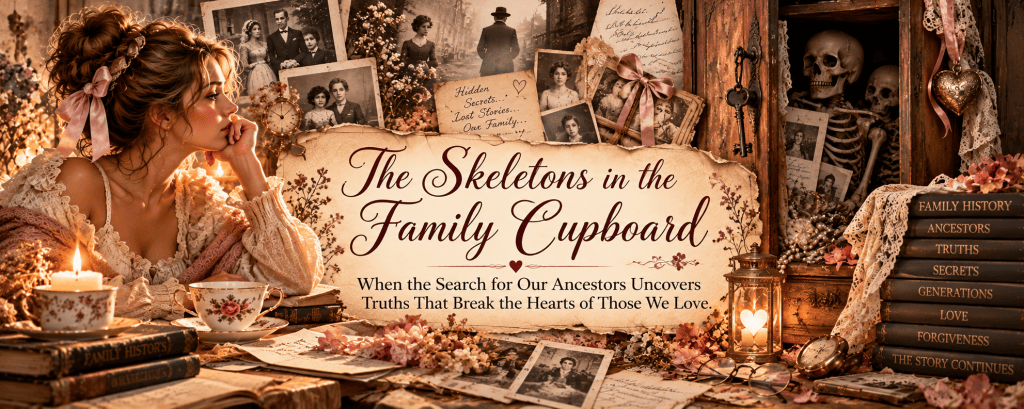
There is something extraordinarily beautiful about researching your family tree. Something almost magical about reaching backwards through the centuries, gently brushing away the dust of time and discovering the people whose lives, loves and losses eventually led to your own existence. I have spent countless years following those fragile threads, searching through census returns, parish registers, birth certificates, marriage records, death certificates, newspaper archives and all manner of historical documents. Every discovery feels like another little piece of a magnificent, unfinished jigsaw puzzle. A name becomes a person. A date becomes a moment in somebody's life. An address becomes a home where children once laughed, where meals were shared, where arguments were undoubtedly had, and where ordinary people lived extraordinary stories without ever imagining that somebody, generations later, would come looking for them.
And I absolutely adore it.
There is a feeling I cannot adequately describe when I discover something new about an ancestor. It is almost as though, for the briefest moment, the distance between us disappears. Somebody who has been gone for a hundred years suddenly feels close enough to touch. I find myself wondering what their voice sounded like, whether they were kind, whether they were happy, what frightened them, what made them laugh and whether they ever imagined that their lives would one day become so important to somebody they would never meet.
Through my research, I have discovered occupations, homes, marriages, children, tragedies, triumphs and heartbreaks. I have followed families through poverty, illness, war and unimaginable loss. I have found stories of resilience that have left me in awe of the people from whom I descend.
But there is another side to genealogy. A side that is rarely mentioned when somebody enthusiastically begins building their family tree.
Because not every discovery is a beautiful one.
Sometimes, when you begin opening the doors of the past, you discover things that previous generations deliberately locked away. Secrets carefully concealed beneath respectability, silence and the passing of time. Stories that were never intended to be told. Truths that somebody once hoped would disappear forever.
And sometimes, in uncovering those truths, you can hurt somebody you love more than words could ever explain.
I know this because I did.
And it is one of the greatest regrets of my life.

When the Past Refuses to Stay Buried.
Every family has its stories. The ones passed down around kitchen tables, repeated at family gatherings and lovingly embroidered with each new generation. We inherit tales of hardworking ancestors, happy marriages, brave soldiers, devoted mothers and fathers, and relatives whose lives seem to belong to another world entirely. But family stories are rather like old photographs. They capture only what somebody chose to preserve. Beyond the edges of the picture, there may be an entirely different story waiting to be discovered.
When I began researching my ancestors, I understood that I might uncover things that were unexpected. Illegitimate births, marriages that were not quite what they appeared, family disagreements, poverty, criminal records, abandoned relationships, and all the complicated little circumstances that make human beings so wonderfully, and sometimes painfully, imperfect. None of these things particularly frightened me. If anything, they made my ancestors feel more real. I have never believed that the people who came before us needed to be perfect in order to be worthy of remembrance.
They were human, after all.
They made mistakes. They fell in love with the wrong people. They made difficult decisions, sometimes out of desperation, sometimes out of selfishness and sometimes because the world in which they lived offered them very few choices. They carried secrets, endured shame and occasionally behaved in ways that would make their descendants raise an eyebrow or two.
And I have always believed that their stories deserve to be told.
Not to embarrass them. Not to judge them. Certainly not to sensationalise their lives.
But because they lived.
Because their experiences mattered.
Because history should not belong only to the respectable, the successful or the people whose lives were considered suitable for polite conversation.
Yet what I failed to fully appreciate was that the past does not always remain safely in the past.
Sometimes it reaches into the present and wounds the people who are still here.

The Discovery That Changed Everything.
Through my research, I uncovered family secrets. Skeletons in the cupboard, if you like. Things that had remained hidden, perhaps deliberately, for generations. And, as I had always done, I documented what I found.
There it was, in black and white.
The historical evidence.
The records.
The pieces of a story that had been waiting patiently to be discovered.
I had not invented anything. I had not set out to hurt anybody. I had simply followed the evidence wherever it led, believing that recording the truth was part of the responsibility I had taken upon myself as a family historian.
But in doing so, I hurt somebody extraordinarily precious to me.
My grandmother.
My lovely grandmother.
A woman I loved with all my heart.
And even writing those words now brings a heaviness that I struggle to explain.
Because what I had discovered about her ancestors was not simply an interesting historical revelation to her. These were people connected to her life, her memories, her understanding of her family and perhaps even part of how she understood herself.
To some, they were names in historical documents, people whose lives I was carefully piecing together from the fragments they had left behind.
To her and myself, they were family.
And there is an enormous difference between the two. But the biggest difference is my grandmother personally knew her ancestor where I had only heard the stories of his life and that is an even more enormous difference.
I could look at a record and see a fascinating discovery. She could look at that same information and feel something far more personal. Perhaps sadness, disappointment, embarrassment or a sense that something she had always believed was being taken away from her.
I cannot claim to know exactly what she felt.
I only know that she was upset and angry.
And that knowledge has haunted me ever since.
I had set out to discover the truth about our family, never imagining that the very thing I loved doing could cause pain to somebody I loved so dearly.
If only I had understood then what I understand now.

When Being Right Doesn't Make Something Hurt Any Less.
This is the question that has troubled me ever since.
Should I have documented what I discovered?
Should I have kept those findings to myself?
Should I have protected my grandmother from information that, although supported by historical evidence, brought her such unhappiness?
I have asked myself these questions more times than I could possibly count.
Because the evidence was there.
Black and white.
Written in documents that had survived long after the people concerned had passed away.
I had not created the circumstances. I had not changed history. I had simply uncovered something that had already happened.
And yet, I was the person who brought that knowledge into the present.
I was the person whose research caused the upset.
There is a terrible conflict in that realisation.
As a family historian, I believe deeply in preserving the truth. I believe that we owe our ancestors the dignity of remembering their lives as honestly as possible, rather than reshaping them into something more comfortable for future generations.
But as a granddaughter, I would give almost anything to undo the hurt I caused.
And those two feelings sit painfully beside one another.
Perhaps the greatest lesson I have learned is that discovering a truth and deciding how, when or whether to share it are two entirely different responsibilities.
A document can provide evidence of an event, but it cannot tell us everything about the emotions, intentions or circumstances surrounding it.
Nor can it prepare us for how somebody living today might react to what we have found.
A historical fact may be beyond dispute, while the way we interpret it, present it and share it still requires enormous care.
I understand that now more than ever.
But understanding something after the damage has been done is a particularly cruel kind of wisdom.

The Goodbye I Never Knew Was Coming.
Only months after I had upset my grandmother, she passed away.
And with her went something I can never retrieve.
The opportunity to know whether she had forgiven me.
That is the part that breaks my heart.
Not simply that I hurt her, although that alone is painful enough, but that I will never know whether the hurt remained between us when she died.
Did she understand that I had never intended to cause her pain?
Did she know how much I loved her?
Did she forgive me?
Or did she leave this world still carrying the sadness my discoveries had brought into her life?
I do not know.
And I never will.
There is something desperately painful about a question that can no longer be answered.
When somebody is alive, there is always the possibility of another conversation. Another chance to explain yourself. Another opportunity to say the words you wish you had said differently.
You imagine there will be time.
Time to make things right.
Time to clear the air.
Time to sit together and somehow find your way back to the warmth and understanding that once existed between you.
But death has a dreadful way of closing doors we never imagined were about to shut.
And suddenly, all those things you thought you might one day say become words with nowhere to go.
I cannot ask her how she felt.
I cannot explain my intentions again.
I cannot take her hand, look into her eyes and tell her that no discovery, no historical document and no family secret could ever have been more important to me than she was.
And that is what hurts most.
Because if I had known how little time we had left, would I have done things differently?
Without hesitation.
I would have chosen my words more carefully. I would have thought much harder about whether she needed to know what I had discovered. I would have considered the heart of the woman standing before me rather than concentrating so entirely upon the history of the people who came before her.
I cannot change what happened.
And that is a bitter pill to swallow.

The Cruel Weight of Not Knowing.
Regret is a strange thing.
It does not always arrive with a great dramatic entrance. Sometimes it settles quietly into the corners of your life, waiting until you least expect it before reminding you of something you desperately wish you could change.
It can appear while you are looking through an old photograph, hearing somebody mention a name or simply sitting quietly with your thoughts.
And suddenly, there it is again.
That dreadful question.
Did she forgive me?
I can tell myself that I never meant to hurt her. I can remind myself that I was following historical evidence and that my intentions were never unkind.
All of those things are true.
But they do not change the fact that she was hurt and angry.
And sometimes I find myself wondering whether she understood the difference between my intentions and the pain my actions caused.
I would dearly love to believe that she did.
I would love to imagine that, somewhere in her heart, she knew her granddaughter had simply become carried away by a passion for family history, never realising how deeply those discoveries might affect her.
But I cannot pretend to know what she thought.
And I think that uncertainty is something I will carry with me for the rest of my life.
People often speak about forgiveness as though it is something we can eventually give ourselves, and perhaps there is truth in that.
But forgiving yourself can be extraordinarily difficult when the person whose forgiveness you long for is no longer here to offer it.
There is no conversation to return to.
No reassurance.
No final answer.
Just love, regret and an aching silence where certainty ought to be.
And I have discovered that silence can be terribly loud.

Would I Change My Research?
Here is where my feelings become rather complicated.
Because despite everything I have written, despite the guilt I carry and the heartbreak connected to what happened, I do not regret researching my family tree.
Not for one single minute.
That may sound contradictory.
How can something bring me such extraordinary joy and such devastating regret at the same time?
But life is rarely as simple as we would like it to be.
Genealogy has given me something I struggle to describe adequately.
It has connected me to people I never knew existed. It has allowed me to walk through centuries of family history, discovering lives that might otherwise have remained forgotten.
I have learned where my ancestors lived, how they earned their living, whom they loved, whom they lost and the extraordinary challenges they faced.
I have stood in places where they once walked and imagined their footsteps beneath my own.
I have visited cemeteries, studied old maps and followed families through towns, villages and streets that have changed almost beyond recognition.
I have found children whose lives were heartbreakingly short, mothers who endured unimaginable losses and fathers who worked themselves into exhaustion simply to keep food upon the table.
I have discovered love stories, tragedies, mysteries and little moments of happiness preserved in the most unexpected places.
And with every discovery, I have felt a connection that is almost impossible to explain.
It is as though the people who came before me are no longer simply strangers separated from me by generations.
They are part of me.
Their lives helped create mine.
Their choices, their journeys, their heartbreaks and their survival all contributed to the extraordinary chain of events that eventually brought me into this world.
How could I possibly regret discovering them?
I cannot.
What I regret is the hurt that came from the way some of those discoveries entered the lives of people I loved.
And that is the distinction I have had to learn to live with.
I do not regret searching for the truth.
I regret that my search caused pain.

The Responsibility of Holding Somebody Else's History.
I think anyone who researches their family tree eventually becomes something of a keeper of stories.
We gather names, documents, photographs and memories, carefully preserving the fragments of lives that might otherwise disappear.
But with that privilege comes responsibility.
Because not every story belongs entirely to us.
A discovery about an ancestor may also affect their children, grandchildren and other living relatives.
A secret that seems like an intriguing historical mystery to one person may represent a painful memory to another.
An unexpected parentage, a hidden relationship, a family estrangement or a long-concealed event can change somebody's understanding of their own family.
And while I still believe historical truth matters, I have come to realise that kindness matters just as much.
Perhaps even more when the people affected are still here to feel the consequences.
I now believe there is an important difference between preserving information and making it public.
A discovery can be carefully documented without immediately being shared with everybody.
It can be recorded accurately while allowing time to consider the feelings of living relatives.
And sometimes, the most compassionate thing we can do is ask whether somebody actually wants to know what we have discovered.
Because not everybody wishes to uncover every secret hidden within their family tree.
Some people find comfort in the stories they have inherited.
Others are eager to know everything, however difficult.
Neither response makes somebody wrong.
We are all entitled to approach our family histories in our own way.
And perhaps, if I had understood that distinction more clearly years ago, things might have been different.
But hindsight, as they say, is a wonderful thing.
Unfortunately, it has a rather cruel habit of arriving when it is no longer of much practical use.

The Ancestors Who Never Imagined We Would Find Them.
There is something else I often think about.
The people whose secrets we uncover never imagined that their lives would one day be examined by descendants armed with computers, online archives, digitised newspapers and DNA testing.
They lived in a world where certain things could remain hidden simply because records were difficult to access, families moved away or uncomfortable subjects were never discussed.
A secret might survive for generations, protected by distance, silence and the passing of time.
But our modern world has changed all that.
Today, we can discover things from the comfort of our own homes that previous generations might have spent a lifetime trying to conceal.
A few clicks can reveal an unexpected marriage, a previously unknown child or a family connection that completely changes the story we thought we knew.
And while that is extraordinary from a historical perspective, I sometimes wonder whether we have fully considered the emotional consequences.
Just because we can uncover something, does that mean we should immediately share it?
Just because a record exists, does that mean everybody connected to it is ready to confront what it reveals?
I do not believe there is one simple answer.
But I do believe that those of us who love genealogy must remember that we are dealing with human lives, not merely historical puzzles.
Every name belonged to somebody.
Every secret had a reason for existing, even if we do not agree with that reason.
And every revelation has the potential to reach far beyond the pages of an old document.

If I Could Speak to My Grandmother One More Time.
Oh, how I wish I could.
Just once.
Not to ask her about another ancestor or discover another family story.
Not to question her about the past or fill another gap in my research.
Simply to sit beside her. To hold her hand. To tell her how desperately sorry I am that something I loved so much caused her pain.
I would tell her that I never wanted to embarrass her, disappoint her or make her feel that the people she came from were somehow less worthy of love or respect.
I would tell her that I have never believed our ancestors needed to be perfect.
That their mistakes, their secrets and their complicated lives do not diminish the value of the generations who followed them.
And I would tell her that nothing I discovered could ever change how much she meant to me.
I wish I could explain that my love of genealogy has always come from a desire to understand our family, not to judge it.
That I wanted to preserve the lives of those who came before us, never imagining that doing so might damage a relationship I treasured so dearly.
But most of all, I would ask her one question.
Do you forgive me?
And I would give almost anything to hear her answer.
Perhaps she would smile, take my hand and tell me not to be so silly.
Perhaps she would say that she had been hurt but understood I had never intended it.
Or perhaps there would still be difficult feelings between us, things that needed time and understanding to heal.
I cannot know.
And I will not invent an answer simply because it would make the pain easier to bear.
But I hope.
Goodness, how I hope.
I hope that somewhere beyond this life, where I believe we may one day meet again, there will be an opportunity for the conversation we never had.
A chance to say everything that was left unsaid.
A chance to hold her close and finally put down the weight I have carried for so long.
Until then, I have only my memories, my love and the hope that she knew how precious she was to me.

A Lesson Written in Love and Regret.
If there is one thing I would say to anybody beginning their family history journey, it is this.
Research with curiosity, but share with compassion.
Follow the evidence. Ask questions. Challenge family legends when the records tell a different story. Preserve the lives of those who might otherwise be forgotten.
But remember that your discoveries may touch people who are still living.
People who have memories, loyalties and feelings connected to the very stories you are uncovering.
Think carefully before revealing something that might cause distress.
Consider whether the person needs to know, whether they wish to know and whether there is a gentler way of approaching the subject.
And if somebody tells you that a discovery has hurt them, listen.
Not as a historian defending the accuracy of a document, but as a human being recognising another person's pain.
Because sometimes the question is not whether the evidence is correct.
Sometimes the question is whether sharing it in that particular moment is worth the hurt it may cause.
I wish somebody had explained that to me before I began uncovering the skeletons in our family cupboard.
Perhaps I would have approached things differently.
Perhaps I would have been more careful.
Perhaps my grandmother and I would have been spared some of the sadness that now shadows those memories.
I cannot say for certain.
But I can take what happened and allow it to make me a more thoughtful researcher, a more compassionate storyteller and, I hope, a wiser person.

The Truth, the Love and the Things We Cannot Undo.
I sometimes think family history is rather like an old tapestry.
From a distance, we see the beautiful picture created by generations of lives woven together.
But turn it over, and there are knots, tangled threads, loose ends and places where the pattern has become complicated.
Those untidy threads are not mistakes in the tapestry.
They are part of what holds it together.
Our ancestors were not perfect, and neither are we.
Their lives contained secrets, regrets and difficult decisions, just as ours do.
And perhaps that is one of the most important things genealogy teaches us.
We are all human.
We all make mistakes.
We all have moments we wish we could revisit, words we wish we could take back and people we wish we could hold just one more time.
My grandmother is one of those people.
And the regret I carry is not something I expect to simply disappear.
It is woven into my own story now, another thread in the complicated tapestry of our family.
But so is the love.
The love I felt for her when she was alive.
The love I still feel now.
And the love that makes the uncertainty of her forgiveness so desperately painful.
Perhaps that is why this particular regret cuts so deeply.
Because if she had not mattered so much, the loss of that reassurance would not hurt nearly as much as it does.
I cannot change the discoveries I made.
I cannot erase the documents.
And I cannot travel backwards to the moment before everything became so complicated.
But I can continue to honour the lives of my ancestors with honesty and care.
I can remember that behind every historical record is a human story.
And I can make sure that, when I write about the people who came before me, I never forget the people who are still here.
Because history is important.
Truth is important.
But so is love.
And sometimes, the hardest lesson of all is discovering that being able to prove something does not necessarily mean we have found the kindest way to share it.

One Last Thought for My Grandmother.
If, somehow, these words could find their way to you, I would want you to know that I am sorry.
Not for loving our family history.
Not for wanting to understand the lives of those who came before us.
And not for believing that every ancestor deserves to have their story remembered.
But for the hurt I caused you along the way.
I wish I had recognised how deeply my discoveries might affect you.
I wish I had understood that what fascinated me could be painful for you.
And I wish, more than anything, that I could know whether you forgave me before you left this world.
That unanswered question has become one of the heaviest things I carry.
I have learned so much about people who died long before I was born, yet there is one thing I desperately wish I knew about somebody I actually had the privilege of loving.
Whether, in the end, she forgave me.
Perhaps there is something terribly ironic about that.
I have spent years searching for answers hidden in the past, carefully piecing together the lives of people who can no longer speak for themselves.
Yet the answer I want more than almost anything cannot be found in a census, a certificate or a dusty archive.
It existed only in my grandmother's heart.
And when she died, that answer went with her.
I shall continue researching our family tree. I shall continue discovering the extraordinary lives, loves, hardships and triumphs of the people whose blood runs through my veins. I shall continue writing their stories because I believe they deserve to be remembered.
And I shall continue finding joy in every new discovery.
But I will never again forget that the truth, however fascinating, can carry a price.
Sometimes a terribly painful one.
And if there is one thing I hope others take from my experience, it is that we should never become so consumed with uncovering the lives of those who have gone before us that we forget to protect the hearts of those who are still beside us.
Because the ancestors will always be there, waiting patiently in their records.
The people we love will not.
And if I could exchange every family secret I have ever uncovered for the certainty that my grandmother left this world knowing how much I loved her, and having forgiven me for the hurt I caused, I would do so in a heartbeat.
Until we meet again, my lovely grandmother, I shall carry both my love and my regret.
And I hope that one day, when the distance between us finally disappears, I will be able to hold you close and hear the words my heart has longed for ever since you left.
Until next time,
Toodle pip,
Lainey.
Intwined —
Because every life has a story worth telling.
❤️💔❤️

