Welcome back to another little piece of my thoughts, my family history, and something that has been weighing rather heavily upon my heart.
Today, I want to talk about a flower.
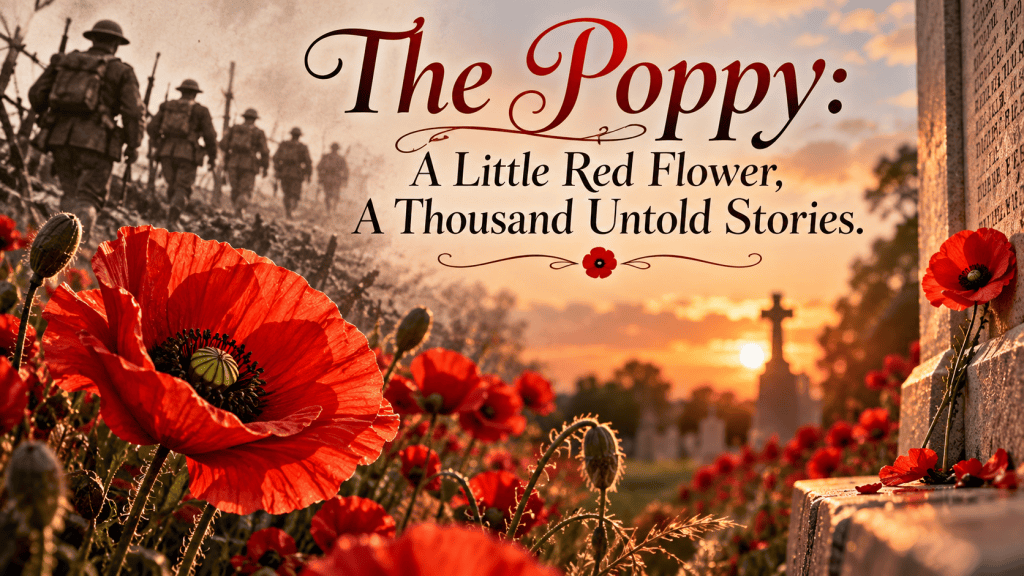
A small, delicate, blood-red flower that grows quietly in fields and along roadsides, its fragile petals trembling in the slightest breeze.
The poppy.
Such a simple little thing, really.
And yet, to me, it carries the weight of a thousand broken hearts, a million unanswered prayers, and generations of families who were never quite the same again.
Because when I look at a poppy, I do not simply see a flower.
I see somebody's son.
Somebody's husband.
Somebody's father.
Somebody's brother.
I see young men who kissed their mothers goodbye, promising they would be home by Christmas, never imagining that the last embrace they shared would become a memory their families would carry for the rest of their lives.
I see frightened boys pretending to be brave, writing letters home with trembling hands, telling their loved ones that everything was fine when, in truth, their world was falling apart around them.
And I see the countless families who waited.
And waited. And waited. For footsteps that would never again come through the front door.

The Poppy Is Personal to Me.
My feelings about remembrance run a little deeper because my own family history is woven so tightly into the tragedy of the two World Wars.
Like so many British families, mine has its own collection of names, dates, photographs and documents that tell stories of lives interrupted by war.
But behind those names are people.
Real people.
People who once laughed around dinner tables, worried about paying bills, fell in love, dreamed of having children and imagined growing old surrounded by their families.
People who had absolutely no idea that, generations later, somebody like me would be sitting here, trying to piece together the fragments of their lives and wondering what they might have become had history been a little kinder.
Many members of my family lost their lives fighting for our country during the World Wars.
And then there was my great-grandfather, Frank Newell.
Frank survived the trenches of the First World War, but survival came at a terrible price.
He lost his toes to frostbite.
Just stop and think about that for a moment.
Not to a bullet. Not to a shell.
But to the bitter, relentless cold of the trenches.
Imagine standing for days in freezing water and thick, filthy mud, your boots soaked through, your feet numb, your body exhausted, while the sound of gunfire and exploding shells reminded you that death was never very far away.
Imagine being so cold that parts of your own body began to die.
And imagine knowing that, even if you survived the fighting, you might never walk quite the same way again.
There is something particularly heartbreaking about Frank's suffering for me, because although our circumstances were worlds apart, I know something of the terrible pain that cold can inflict upon the human body.
You see, I suffer from severe Raynaud's, a condition that dramatically affects my everyday life.
It is not simply a case of having cold hands and feet, as most people imagine. It is extraordinarily painful, frightening and debilitating, affecting even the simplest things that other people take for granted.
I have come frighteningly close to losing my own fingers and toes because of the effects of the cold and the problems with my circulation.
And believe me, there is something terrifying about looking at your own hands or feet and wondering whether they will ever fully recover.
The pain is excruciating. The fear is very real. And the constant need to protect myself from the cold is something that shapes so much of my life.
Yet, even with everything I have experienced, I cannot begin to imagine what Frank endured.
Because when my Raynaud's becomes unbearable, I have the comfort of a semi-warm home, dry clothes, blankets and a rather long prescription of medication I have to take daily.
Frank had a trench.
A freezing, muddy, miserable trench, with nowhere warm to retreat to, no guarantee of dry boots and no certainty that he would even survive until morning.
And that thought absolutely breaks my heart.
Sometimes, when the cold grips my fingers or toes and the pain becomes almost impossible to ignore, I find myself thinking about him. My great-grandfather.
A man I never had the privilege of knowing, yet whose suffering feels strangely close to my own.
I wonder whether he cried from the pain.
Whether he tried desperately to warm his feet.
Whether he feared what would happen if the cold continued.
And whether, in those dreadful moments, he thought about home and longed for nothing more extraordinary than a warm fire, a dry pair of socks and the comfort of the people he loved.
It is a strange and deeply emotional connection to have with an ancestor.
More than a century separates our experiences, and I would never pretend that my suffering compares with the horrors of the trenches.
But perhaps it gives me a tiny window into one small part of what he endured.
And it makes me admire him all the more.
Because my great-grandfather did not simply leave a battlefield behind him.
He carried part of that battlefield home in his own body.
And I often wonder what else he carried.
What did he see?
Whose hands did he hold?
Which friends did he lose?
Did he wake in the night remembering things he could never bring himself to speak about?
Did he ever stand quietly in a garden, listening to the birds, grateful for the ordinary sounds of peace?
I shall probably never know.
And that is one of the saddest things about family history.
We can discover where somebody lived, when they married, how many children they had and where they were eventually laid to rest.
But we cannot always discover the nightmares they endured, the grief they swallowed or the courage it took simply to carry on.
And that breaks my heart.
Because Frank was not merely a name on my family tree. He was my great-grandfather. His blood runs through my veins.
And although we lived in entirely different worlds, there are moments when the pain of the cold makes the distance between us feel just a little smaller.

Perhaps that is one of the most extraordinary things about family history. Sometimes our ancestors are not simply people we discover in the past. Sometimes, through the experiences of our own lives, we find ourselves understanding a little more of theirs.

And when I pin that little red poppy to my coat, I am not remembering a distant historical figure.
I am remembering Frank.
A man who suffered.
A man who survived.
A man whose story deserves to be told.
And a man whose sacrifice I will carry in my heart for as long as I live.

A Flower Born From Devastation.
There is something almost unbearably poignant about the history of the remembrance poppy.
During the First World War, the battlefields of northern France and Belgium were torn apart by artillery, trenches and unimaginable destruction.
Yet amid the shattered earth, the little red field poppy continued to grow.
Its seeds flourished in disturbed soil, and its bright red petals became a striking contrast to the devastation surrounding them.
In 1915, Canadian military doctor Lieutenant-Colonel John McCrae wrote the famous poem In Flanders Fields, following the death of a fellow soldier.
Its opening words have echoed through generations:
"In Flanders fields the poppies blow..."
And from those terrible landscapes of loss, the poppy gradually became an international symbol of remembrance.
Not a celebration of war.
Not a glorification of violence.
But a way of remembering the human beings who suffered because of it.
Those who died.
Those who survived.
Those who returned with wounds nobody could see.
And those who remained at home, trying to rebuild lives from the pieces war had left behind.
I think there is something extraordinarily beautiful about that.
That from ground so brutally scarred by mankind, something so delicate could grow.
Almost as though nature itself was whispering that life must continue, even when the world has forgotten how.

The Men Who Came Home Were Not Always the Men Who Left.
We quite rightly remember those who never returned.
But I often think about those who did.
Men like my great-grandfather Frank.
Men who came home to wives, children, sweethearts and families who had spent years praying for their safe return.
And yet, how many returned as shadows of the men they had once been?
How many carried injuries that would trouble them for the rest of their lives?
How many could no longer bear sudden noises?
How many struggled to sleep?
How many sat silently at the dinner table, unable to explain to their families why they no longer smiled quite as easily as they once had?
We know so much more today about the psychological wounds of war.
But for many of those men, there was little understanding and even less help.
They were expected to come home, put away their uniforms and simply get on with life.
As though the horrors they had witnessed could be folded neatly into a drawer alongside their medals.
I wonder how many wives lay awake beside husbands who cried out in their sleep.
How many children grew up knowing their fathers were haunted by something they could not understand.
And how many men carried their suffering quietly to the grave.
When I think of Frank and the toes he lost to frostbite, I cannot help wondering about the wounds nobody could see.
Because the true cost of war does not end when the guns fall silent.
Sometimes it echoes through families for generations.

And Then I Look at the World Today.
This is where my sadness begins to turn into something else.
Something heavier.
Something that feels terribly close to anger.
Because when I look at Britain today, and at the growing tensions, division and uncertainty across Europe, I cannot help wondering what our ancestors would make of the world we have inherited.
What would Frank think?
What would all those young men who gave their lives think?
Would they recognise the country they left behind?
Would they understand why, after everything humanity endured during two World Wars, we still seem to struggle so desperately to live alongside one another?
I do not believe our ancestors fought so that future generations would all think alike, agree about everything or never question their governments.
Quite the opposite.
I believe one of the greatest things we can honour is the freedom to disagree, to question, to speak openly and to live without the fear that disagreement must turn into hatred.
And that is what troubles me most.
We have inherited freedoms that cost other people their lives, yet sometimes we seem to forget just how precious and fragile those freedoms really are.
We argue over differences.
We divide ourselves into opposing sides.
We allow suspicion and resentment to grow where understanding ought to be.
And all the while, the graves of those who came before us remain silent.
I know the world has never been perfect.
I know the Britain our ancestors knew had its own injustices, divisions and difficulties.
But surely, after so much suffering, we ought to have learned something.
Surely remembrance should encourage us to become a little kinder.
A little wiser.
A little more determined never to allow the horrors of the past to become the future of our children.

When Did a Poppy Become Something to Argue About?
And this brings me to something that has genuinely upset me. Massively upset me if I’m honest.
The suggestion that somebody wearing a remembrance poppy could be refused entry to a public house, including claims involving Wetherspoons.
I find the very thought heartbreaking.
I would hope that such claims are properly established, because an accusation of that nature deserves to be treated seriously.
But the wider question troubles me enormously.
How have we reached a point where a small red flower, worn in memory of the dead, can become the subject of suspicion, hostility or political argument?
I am perfectly aware that different people attach different meanings to national symbols, and that the poppy itself has sometimes become caught up in wider debates.
But I can only speak for myself.

When I wear a poppy, I am not making a political statement.
I am remembering my family.
I am remembering Frank.
I am remembering the young men who never had the chance to become old men.
I am remembering the women who opened telegrams and felt their entire worlds collapse.
I am remembering the children who grew up with photographs instead of fathers.
And I am remembering the men who returned home carrying injuries and memories that would remain with them until their dying day.
That is what my poppy means.
Nothing more sinister.
Nothing more complicated.
Just remembrance.
Just gratitude.
Just love.
And I find it deeply upsetting that such a personal act of remembrance could ever be misunderstood or treated as something shameful.
Nobody should be forced to wear a poppy.
Remembrance, after all, should come from the heart, not from obligation.
But equally, nobody should be made to feel unwelcome simply because they choose to wear one.
Surely there must still be room in our society for both choices to be respected.

They Were Not Fighting for a Perfect World.
Sometimes I think we place an almost impossible burden upon the shoulders of those who fought.
We speak about what they fought for as though every soldier shared precisely the same hopes, beliefs and understanding of the future.
But they were individuals.
Some fought out of duty.
Some out of patriotism.
Some because they wanted to protect their families.
Some because they had been called upon to serve and had little choice.
And some were simply frightened young men trying desperately to survive another day.
They were not all heroes in the storybook sense.
They were human beings.
And that, to me, makes their sacrifices even more extraordinary.
They were ordinary people placed in circumstances so terrible that most of us can scarcely begin to imagine them.
They did not know how history would remember them.
They did not know whether their names would appear on memorials.
They did not know whether their descendants would one day search for them in dusty archives.
They simply lived through the moments history handed them.
And far too many never lived to see what came next.

The Empty Chairs That War Left Behind.
One of the things that has always affected me most about researching family history is the thought of all the lives that never had the chance to unfold.
The weddings that never happened.
The babies who were never born.
The birthdays never celebrated.
The grandchildren never bounced upon a knee.
The ordinary Sunday afternoons, family arguments, Christmas dinners and little moments of happiness that were stolen before they had even begun.
When a soldier died, it was not simply one life that ended.
An entire possible future disappeared with them.
And somewhere, a mother continued setting the table for one fewer person.
A wife slept alone.
A child waited for a father who would never come home.
A family photograph forever held the face of somebody who would never grow older.
That is what I think about when I see the rows upon rows of white headstones in military cemeteries.
Not statistics.
Not military campaigns.
Not victories or defeats.
People.
Thousands upon thousands of people.
Each one loved.
Each one missed.
Each one leaving behind a story that deserved so many more chapters.

I Will Wear My Poppy With Pride.
Every November, when I pin that little red flower to my coat, I carry my ancestors with me.
I carry Frank and the suffering he endured in the trenches.
I carry the memory of those in my family who never returned from war.
I carry the countless other families whose stories I may never know but whose grief was every bit as real.
And I carry a quiet promise.
That I will remember.
That I will continue researching their lives, speaking their names and telling their stories.
That I will never allow them to become nothing more than faded photographs, forgotten dates or names carved into weathered stone.
Because they were here.
They lived.
They loved.
They suffered.
And they mattered.
I do not wear my poppy because I believe war is glorious.
I wear it because I know war is devastating.
I do not wear it because I think my country has always been right.
I wear it because I believe we have a responsibility to learn from the times humanity has been terribly wrong.
And I do not wear it to divide myself from anybody else.
I wear it because grief, sacrifice and the longing for peace are things that should unite us.

A Little Red Flower, and a Promise to Remember.
Maybe, one day, somebody researching our family tree will come across this little piece of writing.
Perhaps they will be a great-grandchild of mine, or somebody born long after I have become another name among the branches.
And maybe they will wonder why a little red flower meant so much to me.
I hope they understand.
I hope they know about Frank Newell and the toes he lost to frostbite in the trenches.
I hope they discover the names of our relatives who gave their lives during the World Wars.
I hope they understand that behind every military record is a person who once had dreams as ordinary and precious as their own.
And above all, I hope they are living in a world that has finally learned how to value peace.
A world where children do not have to say goodbye to fathers going off to war.
Where mothers do not have to bury their sons.
Where young men and women are not asked to surrender their futures upon battlefields.
And where a little red flower can simply be what it was always meant to be for so many of us.
A symbol of remembrance.
A symbol of sacrifice.
A symbol of hope.
Because one day, even the last people who knew those who fought in the World Wars will be gone.
Their voices will fall silent.
Their photographs will fade.
Their letters will become fragile with age.
And their names may survive only in records, on memorials and within the stories their descendants choose to tell.
But as long as we remember them, something of them remains.
So, to my great-grandfather Frank, and to every member of my family who suffered or died in war, I want to say something that perhaps was never said often enough.
Thank you.
For the years you lost.
For the pain you endured.
For the lives you never had the chance to live.
And for the tomorrows that we were fortunate enough to inherit.
I cannot promise that the world will always honour your sacrifice in the way it deserves.
I cannot promise that humanity will never again repeat the mistakes of the past.
But I can promise this.
I will remember you.
Not just on the eleventh hour of the eleventh day of the eleventh month.
Not just when the wreaths are laid or the Last Post echoes through the silence.
But whenever I see a little red poppy growing against the sky.
Because to some, it may be nothing more than a flower.
But to me, it is a family history written in courage, suffering, sacrifice and love.
And some stories are simply too important to ever be forgotten.
We will remember them.
We must remember them.
Always.
Until next time,
Toodle pip,
Lainey.
Intwined —
Because every life has a story worth telling.