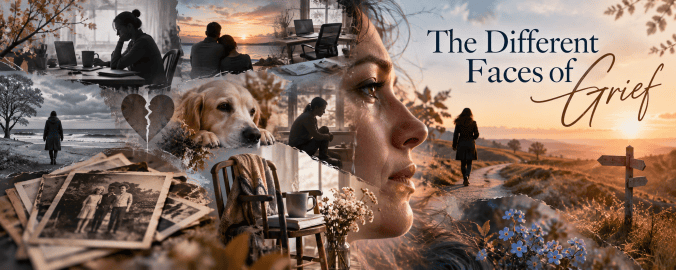
Grief has many faces.
I don't think I truly understood that when I was younger.
Back then, grief seemed quite straightforward. Somebody died. You cried. You went to a funeral. You wore black. People sent cards and flowers. Eventually, somehow, you were supposed to feel better.
That was grief.
Except, of course, it isn't.
Not really.
The older I become, the more I realise that grief is one of the strangest and most complicated emotions we ever experience.
It doesn't have one face.
It has hundreds.
And sometimes, it doesn't look like grief at all.
Sometimes grief is crying so hard that your chest physically hurts.
Sometimes it is anger, sometimes it is silence,
Sometimes it is laughing at something completely ridiculous and then suddenly feeling guilty because, for a few seconds, you forgot you were supposed to be sad. Sometimes grief is staring at an empty chair. Sometimes it is picking up your phone to message somebody before remembering that you can't. Sometimes it is hearing a song in the supermarket and having to stand very still beside the baked beans because, inexplicably, your eyes have filled with tears. And sometimes grief has absolutely nothing to do with death.
I think that might be one of the things we understand least about it.
Because grief isn't simply what happens when somebody dies.
Grief happens when something we loved, needed, expected or imagined is no longer ours.
And there are so many ways for that to happen.
Sometimes grief is missing somebody who is still alive.
We can grieve relationships.
Friendships.
Marriages.
Families.
People who once knew everything about us and eventually became strangers.
There doesn't have to be a funeral for somebody to disappear from your life.
Sometimes people simply walk away.
Sometimes circumstances pull you apart.
Sometimes a relationship ends even though one person desperately wanted it to continue.
And there is a particular kind of heartbreak in losing somebody who is still out there somewhere.
They are still drinking coffee.
Still going to work.
Still laughing.
Still living their life.
Perhaps they are even falling in love again.
Just no longer with you.
And suddenly the person you once spoke to every day becomes somebody you aren't supposed to contact at all.
The person whose name once appeared constantly on your phone disappears from it.
The person you told everything to is now the person you can't tell anything to.
There is a peculiar sadness in that.
Because there is nowhere obvious to put that grief.
No funeral.
No sympathy cards.
No flowers arriving at the door.
People might tell you that you'll meet somebody else.
That it wasn't meant to be.
That time will heal it.
And perhaps one day some of those things will be true.
But they don't change what has been lost.
Because when a relationship ends, you aren't only grieving a person.
You can be grieving an entire way of life.
The morning messages, the private jokes, the familiar voice, the plans for next weekend, the holidays you thought you would take, the Christmases you imagined, the home you might have shared, the children you might have had, the person you thought would still be holding your hand when you were old.
You can grieve a future that existed only in your imagination.
And that doesn't make the loss imaginary.
Sometimes the hardest person to mourn is somebody who is still alive.
Then there is the grief for the future.
Perhaps this is the quietest grief of all.
The grief for things that never actually happened.
The wedding that will never take place.
The children who were imagined but never born.
The house somebody pictured growing old in.
The retirement that illness changed.
The career that never happened.
The journey somebody thought they would take.
The person they believed would be sitting beside them when they were eighty.
How do you mourn something that never existed?
And yet we do.
Because sometimes we don't only lose people.
We lose the future we had built around them.
Whole imaginary lifetimes can disappear in a single conversation, diagnosis, phone call, letter or text message.
And although those futures were never real in the physical sense, they were real inside us.
We had visited them a thousand times in our imagination.
So when they disappear, the grief is real too.
And then there is another kind of loss that I don't think we always recognise as grief.
Losing a job you loved.
We often talk about losing a job in practical terms.
Money, bills, mortgages, pensions, applications, CVs.
What on earth am I going to do now?
And, of course, those things matter enormously.
But sometimes a job was far more than the money that arrived in your bank account at the end of the month.
Perhaps you loved what you did.
Perhaps you had spent years building your career.
Perhaps your colleagues had become friends.
Perhaps you were proud when somebody asked what you did for a living.
Perhaps your work gave you purpose, routine, confidence, independence, a reason to get up in the morning. Maybe it was simply somewhere you felt that you belonged. And then one day it is gone.
Redundancy, illness, a company closing, retirement you weren't ready for, an accident, caring responsibilities.
Circumstances completely beyond your control.
Suddenly, you aren't only asking,
How will I pay the bills?
You might also be quietly asking,
Who am I now?
Because we don't always realise how much of our identity becomes woven into the things we do every day.
You miss the people.
You miss the routine.
You miss knowing exactly where you are supposed to be on a Monday morning.
You miss the ridiculous conversations over cups of tea.
You might even miss the things you used to complain about.
And perhaps the strangest part is watching the place continue without you.
Someone else sits at your desk.
Someone else does the job you once did.
The emails continue.
The meetings happen.
People laugh in the staffroom.
The world you were once part of keeps moving.
Just without you.
That can hurt.
And yet we rarely call it grief.
We say someone has lost their job and then immediately begin talking about what they should do next.
Update your CV. Apply for something else. Retrain. Move on.
But maybe sometimes, before somebody can move on, they need permission to mourn what they have lost.
Because losing work you loved can mean losing a community, an identity, a routine, a purpose and a version of yourself all at once.
That is grief too.
There is grief for who we used to be.
I think many of us carry that one without even realising it.
We look at old photographs and recognise ourselves, yet sometimes that person feels like somebody we once knew.
The younger body, the healthier body, the carefree version of ourselves, the person who hadn't yet experienced certain losses, the person who trusted more easily, the person who thought there would always be plenty of time.
We can miss ourselves.
That sounds rather strange when you say it aloud.
But I think it is true.
Sometimes we grieve the person we were before life happened to us.
And sometimes we grieve the person we thought we would become.
There is grief for places too.
A childhood home sold to strangers.
A grandparent's house emptied after they die.
A school demolished.
A favourite holiday destination changed beyond recognition.
A street that once contained an entire childhood but now looks surprisingly small when you drive along it as an adult.
Places hold pieces of us.
They contain ordinary moments we didn't realise were precious while we were living them.
A kitchen table, a particular chair, the smell of somebody's hallway, a garden gate, a bedroom window, the sound of a clock that you barely noticed until one day it wasn't there anymore.
Perhaps that is why clearing somebody's belongings after they die can feel so brutal.
To somebody else, it is just a cardigan, a mug, a pair of glasses, an old receipt tucked inside a drawer.
But to you, it is evidence.
Evidence that they were here.
Evidence that they existed.
Evidence of an ordinary Tuesday afternoon that nobody thought to photograph.
And grief lives in ordinary things.
It hides in wardrobes. In recipes. In handwriting. In photographs. In Christmas decorations. In perfume.
In songs. In stupid little family jokes that nobody else in the world would understand. It lives in birthdays and anniversaries, of course.
But it also appears on completely unremarkable Wednesdays.
You can be perfectly fine at 10:14 in the morning and devastated by 10:15 because something reminded you.
That is another face of grief.
The ambush.
The moment that comes from nowhere.
Years may have passed.
You might genuinely be happy.
Life may have moved forward.
And then you hear their favourite song.
Or smell their aftershave.
Or somebody walks past who looks like them from behind.
And for one tiny fraction of a second, time folds in on itself.
They are here.
Then they aren't.
Again.
Perhaps that is one of the cruellest things about grief.
There isn't only one goodbye.
Sometimes we say goodbye thousands of times.
There is the grief of losing an animal too.
And anyone who has truly loved one knows that the word pet can feel ridiculously inadequate.
They are woven into the rhythm of our lives.
The footsteps following us from room to room.
The bowl on the kitchen floor.
The fur on clothes.
The lead hanging by the door.
The warm body curled beside us.
The ridiculous habits that once drove us mad and that we would give absolutely anything to be annoyed by again.
When they die, the house changes.
It becomes quieter in a way that other people may not understand.
And grief does not care whether the person or creature we loved walked on two legs or four.
Love is love.
Absence is absence.
There is anticipatory grief.
The grief that begins before somebody has even gone.
When illness enters a family.
When you know that time is becoming precious.
When every ordinary moment suddenly feels as though it should be remembered.
You begin missing somebody while they are still sitting beside you.
It is an extraordinary contradiction.
To have someone and already be grieving them.
Then there is complicated grief.
The grief that comes when the relationship itself was complicated.
Perhaps you loved somebody deeply but were also hurt by them.
Perhaps things were left unsaid.
Perhaps there were arguments that were never resolved.
Perhaps you were estranged.
Perhaps you thought there would be more time to fix things.
Death doesn't magically tidy relationships into neat little boxes.
Sometimes somebody dies and leaves behind love, anger, regret, relief, guilt and sadness all tangled together.
And you can feel all of those things at once.
That doesn't make the grief less genuine.
It makes it human.
There is grief that looks like anger.
Grief that looks like exhaustion.
Grief that looks like keeping ridiculously busy because stopping means thinking.
Grief that looks like sleeping.
Grief that looks like not being able to sleep at all.
Grief that looks like clearing out every cupboard in the house at two o'clock in the morning.
Grief that looks like humour.
Grief that looks like numbness.
And sometimes grief looks suspiciously like absolutely nothing.
Because not everybody cries.
Not everybody falls apart.
Some people become practical.
They organise funerals. Make tea. Phone relatives. Find certificates. Feed everybody. Write lists.
They hold everything together so tightly that people say,
"You're being incredibly strong."
Maybe they are.
Or perhaps they simply haven't fallen apart yet.
There is no correct way to grieve.
And there certainly isn't a timetable.
I think that is something society still gets terribly wrong.
We are very good at recognising certain kinds of grief.
Particularly death.
When somebody dies, people gather.
Messages arrive. Flowers appear. Food is brought. People ask how you are.
But some losses happen almost invisibly.
Nobody sends flowers because your relationship ended.
Nobody brings a casserole because you lost the career you loved.
Nobody sends a sympathy card because illness changed the person you used to be.
Nobody holds a funeral for a future that will never happen.
And yet something has died.
A relationship. A dream. A career. A future. A version of yourself. A sense of belonging.
And the heart can grieve all of them.
Perhaps that is something we should become better at recognising.
Not every grieving person is dressed in black.
Not every grieving person has attended a funeral.
Sometimes the person sitting opposite you at work, standing behind you in the supermarket or smiling at you in the street is mourning something you cannot see.
And then, gradually, the world moves on.
Except your grief doesn't necessarily move at the same speed.
Three months later, everyone else may be living normally again while you are still trying to understand how your own world changed so completely.
A year passes. Then two. Then ten.
And sometimes people assume that grief must have finished by then.
But I don't think grief finishes.
I think it changes shape.
At first, it can fill the entire room.
You can barely see around it.
Then, slowly, life begins growing around it.
New memories arrive. New people. New experiences. New laughter.
You learn how to carry the absence.
Not because what you lost mattered less.
Not because you have forgotten.
But because human beings have an extraordinary ability to continue loving what they can no longer hold.
Maybe that is what grief really is.
Love with nowhere physical to go.
And maybe healing isn't about leaving grief behind.
Maybe it is about allowing it to change its face.
One day it is unbearable sadness.
Another day it is a photograph that makes you smile.
One day it is anger at everything that was taken from you.
Another day it is gratitude that you had it at all.
One day you remember the ending.
Eventually, sometimes, you begin remembering the beginning again.
The laughter. The stories. The ordinary days. The tiny moments that once seemed completely insignificant.
And maybe , after enough time has passed, grief and gratitude begin learning how to live beside one another.
I miss you.
And I was lucky to know you.
I wish things had been different.
And I am grateful they happened at all.
I wish you were still here.
And I carry you with me.
Two things can be true at once.
Maybe that is another face of grief.
Love.
Because beneath all its disguises, the tears, the anger, the numbness, the memories, the longing, the regret and the terrible empty spaces, there was always love somewhere.
Love for a person, love for an animal, love for a relationship, love for a job, love for a place, love for a dream, love for the person we once were, love for the future we thought we were going to have.
And maybe that is why grief has so many faces.
Because love does too.
Until next time,
Toodle pip,
Lainey.
Intwined — Because every life has a story worth telling.
🕊️🕊️🕊️

