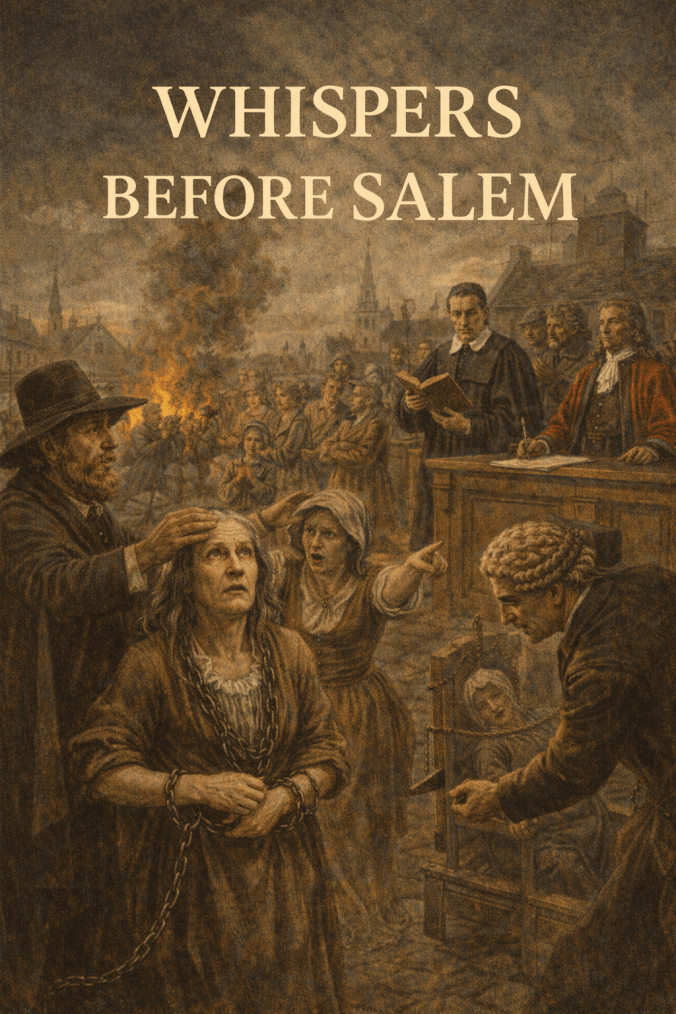
When people think of witch trials, Salem rises like a dark landmark in the imagination, sharp and unmistakable.
Yet Salem was never the beginning.
It was a distant aftershock, a final and dramatic echo of beliefs, laws, and fears that had already haunted Britain for centuries. England, Scotland, and Wales carried the long memory of witchcraft accusations before a single Puritan foot stepped onto New England soil.
The Atlantic did not wash those fears away. It carried them.
To understand witch trials outside Salem is to step into a world where the boundary between the natural and the supernatural was thin, where illness had no clear cause, weather felt personal, and misfortune demanded explanation. Early modern Britain was a place of deep uncertainty. Life was fragile. Infant mortality was high. Harvests could fail without warning. Plague returned again and again. In such a world, belief in witchcraft was not foolishness. It was a way of making sense of suffering.
In medieval Britain, belief in magic had long existed alongside Christianity. Folk healers, charmers, and wise women were part of everyday life. They cured warts, eased childbirth, protected livestock, and whispered prayers that blended pagan custom with Christian faith. For centuries, this was tolerated, even relied upon. The shift toward persecution came slowly, driven not only by belief, but by power.
In England, witchcraft became a legal crime relatively late compared to parts of continental Europe. The first English Witchcraft Act of 1542 briefly made witchcraft a felony, though it was repealed shortly after. The more influential law arrived in 1563 under Elizabeth I. This act made causing death through witchcraft punishable by hanging, while lesser magical harm could lead to imprisonment. In 1604, under James I, the law grew harsher still. Merely invoking spirits, even without proven harm, could now mean death.
English witch trials were grounded in maleficium, the belief that witches caused tangible harm. This shaped accusations into something deeply domestic.
Most cases began with neighbours. A woman asked for food or charity and was refused. Words were exchanged. Later, a child fell ill or a cow died. Memory reached backward, stitching cause to consequence. The accused were often older women, poor, widowed, dependent on parish relief, and already viewed as troublesome or strange. Witchcraft became a language for resentment.
Trials were held in secular courts, often during assizes that swept through counties. Juries were local men who knew the accused, sometimes too well. Evidence was thin by modern standards. Confessions mattered most, and while torture was illegal in England, pressure was relentless. Suspects were watched for days without sleep. They were questioned until exhaustion softened resistance. Their bodies were examined for witch marks, anything that did not bleed or feel pain when pricked. These marks could be scars, birthmarks, or natural blemishes, yet once identified, they became proof.
The Pendle witch trials of 1612 stand as one of England’s most devastating episodes. In a remote part of Lancashire, religious tension between Catholics and Protestants, grinding poverty, and family rivalry collided.
Two families, the Demdikes and the Chattoxes, both associated with folk healing, were accused. The case spiralled when a young girl, Jennet Device, testified against her own family. Her small voice carried deadly weight. Ten people were hanged. The trial was carefully recorded and published, spreading fear and fascination across the country. It showed how easily ordinary lives could be undone once suspicion was given official permission.
Scotland’s witch trials followed a darker and more lethal path.
Scottish law treated witchcraft not simply as harm, but as heresy, a conscious pact with the Devil. This theological framing transformed witch hunting into a moral crusade.
The Witchcraft Act of 1563 made witchcraft punishable by death, and enforcement was aggressive. Scotland would eventually accuse around four thousand people, with executions estimated at over two thousand, one of the highest per capita rates in Europe.
Religion played a powerful role. The Scottish Reformation intensified fear of the Devil’s presence in everyday life. Ministers preached vigilance. Communities were encouraged to report suspicion.
Witch hunting became communal labour. Confessions were extracted through brutal means. Unlike England, torture was legal in Scotland, and its use was frequent. Accused witches were deprived of sleep, bound in painful positions, subjected to thumb screws, or kept awake for days until hallucinations blurred reality. Confessions grew elaborate, filled with tales of night flights, devilish gatherings, and renunciation of baptism. These stories were shaped as much by interrogators’ expectations as by the accused’s desperation.
The North Berwick witch trials of the 1590s reveal how paranoia could spread upward as well as outward. After storms threatened the voyage of King James VI and his new bride, suspicion turned toward witchcraft. Dozens were accused of plotting the king’s death through magic. James personally interrogated suspects and became deeply invested in witch hunting, later publishing Daemonologie, a book that argued passionately for the reality of witches and their threat to Christian society. Royal fear became national fear.
Execution in Scotland was often by burning, usually after strangulation. These deaths were public, meant to cleanse communities and warn survivors. Yet they often deepened terror instead. Witch hunts came in waves, flaring during times of famine, war, and political instability, then receding before rising again.
Wales presents a quieter, more fragmentary history. Witch trials were fewer and less systematised, but belief in magic was deeply embedded in Welsh culture. Healing charms, prophetic dreams, and protective spells were part of everyday life. Accusations did occur, often involving harm to livestock or illness, but many cases were handled under English law after Wales was legally absorbed into England. Some accused were punished not for witchcraft itself, but for fraud or vagrancy. The scarcity of records reflects not absence of belief, but different ways of managing fear, often within the community rather than through execution.
Across Britain, witch trials were shaped by gender, but not exclusively defined by it. Women made up the majority of the accused, particularly those who lived on the margins of society. Poverty made people visible and vulnerable. Dependence bred resentment. Old age invited suspicion. Yet men were accused too, especially in Scotland, where the idea of a diabolical conspiracy widened the net. Healers and cunning folk were especially at risk. When their remedies failed, trust could turn to terror overnight.
The English Civil War created fertile ground for renewed witch hunting. Chaos, displacement, and religious extremism loosened restraint. It was during this time that Matthew Hopkins emerged. Styling himself the Witchfinder General, Hopkins travelled through eastern England accusing hundreds. He claimed divine calling, but his methods were chillingly systematic. Suspects were watched continuously, denied sleep, examined repeatedly for marks. Swimming tests were used, based on the belief that water would reject the guilty. Floating meant condemnation. Sinking risked death. Many were executed based on his accusations. Hopkins operated for only a few years, yet his impact was immense. His career exposed how fear could be weaponised, professionalised, and profited from.
By the late seventeenth century, skepticism began to grow.
Judges questioned evidence.
Philosophers challenged superstition.
Science crept slowly into explanation.
In England, executions declined sharply after the 1680s. The Witchcraft Act was repealed in 1736, redefining witchcraft as deception rather than reality. Scotland followed a similar path soon after. The belief lingered, but the law withdrew its sanction to kill.
Salem erupted just as Britain was stepping away. The ideas that shaped the Massachusetts trials were already aging in their homeland. Legal practices, religious fears, and family histories crossed the ocean with settlers whose ancestors had lived through Britain’s witch hunts. Salem was not an isolated madness. It was inherited.
What makes the British witch trials so haunting is their ordinariness.
They unfolded in villages and towns where people borrowed salt from one another, where children played together, where grudges were small but enduring. Accusations came from neighbours. Testimony came from the young. Judgement came from men who believed they were protecting their communities.
Most of the accused lie in unmarked graves. Their voices survive only through hostile records written by others. Salem is remembered loudly. Britain’s witches are remembered softly, if at all.
Their stories sit between the lines of court documents, waiting.
To remember them is not to indulge in spectacle. It is to recognise how fear becomes policy, how belief becomes law, and how ordinary people can be drawn into extraordinary cruelty.
The witch trials outside Salem remind us that history does not belong only to dramatic moments, but to long patterns of thought that shape how societies treat their most vulnerable.
The witches of Britain were not creatures of darkness. They were people who lived where fear found fertile ground. Their lives ask us not only to look backward, but inward, toward the moments when certainty hardens too quickly and compassion is allowed to slip away.
Until next time,

Ta ta for now.

Yours, Lainey.