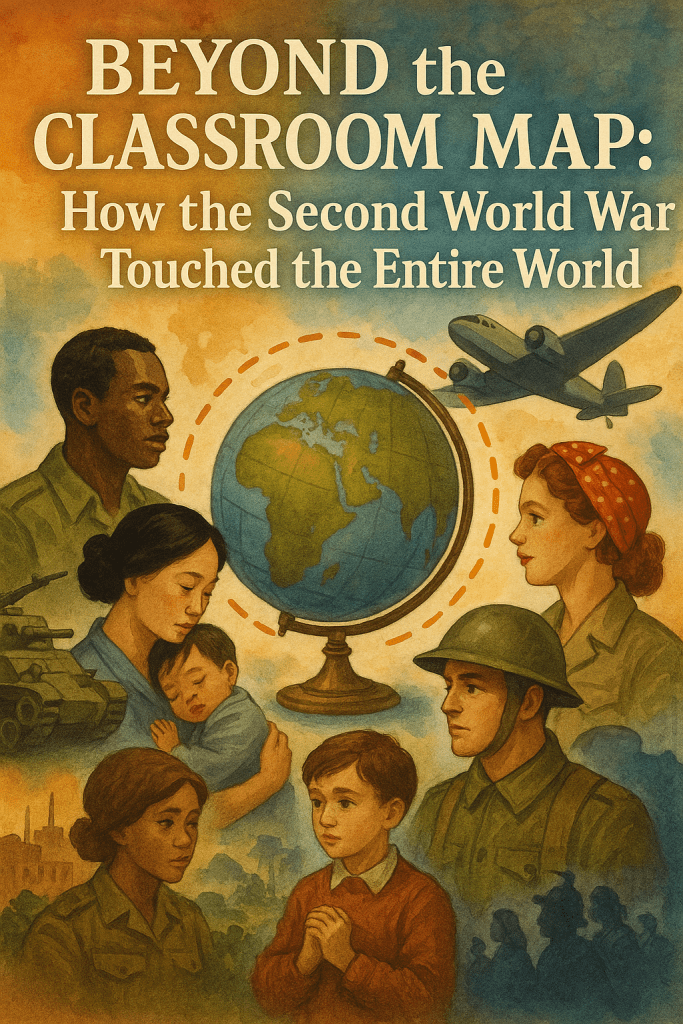
The Second World War was never confined to a neat map pinned to a classroom wall. It did not belong solely to Germany, France and England, with America stepping in later like a final chapter. It was a living, breathing global upheaval that reached into almost every corner of the world, shaping lives in ways both shattering and tender. Yet for many of us, especially those taught decades ago, the story we learned was narrow, trimmed of its vastness, leaving countless voices unheard.
To truly understand the war is to let the map unfold, to see how deeply and widely its shadows and its courage fell.
In Europe, the devastation was immense and deeply intimate. Britain endured bombing and rationing, France occupation and resistance, Germany the moral collapse and ruin of a regime built on terror. But Europe’s story stretches far beyond those familiar borders.
Poland was the war’s first great wound, invaded and divided, its people subjected to brutality, displacement and systematic murder. Eastern Europe became a landscape of fear and endurance, where villages vanished and families were torn apart. In the Balkans, war entangled itself with civil conflict, leaving scars that lingered long after the guns fell silent. Even neutral nations were not untouched. Ireland lived with shortages and loss. Sweden balanced survival, trade and conscience. Switzerland became both refuge and moral question. Europe was not a single story but a mosaic of suffering, resistance and survival.
Beyond Europe, the war had already begun long before many Western classrooms acknowledged it. In Asia, the conflict was well underway in the 1930s. China suffered on an almost unimaginable scale under Japanese invasion, with millions of civilians killed, cities destroyed and families displaced. The horrors endured there were not side stories, they were central chapters. Korea lived under occupation, its culture suppressed and its people forced into labor, shaping divisions that remain to this day. These histories deserve to stand at the heart of how the war is taught, not at its margins.
Across Southeast Asia, the war collided with colonial rule. Burma, Malaya, Indonesia and the Philippines became battlegrounds where ordinary people were trapped between empires. Civilians were forced into labor, starved by disrupted food systems and brutalised by occupation.
Yet from this suffering grew powerful movements for independence. Many who endured the war emerged determined never again to live under foreign rule. The end of the war reshaped these nations not just politically, but spiritually, awakening a fierce desire for self-determination.
Africa’s story, too often overlooked, is woven deeply into the fabric of the war. Hundreds of thousands of African soldiers were conscripted to fight in Europe, the Middle East and Asia, often promised recognition that never came. North Africa became a major theatre of war, its deserts scarred by tanks and trenches. Resources were extracted at great human cost, villages disrupted, economies strained. The war accelerated conversations about freedom and dignity, helping ignite independence movements that would transform the continent in the decades that followed.
In the Middle East, the war unsettled already fragile regions. Iran was occupied to secure oil and supply routes. Palestine became a strategic hub, intensifying tensions that would later erupt into enduring conflict. Ancient cities filled with foreign troops, and civilians lived under constant uncertainty. The war’s end left borders redrawn and promises unresolved, shaping the region’s future in painful ways.
The Pacific islands experienced the war as an invasion of home itself. Guam, Okinawa and countless smaller islands became battlegrounds where civilians were caught between vast military forces. Communities were displaced, landscapes altered and traditions disrupted. For islanders, the war was not an abstract global struggle but a deeply personal loss of land, safety and continuity.
Even Latin America, often treated as distant from the conflict, felt its pull. Nations supplied vital raw materials. Brazilian troops fought in Europe. Coastal cities lived with the fear of submarine attacks. Economies shifted rapidly, reshaping societies and migration patterns. Neutrality did not mean isolation.
And everywhere, families were changed. Parents were separated from children, lovers parted, siblings scattered across continents. Women stepped into roles once denied them, running farms, factories and households with extraordinary strength. Childhood itself was reshaped by evacuation, hunger and loss. Grief became a universal language, spoken quietly in kitchens, fields and shelters across the world.
The war’s end in 1945 did not bring simple relief. It brought reckoning. The Holocaust revealed depths of cruelty that forced humanity to confront itself. Millions wandered as displaced people, searching for homes that no longer existed. Empires weakened, colonies questioned their futures and new nations emerged from the ashes. The world did not heal overnight. It transformed.
And yet, threaded through all this darkness was light. Across continents, people shared food, hid strangers, sang songs in shelters and planted gardens amid ruins.
Love persisted.
Community endured.
Courage bloomed in ordinary lives.
This is why our children deserve the whole story. Not a simplified version where the war belongs to a handful of nations, but the fuller truth of a world entangled in one vast, painful, human experience.
Schools must teach that the Second World War was global in every sense, fought and felt by people of every culture, color and continent.
Only then can history become not just dates and battles, but understanding.
To remember the war fully is an act of compassion. It honors those whose stories were sidelined and reminds us how deeply connected the world has always been.
The Second World War reshaped borders, but it also reshaped hearts. Its echoes live on in families, migrations, politics and memory.
And when we widen the lens, when we listen beyond the classroom map, we learn not only what happened, but why remembering it fully still matters.
Until next time,

Ta ta for now.

Yours,
 Lainey.