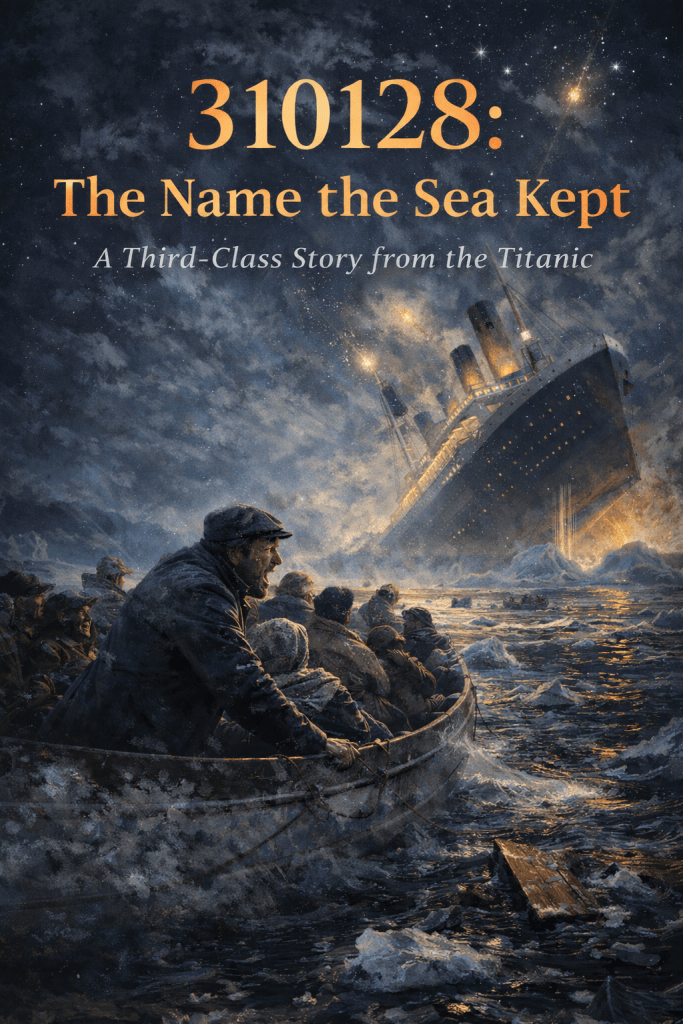
What you are about to read is imagined, but it is not imagined carelessly.
It rises from documents and archives, from passenger lists and inquiry transcripts, from testimonies spoken by survivors and silences left by those who never returned. It is shaped by history rather than invention, by the small, factual details that remain when lives themselves are gone. The people within these pages may be fictional in name, but they are true in substance. Their labor, their fear, their love, their final choices were lived by real men, women, and children. They stood in real places. They felt real cold. They carried real hope.
For me, this is not simply a retelling of a disaster.
It is inheritance.
Members of my own family and my husband’s family boarded the Titanic. Some survived. Some did not. The night divided them permanently, leaving one branch marked by loss and another marked by survival. Their names appear on manifests and memorials, in faded records and family memory. What does not appear are the moments that mattered most. The words spoken. The hands held. The glances exchanged when the future still seemed possible.
I never heard their voices, but they live in the space they left behind. I have wondered how they laughed, who they loved, how they faced that night when certainty gave way beneath their feet. I have wondered how those who survived carried the weight forward, and how the sea kept the rest.
This story is my way of standing beside them.
It is written in remembrance of those whose lives were reduced to numbers, and in honor of those who lived on bearing grief, memory, and silence. It is offered with humility, with care, and with profound respect for every life bound to that crossing.
What follows does not claim to replace history. It listens to it.
A light kept burning for those who were lost.

A space held for those who survived.

A story shaped so they remain present, and never unnamed.
Yours, Lainey.
310128: The Name the Sea Kept -
A Third-Class Story from the Titanic
I was booked as Third Class, Number 310128, which is another way of saying that the sea would learn my name before the world ever did.
My name was Brennan, and I carried it quietly, like a coin kept for luck in a pocket already worn thin.
I boarded the ship with a small brown suitcase, its corners rubbed pale from other journeys, and a wool coat that had seen too many winters to be trusted against another. Inside me was a louder thing, though. A future. It pressed against my ribs with every breath. The Titanic rose above the dock like a promise made of steel, impossibly large, impossibly sure of herself. When I stepped onto her decks, I believed, as so many of us did, that I had stepped into a different life.
Down where Third Class lived, the ship felt alive in a different way. Corridors twisted and folded back on themselves, smelling of coal dust, soap, damp wool, and longing. The walls hummed softly with the effort of motion, a lullaby made of engines and distance. We slept in narrow bunks stacked like shelves of hope, men and families packed close together, strangers bound by the same direction and the same dream. America lay ahead of us like a sunrise we were certain would come.
Hope has a smell. I am convinced of this. It is sharp and sweet, like apples sliced for a journey, like bread wrapped carefully in cloth. It lingered in our quarters, clung to laughter, settled into the seams of our clothes.
Sunday evening, the fourteenth of April, was gentle. Too gentle, perhaps. The sea lay smooth as polished glass, so calm it felt unreal, as if the ocean itself were holding its breath. Someone brought out a fiddle. Another answered with a tin whistle, the notes bright and quick, dancing between the beams overhead. We laughed more than usual. We danced where space allowed. Boots thudded against the floor. Skirts turned. For a little while, the future felt so close we could touch it.
I remember thinking how kind it was of the world to give us such peace.
The shudder, when it came, was not the violence people imagine. There was no crash, no thunder. It was a long, careful feeling, a trembling sigh that passed through the ship’s bones. Metal whispered. Something unseen tore itself open slowly, deliberately. We stopped dancing. Someone laughed and blamed luck, Irish or otherwise. Someone else shrugged and said it was nothing at all.
Then the engines stopped.
Silence at sea is heavier than sound. It presses in on you. It has weight. It spread through the decks like a held breath that had gone on too long. Soon after, the stewards arrived, faces calm by training alone. They told us to put on our lifebelts and make our way up, just to be safe. The words sounded harmless then. Ordinary. They sound different now, after all this time.
The journey upward was slow, a careful migration through narrowing corridors and unfamiliar turns. Signs pointed the way, arrows directing us like obedient birds. At certain doors, we waited. Gates stood between us and the upper decks, opened when officers allowed, closed when they were not yet ready. There was no cruelty in it, not as we understood cruelty then. There was only order. And order takes time. Time was something the ship was already losing, spilling it into the black Atlantic minute by minute.
When we finally reached the open deck, the cold struck like betrayal. It sliced through coats and courage alike. The night was so clear it hurt to look at it. Stars burned fiercely overhead, sharp and unblinking, scattered across the sky as if someone had thrown salt into darkness. Ice floated around the ship, pale and silent, fragments of something vast and indifferent.
The ship leaned slightly forward, an angle small enough to doubt if you did not want to believe it.
I saw lifeboats uncovered, ropes creaking as they were readied. Women and children were called forward. Some resisted, laughing nervously, unwilling to exchange the solid certainty of steel for a small wooden promise. Others went without hesitation, faces set with a courage I will never forget. Those of us in Third Class stood behind invisible lines we did not know how to cross. I remember thinking how strange it was that the world still believed in rules while it was quietly ending.
Somewhere above the confusion, music drifted into the night. The band played steadily, bravely, as if melody itself might hold the ship together. Whether it was a hymn or a waltz, I cannot say. Memory rearranges itself under grief. But I know what it did to us. It made us human again. It reminded us we were not cargo, not numbers stamped on tickets, but souls who loved and hoped and feared.
As the bow sank lower, the truth arrived without drama. Water does not rush when it knows it has already won. It climbed patiently, level by level, finding its way upward like fate itself. Prayers rose in many languages, braided together into one trembling plea. Some men grew restless, pacing, searching for purpose. Others stood very still, as though refusing to move might anchor the ship.
I thought of my mother’s kitchen, the way morning light fell across the table, the quiet dignity of ordinary days. I thought of the girl I had kissed goodbye at the dock, her hand lingering in mine as though memory alone might keep us tethered. I had planned to send for her. I had planned a small house, honest work, a life made of simple things. I had planned everything except this.
When the last boats were lowered, the night felt raw, stripped of comfort. Rockets flared upward, white and pleading, then vanished without answer. Somewhere beyond the dark, another ship may have seen them, or may not have understood. Distance has a way of turning tragedy into silence.
The tilt became undeniable. Plates slid. Chairs scraped. Water climbed the stairs with quiet determination. I gripped the rail and felt the cold bite through iron and into my bones. The stars seemed closer then, cruel in their beauty, as if the sky were leaning down to watch.
When the ship broke apart, it was not fear that filled me, but grief. A deep, aching sorrow, like hearing a great voice cut off in the middle of a sentence. Steel screamed. The sea surged forward to claim what it had been promised. I do not remember screaming. I remember cold, bright and sharp, and the sky spinning away from me.
They say the water kills in minutes. That is true. But before it does, it gives you a moment of impossible clarity. In that moment, I loved everything at once. The past. The future that would never arrive. The ship that had carried us so proudly toward hope and then into darkness.
Dawn came softly, merciful in its pale pink light. Boats drifted among the wreckage, carrying the living, surrounded by the stillness of the dead. A distant ship arrived, smoke rising on the horizon like compassion come too late.
Names were shouted into the frozen dawn, each one flung outward like a lifeline, like a last attempt to pull the dead back into the world. I listened, breath held, as though waiting for my own soul to answer for me. One by one, voices rose and fell, hope igniting and dying with every pause that followed.
When my name came, it hung there, trembling in the air, fragile and alone.
No voice rose to meet it.
No step answered the call.
Only the sea remained, vast and silent, holding me fast, as the world learned to go on without me.
If you listen carefully, on calm nights, you can still hear us. Not as cries, but as stories. We are the third-class dreams, the unmailed letters, the lives that almost were.
We ask only this of those who remember us.
Do not think of us as lost.
Think of us as loved.