There are stories that drift down through generations like soft winds, quiet, unhurried, carrying with them the scent of places we have never stood and the voices of people we have never met. The life of my fourth great-grandfather, Moses Luke (1766–1844), is one such story, a tale woven not from living memory, but from the fragile threads of old parish books, fading ink, and the steady pulse of the blood that still runs in my veins.
Before the certainty of certificates and the clarity of census sheets, family research was an act of faith, tracing footsteps through baptismal margins, marriage banns, and burial lines written by long-gone hands. The parish record was once the sole lantern in the genealogist’s night, flickering but precious, illuminating just enough for us to imagine the rest. And so, as I step into the earliest known years of Moses’s life, I walk alongside that dim yet faithful light, trusting it to guide me through the shadows of time.
In this journey, history is not simply dates and documents, it is inheritance, an intimate knowing that the struggles, hopes, and quiet triumphs of our ancestors echo in our own hearts. The DNA that binds us, the unbroken chain of one blood flowing from past to present, is a testament to their existence and a reminder that we are, in part, the stories they left behind.
And so begins the tale of Moses Luke, a life pieced together from parchment and perseverance, told with reverence for the past and a tender longing to understand the man whose footsteps helped shape my own. Let us wander together into the early years, where whispers of his beginnings still linger between the lines.
Welcome back to the year 1766, Lockerley, Hampshire, England. The countryside lies in a patchwork of green fields divided by hedgerows and ancient oak trees, dotted with thatched cottages and farmsteads. The year has been one of uncertainty and change, both at home and abroad. England is still feeling the effects of the Seven Years’ War, which ended only a few years ago, and its empire is growing in influence though not without strain. The air smells of wood smoke, horses, and freshly turned earth, and life in this quiet Hampshire village follows the familiar rhythm of planting, harvest, and worship.
The monarch is King George III, who has ruled since 1760. He is a young, serious-minded king, born in England unlike his Hanoverian predecessors, and takes pride in being seen as a moral and dutiful ruler. In 1766, the Prime Minister is William Pitt the Elder, formally known as the Earl of Chatham, though his health is poor and his government unstable. Parliament is dominated by the Whigs, but factions within the party are in constant conflict. The House of Commons is composed mostly of wealthy landowners and merchants, while the House of Lords is the preserve of the nobility. Ordinary people have no vote and little influence over politics, though events in the American colonies, including resistance to British taxes, are beginning to cause murmurs of concern even in rural England.
Society in 1766 remains rigidly divided by class. The upper class, aristocrats, landed gentry, and wealthy merchants, live in large houses with many servants, fine furniture, and imported luxuries. Their lives revolve around country estates, London society, and politics. The working class includes farmers, tradesmen, servants, and artisans, most of whom labour long hours for modest wages. The poor form the largest group, often working as agricultural labourers or domestic servants. Their lives are hard, their diet plain, and their homes small and cold. In a place like Lockerley, most people work the land, either on farms owned by the local squire or as small tenants raising a few pigs and chickens to survive. The parish provides poor relief for those who can no longer work, but it is meagre and strictly administered.
Fashion in 1766 reflects the elegance of the Georgian era. Wealthy men wear tailored coats with long tails, waistcoats embroidered with silk or gold thread, knee breeches, and stockings. Wigs remain in fashion, though smaller and more natural than in earlier decades. Women of the upper classes wear gowns with tight bodices and full skirts supported by petticoats or hoops, often made from silk, satin, or fine muslin, and powdered hair styled high and decorated with ribbons or feathers. Among the working people of Lockerley, clothing is practical and durable: linen shirts, woollen breeches, bodices, aprons, and simple caps. Everything is handmade, often patched and reused until it can no longer serve.
Travel in 1766 is still slow and uncomfortable. The roads through Hampshire are rough, muddy in winter, and dusty in summer. The wealthy travel by coach, drawn by teams of horses and attended by footmen. The post chaise, a lighter and faster carriage, is used for long-distance travel. Stagecoaches connect major towns, but journeys are long and expensive. Most villagers rarely travel more than a few miles from home except to attend market days in nearby Romsey or Salisbury. Goods move along local roads or by river barge where possible, and the sound of horses’ hooves and creaking cartwheels is a constant feature of daily life.
Homes in Lockerley vary by wealth. The gentry live in well-built brick houses with glazed windows, wooden floors, and several chimneys. Most villagers live in small thatched cottages made of timber and wattle-and-daub, with low ceilings, uneven floors, and a single main room where the family eats, cooks, and sleeps. The hearth is the centre of the home, providing both warmth and a place for cooking. Fuel comes from wood or peat, though coal is beginning to appear in some rural households as trade expands. Lighting is poor. Candles made from tallow are smoky and foul-smelling, while beeswax candles are costly and reserved for the better-off. After sunset, people gather by the fire, and the village grows quiet once darkness falls.
Hygiene and sanitation are primitive. There is no running water; it is fetched by hand from wells or streams. Washing is limited to faces and hands most days, and full baths are rare. Soap is expensive, and clothes are washed infrequently. Waste is emptied into pits or middens, and chamber pots are used indoors. There is no organised sewage system, and the air around dwellings can be heavy with odours, especially in summer. Disease is a constant threat. Smallpox remains a serious killer, though inoculation is beginning to spread among the wealthy. Typhus, dysentery, and fevers are common, and infant deaths are frequent. Medicine offers little real cure, though herbal remedies, bleeding, and purging are common treatments.
The diet in 1766 depends greatly on class. The gentry dine on roast meats, game, fish, pies, puddings, and imported delicacies such as sugar, tea, and coffee. The working people eat bread, cheese, porridge, and vegetables from their gardens, with meat only occasionally. Ale and small beer are everyday drinks, since water is often unsafe. Tea is beginning to reach the lower classes but remains a luxury. Meals are hearty when possible, but hunger is never far from the poor in times of bad harvests or high prices. Food preservation relies on salting, smoking, and pickling, and spices are rare in country kitchens.
Entertainment in a small Hampshire village is simple and communal. The tavern is the social centre for men, where they drink ale, play cards or dice, and exchange gossip. The church provides another focal point, both spiritual and social, with fairs and feast days marking the calendar. Music is a common pleasure; fiddles, flutes, and folk songs are heard at gatherings and celebrations. In towns, people visit theatres, coffee houses, and assembly rooms, but in Lockerley, amusement comes from storytelling, singing, and local fairs. Gossip spreads quickly, often carried by servants and tradesmen, and talk of local marriages, scandals, or quarrels keeps the community alive with chatter.
Schooling in 1766 is limited but slowly improving. Wealthy families educate their children privately or send their sons to grammar schools and universities. Daughters are taught accomplishments such as music, French, and needlework. For the poor, education is often unavailable. Some parishes have charity schools where children learn to read and recite the Bible, but many boys and girls begin work early in life, helping in the fields or as apprentices. Literacy is spreading slowly, and printed materials such as almanacs and cheap pamphlets are becoming more common.
Religion remains central to life in Lockerley. The Church of England is established by law, and attendance at Sunday service is expected. The local vicar is both spiritual leader and moral authority, recording births, marriages, and deaths. Methodism, founded by John Wesley, is beginning to spread through the country, appealing to the poor and working people with its emotional preaching and promise of personal salvation. In rural Hampshire, however, the parish church remains the heart of the community, its bells calling the villagers together each week.
The general atmosphere of England in 1766 is one of growing prosperity mixed with unease. The country is expanding its trade and empire, but there is tension in the colonies and anxiety about change. In Lockerley, life is slower and more predictable. The sounds of the blacksmith’s hammer, the lowing of cattle, and the call of the church bell mark the passing of time. Nights are lit only by firelight, and winter brings cold rooms and frozen fields. Yet there is a deep sense of community among neighbours who share both hardship and celebration. The world beyond may be shifting toward modernity, but in this small Hampshire village, the rhythm of life continues much as it has for centuries, steady, familiar, and bound to the land.
So we return to the spring of 1766, to the small parish of Lockerley in the Hampshire countryside, where my fourth great-grandfather, Moses Luke, first drew breath.  The 1841 census hints at a birth year close enough to this, holding his beginning somewhere in those early years, though the precise date has slipped quietly from the world. What has endured, however, is the knowledge of the home into which he arrived, a cottage warmed by the lives of his parents, twenty-seven-year-old Hannah Luke nee Grey and twenty-nine-year-old Moses Luke, and filled with the soft footsteps of three little girls, Ann, Elizabeth, and Sarah, each already carried to the baptismal font at St. John’s in the years just before his birth.
It is easy to imagine the spring around his arrival, for Lockerley’s countryside has always worn the season tenderly. Hedgerows greening at their tips, the scent of damp earth rising after the last winter frost, and lambs calling faintly from distant fields. But Moses’s first world was not the open meadow, it was a dim, warm room within a modest cottage, where Hannah faced the ancient labour of bringing life into being.
Birth in 1766 held no clinical brightness, no swift precision. It unfolded slowly, in the soft glow of tallow candles and the hushed murmurs of midwives who learned their skill not from books, but from the rhythm of nature and the wisdom passed from mother to daughter. The air within that small room would have carried the mingled scents of smoke from the hearth, damp linen warmed by a nearby fire, and lavender or rosemary crushed between steady hands meant to soothe. Outside, the world went on, sparrows chattered in the thatch, wind moved through budding branches, but inside, time narrowed to Hannah’s breathing, deep and determined, as she clung to faith and to the hands that steadied her.
And then, at last, a cry. A tiny, fierce declaration that another soul had joined the world. Moses, small and wrinkled and red from the effort of arriving, was lifted into his mother’s trembling arms. The room would have softened then, the women sighing their relief, Hannah whispering her first greeting to her son, and perhaps, somewhere just beyond the door, the quiet shuffle of three sisters tip-toeing near, hoping for a glimpse of the brother who would soon change the shape of their days.
Ann, baptised in November of 1761; Elizabeth, baptised in February of 1763; Sarah, taken to the church in September of 1764, each of them must have peered curiously into the cradle that held this new child. Their small voices, the rustle of their skirts, the wonder in their eyes: these are the moments the parish records never capture, yet they are as true as any ink set down by the clergyman’s quill.
Thus begins the story of Moses Luke, born quietly in a Hampshire spring, welcomed into a home of warmth and work and wonder, recorded only in fragments but lived fully by those who loved him. Soon his name will find its way into the baptismal register, his name Moses recorded for the first time, allowing his story to take shape in the eyes of history and the ink will anchor him more firmly to time. But for now, in this early chapter, we linger in the tender, flickering light of his beginning, grateful for every fragile detail that history has allowed us to keep.
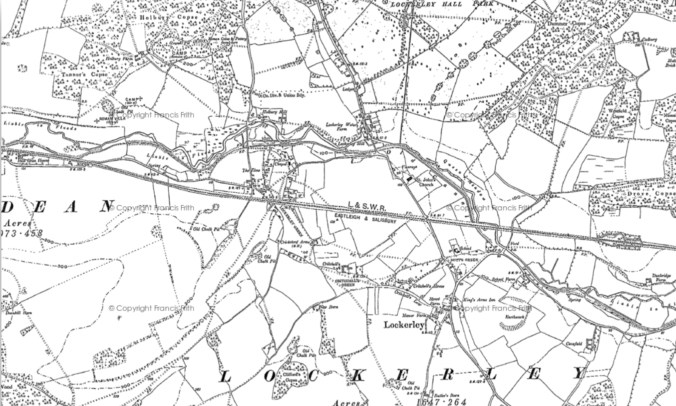
Lockerley is a village and civil parish in Hampshire, England, located on the southern bank of the River Dun, about two miles upstream from its junction with the River Test. The village is situated approximately 16 miles from Winchester, Salisbury, and Southampton, with Romsey, located around 8 km to the south-east, being the nearest town.
The history of Lockerley can be traced back to the medieval period, with evidence of its existence as early as the 12th century. In the Domesday Survey of 1086, Lockerley is recorded as a manor held by Hugh de Port. The village was part of the landholdings of Romsey Abbey, a significant influence in the area until the dissolution of monasteries during the 16th century. At the time of the Domesday Survey, the village consisted of one hide of ploughland, six acres of meadow, and woodland for three pigs. However, the ploughland was later absorbed into the King's forest by William I.
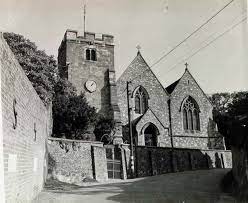
Architecturally, Lockerley is home to St. John the Evangelist Church, a building constructed in 1889–90 by architect J. Colson. The church is designed in a blend of Decorated and Perpendicular Gothic styles, featuring squared grey limestone with brown limestone dressings. The church includes a chancel with an outshot, a nave with transepts, and a southwest tower with a porch beneath. Inside, the church contains a marble reredos depicting the Last Supper, stained-glass windows, and a boarded roof with ribbed detailing. The church also boasts a stone pulpit, font in the Perpendicular style, and a carved screen in the north transept behind the organ.
In addition to the church, Lockerley is home to Lockerley Camp, an Iron Age hillfort located to the east of the village. This hillfort, covering approximately five acres, is a significant archaeological site, though much of it has been reduced by ploughing. A small area to the north remains within a coppice, where the earthworks are more discernible.
In the 19th century, Lockerley Hall was built by Frederick Dalgety, a wealthy merchant. The hall was used as a place to house soldiers during the First World War, and in the Second World War, it became a massive storehouse for the US Army in preparation for the Invasion of Europe. The site included 15 miles of sidings and 134 covered sheds.
Today, Lockerley is a vibrant community with a population of approximately 827 people. The village offers various amenities such as a shop, garage, and Lockerley C of E Primary School. It also has a Baptist chapel, and the Wessex Main Line railway crosses the parish with nearby stations at Dunbridge and West Dean.
The village is home to several local social groups and clubs, contributing to a strong sense of community. Among these groups are the Acorn Club, ArtSeen, Bell Ringers, Choir, Garden Club, Lockerley Silver Band, Women's Institute, and many others that provide opportunities for social engagement and cultural activities. These groups play a significant role in maintaining the active social life of the village.
While Lockerley is rich in history and community life, there are no widely documented myths or hauntings associated with the village. The absence of such stories may be attributed to the relatively modern development of the area and its continued use as a residential and agricultural community, which can sometimes prevent the development of folklore and ghostly legends.
Today, Lockerley continues to thrive, preserving its historical legacy while fostering a vibrant community life. The village is a reflection of rural England’s enduring spirit, with its mix of ancient heritage and modern growth shaping its identity.
On Sunday, the 18th day of May in the year 1766, spring drifted over Lockerley like a soft blessing, its warmth spreading gently across the Hampshire fields and hedgerows. The bells of St John’s Church rang with a mellow, unhurried music, each toll carrying through the budding branches as though calling all creation to witness a sacred beginning. In that sound, one could almost feel the pulse of village life, the footsteps hurrying along the lane, the hush of families entering through the low arched doorway, the flicker of candles readying the church for yet another soul to be welcomed into the fold.
The ancient stone of St John’s had known countless baptisms before this one, yet each brought its own quiet miracle. This morning, Moses and Hannah Luke stepped across the threshold with their newborn son swaddled carefully between them. The elder Moses, twenty-nine years old and weathered by honest labour, held the child close, his large hands instinctively protective. Little Moses’s fingers, impossibly small yet filled with determined life, curled around his father’s thumb as if anchoring himself to the world. Beside them, Hannah, twenty-seven and still tender from childbirth, wore a glow that seemed borrowed from the morning light itself. Her eyes lingered often on her infant son, as though memorising him anew each time she looked.
The church at Lockerley was alive with soft whispers and the rustle of Sunday garments. Sunlight slanted through leaded windows, scattering patterns of gold and blue across the pews. The scent of spring blossoms, hawthorn and early wild roses, drifted in through the open door, mingling with the faint aroma of beeswax and old timber. Curate J. Evans awaited them at the baptismal font, his cassock gently stirring in the draft from the nave. He greeted the family with a nod warmed by familiarity; the Lukes were no strangers to the parish register.
A baptism in 1766 was both humble and deeply reverent, woven from words and rituals that had shaped English faith for generations. The service often began with the gentle strains of a hymn, perhaps "All People That on Earth Do Dwell" or "The Lord My Shepherd Is," melodies carried by the untrained but earnest voices of villagers. Their singing filled the church with a rustic sweetness, rising to the rafters like a prayer made of breath rather than words.
Scripture readings followed, passages commonly drawn from the Gospels: “Suffer the little children to come unto me,” or the promise that each baptized child would be marked as Christ’s own forever. The curate’s voice moved steadily through the familiar cadence, its tone threaded with both duty and tenderness. Mothers in the pews felt their hearts stir; fathers straightened with quiet pride. Baptism was not merely tradition, it was hope, spoken aloud.
When the readings were done, Curate Evans motioned the Lukes forward. The font, carved stone worn smooth by generations of hands, held water that shimmered in the morning light. Hannah brushed a trembling thumb across her son’s cheek before passing him to his father. The elder Moses stepped forward, bowing his head as the curate began the solemn words of the rite, words that had not changed in centuries:
"I baptise thee in the name of the Father, and of the Son, and of the Holy Ghost."
The water touched the baby’s brow, glistening like a single jewel. A tiny gasp escaped him, followed by a soft cry, thin, insistent, and full of life. Hannah’s hands fluttered to her heart. The church seemed to hold its breath for a moment, the congregation leaning ever so slightly forward, as though drawn into the holiness of the act.
Curate Evans traced the sign of the cross upon the infant’s forehead, sealing him into the faith and into the pages of the parish’s long memory. Then, with careful strokes of his quill, he recorded the moment in the register:
Baptised. Moses son of Moses & Hannah Luke. May 18.
Ink met parchment, and a life took its place in history.
As the final prayer drifted through the nave, one asking that the child grow in virtue, courage, and steadfast grace, the elder Moses bowed his head. Though his lips did not move, a father’s prayer rose silently within him, shaped from hope, devotion, and the tender fear that accompanies all new beginnings.
Outside, the churchyard trees stirred gently as the family stepped into the sunlight. Leaves whispered overhead, as though heaven itself breathed a blessing upon the name of the child who would carry his father’s legacy, his mother’s love, and the Luke family’s story into the unfolding years.
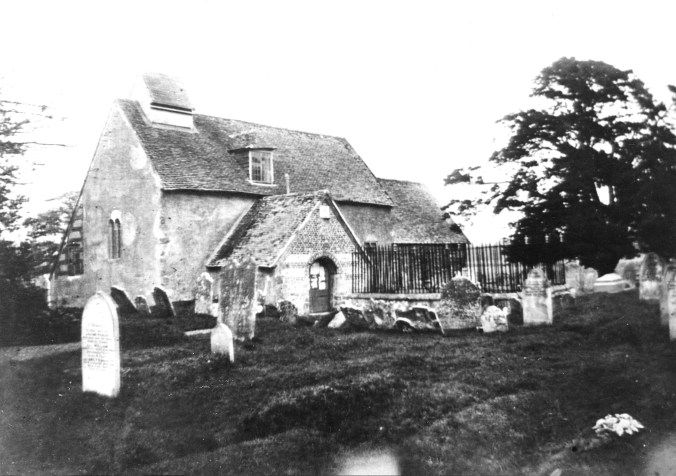
St. John’s Church in Lockerley, Hampshire, is a charming and historic church that has served the local community for centuries. Located in the heart of the picturesque village of Lockerley, which lies in the Test Valley, the church is an important part of the area’s history, culture, and spiritual life.
The history of St. John’s Church dates back to the medieval period, though the current structure reflects several stages of development over the centuries. The original church was likely built around the 12th century, though records from that time are sparse. The church’s dedication to St. John the Evangelist indicates its religious association with the Christian tradition, particularly with the apostle John, one of the most prominent figures in the New Testament. The church’s early history is tied to the broader religious and agricultural practices of the village, which has been a rural community for much of its existence.
Over the centuries, St. John’s Church was subject to several expansions and renovations. The original Norman structure would have been relatively simple, reflecting the needs of a small rural community. However, as Lockerley grew and developed, particularly during the medieval and post-medieval periods, the church was modified to accommodate a larger congregation and to reflect the changing architectural styles of the time. One of the most notable periods of change came in the 19th century, when the church was rebuilt in the Victorian era.
The current building of St. John’s Church was constructed in 1889–90 under the direction of the architect J. Colson, in a style that blends both Gothic and Perpendicular Gothic elements. This period saw significant growth in the Test Valley, and Lockerley, with its proximity to the town of Romsey, benefitted from an expanding population and increased prosperity. The design of the church reflects the period's architectural tastes, with soaring arches, intricate stained-glass windows, and the use of local materials that give the church a distinctive character.
St. John’s Church is a relatively large and impressive building for a rural village church. The structure features a chancel with an outshot, a nave with transepts, and a southwest tower that adds a sense of grandeur to the village’s skyline. The church’s stained-glass windows, depicting various scenes from the Bible, are particularly beautiful, and they provide a striking contrast to the stonework of the building. The wooden roof of the nave, designed with king-post trusses on arch-braces, is another notable feature of the interior, displaying the craftsmanship of the period.
Over the years, St. John’s Church has been at the center of life in Lockerley, hosting regular religious services, weddings, baptisms, and funerals. The churchyard is the final resting place for many of the village’s residents, with gravestones marking the passage of time and offering a sense of continuity to the village’s history. The church continues to play an important role in the spiritual life of the community, offering a space for worship, reflection, and prayer.
In addition to its role as a place of worship, St. John’s Church has also served as a venue for significant community events. The church is a place where people come together to mark important milestones, both religious and personal. Many of the village’s residents, both past and present, have been married, baptized, or buried in the church, giving it a special place in the collective memory of Lockerley.
The churchyard itself is a peaceful and tranquil space, with the graves of local families dotting the landscape. These graves serve as a reminder of the long history of Lockerley, and they provide a connection to the past. The churchyard is not only a site of historical importance but also a beautiful setting for reflection, surrounded by the natural beauty of the Hampshire countryside.
As for rumors of hauntings, like many historic churches, St. John’s has been the subject of local legends and ghost stories. However, there are no widely documented or substantiated paranormal occurrences associated with the church. Given the long history of the building and the village, it is not unusual for local folklore to suggest the presence of spirits or supernatural events. In many cases, such stories are passed down through generations, often becoming part of the cultural fabric of a place. While there may be occasional whispers or tales shared by the community about unexplained occurrences, there is no firm evidence to suggest that the church is haunted.
The forename Moses is one of the most ancient and enduring names in the world, with deep religious, linguistic, and historical significance. It is best known as the name of the great Hebrew prophet who, according to the Old Testament, led the Israelites out of slavery in Egypt and received the Ten Commandments on Mount Sinai. Because of this, the name Moses carries strong associations with leadership, faith, deliverance, and divine law.
The origin of the name Moses is complex and has been discussed for centuries by scholars. In Hebrew, the name is written as Moshe. The biblical account in the Book of Exodus explains that the name was given to the child by Pharaoh’s daughter, who said, “Because I drew him out of the water.” The Hebrew word “mashah” means “to draw out,” which provides a linguistic link to that explanation. However, many scholars believe the name actually has Egyptian roots. In ancient Egyptian, the element “-mose” or “-mes” means “born of” or “child of,” as seen in names like Thutmose (“born of Thoth”) or Ramesses (“born of Ra”). It is possible that the biblical story reinterpreted an originally Egyptian name in Hebrew terms to fit the narrative of Moses being drawn from the Nile.
Over time, the name Moses came to be venerated in Jewish, Christian, and Islamic traditions alike. In Judaism, Moses is regarded as the greatest of the prophets, the lawgiver who established the covenant between God and Israel. In Christianity, he is seen as a precursor to Christ, representing the Old Law that foreshadowed the New Covenant. In Islam, Musa is recognised as one of the most important prophets, mentioned more times in the Qur’an than any other. The name therefore carries reverence and moral authority across three major world religions.
As a given name, Moses became widely used among Jewish communities throughout history, especially as a mark of respect for the biblical figure. It was also adopted among Christians, particularly during the Reformation and Puritan periods, when biblical names became popular. In English-speaking countries, Moses appears in records from the medieval period onward. In early America, it was common among Puritan settlers, who admired Old Testament names for their spiritual strength and moral gravity. Among African American communities, the name took on additional resonance during and after slavery, symbolising freedom and deliverance, inspired by the biblical story of Moses leading his people out of bondage. Harriet Tubman, for example, was often called “Moses” because of her role in leading enslaved people to freedom through the Underground Railroad.
The name has appeared in many forms across languages and cultures. In Hebrew it is Moshe, in Arabic Musa, in Greek Mōysēs, and in Latin Moyses. The English form Moses derives from the Latin and Greek versions used in biblical translations. Variants include Moïse in French, Mose in Italian, and Moisés in Spanish and Portuguese. Diminutive or familiar forms are rare, as the name tends to be used with solemnity.
Moses has been borne by a number of notable figures beyond the biblical patriarch. In the Middle Ages, it was used by scholars and rabbis such as Moses Maimonides, the great Jewish philosopher and physician of the twelfth century. In the modern era, it has appeared among writers, leaders, and artists, including Moses Mendelssohn, the eighteenth-century German-Jewish thinker who helped lay the groundwork for Jewish Enlightenment, and the artist Grandma Moses, whose surname was adopted from her husband’s but contributed to the enduring cultural familiarity of the name.
In symbolic terms, Moses represents wisdom, endurance, and moral authority. He is seen as a liberator, teacher, and intermediary between humanity and the divine. Because of this, the name often conveys a sense of strength and purpose. Though less commonly given to children today than in past centuries, it remains a name of deep spiritual and historical weight, recognised and respected across many cultures and faiths.
The surname Luke in England comes from the personal name Luke, sometimes spelled Louke or Luck, which itself derives from the Latin name Lucas. The Latin form comes from the Greek Loukas, meaning “from Lucania,” a region in southern Italy, or is sometimes interpreted as “light-giving,” related to the Latin word lux, meaning “light.” In England, the surname developed as a patronymic, meaning “son of Luke” or “descendant of Luke.” Some records suggest alternative origins, such as the Middle English personal name Louke, which may have been a shortened form of Lovecok or derived from the Norman name Leu or Leue. In a few cases, it might have referred to someone who came from a place called Luik in Belgium, though that explanation is much less common.
The name began appearing as a hereditary surname during the medieval period, following the general English trend of forming surnames from given names. The personal name Luke was brought to England through Latin and French influence after the Norman Conquest. Historical records show the surname Luke appearing in England from the Middle Ages onward. One of the most notable early families lived in Bedfordshire, where Oliver Luke, born in 1574, served as a Member of Parliament and as High Sheriff of Bedfordshire. His son, Samuel Luke, born in 1603, was also an MP and took part in the English Civil War. Their prominence indicates that by the sixteenth and seventeenth centuries, the Luke family was well established in English society.
Today, the surname Luke is found throughout England, though it is not especially common. It ranks around 1,700th in frequency, with roughly one bearer in every twelve thousand people. Because the name originates from a given name rather than a single ancestral family, it likely developed independently in several parts of the country rather than spreading from one original Luke family.
Like many English surnames, Luke has been associated with a family crest and coat of arms, The Luke family crest, sometimes referred to as the Luke coat of arms, has appeared in several different forms depending on the branch of the family and the region in which it was recorded. Heraldry in England does not assign a single coat of arms to a surname as a whole, but rather to particular individuals and their descendants. Because the surname Luke arose independently in different parts of England and Scotland, several distinct versions of the Luke arms exist.
One of the best-known Luke crests shows a bull’s head with wings in its natural colour, the wings often shown in gold. This crest is associated with the motto “Strenuē insequor,” which means “I pursue vigorously.” The bull’s head is a traditional emblem of strength, courage, and endurance, while the wings suggest aspiration and swift action. Together with the motto, they convey energy, purpose, and determination. Another heraldic version, found in English records, is described as a silver shield with a horizontal band between six red rings. In heraldic symbolism, a ring or annulet represents fidelity and unity, while the horizontal band, known as a fesse, denotes readiness to serve in a military or civic capacity. A further version attributed to a Cornish branch of the Luke family depicts a red shield with a black upper section bearing three silver martlets, and a crest showing a scallop shell. The martlet is a small bird used in heraldry to symbolise continuous effort and a life of active pursuit, while the scallop shell often represents pilgrimage and perseverance.
Some depictions of Luke arms show a tree on a black and blue background. In heraldic colour meanings, black symbolises constancy and resolve, blue stands for loyalty and truth, and the tree represents enduring strength and a deep-rooted family lineage. These elements, though not common to all Luke arms, echo the broader sense of stability and steadfastness associated with the name.
The variations in these designs reflect how different members of the Luke family, over the centuries, were granted or adopted their own heraldic devices. Families from Bedfordshire, Cornwall, and other counties often had their arms recorded separately. For example, one prominent family of Bedfordshire descent, which included Oliver Luke and his son Samuel Luke, both Members of Parliament in the seventeenth century, bore their own distinctive arms. In Scotland, another line of the Luke family used arms that included a diagonal blue stripe with gold buckles and a hunting horn, together with a winged bull’s head as a crest.
When considering the Luke family crest today, it is important to remember that these arms were granted to particular individuals and not to everyone who bears the surname. Modern depictions found on commercial websites or souvenir items often combine or simplify different versions to create a “generic” Luke coat of arms, but historically there was never just one official crest for all Luke families. Anyone interested in the authentic heraldry of their own Luke ancestors would need to trace their lineage and consult official heraldic records such as those of the College of Arms in London.
The turn of the year from 1767 into 1768 brought with it a sorrow that settled quietly over the village of Lockerley, a sorrow that would leave its imprint upon the Luke family for years to come. In those final days of December or the first tender days of January, when frost clung to the bare hedgerows and chimneys carried thin trails of smoke into the still winter sky, Moses’s paternal grandmother, Elizabeth Luke, née Monday formally Robinson, slipped away from this world. No parish record tells us why she died, nor the precise day, nor even the walls that enclosed her last breaths, but it is almost certain that her passing took place in her own home, the place where she had lived, laughed, prayed, and raised her children.
History is silent on the details, but the heart fills in what the ink has forgotten. One can imagine her husband, John Luke, keeping vigil at her bedside, his weathered hands, accustomed to work, resting helplessly atop hers. Perhaps their grown daughter Elizabeth sat close, her breath unsteady, perhaps her sons John and Moses, stood in the doorway, quiet and still, the weight of impending loss pressing against their chest.
And young Moses, only a small boy then, would have been near enough to sense the shift in the air, even if he could not yet understand the meaning of death. Children feel sorrow long before they can name it, they hear the muffled sobs behind closed doors, they sense when a father holds them a little too tightly, or when a mother moves with a heaviness that was not there before.
There is an old English custom that when a loved one dies, a window is opened, just a crack, to allow the departing soul to slip gently into the waiting air. No record confirms that it was done for Elizabeth, but the imagination lingers tenderly on the thought of one of her children unlatching the window, the cold winter breeze drifting in as her spirit lifted quietly into the pale morning sky. It is a comforting picture, a soft mercy layered over the silence of facts.
What remains certain is this, her passing carved a hollow in the heart of her family. For the elder Moses, her son, the grief must have settled deep and sudden. The weight of it would have changed the rhythm of their home, the way he moved, the way he paused, the way his eyes drifted off in quiet moments. And little Moses, though far too young to grasp the permanence of loss, would have felt it all the same. Small children absorb grief like weather, they sense the storms in the adult world without knowing the source. He would have felt the tension in the air, the subdued voices, the tearful tenderness that replaced his father’s usual steadiness.
Elizabeth’s name remains in the parish burial register, and little more. Yet beyond those few strokes of quill, she lives on through those who descended from her, through the son who wept at her passing, through the grandson who unknowingly carried the rhythm of her blood, and through the generations that followed, each one touched by the echoes of a life that once warmed a home in Lockerley.
Her story, though dim in official record, shines quietly in the heart’s remembering. For in every life she helped shape, especially young Moses, who would journey through childhood with her memory hovering like a soft winter shadow, her legacy endures, tender as a whispered goodbye carried on a cold January breeze.
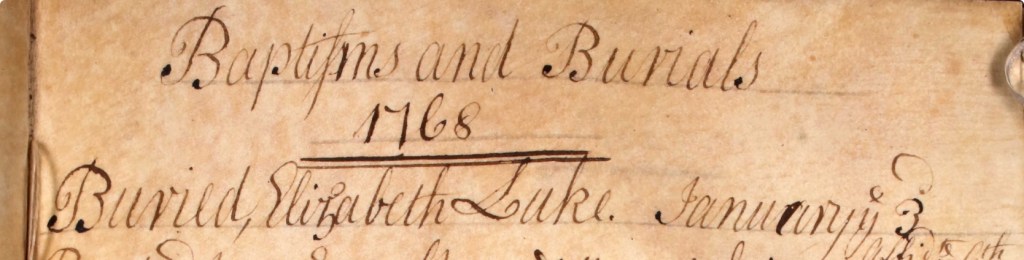
The cold, still Sunday of the 3rd day of January in the year 1768 dawned with a muted heaviness over the village of Lockerley, as though winter itself knew there was sorrow to be shouldered. Frost clung to the thatched roofs, the hedgerows sparkled with thin ice, and every breath that rose into the grey morning air drifted upward like a prayer, fragile, white, and fleeting. On that day, the parish clerk of St John’s Church opened the old baptism and burial book and added a single, unembellished line:
Buried, Elizabeth Luke. January ye 3rd.
Nothing more, no age, no dwelling place, no mention of the family who loved her. Just a name, set quietly among the faded ink of the new year. Yet while the record kept its silence, the hearts of her family carried the weight of an entire life.
Elizabeth Luke, née Robinson, the grandmother young Moses had barely come to know, had died only days before. She likely drew her last breath in her own home, where she had lived with her husband John, surrounded by familiar walls that had witnessed her joys, her work, her exhaustion, her faith. Whatever illness or sorrow took her, history does not say. But I imagine her passing as gentle, her family close, her husband John holding her hand, her daughter Elizabeth brushing her cheek, her sons John and Moses standing solemnly nearby, and little Moses, the grandson who shared her family name, feeling confusion ripple through the household like a cold draft creeping under the door.
In the days between her death and her burial, the Luke family home would have become a place of quiet reverence. According to custom, Elizabeth’s wooden coffin, simple, handmade, likely of elm or oak, would have rested in the main room of the cottage. Candles would have burned near her, their small flames trembling whenever the winter wind struck the shutters. Neighbours and kin would have come to pay their respects, standing around her in stillness, sharing murmured memories, perhaps touching her hand one last time. A window may have been opened for a moment after she died, a gentle superstition allowing her soul to slip into the waiting air. Whether this was done we cannot know, but one can easily imagine a family devoted enough to honour even the quietest rituals of farewell.
On the morning of her burial, the coffin was carried from the home by the hands of men who knew her well, most likely her sons, perhaps her husband if grief and age did not weaken him, and other male relatives or neighbours who bore her weight as though bearing the tenderness of her life itself. They walked the narrow village lane toward St John’s, boots crunching the frost-hardened earth, their breaths rising in misted unison. Behind them followed the family, John with eyes lowered, daughter Elizabeth clutching a handkerchief, son John solemn and pale, and Moses, the elder, walking with grief stiffening his shoulders. And somewhere among them was young Moses, perhaps lifted into someone’s arms, perhaps walking with a small hand held tightly in a larger one, sensing in the air a sorrow he could not yet name.
Inside St John’s, the old stone walls breathed cold. The church smelled faintly of damp wool coats, extinguished candles from the previous night, and the lingering sweetness of winter greenery left from Christmas. A burial service in 1768 was simple yet deeply reverent. A hymn might have been sung softly by the gathered villagers, perhaps “O God, Our Help in Ages Past” or “The Lord’s My Shepherd,” familiar melodies that rose gently into the rafters as though to soothe the grieving.
Curate John Evans read from the Book of Common Prayer, the words steady and solemn:
“I am the resurrection and the life…”
His voice echoed softly through the nave, brushing the cold air with the promise of comfort. Passages from Corinthians or the Psalms followed, chosen for their assurance that death was but a doorway, that the faithful would rise again. Kneeling heads bowed, and gloved hands tightened around handkerchiefs and coat hems.
Then the procession moved out into the churchyard, where the yew trees, ancient guardians of the dead, stood draped in winter stillness. The ground was hard, the earth resisting the spade, yet the grave had been prepared with care. The coffin was lowered with quiet reverence, ropes creaking softly, breath catching in the throats of those gathered.
The curate spoke the final blessing, his breath hanging in the air, and then came the soft thud of earth falling onto wood, the sound that carried the true, irrevocable weight of farewell. One by one, handfuls of soil were given back to the ground. It was custom, and comfort, and grief intertwined.
For young Moses, the moment was likely bewildering, perhaps frightening. But he would have felt the change in the air, the way his father clung to silence, the tremble in his mother’s voice, the heaviness that seemed to settle on the world. In the years to come, he may not have remembered the burial itself, but he would have grown up in the shadow of that early loss, shaped quietly by the grandmother he barely knew yet was forever bound to by the threads of blood and name.
And though Elizabeth’s life survives in history as only a single delicate line:
Buried, Elizabeth Luke. January ye 3rd.
Her true legacy lived on in the tear-filled eyes that watched her coffin descend, in the love that warmed her home, and in the grandson who would one day carry her story forward, even through the silence of the records that forgot her.
Moses’s sister, Susan Luke, entered the world in the autumn of 1768, before the twenty-sixth day of October, when the Hampshire countryside was wrapped in the fading golds and russets of the season. Her birth came to the modest village of Lockerley, where the earth was cooling after summer’s warmth and the hedgerows whispered with falling leaves. She was born to Moses Luke, then about thirty-one years old, and to Hannah, née Grey, about twenty-nine, whose home was already alive with the sounds of young children and the gentle rhythms of family life.
One can imagine the atmosphere on the day of her arrival: the fire crackling softly in the hearth, the windows clouded from the chill beyond, the scent of damp oak drifting in through the cottage door. Autumn births always carried a particular intimacy, for the world outside seemed to hush itself in respect, as though nature paused to welcome the fragile new life being rocked into existence by a mother’s steady arms.
It was on Wednesday, the 26th day of October 1768, that Susan was brought to the ancient stone embrace of St John’s Church to be baptised. That morning, Lockerley lay held beneath a thin veil of mist, the cool air standing still over the quiet fields. The church bells rang softly, deep, resonant notes that drifted across the damp grass and through the bare-limbed trees of the churchyard, calling the village to worship. Their sound was neither urgent nor loud; rather, it seemed to hum with the calm certainty of rituals long repeated.
Inside St John’s, the air smelled of cold stone, beeswax, and the faint sweetness of harvest flowers left near the chancel. Fallen leaves, carried in on the shoes of parishioners, whispered faintly as they dried on the flagstones. Sunlight pushed through the small, wavy glass of the windows, its rays landing in soft patches upon the pews and illuminating particles of dust that danced like tiny blessings in the air.
Moses and Hannah stood before the baptismal font, the same worn basin where each of their children had been welcomed into the faith. Their hearts carried the familiar swell of tenderness and quiet awe, yet each baptism had its own unique weight, its own delicate story. In Moses’s arms rested baby Susan, her face serene beneath the wavering candlelight, her breath a soft flutter against the linen folds that wrapped her.
Hannah stood close beneath her husband’s shoulder, her expression a mixture of calm devotion and deep maternal pride. Their eyes met briefly, just a moment, but one filled with all the hope and gratitude their hearts could hold. Together they stepped forward as Curate John Evans prepared to speak the sacred words.
Evans’s voice rose gently through the nave, steady and sure, carrying the ancient promises spoken over countless infants before her. The clear water in the font shimmered under the flickering glow, reflecting the tiny face of the child who now leaned toward her father’s warmth. When the curate touched the cool water to Susan’s brow, the moment seemed suspended, quiet, holy, and full of promise.
Then came the words that would live in the parish register long after the voices in that church had faded:
Bapt. Susan daugtr. of Moses & Hannah Luke. Octr. 26.
As the ceremony came to its gentle end, the elder Moses bowed his head. No one could hear the prayer that rose silently within him, but his heart spoke clearly enough, asking that his little daughter grow with strength, faith, and steady grace; that the world might be kind to her; and that she always feel the love that had wrapped around her from the very first moment of her life in their small Lockerley home.
Outside, the churchyard’s trees stirred in the crisp autumn breeze, scattering leaves like soft, rustling confetti. It felt as though the season itself had offered its blessing, sending the Luke family home with their newest child cradled safely against the rhythm of her father’s heart.
In the spring of 1769, when the earth was stirring once more after its long winter sleep and the first shy blossoms began to lift their faces toward the warming sun, sorrow crept quietly into the Luke household. It was during this tender season of renewal, when Lockerley’s hedgerows blushed green and skylarks trembled high in the pale blue sky, that Moses’s father, also named Moses Luke, died. The parish records leave the details hushed and incomplete, no cause of death, no mention of the hour, no hint of the room in which he breathed his last. Yet what the ink does not tell, the heart tries gently to imagine.
He likely passed away in the very cottage where he had lived and loved, a place warmed by the laughter of his children and the steady devotion of his wife. Perhaps it was early morning when his final strength slipped from him, sunlight falling in long golden strips across the floor, the scent of damp earth drifting in from the garden, birds calling softly beyond the shutters. In that small, familiar room, the rhythm of the world must have slowed.
I like to believe that his beloved wife Hannah was with him, her hand wrapped around his, her thumb tracing small circles over his skin as if reminding him of every joy they had shared. Maybe she whispered memories of their courtship, of their wedding day, of each child they had welcomed into the world. She may have spoken their names, Ann, Elizabeth, Sarah, Moses, and tiny Susan, each one a prayer, each one a piece of the legacy he would leave behind.
At just three years old, young Moses could not have understood the shape of death, but children sense heartbreak the way they sense a coming storm, in the way adults fall silent, in the way their mother’s eyes shine with unshed tears, in the way familiar routines soften into something strange. There must have been a moment, brief, mysterious, when he felt a sudden shift in the air of their home, a quietness settling like dust, a stillness that did not belong to spring.
His father’s absence would echo softly through his earliest memories, a hollow he might not yet have been able to describe, but one that shaped him all the same. And as the world outside blossomed into life once more, the Luke family stepped into their season of grief, carrying with them the love of a husband and father whose name would live on through the small boy who bore it.
This was the spring when the earth awakened, yet a light in the Luke household dimmed, leaving behind a story of love, loss, and resilience that would follow Moses throughout the rest of his days.
In the spring of 1769, when tender shoots pushed their way through the thawing Hampshire soil and the hedgerows shimmered with early green, the village of Lockerley carried a sorrow that no season could soften. For it was that spring, gentle, fragrant, and full of promise, that Moses, only three years old, lost his father.
By the time the sun rose on Sunday the 14th day of May, the Luke family was preparing for the final rite of farewell.
Inside the home, Moses’s father Moses’s coffin had rested since the day of his passing, a plain wooden box crafted by local hands, simple as the man himself. Its raw boards carried the scent of fresh-cut timber, and the candles burning beside it cast long, wavering shadows that seemed reluctant to leave him in darkness. Through the nights, Hannah sat near him, her hand resting upon the lid where his heart once beat, speaking softly into the stillness as though her words might follow him into whichever world awaited beyond.
Villagers came quietly to the door, stepping inside with lowered eyes. They brought casseroles of broth, warm bread wrapped in cloth, and murmured prayers spoken in soft rural accents. They stood for a moment beside the coffin, men who had worked with him, women who had shared laughter with Hannah at the market, children who had called him “Mister Luke.” In Lockerley, grief belonged to everyone.
And then the morning of the burial arrived.
Four village men, strong, solemn, and humbled by the task, lifted the coffin onto their shoulders. They stepped through the doorway of the Luke cottage, moving into the pale May light where the world waited in silence. Their boots pressed into the damp earth, leaving slow marks behind them as they made the familiar walk along the narrow lane toward St John’s Church.
Behind them walked Hannah, her shawl pulled close, her steps steady despite the weight of grief. Her children clustered around her, each one sensing the strangeness of the day: Ann and Elizabeth walking hand in hand, Sarah holding tightly to her mother’s skirt, Susan barely a toddler, and little Moses, with wide eyes and a thudding heart, walking among them.
The bells of St John’s tolled low and mournful as the procession approached, their sound drifting across the churchyard and collecting gently among the ancient yew trees, trees that had watched over generations of Lockerley’s dead. The church itself, built of weathered stone and lit by narrow windows, seemed to draw its breath in as the family entered.
Burials in 1769 were simple yet deeply reverent. Congregational hymns were rarely sung at funerals then, but the curate’s voice rose with solemn clarity, filling the nave with the sacred, familiar words of the Book of Common Prayer:
“I am the resurrection and the life…”
“In the midst of life we are in death…”
These phrases, echoed so many times within those same walls, drifted upward toward the wooden rafters, mingling with the faint scent of lilies left from Easter and the cool breath of the church’s ancient stones. Some villagers whispered verses from memory, Psalm 23 most of all, that gentle promise of green pastures and still waters fitting for a man who had lived so close to the soil:
“The Lord is my shepherd; I shall not want.”
When the service ended, the congregation flowed out into the churchyard, gathering around the open grave beneath the sheltering yews. The earth piled beside it was dark and cold, smelling of roots and rain. Overhead, the clouds moved slowly, as if even the sky felt compelled to witness the moment.
Curate Evans spoke the final, unwavering words:
“Earth to earth, ashes to ashes, dust to dust.”
The ropes creaked softly as the coffin was lowered, and Hannah clutched her shawl tighter around her trembling frame. The first clod of earth fell with a hollow thud, heavy, final. Though she flinched at the sound, she did not turn away. Her children, gathered close, pressed against her for warmth and comfort, their small faces pale with confusion and fear.
Each handful of earth tossed into the grave was a farewell, a blessing, and a wound. Moses had lived his life upon the land, and now the land received him gently back.
Later, after the grave had been filled and smoothed, after the villagers had drifted away in small murmuring groups, after Hannah had taken her children by the hand and returned to the quiet cottage that now felt unbearably empty, Curate Evans dipped his quill into ink and recorded the burial with careful, steady strokes:
“Buried Moses Luke. May ye 14th, affidavit ye 20th.”
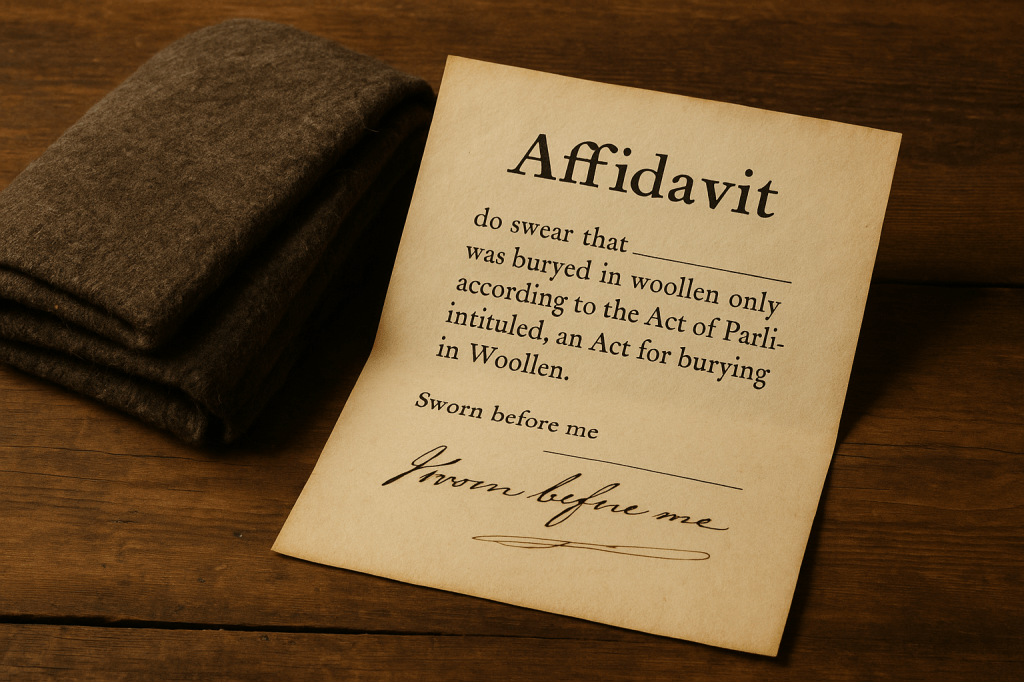
The affidavit, sworn on Saturday the 20th, confirmed that Moses had been buried in a shroud of pure English wool, a requirement of the time, born of both national pride and tradition, a soft final garment for a man who had lived humbly, honestly, and close to the earth.
That evening, as the sun sank behind the rolling Hampshire fields, the churchyard yews whispered in the wind, their long shadows falling across the fresh mound of earth. Lockerley seemed to sigh, a soft farewell carried on the late-spring breeze.
And though the parish register preserved only his name and dates, the true memory of Moses Luke lingered elsewhere, in the grieving heart of his wife, in the bewildered eyes of his young son, in the fields he had walked, and in the quiet love he left behind, woven forever into the fabric of their small, enduring world.
The practice of being buried in a woollen wrap accompanied by an affidavit in England began in the seventeenth century and lasted for more than a hundred years. It was not a religious or superstitious custom but a legal and economic one, created by Parliament to support the English wool trade, which was a cornerstone of the national economy.
In 1666, during the reign of King Charles II, the government passed what was known as the Burial in Woollen Act, officially titled An Act for Burying in Woollen Only. The purpose of the act was to protect and promote the English wool industry at a time when imported linen, particularly from France and the Low Countries, had become fashionable and was threatening local production. By law, every person who died in England and Wales was to be buried in a shroud made entirely of wool. No other fabric such as linen, cotton, or silk could be used for the winding sheet, the shroud, or the coffin lining.
To ensure that the law was observed, the act required that a formal affidavit be made after every burial. This affidavit was a sworn statement, made before a magistrate, a justice of the peace, or a clergyman, confirming that the deceased had indeed been buried in a woollen shroud. The person who made the affidavit was usually a close relative, neighbour, or friend of the deceased. The affidavit had to be sworn within eight days of the burial, and a note of it was entered into the parish burial register.
Typical entries in these registers might read “Buried in woollen according to the Act,” or “Affidavit made by John Smith.” Sometimes the register would note if the act was not observed, recording “Not buried in woollen, fine paid,” showing that some families chose to ignore the law, especially among the wealthy, who could afford the penalty. The fine for failing to comply was £5, which was a considerable sum in the seventeenth century. Half of the fine went to the parish poor, and the other half went to the informer who reported the offence.
The act was renewed several times, notably in 1678 and 1680, to strengthen enforcement and prevent avoidance. These later versions required ministers to keep proper records of the affidavits and make them available for inspection. Each affidavit was to be signed, witnessed, and kept with the parish documents. The cloth used for the shroud had to be of English manufacture, free from any foreign threads or materials. This level of regulation shows how seriously the government took the protection of the domestic wool industry, which employed thousands of people across the country.
The woollen shrouds themselves were usually plain and undyed, though some families commissioned specially woven cloth for the purpose. In poorer households, old blankets or other woollen goods might be used. The shroud was often a simple length of woollen cloth wrapped around the body and tied with woollen cords. For the poorest, who were buried without coffins, it served as both garment and winding sheet. For those who could afford coffins, even the lining inside was required to be woollen.
This practice of burial in woollen continued well into the eighteenth century. Parish registers across England from 1678 to around 1814 contain frequent references to woollen burials and affidavits. It became a routine part of funeral procedure: after the burial, a relative or witness would appear before a magistrate, swear the affidavit, and the minister would record the fact in the register.
Over time, however, enforcement of the law weakened. By the late eighteenth century, fashions had changed, and the social stigma attached to woollen burial among the gentry and clergy meant that many quietly ignored the rule. In some places, communities turned a blind eye, and in others, fines were simply paid. The industrial revolution also transformed the textile industry, making the old mercantile protection of wool less relevant. Eventually, the Burial in Woollen Acts were repealed in 1814, ending one of the more curious laws in English social history.
For historians and genealogists, the affidavit entries that survive in parish records are now a valuable source of information. They provide confirmation of burials and often include the names of witnesses or relatives who swore the statement. In some cases, they reveal the occupations or social relationships of people who might otherwise have left no written trace. The phrase “affidavit made” or “buried in woollen” found in old registers is a direct reminder of this unusual law.
The Burial in Woollen Acts offer an intriguing glimpse into everyday life in post-Restoration England, showing how national economic policy extended even to the rituals of death and burial. They demonstrate the government’s determination to support home industries, the reach of parish authority into private life, and the way ordinary people had to adapt to laws that blended commerce, conscience, and custom. Though the idea of swearing an affidavit for a woollen burial seems strange to us now, for over a century it was a familiar part of English parish life, recorded faithfully in church registers up and down the country, from the humblest village to the grandest town.
Thursday, the 21st day of October in the year 1773 dawned with a muted autumn glow over the Hampshire village of Lockerley. The air held that familiar October hush, a stillness that seemed to gather itself between the reddening leaves and the pale sky, as if nature were pausing to witness a quiet turning in the life of the Luke family. Young Moses, no more than six or seven, stood inside St John’s Church with his hands folded tightly before him, his eyes wide with a child’s uncertain wonder. He had buried a father in this churchyard only four years earlier, the stones and shadows of the place still whispered memories of grief. Yet today, St John’s was dressed not in mourning but in the soft, hopeful tones of a wedding.
His mother, Hannah Luke, stood near the chancel beneath the old timbered roof, her heart beating with a mix of sorrow and courage. She had carried widowhood with dignity, whispering stories of Moses’s father on winter evenings, keeping his memory alive with tender persistence. But widowhood was a heavy cloak in rural England, and life, with its many demands and its quiet insistence on survival, had gently urged her toward a new path.
Beside her stood William Arter, a man of the parish of Sherfield English, steady and respectful as he prepared to enter a union that bound not only two hearts, but two lives with all their shadows and hopes. Moses studied him with guarded curiosity. William was neither replacement nor intrusion, simply a man who had stepped into their story at a time when stability was hard-won.
St John’s Church that day bore little resemblance to the one Moses remembered from funerals. The air was filled with the rustle of better garments, the soft sweep of woolen gowns, the muted creak of leather shoes polished for the occasion. Hannah wore her best dress, likely a gown of sturdy homespun wool in muted tones of brown or blue, her hair pinned beneath a simple linen cap. Weddings in rural Hampshire were not lavish affairs, but they carried their own quiet beauty, a clean apron, a freshly brushed coat, a sprig of late autumn greenery tucked into the seams of a bonnet.
William, too, would have worn his best, breeches pressed as neatly as work allowed, stockings without holes, and a waistcoat reserved for Sundays and holy days. There were no wedding rings exchanged in the Anglican tradition of the time, no elaborate flowers or music. Yet the solemnity of the moment lent the church a glow richer than any decoration.
The wedding began with the familiar cadence of the Book of Common Prayer, its phrases as ancient as the stones beneath their feet. Curate William Richardson, his voice steady and resonant, read the final call of the banns, affirming that no lawful impediment stood between the couple. His words rose into the rafters, mingling with the faint smell of damp wool and extinguished candles:
“Dearly beloved, we are gathered here in the sight of God…”
Popular passages for weddings in that era included readings from Corinthians “Charity suffereth long, and is kind” and Psalms that spoke of steadfastness and shelter. Though hymns were not typically sung in church weddings then, the congregation may have hummed familiar melodies under their breath, the old tunes that carried through their lives like gentle companions. And the curate’s prayers, spoken with deliberate earnestness, evoked blessings for a life of unity, patience, and shared burdens.
As the vows were spoken, Moses watched his mother closely. He saw the slight tremor in her hands, the way she lifted her chin with quiet resolve, the way she gazed ahead, not forgetting her past, but stepping bravely into a future that demanded hope.
When the moment came for signatures, both bride and groom pressed their marks, simple X’s, beside their names, symbols of their lives etched into the parish register. Their witnesses, Richard Stile and Sarah Blake, stood beside them, offering the silent support of community.
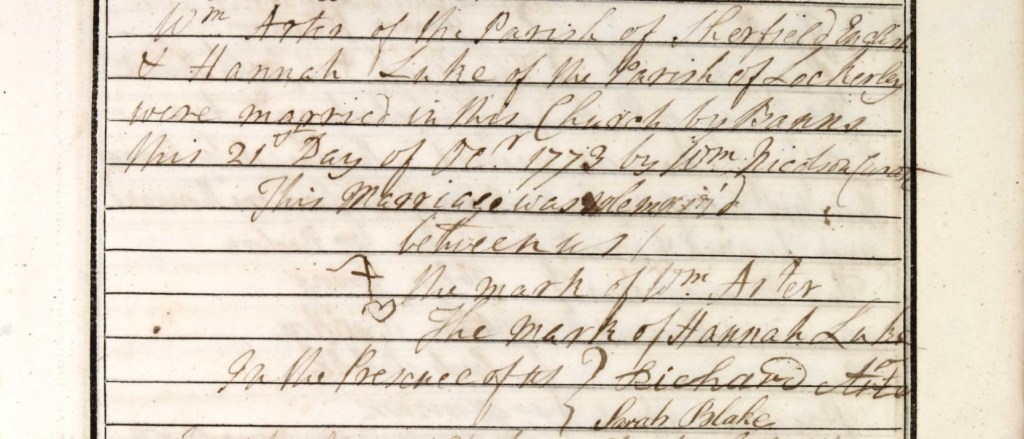
The parish record captured the moment in ink that would outlast them all: Wm Arter of the Parish of Sherfield English & Hannah Luke of the Parish of Lockerley were married in this Church by Banns this 21st Day of Octr 1773 by Wm Richardson Curate.
This Marriage was solemnized between us
The mark X of Wm Arter
The mark X of Hannah Luke
In the Presence of
Richard Stile
Sarah Blake.
Moses did not fully comprehend the weight of marriage. Yet as the quill scratched softly against the parchment, he felt the shift in his small world, a gentle, inevitable turning of the wheel of life. October light filtered through the narrow windows, soft and golden, falling across the stone floor like a quiet blessing.
When the ceremony ended, the newly married couple stepped out into the crisp autumn air, and Moses slipped his hand into his mother’s instinctively. The churchyard seemed to glow beneath the fading afternoon sun, the gravestones casting long shadows that stretched toward them as if acknowledging both the memory of his father and the promise of what lay ahead.
For in that moment, the little boy understood one thing as clearly as the hand he held, life was changing, yes, but he and his mother would face whatever came next together, their bond unbroken, their hearts entwined in both the ache of the past and the hope of the future.
On Friday, the 5th day of January in the year 1781, the quiet market town of Romsey lay wrapped in the soft austerity of winter. Frost traced delicate lacework across the rooftops, and a pale sun lingered low in the sky, casting long, silvery shadows through the narrow streets. The bells of the parish church began to ring, slow, steady notes that shimmered through the crisp morning air and called the town to witness a moment of gentle promise.
Inside the ancient church, whose stones had stood for centuries and seen countless vows spoken beneath their vaulted arches, Moses’s sister, Ann Luke, now twenty years old, stood at the altar. The air inside was cool, scented faintly with old wood and the lingering evergreen boughs left from Christmas celebrations. Candles flickered softly along the chancel, their light catching the golden threads of dust drifting in the stillness.
Ann wore no extravagant gown, just a simple dress of her best wool, perhaps a ribbon in her hair, and an apron she had smoothed countless times with her nervous hands. Yet there was a quiet grace about her, the natural beauty of a young woman stepping with courage into the next chapter of her life. Raised in Lockerley, shaped by seasons of joy and sorrow, she had watched her siblings grow, had weathered the loss of their father, and had helped her mother as best she could. Now, she stood ready to weave her own story.
Beside her stood Robert Weeks, the man she had chosen, or perhaps the man life had gently guided her toward. He too was plainly dressed, his hair tied back neatly, his boots brushed for the occasion. Their hands trembled when they reached for each other, but their eyes spoke steady reassurance.
The wedding service followed the beloved rhythms of the Book of Common Prayer, words as familiar to the congregation as the rise and fall of the seasons:
Dearly beloved, we are gathered together here in the sight of God…
Prayers were spoken for their union, for patience, for comfort in adversity, and joy in companionship. Though hymns were rarely sung in parish weddings of this time, the quiet murmur of whispered devotion filled the air, as some parishioners mouthed their favourite psalms, especially Psalm 128, traditionally associated with marriage.
Ann listened with a heart full of quiet anticipation. She had known duty, responsibility, and grief far earlier than most young women. Yet here, beneath these ancient rafters, she felt something warm and certain rising within her: hope.
When it came time to sign the parish register, the rector dipped his quill, the feather trembling gently in his hand before touching the page. With careful strokes he wrote:
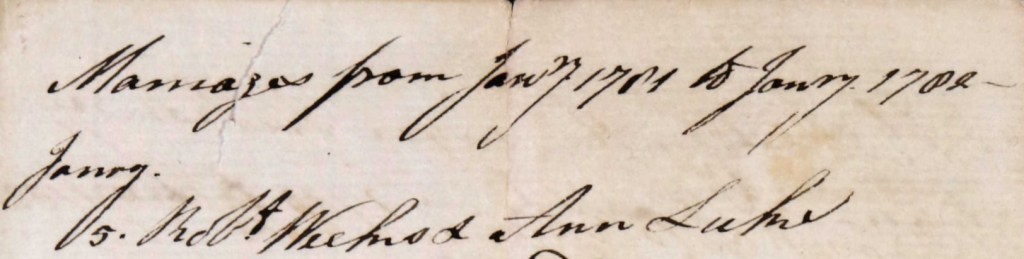
Marriages from Janry 1781 to Janry 1782.
Janry 5. Robt. Weeks & Ann Luke.
As the ink soaked into the parchment, Ann’s life changed, not with the sweep of a grand gesture, but with the quiet permanence of her name joining Robert’s in both church and memory. On that crisp January morning, she stepped away from the familiar hearth of Lockerley and into the shared path that awaited her.
Somewhere in the pews, her younger brother Moses, now a boy of about fifteen, watched tenderly as his sister wed and felt both pride and a tender ache. Another sibling stepping into adulthood. Another shift in the world he knew. Yet he would carry her name in his heart just as she carried his in hers, the Luke children always bound together, even as life called them down different roads.
As Ann left the church hand in hand with her new husband, the bells began to ring again, their sound bright and hopeful, echoing across the frosted rooftops of Romsey. And in that clear winter light, Ann Weeks took her first steps into a future shaped by faith, courage, and love, her story forever entwined with the man who walked beside her.
Monday, the 21st day of July in the year 1783 dawned warm and sweet over the waters and woodlands of Eling. Summer drifted lazily across Hampshire, dragonflies skimming the river’s edge, bees humming in the wildflowers that bordered the lanes, and in the gentle heat of the morning, the churchyard of St Mary’s glowed beneath the sun. Its ancient stones held centuries of whispered vows and soft-footed farewells, but on this day, they awaited a new beginning.
Among the villagers gathering beneath the spreading branches of the churchyard yews stood Moses, his heart full in a way he struggled to put into words. He watched as his younger sister Sarah, once the little girl who clutched his sleeve and followed him like a shadow, now walked toward the church door with the calm certainty of a bride. He remembered her first laugh, bright and bubbling, her small hand slipping into his when storms frightened her, her fierce loyalty, her tenderness, the way she found beauty in even the smallest of things. And now, seeing her poised at the threshold of St Mary’s, Moses felt both the bittersweet ache of letting go and the swelling pride of a brother witnessing his sister choose her own life.
Sarah wore her best gown, simple, likely hand-stitched by her mother or sisters, made of homespun wool or linen softened by years of washing. Over it she may have draped a white kerchief or a borrowed lace cap, the kind of quiet embellishment rural brides treasured. Her cheeks were flushed not with worry, but with gentle anticipation. Beside her stood Robert Morris, steady and sincere, a man of the same parish, familiar to all who lived within the reach of the church bells.
Inside, the church was cool and dim, the stone floor breathing out centuries of summer heat stored within its walls. Light filtered through the small leaded windows in softened gold, settling on the pews like dust from heaven itself. The faint scent of old timber and lingering incense drifted through the nave. A hush fell as Curate George Willis stepped forward, his voice carrying the calm authority of one accustomed to binding lives together.
He opened the parish register and, with careful strokes of ink, recorded the words that would outlast them all:
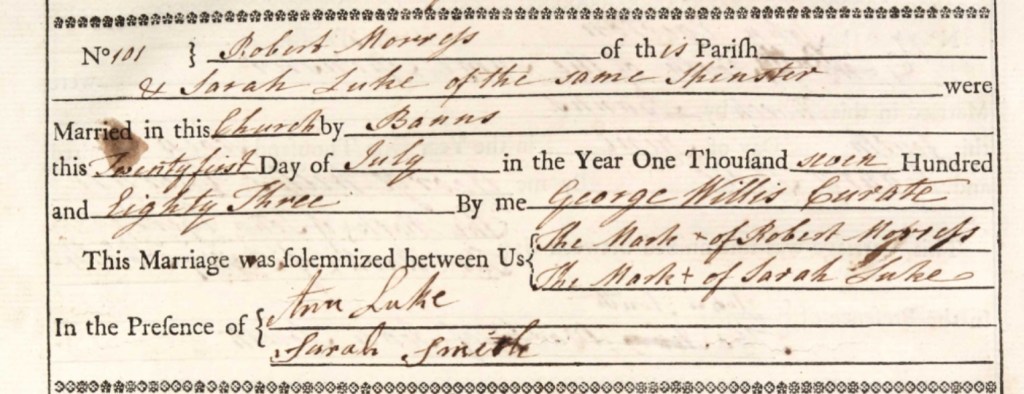
No 101.
Robert Morris of this Parish & Sarah Luke of the same Spinster were Married in this Church by Banns this Twenty first Day of July in the Year One Thousand seven Hundred and Eighty Three By me George Willis Curate.
This Marriage was solemnized between us

The Mark X of Robert Morris

The Mark + of Sarah Luke.

In the Presence of

Ann Luke,

Sarah Smith.
Moses watched as Sarah leaned forward to make her mark, a small cross, drawn with unwavering hand, her way of writing herself into the story of her new life. That single stroke of ink held so much: the hardships she had lived through, the strength she had learned from their mother, the tenderness she carried from childhood, and the hope she now offered to her future.
The wedding service unfolded with the familiar rhythm of the Book of Common Prayer, words spoken in countless English churches before this one. Curate Willis’s voice rose and fell in gentle cadence:
“Dearly beloved, we are gathered together here…”
“For better for worse, for richer for poorer…”
Though parish weddings rarely included congregational hymns, the gathered villagers whispered psalms under their breath, perhaps Psalm 67 or Psalm 128, verses that echoed the promises of fruitfulness, steadfastness, and divine blessing. Sarah and Robert exchanged vows with quiet sincerity, their voices soft but certain beneath the vaulted ceiling.
When the final Amen crossed the curate’s lips, they turned and walked down the aisle together, sunlight spilling across the stone floor ahead of them. Sarah’s steps were light, almost floating, and for Moses, it was as if he glimpsed her soul glowing through the moment, full of certainty, full of joy.
He followed her out into the bright summer air, where the bells of St Mary’s rang with warm exuberance. Their sound rippled across the churchyard, carrying through the trees and into the open fields beyond. A soft breeze stirred the grass, as if all of Eling breathed out a blessing.
For Moses, watching his sister step into her new life stirred a tenderness he would hold for the rest of his days. He mourned the little girl she once was even as he celebrated the woman she had become. And as the sunlight wrapped itself around them, he felt a truth settle quietly in his heart, that love, between siblings, between husband and wife, between families scattered across Hampshire’s gentle hills, was the thread that would bind them, even as time pulled them into different directions.
Sarah Morris walked away from the church that day with Robert’s hand in hers.
But Moses walked away with her joy in his heart, and the comforting certainty that the Luke family, however changed, remained forever stitched together by devotion, memory, and love.
St Mary’s Church, Eling, stands on a rise known as Eling Hill overlooking the marshes, tide mill and the water of the Solent-Test estuary in Hampshire. The origins of the church are ancient: it is believed to date back to Saxon times, the original building being timber-constructed, later replaced by stone in the Norman period. It is often described as one of the ten oldest church sites in England.
The present church fabric shows multiple phases. The nave and chancel date from the late 11th or early 12th century. The north aisle and tower were added in the 14th and 15th centuries. Much of the visible exterior, however, reflects a major restoration in 1863-65 by the architect Benjamin Ferrey, meaning that aside from the tower and north aisle the look is very Victorian. The church is listed Grade II* for its architectural and historic interest.
Inside, some remarkable survivors of the early periods remain. A small Norman window and a simple stone arch hint at Saxon or early Norman origins. On one wall a memorial honours parishioners who lost their lives in the sinking of the Titanic, reflecting the local connection with maritime activities. The churchyard and church setting are elevated and commanding, providing broad views over the surrounding landscape, with Eling Tide Mill close by and the marshes below, giving the site both visual prominence and a sense of being part of both land and water.
Eling has a long history as a settlement associated with maritime and industrial work: the tide mill near the church is among the few working tide mills in the country and has been recorded since the Domesday Book of 1086 (though the current mill structure is later). The church would have served generations of mill‐workers, shipbuilders, toll-bridge keepers and marshland farmers in its community. The arcades and architectural details reflect a parish church that has grown and adapted through centuries of change. The interior contains monuments, tombs, and fittings that record the local families and their lives through the medieval, early modern and modern eras.
As for ghost stories or hauntings, there are no well-documented tales of apparitions specific to the church that have become widely circulated. The church’s age, isolated hilltop position, ancient stones and churchyard may contribute to a quietly evocative atmosphere, and some visitors remark on a reflective, slightly other-worldly calm especially at dusk. Because the setting overlooks marshes and water, and because the landscape has long been tied to tides and labour, there is a subtle sense of history pressing in, which sometimes feels like a ghost of a past way of life rather than a specific ghostly figure.
Today the church remains an active parish in the Diocese of Winchester, part of the parish of Marchwood and Eling, continuing to serve the local community while also attracting visitors interested in its age, architecture and setting. Its combination of Saxon origin, Norman fabric, Victorian restoration, historic memorials and setting beside a working tide mill gives it a rich tapestry of English local history, linking church, industry, landscape and community across the centuries.
Monday, the 16th day of January in the year 1786 dawned cold and breathless over the village of Lockerley. Winter’s hush lay across the Hampshire fields like a pale blanket, the hedgerows rimed with frost, the ponds stiffened into quiet glass. Smoke curled from cottage chimneys in slow grey spirals, rising into the white morning sky. Yet beneath the chill, a soft warmth stirred, one born not of weather, but of hope.
At St John’s Church, its stone walls darkened by centuries of rain and prayer, the bells began to toll their gentle summons. Their sound drifted across the frozen earth, inviting villagers to gather for a moment of quiet joy. Within the sanctuary, the air was cool but alive with the soft glow of candles set along the chancel, their light fluttering against the old timbers overhead. A faint scent of wax mingled with the cold breath of winter slipping in each time the door creaked open.
Here, before the familiar altar, stood Elizabeth Luke, twenty-two years old, Moses’s sister, a spinster of the parish. She wore her best gown, likely wool, sturdy but softened by years of careful washing, and a clean white cap tied neatly under her chin. The fabric may not have been fine, but it held dignity, its threads woven with the quiet pride of a woman who had weathered hardship and was now ready to step into the future with steady grace.
Her hands trembled slightly as she clasped them together. Yet her eyes held a gentle resolve. Standing beside her was John Finch, a bachelor of Lockerley, dressed in his Sunday coat, the lines of honest labour still visible in his posture. Though neither of them possessed great wealth or grandeur, their union carried the strength of shared community and simple devotion.
The rector, Robert John, opened the worn pages of the register and spoke with solemn clarity. His voice, steady, measured, warmed by long years of service, carried through the ancient nave as he read the banns for the final time. The words echoed softly between the stone arches, mingling with the faint rustle of winter shawls and the quiet breath of those gathered.
When the vows were spoken, they followed the familiar cadence of the Book of Common Prayer, each phrase a thread in the ancient tapestry of English marriage:
“To have and to hold…
In sickness and in health…
Till death us do part.”
Elizabeth’s cheeks flushed with warmth despite the winter air. She had known sorrow, she had endured the loss of her father, the shifting shape of family life, the years of responsibility carried alongside her mother and siblings. Yet today, she stepped forward with a heart that dared to hope again.
When the moment came to sign the register, Rector John dipped the quill into dark ink and held it out to John Finch, who pressed his mark, a simple X, beside his name. Then he offered it to Elizabeth.
Her hand trembled, not from fear but from the gravity of the moment. The quill was unfamiliar, the gesture heavy with meaning. With humble grace she pressed her name in full, her script uneven yet earnest:
Elizabeth Luke.
It was a rare moment of quiet pride, her own name written by her own hand, marking her place in the parish’s long story.
The entry was completed with the presence of two witnesses:
the mark X of Joseph Kemish
and Robert Tubb.
The moment was recorded faithfully in the parish register:
John Finch, Bachelor, and Elizabeth Luke, Spinster, both of this Parish, were married in this Chapel by Banns this sixteenth day of January in the year of our Lord one thousand seven hundred and eighty-six. By me Robt. John, Rector.
This marriage was solemnized between us,
the mark X of John Finch,
Elizabeth Luke.
In the presence of the mark X of
Joseph Kemish,
Robert Tubb.
As the ink glistened and then slowly dried upon the page, Elizabeth lifted her eyes toward her new husband. A faint smile, small, hesitant, but radiant, touched her lips. It was the kind of smile that blooms only in moments of deep certainty, when the heart glimpses the life waiting just beyond the church doors.
Outside, the cold January sunlight lay pale across the gravestones, but inside, warmth swelled gently in the space between bride and groom. And behind them, perhaps standing at the back or just outside the doorway, Moses watched his sister with quiet admiration. Another sibling stepping bravely into adulthood. Another soul finding companionship in a world sometimes too hard to face alone.
When Elizabeth and John walked out of St John’s as husband and wife, the crisp winter air met them like a blessing. Their footprints pressed together into the frosted ground, two paths merging into one. And Moses, following behind, felt both the bittersweet tug of change and the soft reassurance that love, steady, humble, and enduring, would always bind the Luke family to one another, no matter where life carried them.
Thursday, the 21st day of January in the year 1790 dawned beneath a veil of winter mist, the kind that softened every edge of the Hampshire landscape and made the world feel suspended in a tender, breathless quiet. The village of Mottisfont lay hushed beneath the pallor of midwinter, its thatched roofs dusted with frost, its hedgerows silvered beneath the pale morning light. From the tower of St Andrew’s Church, the bells began to ring, slow, measured notes that drifted across the fields, calling the parish to witness a moment both humble and profound.
Within the old stone walls of the church, warmed only by the soft flutter of candlelight and the presence of gathered hearts, twenty-three-year-old Moses stood before the altar. The winter cold clung to his coat, but inside, something gentler stirred, a steady warmth rising from the hope of the life he was about to begin. A bachelor of the parish, his hands were calloused, etched with the story of honest labour upon the land. Those same hands now trembled faintly at his sides, not with fear, but with reverent anticipation.
Beside him stood eighteen-year-old Catharine Mason, a spinster of Mottisfont, her youth softened by the innocence of the moment and illuminated by the quiet glow of the candles. Her best gown, likely of wool dyed in some modest shade, blue or russet, fell simply around her, and a ribbon or linen cap framed her face with tender simplicity. She was not adorned in finery, yet she stood with a grace that made the very air shimmer around her.
The rector, Robert John, lifted the Book of Common Prayer, its pages worn from years of guiding villagers into covenant. His voice carried gently beneath the timbered beams overhead, unfolding each solemn phrase with deliberate care:
“Dearly beloved, we are gathered together here…”
“For better for worse, for richer for poorer…”
“With my body I thee worship, and with all my worldly goods I thee endow…”
These sacred words, spoken countless times before in the same place, wrapped themselves around Moses and Catharine like a woven shelter of tradition and blessing. The small congregation, neighbours, kin, fellow parishioners, stood in quiet reverence, the soft rustle of woolen sleeves and the faint tapping of shoes upon stone the only sounds between prayers. Weddings in such rural parishes rarely included hymns, yet the unspoken devotion in the room was as melodic as any choir.
When the exchange of vows was complete, the rector guided them to the small wooden table where the parish register lay open, its pages spread beneath the soft glow of candles. Moses took the quill first. His hand, shaped by years of work, moved with slow care as he made his mark, a simple sign, yet one that carried the full weight of his promise. Catharine followed, her own mark drawn with quiet grace beside his.
And then, with practiced strokes of ink, the rector recorded their union forever:
Moses Luke of the Parish of Mottisfont, Bachelor, and Catharine Mason of the same, Spinster, were married in this Church by Banns this twenty first Day of January in the Year One Thousand seven Hundred and ninety by me Robt. John, Rector.

This Marriage was solemnized between us,

the mark of Moses Luke,

the mark of Catharine Mason,

In the Presence of
the mark of Isaac Hurst,

the mark of Elizabeth Mason.
It was simple. It was solemn. It was everything.
As the final blessing drifted through the nave, soft as breath, steady as faith, Moses lifted his gaze to his new wife. Candlelight danced warmly across her features, softening every shadow, and in that small moment, the cold outside seemed inconsequential. The world beyond the church doors might still be gripped by the bite of January, but here, within these ancient walls, a new life had begun, quietly, tenderly, with the strength of two hearts choosing one another.
When Moses and Catharine stepped out into the winter morning, the mist parted just enough for a pale sunbeam to catch on the frost, scattering light like blessings across their path. And Moses, feeling the warmth of her hand in his, knew that whatever hardships lay ahead, they would face them side by side, bound by vows spoken beneath the old timbers of St Andrew’s and sealed with the promise of a shared life.
St Andrew’s Church in Mottisfont, Hampshire, stands at the heart of the village beside the River Test, not far from the gates of Mottisfont Abbey. Its quiet churchyard, shaded by old trees and edged by low stone walls, has looked out over the same pastoral landscape for many centuries. The church is one of those rare places where almost every period of English church history leaves its mark, from Saxon foundations to medieval rebuilding and Victorian restoration. It is still the parish church of Mottisfont and forms part of a wider benefice in the Test Valley.
The origins of St Andrew’s reach back to Saxon times. The first church here was almost certainly built before the Norman Conquest, when Mottisfont was a small settlement near a crossing of the Test. Some parts of the current building are thought to date from the late eleventh or early twelfth century. The lower courses of the nave walls and a blocked north doorway suggest Norman workmanship, with thick masonry and simple round-headed arches. These early features reveal that the original church was modest and probably rectangular, built to serve a small farming community long before the priory was founded nearby.
When Mottisfont Priory was established in the early thirteenth century by William Briwere, a powerful royal official, the church became closely tied to the priory’s estate. The canons of the Augustinian house took an active role in the parish, and for several centuries St Andrew’s effectively functioned as the priory’s church. In this period the building was enlarged and beautified. The chancel and tower were added in the thirteenth century, and windows of that era still light the nave and chancel. The south aisle, with its arcade of pointed arches, was built in the later Middle Ages, perhaps to accommodate the growing priory community and local population.
After the Dissolution of the Monasteries in the 1530s, Mottisfont Priory was converted into a country house, but St Andrew’s remained in use as the parish church. The priory’s new owners, including the Mill family and later the Barker and Russell families, continued to support and endow it. A striking survival from this time is the font, probably Norman in origin, carved from a single block of stone. The church’s tower contains a peal of bells dating from different centuries, with one from the early seventeenth century. The roof timbers and interior fittings reflect repairs and additions made during the seventeenth and eighteenth centuries, when the small rural parish continued to worship here in relative obscurity.
In the nineteenth century the Victorians turned their attention to restoring and preserving the building. In 1885–86 the architect William Butterfield, known for his distinctive Gothic Revival style, undertook a careful restoration of St Andrew’s. He renewed the roof, restored the chancel arch, and replaced some windows while keeping the medieval structure intact. Butterfield’s work gave the church its present balanced appearance, with red brick repairs contrasting against the chalk and flint of the older masonry. The interior was refitted with pews and a pulpit in keeping with Victorian liturgical ideals.
Inside, St Andrew’s has a simple but serene atmosphere. The chancel is floored with old tiles, and fragments of medieval wall painting survive under later limewash. The east window contains stained glass from the nineteenth century, but other windows include pieces of older glass, possibly from the priory or earlier restorations. The memorials on the walls tell the story of the local families who shaped Mottisfont’s history. The Mills, Russells and Barkers are all commemorated here, linking the church to the great house next door. The organ, installed in the late nineteenth century, was provided through local subscription and continues to accompany services.
In the churchyard are several chest tombs and headstones from the seventeenth and eighteenth centuries, their inscriptions softened by weather and time. The site has long been known for its tranquility, with the sound of the River Test nearby and the scent of flowers from the gardens of Mottisfont Abbey drifting across the wall. The churchyard itself may occupy ground that has been sacred since before the Norman period, and its slightly raised position hints at early settlement beneath.
There are stories told locally of the church being haunted by a figure believed to be one of the priory canons, seen occasionally near the south porch or drifting across the churchyard on misty evenings. Another tale, mentioned by some villagers in the twentieth century, tells of faint chanting heard near the tower at night, said to be echoes of the medieval canons who once sang their offices here. These stories are typical of old English parish churches with monastic connections—gentle hauntings that add atmosphere rather than fear. There is no record of any formal ghost investigation or documented apparition, but the age and setting of St Andrew’s make such legends unsurprising.
Today the church continues to serve the people of Mottisfont as it has for nearly a thousand years. Regular services, weddings and concerts are held there, and the building is open to visitors who come to see both the church and the nearby National Trust property of Mottisfont Abbey. The two together form one of Hampshire’s most evocative historic ensembles, linking the sacred and the domestic, the medieval and the modern.
St Andrew’s Church is, in essence, a quiet survivor. It has witnessed the rise and fall of a monastery, the upheavals of the Reformation, the changes of the gentry age, and the restorations of the Victorians, yet it remains a working parish church, filled with light, memory and continuity. Whether or not the ghosts of canons still wander by night, there is a spiritual presence in the place that speaks of centuries of faith, labour and quiet endurance beside the slow, shining water of the River Test.
And so we come to the close of Moses Luke’s early story, those first tender chapters shaped by the gentle rhythms of rural Hampshire, by love and loss, by seasons of hardship and quiet grace. From the moment he first entered the world in the spring of 1766, the countryside around Lockerley cradled him, its hedgerows whispering secrets of the generations before him. His childhood unfolded beneath the toll of parish bells, the flicker of candlelight upon old stone, and the ever-present strength of a family bound together by resilience.
He knew sorrow before he could name it: the passing of his grandmother, the burial of his father, the shifting shape of home as grief wove itself into the very air he breathed. Yet he also knew the steady warmth of those who remained, his mother’s steadfast love, his sisters’ laughter echoing through the cottage, the familiar kindness of neighbours who carried the weight of one another’s burdens with gentle hands.
With each baptism, each funeral, each wedding that touched his young life, Moses grew in the quiet understanding that every joy and every sorrow was part of a larger tapestry, threads woven long before him and destined to continue long after. He walked through childhood as a survivor of loss, but also as a witness to hope; he watched his family rise, time and time again, with the unyielding courage of rural folk who loved fiercely because life demanded it.
By the time he stood before the altar in Mottisfont at twenty-three years old, ready to give his heart to Catharine Mason, Moses had already lived a life shaped more deeply than most by the churchyard stones and the hearthside stories of his kin. His early years carved in him a tenderness, a strength, a quiet determination that would guide him into manhood.
This first part of his life, though marked by uncertainty and shadow, also shimmered with the promise of dawn. It carried him from cradle to covenant, from the soft breath of infancy to the solemn vows of a husband, and in those years he learned the enduring truth that would follow him throughout his days:
That love, even when tempered by loss, is the anchor that steadies every storm.
Part I ends with Moses stepping out from the doors of St Andrew’s on that cold January day in 1790, his wife’s hand entwined with his, and the path of his future unfolding quietly before him. The boy who once clung to his mother’s skirts now walked forward as a man, shaped by the past, strengthened by devotion, and ready to write the next chapter of his life with courage and grace.
His story continues, but for now, we let the winter light close softly around him as he begins his journey into the years ahead.
Until next time,
Toodle loo,
Yours Lainey.