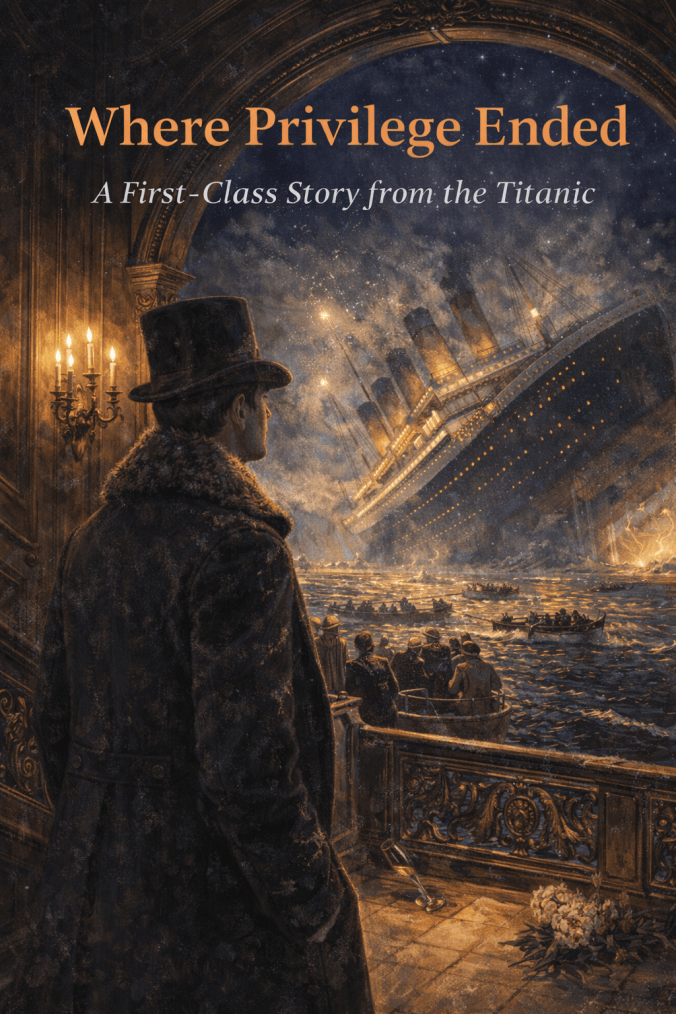
This story is offered with care.
It is rooted in historical records, passenger manifests, crew lists, inquiries, letters written before departure and testimonies given after survival. It also acknowledges the limits of record keeping. Many who boarded the Titanic left behind nothing but a name, a number, or a line in a ledger. Their inner lives, their last hours, and the shape of their courage were never written down.
The characters in this story are imagined, but their experiences are not. They reflect the lives of real people constrained by class, duty, and circumstance. What is portrayed here is drawn from what is known, and from what can be responsibly inferred, not from invention for its own sake.
For my family, this history is personal.
Members of my own family and my husband’s family were aboard the Titanic. Some survived and lived long lives carrying memory and grief. Others were lost, their futures ending in the dark Atlantic. That night divided our family history in ways that are still felt, even generations later.
I did not inherit their voices, but I inherited the consequences of that night. I inherited questions without answers and silences that became part of our family story. This narrative is a way of acknowledging those silences without attempting to fill them falsely.
This story is written with restraint and respect.
It does not seek spectacle. It seeks humanity. It seeks to remember the people who trusted the ship, boarded it with hope, and faced circumstances they could not control.
What follows is not meant to dramatise tragedy.
It is meant to keep faith with those who lived it.
Yours, Lainey.
“Where Privilege Ended -
A First-Class Story from the Titanic.”
I traveled First Class, which is to say I believed the world would make room for me.
My name was Frances, and I had been taught, gently and thoroughly, that life rewarded those who expected good treatment from it.
My cabin was an exercise in reassurance. Warm wood paneling glowed softly beneath shaded lamps. The bed was dressed in crisp linen that smelled faintly of soap and order. Fresh flowers appeared each morning without request. Silver waited precisely where it should, polished to a confidence that required no comment. A steward knew my name, my schedule, the way I took my tea. The ship did not simply transport us. It affirmed us. Every corridor, every meal, every nod of recognition told us that we were safe because we mattered.
First Class was not only a ticket. It was a belief system.
Sunday, April 14, unfolded flawlessly. The sea was calm, obedient, as though it had agreed to stay out of the way. The day passed in idle pleasures, letters written and folded, walks taken beneath the open sky, conversations drifting lazily from one agreeable topic to the next. That evening, dinner stretched luxuriously long. Crystal caught the light. Laughter lingered. We spoke of business ventures, of homes left behind, of America as if it were a grand idea waiting patiently to receive us. Beyond the windows lay the Atlantic, vast and dark, but it felt decorative, like scenery arranged for our enjoyment.
When the ship brushed the iceberg, I did not recognize it as danger.
There was a faint vibration beneath the china, a momentary hesitation in the engines, so slight it could be mistaken for intention. Someone commented on it with mild curiosity. Another dismissed it with a smile. The orchestra did not falter. Conversation resumed. Confidence smoothed over the moment like silk drawn across a flaw. We had paid dearly for certainty, and certainty obliged us.
Later, there came a knock at my door. The steward stood there, impeccably calm, suggesting I put on a lifebelt and step outside for a short while. His voice was polite, his expression carefully neutral. I felt a flicker of irritation, fastening the cork vest over my evening clothes as though humoring a needless rehearsal. It did not occur to me that rehearsals are meant to prepare you for something real.
The cold outside was astonishing.
It did not announce itself. It struck. It sliced through fur and wool, through habit and assumption, straight into the core of the body. Above us, the stars burned with merciless clarity, sharp and innumerable, as though the universe itself had leaned closer to watch. The sea lay flat and black, scattered with pale ice that looked unreal, like fragments of broken porcelain.
I noticed the lifeboats then. Too orderly. Too few.
Women and children were being gathered, efficiently, calmly. There was so much order. And because of that order, I trusted everything. This ship had been designed by the finest minds, commanded by professionals, governed by rules that had never failed me before. Surely this was precaution, not panic. Surely there was no need for haste.
We lingered. We spoke with acquaintances. We reassured one another with practiced ease. A vessel this magnificent could not be undone by something so crude as ice. The idea itself seemed improper.
Music drifted across the deck, refined and steady. It gave the night manners. It allowed us to remain who we were, composed and dignified, even as time slipped quietly away. The truth approached softly, almost apologetically.
When my wife was asked to enter a lifeboat, she refused at first. We had shared too many years to be separated by what felt like inconvenience. I told her, lightly and foolishly, that I would follow on the next one. That there would be plenty of room. That this was all being handled exactly as it should be.
She went only when an officer insisted.
I stood at the rail and watched her descend, wrapped in my coat, her face pale but controlled. She looked up once. I raised my hand. She raised hers. The boat slipped downward and away, shrinking into darkness, and something essential in me loosened and fell with it.
The deck thinned.
The ship’s angle, once dismissible, became undeniable. Conversation fractured and fell apart. Laughter vanished. The cold deepened into something invasive, the sort that reaches past flesh and into belief. Orders grew sharper. Rockets tore white scars into the sky and disappeared unanswered. The certainty we had worn so comfortably dissolved, leaving us suddenly exposed.
It was then, with remarkable clarity, that I understood the ship was dying.
The realisation did not come with hysteria. It came quietly, devastatingly, stripping away titles and habits in an instant. Wealth fell silent. Status meant nothing. We were reduced to what we had always been beneath it all, fragile bodies standing on borrowed ground.
When the water reached the deck, it came alive, swift and merciless. The tilt increased sharply. People ran. Others stood rooted, unable to reconcile motion with belief. The great ship groaned, a deep wounded sound, and then came the tearing, the terrible surrender of steel.
When she broke, the night broke with her.
The water struck with absolute finality. Breath vanished. Thought scattered. The stars reeled overhead as cries rose and were swallowed whole. The sea made no distinctions. It claimed the careful and the careless, the rich and the poor, with the same indifferent hands.
And yet, even then, there was beauty.
The sky remained impossibly clear. Somewhere, impossibly, the music lingered in memory. I saw my wife’s smile from that morning. I saw rooms filled with warmth and laughter. I saw the life I had assumed would continue because it always had.
Morning arrived softly, almost shyly, illuminating wreckage and silence. Boats drifted across the water, heavy with survivors and sorrow. A distant ship appeared, smoke on the horizon like both salvation and accusation. Names were read aloud, familiar voices searching the air.
Mine was spoken.
It found no answer.
If you remember us of the First Class, remember this. We were not villains, nor heroes. We were people shaped by comfort, taught to trust the world because it had so rarely contradicted us.
The sea corrected that belief, finally and without malice.
Still, we loved.
We hoped.
We believed, right up until the night taught us otherwise.