This story was not written to reimagine the Titanic, but to listen to it.
It is grounded in evidence rather than spectacle, in deck plans and duty rosters, in casualty lists, in testimony offered years later by people who survived when others did not. It draws from what can be proven and from what can only be felt. Where the historical record falls silent, imagination is used not to embellish, but to stand in the spaces where voices were lost.
The figures in this story are fictional, but their circumstances are not. Their experiences were lived by real people, bound by class, duty, language, and chance. The fear, the confusion, the courage, and the quiet endurance belong not to invention, but to history.
This story is personal.
Members of my family and my husband’s family were among those aboard the Titanic. Some were claimed by the sea. Others carried the memory forward into long lives shaped by what they had seen and survived. That division has echoed across generations, leaving questions that no archive can answer and silences that no document records.
I did not inherit their voices, but I inherited their absence and their survival alike. I inherited the weight of wondering who they were in the moments before the night turned, and how the world felt when it did.
This story is written with care for both the lost and the living.
It does not seek to retell the sinking as legend or myth. It seeks to restore scale to the human experience within it, to honor ordinary lives caught in extraordinary circumstances. It is an offering made quietly, with gratitude for those who endured and reverence for those who did not.
What follows is not meant to answer every question.
It is meant to remember.
Yours, Lainey.
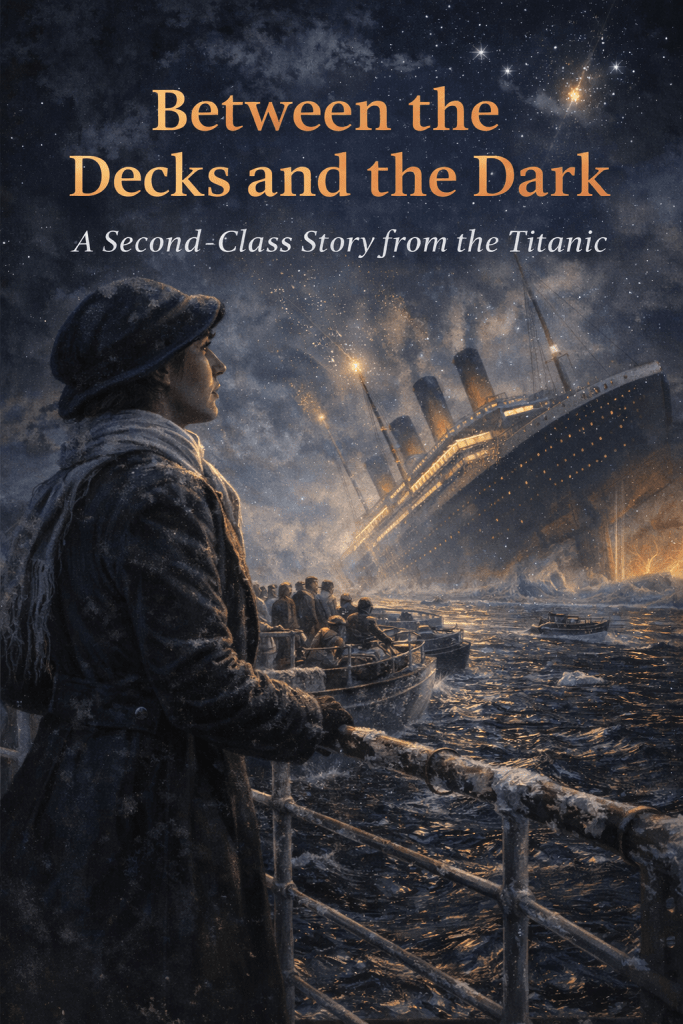
“Between the Decks and the Dark -
A Second-Class Story from the Titanic.”
I traveled Second Class, which is another way of saying I lived between worlds. My name was Emily, and I occupied that careful middle space where comfort existed, but certainty did not.
I had paid enough to escape the lowest decks, enough to have clean sheets and a door that closed and a mirror mounted firmly to the wall. There was a small table in my cabin and a chair bolted politely to the floor, as if even furniture aboard this ship understood the importance of order. The corridors were quiet and well lit. The carpets softened the sound of footsteps. There were flowers arranged in the public rooms, their presence meant to suggest permanence, and books set neatly in the library, as though the future were already scheduled and waiting to be read.
Second Class carried a particular belief with it. That life improved gradually. That progress was something one climbed toward patiently, rung by rung. We were teachers, clerks, governesses, small businessmen, widows with modest means. We were people who trusted systems. Who believed rules existed to protect us. Who thought the world, while not always kind, was at least fair.
On Sunday evening, April 14, 1912, the ship felt entirely at ease with itself. After supper, many of us gathered in the lounge. The lamps cast a warm glow over polished wood and quiet conversation. There was talk of the crossing, of New York boarding houses and proper hotels, of letters that would be written once we arrived. Someone read aloud from a book. Someone else laughed a little too loudly, as though happiness required defending. Outside the windows, the sea lay dark and smooth, reflecting nothing at all. It looked endless, but it did not look dangerous.
When the impact came, it barely interrupted the sentence being read.
A small shiver passed through the deck, delicate as a polite cough behind a gloved hand. Glasses trembled. A few of us glanced around, puzzled more than alarmed. Then the engines slowed, and then they stopped entirely. This was what unsettled me most. A ship is not meant to fall silent mid-thought.
We were told calmly that there was nothing to worry about. Kindly voices. Reassuring smiles. Still, coats were fetched. Lifebelts were brought out and tied with embarrassed laughter, as though caution itself were faintly improper. We made our way upward not in fear, but curiosity. I remember thinking how well everything still worked, how confidence can linger long after safety has quietly departed.
On deck, the cold rewrote the night.
It struck sharply, biting through wool and into the certainty I had carried with me all my life. The stars were terrifying in their beauty, fierce and countless, burning as though the sky itself were watching without mercy. Ice lay scattered across the black water, pale shapes drifting silently, fragments of something vast and unconcerned. The ship leaned slightly forward, only just enough to unsettle the body, only just enough to suggest that gravity itself was reconsidering its loyalties.
Lifeboats were being uncovered. I watched women step forward, some obedient, some hesitant, some laughing in disbelief. Husbands pressed coats into trembling hands, faces tight with words they could not find room to say. Children cried in that particular way children do when they sense that the adults have begun lying for reasons they do not fully understand.
We in Second Class stood close enough to see everything and far enough to feel oddly detached from it. We waited for instruction. We waited because we had been trained to believe that waiting was sensible, that authority would arrive before disaster did, that patience was a virtue that would always be rewarded.
Music drifted across the deck, improbably elegant, steady and composed. It stitched dignity into the air. For a time, it worked. You could almost believe the night was a performance, that this interruption would soon be corrected, that the ship would gather itself and continue on as planned.
But time began to behave strangely.
The tilt grew sharper. The cold deepened. The water climbed invisibly below us, like a thought no one dared finish. Orders became firmer. Faces lost their color. Lifeboats were lowered half full, not from cruelty, but from disbelief. The mind resists impossible things. It needs time to accept that something so large, so trusted, so carefully constructed can be ending.
I helped a woman into a boat. We had spoken once before, briefly, about novels. She clutched my hand too tightly, her eyes wide and shining. Then the ropes creaked, and she was lowered away from me, shrinking into the dark until she became only another shape against the sea. I watched until I could no longer tell her face from the night.
I did not follow.
I wish I could say it was bravery. It was not. It was hesitation. The terrible, ordinary pause of someone waiting to be told what to do when no one left truly knows. I had lived my life believing that order would always assert itself in time. That someone would step forward and say now. That moment never came.
The ship’s angle grew steep. Plates slid. The cold sharpened into something almost alive. Prayers rose in murmurs, then cries, in voices stripped of politeness at last. Steam hissed from somewhere deep below. Rockets screamed upward and vanished without reply. Somewhere beyond the darkness, help existed. It simply did not exist here.
When the final moments came, they came without ceremony. The ship broke apart with a sound like grief made physical, steel tearing as if it could feel pain. The sea rushed in, merciless and freezing, and the world became noise and water and stars spinning wildly overhead.
The cold was immediate and absolute. It stole breath, thought, identity. But before it claimed everything, it gave me one perfect, devastating instant of clarity. Life is never owned. It is only borrowed. And I had loved it fiercely, even while believing myself careful rather than brave.
Morning arrived pale and ashamed, spreading gently over wreckage and silence. Boats drifted among what remained, collecting the living and the unbearable weight of the dead. A distant ship came at last, smoke on the horizon like an apology that could not undo what had already happened.
My name was read from a list.
No one answered.
If you remember us, remember this. We were not reckless, or foolish, or heroic. We were hopeful. We believed in progress, in order, in the quiet promise that tomorrow could always be reached by patience alone.
The sea taught us otherwise.
The lyrics were written by me
but the music and vocals were AI generated.
🦋🦋🦋

