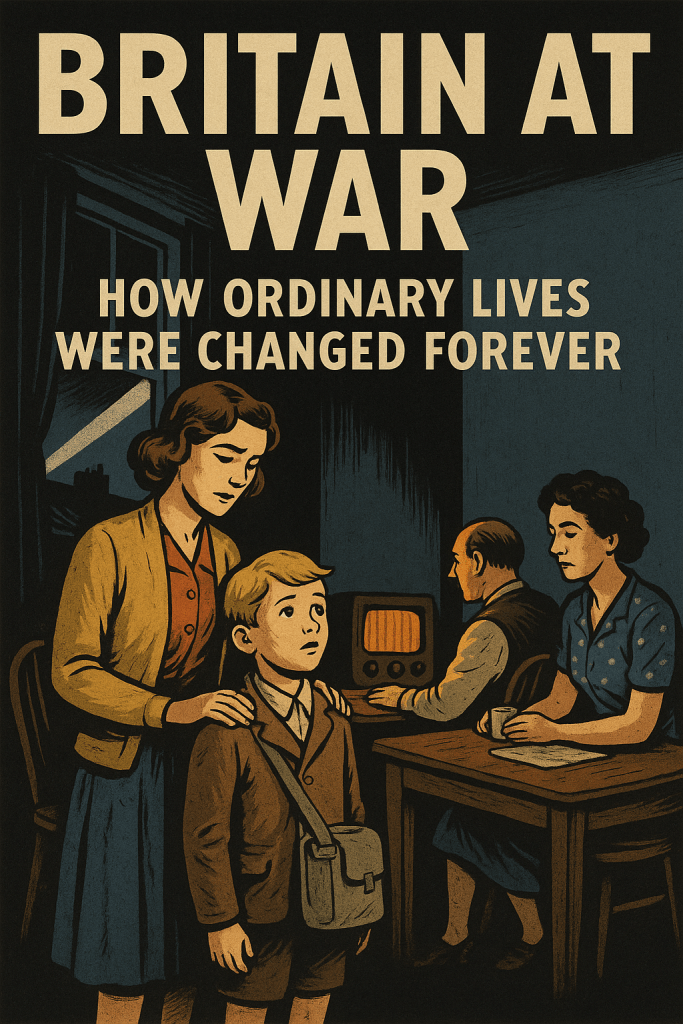
War never arrives with a single dramatic knock. It seeps in first, through uneasy headlines, through conversations that pause mid sentence, through the sudden sense that the familiar world is holding its breath.
In Britain, the World Wars did not begin only on distant shores or muddy battlefields. They began at kitchen tables, in schoolrooms, on railway platforms and along quiet streets, gently but irrevocably reshaping everyday life until nothing felt quite as it once had.
For ordinary people, war was not strategy maps or speeches carried on the wind. It was absence made visible. It was sons leaving home with suitcases too light for the burden they carried. It was fathers kissing children goodbye with smiles that lingered just a second too long. It was mothers learning to stretch meals, to swallow fear, to make bravery look ordinary for the sake of young eyes watching closely. Life did not stop, but it narrowed, drawing itself tightly around survival, duty and the fragile, stubborn art of hope.
Homes were among the first things to change. Windows were blacked out with fabric and paint, transforming warm, familiar rooms into shadowed spaces once the sun went down. Evenings grew quieter, voices softer, footsteps careful. Radios became lifelines, glowing softly in darkened rooms as families gathered close, listening to music, speeches and the measured tones of the news. These broadcasts stitched the nation together, offering reassurance, information and shared silence. At the same time, ears remained tuned for another sound entirely, the rising wail of sirens that sent hearts pounding and bodies moving quickly toward shelters.
Food became both obsession and ritual. Ration books were precious things, tucked into handbags and coat pockets, pages marked and monitored with care. Meals grew smaller, but ingenuity flourished. Carrots sweetened cakes, soups were thickened with imagination more than ingredients and leftovers were transformed again and again. Across towns and cities, gardens, parks and vacant land turned green with purpose. Allotments appeared where lawns once lay unused. Growing food was practical, certainly, but it was also deeply emotional. Each potato lifted from the soil felt like a quiet act of defiance, a reminder that life could still be nurtured.
Work reshaped itself in ways few could have imagined before. Women stepped into factories, farms, offices and transport roles in unprecedented numbers. They welded ships, assembled aircraft, drove buses and managed logistics, often while still running households and caring for children. Their days were long, their hands sore, their exhaustion deep, yet many later spoke of pride and purpose, of discovering strength they had never been allowed to show. Men who remained at home filled roles once closed to them, learning that survival required flexibility as much as endurance. When the war ended, life did not simply revert. The old patterns had been altered forever.
Children experienced war with a clarity that marked them for life. Evacuation separated families, sending children from cities to countryside homes that smelled different, sounded different, felt different. Some found kindness, fresh air and adventure. Others found loneliness that settled quietly and stayed. Schooling was disrupted, play took place among rubble or borrowed fields and childhood itself grew more observant, more serious. Many learned early that security could vanish overnight and that adaptability was a form of courage.
Community became a lifeboat. Neighbors who had passed one another for years without a word now checked in after air raids. Shelters filled with strangers who became companions through shared fear, whispered jokes and cups of tea balanced carefully on knees. Hardship softened boundaries. There was comfort in numbers, in shared laughter, in the simple question asked sincerely, “Are you safe?”
Faith and superstition walked hand in hand. Some turned to churches, finding solace in ritual and prayer. Others clung to small personal habits that offered a sense of control, lucky charms tucked into pockets, routines repeated faithfully. Letters crossed seas and continents, read and reread until paper thinned. Weddings were hurried and heartfelt, stripped of grandeur but heavy with meaning. Love, under threat, felt sharper and more urgent, cherished with an intensity born of uncertainty.
When peace finally came, it did not arrive like a neat ending. Britain emerged altered in body and spirit. Streets were rebuilt, but loss lingered in empty chairs, in names spoken less often, in silences that stretched across generations. Yet alongside grief lived resilience. Years of shared struggle had forged a quiet strength, a belief in collective endurance. Normality returned, but it was a new normal, shaped by memory and adaptation.
The World Wars changed Britain not only economically or politically, but emotionally. They rewrote family stories, influenced how people spoke about fear, duty and love, or chose not to speak at all. Their echoes remain in habits passed down, in the careful saving of things just in case, in the deep respect for modest courage and shared responsibility.
Britain at war was not only a nation fighting. It was millions of ordinary lives learning how to endure, how to adapt, how to find warmth in cold years. It was a country discovering that strength is not always loud or dramatic. Sometimes it looks like a mother making supper from almost nothing, a child smiling bravely in a shelter, a neighbor knocking gently on a door to ask if help is needed.
And perhaps that is the truest legacy of wartime Britain. Not only the battles remembered in books, but the quiet ways ordinary people held one another up and carried that resilience forward into the world that followed.
Until next time,

Ta ta for now.

Yours Lainey.