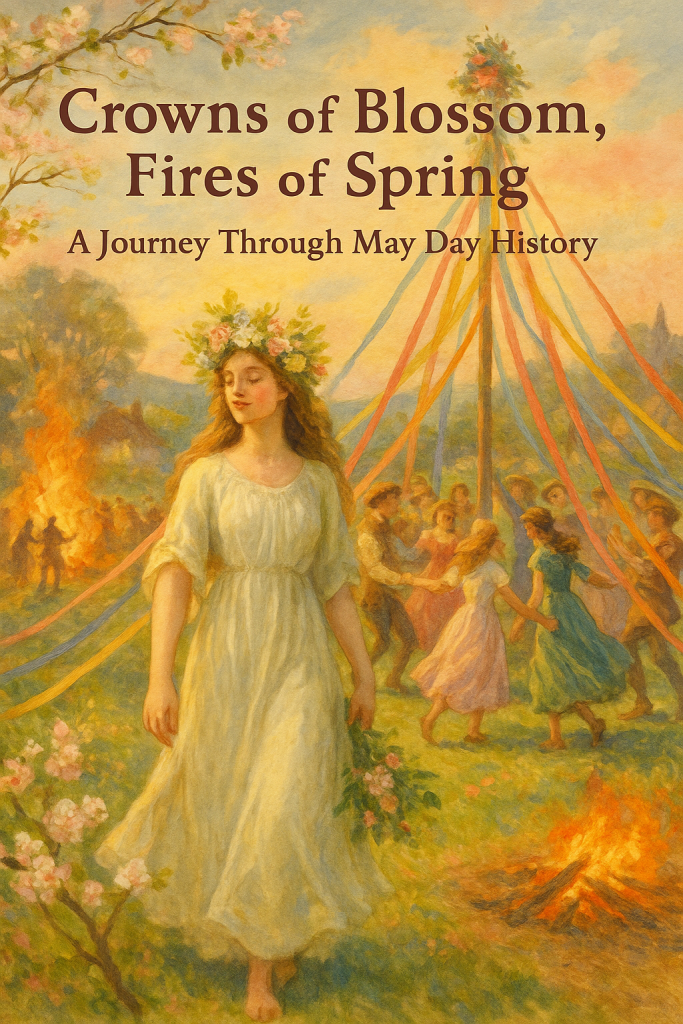
May Day has always arrived with a kind of shimmer, as though the air itself loosens into a song only spring can sing. Across England and the wider United Kingdom, the first day of May has for centuries been a celebration of youth, light and the earth’s long-awaited flourishing. It is a festival older than written memory, a jubilant weaving of ancient pagan rites, medieval merrymaking and village charm that has endured through the centuries. To speak of May Day is to speak of spring’s own birthday, a day when the world seems to swirl with color, warmth and promise, like a garland threaded with ribbons of many hues.
Long before Christianity shaped the spiritual rhythms of the British Isles, the peoples of early Britain welcomed May with festivals honoring the returning fire of the sun. Among the Celts, Beltane blazed on the eve of May, a night when bonfires crowned the hillsides of Scotland and Ireland. Flames leapt skyward like stars breaking free, casting warm light over fields still damp from April rains. These fires held meaning deeper than their glow. They offered protection against unseen forces, cleansed the air and marked the shifting of the world from winter’s grip into summer’s vibrant embrace. People danced around them long into the night and led cattle between twin fires to bless them for the coming season. With smoke in their hair and sparks in their clothes, they greeted dawn as if stepping into a new chapter of the year.
In England, similar instincts blossomed into their own spring rituals, gently becoming what we now know as May Day. The Romans had brought Floralia, their exuberant festival of flowers, and the Anglo-Saxons honored the month they called Þrimilci-mōnaþ, the three-milkings month, when cows were so nourished by fresh pastures that they could be milked several times a day. Across these layers of history, the first day of May grew into a natural invitation to celebrate, a moment when the land seemed young again and so, too, did the people who lived upon it.
By medieval times, May Day had bloomed into one of the most cherished festivals of the year. At dawn, villagers slipped into the woods to gather boughs and blossoms in a tradition known as bringing in the May. Hawthorn, with its creamy, fragrant blooms, was especially beloved and carried home like treasure. Young men and women returned with garlands around their necks and branches in their arms, singing as they walked back along the lanes. Greenery and flowers adorned doorways, windows and churches, welcoming summer’s arrival with living color. This greenery was more than decoration. It was an invitation for joy to linger, for luck to settle in the home and for life to return in full measure.
The Maypole, tall and stately, became the jeweled heart of the festivities. Raised upon the village green, it stood either as a young tree or a polished pole, crowned with flowers and fluttering ribbons. Around it the dancers gathered, weaving ribbons in bright patterns that spiraled downward like sunlight captured in silk. The dance mingled flirtation with fellowship, tying the community together in movement and mirth. Elders taught the steps to the young, and laughter rang through the air whenever ribbons tangled or someone danced the wrong way. The dance was playful, but it also echoed the weaving of the seasons, binding earth, people and time together.
Another enchantment of May Day was the choosing of the May Queen. Often the most admired young woman of the village, she was crowned with blossoms and led through the streets in a gentle and fragrant procession. Her floral crown symbolized purity, hope and the generous fertility of the season. Some villages crowned a May King or welcomed the appearance of the Jack-in-the-Green, a figure so thoroughly dressed in foliage that he seemed to be a walking grove, a spirit of the season made real. Together, these figures embodied the joyful union of earth and sun, heralding good harvests and warm, bright days ahead.
Every region of the United Kingdom colored May Day with its own traditions. In Cornwall, the Obby Oss danced through the narrow streets of Padstow accompanied by music and cheering crowds, blending ancient legend with heart-thumping celebration. In Wales, birch branches were hung above doorways to bring luck, and young lovers stole away among blossoming hedges to exchange vows. In Scotland, Beltane bonfires endured especially in the islands and Highlands, where young people leapt over the last glowing embers to welcome summer’s blessing upon their health and happiness. Though each region sang the season’s arrival in its own voice, the heart of May Day was universal: the joy of flowers, sunlight and the first warm breath of summer.
As the centuries passed and Christianity grew across the land, May Day did not fade. It slipped gently into the new religious calendar, softened and embraced as a beloved sign of spring. Churches blessed the garlands gathered at dawn. Village greens hosted games, feasting and music. Families looked forward to the day as one of the happiest of the year. The May Queen’s floral crown gradually became a symbol not of pagan goddesshood but of youthful purity and hope. The Maypole dance remained, reimagined as a folk custom that delighted both children and adults.
Even the rise of industry, with its factories and changing rural landscapes, could not erase May Day’s enchantment. Victorian England, nostalgic for the countryside of old, revived May Day traditions with romantic enthusiasm. Schools held Maypole dances, towns dressed their squares in flowers and London itself bloomed with parades and garlands. The holiday became a gentle reminder of shepherds on green hillsides, blooming meadows and the sweet, simple joys of village life.
Today, May Day continues to flutter into towns and villages across the United Kingdom each year. Maypoles rise. Ribbons stream. Children practice dances that their great-grandparents once performed. Bonfires still burn on Scottish hills. The Obby Oss still dances through Padstow. May Queens still smile beneath crowns of wildflowers. Even in a modern world that moves at quickened pace, May Day remains a pause, a breath, a reminder that beauty is worth celebrating.
The story of May Day is the story of spring itself: ancient yet forever new, rooted in the earth yet always reaching higher, filled with laughter, color and hope. It reminds us that joy is a heritage we inherit simply by being human, and that communities, like flowers, bloom brightest when they gather together. When ribbons flutter on a green or dancers circle beneath the sun, we glimpse a celebration as timeless as sunlight and as young as the year itself.
Until next time,

Ta ta for now.

Yours Lainey.