This story exists in the space between what is known and what is remembered.
It is informed by history, by inquiry transcripts and passenger records, by the careful work of those who preserved facts when grief might have erased them. It also acknowledges what history cannot hold, the private moments, the fleeting thoughts, the ordinary humanity that never makes its way into official accounts. Where the record ends, imagination steps in gently, not to rewrite events, but to honor the lives that moved through them.
The people in this story are fictional, but their lives are shaped by reality. Their choices, limitations, and fears were shared by thousands aboard the Titanic. Nothing here is meant to diminish the truth of what occurred. Everything here is meant to bring it closer.
For my family, this ship is not a distant story.
Members of my own family and my husband’s family were among those who sailed. Some survived and carried the night forward with them. Others were lost and remain known to us only through names, dates, and silence. That divide did not end in 1912. It has lived on, shaping conversations, memories, and unanswered questions across generations.
I did not know these people, but I feel the imprint they left behind. I have wondered how they faced uncertainty, what they believed in as the hours passed, and how the world felt in the moment before it changed forever.
This story is written in recognition of that wondering.
It is offered not as a definitive account, but as an act of care. A way of acknowledging lives that were once vivid and present, and are now preserved only through fragments. It is written with respect for the dead, compassion for the survivors, and humility before history itself.
What follows does not attempt to explain the Titanic.
It simply remembers the people who were there.
Yours, Lainey.
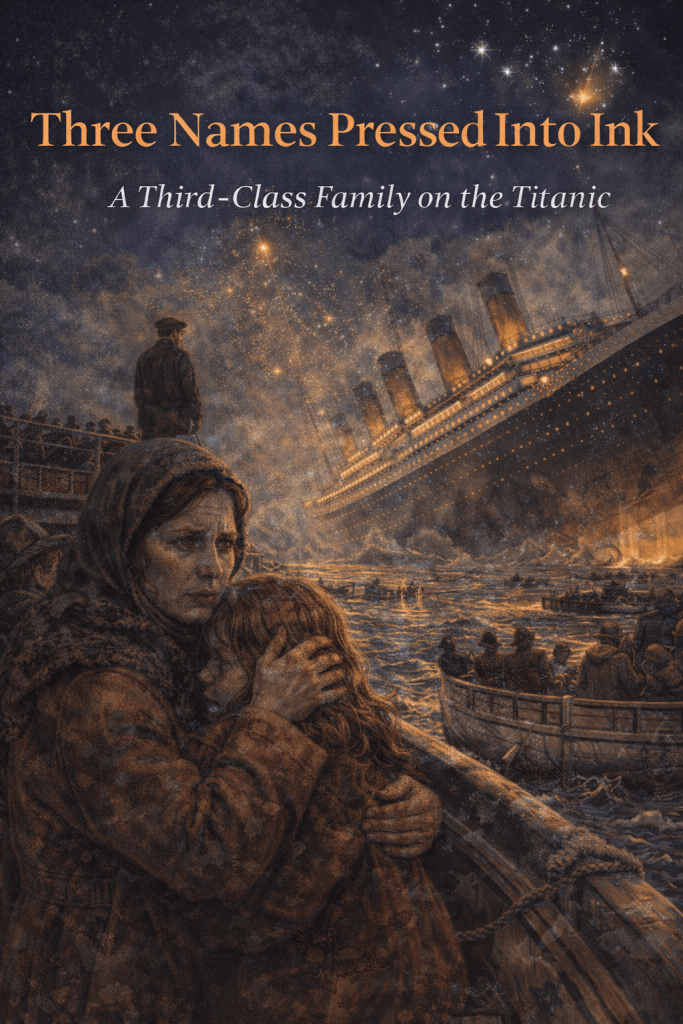
“Three Names Pressed Into Ink -
A Third-Class Family on the Titanic.”
They were listed together on the manifest, Patrick, Kathleen, and Eleanor, Irish, Third Class, three names pressed into ink as if ink could hold a family steady against the Atlantic.
They boarded with the quiet courage of people who had already survived harder things. Ireland had taught them that courage does not shout. It endures. Patrick carried their single trunk himself, though a steward offered to help. It held everything they owned that could be packed into wood and rope, clothes carefully folded, a tin photograph frame, a pair of small shoes wrapped in cloth for Eleanor. Kathleen kept close to her daughter, her hand never leaving the child’s sleeve, not from fear exactly, but from habit. Distance, she knew, was how things were lost.
They did not speak grandly of the future. Their hopes were modest, shaped by scarcity. Work that paid regularly. Rooms with windows. A table that was always filled before the children were. Eleanor attending school with shoes that fit and books that stayed dry. America was not a dream to them. It was a remedy.
That Sunday evening, they danced.
Down in Third Class, the ship lived differently than it did above. The ceilings were low. The corridors were narrow. The air was warm and thick with bodies and breath and coal dust. None of that mattered. A fiddle sang brightly, sharply, the bow moving so fast it seemed it might lift the player off his feet. Someone stamped time with a boot heel. Someone clapped until their palms burned. Laughter burst out, loud and unguarded, the kind of laughter that comes from people who know joy does not visit often and seize it fiercely when it does.
Patrick took Kathleen’s hands and spun her, awkward but beaming. Eleanor wedged herself safely between them, small boots skidding as she tried to keep up. She squealed when Patrick lifted her onto his boots so she could dance tall, her hair slipping loose, her cheeks flushed. Kathleen laughed until her chest hurt, watching them, feeling something rare and fragile settle inside her. For that hour, it felt as though they had already arrived somewhere good.
Between songs, they spoke of America. Of wages that came on time. Of streets where bread did not vanish by noon. Of Eleanor sitting at a desk, her name written carefully on a slate. The future felt close enough to brush against them.
When the ship shuddered, no one stopped dancing.
It was too small, too gentle, like the ship clearing its throat. Someone made a joke. The fiddler paused, then resumed. Eleanor clapped again. Happiness, once invited in, refused to leave at once.
Then the engines stopped.
The silence slid through the space slowly, like cold air finding its way under a door. Conversations thinned. Smiles faltered. People looked at one another, puzzled. A steward passed through too quickly, eyes fixed ahead, not meeting questions. No alarm rang. No explanation followed.
Later, they were told to put on lifebelts, just as a precaution.
Kathleen’s hands shook as she fastened Eleanor’s, tightening it too much until the child wriggled and complained. Patrick adjusted his own and forced lightness into his voice, a cheer he did not feel. Calm words without clarity have a way of breeding fear.
They were told to go up on deck.
No one told them how.
They followed the movement of bodies into the lower passages, into the belly of the ship where corridors twisted and narrowed and staircases led nowhere they were meant to go. The Titanic, which had seemed so solid and confident, revealed herself as a maze, one built not for escape, but for separation.
They tried one way and found it blocked.

Another ended in iron gates.

Another bore a sign they had learned to obey all their lives.
No admittance.
People pressed forward, then were forced back. Voices rose. Eleanor began to cry, sensing that the adults no longer understood the rules of the world. Patrick lifted her, pressing her face against his shoulder, murmuring reassurances that grew thinner with every dead end. Kathleen felt her heart pounding against her ribs. Beneath her feet, the floor felt subtly wrong, the faintest suggestion of movement.
At one gate, iron bars stopped them completely. Beyond it was a staircase leading unmistakably upward. They could see it. They could almost touch it.
They were told to wait.
Minutes passed. Minutes that would later become unbearable to count. The ship leaned almost imperceptibly. Somewhere below, water was already working its way upward, patient and unopposed.
When the gate finally opened, there was no apology. Just a gesture.
Go.
They surged through, climbing into spaces they had never been permitted to enter, spaces that still seemed to resist their presence. By the time they reached open deck, the night felt like an enemy.
The cold struck hard, without mercy.
It sliced through coats, through skin, through breath. Kathleen gasped. Eleanor clung to Patrick’s neck, sobbing now in earnest. Above them, the stars burned with a clarity that felt cruel. The sea lay flat and black, scattered with ice that glittered like broken teeth. Lifeboats hung overhead, shockingly small.
They had arrived late, not by chance, but by design.
Orders cut through the air now, sharp and urgent. Women and children forward.
Patrick’s arms tightened around Eleanor instinctively. Kathleen felt the moment before it happened, a tightening in the world itself.
Hands reached in.
Eleanor screamed, not terror yet, but confusion, as she was pulled suddenly from Patrick’s grasp.
Kathleen cried out, grabbing for her daughter, for Patrick, for anything solid. Patrick surged forward, pleading, his voice breaking through the noise, through the rules, through the night.
There was no time.
Kathleen was pushed into the lifeboat after Eleanor, stumbling, nearly falling. She turned back, arms outstretched, screaming Patrick’s name.
He was right there.
Close enough to see the devastation in his face. Close enough to make the separation unbearable. He reached for them, but bodies and rules and finality held him back. He raised one hand, not waving, not dramatic, simply holding it there, as though that alone might keep them tethered.
The boat dropped.
There were no goodbyes.
No last words pressed into Eleanor’s ear.
No promises spoken into the dark.
Kathleen watched him recede as the lifeboat descended, her mind refusing the truth her eyes recorded. Eleanor screamed for her father until her voice broke, then buried her face in Kathleen’s coat, sobbing.
From the water, they watched the Titanic die.
They watched the lights blaze against the darkness, the angle steepen, the ship tear itself apart with a sound that did not belong to the world of the living.
They heard the screaming afterward, hundreds of voices rising and fading and vanishing into silence. Kathleen pressed Eleanor’s head against her chest so she would not see, though she could not shield her from the sound.
Then there was only the sea.
Morning came softly, merciless in its beauty. Another ship arrived. Names were called. Patrick’s did not return to them.
Kathleen lived.
Eleanor lived.
That fact would follow her like a shadow.
In the days that followed, Kathleen learned the weight of guilt, not sharp, but constant. Guilt that she had lived. Guilt that she had not fought harder. Guilt that Eleanor slept while Patrick lay somewhere beneath the Atlantic, unreachable and unnamed.
Eleanor asked for her father again and again.
Kathleen learned how to answer without lying and without breaking. She learned how to carry grief quietly, because a child still needed warmth. She learned that some wounds never close, they simply become part of how you breathe.
They were not allowed to say goodbye.

They were not given time.

They were not treated as equals, even at the edge of death.
Patrick went down with the Titanic not because he lacked courage, but because the world decided, too late and too cruelly, who was permitted to live.
They had danced that night.

They had laughed.

They had believed.
And Kathleen and Eleanor carried the cost of that belief with them, every step forward, for the rest of their lives.
The lyrics to the song were written by me
but the music and vocals were AI generated.
🦋🦋🦋

