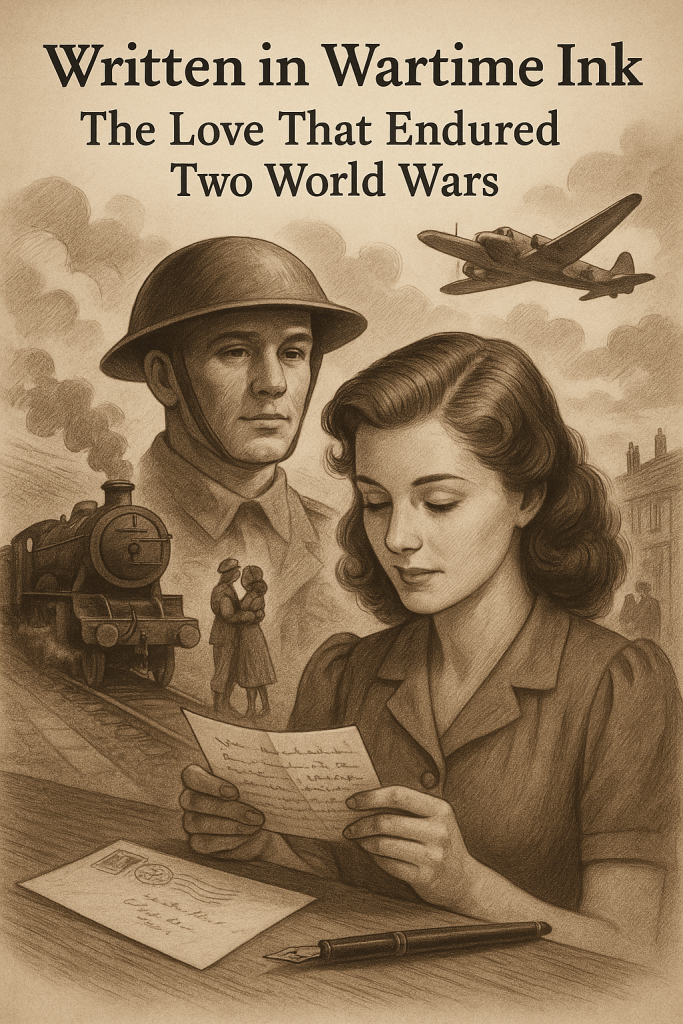
Love in wartime Britain rarely announced itself with grand gestures or sweeping declarations. It learned to speak in lowered voices and careful sentences, to live between train timetables and censorship stamps, to survive on paper thin as hope and moments stolen from uncertainty. During the First and Second World Wars, love did not disappear beneath uniforms, sirens and ration books. It adapted. It waited. It endured. And in many ways, it grew deeper for having been tested so fiercely.
During the First World War, love was often measured in miles and silence. Young men left villages, towns and cities for places whose names felt distant and unreal, carried across the Channel into landscapes of mud, thunder and fear. Those who remained learned the geography of absence. Kitchens grew quieter. Beds felt wider. Days stretched long with waiting and listening. Letters became lifelines. Written in trenches or dimly lit rooms at home, they crossed seas and battle lines, folded and unfolded until the creases softened and the paper thinned. Words were chosen with care. Fear was often edited out, replaced with humor, affection and small details of daily life meant to soothe. Ink carried kisses where mouths could not, and handwriting itself became a comfort, a trace of the beloved’s presence.
Courtship in these years often moved quickly, shaped by the knowledge that time was fragile. Engagements were brief and weddings hurried. A few days of leave might be all that stood between strangers and spouses. Churches filled at short notice, sometimes with borrowed rings and hastily altered dresses. Brides wore what they owned, not the white ideals of later decades but practical gowns that spoke of resilience rather than display. Photographs were taken not for vanity but for proof, something solid to tuck into a pocket and carry back to the front. Love did not wait for peace. It claimed the moment it was offered.
When the First World War ended, joy arrived tangled with grief. Many returned changed, quieter, carrying memories they could not easily share. Love learned patience. It learned to sit beside silence and not demand explanation. Some marriages deepened through shared endurance. Others struggled beneath the weight of trauma and loss. Love, like the nation itself, had to relearn how to breathe.
By the time the Second World War began, Britain understood the cost of separation, yet that knowledge did little to soften the ache. Once again, letters became sacred objects. This time they traveled farther, to North Africa, Italy, Burma, the skies above Europe and the cold waters of the Atlantic. Censorship trimmed sentences, black ink crossing out truths that could not be sent. Lovers learned to read between lines, to feel emotion in the slant of handwriting, to count days by postmarks. A delayed letter could bring sleepless nights. An unexpected one could lift an entire week.
Love during the Second World War often unfolded in borrowed moments. Dance halls glowed briefly under blackout rules, music spilling warmth into darkened streets. People met with an understanding that time was uncertain and tomorrow never promised. Romance moved quickly, honestly. There was little appetite for hesitation when life itself felt precarious. Many couples married within weeks, driven not by recklessness but by clarity. Love felt urgent, precious, worthy of immediate commitment.
Weddings during these years were modest but deeply moving. Rationing shaped every detail. Cakes were small or symbolic. Flowers were gathered from gardens or hedgerows. Guests arrived in uniform or work clothes, sometimes straight from factories or training camps. Yet the vows carried immense weight. To promise a future together while the world trembled was an act of quiet defiance. Love itself became resistance.
Long separations reshaped marriages in unexpected ways. Women ran households alone, raised children, managed finances and made decisions once shared. They grew strong through necessity, capable and self-reliant. Men returned to partners who had changed, matured and endured in their own battles. Love had to stretch, to renegotiate itself. Many couples succeeded not through fantasy, but through devotion built on shared sacrifice and mutual respect.
Quiet devotion defined these years. Love lived in small gestures: a favorite meal saved for precious leave, a scarf knitted through sleepless nights, a photograph kept close to the heart. It lingered on railway platforms, in waved handkerchiefs and eyes held too long. It existed in grief as well, when telegrams arrived instead of letters, and love had to learn how to remember rather than hope.
Beyond romance, love bound communities together. Neighbors cared for one another’s children. Friends became family. Loss was shared, and so was comfort. Love expanded outward, becoming collective, a net woven from kindness, endurance and shared humanity.
When peace finally returned, love stepped into a changed world. Some couples reunited with joy so sharp it felt unreal. Others met again as strangers shaped by different versions of the same war. Love did not erase what had happened, but it offered a place to rest afterward. It allowed people to rebuild not only homes and cities, but hearts.
Looking back, love in wartime Britain reveals itself not as fragile, but as astonishingly resilient. It survived distance, fear, scarcity and silence. It learned new languages: ink and waiting, patience and faith. It proved that love does not require ease to flourish. Sometimes it grows strongest in the hardest soil.
These stories remain with us still, carried in letters tied with ribbon, in photographs worn smooth by touch, in memories passed quietly from one generation to the next. They remind us that even in the darkest hours, love found a way to endure, faithfully, tenderly and with extraordinary grace.
Until next time,

Ta ta for now.

Yours Lainey.