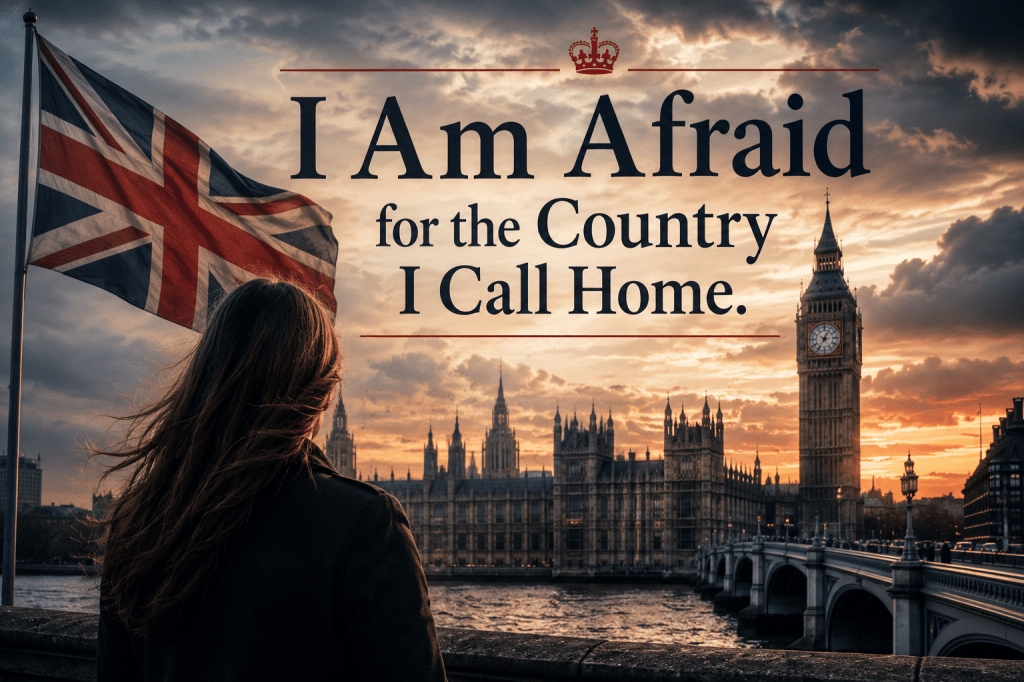
This is probably one of the hardest things I have ever written.
I am a white English woman, born and raised in England. I say that because, in today's climate, conversations about race and identity often begin with assumptions about people like me. I make no apology for being proud of who I am, just as I believe every person should be free to take pride in their own heritage. My love for England does not require me to diminish anyone else's.
The United Kingdom is the only home I have ever known. Our rolling countryside, our ancient churches, our history, our traditions, our villages, our values and our people are woven into every part of who I am. My ancestors lived here. My family history is rooted in this soil. When I look across our beautiful countryside or hear the church bells on a Sunday morning, I don't simply see a country.
I see home.
Before anyone decides what this piece is about, I need to say something clearly.
This does not come from hatred.
It does not come from racism.
It does not come from believing that everyone who comes to Britain has bad intentions. I know that is not true. Many people have come here, worked hard, respected this country, contributed to society and built wonderful lives. Britain has always welcomed people who have enriched our nation.
My fear is not about someone's race.
It is not about someone's nationality.
It is about whether the country I have loved all my life is changing in ways that leave me frightened for its future.
Every day I seem to read another story that leaves a knot in my stomach.
Another family devastated by violent crime.
Another child whose innocence has been stolen.
Another stabbing.
Another headline about a woman being attacked.
Another community trying to come to terms with a tragedy.
Crime has many causes, and no single issue explains every terrible act. I know that. But as these stories accumulate, they create a growing sense of anxiety that I know I am not alone in feeling.
As a woman, I cannot help but think about children.
Especially little girls.
Every time another horrific story appears in the news, I imagine a family whose lives have changed forever. Every victim is somebody's daughter. Somebody's granddaughter. Somebody's little girl who should have had an entire future ahead of her.
Those fears are real.
And I don't believe people should be afraid to say they are worried about the future of public safety in their own country.
What saddens me almost as much is that many ordinary people feel they cannot even express these concerns without immediately being labelled.
It often feels as though asking questions about immigration, policing, community safety or social change is enough for some people to assume the worst about your character.
That breaks my heart.
Because wanting your country to remain safe does not automatically make you hateful.
Wanting children to be protected does not make you racist.
Wanting elected leaders to listen to the concerns of the people they represent does not mean you wish harm upon anyone else.
Whether others agree with me or not, I sometimes feel that the concerns of many ordinary people are dismissed too quickly instead of being listened to respectfully. In a democracy, people should be able to raise concerns, disagree, and debate difficult issues without immediately questioning one another's humanity.
Listening is not weakness.
Listening is democracy.
As a Christian, I was taught to love my neighbour.
To forgive.
To show compassion.
To care for those who are vulnerable.
Those values matter deeply to me and always will.
Because of my faith, I believe every human being has value.
I believe genuine compassion matters.
I also believe compassion and responsibility should walk hand in hand.
A country should be kind.
A country should also be safe.
Those two ideals are not enemies.
They belong together.
I love seeing the Union Flag flying.
I love our history.
I love our traditions.
I love our churches.
I love our Remembrance services.
I love our countryside.
I love hearing stories of the generations who built this nation through hard work, sacrifice and resilience.
Most of all, I think about the men and women who lived through the Second World War.
Some were barely more than boys when they put on a uniform.
Some never returned.
Some carried wounds, both visible and invisible, for the rest of their lives.
Families waited for letters that never came.
Children grew up without fathers.
Parents buried sons and daughters who had everything to live for.
They sacrificed not because they loved war, but because they loved their country.
Whenever I stand before a war memorial and read the names carved into stone, I find myself wondering who they were.
What dreams did they have?
Who did they hope to marry?
What lives never had the chance to be lived because they gave everything for Britain?
I’ve heard the older generations express sadness about the changes they see around them today. Whether or not everyone shares those views, hearing people who remember wartime Britain speak with such emotion leaves a lasting impression on me. It makes me reflect on what those generations believed they were protecting.
I often find myself asking what those young men believed they were fighting for.
Surely it was not only to defeat tyranny overseas.
Surely it was to defend a country where freedom, democracy, the rule of law, community, and the British way of life could continue for generations.
That thought alone brings tears to my eyes.
Not because I believe Britain has lost those things completely, but because I believe every generation has a duty to protect them.
We honour those who fell not only by remembering their sacrifice, but by caring deeply about the future of the country they loved enough to die for.
That is why I sometimes feel so emotional.
Because loving your country means worrying when you believe something precious could be slipping away.
I don't claim to have all the answers.
Britain faces enormous challenges.
Crime.
Housing.
Healthcare.
Immigration.
Economic pressures.
Social cohesion.
None of these issues are simple, and none can be solved by anger alone.
But surely we should never become afraid of asking difficult questions.
Surely we should never dismiss people simply because they express concern.
Surely loving your country should never become something people feel embarrassed to admit.
I want a Britain where children can play safely.
Where women can walk home without fear.
Where communities trust one another.
Where people from every background who make Britain their home respect the laws, freedoms and values that have shaped this nation.
Where governments listen carefully to the people they serve.
Where disagreements are met with conversation rather than contempt.
When I say I am afraid for my country, I am not saying I have given up hope.
Hope is exactly why I write these words.
Because people who have stopped caring remain silent.
People who love something speak up.
Not with hatred.
Not with violence.
But with honesty.
With compassion.
With courage.
I love England.
I love its villages.
Its history.
Its humour.
Its resilience.
Its churches.
Its traditions.
Its people.
Nothing I have written comes from wishing harm upon anyone.
Everything I have written comes from loving the country that has shaped every part of who I am.
You may disagree with me completely.
That is your right.
All I ask is that my words are read as they were written.
Not from hatred.
Not from prejudice.
But from the heart of someone who loves her country deeply, worries about its future, and hopes that future generations will inherit a Britain that is safe, free, compassionate and strong.
Because sometimes the deepest fears are born from the deepest love.
Until next time,
Toodle pip,
Yours, Lainey.