Along Britain’s long and indented coastline, where mist clings to chalk cliffs and the sea mutters secrets against shingle and sand, there once moved a quieter kind of rebel.
Not the swaggering highwayman or the red-coated naval hero of popular memory, but women who knew the tides as well as they knew their own hearths. They smuggled not merely goods, but defiance, survival, and a fierce domestic courage that history has too often chosen not to see.
Smuggling in British history is usually remembered in raised voices and sharp silhouettes. We are taught to picture fast boats slicing black water, armed men vanishing into sea mist, daring chases along moonlit shores. Yet beneath that familiar thunder ran a softer, steadier current, carried by women whose greatest power lay in being overlooked. Their labour was quiet by design, their success dependent on passing unnoticed. Without them, many smuggling networks would have faltered, stalled, or collapsed entirely. Their stories survive not in heroic ballads or commemorative stone, but in court records, half-remembered folklore, and the carefully preserved silences of official history.
These women did not look like criminals. That, above all else, was their greatest strength.
From the late seventeenth century into the early nineteenth, smuggling flourished when law and livelihood fell out of step with one another. Heavy taxes on tea, spirits, tobacco, silk, lace, salt, soap, and countless other necessities transformed ordinary goods into forbidden luxuries. Along the coasts of Kent, Sussex, Cornwall, Devon, Suffolk, and far beyond into Scotland and Wales, smuggling was not an exotic crime but a rhythm of daily life. Government excise laws were felt as distant, punitive, and deeply unfair. Illicit trade emerged not only as defiance, but as necessity, a means of survival woven into local economies. Women stepped into this world with ease, not as silent companions, but as organisers, couriers, financiers, and quiet strategists.
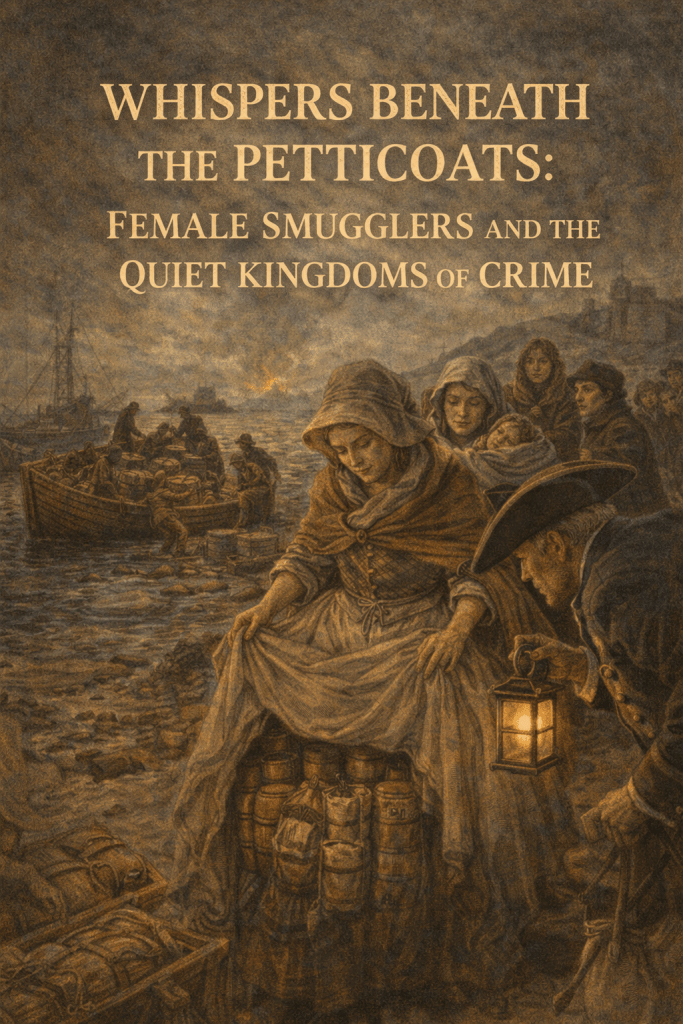
They stitched secrecy into everyday routines. Contraband slept beneath cradles and coffins, hid beneath shawls and petticoats, or rattled softly in baskets meant for market produce. Customs men searched ships and carts with stern efficiency, but rarely the calm authority of a woman going about her business. Respectability itself became camouflage. A teapot might hold tea worth more than a month’s wages. A cradle might rock gently over a fortune.
Long before the great smuggling gangs of England rose and fell, there was Grace O’Malley, the Irish sea queen whose life reads like saltwater legend. Born on the western edge of Ireland in the sixteenth century, her influence rippled through the maritime world that bound Ireland, Scotland, and England together. She commanded ships, levied tolls, and moved goods in defiance of English authority. Pirate, smuggler, rebel, ruler. She negotiated face to face with Queen Elizabeth I, proving that illicit trade could be politics, survival, and sovereignty carried on the wind.
In Grace, we glimpse an early truth that would echo for centuries, women were never merely passengers in the shadow economy.
By the eighteenth century, smuggling had woven itself tightly into the fabric of English coastal life, and women became its unseen sinews. Nowhere was this clearer than among the feared Hawkhurst Gang, whose violence and organisation terrorised the south-east. History fixates on the gang’s brutal male leaders, yet behind them stood women who managed intelligence, hid contraband in homes and inns, laundered profits, bribed officials, and warned smugglers of approaching excise officers. Innkeepers’ wives were particularly trusted. Entire shipments of tea, brandy, and tobacco passed through kitchens, cellars, and bedchambers without ever touching open ground. The domestic sphere became a logistical hub, its familiarity providing perfect cover.
Further west, along the Cornish coast, smuggling wore a gentler but no less determined face. Here it was less about gangs and more about communities, entire villages bound together by shared risk and quiet agreement. Many women were widows of the sea, or wives whose husbands were absent, hiding, imprisoned, or lost. They ran operations from kitchens and caves, timed deliveries to the moon and the tide, and raised children amid an unspoken understanding that the law was something distant and abstract, less real than hunger or winter. Court records speak dryly of women charged with moving untaxed tea or striking a customs officer, but behind those sparse words lie nights of cold wind, heavy bundles, and hearts hammering at every unexpected footstep.
Sussex offers glimpses of similar lives. Folklore and court testimony tell of women leading packhorses inland under the harmless pretence of market travel. Their skirts concealed silk and lace, their baskets hid tea bricks and tobacco leaves. One woman, tried in the 1740s, was found carrying so much tea beneath her clothing that customs officials expressed astonishment she could walk at all. She pleaded poverty, illness, ignorance. The court fined her lightly, perhaps amused, perhaps unconvinced of her danger. Within months, she returned to smuggling, undeterred.
Scotland, too, has its quiet heroines. During the height of whisky smuggling in the Highlands and islands, women brewed, transported, and sold spirits that defied excise laws imposed from distant centres of power. In remote glens, women carried small casks beneath cloaks or disguised as laundry bundles. Some served as lookouts along ridgelines, passing warnings through gestures, songs, or the simple act of hanging washing at the wrong hour. Others ran illegal stills while men worked elsewhere, ensuring production never ceased. In places where land was scarce and authority felt imposed rather than earned, smuggling became economic self-preservation, and women kept it alive.
Wales offers quieter but no less revealing examples. In the early nineteenth century, a woman named Ann Jones appears repeatedly in court records for smuggling tobacco and spirits through market towns. She was described as respectable, persistent, and entirely unrepentant. Each time she was caught, she paid her fine, returned home, and resumed her trade. Magistrates seemed unsure how to classify her. Criminal or nuisance, threat or inconvenience. She was all of these, and none of them, embodying the uncomfortable truth that smuggling often sat perilously close to ordinary life.
Some women step more clearly into the light. Margaret Catchpole of Suffolk rode her horse through the darkness with contraband hidden beneath her skirts, a solitary figure galloping along lonely roads. Her life was marked by arrests, an audacious prison escape, and eventual transportation to Australia. Victorian writers later reshaped her into moral lessons and sentimental fiction, but beneath the layers of myth remains a woman of remarkable daring and stubborn independence. She smuggled not for romance, but for love, money, and the refusal to accept the narrow life laid out before her.
Others, like Mary Bryant, moved through crowded criminal networks where smuggling, theft, and informal trade blurred together. Before her famous escape from an Australian penal colony, Mary navigated England’s shadow economies, carrying goods and messages in the fragile space between legality and hunger. Her story reminds us how porous the boundary was between survival and crime, especially for women.
Clothing was central to all these lives. Petticoats stiffened with tea bricks. Bodices sewn with hidden pockets. Shawls weighted with lace. Baby cradles hollowed to conceal contraband. Pregnancy, age, illness, and motherhood became disguises as effective as any false-bottomed cart. Women understood the assumptions placed upon them and turned those assumptions into tools. Customs officers hesitated. Searches softened. Respectability shielded crime.
These women were far more than carriers. Many controlled storage sites, managed distribution routes, handled money, and negotiated trust between networks. Widows were especially prominent, often inheriting smuggling operations when husbands died or were imprisoned. Running an illicit trade required discretion, patience, organisation, and emotional intelligence, skills women had honed within households and communities long before the law acknowledged their authority.
The danger was constant. Smuggling could erupt into violence without warning. Informers were despised and punished. Women caught repeatedly faced imprisonment, transportation, public humiliation, and the loss of their children.
Yet courts often underestimated them, framing their actions as moral weakness or desperation rather than calculated criminal enterprise. This misjudgement allowed many women to continue operating in plain sight, protected by the very stereotypes used to diminish them.
Smuggling rarely existed alone. Women involved in the trade fenced stolen goods, ran unlicensed taverns, sheltered fugitives, and carried messages between networks. These were economies built on trust rather than rigid hierarchy. Women flourished here, not through force or spectacle, but through connection, memory, and presence.
As the nineteenth century advanced, enforcement tightened. Searches grew more invasive. Surveillance expanded. Women appeared more frequently in court records, their harmless disguises no longer accepted without suspicion. Slowly, the age of quiet smuggling faded, replaced by industrial policing and bureaucracy.
History has preferred the drama of pursuit to the patience of concealment. It remembers men with guns and boats, not women with needles, baskets, and stories rehearsed in advance.
Yet these women shaped Britain’s illicit economies as surely as any gang leader or coastal runner. They did not seek to overthrow the state. They bent it gently and persistently, finding spaces where none were meant to exist.
To remember female smugglers is to remember that crime is not always loud, and resistance is not always defiant.
Sometimes it looks like a woman crossing a market square, her skirts heavy, her expression calm, carrying an entire hidden world beneath the ordinary fabric of her life.
Until next time.

Ta ta for now.

Yours, Lainey.