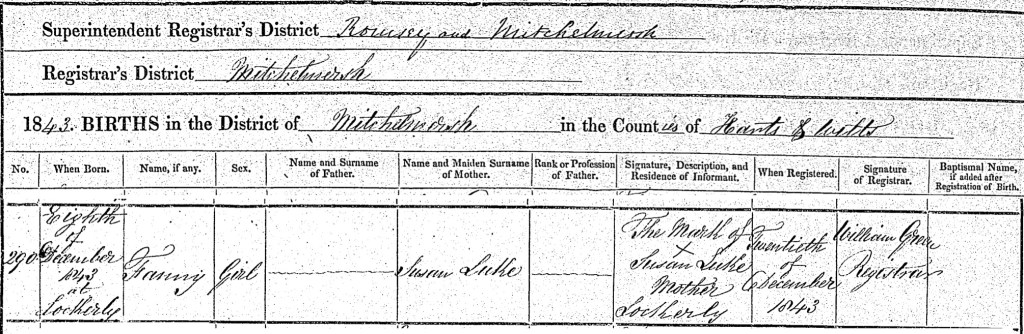
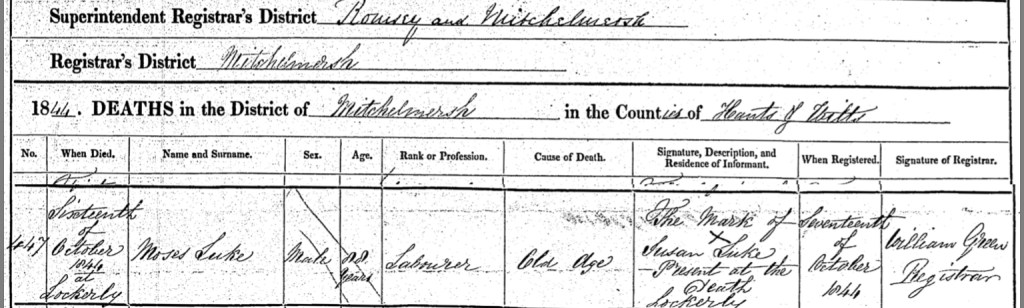
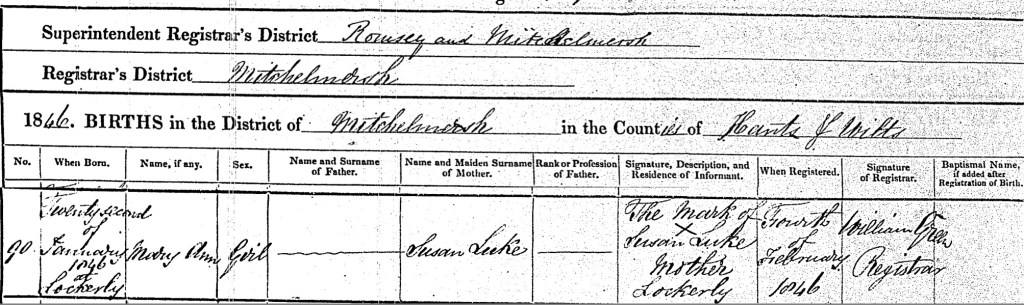
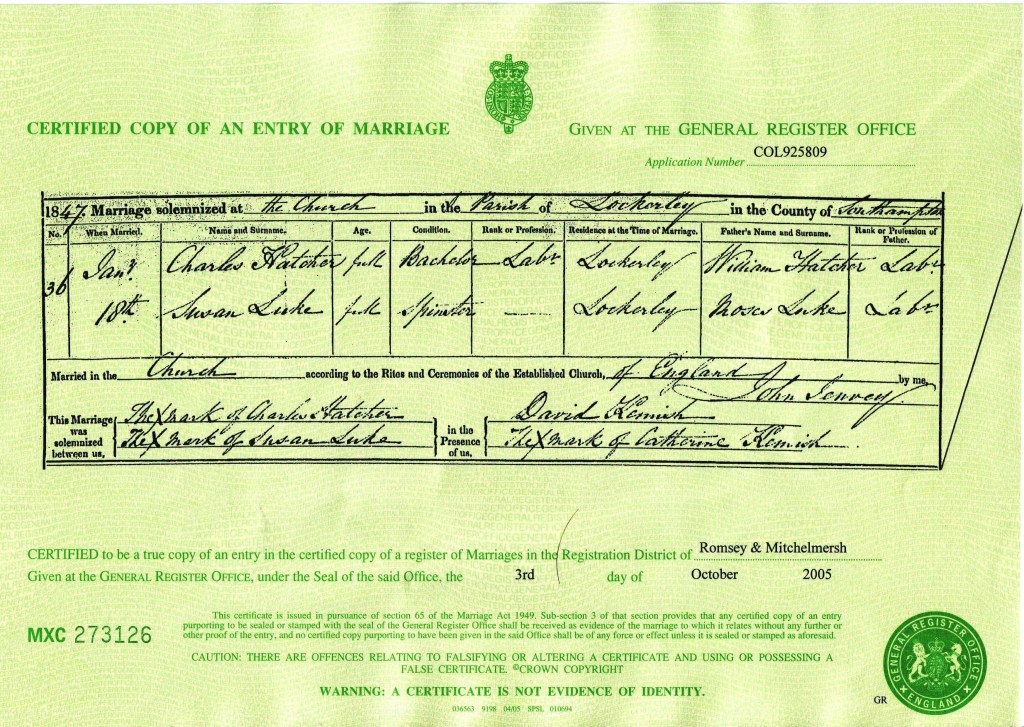
Step softly into the life of Susan Luke, my 3rd great-grandmother, whose story was never bound in leather or gilded in gold, yet drifts through time like a warm breath on a frosted window. Hers is a life pieced together from stubborn parish records, those smudged and tattered sentinels of the past that guard their secrets with surprising resolve. And yet, through every faded baptismal entry, every misspelled name, every ink blot swollen by centuries, her spirit still glimmers.
Family history is a kind of quiet magic, a lantern we carry into the dusk in hopes of finding the footsteps of those who walked before us. It demands patience, devotion, and sometimes a little surrender, especially when wrestling with the cryptic scrawl of nineteenth-century rectors who never imagined their hurried penmanship would one day be pored over by descendants longing for connection. But with every breakthrough, every rediscovered moment, we breathe life into those who once breathed for us.
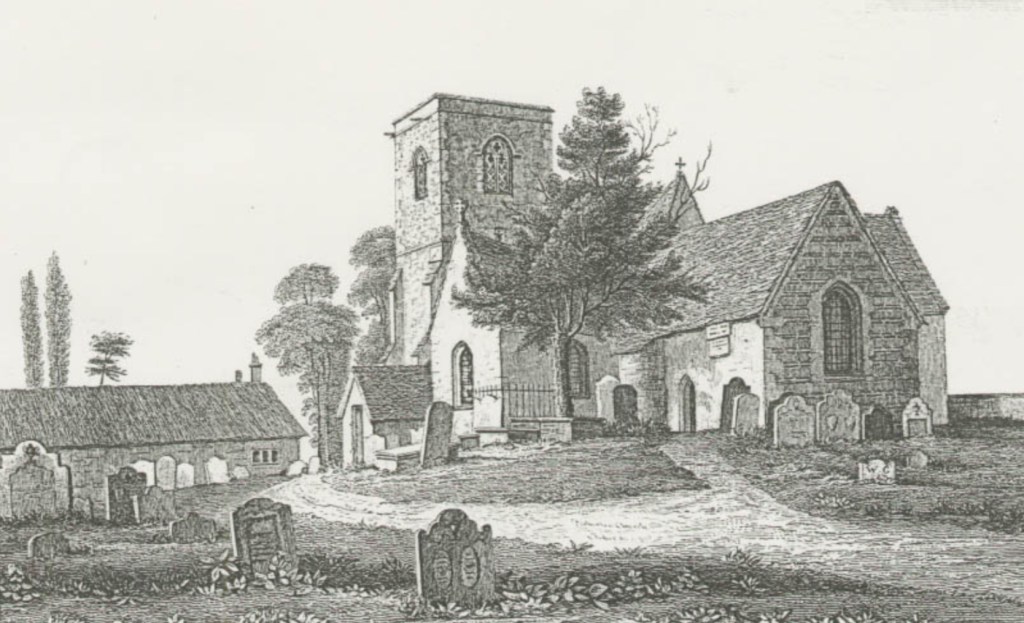
Step into Susan’s early years, where the fields of Lockerley cradled her childhood and the church bells of St. John’s tolled the rhythm of her days. Feel the tender romance of a world lit by candle flame, where dreams were spun from simple hopes and the steadfast resilience of rural life. Walk with her down muddy lanes, through seasons of sweetness and sorrow, past the threshold of the cottage where she learned both labor and love. Watch her cradle new life at the font, stand bravely at gravesides, and gather joy from the ordinary moments that would one day shape the extraordinary tapestry of generations to come, including mine.
This is not a tale of royalty or renown. It is something richer, quieter, more enduring:
the story of a woman who lived fully, loved deeply, and left behind a legacy that still hums softly beneath our skin.
Come, let the bells ring you back to the nineteenth century.
Let the worn pages of history part gently beneath your fingertips.
Let the life of Susan Luke, humble, and profoundly human, open before you.
Her story waits to be told once more.
Welcome back to the year 1820, Lockerley, Hampshire, England.
 The world you step into is quieter than our own, yet filled with the soft hum of human endeavor, the rhythms of the land, and the weight of a society on the brink of great change.
In 1820, the country is adjusting to the new reign of King George IV, following the long and troubled illness of his father, George III. The prime minister is the capable yet controversial Lord Liverpool, guiding Parliament through the uneasy aftermath of the Napoleonic Wars. Britain is powerful, but beneath its polished veneer lies unrest, poverty, and calls for reform. The political atmosphere feels heavy, as if holding its breath.
In rural Hampshire, the differences between classes are clear and rarely questioned. The wealthy live comfortably in large houses warmed by coal fires, with servants tending to every need. Their clothing is elegant, made from fine cotton, wool, and silk, tailored to flatter and impress. Carriages draw them from place to place, their wheels carving smooth tracks across the country roads.
The working class, including agricultural labourers like many in Lockerley, live much more modestly. Their clothes are practical, patched, and worn. Women wear simple gowns and aprons; men dress in coarse trousers, shirts, and waistcoats. They walk most places unless fortunate enough to ride atop a cart. Their houses are small cottages with thatched roofs, smoky hearths, and uneven floors. The poor live even more precariously, often in one-room dwellings shared by several family members, with cold and damp as daily companions.
The transportation of the era is slow and earthy. Horses carry riders and goods, carts creak along dirt roads, and the stagecoach links towns together like beads on a thread. Travel is expensive and tiring, but it is beginning to grow more widespread as roads improve.
Inside the cottage, heating comes from the hearth. Wood is precious; coal more common in towns than in rural villages. Lighting is provided by tallow candles or rushlights that flicker more than they shine. Night feels deep and long, and the world outside the door grows utterly dark.
Hygiene is a more complicated matter. Bathing is infrequent due to the labor involved in hauling and heating water. Hands are washed with cold water and lye soap, but full-body bathing may only happen once a week, if that. Sanitation is basic. Chamber pots are emptied each morning, and outdoor privies stand at the edges of cottage gardens. Waste often seeps into the soil or the streams that twist through the village.
Food depends on the season. Bread, cheese, porridge, root vegetables, and occasionally salted meat form the daily meals. Anything fresh is a blessing. Tea is a luxury many working families stretch their budgets to maintain, a comfort at the end of long days. For the wealthy, dining becomes a performance: roasts, puddings, imported fruits, and wines delivered from afar.
Entertainment is homespun. Villagers gather in taverns, share tales by the fire, sing songs, and celebrate festivals rooted in centuries-old traditions. Children play simple games in the lanes. Books exist, but they are precious to the poor; a well-worn Bible is often the only volume in the home.
Diseases cast long shadows over the era. Measles, smallpox, tuberculosis, typhus, and cholera remain constant threats. The death of infants is heartbreakingly common. Doctors have limited knowledge, and many remedies rely on folk wisdom or the church’s quiet assurances.
The environment around Lockerley is lush and green, with hedgerows humming with life, fields stretching out in patchwork shades, and the air carrying the earthy smell of livestock and tilled soil. The world feels slower, yet full of life and hard work.
Gossip moves swiftly through a village this size. Who is courting whom, who is expecting a child, whose cow has gone missing, and who was seen returning home after midnight; the entire social fabric is woven from such threads. Every life is visible in a place where privacy is a rare luxury.
Schooling depends entirely on one’s station. Wealthy families hire tutors or send children to private academies. Labouring children work early, though some attend local dame schools where learning is basic but valuable. Most working families teach their children at home as best they can, passing down skills needed to survive.
Religion shapes the rhythm of the village. Sunday is a sacred pause, with families filing into St John’s under the toll of the bells. Baptisms, marriages, and burials mark the milestones of life. The church is a constant, offering structure, comfort, and community, even for those who struggle.
This is the world Susan Luke was born into, a place of candlelit evenings, muddy boots, whispered prayers, simple joys, shared burdens, and the quiet dignity of ordinary lives.
Welcome back to the year 1820, Lockerley, Hampshire, England, where the world still moved at the pace of horses’ hooves and human breath, and where the first quiet cries of a child named Susan Luke were carried into the cold winter air.
Susan Luke was born in the fading hush of winter’s grip, either in the final days of 1819 or the earliest dawn of January 1820. The exact date slipped away long ago, lost to time like frost melting on an old windowpane. Yet the records, those stubborn parish pages inked by sleepy vicars, lean toward the first weeks of 1820. Her baptism confirms the year, even as every census drifts a little, as if her life were too spirited to be held still by numbers:
1841 whispering 1821.

1851 returning to 1820.

1861 leaning back to 1819.

1871 settling again at 1821.

1881 echoing the same.

1891 bending to 1819.

1901 circling once more to 1820.
Through these shifting years, one truth remains steadfast, Susan was born here, in Lockerley, where the hedgerows sigh in the wind, where the lanes soften under winter rain, and where her family carved out their lives with calloused hands and simple faith.
Her father, Moses Luke, was around fifty-three when she entered the world, a labourer by trade, one of the many men who bent their backs to Hampshire soil, coaxing life from land that was often reluctant to give. Her mother, Catherine “Kitty” Luke (née Mason), was about forty-eight, her body seasoned by childbirth, grief, and the relentless rhythm of cottage life. Susan was their ninth child, arriving after Moses, Sarah, John, William, Phoebe, Christian, Charlotte, and Henry, each one another stitch in the quilt of this humble family.
Susan’s first breath was likely drawn in a small cottage, warm only where the fire reached, its walls holding the scents of hearth smoke, damp wool, and the lingering sweetness of stored apples. Labour in rural Hampshire was no quiet affair. There were no doctors drifting in with polished instruments, no sterile rooms; no soft white linens. Catherine would have laboured in the dim glow of a tallow candle, her breath clouding in the cold, her hands gripping whatever they could find, perhaps Moses’ arm, perhaps the edge of a wooden table worn smooth by years of use.
A midwife from the village, experienced but unschooled, would have arrived with her basket of simple tools, linen strips, a bit of herbal salve, prayers whispered under her breath. Outside, frost may have clung to the hedges. The fields would have been hushed, the world holding itself still as another soul pressed her way through pain into presence.
When Susan finally emerged, tiny, red-faced, howling her first protest at the cold, she was wrapped in whatever warmth could be found. A brother might have peered shyly around a doorway. A sister may have fetched water from the kettle. Moses, his hands roughened by years of labour, would have cradled her with a tenderness reserved only for his own.
What must that moment have felt like for Catherine? Her ninth child, arriving in the winter of a country changing around them, King George III had just died, and George IV would soon claim the throne. The world was shifting, but in this cottage, life was beginning anew.
Susan’s infancy was shaped by the realities of her class. The wealthy of England lived in grand homes lit by oil lamps, eating from porcelain plates, their births attended by physicians. But Susan, like most children of Lockerley, grew up in the embrace of simplicity. Her world was woodsmoke and mud, the scratch of homespun wool, the creak of cart wheels on the lane, the sturdy comfort of family pressed close by necessity rather than choice.
Yet there is something profoundly beautiful in such beginnings. The heart learns early to find joy not in luxury but in presence. In the warmth of bodies gathered near a fire. In the soft songs of a mother as she hushed her newest child. In the quiet determination of a family who had already weathered hardship and still opened their arms wide for another life.
So Susan Luke entered the world, not in grandeur, but in love. Not with fanfare, but with the heartbeat of a village that knew her family, knew her name, and would shape the contours of her earliest years.
Hers was a candlelit childhood, a story built from the soil beneath her feet, and from the gentle, stubborn resilience passed down by Moses and Catherine. And though the years of her birth flicker uncertainly on the records, her presence in this place, in Lockerley, in this family, in the threads of history, remains as steady as the church bell that rang across her days.
This is where her journey truly begins.
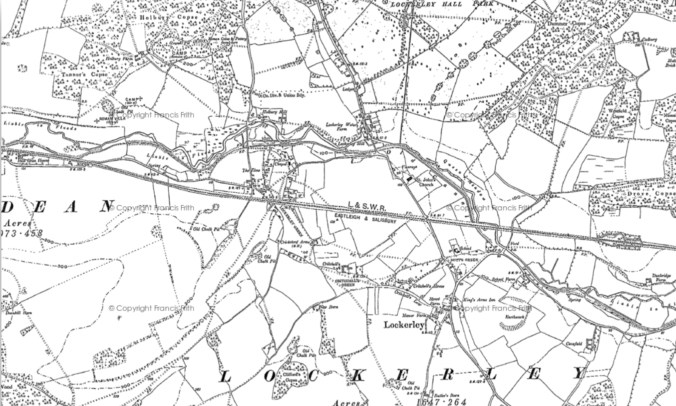
Lockerley is a village and civil parish in Hampshire, England, located on the southern bank of the River Dun, about two miles upstream from its junction with the River Test. The village is situated approximately 16 miles from Winchester, Salisbury, and Southampton, with Romsey, located around 8 km to the south-east, being the nearest town.
The history of Lockerley can be traced back to the medieval period, with evidence of its existence as early as the 12th century. In the Domesday Survey of 1086, Lockerley is recorded as a manor held by Hugh de Port. The village was part of the landholdings of Romsey Abbey, a significant influence in the area until the dissolution of monasteries during the 16th century. At the time of the Domesday Survey, the village consisted of one hide of ploughland, six acres of meadow, and woodland for three pigs. However, the ploughland was later absorbed into the King's forest by William I.
Architecturally, Lockerley is home to St. John the Evangelist Church, a building constructed in 1889–90 by architect J. Colson. The church is designed in a blend of Decorated and Perpendicular Gothic styles, featuring squared grey limestone with brown limestone dressings. The church includes a chancel with an outshot, a nave with transepts, and a southwest tower with a porch beneath. Inside, the church contains a marble reredos depicting the Last Supper, stained-glass windows, and a boarded roof with ribbed detailing. The church also boasts a stone pulpit, font in the Perpendicular style, and a carved screen in the north transept behind the organ.
In addition to the church, Lockerley is home to Lockerley Camp, an Iron Age hillfort located to the east of the village. This hillfort, covering approximately five acres, is a significant archaeological site, though much of it has been reduced by ploughing. A small area to the north remains within a coppice, where the earthworks are more discernible.
In the 19th century, Lockerley Hall was built by Frederick Dalgety, a wealthy merchant. The hall was used as a place to house soldiers during the First World War, and in the Second World War, it became a massive storehouse for the US Army in preparation for the Invasion of Europe. The site included 15 miles of sidings and 134 covered sheds.
Today, Lockerley is a vibrant community with a population of approximately 827 people. The village offers various amenities such as a shop, garage, and Lockerley C of E Primary School. It also has a Baptist chapel, and the Wessex Main Line railway crosses the parish with nearby stations at Dunbridge and West Dean.
The village is home to several local social groups and clubs, contributing to a strong sense of community. Among these groups are the Acorn Club, ArtSeen, Bell Ringers, Choir, Garden Club, Lockerley Silver Band, Women's Institute, and many others that provide opportunities for social engagement and cultural activities. These groups play a significant role in maintaining the active social life of the village.
While Lockerley is rich in history and community life, there are no widely documented myths or hauntings associated with the village. The absence of such stories may be attributed to the relatively modern development of the area and its continued use as a residential and agricultural community, which can sometimes prevent the development of folklore and ghostly legends.
Today, Lockerley continues to thrive, preserving its historical legacy while fostering a vibrant community life. The village is a reflection of rural England’s enduring spirit, with its mix of ancient heritage and modern growth shaping its identity.
On a cold and breathless winter’s morning, Sunday the 9th day of January 1820, Moses and his wife Catharine Kitty, whom all in Lockerley knew affectionately as Kitty, stepped across the threshold of St John’s Church with their newborn daughter cradled close against the cruel January air. The frost still clung to the hedges outside, white as wool, and the puddles on the lane had hardened into glass beneath their boots. Yet inside the ancient stone church, the candles whispered their golden glow along the nave, warming the shadows and softening the cold.
Behind Moses and Catharine walked their brood of eight children, Moses, Sarah, John, William, Phoebe, Christian, Charlotte, and little Henry, their breath rising in pale clouds as they pressed close to one another. The Luke children had grown up with these stones, these pews, these hymns; to them, St John’s was as familiar as the fields and cottage they called home.
Moses, a labourer whose hands were worn and furrowed like the very earth he tilled, stood with quiet, unspoken pride. Beside him, Catharine, at about forty-eight years of age, held her ninth child tightly beneath her shawl. Tiny Susan, Susanna, as she would be called this day, slept in the soft, rhythmic dreaming of the newborn, her cheeks ruddy from the cold.
The liturgy for the day followed the well-worn pattern of the Church of England, but each moment felt enchanted by the presence of this fragile new soul. As the bells of St John’s gave their slow, solemn call, the congregation gathered, filling the pews with murmured greetings and rustles of wool and linen.
A hymn was sung as the service began, likely one known by every voice in the room, such as “All Praise to Thee, My God, This Night” or “Hark, the Glad Sound!” Their simple, steady cadences rose up beneath the rafters, mingling with candle smoke and the scent of damp wool. It was the sort of singing that did not strive for perfection, but for community.
Reverend I. Williams, in his white surplice and black stole, began the morning prayers, his voice echoing softly through the nave. Passages from the Book of Common Prayer followed: familiar, steadfast, a balm against the winter world outside.
After the readings, perhaps from Isaiah or Matthew, passages of promise and shepherding and light, the time came for the baptism. Reverend Williams called the Luke family forward, and the village’s hum quieted entirely. It was a sacred hush, the kind that holds even the youngest child still.
The font stood near the door, as tradition required, a symbol that baptism is the threshold into faith itself. Its stone was cold to the touch, its basin filled with water Reverend Williams had blessed moments earlier.
“Name this child,” he said gently.
Catharine lifted her daughter just enough, her voice barely above a whisper.
“Susanna Luke.”
And thus her name entered the centuries-old memory of Lockerley.
Reverend Williams dipped his fingers into the water and let it fall in three shimmering drops across Susan’s brow.
“I baptize thee in the Name of the Father, and of the Son, and of the Holy Ghost.”
The words drifted into the rafters like the slow ascent of a prayer.
As her skin met the blessed chill, Susan stirred, not crying, but sighing, as if answering some ancient call. The congregation leaned in with tender curiosity, watching the newest member of their world breathe her first sanctified breaths.
The Reverend continued with the traditional prayers: asking God to receive this child, to bless her journey, to guard her from harm, and to let her grow in faith and love. Moses bowed his head deeply, his coarse hands folded with reverence. Catharine’s eyes glistened, not with fear, nor even with relief, but with that quiet, aching gratitude only a mother knows.
A final hymn rose, perhaps “O God, Our Help in Ages Past,” the words ringing with the weight of centuries and the promise of those yet to come. The congregation sang with full hearts, for a baptism was not merely a rite; it was a renewal for everyone present, a reminder that hope still entered the world in tiny swaddled bundles.
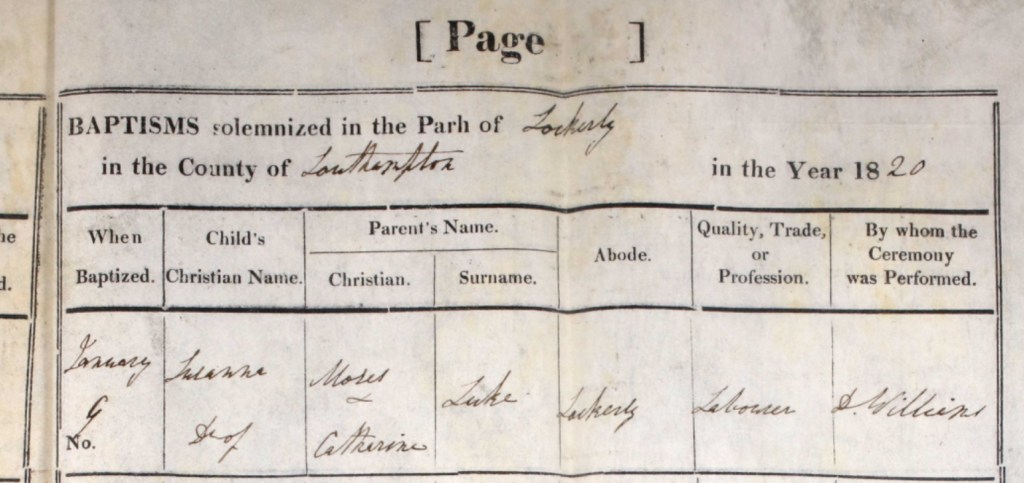
The parish register captured the moment with stark simplicity:
Baptisms solemnized in the Parish of Lockerly in the County of Southampton in the Year 1820.

When Baptized: January 9.

Child’s Christian Name: Susanna Luke.

Parent’s Names: Moses and Catharine Luke.

Abode: Lockerly.

Quality, Trade, or Profession: Labourer.

By whom the Ceremony was Performed: I. Williams.
Just ink and parchment. A few plain lines.
Yet beneath those lines lived the glow of candle flames dancing along cold stone; the harmony of hymns sung by neighbours whose lives entwined with the Luke family daily; the warmth of Moses’ love, standing solid as oak beside his wife; and the fragile, precious beginning of a life that would unfold across eight decades in this very village.
For in that quiet moment, in a church older than memory, Susan Luke was given to her family, her community, and her God.
And the world, small and frostbitten as it was that morning, made room for her.
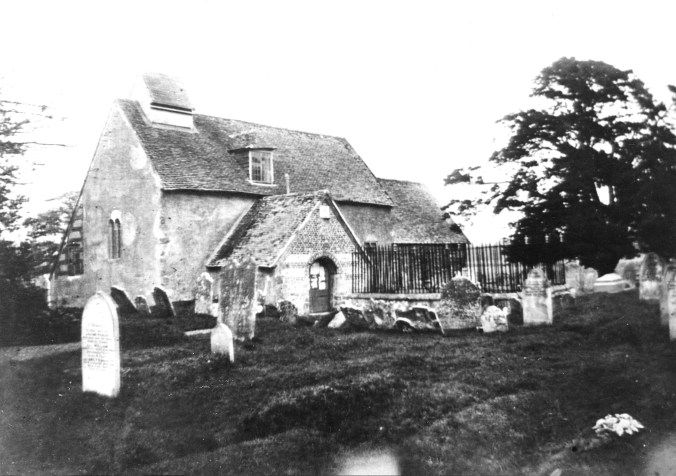
St. John’s Church in Lockerley, Hampshire, is a charming and historic church that has served the local community for centuries. Located in the heart of the picturesque village of Lockerley, which lies in the Test Valley, the church is an important part of the area’s history, culture, and spiritual life.
The history of St. John’s Church dates back to the medieval period, though the current structure reflects several stages of development over the centuries. The original church was likely built around the 12th century, though records from that time are sparse. The church’s dedication to St. John the Evangelist indicates its religious association with the Christian tradition, particularly with the apostle John, one of the most prominent figures in the New Testament. The church’s early history is tied to the broader religious and agricultural practices of the village, which has been a rural community for much of its existence.
Over the centuries, St. John’s Church was subject to several expansions and renovations. The original Norman structure would have been relatively simple, reflecting the needs of a small rural community. However, as Lockerley grew and developed, particularly during the medieval and post-medieval periods, the church was modified to accommodate a larger congregation and to reflect the changing architectural styles of the time. One of the most notable periods of change came in the 19th century, when the church was rebuilt in the Victorian era.
The current building of St. John’s Church was constructed in 1889–90 under the direction of the architect J. Colson, in a style that blends both Gothic and Perpendicular Gothic elements. This period saw significant growth in the Test Valley, and Lockerley, with its proximity to the town of Romsey, benefitted from an expanding population and increased prosperity. The design of the church reflects the period's architectural tastes, with soaring arches, intricate stained-glass windows, and the use of local materials that give the church a distinctive character.
St. John’s Church is a relatively large and impressive building for a rural village church. The structure features a chancel with an outshot, a nave with transepts, and a southwest tower that adds a sense of grandeur to the village’s skyline. The church’s stained-glass windows, depicting various scenes from the Bible, are particularly beautiful, and they provide a striking contrast to the stonework of the building. The wooden roof of the nave, designed with king-post trusses on arch-braces, is another notable feature of the interior, displaying the craftsmanship of the period.
Over the years, St. John’s Church has been at the center of life in Lockerley, hosting regular religious services, weddings, baptisms, and funerals. The churchyard is the final resting place for many of the village’s residents, with gravestones marking the passage of time and offering a sense of continuity to the village’s history. The church continues to play an important role in the spiritual life of the community, offering a space for worship, reflection, and prayer.
In addition to its role as a place of worship, St. John’s Church has also served as a venue for significant community events. The church is a place where people come together to mark important milestones, both religious and personal. Many of the village’s residents, both past and present, have been married, baptized, or buried in the church, giving it a special place in the collective memory of Lockerley.
The churchyard itself is a peaceful and tranquil space, with the graves of local families dotting the landscape. These graves serve as a reminder of the long history of Lockerley, and they provide a connection to the past. The churchyard is not only a site of historical importance but also a beautiful setting for reflection, surrounded by the natural beauty of the Hampshire countryside.
As for rumors of hauntings, like many historic churches, St. John’s has been the subject of local legends and ghost stories. However, there are no widely documented or substantiated paranormal occurrences associated with the church. Given the long history of the building and the village, it is not unusual for local folklore to suggest the presence of spirits or supernatural events. In many cases, such stories are passed down through generations, often becoming part of the cultural fabric of a place. While there may be occasional whispers or tales shared by the community about unexplained occurrences, there is no firm evidence to suggest that the church is haunted.
In the early 1800s, naming a child in Hampshire was not a whimsical or casual act. It was deeply woven into the fabric of family, parish life, tradition, and even the silent hopes that parents carried in their hearts. Each name reflected something of who the family was, its ancestry, its standing, its faith, and the unspoken tenderness between generations.
Though customs varied from village to village, several patterns were beautifully common across rural Hampshire, especially among labouring families like the Lukes.
Naming children after parents and grandparents was the strongest and most enduring custom. The first son was often named for the father’s father, the second for the mother’s father. Similarly, the first daughter frequently bore the name of the mother’s mother. This was a way of honouring the dead, keeping their memory alive beneath the thatched roofs and within the church walls where generations had knelt before.
Families with several children, like the Lukes, often used the same small pool of cherished names again and again, sometimes across cousins, sometimes across siblings born decades apart. Names were viewed as heirlooms, carried forward with quiet pride.
Another deeply rooted practice was the use of biblical names, especially among Anglican families and those who lived by the liturgical seasons. Names like Mary, Martha, Elizabeth, Sarah, Phoebe, Susanna, John, William, Joseph, and Henry carried spiritual familiarity. They were safe, respectable, and tied to Scripture and Sunday sermons. In a world where church marked the rhythm of life, christenings, marriages, burials, biblical names felt like anchors.
Some names reflected virtues or hopes, Faith, Patience, Charity, Mercy, and Grace. Though more common among nonconformists and Puritans earlier in history, a few persisted in places like Hampshire, where tradition could linger like mist over the fields.
Middle names were not yet widespread among working families. Most children received only one given name. A middle name was a luxury, something found more often among the wealthier or rising middle class. In rural villages such as Lockerley, a single sturdy Christian name was enough to live a whole life with.
Nicknames were equally important. A Catherine might be Kitty, a Mary could be Polly, a Sarah might be Sally, a Susanna often became Susan. These affectionate names were used daily, even though parish registers clung firmly to formal spellings. The home name and the church name danced together across a lifetime.
In Hampshire, names also revealed social belonging. Farmers, shepherds, and labourers rarely strayed into fashionable names. They chose what their fathers and mothers had chosen. Meanwhile, wealthier families, those with larger houses, servants, and social ambition, sometimes adopted names inspired by literature, royalty, or classical antiquity. But the working families preferred the comfort of names that had weathered centuries of English soil.
Tragically, high infant mortality also shaped naming customs. It was not uncommon for a child who died in infancy to have a younger sibling named after them, as if the first child’s memory could live again in the second. In parish registers across Hampshire, one often finds two Marys or two Johns in a single family, the earlier child lost to illness or misfortune. This practice was not seen as morbid but as restorative, a reclaiming of hope.
Baptismal timing also influenced names. Many babies were named on the day of their christening, especially during winter when cold, illness, and hardship made parents fearful of waiting too long. The vicar’s voice, the Book of Common Prayer, the lineage of godparents (chosen carefully from family or close neighbours), and the presence of parish witnesses all shaped the child’s naming day.
Godparents themselves played an important role. Their names sometimes became the inspiration for the newborn’s. A respected neighbour, a cherished sister, or a beloved brother might be honoured in the naming of a child, forging lifelong bonds.
Above all, names in Hampshire were stories, quiet ones, humble ones, stitched with tenderness and resilience. They honoured what had come before, even as they shaped what would come after.
So when Moses and Catherine named their ninth child Susanna, Susan, they were not merely choosing a pretty biblical name. They were placing her firmly within the long and ancient fabric of their family, their village, and their faith. They were linking her to mothers and grandmothers before her, giving her something enduring, steady, and rooted in the soil she would walk all her life.
The name Susan carries with it a softness, a quiet grace, and a history that stretches back far beyond the gentle hills and hedgerows of England. Though simple in sound, it is ancient in lineage, rooted deeply in cultures, languages, and faiths that long predate the villages where it later blossomed.
Susan finds its earliest beginnings in the Hebrew name Shoshannah, meaning lily. Not just any flower, but the lily specifically beloved in biblical poetry: delicate yet resilient, a symbol of purity, renewal, and quiet beauty. In Hebrew scripture, the lily often represents both the fragility and the sacredness of life. In time, as languages shifted and empires rose and fell, Shoshannah found new forms. In Greek it became Sousanna, in Latin Susanna, and eventually it drifted like fragrance into medieval Europe.
By the time the name reached England, sometime during the Middle Ages, Susanna appeared in parish registers and religious texts as a gentle biblical name suited to a Christian girl. It was familiar, modest, and full of devotional warmth. But the form Susan, shorter, simpler, and easier on English tongues, became more common after the Reformation. As the English language shed some of its older, Latinate flourishes, Susan emerged as the preferred version, practical and pleasing in equal measure.
The name flourished especially in the 17th, 18th, and early 19th centuries, becoming beloved in both rural villages and growing towns. It was a name you might hear called from a cottage doorway at dusk, or spoken in the quiet of a baptism beneath timbered church roofs. In England, names often carried echoes of scripture, but they also reflected the hopes of parents, and Susan, with its floral meaning, felt gentle and wholesome, a blessing on a child’s life.
By 1820, the year Susan Luke was born in Lockerley, the name Susan was familiar, steady, and warmly traditional. It was used among labouring families, farming households, tradespeople, and the rising middle class. Not lavish, not aristocratic, but lovingly ordinary and in that ordinariness lay its strength. It was a name of hearth fires, handwoven shawls, and fields gleaming with early morning frost. A name mothers sang softly while rocking their infants. A name that felt trustworthy, rooted, and enduring.
The full form Susanna, which appears in her baptism, reflects the formal style of parish registers in the early 19th century. Clergy often preferred biblical or classical spellings for the record, while families used the simpler everyday form at home. This was incredibly common. A girl baptised Susanna might be called Susan for all her years.
As time passed, the popularity of Susan rose and fell like the tide. By the mid-20th century it would soar again, becoming one of the most beloved English names of the 1950s and 60s. But in Susan Luke’s time, it was a name of quiet dignity, carried by women who lived ordinary yet extraordinary lives, stitched from labour, love, faith, and perseverance.
To speak the name Susan today is, in a way, to touch the hands of all those Englishwomen who carried it before, cottage wives, farm daughters, lace-makers, midwives, mill workers, and mothers who watched their children grow beneath the same rain-softened skies. It is a name full of history, resilience, and the gentle beauty of a winter lily bravely blooming against the cold.
And in Lockerley in 1820, it belonged to a newborn girl swaddled against the frost, whose life would one day ripple forward through generations, until it reached me.
The surname Luke in England comes from the personal name Luke, sometimes spelled Louke or Luck, which itself derives from the Latin name Lucas. The Latin form comes from the Greek Loukas, meaning “from Lucania,” a region in southern Italy, or is sometimes interpreted as “light-giving,” related to the Latin word lux, meaning “light.” In England, the surname developed as a patronymic, meaning “son of Luke” or “descendant of Luke.” Some records suggest alternative origins, such as the Middle English personal name Louke, which may have been a shortened form of Lovecok or derived from the Norman name Leu or Leue. In a few cases, it might have referred to someone who came from a place called Luik in Belgium, though that explanation is much less common.
The name began appearing as a hereditary surname during the medieval period, following the general English trend of forming surnames from given names. The personal name Luke was brought to England through Latin and French influence after the Norman Conquest. Historical records show the surname Luke appearing in England from the Middle Ages onward. One of the most notable early families lived in Bedfordshire, where Oliver Luke, born in 1574, served as a Member of Parliament and as High Sheriff of Bedfordshire. His son, Samuel Luke, born in 1603, was also an MP and took part in the English Civil War. Their prominence indicates that by the sixteenth and seventeenth centuries, the Luke family was well established in English society.
Today, the surname Luke is found throughout England, though it is not especially common. It ranks around 1,700th in frequency, with roughly one bearer in every twelve thousand people. Because the name originates from a given name rather than a single ancestral family, it likely developed independently in several parts of the country rather than spreading from one original Luke family.
Like many English surnames, Luke has been associated with a family crest and coat of arms, The Luke family crest, sometimes referred to as the Luke coat of arms, has appeared in several different forms depending on the branch of the family and the region in which it was recorded. Heraldry in England does not assign a single coat of arms to a surname as a whole, but rather to particular individuals and their descendants. Because the surname Luke arose independently in different parts of England and Scotland, several distinct versions of the Luke arms exist.
One of the best-known Luke crests shows a bull’s head with wings in its natural colour, the wings often shown in gold. This crest is associated with the motto “Strenuē insequor,” which means “I pursue vigorously.” The bull’s head is a traditional emblem of strength, courage, and endurance, while the wings suggest aspiration and swift action. Together with the motto, they convey energy, purpose, and determination. Another heraldic version, found in English records, is described as a silver shield with a horizontal band between six red rings. In heraldic symbolism, a ring or annulet represents fidelity and unity, while the horizontal band, known as a fesse, denotes readiness to serve in a military or civic capacity. A further version attributed to a Cornish branch of the Luke family depicts a red shield with a black upper section bearing three silver martlets, and a crest showing a scallop shell. The martlet is a small bird used in heraldry to symbolise continuous effort and a life of active pursuit, while the scallop shell often represents pilgrimage and perseverance.
Some depictions of Luke arms show a tree on a black and blue background. In heraldic colour meanings, black symbolises constancy and resolve, blue stands for loyalty and truth, and the tree represents enduring strength and a deep-rooted family lineage. These elements, though not common to all Luke arms, echo the broader sense of stability and steadfastness associated with the name.
The variations in these designs reflect how different members of the Luke family, over the centuries, were granted or adopted their own heraldic devices. Families from Bedfordshire, Cornwall, and other counties often had their arms recorded separately. For example, one prominent family of Bedfordshire descent, which included Oliver Luke and his son Samuel Luke, both Members of Parliament in the seventeenth century, bore their own distinctive arms. In Scotland, another line of the Luke family used arms that included a diagonal blue stripe with gold buckles and a hunting horn, together with a winged bull’s head as a crest.
When considering the Luke family crest today, it is important to remember that these arms were granted to particular individuals and not to everyone who bears the surname. Modern depictions found on commercial websites or souvenir items often combine or simplify different versions to create a “generic” Luke coat of arms, but historically there was never just one official crest for all Luke families. Anyone interested in the authentic heraldry of their own Luke ancestors would need to trace their lineage and consult official heraldic records such as those of the College of Arms in London.
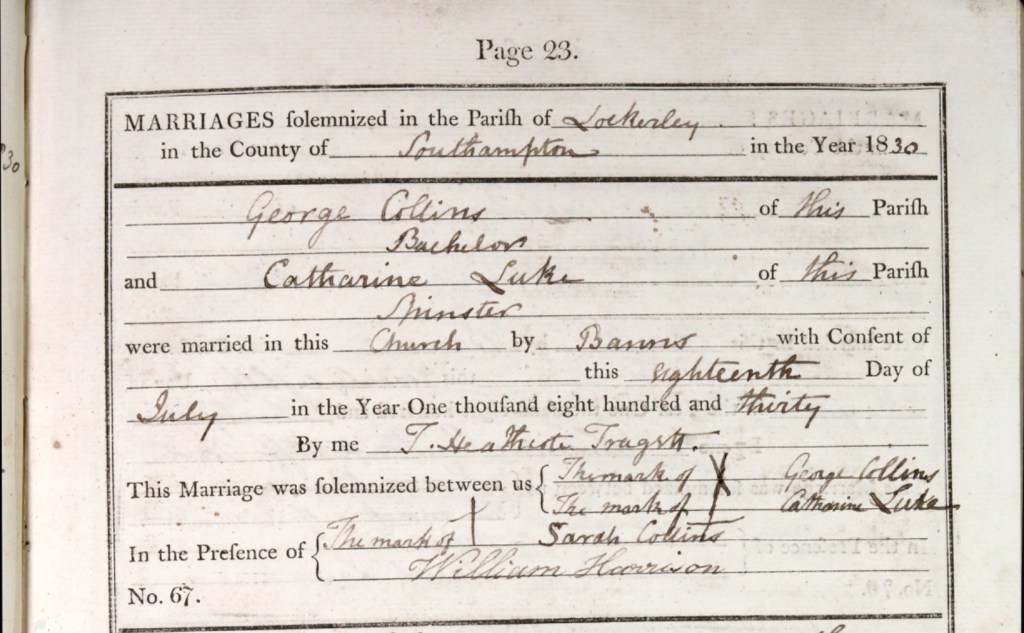
On a warm Sunday morning, the 18th day of July 1830, when summer light spilled across the hedgerows of Lockerley like honey poured from heaven, the Luke family walked the familiar lane toward St John’s Church. The bells tolled with a bright, hopeful urgency, their echoes dancing over the fields where Moses Luke had worked for decades and where his children had played in barefoot freedom. But today, those children were grown, and one of them, quiet, steady Catharine, elder sister to little Susan, was walking toward her future.
Susan, now a girl of about ten, watched her sister with wide, shining eyes. To her, Catharine looked transformed, not because of silk or jewels, for such luxuries were far from a labouring family’s reach, but because of the soft radiance in her face, the delicate trembling of joy threaded with nerves. Her gown was simple: clean white muslin or a pale cotton dress kept for special Sundays, perhaps freshened with ribbon or lace stitched carefully by her mother’s hand. A bonnet framed her features, tied beneath her chin with a bow that fluttered softly in the summer breeze. Brides of her class did not dress extravagantly; they wore what they had, what they treasured, what spoke quietly of dignity.
George Collins waited for her near the church door, also plainly dressed, yet scrubbed and brushed with earnest care. His hands bore the marks of rural life, just as hers did, but his eyes softened when he saw her approaching. He stood as a bachelor of this parish, ready to claim this new beginning with a heart full of hope.
Inside St John’s, the air was cool, scented with old timber, limestone, and faint traces of beeswax polish. Sunlight spilled through the windows in sleepy golden beams that crossed like gentle blessings. Catharine had walked these stones since she was a child, baptised here, taught her prayers here, watched the seasons of life unfold from these wooden pews.
The Church of England wedding service of 1830 was both solemn and tender. The congregation would have stood as the curate, Reverend T. Heather Fougth, began with the familiar words:
“Dearly Beloved, we are gathered together here in the sight of God…”
The readings likely came from Corinthians or Ephesians, passages long cherished at English village weddings, verses of charity, faith, and the sanctity of the marriage bond. Hymns such as “O God of Bethel, By Whose Hand” or “The Voice That Breathed O’er Eden” may have been sung softly, carried by voices that had known one another for generations.
There were no violins or grand organs, the music was made of warm breath and honest hearts.
When it came time to make their vows, George and Catharine spoke quietly, their voices trembling but unwavering. Neither could sign their name, but this was no shame in Lockerley, where many labourers left their lives in marks rather than letters. With steady hands they each drew an X in the register, and that simple mark held the weight of every promise they made.
In that moment, when their thumbs pressed the quill, when the ink still glistened, the entire village seemed to hold its breath. The Luke children watched. Sarah Collins and William Harrison bore witness. Even little Susan felt it, the sacredness of stepping into a new life.
The Reverend offered prayers for prosperity, health, and faithfulness. He blessed their union in the sight of God and the people who loved them. Then the curate spoke the words that echoed in every church from Hampshire to Northumberland:
“Those whom God hath joined together let no man put asunder.”
And just like that, the ceremony was complete. But the emotions lingered, floating like motes of dust in sunlight, settling gently upon their shoulders.
As they stepped out into the golden warmth of the July day, Catharine and George emerged as husband and wife. The heavy church door closed behind them with a soft thud, sealing the moment into the memory of Lockerley. Outside, the breeze carried the scent of ripening hay, and somewhere nearby a lark sang, as if offering its own blessing.
The parish register preserved it in austere ink:
Marriages solemnized in the Parish of Lockerley in the County of Southampton in the Year 1830.

George Collins, Bachelor, of this Parish and Catharine Luke, Spinster, of this Parish
were married in this Church by Banns…
this eighteenth Day of July By me T. Heather Fougth, Curate.

This Marriage was solemnized between us:

The mark X of George Collins

The mark X of Catharine Luke

In the Presence of
:
The mark X of Sarah Collins,

William Harrison.
Simple marks on fading paper.
Yet beyond those marks lived the golden morning light, the trembling of two young hands, the scent of summer grass, the quiet pride of a labourer’s family
and a bride stepping into her future with faith, courage, and the steady heartbeat of love.
That day, Catharine Luke became Catharine Collins.
And in the imagination of her little sister Susan, who watched from the pew, feet dangling above the stone floor, it must have seemed like watching a story unfold, one she could not yet name, but one she would carry with her for the rest of her life.
When Susan was a girl of fourteen winters, the quiet turning of the year brought with it a sorrow that lingered like frost on the soul. In late December of 1833, sometime before the second day of January 1834, Susan’s grandmother, Hannah Arter, formerly Luke, born Grey, slipped from this world in Devizes, Wiltshire. She was about ninety-four years old, an age reached by few, especially in those humble, unforgiving times.
No death certificate marks her passing, such official papers would not exist until 1837. History holds her death only in the softest of shadows. We do not know whether she died in her own bed or another’s, whether she was ill for long or merely grew tired of the long road she had walked for nearly a century. We do not know who held her hand as the year’s last light faded, whether a daughter lifted her pillow or a grandson whispered a farewell prayer.
But in the spaces where the record falls silent, the heart may speak.
I like to imagine her passing not as a lonely extinguishing, but as a quiet homecoming. A candle guttering gently, not violently. I imagine that Susan’s father, Moses, made his way to her bedside in those final moments, that he, her son, whose very life marked her legacy, sat near enough that she could feel him there. Perhaps he touched her weathered hand, the one that had once woven his childhood clothes or smoothed his hair when he was small. Perhaps he whispered her name. Perhaps she recognised him even when her sight had faded, because a mother knows her child long after the world has grown dim.
Hannah was born in a different century, one where England was lit only by firelight and dreams, yet she lived long enough to see her grandchildren run through the fields of Lockerley, long enough to know that her line continued in the laughter of little ones, including Susan, her granddaughter, who would one day carry the family’s quiet resilience through her own eighty-three years.
For young Susan, the news of her grandmother’s death would have come like a winter wind, sharp, cold, and strangely stilling. Susan likely remembered Hannah only in fragments, a visit in her early childhood, a story told beside a hearth, the soft rasp of an elderly voice that carried wisdom shaped by ninety-four seasons of sun and sorrow. In rural families, stories were heirlooms, and perhaps Susan had heard her grandmother’s name spoken around the fire on long winter evenings. Now that name took on a new weight, something solemn, something permanent.
In Devizes, the church bells would have tolled slowly for Hannah, each peal stretching into the cold air as if marking the passing of not just a woman, but a century of memories held within her.
And though Susan did not stand by her grandmother’s side, her life would forever carry a quiet thread that stretched back through Moses, through Hannah, through all those whose names are now softened by time. The women of this family, resilient, enduring, bound by faith and the land, moved through history with the steady, tender strength that holds generations together.
So Hannah passed from this world in the hush of winter, and the year turned without her. Yet her spirit lived on, in the hands of her son, in the quiet grief of her kin, and in the heart of a young girl named Susan, who perhaps looked up at the January sky and felt, without understanding why, that the world had grown a little older overnight.
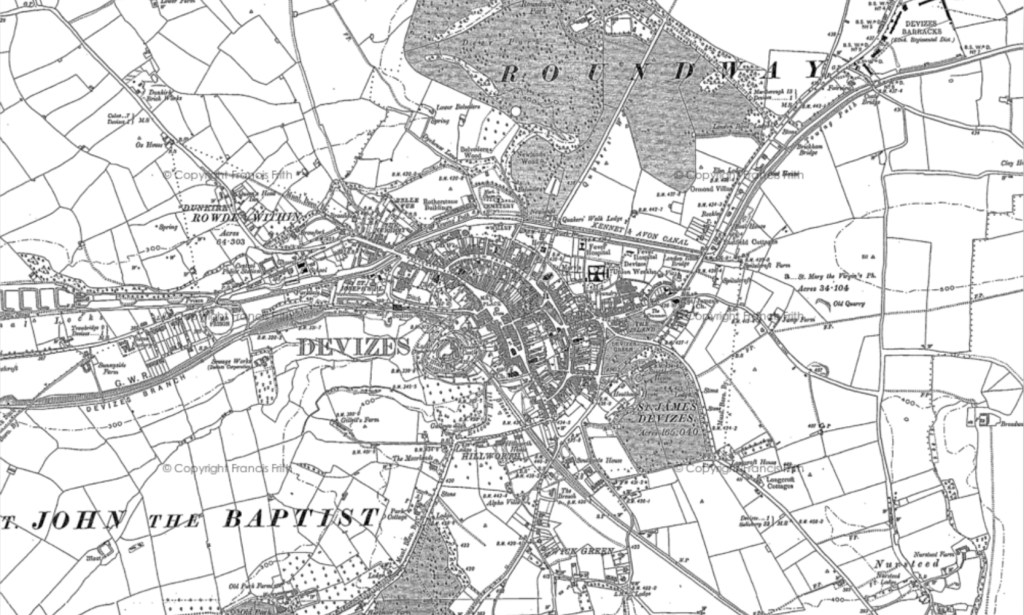
Devizes in Wiltshire is a market town rich in history, character and curious stories, set on a hill above the surrounding countryside. Its origins can be traced back to the early Middle Ages, growing around a great Norman castle that once dominated the landscape. The name Devizes is believed to come from the Latin word ad divisas, meaning “at the boundaries,” because the original castle was built near the dividing lines of several manors. Over time this became de Vies, Devise, and eventually Devizes.
The earliest settlement grew up around Devizes Castle, which was begun in the early twelfth century by Bishop Roger of Salisbury. It was one of the most formidable castles in the kingdom, so impressive that it became a favourite royal stronghold. Kings and queens stayed there, political prisoners were held within its walls, and it played a part in the struggles between monarchs and churchmen. The castle was destroyed during the English Civil War in the seventeenth century to prevent it being used again, and today only fragments of the medieval structure remain. On the site now stands an imposing Victorian mansion, privately owned, built in the nineteenth century in a romantic interpretation of medieval style.
As the castle declined, the town itself grew into a busy market centre. Devizes received its first charter in the medieval period and became known for its thriving markets and fairs. It produced cloth during medieval times, and later became known for brewing, with famous names like Wadworth & Co. still associated with the town today. Its central market place, large and open, served as the heart of local commerce and remains one of the most distinctive parts of the town.
In the Georgian era Devizes reached a new level of prosperity. Fine houses and elegant public buildings were constructed, giving much of the town its present architectural character. The wide Market Place, the handsome town hall and the graceful terraces reflect the tone of eighteenth- and early nineteenth-century life. This period also brought the construction of the Kennet and Avon Canal, completed in the early 1800s. The canal includes the famous Caen Hill Locks just outside Devizes: a remarkable flight of twenty-nine locks rising steeply up the hillside. This engineering achievement helped connect the town to wider trade routes and remains one of Devizes’ most striking landmarks.
The town has more than its share of unusual stories. One of the most famous concerns the Devizes “Moonrakers.” According to legend, smugglers hiding barrels of contraband in a pond were caught by customs officers. Pretending to be simple local folk, they claimed they were trying to rake cheese from the water, the cheese being the reflection of the moon. The story pokes gentle fun at the supposed foolishness of locals, but in truth it reveals their cleverness in distracting officials with a humorous tale. The nickname “Moonrakers” is still affectionately used for people from Wiltshire.
Devizes also has a long history of inns and brewing, partly because it lay on important coaching routes between London, Bath and the West Country. Before the railways arrived, these roads ensured a lively flow of travellers, trade and gossip. Although the railways bypassed Devizes later in the nineteenth century, leading to a short period of decline, the town adapted and retained its importance as a local centre.
As for hauntings, Devizes has no shortage of ghost tales. The Bear Hotel, an ancient coaching inn dating back to the sixteenth century, is said to be home to several restless spirits, including a mysterious lady who walks the upper floors. The old Assize Courts, where prisoners awaited judgment, are also linked to ghostly reports, and various old houses in the town centre have stories of footsteps, voices or apparitions that appear at certain times of year. Given the town’s long history of conflict, commerce and imprisonment, it is perhaps unsurprising that the supernatural has found such fertile ground in local memory.
Today Devizes is a thriving town that manages to preserve its historic character. Its streets are lined with Georgian buildings, medieval lanes and Victorian fronts, while the Market Place remains a bustling hub. The canal and locks draw visitors who walk the towpaths or explore the surrounding countryside. Museums, churches, inns and breweries offer reminders of the town’s long and varied past.
To walk through Devizes is to experience a blend of medieval roots, Georgian elegance and lively folklore. From its days as a mighty castle stronghold to its role as a coaching centre, market town and canal hub, Devizes continues to stand as one of Wiltshire’s most colourful and historically rich places. If you would like, I can also describe the castle’s history in more depth, or explore any specific period of the town’s past.
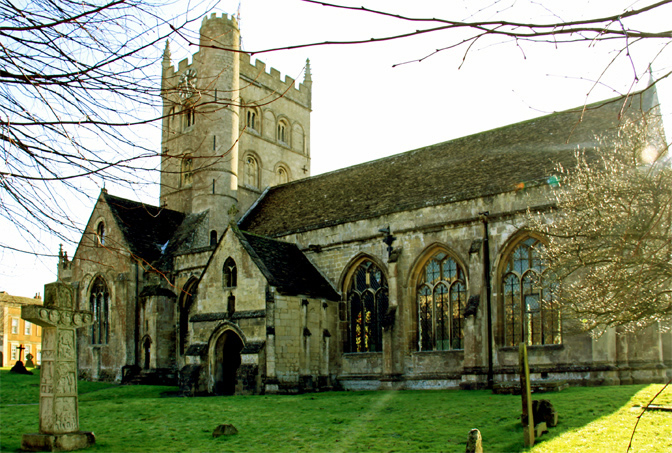
Frost clung like powdered glass to the iron gate of St John the Baptist Church, shimmering in the pale January sunlight, when fourteen-year-old Susan stepped into the churchyard beside her family. It was Thursday, the 2nd day of January 1834, the day her grandmother, Hannah Arter, née Luke, formerly Grey, was to be laid to rest in St John the Baptist Churchyard, Devizes, Wiltshire. The air was sharp enough to sting the lungs, but Susan felt as though she were breathing through a veil of cotton, soft, muffled, unreal. Grief often dresses the world in quiet.
In Devizes, funerals unfolded as they had for generations. The coffin, simple, wooden, shaped by local hands, had rested in the home before the burial. There, neighbours and kin had stepped in quietly, removing their hats, touching the coffin with reverence, whispering memories in the flicker of candlelight. Susan had seen it earlier that morning, and the sight of it had tightened her throat with a grief she could not yet name. It was strange to think that a life so long could be housed in something so small and so still.
Now, the coffin was carried from the house to the church by strong village men, Susan’s father Moses among them, their breath rising in pale clouds. The Lukes were a family of labourers, of earth and sweat and strength, and it felt right that Hannah’s son should carry her one last time. Susan walked behind them, holding tightly to Kitty’s hand. Her boots crunched over the frozen ground, each step a reminder of the cold and the love that bound them all together.
The churchyard was hushed, as if even the birds understood. The bare branches above seemed to bow their heads. Frost lingered on the grass like a blessing.
Inside the church, the curate’s voice rose, steady and low, through the ancient nave. He began the familiar words from the Book of Common Prayer, words Susan had heard at other funerals, but never felt so deeply:
“I am the Resurrection and the Life…”
The hymns drifted through the cold air “O God, Our Help in Ages Past” and perhaps “Rock of Ages” their notes trembling softly like the breath of winter itself. Susan’s own voice wavered as she sang, catching on the tightness in her chest. Yet singing felt right. It felt like a gift she could offer to a grandmother she barely knew, yet somehow deeply loved.
Readings followed, comforting, familiar passages that spoke of eternal rest, of peace, of the promise of life beyond:
“For this corruptible must put on incorruption…”
Then they stepped outside again, where the open grave waited, dark soil beneath a sky washed pale by winter. Susan stood between her siblings, the wind lifting strands of her hair. She watched as the coffin was lowered slowly, carefully, into the earth. The ropes creaked softly, and the ground, hard with frost, seemed reluctant to open for one who had lived so long.
Moses bowed his head. Kitty pressed a gloved hand to her lips. The curate spoke the final words, his breath turning to mist in the cold air:
“Earth to earth, ashes to ashes, dust to dust…”
A handful of soil fell onto the coffin with a soft thud. Susan shivered, not from cold alone, but from the heaviness of watching a life return to the earth. It felt like witnessing the turning of a page in a book older than she could fathom.
As the family lingered, she thought of Hannah’s nearly ninety-four years, years Susan would never fully know. Years lived through wars, harvests, childbirths, losses, laughter, and the quiet heroism of surviving. Years that stretched far beyond Susan’s own memory, yet shaped her life in subtle ways, through Moses’s strength, through Kitty’s wisdom, through the stories shared by hearthlight.
Standing there in the crisp January air, Susan felt something settle in her heart, a thread connecting her to the women who came before her. She understood, perhaps for the first time, that her own life was part of something larger, woven from generations of hands that had worked the land, prayed in small churches, and loved with a quiet, enduring depth.
When the burial ended, the family walked away slowly, leaving Hannah to her rest beneath the winter sky. Susan turned once more to look at the fresh mound of earth, her breath a small cloud of warmth in the cold.
In that moment, she did not feel the chill. She felt legacy.
She felt memory.
She felt love stretching forward and backward in time.
And though the frost remained upon the gate, the world felt just a little warmer for having carried Hannah’s story this far.
St John the Baptist Church in Devizes, Wiltshire is a church of remarkable historical depth and architectural richness. It stands on Long Street near the heart of the town and carries a designation of Grade I for its exceptional interest. The structure’s origins date back to the early twelfth century, around 1120–1130, when it was built under the auspices of the Bishops of Salisbury as the chapel associated with the nearby castle.
The building’s original purpose was to serve the garrison of Devizes Castle: though modest in appearance compared with later parish churches, the ambition of its architecture marks it out. The chancel is vaulted in Norman style, with intersecting arcading on its walls and ribbed vaulting above, a rare survival of Romanesque interior detailing in England. Over the centuries, the church expanded and evolved. In the fifteenth century the nave was rebuilt and aisles were added, chapels flanking the chancel were constructed such as the elaborate Beauchamp Chapel dating to 1492, and the tower was given a striking plan with five bays on two faces and three on the other two, a layout unique amongst Norman central towers. In the nineteenth century, major restoration work was carried out: the west front was rebuilt in Perpendicular style in 1863 by architect Slater, seating was increased and the fabric updated.
Architectural features inside the church are compelling. The massive tower crosses the nave at the centre, giving the church a cruciform plan. Norman corbels and sculpture remain in parts of the transepts and chancel, and the south chapel (Beauchamp Chapel) is richly decorated with pinnacles, battlements and large perpendicular windows, a testament to the wealth and patronage of late medieval Wiltshire. The interior atmosphere is one of layered history: beneath Victorian pews one still senses the Norman shafts and Romanesque arches, and the light through later stained glass falls on ancient stonework that has seen nearly nine centuries of service.
In its long life the church has lived through times of conflict and change. During the English Civil War the castle that the church once served was besieged and destroyed, and the church itself suffered damage to its roof and tower as lead was stripped off and the building’s structure used for military ends. Evidence of this includes grapeshot damage in the east wall of the tower crossing, testimony to the violent past embedded directly in the stones. The churchyard too holds stories of tragedy: one memorial records the deaths of five young people from a nearby village who drowned in a pond in 1751, their epitaph serving as a moral warning for others.
While there is no prominent catalogue of ghostly apparitions specifically tied to St John the Baptist Church in Devizes, the weight of its antiquity, its heavy Norman tower, its connections with war and castle life, and its quietly haunting interior lend it an air of the supernatural. Visitors sometimes speak of a feeling of solemn stillness in the crossing beneath the tower, or a heightened awareness of footsteps echoing in the nave when the church is otherwise empty. These sensations are rarely documented and remain personal rather than part of a widely circulated legend.
Today the church remains an active parish within the Church of England, serving Devizes and acting as a centre for worship, music and community life. At the same time it is a major historic monument, drawing visitors interested in Norman architecture, medieval chapel art, and the story of the town’s castle and its religious companion. Walking into the church is to step into nearly a thousand years of English history, where Norman bishops, medieval patrons, war-torn conflicts and Victorian restorers all left their marks.
Spring unfurled its gentle breath across Lockerley like a blessing, the world awakening in a soft hush. Morning drifted in tenderly, as though afraid to disturb the beauty it found. Cool air carried the scent of damp soil and new blossoms, and a pale wash of golden light spilled over the horizon, warming the budding hedgerows and stirring the birds into song. Their melodies stitched the dawn into something living, fluttering, full of promise. Dew clung to the grass in tiny silver beads, each one catching the sunlight like a jewel, and a playful spring breeze slipped through the lanes as if ushering the village into a day meant for joy.
It was Tuesday, the 22nd day of April 1834, and within the humble, much-loved walls of St John’s Church in Lockerley, the Luke family gathered to witness the next thread in their family tapestry being woven. Today was Charlotte Luke’s wedding day, Susan’s sister, her childhood companion, the girl whose laughter had long danced through the cottage and across the fields of their youth.
Inside the church, everything felt washed clean by springtime, the scent of polished pews, the quiet echo beneath the vaulted timbers, the soft flicker of candles that had watched generations stand where Charlotte now stood. For a farming family like the Lukes, this day was not adorned with grandeur, it was adorned with sincerity.
Charlotte wore what many brides of the time wore, her best gown, likely pale or softly coloured, clean and pressed with loving care. White had not yet claimed its future reign over bridal fashion, and a new dress was a luxury few could afford. Perhaps Kitty had added a fresh ribbon or lace, or tucked a sprig of early spring flowers into her daughter’s bonnet. Charlotte’s hands trembled a little, though her face glowed with quiet certainty.
Susan, standing among her siblings, watched her father Moses take Charlotte’s arm. Something inside her tightened with emotion, love, pride, the ache of seeing her sister step into a new world. Moses, a labourer with hands shaped by earth and toil, walked with remarkable gentleness. Today he was not a man defined by work, but a father giving away his daughter. Susan felt tears gather even before the vows began.
The church filled with soft murmurs as the Curate, William P. Hulton, prepared to begin. A hymn rose up, voices familiar, warm, and imperfect. Perhaps they sang “The Voice That Breathed O’er Eden”, a beloved wedding hymn even then, or the ever-present “O God of Bethel, By Whose Hand.” Their voices floated through shafts of spring sunlight, making the air shimmer with a sense of blessing.
Then came the reading, possibly from Corinthians, for it was often chosen in these rural Hampshire ceremonies:
“Charity suffereth long, and is kind…”
Simple words, ancient words, yet they moved through the church like soft waves, settling gently in every heart.
The Curate’s voice guided them through the familiar patterns of the Church of England marriage service, solemn, tender, binding:
“Wilt thou have this woman…?”

“I will.”

“Wilt thou have this man…?”

“I will.”
Susan felt the tears slip down her cheeks as Charlotte repeated the words. The sound of her sister’s voice, strong yet trembling, seemed to echo through all the years they had shared, chasing geese in the yard, whispering secrets after dark, gathering kindling in winter, dreaming of futures drawn in soft childhood imaginings.
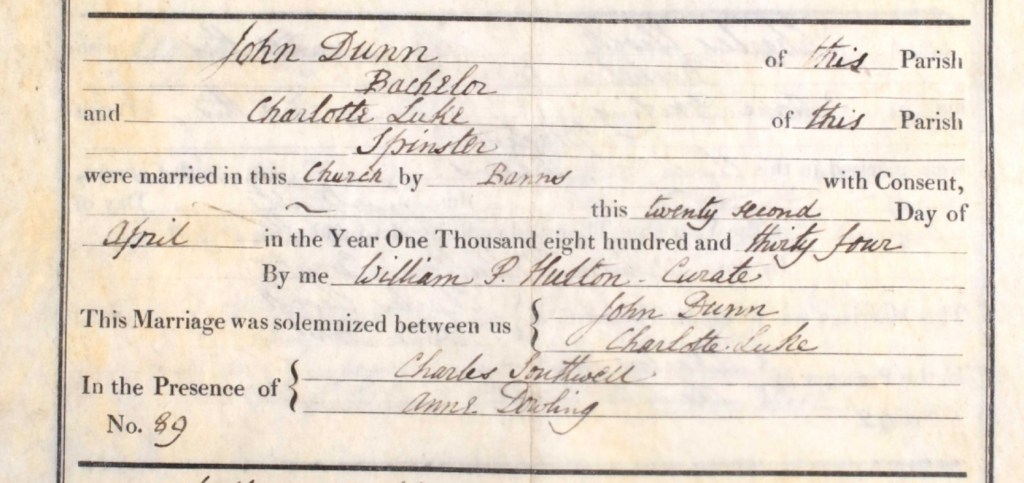
When it came time to sign the register, Charlotte and her beloved John Dunn, son of John and Eliz Dunn of Romsey, wrote their names with steady hands. Susan knew how rare it was, how proud her family must have been, to see actual signatures rather than simple marks. It felt like a step forward, a piece of dignity captured in ink.
The register recorded the moment plainly:
John Dunn, Bachelor, of this Parish, and Charlotte Luke, Spinster, of this Parish, were married in this Church by Banns this twenty-second Day of April
in the Year One Thousand Eight Hundred and Thirty-Four. By me, William P. Hulton, Curate.
This Marriage was solemnized between us:
John Dunn
Charlotte Luke
In the Presence of:
Charles Southwell
Anne Darling
No. 89
Just names on paper. Yet behind each stroke of ink lay the heartbeat of a village.
Outside, spring wrapped the newly married couple in light. The church door swung open, and a warm breeze swept in as though congratulating them. Birds burst into song. A few petals from late-blooming blossoms drifted, caught in the air like nature’s confetti.
Susan watched Charlotte step into her new life beside John Dunn, her hand tucked into his arm, her face bright with courage and hope. The sight pierced her heart with a tender ache, joy for her sister, pride for her father, and a young girl’s dawning understanding that life forever moves forward, carrying loved ones into new chapters while she remains on the threshold of her own.
And though the church register captured only the bare bones of the day, Susan carried its soul, the hymns that trembled like butterflies in the rafters, the vows spoken with quivering conviction, the sunlight that crowned her sister’s hair, and the stirring certainty that love, quiet, ordinary, steadfast love, was the truest blessing of all.
It was a spring morning she would never forget.
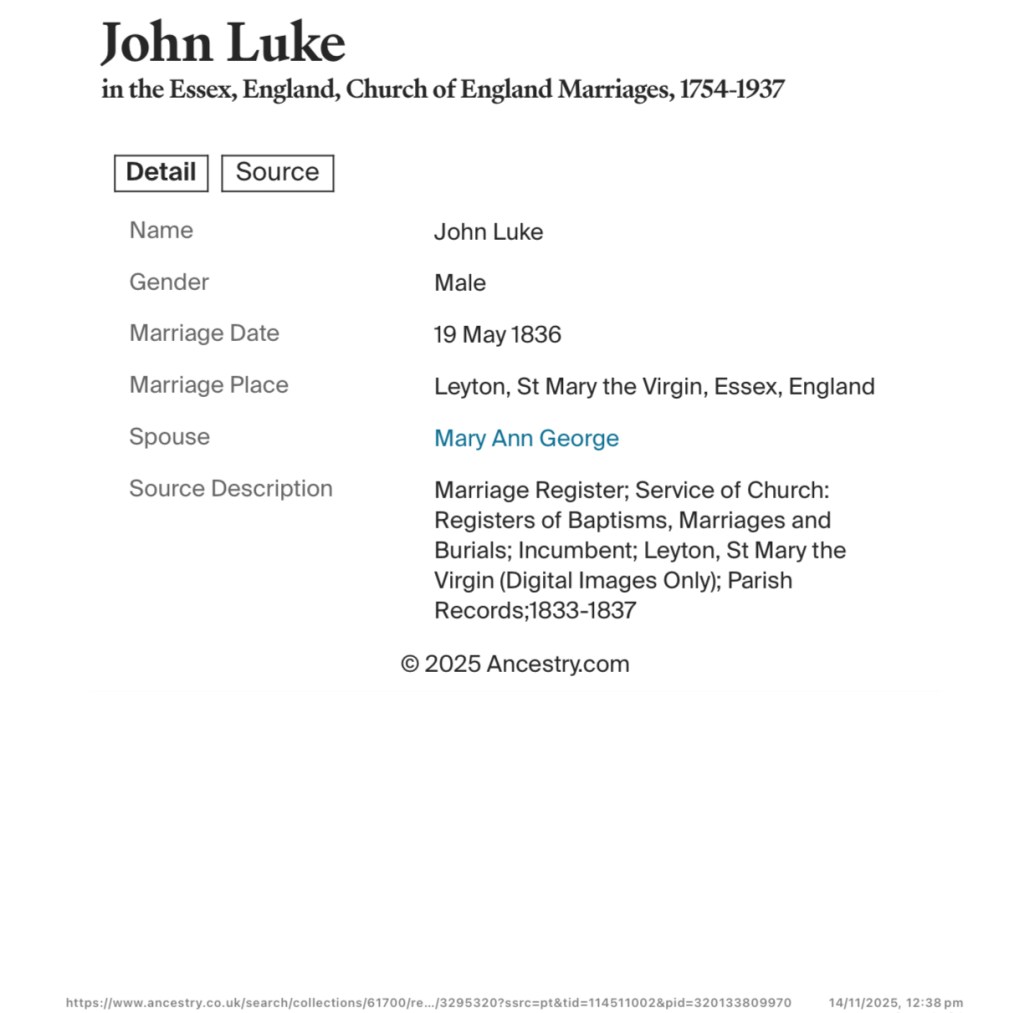
On Thursday, the 19th day of May 1836, dawn drifted softly across Leyton, but Susan Luke did not see it with her eyes. She saw it with her heart.
From her home in Lockerley, miles away across fields, roads, and county lines, she imagined the morning beginning in the east, gentle, tender, hesitant, as though the sun itself paused to honour her brother John on the day he would become a married man.
She pictured it all while standing at the cottage door, the air around her smelling of Hampshire earth, wildflowers, and the faint sweetness of cow parsley brushing the hedgerows. In her mind, a thin silver mist unfurled above the meadows of Leyton, drifting toward the River Lea. She imagined the water catching the first pale shimmer of morning, stirring with the same flutter of excitement she felt deep within her chest.
Birdsong in Lockerley became birdsong in Leyton.
The soft hum of bees near their cottage became the murmur of distant Essex fields.
The gentle warmth of the rising sun on her face became the light falling upon her brother as he prepared to wed Mary Ann George.
I do not know whether anyone from the Luke family stood beside John that day. The journey was long, the cost heavy. But I feel certain, achingly certain, that their presence wrapped around him even if their bodies could not.
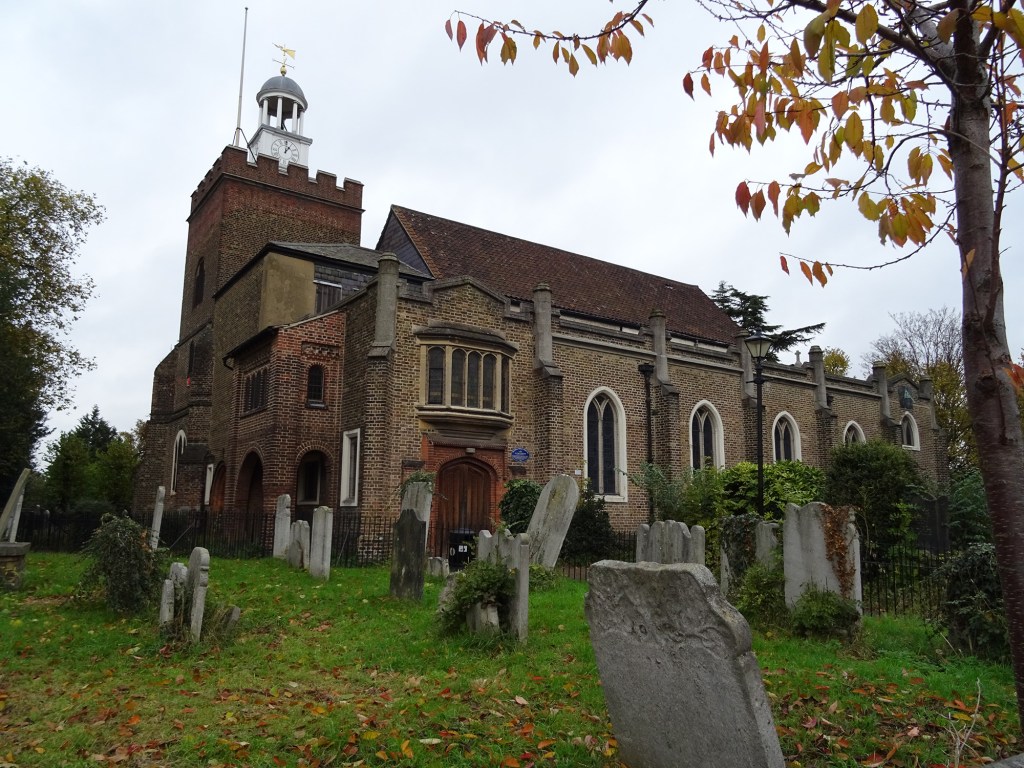
Susan tried to imagine what he wore. His best coat, brushed carefully. Hands washed and reddened by the water pump. Hair smoothed with nervous fingers. She pictured him stepping into St Mary the Virgin Church in Leyton, its old stones holding centuries of whispered vows and Sunday hymns. Far from Lockerley, yet sacred all the same.
In her imagination, the church was warm with spring light, dust motes swirling like tiny blessings. She pictured the curate standing ready, the parishioners rising, and Mary Ann walking toward her brother, soft steps, a simple gown, a shy courage in her eyes.
Susan wondered:
Would the choir sing “The Voice That Breathed O’er Eden” as it had during Charlotte’s wedding?
Would John’s voice tremble slightly when he said “I will,” just as their father’s had trembled giving Charlotte away?
Would Mary Ann’s hand rest in his like something found, not taken?
She hoped so, oh, how she hoped so.
Susan imagined John’s thoughts as clearly as if she could hear them. She saw him remembering home…
Moses bending over the fields.
Kitty humming beside the hearth.
Charlotte, newly wed herself.
Henry, climbing the oak tree near the lane.
And herself, little Susan, no longer so little now, standing barefoot in the grass, sending her love across counties and miles.
As she moved through her own day, feeding the chickens, sweeping the cottage floor, helping Kitty with chores, her thoughts kept lifting toward Essex like a tether pulled by the wind.
When the ceremony ended in her imagination, John and Mary Ann stepped out of the church into sunshine. She pictured them smiling at one another with the shy boldness of new beginnings. The bells rang out. A breeze stirred the trees. Somewhere, a child laughed. Somewhere, a flower dropped its petals in celebration.
And when evening fell over Lockerley, it fell over Leyton too.
Susan watched the sky turn from rose to lavender to deep blue, wondering if her brother saw the same colours. She imagined the fields around him glowing with the soft hush of dusk, imagined the scent of warm grass settling around him like a blessing.
She did not need to be present to feel the beauty of the day.
She felt it in the quiet pulse of her heart.
 She felt it in the way spring wrapped the world in tenderness.
She felt it in the bond they shared, strong enough to cross miles, strong enough to live in imagination where physical presence could not.
It was a day unrecorded by history books, unnoticed by the world beyond Essex… yet precious to Susan.
A day filled with the soft, breathing poetry of love, distance, memory, and the threads of family that held her heart gently in their weave.
St Mary the Virgin Church in Leyton (now in the London Borough of Waltham Forest) is a parish church with deep roots in local history. A church has stood on the site for many centuries; the first clear record dates from around 1200, when the manor and church of Leyton were granted to Stratford Langthorne Abbey. Although the current building is mostly nineteenth‐century in appearance, some parts date from the seventeenth century, most notably the brick tower and north aisle wall from 1658.
Over time the church underwent numerous rebuildings and extensions. In 1693 the chancel was rebuilt in brick with a circular east window. In 1822 a south aisle was added, the roof was renewed, the chancel raised and the church enlarged to cope with a growing population of “small traders, labourers and servants” who were increasingly living in Leyton and using the church. Further alterations took place in the late nineteenth and early twentieth centuries: the baptistry was added in 1884, the east window renewed in 1853, and a major restoration of the nave and sanctuary was carried out in 1929-1932. Bomb damage from the Second World War was repaired in the early 1950s.
Architecturally the church is striking for its mix of periods. The tower is of three stages, built in red brick with corner buttresses, and is topped by a cupola clock turret added in the eighteenth century. The nave has arcades on octagonal piers, with round-headed arches surviving from earlier work. The south aisle features Y-shaped window tracery, added in 1822, and the clerestory above is built in stucco with square-headed windows. Inside there are monuments of considerable interest, including elaborate seventeenth- and eighteenth-century memorials to local dignitaries, such as the Hicks family and the Bosanquet family.
In terms of its community history, the church reflects the changing fortunes of Leyton. In the Middle Ages it was a poor parish: records from 1254 show the vicarage valued at only forty shillings a year. By the eighteenth century the area was becoming attractive to London merchants and bankers as a “retiring place from London,” leading to a rise in population and the need for church enlargement and refurbishment. The parish registers of baptisms, marriages and burials survive for many decades and reflect the lives of ordinary people, apprentices, servants and the growing suburban community.
While the church does not have widely-documented hauntings or ghost stories attached to it, its long history and survival through periods of change give it a powerful sense of presence. Some visitors report a quiet solemnity in the older parts of the nave and the memorials tucked in side-chapels, as if the stones themselves recall past generations of worshippers and local life. The churchyard and interior combine everyday local history with architectural ambition, making it a place where both community and heritage are clearly intertwined.
Today the church remains active, part of the Church of England, and functions as a parish centre, a place of worship, and a landmark in Leyton. Its Grade II* listing recognises its architectural and historical importance, and for anyone interested in East London’s ecclesiastical history, it stands as a fine example of a parish church that evolved over centuries from rural origins to suburban life.
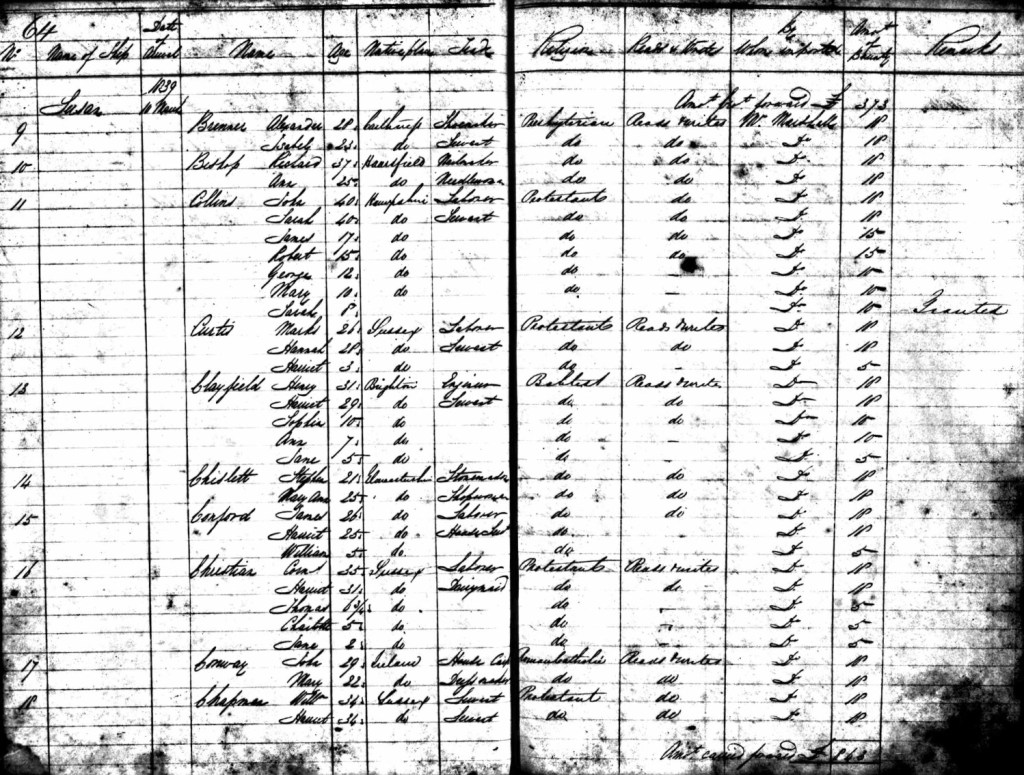
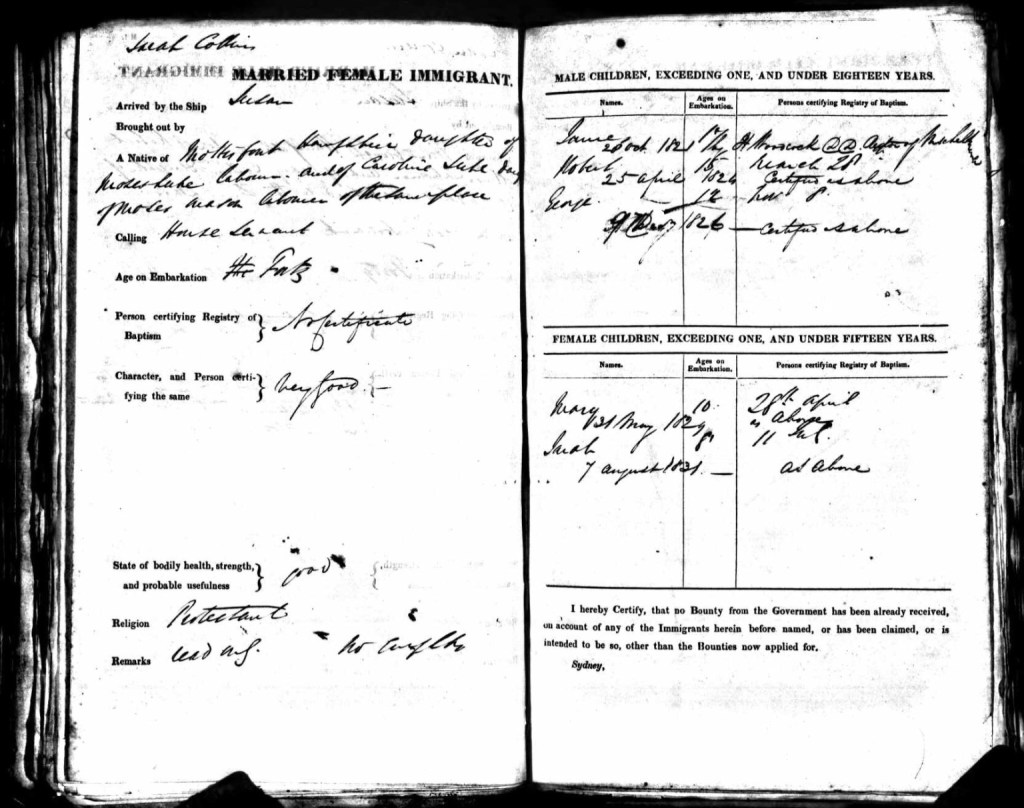
On Sunday, the 10th day of March 1839, while spring’s first whispers brushed softly across Hampshire, Susan Luke felt the world shift, though she could not hear the waves, nor see the distant shore, nor feel the tremble of the immigrant ship Susan as it finally reached its faraway destination. She simply felt it, deep inside her chest, a quiet tug on a thread that had always bound her to her sister Sarah.
Somewhere across oceans, unseen hands of wind and water were carrying her eldest sister onto new soil.
Sarah Collins, née Luke, forty years old, shaped by the fields of Lockerley and the smoke of family hearths, stepped down the gangplank into a land no Luke had ever touched before. But Susan saw her not with her eyes, but with her heart’s vivid imagining.
She pictured Sarah standing tall, her bonnet tied firmly beneath her chin, her hands roughened by years of labour and love, her eyes carrying memories of England, the dusty lanes of Lockerley, the worn pews of St John’s, the faces of siblings gathered around a cottage fire. Susan imagined Sarah whispering a silent farewell to the girl she once was, even as she greeted the woman she had become.
The voyage had begun months earlier, on Saturday, the 8th of December 1838, when Sarah, her husband John, and their six children left Plymouth, Devon, beneath a sky the colour of pewter. Frost clung to the quayside. Their breath rose in small clouds. The ship’s ropes creaked like old bones shifting.
The immigration ledger recorded their departure with cold precision:
Collins John, 40, Carpenter, London

Collins Sarah, 40, Steward

Collins James, 17

Collins Robert, 15

Collins George, 12

Collins Mary, 10

Collins Sarah, 7

Religion: Protestant

Read and Write: do

Remarks: granted.
Just ink on paper .
Just names, numbers, occupations. But to Susan, they were a living history, her family.
She knew the shape of each of them.
James, tall for his age, shoulders stiff with the responsibility of nearly-manhood.
Robert, bold and restless, eyes always scanning the horizon as though born for places far beyond Hampshire’s hedgerows.
George, thoughtful and observant, his hands always busy with something, string, wood, a pocketful of stones.
Mary with her quiet grace, her hair always coming loose in soft wisps no matter how neatly it was pinned.
Little Sarah, only seven, still half-tethered to childhood dreams, clutching her mother’s skirt with both hands.
Susan imagined the moment the family stepped aboard the Susan. The winds biting. The ship groaning. Sarah taking one final look toward the shore, knowing she was leaving behind not only England, but the faces of those who had known her since birth.
She imagined her sister’s courage, how it might have quivered in her chest like a bird’s heartbeat, but still she stepped forward.
Throughout the long voyage, when storms howled like wounded creatures and water crashed against the hull with terrifying force, Susan believed it was Sarah who steadied her family. She could almost see her, whispering to little Sarah in the dark, smoothing Mary’s hair each morning by the dim lantern light, placing a firm hand on Robert’s shoulder when restlessness threatened to spill into trouble, offering George quiet tasks to keep his mind busy, and meeting James’s troubled gaze with a mother’s silent assurance, you are not alone, you are never alone.
Susan never heard any of these stories. Yet she knew them to be true in the marrow of her bones.
When the ship finally docked and the family stepped onto foreign soil, Susan imagined Sarah pausing, just for a heartbeat, her feet sinking slightly into the new earth.
What did she see?
What scents greeted her?
What dreams unfurled beneath that unfamiliar sky?
Susan pictured her sister’s face lifted toward the light, not in triumph, but in steady, quiet resolve. Sarah had always been strong, not loudly, not boastfully, but in the way of women who survive storms with tenderness and stubborn hope.
And though oceans now lay between them, Susan felt her sister’s courage like a warm ember inside her own chest. She stood outside the cottage that morning, Hampshire mist curling around her, and whispered a blessing into the wind, sending it across the sea.
For while the immigration ledger captured only sparse details, a few neat lines, practical and spare, Sarah’s true journey lived far deeper.
It lived in her bravery.
In her endurance.
In the love she carried for the family she left behind.
In the faith that guided her through restless waters.
And in the hope that waited for her on the far shore.
To Susan, the 10th of March 1839 was not merely the day her sister reached a new land.
It was the day her imagination stretched across an ocean.
 The day her heart learned how far love could travel.
The day she understood that a woman’s courage, like the sea, can be vast, wild, and achingly beautiful.
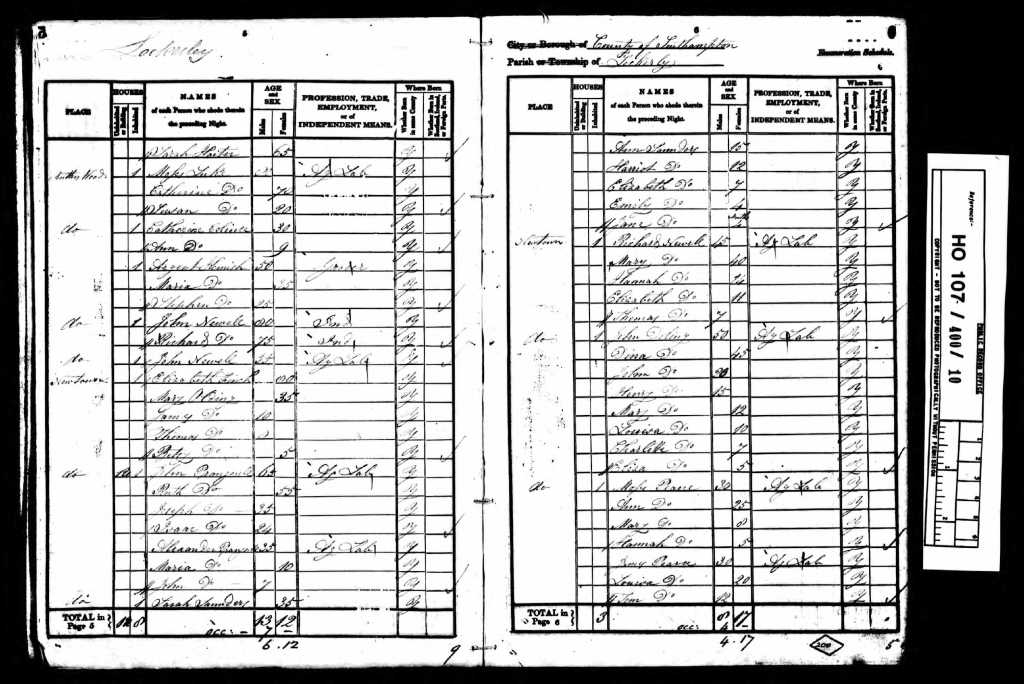
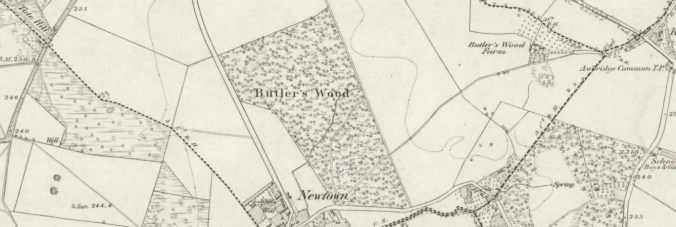
On Sunday, the 6th day of June 1841, the evening settled gently over Butlers Wood in Newtown, Lockerley, as though dusk were laying a cool hand upon the fields after a long summer day. Twenty-year-old Susan stood at the cottage door, watching the sky turn from warm gold to rose, then to a soft, dusky blue. The scent of cut grass drifted through the air, mingling with woodsmoke and the distant call of a night bird. The world felt suspended, hushed, waiting, as if it knew that this night would become a small, enduring mark in the story of her life.
For this was census night, the first ever to touch her with its quiet insistence.
Inside the cottage, her father Moses, moved slowly but steadily, his body weathered by decades of labour in Hampshire’s fields. Though time bent his back and stole some of his strength, he was still recorded proudly as an Agricultural Labourer, a title earned by sweat and seasons, by the steady turning of the earth beneath his hands. Her mother, Catherine, Kitty, sat near the hearth, her fingers working gently over a mending task as the fire cast an amber glow upon her face. The years had softened her features but not the warmth in her eyes.
The census was not taken by the villagers themselves, but by men appointed as enumerators, often schoolmasters, parish officials, or literate tradesmen who knew the lanes as well as the families who lived among them. Dressed neatly, census books tucked beneath their arms, they walked from door to door as evening thickened, visiting each household in turn. In 1841, they did not write down relationships or the tender intricacies of family life; they captured only names, approximate ages, occupations, and whether one was born “in county” or “out.”
The enumerator who approached Butlers Wood would have knocked gently on the Lukes’ wooden door, perhaps removing his hat, perhaps offering a polite greeting. Susan would have stepped forward, smoothing her apron, her heart fluttering with the awareness of being counted, of being seen in the quiet ledger of the nation.
He would have looked upon the three of them, Moses, Catherine, Susan, and written their names with brisk, unfussy strokes, unaware of the stories that lived behind each one.
Unaware of Moses’s long years of toil.
Unaware of Kitty’s steady devotion.
Unaware of Susan’s unspoken dreams.
Just three lines in a book.
Yet to Susan, it felt as if time itself had paused to acknowledge the shape of her family.
Through the small cottage window, Susan could see the homes of their neighbours. To one side lived 65-year-old Sarah Haiter, a familiar figure whose steps along the lane were as constant as the turning of the seasons. To the other side lived someone even closer to Susan’s heart, her sister Catherine, and Catherine’s daughter Ann Collins, her name recorded as Colince in the enumerator’s uncertain hand. Susan smiled when she heard Ann’s laughter through the hedgerow, the sound mingling with the soft rustle of leaves. How comforting it was, on this quiet night of counting and recording, to know that family pressed close on both sides.
The enumerator moved on, his footsteps fading into the warm twilight, leaving behind the faint scratch of ink drying upon paper, the Lukes forever fixed in the census of 1841.
But for Susan, the moment lingered long after he departed. She stood beneath the darkening sky, thinking of all that had changed and all that remained. She was twenty now, no longer the barefoot girl chasing sunbeams through Lockerley’s lanes. She stood between youth and womanhood, between memory and possibility. The census recorded her as simply “Susan, age 20,” but she felt the stirrings of a deeper truth, of belonging, of identity, of her place within the vast, unfolding story of her family.
As the evening deepened and the first stars pricked through the blue, Susan closed the cottage door softly behind her, the warmth of her parents’ voices drifting through the dim firelit room.
Outside, the village breathed.
Inside, the Lukes lived and hoped, counted not just by the enumerator’s careful hand, but by the love that bound them, quietly, indelibly, together.
Butler’s Wood, situated near Newtown in Lockerley, Hampshire, is a historic woodland with deep roots in the region's agricultural and social history. The wood was enclosed in July 1815 under the Inclosure Act of 1811, which aimed to consolidate and privatize common lands for more efficient farming practices. This enclosure marked a significant shift in land use and ownership in the area.
The landscape surrounding Butler’s Wood was predominantly agricultural, with crops like wheat, barley, oats, and turnips being cultivated. The subsoil consisted of gravel, and the soil was a mix of chalk and clay, which influenced the types of crops that could be grown and the farming methods employed.
In the 19th century, the area experienced significant changes. The construction of the railway line through Lockerley in the mid-1800s facilitated the transport of goods and people, leading to increased development and urbanisation in the region. This development included the establishment of new farms, residential areas, and infrastructure, transforming the rural landscape.
Life for twenty-year-old Susan, living at Butler’s Wood in Newtown, Lockerley, Hampshire in 1841, would have unfolded in rhythms as steady and familiar as the turning of the seasons. Everything around her, every sound, every scent, every task, was shaped by rural English life in the early nineteenth century, where time was measured not by clocks but by daylight, harvests, and the needs of home and land.
Her days would have begun early, often before the sun had fully risen. The small cottage at Butler’s Wood would stir awake with the gentle clatter of her mother Kitty moving about the hearth, rousing warm embers from the night’s fire. The hearth was the heart of the home, their only true source of heat and the place where every meal was cooked. In winter, the fire never fully died, but in milder months it needed coaxing each morning, and Susan would often help her mother gather kindling, blow life into the coals, and hang the kettle to boil.
Breakfasts were simple. Bread, often coarse and homemade, perhaps still warm from the previous day’s baking. A little cheese if the family had managed to keep some from mould. Porridge on colder mornings, stirred slowly in an iron pot. Tea was a small luxury, carefully measured; sometimes it was stretched with herbs gathered from the woods and hedgerows. Milk was precious and used sparingly unless they had access to a neighbour’s cow. Life was built from frugality, yet there was comfort in these routines.
After breakfast, Susan’s tasks would unfold quietly but unendingly. She helped her mother wash clothes in cold water drawn from a nearby stream or pump, scrubbing linens on washboards with harsh lye soap that stung the skin. She mended garments by firelight, patched her father’s work trousers, and kept the small cottage swept and tidy. Floors were often packed earth or uneven wooden boards, always in need of sweeping. The cottage walls were low and smoked-stained from years of fire, but it was home, warm with the familiarity of family voices.
Though her father Moses was eighty years old, he was still recorded as an agricultural labourer, which meant that Susan’s help was often needed outdoors. Young women in labouring families did not shy from field work. She would have joined him at times in gathering stones from fields, gleaning leftover grain after harvest, pulling weeds from kitchen gardens, or carrying baskets of potatoes and turnips to store in the cottage. Her father’s work was hard and unending, shaped by the demands of wealthy farmers who owned the land. His hands were calloused, his back bent by years of ploughing and hedging, and Susan would have done what she could to lighten his load.
Meals through the day followed the same modest pattern. Root vegetables formed the backbone of their diet, potatoes, turnips, carrots, and onions. Cabbage, peas, and beans supplemented what they grew or what neighbours shared. Meat was rare, usually salted or boiled into broth, often reserved for Sundays or special occasions. Most meals were stews simmered in a single pot, hearty enough to sustain but never extravagant. Bread was ever-present, sometimes baked by neighbours, sometimes bartered. Ale or small beer was common, safer to drink than unboiled water, though tea was the household’s cherished comfort.
Village life in Lockerley was close-knit, full of familiar faces and intertwined histories. The same lanes Susan walked had carried generations of Lukes before her. Their neighbours were anchors of daily life. Just beyond their cottage lived sixty-five-year-old Sarah Haiter, and on the other side, her sister Catherine and young niece Ann, family so close that Susan could hear their laughter through the hedgerows. Visits between cottages were common, especially on Sundays after church at St John’s, when families shared news, stories, and the warmth of companionship.
Travel was slow and simple. Feet were the primary means of movement, strong from years of walking the winding lanes. If fortunate, a neighbour might offer a ride atop a cart pulled by a tired farm horse. Longer journeys, like those to Romsey or Salisbury, required planning and endurance. The stagecoach passed through larger towns, but such travel was expensive and usually reserved for emergencies or rare occasions.
Susan’s evenings were gentle. After chores were finished and supper eaten, the family gathered near the fire. Moses might tell stories of his own childhood in Lockerley, memories reaching back to a world Susan could hardly imagine. Kitty mended clothes by firelight, and Susan might help, threading needles with fingers stained by work. Oil lamps and tallow candles offered faint pools of light, flickering shadows across the room. On warm nights, they sat outside listening to night birds and distant animal sounds drifting from the woods.
Life for Susan was not easy, but it was full, full of labour, of love, of the steady heartbeat of village life. She lived in a world where every loaf of bread, every stitch of thread, every spark from the hearth carried the weight of generations. She learned resilience from her mother, determination from her father, and the quiet beauty of rural life from the landscape around her.
In 1841, she stood on the cusp of womanhood, shaped by Butler’s Wood, by the soil under her nails, by the rhythm of her parents’ footsteps, and by the simple, enduring strength of a Hampshire girl with dreams she scarcely dared to speak aloud.
Morning unfolded over Butler’s Wood with a softness that felt almost sacred, as though midsummer itself understood that this day would require gentleness. Pale light threaded through oak and beech leaves, warming the cool breath of night that still clung to the moss and earth. Bees hummed drowsily through the bracken by noon, the air thick with the sweetness of blossoms opening to the heat. Yet within the Luke family’s cottage on Friday, the 16th day of July 1841, time seemed to move differently, slow, heavy, careful, as though it knew it must carry a precious soul toward its final rest.
Inside, Susan’s beloved mother, Catherine Kitty lay in her narrow bed, her breaths soft and shallow, each one a fragile thread tethering her to this world. Twenty-year-old Susan sat close, her fingers wrapped gently around her mother’s hand. She could feel the faint warmth fading, the once-strong pulse now flickering like a candle’s last glow. Beside them, Moses, eighty years old and bowed by years of labour and love, held his vigil with a trembling devotion. His weathered hands smoothed Kitty’s blanket. His lips shaped words meant only for her, broken murmurs of gratitude, love, and sorrow.
As the afternoon sunlight lengthened across the floor, Kitty’s breathing grew quieter.
Then softer still.
And finally, it stilled altogether.
Her passing felt like the gentlest sigh, so light that Susan almost thought she imagined it. The room seemed to hush, even the dust motes suspended in a golden beam of light. For a heartbeat, Susan could not move. She felt the shift in the world as something deep and irrevocable.
Then she remembered.
Her mother had once told her, long ago, perhaps on another summer’s day, that when a soul leaves the body, the window should be opened so it may find its way into the open air.
Susan rose on shaking legs, crossed the small room, and lifted the latch with trembling fingers. The window swung outward with a creak, inviting the warm July air to drift inside. A soft breeze brushed her face, curling around her like an embrace. She liked to think it gathered her mother’s spirit gently, carrying it upward into the great, welcoming sky.
When she turned back, she found Moses still bent over Kitty, his shoulders quivering, his breath catching in uneven whispers. The sight pierced her like a blade. She moved to him, placing an arm around his back, guiding him gently upright. He leaned into her, not fully, but enough that she could feel the immensity of his grief. Together they stood, holding on to one another as the truth settled like a slow, inevitable shadow.
Kitty was gone.

And nothing would ever be the same.
In the hours that followed, Susan moved with a reverence born of love and duty. She washed her mother’s face with warm water, smoothing back the silvered hair that had once been bright with youth and tied beneath Sunday bonnets. She straightened the blankets, arranged Kitty’s hands over her chest, and laid her out with tenderness, each touch a blessing, each breath a farewell. Moses remained near, silent and hollow-eyed, unable to look away.
The cottage grew dim as evening approached. Outside, birds still sang, utterly unaware that the world inside these walls had been cleaved in two.
In the days that followed, Moses performed the solemn duty that fell to him as husband. On Tuesday the 20th of July, he walked, slow, steady, burdened, to the registrar. His step was uncertain, his grief raw beneath the July sun. There, with hands made clumsy by age and sorrow, he placed his simple X in the death register of Mitchelmersh. A mark so small, so plain, yet it held the weight of a lifetime shared.
The record wrote it plainly, starkly:
DEATHS in the District of Mitchelmersh in the County of Hants & Wilts
No. 246
When Died: Sixteenth of July 1841 at Lockerley
Name and Surname: Kitty Luke
Sex: Female
Age: 72 years
Rank or Profession: wife of Moses Luke, Labourer
Cause of Death: Natural Decay
Signature, Description, and Residence of Informant: The mark X of Moses Luke, Occupier, Lockerley
When Registered: Twentieth of July 1841
Signature of Registrar: Thos. Green, Registrar, Lockerley
When Registered: Twentieth of July 1841
Signature of Registrar: Thos. Green, Registrar
The Ink dried. The page closed. But for Moses and Susan, the reality had only begun to settle.
The cottage felt unbearably quiet without Kitty’s soft movements, her gentle humming, the way she warmed even the coldest mornings with her presence alone. Susan found herself pausing in doorways, expecting to hear her mother’s voice. Moses, once sturdy even in age, seemed smaller now, his world suddenly unfamiliar without the woman who had walked beside him for so many decades.
And yet, amid the sorrow, a tender peace lingered too. Kitty had lived a long life, faithful, loving, rooted in the soil and seasons of Lockerley. Her passing, though painful, was gentle. And the love she left behind filled every corner of the cottage, in the worn handle of her teapot, in the quilts she had stitched by lamplight, in the memory of her laughter.
For Susan, grief did not come as a storm but as a tide, soft, steady, sorrowful. Some moments it receded, leaving her grateful for the years they shared. Other moments it rose so high she could scarcely breathe.
But through it all, she felt her mother near, in the rustle of the trees outside the window, in the warmth of the July air brushing her cheek,
and in the steady, fragile heartbeat of her grieving father at her side.
Kitty was gone from their sight.
But she had not vanished.
She had simply slipped into the open air.
On Tuesday, the 20th day of July 1841, the morning light crept gently into the cottage at Butler’s Wood, but to Susan, it felt like dawn rising over a world forever changed. The air was too quiet, the rooms too still. The familiar rhythm of her mother Kitty’s footsteps, once the soft heartbeat of their home, had vanished. The spinning wheel stood motionless. The hearth’s comforting clatter had fallen silent. The cottage seemed hollow, as though something sacred had slipped from it in the night.
Her mother’s coffin rested on trestles in the front room, where Kitty had once hummed while folding linens or plaiting rushes. The fresh scent of timber lingered faintly, mingling with the lavender Susan had tucked inside the shroud, a final offering of gentleness. Through the long night, Susan and her father Moses had kept vigil, he sitting with one weathered hand resting on the wooden lid, tracing the place where her mother’s fingers would have lain.
To Susan, he looked impossibly small, as if grief had peeled away decades of strength. He did not weep loudly, his sorrow was quieter, deeper, a trembling in his breath, a soft murmur of Kitty’s name that broke Susan’s heart anew each time it slipped from him.
When the four village men arrived, men who had worked beside Moses under the same Hampshire sun for years, they stepped into the cottage with reverent solemnity. Each carried the weight of memory in his eyes. Susan watched them lift Kitty’s coffin with steady hands, their movements slow and tender. As they bore her mother toward the door, Susan felt a sharp ache rise in her chest. This was Kitty’s final leaving. The moment the cottage stopped being the place where her mother lived and became only the place where her memory remained.
Moses followed behind the coffin, each step a battle between love and breaking. Susan walked beside him, her arm linked through his, guiding him gently down the lane they had travelled so many times as a family. But today the lane felt different, emptier, muted, washed in the strange hush of mourning. Summer hedgerows shimmered green, bees drifted lazily between blossoms, and the air smelled of warm grass and distant hayfields. Yet to Susan, all this beauty felt dimmed, like sunlight struggling through clouds.
When St John’s Church came into view, the ancient yews bowed in the warm breeze as though inclining themselves in solemn greeting. Susan had walked this path with her mother countless times, for Sunday services, baptisms, the weddings of siblings. Now she walked it behind a coffin, her father’s trembling hand clinging to hers.
Inside, the church was cool and hushed, the stone walls holding centuries of sorrows and blessings. Moses paused beside Kitty’s coffin, laying both hands upon it, his breath shaking. Susan stood close, feeling his grief through her bones. He whispered something, words only Kitty could claim and Susan felt tears spill onto her cheeks. She realised then that she was not just mourning a mother, she was mourning the gentle anchor of her family.
The curate Edmond Dunford read from the Book of Common Prayer, his voice rising like a distant tide:
“I am the resurrection and the life…”
Susan heard the words, but they slipped through her. She was drifting through memories: Kitty brushing her hair by lamplight, smoothing Moses’s collar on Sunday mornings, laughing softly at the hearth. When the curate spoke the final “Amen,” the words felt like a soft closure, a door gently falling shut.
Outside beneath the July sun, the burial record waited for its ink:
Name: Kitty Luke

Abode: Lockerley

When Buried: July 20th

Age: 71 years

By whom the Ceremony was performed: Edm. Dunford.
A small script recording the end of an entire world.
At the graveside, Susan held her father as the ropes groaned and lowered the coffin into the cool earth. The hollow thud of soil striking wood sank into her soul. She tightened her grasp around Moses’s arm as his knees weakened. His tears fell silently, travelling down lines carved by a lifetime of toil and tenderness.
After the last handful of earth was placed and the curate closed his book, Moses remained standing by the grave, staring at the mound of fresh earth as though willing himself to memorise its shape. Only when the churchyard grew utterly still did he whisper her name, a soft, aching sound that carried the weight of their entire marriage.
As they turned back toward their cottage at Butler’s Wood, Susan felt the finality settle onto their shoulders. The home would never sound the same. Never feel the same. Never breathe the same warmth. She clung to her father, knowing she must now become for him what Kitty had been, steady hands, a quiet presence, a fragment of what had been lost.
And yet, beneath the grief, she felt something tender and eternal whisper through the summer air.
Kitty’s love had not vanished.
It lingered in the sunlight on the lane, in the hush beneath the yew trees, in the warmth that brushed Susan’s cheek as she walked home.
Her mother’s spirit remained, woven into the soil of Lockerley, into the wind that swept through Butler’s Wood, and into the hearts of the husband and daughter who would carry her memory for the rest of their days.
Love like Kitty’s does not end.
It becomes the very breath of the world left behind.
In the quiet heart of Lockerley, where winter lingered gently among the fields and hedgerows, Monday, the 6th day of February 1843, dawned pale and cold. Frost clung to cottage roofs like a silver veil, and the stillness of the season wrapped itself around the village, as if the whole world were holding its breath. And in the small, humble home where twenty-three-year-old Susan Luke lived, something extraordinary unfolded, something tender, fierce, and profoundly human.
A child was coming.
For women in Lockerley, childbirth was an intimate battle fought in the dim warmth of the cottage hearth. There were no doctors, no sterile rooms, no instruments gleaming beneath lantern light. There were only the old ways, passed from mother to daughter, neighbour to neighbour, generation to generation. Warm water was heated in iron pans. Clean rags were stacked near the bed. A trusted midwife, or sometimes only an older village woman, was summoned through early-morning darkness, her footsteps crunching across the frozen lane.
Labour was long, raw, and unlit by any comfort beyond companionship and prayer. Women bore their pain loudly or silently; both were honourable. Outside, the wind might rattle the shutters, but inside, the room swelled with breath, effort, and whispered encouragement. Susan clutched the edge of the mattress, her dark hair damp with sweat, her body tightening again and again as nature called her forward. She was young, frightened, alone in ways that mattered deeply, but she was also strong, a strength born from the soil of Lockerley itself.
And then, as the hours passed and the February light weakened into grey, a cry rose, a thin, sharp, beautiful song.
A girl.
A daughter.
Susan held her newborn close, the little body warm against her skin, tiny fists curling into the air as if claiming her place in the world. She named her Ellen.
Ellen’s birth was recorded in the District of Mitchelmersh, within the Counties of Hants and Wilts, under the gentle care of Registrar William Cole, who penned her arrival on Wednesday the 15th day of February, 1843:
Births in the District of Mitchelmersh in the Counties of Hants & Wilts
No.: 96
When Born: Sixth of February 1843 at Lockerley
Name, if any: Ellen
Sex: Girl
Name and Surname of Father: —
Name and Maiden Surname of Mother: Susan Luke
Rank or Profession of Father: —
Signature, Description, and Residence of Informant: The mark of Susan Luke, Mother, Lockerley
When Registered: Fifteenth of February 1843
Signature of Registrar: William Cole, Registrar
Baptismal Name, if added after Registration of Birth: —
Susan did not sign her name; she marked the register with an X. But her love, her courage, her defiance of shame, that needed no letters.
For the space where a father’s name should have been remained starkly, painfully empty.
In a village like Lockerley, such silence spoke loudly. An unmarried mother was gathered into the harsh judgment of parish eyes, the whispers slipping like cold draughts beneath cottage doors. Some neighbours would have looked at Susan with pity curled inside their glances; others with reproach sharpened by custom. Respectability mattered. Appearances mattered. And yet here she was, bringing life into the world without a husband’s name to shelter her.
But Susan had endured grief before, she had held her mother as she died, watched her father break with sorrow, and felt poverty’s weight press upon her daily life. She could endure this too.
Whispers suggested that Charles Hatcher, twenty-eight years old, was the man whose blood now flowed in little Ellen’s veins. Whether his absence was chosen or forced, only time and silence knew. But Susan faced the world as she always had, quietly, resolutely, with the steadfast tenderness she had inherited from Kitty.
In the nights that followed Ellen’s birth, as winter winds breathed against the windowpanes, Susan rocked her daughter close. She memorised the soft rise and fall of her tiny chest, the warmth of her cheek, the fragile whimpering breaths that softened into sleep. She whispered lullabies learned from her mother, let her tears fall freely when fear overtook her, and held her child as if she could protect her from every pang of the world.
To the parish register, Ellen was merely entry No. 96.
To the village, she was the child of a woman who had strayed from the expected path.
But to Susan, She was joy carved from sorrow, light born of longing, a heartbeat placed gently in her arms by fate itself.
And in that small Hampshire cottage, warmed only by the hearth and the love of a young mother, Ellen’s story began, not in shame, but in the quiet, unwavering grace of Susan’s courage.
On Thursday, the 23rd day of February 1843, winter lay heavy over the little village of Sherfield English, its cold breath settling softly upon hedgerows and fields as if the season itself were preparing to surrender something precious. And within a modest cottage there, a life was quietly slipping away.
Susan’s brother, William Luke, only forty-six years old, a labourer whose hands had carried the weight of Hampshire’s soil, its harvests, its unyielding seasons, met his final moments not in loneliness but in the gentle presence of Harriet Moody. She sat beside him as his breathing grew thin, as the shadows lengthened across the room. Hers was the last face he saw, her hand perhaps wrapped around his, offering that small, tender grace that stands between life and eternity.
Whether any of his many siblings knew how quickly his health had failed, whether Moses, his ageing father, or Susan, who had already borne so much loss, reached him before the end, history does not say. I hope he had not crossed that threshold alone, that someone had whispered a prayer, a memory, a comfort to him as he passed.
It was Harriet herself who made the solemn walk that same day to the register office. She carried the news like a stone in her chest, stepped through the quiet door, and spoke the words of his death to Registrar William Gibbs, who set his pen to the page.
The record wrote it plainly:
DEATHS in the District of Mitchelmersh in the Counties of Hants & Wilts
No. 235

When Died: Twenty-third of February 1843 at Sherfield English

Name: William Luke

Sex: Male

Age: 46 years

Rank or Profession: Labourer

Cause of Death: Phthisis

Informant: Harriet Moody, Present at the Death, Sherfield English
Registered: Twenty-third of February 1843

Registrar: William Gibbs.
Just lines of ink.
Just cold, factual words.
Yet they marked the ending of a life that had once been warm and laughing and full of gentle stubbornness.
Beyond those columns lived a man who had run through the fields of Hampshire as a boy, whose boots had worn paths along ancient lanes, whose smile had softened long days spent in labour. A brother who had shared bread at the family table, who once laughed beside the hearth-fire of Butler’s Wood, who had carried the Luke name with quiet pride.
When news reached Lockerley, it must have struck Susan like a cold wind. She had barely begun to mend the wound left by her mother’s death. Her heart was still tender, still searching for the softness Kitty had carried in her hands and voice. And now William, another piece of her family’s foundation, was gone.
In the stillness of that February evening, Susan sat beside her father, the two of them bound together by grief once more. Moses, worn with age and sorrow, may have bowed his head into his hands. Susan may have placed her hand upon his shoulder, feeling the tremor of his breath. For a moment, the cottage felt unbearably small, too full of memory, too empty of the ones who had shaped it.
But soon another duty rose gently before Susan, one made heavier by distance and oceans.
She would need to find someone who could write a letter for her.
A letter to Sarah, her sister living in Australia.
A letter that would travel across the world, carrying words Susan could not soften, could not dress in hope. Words that would cross sea and sky to tell their faraway sister that another piece of home had slipped into the grave.
As Susan sat in the dim lamplight, Ellen sleeping softly in her cradle, she felt the years stretching behind her like a chain of vanished moments, her mother’s passing, her daughter’s birth, and now her brother’s death. Yet woven through the sorrow was love, quiet, enduring, and impossibly strong. The kind of love that carries a family through time, even as its members slip one by one into the gentle silence of the past.
William’s voice had faded.
But the memory of him, his laughter, his kindness, the simple steadfastness of who he was, would remain, echoing softly through the fields he once walked, through the hearts of those he left behind, and through the ink of every record that bears his name.
Sherfield English is a small village located in the Test Valley district of Hampshire, England. It lies just a few miles northwest of Romsey and is set within the picturesque Hampshire countryside, surrounded by farmland and natural beauty. The village has a rich history that spans several centuries and is deeply connected to the rural landscape of southern England.
The name "Sherfield" likely comes from Old English, where "scear" refers to a slope or hill and "feld" means open land or field, suggesting the village was established in an area with a prominent geographical feature. The addition of "English" to the name occurred later, distinguishing it from other similarly named places following the Norman Conquest of 1066.
Sherfield English's development can be traced back to the medieval period, when it was primarily a farming community. The village's history reflects the broader agricultural heritage of Hampshire. It grew slowly but steadily, with most residents engaged in farming and agricultural work, a typical occupation for rural England at the time. The village’s centerpiece was the parish church, St. Leonard’s Church, which has served as a spiritual and social center for the community for many centuries. The church, with its origins dating back to the 12th century, is a key focal point of the village and reflects its long religious history.
In the 19th century, Sherfield English, like many rural areas, began to see changes brought on by population growth and the rise of industrialization. While the village remained largely agricultural, the expansion of transportation networks, particularly railways, brought new opportunities for trade and communication. This period also saw the construction of several cottages and houses in the village, leading to an increase in population.
The architecture of Sherfield English retains much of its historic character, with a mix of old cottages and larger homes. Despite the growth of nearby towns, the village has managed to maintain its rural charm and peaceful atmosphere, remaining a quiet, residential area. Its location, just a short distance from Romsey, offers a blend of tranquility and accessibility.
St. Leonard’s Church, at the heart of Sherfield English, has been integral to the community since its establishment. It was built in the 12th century, with subsequent renovations and expansions reflecting changing architectural styles and the evolving needs of the congregation. The church is dedicated to St. Leonard, the patron saint of prisoners and the mentally ill, and its role in the community has been central to the village's spiritual life. The churchyard around St. Leonard’s Church contains numerous gravestones, many of which date back several centuries, and the church remains an active site for worship, weddings, and other community events.
Sherfield English is also steeped in local folklore, and like many historic English villages, it has its share of ghost stories and rumored hauntings. St. Leonard’s Church, with its long history, is often the focal point of these tales. Some locals have reported strange occurrences in and around the churchyard, such as the sensation of being watched or hearing unexplained sounds like distant footsteps or murmurs. There are also stories about church bells ringing at night without anyone in the building to ring them, adding to the eerie reputation of the church. While these accounts remain largely anecdotal, they contribute to the village’s sense of mystery and intrigue.
In addition to the church, other old buildings in the village, such as historic houses and inns, are also said to be associated with ghostly activity. Some residents have claimed to see shadowy figures in certain rooms or have experienced cold drafts in areas of these older properties. These stories, while not officially documented, persist as part of the village's folklore and add to the character of Sherfield English.
Today, Sherfield English remains a picturesque and peaceful village, with a small but active community. The surrounding countryside offers opportunities for outdoor activities such as hiking, cycling, and birdwatching, making it an attractive location for those seeking a rural lifestyle while still being close to Romsey and other nearby towns. The village's historical charm, combined with its natural beauty and connection to local traditions, continues to make it a unique place to live and visit.
Sunday, the 26th day of February 1843, broke with a pale, reluctant light over Lockerley, as though dawn itself felt the weight of the sorrow that would soon pass through its lanes. A thin, cold mist wove itself between hedgerows and pooled in the hollows of the earth, blurring familiar shapes into something ghostlike and distant. The winter air was sharp, each breath drawing a chill deep into the chest, and the sky hung low and colourless, pressing down upon the village like a heavy, grieving hand.
Inside the Luke cottage, the world felt suspended. Susan, her shawl pulled tightly around her shoulders, prepared herself for the walk to St John’s Church, a walk she had made so many times before, for baptisms, weddings, and Sunday services. But never had the journey felt this long, nor the air this heavy.
William’s coffin had not rested in their childhood home, he had died in Sherfield English, just a few miles distant, his final breaths witnessed by Harriet Moody, the woman who had cared for him in his decline. And so the coffin had come directly from that village, borne across fields still hard with frost. But when the funeral bier appeared at the edge of Lockerley, Susan felt something inside her break, a final, undeniable truth settling heavily into her heart.
Her brother was gone.
Four village men, neighbours, labourers, men who had known William’s laughter and his quiet way. Or maybe his brothers, Moses, John and Henry, walked with sombre steps, their breath rising in faint clouds. Their hands gripped the wooden handles of the bier, moving in the slow, reverent rhythm that funerals demanded. William’s coffin was plain, fashioned from simple timber, but Susan saw it differently. To her, it was the sum of everything he had been, kind, steady, hardworking, a man shaped by the Hampshire soil.
The mourners followed behind: Moses, aged and bent, eyes red with a grief almost too deep for him to bear; siblings with heavy hearts, neighbours, and Susan, who felt as though she walked beneath a veil of sorrow. Ellen, still an infant, was most likely left with a trusted neighbour to spare her the cold. Susan’s arms felt strangely empty without her child’s small weight, as though loss now touched every part of her life.
As they approached the churchyard, the great yew trees, older than memory, guardians of generations, stood silent and immovable. Their dark branches stirred only faintly, as if bowing in respect. Susan felt their stillness settle around her, ancient, watchful, eternal.
Inside St John’s, the air was cool and dim, carrying the scent of wax, damp stone, and the faint perfume of evergreens placed near the chancel. Funerals in rural parishes were simple, solemn affairs. Congregational singing was rare, but sometimes a soft, trembling voice would begin “O God, Our Help in Ages Past,” a hymn whose words carried both comfort and finality. Whether sung or merely breathed in memory, its presence seemed to linger that morning.
Curate John Dunford stood ready at the chancel steps, his white surplice glowing faintly in the weak light. His voice rose with the familiar words from the Book of Common Prayer:
“I am the resurrection and the life…”
The words, meant to console, felt instead like stones falling into the cold air. Susan tried to listen, but her mind drifted to the brother she had once known, the boy who teased her by the hearth, the young man who walked through the fields with effortless ease, the brother who smiled with quiet warmth that made the world feel safe.
Now he lay before her in a wooden box.
When the curate motioned for the coffin to be carried to the grave, the men moved with solemn care, lowering the bier and lifting the coffin’s weight on their shoulders. Susan followed close behind, her steps trembling as she walked the short distance into the churchyard. The winter earth, hard and unyielding beneath her feet, seemed to resist the very idea of receiving her brother.
At the open grave, the mist swirled faintly, as though the air itself mourned.
The ropes groaned softly as the coffin was lowered.
Susan felt Moses sway beside her, his breath hitching.
She reached for his arm, steadying him, steadying herself.
Then came the sound, that unmistakable, eternal sound of the first shovelful of earth striking wood.
A dull, heavy thud.
A sound like finality.
A sound that carved itself into her heart.
Tears slipped silently down Susan’s cheeks. She did not sob; her grief ran too deep for sound. Instead, she watched as earth slowly covered the coffin, each handful sealing another piece of their family’s shared past.
The burial register would record it with cold precision:
Name: William Luke

Abode: Sherfield English

When Buried: February 26th

Age: 46 years

By whom the Ceremony was Performed: John Dunford, Curate
But the register could not capture the tremor in Moses’s hands, nor the way the winter light dimmed as if to honour William’s passing. It could not hold the ache of sisters left behind, the hollow that opened in Susan’s chest, the silence that followed the final prayer.
When the last of the earth was patted down, when the curate closed his book, when the mourners began their slow journey home, Susan remained a moment longer. The air was cold, but she did not feel it. She knelt beside the fresh mound, laying her palm upon the damp soil as though she could still reach him somehow.
“I love you,” she whispered, words carried away on the faint breath of winter.
Then she rose, taking Moses’s arm, guiding him gently back through the churchyard, beneath the watching yews, and toward a world that felt suddenly emptier. Susan knew the walk home would be quiet, the cottage colder, the night longer.
Her brother was gone.
And yet, his memory lingered in the soil beneath her feet, in the winter air, in the heart of a sister who would carry him with her for all the years yet to come.
Spring had only just begun to unfurl her soft green fingers across Lockerley when Sunday, the 19th day of March 1843, arrived, a day washed in birdsong and new blossoms, the kind of day when the world seems to breathe hope into every living thing. The lanes smelled of damp earth warming in the sun, and the first buds on the hedgerows trembled in the gentle breeze. It was a morning meant for beginnings, and for Susan Luke, it held the weight and wonder of her daughter’s first step into the arms of God.
She walked the familiar path toward St John’s Church, Ellen swaddled carefully in her arms. The baby’s breath came soft and warm against her mother’s chest, her tiny fingers curling in sleep as Susan held her close. Though only weeks old, Ellen had already changed the rhythm of Susan’s life, every heartbeat, every breath, every trembling fear and fierce hope seemed woven into the small, perfect body she carried.
Inside the church, the ancient wooden beams arched overhead like the ribs of a protective ship. The air smelled faintly of beeswax polish and old stone warmed by centuries of prayer. Sunlight spilled through the clear leaded windows, soft enough to rest on Ellen’s sleeping face like a blessing.
Baptisms in rural Hampshire were simple but deeply sacred. The service began with the congregation singing a familiar hymn, perhaps “There Is a Fountain Filled with Blood” or the gentler “Hark, the Glad Sound!” Their voices were uneven, humble, and human, rising like drifting smoke toward the rafters. Susan lifted her gaze briefly, imagining her own mother, Kitty, once singing beneath this very roof. The memory sent a tremor through her heart.
Then Curate Edmund Duroford stepped forward, his linen surplice brushing softly as he approached the stone font. The water within shimmered faintly in the morning light, rippling with each movement in the church as though stirred by anticipation.
Susan stepped into the aisle, Ellen cradled in her arms like a fragile promise.
The curate’s voice filled the still air with the words familiar to generations:
“Dearly beloved, we are gathered together…”
Scriptures were read, the comforting passage from Mark “Suffer the little children to come unto me” and a prayer rose for the child’s protection, her future, her soul. Susan bowed her head, whispering her own quiet plea that Ellen’s life be gentler than her own had been, that she might never know loneliness or shame.
Then came the moment.
As the curate took Ellen into his arms, the church seemed to hold its breath. Her tiny eyelids fluttered, her lips parted as if tasting the air. The cool water touched her brow in three delicate droplets.
“I baptize thee in the Name of the Father, and of the Son, and of the Holy Ghost.”
A hush followed, holy and trembling.
Susan felt her eyes fill with tears, of relief, of love, of the fierce courage she had carried alone these past months.
After the final prayers, the hymn “O God, Our Help in Ages Past” rose softly, voices wavering like candle flames. Susan sang with them, her voice thin but steady, cradling Ellen close once more.
Later, with the church emptied of worshippers, Curate Edmund Duroford bent over the parish register and recorded her daughter’s baptism:
No. 92

When Baptized: March 19th

Child’s Christian Name: Ellen

Parents’ Names: Susan Luke

Abode: Lockerley

Quality, Trade, or Profession: Spinster

By whom the Ceremony was performed: Edmund Duroford, Curate.
No father’s name. Just white space. Just absence.
But Susan felt no emptiness in that moment, only the fullness of the child sleeping in her arms.
Whispers in the village had already begun, of course. They had begun long before Ellen’s birth, when Susan’s belly first bloomed beneath her apron. Women paused longer at their wells. Men exchanged knowing looks. And when Ellen arrived without a father’s name, some lifted their eyebrows, others sighed, a few frowned.
But Susan held her ground with quiet dignity.
She had survived grief before.
Survived loss.
Survived loneliness.
And she would survive this.
As for Charles Hatcher, the man whispered to be Ellen’s father, no one knew the truth of his heart that day.
Was he there, hidden among the pews, head bowed in silent regret?
Was he outside by the church gate, watching mother and child with aching longing?
Or did shame keep him distant, his absence another quiet wound?
History falls silent here.
But in the delicate space where fact ends and feeling begins, I allowed myself one tender hope, that he had come, and that he had watched their daughter receive her first blessing, even if he had done so in wordless stillness.
When Susan stepped out into the spring sunlight, Ellen nestled against her chest, she felt the day wrap around them like a promise. Her daughter had been welcomed into the world, not with judgment, not with scorn, but with water, prayer, and love.
And beneath the budding branches of Lockerley, Susan walked home with her newborn,
a woman marked by challenges, strengthened by love, and beginning, at last, a new chapter
with the tiny girl whose life had just been placed gently into God’s hands.
Tuesday, the 6th day of June 1842, rose warm and bright over Fisherton Anger in Wiltshire, the kind of early-summer morning that seemed stitched together from birdsong and soft sunlight. St Clement’s Church stood quietly beneath the wide Wiltshire sky, its old stones drinking in the warmth of the day. The air held that rare, shimmering stillness that often accompanies moments of great change, as though the world itself knew a new chapter was unfolding within its ancient walls.
Inside, dust motes danced lazily in beams of golden light as Catherine Collins, once Catherine or Christian Luke of Lockerley, stepped into the aisle. She was recorded in the register as being of full age, yet to the memory of her sister Susan, she was still the girl who once chased geese by the riverbank, plaited rushes with Kitty, and laughed under the yew trees of St John’s. But life had carved deeper lines into her heart since those days.
Her gown would not have been white, few brides outside wealthy families wore white in 1842. Instead, Catherine likely wore her best day dress, perhaps of soft brown or blue wool, with a freshly laundered cap or bonnet tied neatly beneath her chin. A sprig of summer flowers, wild roses, cow parsley, or perhaps a simple posy of herbs, may have been tucked into her bodice.
The church smelled of warmed stone, beeswax, and early-summer air drifting through the half-open door. When the service began, the curate Alfred Mackay led the familiar patterns of the Church of England marriage rite. A hymn might have risen from the small congregation, perhaps “The Voice That Breathed O’er Eden” or “Lead Us, Heavenly Father, Lead Us.” Their voices echoed softly beneath the wooden rafters, weaving through sunlight like fragile threads of blessing.
As the curate read aloud passages from scripture, likely Corinthians, “Charity suffereth long, and is kind…” Catherine must have stood very still, letting the words settle gently around her. These readings, ancient and tender, had witnessed countless unions before hers, but today they belonged to her alone.
David Kemish, the man beside her, was a traveler, a life shaped by moving roads, open skies, and uncertain futures. He stood in his best coat, perhaps borrowed or brushed vigorously for the occasion, his hands roughened by work and weather. When the time came to sign the register, he could not write his name; instead, he made his mark, a simple, earnest X, upon the page.
Catherine’s hand followed, her own X pressed beside his.
Two marks.
Two lives intertwining in quiet simplicity.
The marriage register recorded the moment with the usual calm, unfeeling precision:
1842. Marriage solemnized in the Parish of Fisherton Anger in the County of Wilts
No. 180
When Married: June 6
Name and Surname: David Kemish, Catherine Collins
Age: Full age, Full age
Condition: Bachelor, Spinster
Rank or Profession: Traveller, —
Residence at the Time of Marriage: Fisherton Anger, Fisherton Anger
Father’s Name and Surname: Blank, Blank
Rank or Profession of Father: Blank, Blank
Married in the Church according to the Rites and Ceremonies of the Church of England, by me, Alfred Mackay.
This Marriage was solemnized between us,
David Kemish X his mark
Catherine Collins X her mark
In the Presence of us,
Henry Luke X his mark
Amelia Bailey X her mark.
Catherine’s brother Henry Luke stood by her side, strong and steady, a quiet reassurance that she was not alone. For Catherine carried a truth that the register did not: though it labeled her spinster, she was not untouched by marriage. She came to this altar as a woman who had once been a wife, who had loved and lost, though not by death.
Years earlier, she had married George Collins in Hampshire, a union made with hope, with love, with the promise of a shared life. But in February 1831, fate had torn them apart when George was transported as a convict to Van Diemen’s Land. Catherine had been left behind, a wife without a husband, a woman suspended between grief and endurance. She lived years without word, without certainty, without closure. In that far-off colony, George built a new life, marrying Mary McCaul in 1837, living in Port Sorell, and dying there in May 1859.
By the time Catherine placed her mark beside David Kemish’s in 1842, the world had already reshaped itself around her, often without her consent. Today, she stood not as a forgotten wife, but as a woman brave enough to begin again.
As the final prayers were spoken “Those whom God hath joined together let no man put asunder…” the curate looked upon them with gentle solemnity. Catherine might have lifted her gaze to the stained-glass window above, where colored light bathed her face in hues of sapphire and gold. For the first time in many years, she allowed herself to imagine a future shaped not by loss, but by possibility.
Outside the church, sunlight warmed the stone path as the small procession stepped into the day. The bells of St Clement’s did not often ring for village weddings, but Catherine might have imagined their peal in her heart. The sky felt wide with promise.
And somewhere in Lockerley, perhaps tending to baby Ellen or caring for her ageing father Moses, Susan may have paused, sensing that something tender and irrevocable was happening miles away. Whether she could attend or not, she held Catherine close in her thoughts, whispering a silent blessing for her sister’s new beginning.
For on that warm June day, beneath the gentle hush of a small Wiltshire church, Catherine Collins, once a young bride, once a forsaken wife, became Catherine/Christian Kemish. She stepped into a life not defined by the past that had wounded her, but by the courage that carried her forward.
And Susan, across the miles, carried the beauty of that moment in the quiet chambers of her heart, knowing her sister had finally found the chance to begin again.
St Clement’s Church once stood at the heart of the old parish of Fisherton Anger, just west of Salisbury, and for centuries it was the place where the people of that small, sometimes rough-edged community were baptised, married and buried. Today the church itself has vanished, but its story survives in reused stones, surviving records and the shape of the ground where it stood.
The dedication to St Clement, traditionally regarded as an early Bishop of Rome and a disciple of St Peter, reflects the deep antiquity of Christian tradition in the parish. The first clear written mention of St Clement’s at Fisherton Anger dates to 1319, but the existence of a plain Norman circular font, now preserved in St Paul’s Church, shows that there was already a stone church here by the Norman period, probably in the twelfth century or earlier.
Architecturally, St Clement’s was a modest but complete medieval parish church. Much of its fabric was thirteenth-century flintwork, with a nave, a north aisle, north and south transepts, a chancel at the east end and a west tower with a south porch. In the late fifteenth or early sixteenth century the belfry stage of the tower was added and some Perpendicular-style windows were inserted, giving the church a slightly later Gothic character in places. By the early nineteenth century, visitors described it as an unassuming village church, which fits with its appearance in surviving sketches: a small flint church amid fields and cottages rather than a grand town building.
Fisherton Anger itself began as a quiet farming settlement beside the River Nadder, a little way outside medieval Salisbury, but over time it gained a livelier, sometimes notorious reputation. By the sixteenth century houses and inns had grown up along Fisherton Street to serve less wealthy visitors to Salisbury, and the area acquired a name for too many alehouses and some disreputable brothels. A gaol was built near the bridge, and gallows stood just north of the settlement at the junction of the Wilton and Devizes roads. The people who worshipped in St Clement’s would have known a parish that mixed farm work and river traffic with prisons, executions and travellers’ trade.
By the early nineteenth century Fisherton Anger’s population was growing rapidly as Salisbury expanded and, later, as the railways arrived. St Clement’s, never large, was no longer adequate for the numbers of people it was meant to serve. In 1851 a foundation stone was laid for a new parish church, St Paul’s, on Fisherton Street, and St Clement’s was demolished soon afterwards, around 1852–54. This was not the end of St Clement’s fabric, however. The tower buttresses, some of the interior arches and piers, the bell frame and the six bells, and the thirteenth-century circular font were all carefully moved across to the new St Paul’s. The new tower was even built to the same size as that of St Clement’s so the old bell frame and bells would fit. Some monuments from St Clement’s were also reinstalled in the new church, so that parts of the old parish church live on inside its Victorian successor.
Nothing of the church walls now stands on its original site, but the churchyard has survived and been turned into a small, quiet green space sometimes described as a secret garden.
Beneath the grass lie the burials of generations of parishioners whose stones have mostly gone or weathered away. Old images, including nineteenth-century sketches and at least one painting by John Constable that shows the scene around Fisherton Anger, help to fix the lost building in imagination: a flint-walled church not far from the later railway line, looking across to Salisbury Cathedral if you turned a little on the spot.
As for hauntings, there is no well-established tale of a specific ghost tied solely to St Clement’s itself, in the way that some churches have a named “grey lady” or a well-known apparition. What does exist is a wider aura of haunting around Fisherton Anger as a whole. Modern writers on local history describe the area as a place of ghosts, witches and monsters, drawing on its stories of executions at the gallows, the infamous witch Anne Bodenham who was tried and hanged nearby in the seventeenth century, grim episodes connected with the old gaol, and various curious births and deaths that made their way into pamphlets of the time. When you stand in the old churchyard garden, a little hidden corner near the modern station and roads, it is easy to feel that you are in a pocket of older, darker history surrounded by the newer city.
The atmosphere of the former church site is therefore more quietly haunted by the memory of a lost community than by a single spectre. There is the sense of a village that once had its own identity, its own church, its own dead, now absorbed into Salisbury. The dedication to St Clement, the Norman font now used in St Paul’s, the arches and bells transplanted from their original home, and the surviving burial ground together tell a story of continuity through change. St Clement’s Church may no longer be standing, but its stones, its sound and its soil still bind Fisherton Anger’s past to the present in a way that many local people find oddly moving and, in its own way, a little ghostly.
Friday, the 8th day of December 1843, crept into Lockerley wrapped in a shroud of winter frost. The world outside lay hushed beneath a brittle veil of ice, hedgerows white-tipped, rooftops shimmering under the pale dawn, fields stiff with cold. It was a morning made of stillness, one of those rare winter days when the earth seemed to hold its breath.
Inside a small cottage at Butler’s Wood, however, the stillness broke with the low, rhythmic surge of a woman in labour.
Twenty-three-year-old Susan Luke, already mother to little Ellen, now braced herself for the arrival of her second child. The cottage was warm with firelight, the scent of smoke and boiling water filling the cramped room. Labour in rural Hampshire in the 1840s was not the quiet, managed affair it would one day become. It was raw and human, unfolding in the language of women, breaths, whispers, encouragement, and pain softened by familiar hands.
Susan’s neighbour and friend, older, wise, steady, was almost certainly with her (Lets call her Eliza). Women like Eliza were the heartbeat of the community, guiding expectant mothers through the storm of childbirth with knowledge earned through years of attending births, burying their own losses, and holding generations of Lockerley children in their weathered hands.
Eliza would have arrived before dawn, shawl wrapped tightly around her shoulders, breath rising in little clouds as she hurried through the frost. She would have rolled up her sleeves, placed her basket by the hearth, and set to work heating water, preparing linens, murmuring words of reassurance in that calm, practical voice women trusted.
If a midwife had been called, an older village woman with experience rather than formal training, she might have asked a small fee:
perhaps a shilling or two,
or a loaf of bread,
or a length of cloth,
or simply the promise of help when her own time of need came.
Payment was flexible, kindness was currency.
Labour was long, the kind that bent time into strange shapes. Susan gripped the edge of her bed, her dark hair damp with sweat, her breath coming in sharp bursts. Eliza held her hand, wiped her brow, and whispered, “You’re nearly there, my girl… nearly there…”
And then, in the quiet heart of winter, beneath the low December sky, a cry rose, thin, high, and beautifully alive.
A girl.
 A daughter.
 Fanny Luke.
The moment she was placed into Susan’s trembling arms, the whole world warmed, if only a little. The winter outside no longer felt quite so cold. Fanny’s small fist curled around Susan’s finger, anchoring her to a love deeper than shame or circumstance. For though no father’s name would be written beside her own, Fanny was no less wanted, no less cherished.
Later, on Wednesday, the 20th day of December 1843, Susan wrapped her newborn against the cold and travelled to the register office in Mitchelmersh. Her steps were slow, careful, her arms aching not with burden but with the weight of devotion. There, Registrar William Green recorded her daughter’s arrival:
When Born: Eighth of December 1843 at Lockerley
Name, if any: Fanny
Sex: Girl
Name and Surname of Father: —
Name and Maiden Surname of Mother: Susan Luke
Rank or Profession of Father: —
Signature, Description, and Residence of Informant: The mark of Susan Luke, Mother, Lockerley
When Registered: Twentieth of December 1843
Signature of Registrar: William Green, Registrar
Baptismal Name, if added after Registration of Birth: —
Susan signed not with a script of letters but with a simple X the mark of a mother who loved fiercely but lived quietly, a woman whose literacy mattered far less than her strength.
The space for the father’s name lay starkly empty, an omission that would not go unnoticed in village whispers. Yet Susan knew, quietly, inwardly, that twenty-nine-year-old Charles Hatcher was the man who had stirred her heart and shaped this child’s existence. Whether he claimed that truth or fled from it, only the silent bones of time could say.
But in that moment, as Susan held Fanny close while the ink dried on cold paper, none of that mattered. Winter pressed its chill against the windowpanes, but her daughter’s breath warmed her neck, soft and steady.
Fanny’s life began in frost, but it was warmed by her mother’s courage,
softened by the hands of women who helped her into the world, and recorded in ink that could never capture
the depth of the love that ushered her first cry into the winter air.
And in the quiet heart of Lockerley, a new story began, woven into the soil, rooted in devotion,
and carried forward by the unwavering strength of Susan Luke, a mother twice over, who met life’s hardships not with shame, but with a heart fierce enough to cradle the world.
Wednesday, the 16th day of October 1844 rose quietly over Lockerley, an autumn morning draped in muted gold and soft greys, as though the sky itself grieved. The fields lay like a worn patchwork quilt across the earth, hedgerows bowed under the hush of the season, and a fragile mist hovered in the hollows of the land, reluctant to lift. It was the kind of morning where grief feels at home, moving gently through the light.
Inside the cottage at Butler’s Wood, time thinned to a trembling stillness.
On his narrow bed lay eighty-year-old Moses Luke, labourer, husband, father, a man weathered by seasons, softened by love, strengthened by sorrow. His breath rose and fell like fading ripples on pond water, each one weaker than the last, until they were barely there at all.
Beside him sat Susan, his loyal daughter, holding his hand as though her touch alone could keep him tethered to the world. His hand, so familiar, so loved, was roughened by years of ploughing fields, mending tools, wiping children’s tears, and steadying the life of a family. To Susan, it was the hand that had first lifted her into the world and guided every step since.
The cottage was wrapped in that strange silence that visits when death draws near. The fire whispered low in the grate. Outside, the autumn wind brushed softly against the shutters, as if urging Moses to follow its call.
Susan leaned close, smoothing back his silver hair, her tears falling quietly.
His breathing softened…
then softened again…
until it was barely a sigh against the morning light.
And then, with a peace that felt almost sacred, it ceased.
No fear.
No struggle.
Just a gentle yielding, as though he had finally heard Kitty calling him home, as though the long ache of widowhood had finally eased into reunion.
Susan bowed her forehead to his still hand, the weight of her grief crushing and tender all at once. In that moment she was a child again, longing for one more word, one more laugh, one more afternoon at the hearth.
Her mother’s old wisdom whispered through memory:
“When a loved one passes, open the window, my dear, so the soul may find its way.”
With trembling hands, Susan rose and pushed open the small wooden window. The cool autumn air swept in, lifting the curtains, brushing Moses’s hair, curling around Susan like an unseen embrace.
She imagined his spirit rising softly through the open frame, upward, outward, toward the sky, where Kitty waited beneath the gentle yew shade of eternity.
Susan stood there a long while, letting the breeze dry her tears and carry her grief.
But once Moses’s soul had left, there was much to be done. Death in 1844 was not only sorrow; it was duty, ritual, and work.
Susan closed her father’s eyes and gently straightened his limbs, as was customary. Death brought a reverence into the room, a quiet, holy duty shared by the women of the village. A neighbour would have been sent for, to help “lay out” the body. They washed Moses tenderly, combed his thinning hair, and clothed him in his cleanest shirt. A white cloth or sheet was drawn across him, candles lit if any could be spared.
In the countryside in 1844, undertakers were rare, luxuries of towns and cities. In villages like Lockerley, the community itself took on the tasks of mourning. Men from nearby cottages crafted a coffin from local timber or arranged for a carpenter to do so. It might cost a few shillings, sometimes more. If the family could not afford it, the parish would help, though parish help often stung the pride of families who feared appearing destitute.
Susan, who had so little and yet so much heart, would have done everything she could to give her father dignity.
The coffin, once brought, would rest on trestles in the cottage’s main room, the wake room, where neighbours came softly, offering comfort, sharing memories, bringing small tokens of food or help. They sat with Susan into the evening so she would not be alone with her grief or the still figure of her father.
Candles flickered.
Voices murmured.
Prayers rose from trembling lips.
It was the tender rhythm of rural mourning.
When daylight strengthened enough to see the road, Susan wrapped her shawl around her shoulders, kissed her father’s cold brow, and stepped into the sharp October air.
Her walk to Romsey felt endless, each step a pulse of grief.
Every hedge she passed carried a memory.
Every field held her father’s footprint.
Every cottage she saw held someone who had known Moses’s quiet strength.
The registrar’s office, with its ledgers and cool indifference, felt unbearably harsh. Susan answered their questions through trembling breath. And when asked for her signature, she again offered the humble cross that had become her mark:
X The mark of Susan Luke, present at the death, Lockerly.
To the registrar, it was another line in a day full of lines.
To Susan, it was the weight of an entire life, her father’s decades of labour, laughter, hardship, love, condensed into a few strokes of cold ink.
The registrar William Green wrote with clean, unemotional lines:

DEATHS in the District of Mitchelmersh in the County of Hants & Wilts, 1844
No. 257
When Died: Sixteenth of October 1844 at Lockerly
Name and Surname: Moses Luke
Sex: Male
Age: 80 years
Rank or Profession: Labourer
Cause of Death: Old Age
Signature, Description, and Residence of Informant: The mark X of Susan Luke, present at the death, Lockerly
When Registered: Seventeenth of October 1844
Signature of Registrar: William Green, Registrar
After registering the death, Susan walked home. There would be a burial to prepare for. The coffin would be carried from the cottage by four strong men, perhaps neighbours or kin, across the crisp autumn ground, up the gentle rise toward St John’s Church, where the yews stood waiting like ancient sentinels.
The curate would prepare the burial service. The Book of Common Prayer would be opened. The words Susan had heard too recently, at her mother’s funeral, would echo again:
“I am the resurrection and the life…”
And so, as the autumn leaves swirled around her feet, Susan walked home from Romsey, her heart heavy yet held together by memory.
Her father was gone.
 But not into darkness. Into the waiting arms of Kitty,
into the gentle quiet of the yews,
into the eternal story of Lockerley’s soil.
And Susan walked, knowing that love like theirs does not die.
It simply moves to another room and waits.
On the sorrowful autumn Sunday of the 20th day of October 1844, the air above Lockerley hung still and pale, as if even the sky had paused its breath in mourning. The hedgerows, brushed with fading golds and russets, drooped against the soft mist that lingered over the fields like a veil. It was a day stitched with grief and reverence, a day the earth prepared to receive back one of its oldest, gentlest sons.
Three days earlier, in the humble cottage at Butler’s Wood, Moses Luke’s long life had eased into eternity. Now, as Sunday’s muted light settled over the village, Lockerley readied itself to carry the beloved labourer on his final journey.
Inside the cottage, his coffin rested in the front room, where the low morning sun fell across its simple boards, warming the air with a faint glow. The scent of woodsmoke drifted from the hearth, weaving with the aroma of drying herbs Susan kept hanging from the beams. Neighbours slipped quietly inside, hats clutched respectfully in their hands. They stood in solemn silence, offering bowed heads, whispered prayers, and gentle nods to Susan.
Many had known Moses all their lives.
They had tilled the same stubborn soil with him,
shared water jugs in the scorching summers,
and swapped stories by lamplight in the dark winters.
Some remembered him as a young groom with Kitty shining at his side, their laughter drifting across the fields. Others pictured him as the steady father whose children once ran barefoot beneath the hedgerows, their joy echoing across the valley.
Now those children came to stand beside him one last time.
Moses, the eldest son, stood bowed, the weight of responsibility settling upon him like the early frost. John, stoic and strong, found his throat tighten with memories he could not voice. Phoebe and Christian wept softly, hands clasped as though their shared sorrow could steady them. Charlotte traced the grain of the coffin with trembling fingers, remembering how her father once smoothed her hair with those same calloused hands. Henry, the youngest, lingered just behind the others, eyes bright with unshed tears, fighting the collapse of the fragile composure he clung to.
And Susan, faithful, gentle Susan, had been there as her father slipped from this world. She had held his hand, whispered to him of Kitty waiting somewhere just beyond the veil, and opened the cottage window so his soul might drift into the open air, just as her mother had taught her long ago. She alone had walked to Romsey with the weight of duty pressing against her chest to register his passing. She alone had made her trembling mark in the cold, emotionless ledger.
Across the world, in Van Diemen’s Land, Sarah, who had left Hampshire years before, moved through her day unaware, yet carrying a strange heaviness in her chest. A daughter often knows before the letter arrives.
When the hour for the funeral arrived, outside, four men stepped forward, his sons, his neighbours, men whose lives had been shaped beside his. Together, they lifted the coffin onto their shoulders. Their steps were slow, rhythmic, reverent, each footfall echoing the weight of the life they carried.
Behind them walked the Luke family, their tears falling silently upon the lane Moses had walked ten thousand times. Small droplets darkened the earth he had tended, as though grief itself seeped into the soil that had been his companion through every season.
They passed the hedges he had trimmed,
the fields he had ploughed,
the cottages where he had once paused to share a pipe or kind word.
Lockerley felt changed, quieter somehow, as though listening to the procession.
When they reached St John’s Church, the bell tolled, a long, mournful call that rolled across the fields like a lament. The ancient tower stood firm beneath the pale autumn sky, yet even its stones seemed softened by grief.
Within the cool stone walls, the air carried scents of beeswax, damp earth, and faded evergreens. Curate John Jenveystepped forward, his voice echoing gently as he opened the Book of Common Prayer. His words rose into the stillness:
“I am the resurrection and the life…”
They fell like balm upon trembling hearts.
The congregation murmured the responses, their voices fragile, weaving with grief. Perhaps the 23rd Psalm was spoken, its gentle cadence offering comfort:
“The Lord is my shepherd; I shall not want…”
Hymns were not yet commonly sung at Anglican funerals, but the silence between prayers felt like music, the softest, most aching kind, each breath a tribute to the man they loved.
Outside, the yew trees, ancient guardians of the churchyard, stood watch as the coffin was carried to the open grave. Their dark branches whispered in the autumn breeze, as though welcoming Moses back to the earth he had tended with his hands and his heart.
Curate Jenvey’s voice trembled as he spoke the final words:
“Earth to earth, ashes to ashes, dust to dust.”
Susan clung to Charlotte’s arm as the first handful of soil fell, a soft, hollow thud that struck her like a cry. Moses, the eldest, pressed his face into his hands. Henry stared at the earth, fighting the sobs gathering in his chest. Each child carried a private memory,
their father’s laughter,
his steady presence,
his quiet humour,
his unwavering love.
Sarah, across the world, would one day sit beneath a foreign sky and weep for a father whose burial she had not seen, yet whose love she had carried across oceans.
When the last prayer faded and the villagers drifted away, the parish register captured the moment in strokes of unfeeling ink:
Name: Moses Luke

Abode: Lockerley

When buried: Octr 20th

Age: 88

By whom the Ceremony was performed: John Jenvey, Curate

No. 216
So brief. So plain. So utterly incapable of holding the vast, quiet beauty of a life lived for nearly ninety years.
But Lockerley remembered
The fields remembered his footfall.
 The hedgerows remembered his steady hands.
The lanes remembered his stories.
 The very soil held the imprint of his labour, his love, his life.
And now, beneath the ancient yews and the soft October sky, Moses Luke slept beside his beloved Kitty, reunited at last beneath the trees that had watched over every chapter of their story.
Susan stood at the grave as long as she could bear, the wind brushing her cheek like a father’s final blessing.
Love like theirs does not end.
It settles gently into the earth, into memory, and into the souls of those who remain.
Susan’s brother, Henry Luke, then thirty-one years old, married twenty-year-old Elizabeth Edwards in the Romsey district of Hampshire sometime during the July to September quarter of 1845. Their union is recorded only in the civil index, a quiet line preserved among thousands, offering the faintest glimpse of a moment that must have held hope, promise, and the beginning of an entirely new chapter in Henry’s life.
Sadly, the details of their wedding day remain just beyond my reach.
As much as I long to paint the scene with the same tenderness and depth given to the rest of the family’s story, the rising cost of certificates has forced me to make a difficult and heartfelt decision. With the sheer number of records needed to tell Susan’s life, and the many lives woven around hers, I simply cannot afford to purchase every certificate I do not already own. It pains me dearly not to be able to offer you the full tapestry of this moment, but without unlimited means, I must be careful where I place my resources.
For now, Henry and Elizabeth’s marriage stands in the story as a doorway half-open, its details waiting quietly in the wings.
If you wish to obtain their complete marriage certificate yourself, the information below will help you order it:
GRO Reference:
Marriages Sep 1845
, Luke, Henry,
Burnettt, Elizabeth,
Romsey
, Volume 7, Page 273.
On a cold winter’s day, Thursday, the 22nd day of January 1846, Lockerley lay wrapped in a hush of frost, the fields silvered and still, as though the whole world paused to witness the arrival of a new soul. In the quiet little cottage, most likely at Butler’s Wood, Newtown, Lockerley, twenty-six-year-old Susan Luke, gathered her strength as another child came into the world beneath the soft breath of winter.
Snow clung to the hedgerows outside, and the air carried that rare stillness that only deepest winter knows. Inside, the fire crackled low, its embers glowing like small, beating hearts upon the hearthstone. Labour came to Susan with the familiar ache and fear and fierce devotion she had known before. Whether Eliza or another neighbour woman stood beside her, as was the way in small Hampshire villages, Susan bore the pain with the quiet courage that had become her signature.
And then, in the dim warmth of that winter cottage, a cry rose, thin, bright, and full of life.
A girl. Tiny. Perfect.
 Mary Ann Luke.
As Susan held her against her breast, the world felt momentarily softened, thawed by the heat of a newborn’s breath, the fragile weight of a life she alone would shoulder. The father’s name would not appear in any register, but in the unspoken quiet between the lines of history, the truth lingered gently, thirty-one-year-old bachelor Charles Hatcher was almost certainly the man who had helped shape this little soul’s beginning.
Two weeks later, on Wednesday the 4th day of February 1846, Susan wrapped her newborn tightly in blankets and made the familiar walk to the register office in Mitchelmersh. The air bit at her cheeks, and frozen puddles cracked beneath her boots. She moved slowly, protectively, her body still tender from birth, her arms full of the fragile weight that made every hardship worth bearing.
Inside the registrar’s room, cool, formal, smelling faintly of ink and cold air, William Green took up his pen. He opened the ledger, thick with the stories of the living and the dead, and inscribed the details of Susan’s little girl:
1846. Births in the District of Mitchelmersh in the Counties of Hants & Wilts
No.: 90
When Born: Twenty-second of January 1846 at Lockerley
Name, if any: Mary Ann
Sex: Girl
Name and Surname of Father: —
Name and Maiden Surname of Mother: Susan Luke
Rank or Profession of Father: —
Signature, Description, and Residence of Informant: The mark of Susan Luke, Mother, Lockerley
When Registered: Fourth of February 1846
Signature of Registrar: William Green, Registrar
Baptismal Name, if added after Registration of Birth: —
Susan made her mark, the plain, humble X of a woman who could not write her name but who could create life, sustain life, and give love without limit.
That mark was not illiteracy. It was devotion. It was truth. A single, trembling cross on a cold February morning that said:
I am her mother. She is mine. And we will face the world together.
Thus Mary Ann’s story began with winter light, a mother’s courage, and the quiet, enduring love that seemed to run like a river through every generation of the Luke family.
On a crisp winter morning, Monday the eighteenth of January in the year 1847, the village of Lockerley stirred beneath a veil of pale sunlight and frost. The fields glimmered under a brittle shine, hedgerows stiff with ice, and a thin ribbon of mist drifted across the familiar lanes as though the land itself paused to mark the quiet significance of the day. This was the morning when Susan Luke, the daughter of the late Moses Luke, and Charles Hatcher, son of William Hatcher, would walk together into the little church of St John’s and bind their futures with the sacred words of marriage.
Susan rose in the dim light of dawn, her breath soft in the cold air of the cottage. She dressed with care, smoothing the fabric of her best gown, a simple garment in a modest winter shade, for white dresses belonged only to the wealthier brides of grander towns. She tied her bonnet ribbons beneath her chin and wrapped her shawl snugly about her shoulders, thinking, as she often did, of her father who had once watched proudly as she grew from girl to woman. Today, she walked toward a new beginning.
Charles, too, prepared quietly in his own lodging. He fastened his worn but carefully brushed coat, the good one saved for Sundays and special occasions. Though accustomed to hard work in the fields, his hands trembled slightly as he laced his boots. The day ahead felt momentous, full of promise, and the winter sunlight through the window seemed brighter than usual.
The lane leading to the church felt different beneath their feet. It carried the echoes of their childhood paths, the murmur of neighbours who had known their families for generations, the memories of all who had lived and loved among the Hampshire fields. With each step, the cold air wrapped around them like a blessing, as if the land itself acknowledged the beginning of their shared journey.
St John’s Church waited in the stillness, its stone walls bearing centuries of whispered prayers. The air inside held the faint scent of beeswax and evergreen boughs that lingered from Christmas, mingling with the quiet murmur of voices settling into the pews. The candles on the altar flickered softly, casting warm halos across the wooden floors and illuminating the worn hymnals tucked into their places.
There was little pomp, no triumphant organ music, no grand procession. Rural weddings often unfolded in a tender simplicity, the silence itself becoming part of the ceremony. Perhaps a quiet hymn surfaced from the congregation, one of the gentle and familiar strains like O Worship the King or The Voice That Breathed O’er Eden. More likely, the moment carried itself on stillness and the murmured rustle of clothing as Susan and Charles stepped toward the altar.
Minister John Jenvey stood before them, his voice rising with the solemn rhythm of the Book of Common Prayer. The ancient words floated through the dim air.
“Dearly beloved, we are gathered together here in the sight of God…”
Susan’s heart beat steadily beneath the fabric of her dress. Charles lifted his gaze toward her, and something unspoken passed between them, gentle and steady. The readings followed, perhaps the familiar verses of Corinthians, speaking of love’s patience and kindness, or another Scripture chosen for the blessing of two humble souls joining their lives.
The vows were spoken in hesitant but earnest voices. Susan’s hands trembled slightly in Charles’s, warmed by the promise that now linked them together. Though neither could write their names, when the time came to sign the register, they made their simple marks, the small but profound crosses that stood for their truth. These marks, Charles’s and Susan’s, did not diminish them. Instead, they shone as symbols of courage and commitment, the quiet determination of two people stepping forward into life’s unknown seasons.
The marriage was entered into the register under the district of Romsey and Mitchelmersh, on page thirty-six. Minister Jenvey recorded every detail with the care such moments deserved:
Marriage solemnized at the Church in the Parish of Lockerley in the County of Southampton

When Married: January 18th, 1847

Name and Surname: Charles Hatcher, Susan Luke

Age: Full, Full

Condition: Bachelor, Spinster

Rank or Profession: Labourer, (blank)

Residence at the Time of Marriage: Lockerley, Lockerley

Father's Name and Surname: William Hatcher, Moses Luke

Rank or Profession of Father: Labourer, Labourer

Married in the Church according to the Rites and Ceremonies of the Established Church of England by me, Minister: John Jenvey

This Marriage was solemnized between us:

The X Mark of Charles Hatcher

The X Mark of Susan Luke

In the Presence of:

David Kemish

The X Mark of Catherine Kemish.
Their witnesses stood beside the couple, David and Catherine Kemish, Susan’s sister and brother-in-law, whose presence offered steady support, their own marks nestled beside those of the bride and groom.
Stepping out into the winter light as husband and wife, Charles and Susan felt the world shift around them. Frost glimmered along the grass, the air crisp and bright, as if the land whispered its approval. Their wedding was not adorned with wealth or finery, there were no carriages or lavish feasts. Instead, there was something far richer, the strength of two working souls who had weathered hardship, who had known sorrow and resilience, who chose each other not for grand promises but for companionship, hope, and the chance to build a life together.
Their footsteps along the lane back to their home felt new and familiar all at once. They were walking the same path they had always known, yet everything had changed. Their lives, once separate, now flowed forward as one.
Charles and Susan Hatcher were not simply names on a page or entries in a register. They were living threads in the fabric of your family’s story. Their choices, their quiet love, their endurance, all of it gently rippled through generations, carrying their legacy forward to you and I.
The surname Hatcher is of English origin and carries with it a long and fascinating history that dates back to the Middle Ages. It is primarily an occupational or locational name, deriving from the Old English word “hæcc” or “hacca,” meaning a gate, hatch, or wicket, combined with the suffix “-er,” which denotes a person associated with a place or occupation. In this case, a Hatcher would likely have been a keeper of a gate or someone who lived near a hatch gate, often a type of gate across a river or drainage channel used to control water flow. This origin ties the name to the rural and agricultural life of medieval England, when land, water, and farming shaped both livelihoods and identities.
The earliest recorded forms of the surname appear in southern England, particularly in counties such as Wiltshire, Hampshire, and Somerset. One of the earliest known references to the name is found in the 13th century, when individuals bearing the name “le Hatcher” were recorded in various tax and manorial rolls. The name appears in several forms through history, including Haccher, Hatchar, and Hachere, before settling into the modern spelling of Hatcher. It is possible that some bearers of the name also came from villages with “Hatch” in their names, such as West Hatch in Somerset or Hatch in Wiltshire, making it partly locational as well.
As families began to establish themselves, the Hatchers became more prominent in Hampshire and neighboring counties. During the 16th and 17th centuries, records show Hatcher families involved in farming, trade, and later in parish and civic roles. By the time of the 19th century, the name had spread more widely across England and beyond, particularly to the United States, where several early settlers named Hatcher arrived in Virginia and New England during the colonial period. Many of these emigrants were from southern English counties, carrying their family name and traditions across the Atlantic.
The English Hatcher family crest and coat of arms reflect the symbolism common in heraldry of the gentry and freeholders of the late medieval and early modern periods. The most widely recognized Hatcher coat of arms depicts a shield featuring three hatches or bars arranged across its surface, often rendered in silver and black or red, representing strength, protection, and steadfastness. Some versions of the arms include a chevron, symbolizing protection and faithful service, or a lion, representing courage and loyalty. Above the shield, the crest commonly features a bird, often a falcon or dove, denoting peace and resolve. The family motto associated with certain branches of the Hatcher family is sometimes given as “Ad Finem Fidelis,” which translates as “Faithful to the end,” a phrase that encapsulates the steadfast nature of the family’s heritage.
Heraldic designs varied slightly depending on branch and region, as coats of arms were often granted to specific individuals rather than to entire surnames. However, all versions of the Hatcher arms share a sense of dignity and craftsmanship typical of English heraldry of the period.
In summary, the surname Hatcher is an old English name rooted in agricultural and rural traditions, likely born from the role of gatekeepers or those living near hatch gates. It has been present in southern England for over seven centuries, particularly in Hampshire, Wiltshire, and Somerset. The Hatcher coat of arms, with its heraldic imagery of strength and loyalty, stands as a visual symbol of an enduring English lineage tied closely to the land and its communities.
From Frost to Footsteps: Susan’s Early Journey.

Susan, child of winter’s breath,
cradled where the yews stand tall,
you learned to walk through tender light,
and learned too soon how shadows fall.

Your cradle rocked in humble rooms,
your lullabies were winds and rain;
you grew beneath the Hampshire sky,
a quiet heart that held its pain.

You held your mother’s fading hand,
you kissed your father’s final dawn,
you opened windows for their souls,
and carried on when they were gone.

You bore your children through the night,
with trembling strength and courage worn,
their first soft cries became your song,
your hope renewed with every morn.

And now you stand as winter breaks,
a bride beneath St John’s old stone,
your past stitched gently at your back,
your future waiting, still unknown.

Oh Susan, woven into time,
your story blooms from loss and grace;
a life begun in frost and faith,
a life the years will not erase.
As we close the first chapter of Susan Luke’s story, let us linger for a moment in the quiet glow of all that her early years have held. She began her life in the soft winter light of 1820, a child cradled by the fields of Lockerley and sheltered beneath the old yews of St John’s. She grew not in a world of grandeur or privilege, but in the humble, honest rhythms of rural Hampshire, where every season taught its own lessons, and every hardship nudged her gently toward womanhood.
She learned to work beside her mother, to love deeply and quietly, to survive sorrow with a steadiness that belied her age. She knew the ache of watching her grandmother and mother slip into the next world. She held her father’s hand through his final dawn, and she gave her own children life with the fierce devotion only a mother knows. Though the world judged women like her, young, unmarried, burdened with children, Susan met each dawn with courage, stitching survival and tenderness into the fabric of her days.
These were the years that shaped her, the years of moss-scented lanes and candlelit labour, of carrying burdens too heavy for her young shoulders, and of holding onto hope even when her heart trembled.
And then, on a cold January morning in 1847, she stood within the stone walls of St John’s Church, no longer the girl who ran through Lockerley’s hedgerows, nor the young woman weeping at gravesides, nor the frightened mother walking alone to the registrar’s door. She stood instead as a bride, hand in hand with Charles Hatcher, choosing love after a lifetime of loss, choosing a future that was hers to build.
In that moment, the first part of her story came full circle.
The little girl born beneath winter’s breath became the woman who would step forward into the unknown, carrying with her every memory, every trial, every fragile joy of the years that had come before.
This is where we leave her, for now, on the threshold of a life newly joined, the frost still bright upon the Hampshire lane, her heart lifted by the simple, extraordinary hope of beginning again.
Part 1 closes with a blessing to her journey.
Part 2 waits quietly ahead, ready to unfold the next chapter of her tender, enduring story.
Until next time,
Toodle pip,
Yours Lainey.
I have brought all certificates throughout Intwined,

Please do not download
or use them without my permission.

All you have to do is ask.

Thank you.