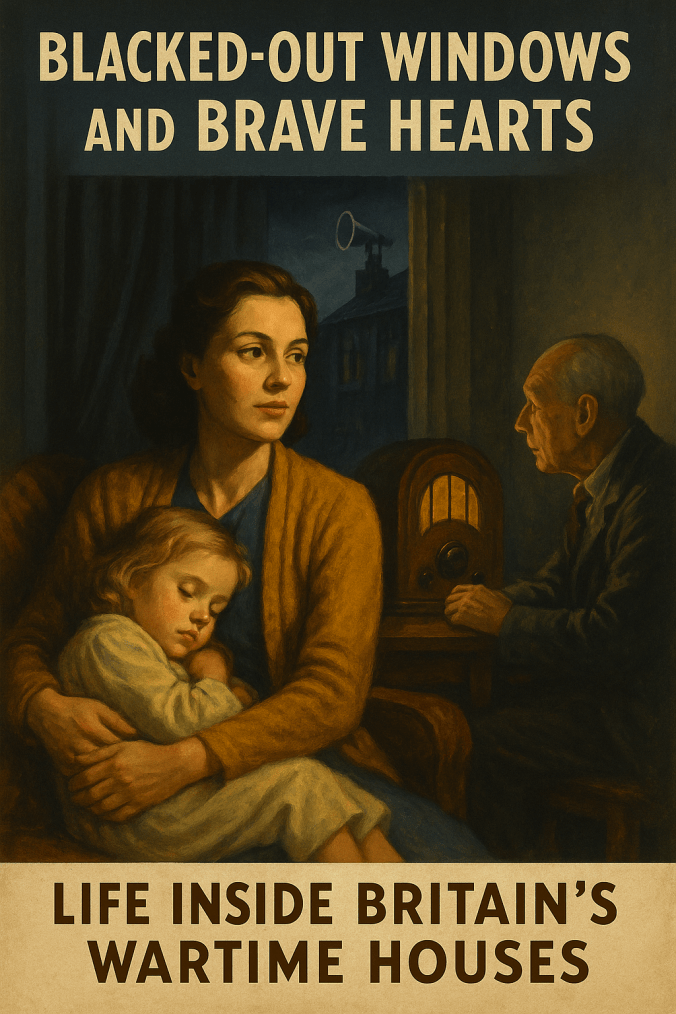
War did not arrive in Britain only through headlines or distant reports from foreign fields. It crossed thresholds and settled quietly inside houses. It crept into kitchens and bedrooms, rearranged furniture, darkened windows and reshaped the rhythms of family life. During the First and Second World Wars, the home front was not a refuge from conflict but one of its most intimate stages, where ordinary people practiced extraordinary courage in moments so small they rarely found their way into history books.
As daylight faded, houses changed their character. Evenings became rituals of concealment. Blackout curtains were drawn tight, heavy and absolute, pinning back every trace of light as carefully as a secret. Windows were taped or boarded, keyholes stuffed, doors checked again and again. Streets disappeared into darkness so complete it felt like a held breath. Inside, lamps were shaded, candles cupped in hands. Families learned to move by memory alone, counting steps between chair and hearth, whispering instead of speaking. The darkness carried fear, but it also gathered people closer. Shadows softened faces. Voices steadied one another. In the absence of light, closeness grew.
Food shaped the days with quiet authority. Ration books lived close at hand, tucked into drawers beside cutlery, consulted as faithfully as clocks. Meals grew smaller, but their meaning deepened. Stews were stretched with ingenuity, puddings coaxed into being from unlikely ingredients, leftovers guarded carefully. Gardens, allotments and window boxes became lifelines, feeding families in ways tins could not. Children learned early that nothing was wasted, that even a crust had value. A meal placed on the table, however plain, felt like a small triumph. Eating together became an anchor, a daily promise that life still held.
The shape of space inside houses shifted under the weight of necessity. Shared bedrooms became common as families gathered together for warmth and reassurance. Mattresses were pulled into parlors, blankets layered thickly against fear as much as cold. Children slept beside parents, siblings curled close, their breathing forming a quiet chorus in the dark. Privacy faded, replaced by a collective endurance that wrapped families together. The home became a shelter not only from bombs, but from the loneliness that war threatened to bring.
Air raid nights were the most demanding. The siren’s cry cut through sleep with merciless clarity, a sound that allowed no hesitation. Shoes were pulled on with shaking hands, coats grabbed, gas masks reached for. Children were lifted half-awake, pressed close. Some families hurried through darkened streets to public shelters, others descended into Anderson shelters in gardens or crowded beneath sturdy tables. In those cramped spaces, time stretched and folded strangely. People listened for the fall of bombs, counted seconds, whispered prayers or told stories meant to steady small hearts. The earth shook, dust fell, and still they waited together.
Inside shelters, another kind of home was formed. Neighbors became companions, strangers transformed into guardians of one another’s children. When tea could be made, it was shared. Jokes were offered gently, kindness passed through glances and small gestures. Fear was present, but it did not stand alone. Resilience sat beside it. Endurance became communal, carried not by one person but by many, pressed shoulder to shoulder in the dark.
By day, houses bore the quiet marks of war. Windows were patched with cardboard or boarded entirely. Wallpaper peeled, furniture shifted into safer rooms. Radios became hearths of sound, their voices filling kitchens and sitting rooms with news, music and reassurance. Familiar broadcasters felt almost like family, their steady tones bringing order to uncertainty. Children listened alongside adults, learning to read the world through sound, to sense hope or danger in a voice.
Much of the daily weight of this life fell to women. They ran households under constant strain, balancing fear with routine, making order where little could be controlled. They soothed children, mended clothes, wrote letters, held families steady when the world felt unmoored. Men home on leave stepped into houses that had changed, noticing new rhythms, new strengths, quiet evidence of how life had carried on in their absence.
Yet even in these altered homes, joy found its way in. Birthdays were marked with handmade cards. Christmases were modest but heartfelt, decorations fashioned from scraps, candles glowing briefly in darkened rooms. Music played on battered pianos or crackling radios. Stories were told, laughter coaxed carefully into being. These moments mattered more than their simplicity suggested. They reminded families who they were beyond the war.
The courage demanded by the home front did not wear uniforms or earn medals. It lived in patience, in routine, in care offered day after day. It was the bravery of staying, of keeping life moving under threat. It was quiet, steady and shared.
When the wars finally ended, houses slowly returned to light. Curtains were drawn back, windows opened, furniture moved again. Yet the memory of those years lingered in habits and hearts. People saved string and paper, valued togetherness, understood how fragile ordinary life could be. The home had been tested and it had held.
The story of Britain’s wartime houses is the story of war lived intimately. It is a tale of kitchens and bedrooms, shelters and radios, fear and resilience woven tightly together. It reminds us that courage is not always loud or visible. Sometimes it lives quietly inside houses, in the way people endure together, holding one another through the dark until morning comes.
Until next time,

Ta ta for now.

Yours, Lainey.