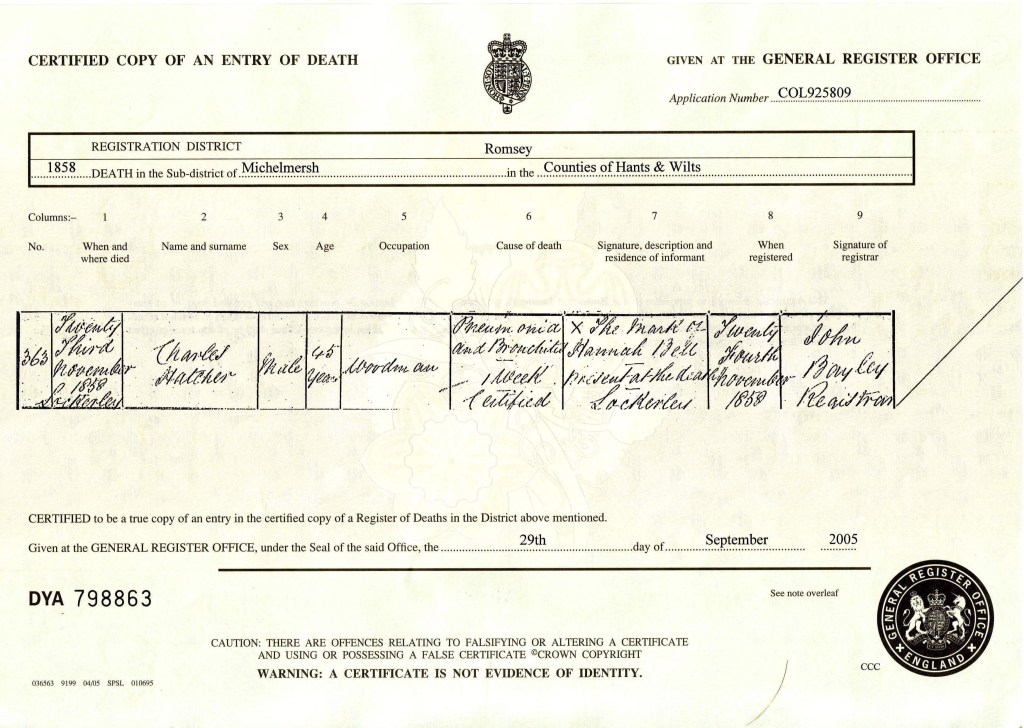
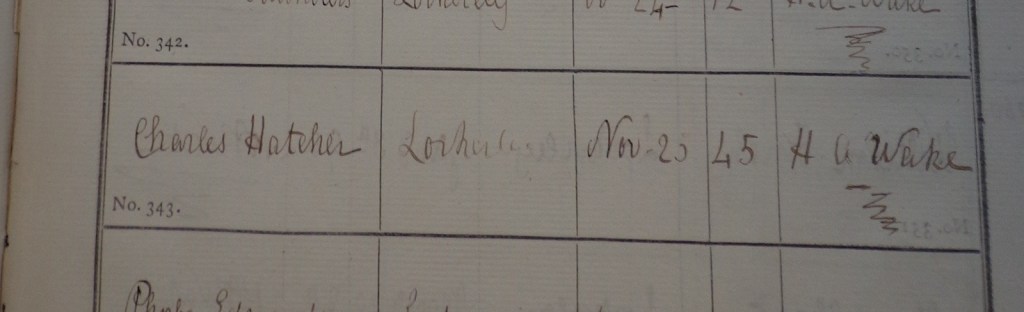
Step once more into the quiet lanes of Lockerley, where the frost of Susan’s girlhood has melted into the softer dew of early womanhood, and where the echoes of all she has lived still linger gently among the hedgerows. The first chapters of her life were shaped by loss and courage, by cradle songs and graveside prayers, by the tender weight of children in her arms and the aching emptiness of parents laid to rest. Now, as we open the next part of her journey, we find her standing not at an ending, but at the fragile threshold of a beginning.
For Susan, love did not arrive on wings of fairy tale splendour. It came quietly, humbly, like winter sun slipping through a cottage window. It came to her in the form of Charles Hatcher, a man of the same soil, the same hardships, the same unpolished goodness that marked her own life. Together, they stepped before the ancient stones of St John’s Church, offering vows shaped not by luxury but by hope, devotion, and the simple yearning to no longer walk through the world alone.
This is where Part 2 begins: with two hands joined beneath a January sky, with promises whispered into the cold air, with the murmur of prayers rising around them like blessings stitched into time. Yet marriage, for a woman like Susan, was never just a moment, it was a lifelong weaving. A weaving of joy and burden, of partnership and sacrifice, of children born into tenderness and others lost to silence, of seasons that changed the face of the land and the shape of her heart.
In the chapters ahead, we will follow Susan not as a girl navigating the uncertainties of her first steps, but as a wife, a mother many times over, a woman carving out survival and tenderness in equal measure. Through baptisms and burials, through harvests and heartbreaks, through every line written by vicars’ hands and every quiet space where the records fall silent, her life unfolds in a tapestry both fragile and fierce.
Come now, step with me into the next part of her story.
The frost of her early years has passed.
The footsteps she leaves from here on will carry her through love, loss, and the long, faithful road toward the end of a life fully lived.
This is Susan’s journey,
until death do us part.
Welcome back to the year 1849, Lockerley, Hampshire, England.
The world you step into feels both familiar and foreign, a place caught between the lingering weight of old centuries and the trembling promise of new ones. The air carries the scent of damp earth, woodsmoke, and the faint sweetness of hay resting in forgotten corners of barns. Life here moves with the slow rhythm of the seasons, shaped by the land, the church bells, and the quiet endurance of its people.
Across the nation, Queen Victoria sits upon the throne, her rule now well established after more than a decade. Her steady presence offers comfort in a world that is changing faster than many can understand. In London, Lord John Russell leads the government as Prime Minister, guiding Parliament through an age crackling with reform, resistance, and restless ambition. But here in Lockerley, the names of politicians and noblemen drift lightly on the air, rarely touching the daily reality of those who live by the rise and setting of the sun.
The divide between classes in 1849 is as pronounced as the deep furrows ploughed through Hampshire soil. The wealthy live in a world of broad estates, polished servants, velvet drapes, and travel by elegant carriages. Their days are gilded with privilege, wrapped in layers of silk and wool brought from distant lands. The working class, like most souls in Lockerley, live by their bodies’ strength. Agricultural labourers bend beneath the weight of tools, the burn of frost on fingers, the aching certainty that tomorrow will demand just as much of them. Their homes are simple cottages, their garments plain and durable, often passed from one generation to another until the fabric gives way. The poor live in harder shadow still, scraping by on seasonal work and parish assistance, their homes cramped, their meals sparse, their futures uncertain.
Women’s dresses widen into bell-shaped skirts supported by petticoats, while men wear sturdy trousers, shirts, and waistcoats, their boots scuffed from the fields. Travel remains slow. Most journeys are made on foot, by cart, or by horseback, the railways still a distant thunder in larger towns. In Lockerley, life is measured in miles walked, not miles travelled.
Cottages in 1849 are warmed by the glow of the hearth, the fire at their centre doing the work of warmth, food, and comfort. Smoke threads upward through low chimneys, and rooms flicker with the golden light of tallow candles. Nights are longer, darker, deeper; shadows linger in corners until morning coaxing them away. Hygiene is simple and sparse, a basin of cold water, a bar of rough soap, and whatever time a working life permits. Sanitation is basic, often little more than earth closets outside the home, and sickness travels easily wherever water runs shallow and work runs long.
Food on most tables is plain but sustaining: bread, potatoes, porridge, seasonal vegetables, a little meat if fortune allows. Tea sweetens the harshness of long days, when it can be afforded; otherwise, ale or small beer is common. For entertainment, the village turns to each other, storytelling around the hearth, song, the rare excitement of a fair or market day, gossip carried from cottage door to parish lane like snippets of wind-tossed conversation.
In 1849, disease shadows every home. This is the year cholera stalks England for the second time, its presence a whispered dread in towns and cities. Although Lockerley lies sheltered among fields, fear still trickles into rural hearts. Illnesses like influenza, fever, and consumption claim lives quietly, sometimes suddenly, even among the strong.
Schooling exists but is limited. Many children labor in the fields beside their fathers, their days shaped more by seasons than by lessons. Yet some learn their letters in parish rooms, guided by an earnest desire to give the next generation tools their parents never had.
Religion holds a deep and steady place in the lives of Lockerley’s people. The church stands as both spiritual anchor and communal centre. Baptisms, marriages, and burials weave together the threads of every family’s story. Sunday is a day of stillness and obligation, a pause in the unending cycle of work. The curate’s voice, rising beneath the ancient beams of St John’s, reaches the hearts of many who cannot read his Scriptures but understand them all the same.
And all the while, life continues in its quiet, dutiful way. The turn of a plough. The cry of a newborn. The hush of grief beneath the yews. The laughter of children running through muddy lanes. The centuries-old rhythm of labour, love, loss, and enduring faith.
In the year 1849, Lockerley breathes softly. Its people rise with the dawn, rest by firelight, and live their lives woven deeply into the fabric of the English countryside, a world both fragile and resilient, ordinary and extraordinary, waiting patiently for the story of the next day to unfold.
Life for Susan in 1849, as a newly married woman raising three young daughters, unfolded in a tender but demanding rhythm, shaped by the land, the seasons, the expectations of the parish, and the quiet resilience she had already learned to carry.
When Susan married Charles in 1847, the whole shape of her life shifted. Marriage did not erase the hardships she had endured as a single mother, nor did it rewrite the years in which she had been viewed with suspicion, pity, or whispered judgement. But it softened her footing in the village. Where once she had walked Lockerley’s lanes with the weight of three illegitimate births upon her shoulders, now she walked as a wife, and that change altered the way others looked at her. Those who had once drawn back now nodded with a little more warmth, as though her marriage had woven her more securely into the parish fabric. She was no longer the girl who bore children out of wedlock; she was now Mrs Hatcher, a woman respectably settled, her daughters folded under a man’s name and roof.
Her days were long, full, and unending. She woke before the sun, often before the fire had even left its ashes from the night before. Her first task was always to coax life back into the hearth, blowing gently at the embers until they sparked and flared. The warmth crept slowly into the cottage, lifting the chill from her children’s sleeping forms. Mary Ann, barely toddling, needed her hand; Fanny followed her mother like a little shadow; Ellen, older now, had learned to help where she could, her small fingers careful but eager.
Everything in Susan’s world was woven from necessity. The washing of clothes, the mending of tears, the kneading of bread, the scrubbing of floors, the fetching of water. She carried her family’s life on her back and in her hands, and yet there was a quiet beauty to it. The scent of yeast rising. The crackle of the fire. The small, warm bodies of her children pressed against her as she dressed them for the cold morning. The soft laughter of girls playing near the cottage door while she hung damp linens across the yard.
Charles’s presence eased some of her burdens. His wages, though still meagre, meant more food on the table and fewer nights fearing the bite of hunger. His hands took on the heavy labour of the fields, his boots leaving familiar tracks across the lane each dawn as he went to work under the vast Hampshire sky. When he returned in the evening, tired and mud-stained, the cottage felt more complete. Susan, who had spent much of her early motherhood alone, felt now the steady comfort of partnership. It was not a life of luxury or abundance, but it was a life shared, which made all the difference.
The villagers saw the change too. Before marriage, Susan would have been met with tight smiles or lowered gazes, some women whispering behind cupped hands, some men looking past her as if she were made of thin air. After her wedding, the tone softened. Marriage had restored her to respectability in their eyes, and although some memories lingered, they were no longer wielded like quiet weapons. Neighbours asked after the children with more warmth. Older women offered small kindnesses, an extra loaf, a piece of cloth, a suggestion for easing a child’s fever, as if the tying of her marriage knot had finally anchored her safely within their circle.
But acceptance did not mean ease. Work for the rural poor was relentless. Susan’s hands grew older faster than her face, worn by cold water, by scrubbing, by lifting children, by tending to every task that kept hunger and cold at bay. Her body bore the marks of all she had lived through, and yet her spirit seemed to shine stronger for it.
There were moments of gentleness too. Evenings when she sat by the fire with Ellen on her lap, Fanny leaning against her shoulder, Mary Ann asleep beside her. Days when the sunlight fell just right through the cottage window, turning the dust motes into drifting gold. Sundays when she walked with her family to St John’s, the bells echoing across the fields, the girls’ hands tucked warmly in hers.
In those moments, the years before marriage, the whispers, the judgements, the loneliness, felt distant. Susan was building a home now, shaped not only by hardship, but by love, endurance, and the small, daily triumphs of a woman determined to give her children more than she had ever been given.
By 1849, life had become a delicate weaving of chores and comfort, of effort and faith, of survival and tenderness. Susan had stepped into marriage without forgetting who she had been, but with the quiet certainty that she was becoming something more. A wife. A mother of three. A woman whose story continued to deepen with every passing season.
Her days were not easy, but they were hers, and the love she poured into them would echo through generations long after the fires of her little cottage grew cold.
On Friday, the 9th day of February in the year 1849, winter lay softly over Lockerley, as though the season itself were holding its breath for the moment that was about to unfold. Frost clung to the grass in silver pearls, and the pale morning sun crept slowly over the hedgerows, touching the world with a cold, delicate glow. But inside a small cottage tucked within the quiet embrace of Butler’s Wood, the air shimmered with warmth, with breathless hope, with the aching sweetness of new life.
Here, in the familiar low-ceilinged room where so many of her joys and sorrows had taken root, twenty-nine-year-old Susan Hatcher brought her fourth child into the world. The fire crackled gently at the hearth, its light dancing across the rough-hewn beams as the final waves of labour surged through her. It was a pain she knew well, a pain she met with courage, with grit, with the timeless strength of women before her. Whether a neighbour woman or an experienced midwife had come to guide her through the storm, paid a few shillings, or perhaps paid only with gratitude, we cannot know. But someone, some warm, steady pair of hands, was likely there to wipe her brow, to whisper encouragement, to lift the child and place him against her trembling chest.
When the cry finally burst forth, sharp, bright, and perfect, the world inside the cottage shifted. Every shadow softened. Every breath grew sacred. Susan gathered her newborn son to her breast, her heart swelling with a love too large to fit inside her tired, aching body. She traced her fingers along the downy curve of his cheek, marvelling at the tiny miracle she had carried through winter’s coldest weeks.
Charles stood nearby, his coarse, calloused hands hanging helplessly at his sides, his eyes shining in the dim light. Thirty-four years old, a labourer shaped by the fields and the weather, he was a man unused to gentleness. But the sight of his son, this small, perfect boy, softened him completely. Pride rose in his chest like the first warm breeze of spring. The land might bend him. Poverty might weary him. But this… this was his legacy, warm and breathing in coarse swaddling.
Outside, the church bell at St John’s might have tolled the hour, its sound drifting across the frozen fields as it had done for generations. But on this morning it felt different, as though the bell itself recognized the significance of the moment, ringing for beginnings instead of endings.
A month later, on Friday the 9th of March, 1849, the soft miracle of that winter’s day found its way into the great ledger of births at the Mitchelmersh register office. Registrar William Green dipped his pen into ink and wrote with the same practiced precision he had used for countless others:
Births in the District of Mitchelmersh in the Counties of Hants & Wilts.
Number 493.

When Born: Ninth of February 1849 at Lockerley.

Name: John.

Boy.
Father: Charles Hatcher.

Mother: Susan Hatcher, formerly Luke.

Father’s Profession: Labourer.

Informant: The mark of Susan Hatcher, Mother, Lockerley.

Registered: Ninth of March 1849.
Registrar: William Green.
And when the moment came for Susan to sign, she pressed a small, humble X beside her name, a simple cross, trembling slightly beneath her fingertips. She could not write the letters the registrar expected, but she carried something richer, deeper: the ability to bring life into the world, to nurture, to endure, to love with ferocity and faith. That mark was more than her signature, it was her story, her truth, her strength carved into the page.
Charles stood at her side, the weight of responsibility settling upon him like a mantle. He rose each morning before the rest of the village stirred, stepping into the harsh dawn to earn the meagre wages that kept their home alive. His back bent beneath the demands of the land, his hands chafed and cracked. But now, with John added to their growing brood, his toil meant something larger. Every seed he sowed, every hedge he trimmed, every field he laboured over, it was all for them.
Little John entered the world not into wealth, but into something far more enduring, a home knitted together by determination, tenderness, and love. The winter wind whispered against the cottage walls that evening as Susan rocked her newborn under the dim glow of the fire, the flame casting amber light across his tiny face. She whispered his name into the stillness, John Hatcher, letting it settle into the quiet of the night like the beginning of a prayer.
He was born of winter’s hush, born of labour’s storm, born of love’s enduring fire. A son of Lockerley, nestled beneath the same wide Hampshire sky that had seen his father and grandfather before him. And though he lay swaddled in coarse cloth and innocence, he was already part of something much greater, a story written not only in ink and parish records, but in the blood and courage of the generations who had shaped the path leading to his first breath.
John’s life had begun.
 And Susan’s heart, weathered, resilient, bound by love, expanded once more to hold him.
Spring unfurled gently over Lockerley on Sunday the 25th day of March, 1849, the kind of morning that seemed to breathe rather than merely dawn. A pale wash of light softened the sky, brushing the fields with the faintest silver as the earth exhaled the damp sweetness of new beginnings. Primroses, shy and golden, peered from beneath hedgerows, and the soft scent of fresh-turned soil drifted lazily across the village. Even the birdsong felt tender, as though the world understood that something sacred awaited within the walls of St John’s.
And then the bells began, slow, deep, and utterly gentle. Their sound drifted across the Hampshire fields like a long, steady heartbeat, calling the people of Lockerley to worship, to witness, to remember the turning of life’s quiet wheels.
Inside the flint-walled church, where centuries of baptisms, vows, and farewells had settled like dust upon stone, Susan and Charles Hatcher stood shoulder to shoulder. In Susan’s arms lay their newborn son, John, only weeks old, his tiny chest rising in soft, peaceful breaths as though he slept in the very hands of God. His birth, carved from the deep cold of February, had brought warmth into their cottage, a warmth that radiated still from his little body now wrapped in coarse cloth and a mother’s fierce love.
The flicker of candles played across Susan’s tired but glowing face. She had carried John through the hardest weeks of winter, had birthed him by firelight with strength she did not know she possessed, had held him through the long nights when frost crept along the windows and silence pressed close. And now, beneath the very rafters where she herself had been baptised twenty-nine years before, she brought him forward to be welcomed into the world of faith and community.
Charles stood straight beside her, his boots planted firmly upon the worn stone floor. His hands, so accustomed to plough handles and hedging tools, rested with surprising gentleness upon his son’s blanket. For a moment, his breath caught. This small life, this fragile warmth, was the harvest of all his years of toil, the living proof that even those born to hardship could leave something beautiful behind.
Curate George Austen stepped forward with the solemn tenderness that only long service to village souls could teach. His voice carried softly through the church, steady and warm, as he welcomed the child into God’s keeping. When the water touched John’s brow, it gleamed for an instant in the slanting light before dissolving into his skin, holy and fleeting. The church seemed to hold its breath. Only the rustle of Susan’s gown and the soft sighing of the candles stirred the air.
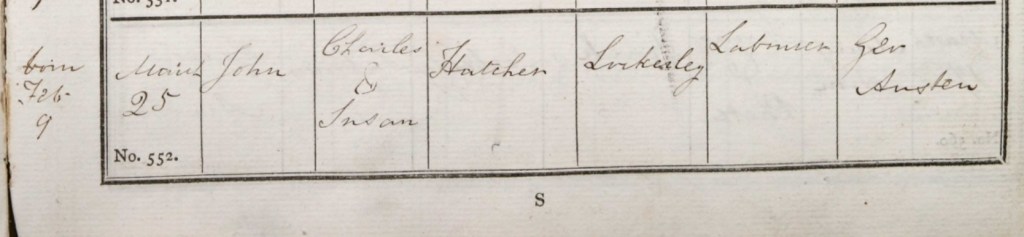
In the quiet, the curate wrote with precise care in the parish register:
Baptized: March 25, 1849

Child’s Christian Name: John

Parents’ Names: Charles and Susan Hatcher

Abode: Lockerley

Quality, Trade, or Profession: Labourer

By whom the Ceremony was performed: Geo. Austen
The ink dried quickly upon the page, but the moment itself lingered tenderly in the hearts of those present.
Susan looked down at her son, feeling the echo of all she had lived, the losses she had borne, the children she had raised alone, the love she had finally found in Charles, a man steady as the fields he worked. Here, in this fragile child, all of it came together like threads woven into a single, shimmering tapestry.
Charles’s eyes glistened as he pressed his hand lightly to his son’s blanket. This baptism was a vow he made silently to himself, to protect, to guide, to labour not only for survival, but for the promise of this small, perfect life.
When the final “Amen” faded into the soft hush of the church, the family stepped out into the brilliant spring sunlight. The air was cool, the earth yielding, the hedgerows budding with new promise. Somewhere beyond the fields, a plough cut the soil in steady strokes, the same work Charles would return to the next day, though with a lighter heart and firmer purpose.
John Hatcher had been named, blessed, and held up to Heaven. His life, tender and new, belonged now to the rhythm of Lockerley, to the faith of its people, to the legacy of the Hatchers and the Lukes before them.
As Susan carried him home, the church bells chimed again, their notes floating down the lane like a whispered blessing, soft and certain:
Even the humblest lives, shaped by endurance and bound by love, are known by God and cherished by time.
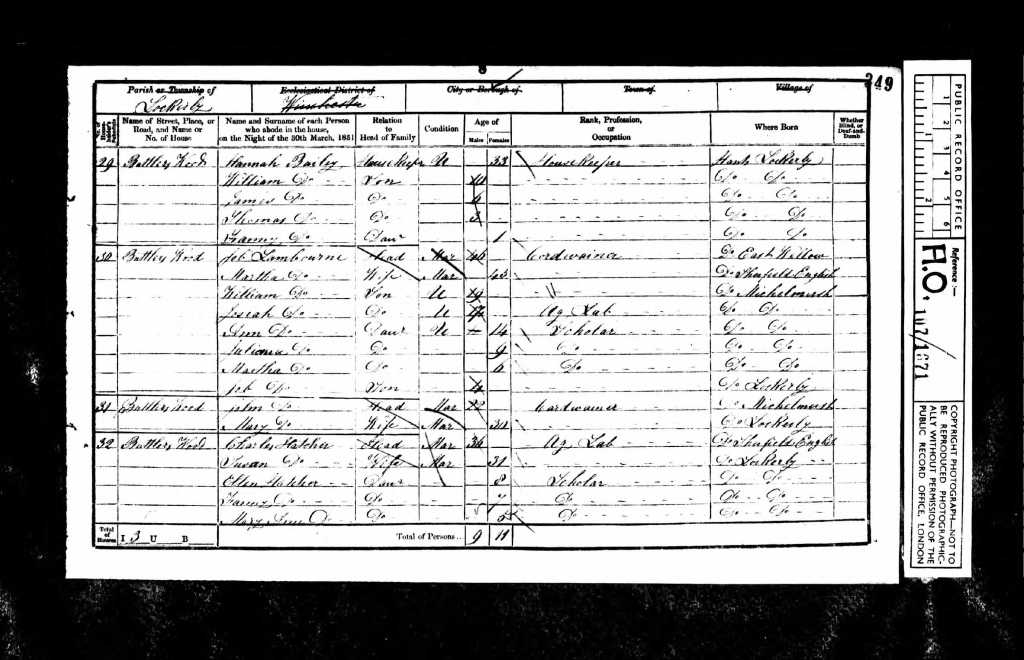
On the still, cool evening of Sunday the 30th day of March 1851, a gentle hush settled over Newtown,  Lockerley, as though the village were holding its breath for the counting of souls. The sky above Butlers Wood softened into a deepening blue, and the last birds curled their songs into the branches before night claimed the hedgerows. It was census night in England, the night when every hearth, every cottage, every wandering life would be recorded, captured like a single breath in the great lungs of the nation.
In those days, the census was not a distant task done by unseen hands. It was personal. It was human. A parish official or local enumerator, often a man known to everyone by name and habit, walked the muddy lanes carrying a leather-bound book and a stack of household schedules. Earlier that week he had delivered one to every door, knocking softly, offering a polite nod, explaining in simple words that the Queen required each home to be accounted for. Many could not read or write, so on this evening he returned to each cottage, stepping into the warm glow of firelight to ask the questions himself, filling in the answers with a careful hand so no family was left unseen.
And so he came to the Hatchers’ home.
The cottage at Butlers Wood, Newtown, Lockerley, glowed faintly against the deepening dusk, a single candle flickering behind the small glass panes. Inside, Susan Hatcher, now thirty-one years old, tended the fire while her children settled in for the night. Her husband, thirty-six-year-old Charles, sat at the table with the quiet weariness of a man who had worked the fields since dawn. Their four young ones, Ellen, eight; Fanny, seven; Mary Ann, five; and little John, two, moved about the room with soft footsteps and whispering laughter, their small bodies warmed by the hearth, their bellies filled after a modest supper.
When the enumerator stepped into the doorway, Susan’s heart gave a small flutter, not of fear, but of familiarity. There is a great possibility that this house, this very room, carried the ghosts of her earlier life. She had most likely lived here with her father Moses before his passing in 1844. She had walked across these same wooden boards with her mother Kitty long before that, Kitty, whose hands had once kneaded bread at this same table, whose voice had woven lullabies into the beams above Susan’s head. Now Susan stood where her mother had once stood, her own children at her feet, the past and present folding gently into one another.
Was this still truly her home?
Or was it a memory she walked inside of?
Every corner held a whisper of before, the echo of her father’s boots against the threshold, the faint scent of her mother’s lavender soap lingering as though time refused to sweep it away, the ghosts of siblings who had grown up, married, sailed across oceans, or moved into lives of their own. Some were still near, some impossibly far. Yet all of them seemed to breathe softly through the walls, reminding her that she had been a daughter long before she became a wife and mother.
As the questions began, the enumerator’s voice blended with the crackle of the fire. He wrote down their names with the steady rhythm of a man who had filled dozens of pages already that night. Ellen, bright-eyed and helpful, sat quietly beside her mother, Fanny leaned into Susan’s side, Mary Ann clutched her doll made of scraps, and John toddled about, unaware that this simple moment would be preserved long after they were gone.
Outside, the neighbouring cottage of John and Mary Lambourne stood warm and lively, their home filled with the familiar sounds of rural life. Beyond them, another house, dark, uninhabited, its windows staring blankly toward the woods, remained untouched by laughter or lamplight, a quiet reminder that not every hearth was kept burning, not every story continued.
Within the Hatcher home, however, life pulsed gently. The scratch of the enumerator’s pen, the soft rustle of children’s breaths, the glow of the hearth reflecting in Susan’s thoughtful eyes, all of it formed a portrait of a family caught in a single, fleeting moment of time.
When the census man finally closed his book, bid them goodnight, and stepped back into the cooling air, his lantern casting a small pool of light along the lane, Susan watched him disappear into the darkness. She drew the bolt across the door, gathered her children close, and let her gaze wander to the rafters above.
She wondered if her father’s spirit lingered still in that quiet space where the smoke curled upward. She wondered if her mother would have been proud. She wondered how so many years had slipped by since she was the child in this home, and how suddenly she had become the keeper of it.
As the candle sputtered softly and the fire sank into embers, Susan held her family close in her heart. The world outside changed slowly, but inside these walls, the rhythms of love, labour, and memory continued on, steady as breath, gentle as spring light, enduring as the land beneath their feet.
And thus, on the census night of 1851, Susan’s story, and the story of all she loved, was quietly written into the ledger of time, preserved not only in ink, but in the warm, living heartbeat of her home.
On Friday, the 31st day of October 1851, when autumn rested like a soft sigh across the village of Lockerley and the world glowed in muted amber, a new life stirred within the small cottage at Butler’s Wood, Newtown. Outside, the leaves drifted in slow spirals, whispering against the windowpanes, while the last light of the afternoon sank gently into the hedgerows. Inside, time narrowed to a single, trembling focus: Susan’s labour had begun.
Unlike the births of Ellen, Fanny, and Mary Ann, arrivals shadowed by the stigma of illegitimacy, this labour was different. Susan was now a married woman, Susan Hatcher, wife of Charles. And in 1851, that single truth softened the world around her. No pitying glances from neighbours. No whispered judgments carried on village winds. No tightening of lips from the parish women who once questioned why she bore children without a husband’s name to shelter them.
Now, hands reached out to help her. Doors opened without hesitation. And the midwife, most likely a local woman who had attended dozens of Lockerley births, came not with raised brows, but with gentle confidence, bringing her bag of herbs, linen cloths, and years of quiet experience. She might have been paid a small fee, perhaps a few shillings earned through the Hatchers’ scrimped savings or the kindness of neighbours. But her presence was priceless. She touched Susan’s forehead, murmured encouragement, and soothed her with warm water scented faintly with chamomile.
Labour in a rural Hampshire cottage was raw and unadorned, a symphony of human strength and ancient ritual. The fire burned low but steady. The air smelled of smoke, damp wood, clean sheets, and the faint iron tang of birth. Charles, thirty-seven years old, strong from his years in the fields, hovered nearby, awkward, anxious, helpless in the way men often were during childbirth, yet present with a heart full to the brim. He wiped Susan’s brow, held her hand when she wanted it, stepped aside when she needed space. His presence was a balm she had never known during her earlier confinements, when she had birthed alone with only the midwife’s hand and her own courage to carry her through.
And then, at last, as twilight deepened into night, a cry rose into the warm air, a clear, small note of life. Their daughter had arrived.
Rosa.
Born on an autumn evening, beneath the low beams of the cottage Susan had known since childhood, her first breath woven into the very same air that had once cradled Susan herself as a girl beneath her mother Kitty’s watchful love. The past and present converged in that moment: Susan was no longer the frightened young woman of her unmarried years, bearing children with trembling uncertainty. She was a wife, a mother many times over, a woman who had walked through hardship and emerged with strength forged in grief and hope alike.
Rosa lay against Susan’s breast, her tiny body warm and soft, her hair damp, her cry easing into soft sighs. Charles stood beside them, his eyes bright with relief and wonder, the lines of toil on his face softened by joy. The midwife smiled, her task complete, her heart warmed by yet another safe arrival in this humble Hampshire home.
Weeks passed, the days filled with the tender rhythms of newborn life. The leaves fell in deeper drifts. The frost crept along the edges of the lane. And as November settled in, Susan wrapped her shawl around herself and set out for Mitchelmersh to register the birth, baby Rosa nestled close to her heart. The journey was familiar now, she had walked it before, but each step carried a new steadiness. She was no longer alone. She no longer walked the road marked by shame; she walked as a wife, as a mother whose children bore a father’s name.
At the register office, Registrar Charles Gouldard dipped his pen and wrote the details with practiced care:
When Born: Thirty-first of October 1851 at Lockerly
Name, if any: Rosa
Sex: Girl
Name and Surname of Father: Charles Hatcher
Name and Maiden Surname of Mother: Susan Hatcher formerly Luke
Rank or Profession of Father: Labourer
Signature, Description, and Residence of Informant: The mark of Susan Hatcher, Mother, Lockerly
When Registered: Fourteenth of November 1851
Signature of Registrar: Charles Gouldard, Registrar
Baptismal Name, if added after Registration of Birth: —
When asked to sign, Susan pressed her cross upon the page “The mark of Susan Hatcher, Mother, Lockerley.” Though it was not her written name, it was her truth, her pride, her place in the world. A mother. A wife. A woman whose mark carried more love than any flourish of ink could ever show.
When she stepped back onto the crisp November road, the world smelled of distant woodsmoke and fallen leaves. Rosa slept peacefully, her tiny breath warm against Susan’s neck. And Susan felt her heart swell with something quiet and beautiful, a sense that, at last, life had turned its gentler face toward her.
Her daughter had been born beneath the falling autumn leaves, not into judgment or loneliness, but into a home lit by love, warmed by marriage, and shaped by the steadfast grace of her Hampshire life.
On a crisp winter’s morning, Sunday the 7th day of December 1851, Lockerley lay softened beneath a silver hush. Frost clung to every hedge and hollow, turning the countryside into a delicate lacework of white. Thin spirals of smoke rose from cottage chimneys along the lanes of Newtown, drifting gently into the pale sky like quiet prayers lifted heavenward. The earth itself seemed to pause in reverence, holding its breath for the moment unfolding within the old stone walls of St. John’s Church.
Inside the church, warm candlelight shimmered across cold flint, chasing back shadows that had rested there for centuries. The scent of beeswax mingled with the chill breath of winter stone, and the echoes of old hymns seemed to linger in the rafters, even though this service would be one of prayer, not song. It was a morning of remembrance, devotion, and quiet redemption, a morning that would bind the Hatcher family forever in ink, in water, and in grace.
Susan and Charles stood together at the baptismal font, side by side as husband and wife, their hearts steady, their hands trembling with the sacredness of the moment. Charles, aged thirty-seven, stood with the unassuming dignity of a man shaped by the soil of Hampshire. His hands, broad, roughened, and cracked from years of labour, were clasped before him as if holding in place the overwhelming tenderness swelling in his chest. He wore his Sunday best, though the frayed edges whispered of hard seasons and humble means.
Susan, thirty-one and radiant in her quiet way, cradled their baby daughter Rose. The glow of stained glass brushed her cheeks with faint colour, turning the moisture in her eyes into tiny glints of light. She was serene, but there was a deep, trembling ache beneath her calm, a mixture of joy, gratitude, and the ghosts of years that had not always been kind. For she had known what it was to bring children into the world without a husband’s name to shelter them, to endure the whispers, the sidelong glances, the weight of judgment.
But today… today was different.
Today, three daughters would be blessed before God.
Today, the past would meet forgiveness.
Today, love would rewrite what life had once written in sorrow.
Curate Alfred Robinson stepped forward, a gentle presence with a voice that soothed like warm oil against the cold air. He opened the Book of Common Prayer, its worn pages familiar beneath his hands, and began the holy rite.
“I baptize thee in the name of the Father, and of the Son, and of the Holy Ghost.”
The words echoed softly beneath the vaulted roof, weaving themselves into centuries of prayers spoken before this very font. The candlelight flickered upon the water, making it shimmer like captured starlight.
Fanny was brought forward first, bright-eyed, lively, her curls dancing around her face as the cold water touched her brow. Her breath caught with surprise, then softened into a shy smile. Her life, once marked by the word “illegitimate” in an old registry book, was now lifted into a new truth, held in her mother’s arms and claimed by the man who loved her as if she were his own flesh.
Next came Mary Ann, solemn, curious, her gaze wandering upward to the ancient beams as though she sensed that this moment was larger than she could yet comprehend. Her small hands clasped her mother’s skirts, her eyes wide, the blessing falling upon her like a whispered promise.
And then little Rose, the newborn, warm and soft against Susan’s breast. Her skin glowed with the tender flush of infancy, her dark lashes fluttering as the holy water touched her delicate brow. She blinked once, twice, then settled into a small sigh, as though even she felt the sacredness of her naming.
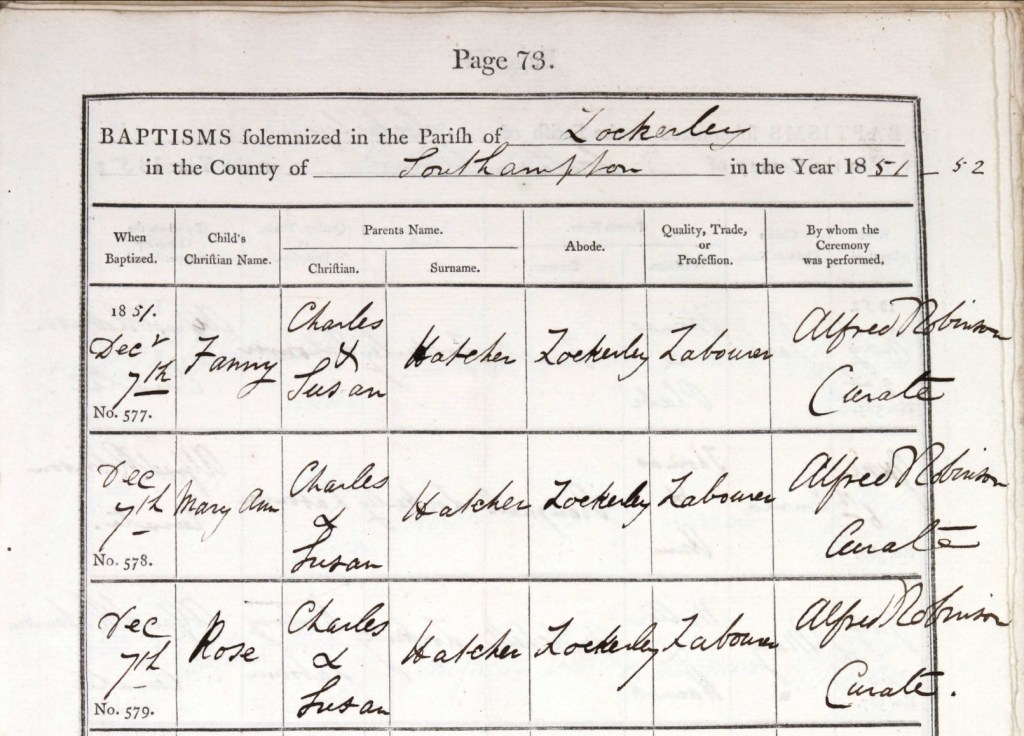
Their names were written into the parish register, entries 577, 578, and 579, in the careful script of the curate:
BAPTISMS solemnized in the Parish of Lockerley in the County of Southampton in the Year 1851

No. 577

When Baptized: Dec 7th 1851

Child’s Christian Name: Fanny

Parents’ Names: Charles & Susan Hatcher

Abode: Lockerley

Quality, Trade, or Profession: Labourer

By whom the Ceremony was performed: Alfred Robinson, Curate
No. 578

When Baptized: Dec 7th 1851

Child’s Christian Name: Mary Ann

Parents’ Names: Charles & Susan Hatcher

Abode: Lockerley

Quality, Trade, or Profession: Labourer

By whom the Ceremony was performed: Alfred Robinson, Curate
No. 579

When Baptized: Dec 7th 1851

Child’s Christian Name: Rose

Parents’ Names: Charles & Susan Hatcher

Abode: Lockerley

Quality, Trade, or Profession: Labourer

By whom the Ceremony was performed: Alfred Robinson, Curate.
Simple words.
But they changed everything.
For though Fanny and Mary Ann had come into the world before Susan was married, before Charles’s name could stand beside theirs, today Charles claimed them wholly, proudly. Not by blood, perhaps, but by something far stronger: a father’s heart, a husband’s devotion. He had already raised them, fed them, soothed their nighttime tears, worked long days so that their bellies might be full and their shoes repaired. Now heaven itself acknowledged what life had already proven true.
In the warm hush of St. John’s, Susan felt her heart swell. She saw the man beside her not merely as her husband, but as the anchor that had steadied her life since the day she became his wife. His rough hands trembled slightly, his eyes shining as he watched each child’s blessing. To him, this was not only baptism, it was absolution, belonging, a binding of love to lineage.
When the final prayer was spoken and the curate closed his book, the church fell into a holy stillness. Outside, the frost glimmered like powdered glass upon the churchyard, and the soft toll of the bell drifted across the fields, calling time forward once more.
Charles and Susan gathered their daughters close and stepped out into the winter morning. Their breath rose in pale clouds. Their boots crunched upon the frozen earth. The children’s laughter—Fanny’s bright, Mary Ann’s soft, Rose’s newborn murmurs, rose sweetly into the cold air.
No longer were they marked by the judgments of the past.
They were blessed.
They were claimed.
They were a family, whole and holy.
And though the ink upon the register would one day fade, the memory of that morning, the warmth of candlelight, the shimmer of water, the steady love of a father who claimed what society once denied, remained alive in the heart of Lockerley, whispered by the walls of St. John’s whenever the winter sun shone through its ancient glass.
It was a day of grace.
 A day of healing.
A day where love stood taller than any sorrow that had come before.
On Friday, the 2nd day of January 1852, winter pressed heavily upon Newton Lane in Romsey, the sky low and colourless, the air thick with that stillness that often precedes sorrow. Somewhere along that narrow lane, in a modest home touched by cold and shadow, Susan’s world shifted, quietly, devastatingly, as news of her sister Charlotte’s passing slipped across the miles and into her life like a slow, unendurable ache.
Charlotte Dunn, once Charlotte Luke, her sister in blood, in childhood mischief, in whispered confessions whispered beneath hedgerows, in shared laughter beside the hearth of their mother’s kitchen, had slipped beyond the reach of earthly hands.
She was only forty-four.
Charlotte’s body had succumbed to Anasarca, that cruel swelling of flesh and tissue that comes not gently but as a final, suffocating consequence of deeper illness. It was a suffering that bloated the limbs, tightened the skin, made breath hard to catch, made even the smallest movement an agony. A condition born from the silent failing of organs, from exhaustion, from the relentless weight of a life lived through hardship.
But Charlotte had not died alone. Beside her stood Hester Handcock, a loyal friend or neighbour whose presence in those final hours was its own quiet mercy. When Charlotte’s breaths grew shallow, when her eyes dimmed, when silence pressed itself gently upon her, Hester was there, bearing witness to the end of a life woven with tenderness, struggle, and sisterhood.
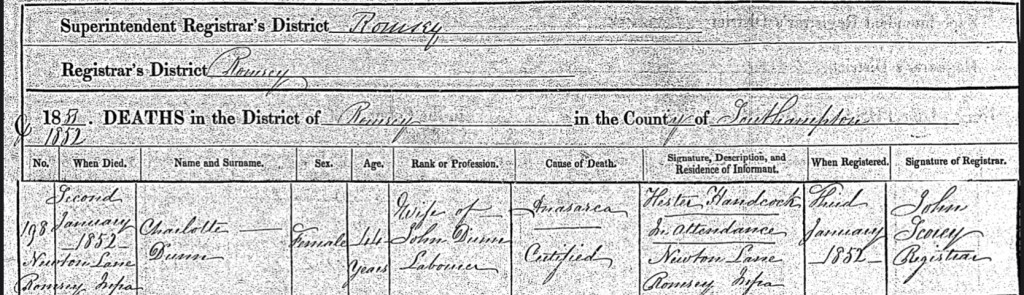
The next morning, on Saturday the 3rd day of January, Hester wrapped her shawl tightly around her shoulders and walked through the winter air to the Romsey register office. Inside its cool, echoing walls, Registrar John Sconey dipped his pen in ink and recorded the facts with practiced precision:
1852. Deaths in the District of Romsey in the County of Southampton
No.: 198
When Died: Second January 1852, Newton Lane, Romsey Infra
Name and Surname: Charlotte Dunn
Sex: Female
Age: 44 years
Rank or Profession: Wife of John Dunn, Labourer
Cause of Death: Anasarca, Certified
Signature, Description, and Residence of Informant: Hester Handcock, in attendance, Newton Lane, Romsey Infra
When Registered: Third January 1852
Signature of Registrar: John Sconey, Registrar
A few slender lines. A few strokes of ink. An entire life reduced to a quiet cluster of words.
But behind those plain entries lived something immeasurable.
For Susan, who was not at her sister’s bedside when death took its gentle, irreversible hold, the loss arrived not as ink but as a breaking. She would have felt it before she heard it, a subtle shift within her spirit, as though something had been quietly torn. Perhaps she stood at her cottage window that morning, her breath fogging the glass, watching a pale sun struggle through the branches. Perhaps she felt a heaviness she could not name, a coldness that seeped deeper than winter air.
In that moment, her mind would have drifted back to years now softened with time, Charlotte as a girl with wind-tangled hair, racing barefoot through summer grass.
Charlotte’s laughter bubbling through their mother Kitty’s kitchen.
Charlotte’s hands, larger than Susan’s, clutching hers as they walked to St John’s on frosty mornings.
Charlotte’s wedding day, her shy pride, her trembling vows.
Charlotte holding her first child, her face tender with a mixture of hope and fear.
All those memories rose like warm breath on cold air, visible for a moment before fading into the ache of loss.
Susan, now a wife and mother herself, surrounded by the lively noise of children and the familiar creak of the old cottage, carried this new sorrow quietly. Her heart would have stretched across the miles to Newton Lane, wishing she could have touched Charlotte’s hand one last time, wished she could have told her how deeply she was loved, how fiercely she would be missed.
But grief, like winter, settles where it must.
Romsey continued its slow routines that day, chimneys smoking, carts rumbling along narrow lanes, the Abbey bells ringing across rooftops, unaware that one woman’s world had been gently undone. Yet Susan held Charlotte not in registers or stone, but in the living warmth of memory, where sisterhood endures long after breath has ceased.
In her heart, Charlotte remained.
In the quietest places, she still laughed.
In the softest memories, she still lived.
And though the world had taken her away, Susan’s love insisted on keeping her close.
On a quiet winter Sunday, the 4th day of January 1852, Romsey lay beneath a pale, frost-silvered sky, the kind of wintry stillness that feels like the world itself has paused to mourn. Ice clung to hedgerows like delicate lace, the cold air sharp as breath on glass, and a thin veil of mist drifted across Botley Road where Romsey Cemetery waited in solemn silence.
Susan was there.
She had travelled from Lockerley that morning wrapped in a heavy shawl, her heart trembling beneath its woolen folds. Every step toward Romsey seemed to echo the truth she did not want to face. Her sister Charlotte, her childhood companion and confidante, the girl who once raced her across meadows and whispered secrets beneath the hedgerows, now lay still in a wooden coffin.
Charlotte’s body had rested for two days in the home on Newton Lane where she had lived with her husband John and their children, Sarah and Henry. When Susan entered the house earlier that morning, the air felt heavy, the quiet too deep. Charlotte’s coffin waited near the window where soft winter light fell across the boards. Her face, washed, composed, gently arranged, had the serenity of someone finally released from suffering.
Susan reached out and touched her sister’s hand through the linen shroud. It was cold, unyielding. A final truth she was not ready to hold. She whispered a prayer, though she could not remember the words. All she knew was love, loss, and the ache of a bond severed too soon.
When the time came, four men stepped forward, John Dunn himself, grief carved into his face, alongside Susan and Charlottes brothers Moses,John and Henry. With slow, reverent steps, they lifted the coffin from its trestles and moved out into the frozen daylight. Susan followed close behind, her tears already gathering despite the cold.
The bell of Romsey Abbey tolled across the rooftops, a low, mournful note that seemed to tremble through the air. It followed the funeral party as they walked through the quiet town, Susan keeping one hand pressed to her chest as if to steady her breaking heart. Sarah clutched her father’s coat, her young face streaked with silent tears, while Henry walked with stiff little steps, trying to be brave.
At Romsey Cemetery, the bare trees stretched their dark branches against the pale sky, their silence heavy and ancient. Frost glittered on the ground, and Susan felt it crunch softly beneath her shoes as the coffin was gently set down beside the open grave.
Curate H. C. Pigon stepped forward, his voice soft yet firm as he opened the Book of Common Prayer. The familiar words rose into the cold air, steady as breath, ancient as time.
“I am the resurrection and the life…”
No hymns were sung, the Anglican burial rite of this era was spare, solemn, but in the stillness, it felt as though the world itself hummed a gentle lament.
When the 23rd Psalm was spoken, “The Lord is my shepherd; I shall not want,” Susan bowed her head and let her tears fall freely. She thought of Charlotte as a child, running barefoot through the fields, of her on her wedding day, shy and radiant, of the sound of her laughter echoing through their mother Kitty’s kitchen. The memories fell over her in warm, painful waves.
Then came the moment she had dreaded.
The coffin was lowered.
The ropes creaked.
And the first handful of soil fell with a soft, hollow thud.
Susan flinched, pressing her trembling fingers to her lips. John laid his hand upon the brim of his hat, his whole body shaking. Sarah sobbed openly now, clinging to Susan’s skirt, and little Henry’s lower lip quivered before he hid his face against his father.
The wind stirred gently through the cemetery, brushing through the yew trees like a sigh. It felt to Susan as though the air itself was grieving.
When the final prayer was spoken
“Earth to earth, ashes to ashes, dust to dust”
the curate closed his book, and the cold winter silence settled again over the grave.
Later, the burial would be recorded in tidy, emotionless lines:
Name: Charlotte Dunne

Abode: Newton Lane

When buried: January 4th

Age: 44 years

By whom the Ceremony was performed: H. C. Pigon, Curate.
But no ledger could ever hold what Susan felt.
As the mourners drifted away in small, quiet groups, Susan remained, her gloved hand resting on the fresh mound of earth. The frost stung her skin, but she did not move. She whispered a final goodbye, one only the winter wind heard.
Charlotte had been her sister, her mirror, her childhood, her friend.
And though the earth had closed over her, Susan felt her presence still, warm and alive in memory, in the blood that flowed through her children’s veins, in the quiet corners of her heart where love cannot die.
When she finally turned to leave, the sky above Romsey seemed a fraction brighter, as though her sister’s spirit had slipped into the morning light, carried gently toward peace.
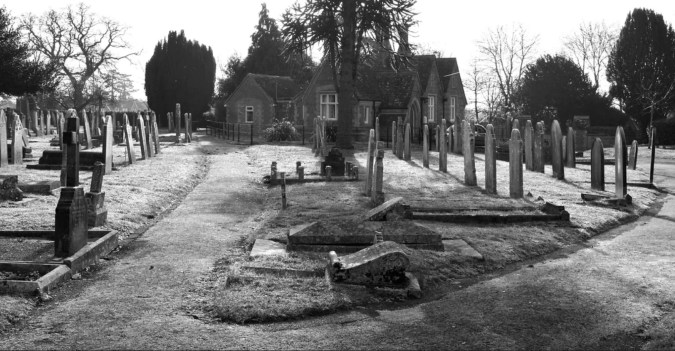
Romsey Old Cemetery, located on Botley Road in Romsey, Hampshire, is a historically significant site that holds an important place in the town’s past. Established in the 19th century, it reflects the community’s evolving history, serving as the final resting place for many residents over the years. The cemetery, which sits on the outskirts of the town, offers a glimpse into the lives of Romsey’s past inhabitants, many of whom were part of the town’s agricultural and industrial development. While it remains a peaceful and serene place today, the cemetery has also been the subject of local legends and ghost stories, adding a layer of mystery to its historical importance.
The cemetery was created in the early 1800s to accommodate the growing population of Romsey. As the town expanded, the older burial grounds at the local churches became insufficient, prompting the establishment of the Old Cemetery on Botley Road. This burial ground became a key part of Romsey’s religious and social life, as it provided a place for the deceased to be laid to rest while also serving as a symbol of the community’s traditions and beliefs about death and remembrance. The cemetery was designed to be spacious and accommodate a large number of graves, and many of Romsey’s prominent families from the 19th and early 20th centuries are buried there. Over the years, it became a serene and reflective space, offering solace to families mourning their loved ones.
The architecture of the cemetery, with its rows of gravestones and memorials, reflects the styles and trends of the time, with many gravestones bearing intricate carvings and epitaphs that tell the stories of the people interred there. As with many cemeteries of the period, the space became more than just a burial ground, it was a place for the community to gather, reflect, and remember. The cemetery was used not only for burials but also as a space for memorials and commemorative plaques, contributing to its historical significance.
Though peaceful today, the cemetery has been associated with various rumors of hauntings and ghostly occurrences. Over the years, locals have told stories of strange sightings and unexplained sounds, particularly during the evening hours. Visitors and residents have occasionally reported seeing shadowy figures moving between the graves or hearing faint footsteps when no one is around. These eerie stories have helped build the cemetery’s reputation as a site with a haunted past, adding to its intrigue.
The most common ghostly tales connected to Romsey Old Cemetery describe figures that seem to materialize among the gravestones before vanishing as quickly as they appeared. Other reports suggest the sounds of whispering voices or soft footsteps echoing through the cemetery, even when it is quiet and still. Some claim that the air around the cemetery feels unnaturally cold, particularly in certain areas. While there is no documented evidence to support these claims, the cemetery’s age and historical significance, coupled with the emotional weight of the graves, make it a natural setting for such stories to emerge. Many of the legends surrounding the cemetery are based on local folklore, passed down through generations.
The cemetery has also been the subject of speculation due to some of the stories attached to specific graves. Certain gravestones, particularly those marking untimely or tragic deaths, are said to be the focus of these supposed hauntings. Whether these tales are the result of the imagination or rooted in the real-life sorrow and loss experienced by the community remains unclear. What is certain, however, is that the cemetery’s long history and its connection to the people of Romsey have contributed to the sense of mystery that surrounds it.
Today, Romsey Old Cemetery remains a quiet and respected site for reflection. While the supernatural stories continue to intrigue some visitors, the cemetery is primarily a place for remembrance and contemplation. It continues to serve as a final resting place for the people of Romsey, offering a tranquil space where families can visit and reflect on the lives of those who came before them. The cemetery’s significance is not only in the stories it holds but in the role it plays in connecting the past with the present, allowing those who visit to pay their respects and honor the town’s history.
On a gentle summer morning, Sunday the 8th day of July, 1855, when the fields of Lockerley shimmered beneath a haze of gold, Susan Hatcher felt the world fold inward around her, tight, rhythmic, aching, and filled with both fear and fierce love. The hayfields outside lay heavy with ripening sweetness, the hum of insects rising steadily beneath the broad Hampshire sky, yet within the weathered cottage at Butler’s Wood, time seemed to move according to an entirely different rhythm: the rhythm of birth.
Thirty-five years old now, her body seasoned by life and softened by love, Susan laboured in the dim, cool room where the chalk and flint walls held back the worst of the summer heat. She had known childbirth before, three times in seasons both kind and cruel, but this time felt different. She was no longer the frightened young woman giving birth under the heavy shadow of judgment. She was a wife now, a respected matron of her own small household, and every pain she endured seemed steadied by the knowledge that she no longer bore the weight of her labour alone.
Outside the cottage, her husband, forty-one-year-old Charles Hatcher, tried desperately to quiet the storm inside him. He paced the narrow lane, stopping now and then to press his hands to his face, or to glance up at the thatched roof as if he might somehow sense what was happening beyond those walls. Charles had weathered bitter winters in the fields, rain thick as wool, hunger, doubt, the grinding ache of endless toil, but nothing had ever made him feel as helpless as the sound of Susan’s muffled cries drifting through the shuttered window.
He fetched water.
He tended the fire.
He whispered silent, clumsy prayers, simple words from a simple man who loved deeply and wished fiercely that he could share the burden she bore within.
Inside, an elderly village woman whose hands had caught half the babies born in Lockerley for the past forty years, worked with steady calm. She murmured encouragement between contractions, her voice as worn and warm as the linen cloths she pressed to Susan’s brow. The air smelled of fire-warmed linen, of sweat and hope, of life being shaped through pain as old as time itself.
Hours passed this way, the sun drifting toward the west, casting long shadows across the hedgerows where sparrows darted and the scent of elderflower drifted through the open window. And then, just as the heat began to soften into the first breath of evening, the sounds in the cottage changed.
A cry, thin, piercing, beautiful, rose into the summer air.
Charles froze. His hands fell still at his sides. His breath caught.
And then the elderly villagers voice, like a soft bell:
“It’s a boy.”
He entered the cottage as though stepping into a dream. The golden light of late afternoon bathed the room in a warm, forgiving glow. Susan lay propped upon the bed, her hair clinging to her temples, her face pale yet radiant with the gentle, exhausted triumph only a mother can wear. In her arms, swaddled in coarse but clean linen, was their son.
Charles knelt beside her, his rough fingertips brushing the child’s cheek with reverence, as though afraid the slightest touch might break the fragile miracle before him. And Susan, her voice a whisper softened by love, breathed the name that would become part of their family’s story for generations to come:
“George.”
Thus, on that quiet July afternoon, George Hatcher entered the world, child of the fields, child of summer light, child of a marriage forged in resilience and devotion. His life began in the same humble cottage where laughter and hardship had mingled for years, where his siblings had taken their first breaths, where Susan had grown from a frightened, unmarried girl into a woman beloved and steady, a mother who now held her child without fear of judgment.
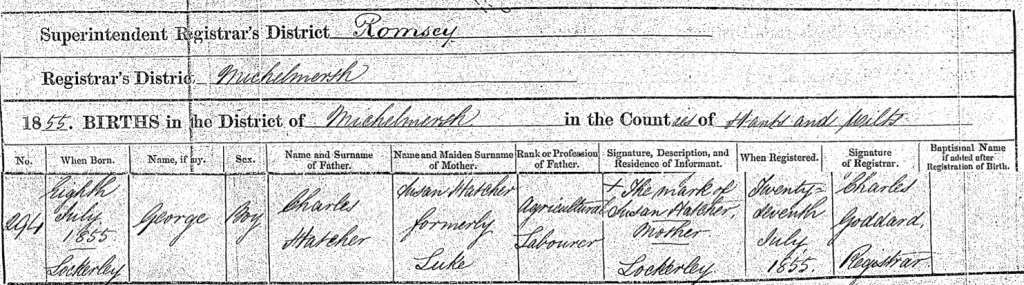
Nineteen days later, on Friday the 27th day of July, 1855, Susan made the familiar journey to the register office in Mitchelmersh. Still weak from childbirth, she carried herself with quiet pride, her shawl wrapped tightly against the soft breath of summer breeze. Registrar Charles Goddard received her with the perfunctory gentleness of a man accustomed to both joy and sorrow, asking his questions, dipping his quill, recording the details with practiced precision:
1855 Births in the District of Mitchelmersh, in the Counties of Hants and Wilts.
No. 294
When Born: Eighth of July 1855 at Lockerly
Name, if any: George
Sex: Boy
Name and Surname of Father: Charles Hatcher
Name and Maiden Surname of Mother: Susan Hatcher formerly Luke
Rank or Profession of Father: Agricultural Labourer
Signature, Description, and Residence of Informant: The mark of Susan Hatcher, Mother, Lockerly
When Registered: Twenty-seventh of July 1855
Signature of Registrar: Charles Goddard, Registrar.
Susan could not write her name, but she pressed her X upon the page with the confidence of a woman whose heart told more truth than any inked letters ever could. That simple cross held her love, her endurance, the fullness of her journey from shame to belonging.
Outside, life went on as it always had, the rumble of a cart, the smell of hay baked sweet by the sun, a dog’s bark echoing across the lane. But for Susan, everything had changed.
That night, in the warm flicker of the hearthlight, Charles held baby George against his chest. The older children gathered close, their eyes wide with wonder. Susan watched them, her heart full, her hand resting gently upon her husband's arm.
For this, this circle of flickering light, this cluster of small faces, this tiny heartbeat pressed against a father’s chest, was her life’s truest treasure. Not the wealth she never had, not the words she couldn’t write, but the family she had built through courage, sacrifice, and a love that had weathered every storm.
Thus began the life of George Hatcher, a child born beneath a broad summer sky, cradled by the hands of a steadfast mother, welcomed with trembling joy by a father who counted family as his only riches. His story began in love, pure, enduring, and written in the quiet, eternal language of the heart.
On a soft and mellow Sunday, the 12th day of August, 1855, the village of Lockerley stirred beneath a warm summer sky, its hedgerows humming with life, its fields rippling beneath the sun like green-gold silk. Morning light poured gently upon the flint walls of St John’s Church, the heart of the parish for generations, where the cool air inside still held the scent of beeswax, old wood, and prayers whispered long before Susan herself had been born.
It was here, beneath the vaulted timbers and ancient stone, that Susan and Charles arrived with their newborn son, little George, just one month old. Susan, still tender from the pains of July’s labour, held her infant close, his warm, fragile weight resting against the soft linen at her breast. Her heart fluttered with that familiar ache of love, a mixture of hope, fear, memory, and wonder. She had carried him through the long months of pregnancy, birthed him through heat and effort and whispered prayers, and now she carried him into the house of God, where she herself had once been presented as a child.
Charles walked beside her, his steps steady, his hands roughened by the labour that fed them. Though a quiet man, humble in manner and in means, his eyes softened as he looked upon his son. He had known toil, hardship, loss; he had known the ache of being born into a world of struggle. But here, in this church where sunlight fell like a benediction through the high windows, he felt pride, deep, simple, unspoken.
The church bell had tolled earlier that morning, gathering the small congregation, and now the murmur of voices fell into a reverent hush as Curate H. A. Wakes stepped toward the font. He was a gentle figure, his cassock whispering across the stone floor, his hands worn from years of shepherding the souls of Lockerley. He greeted the family with a soft nod before opening the Book of Common Prayer, its pages smooth with age, its words as old as the faith itself.
The ceremony unfolded in the steady, familiar rhythm the parish had known for centuries. A hymn was sung, likely the tender cadence of “All glory, laud, and honour,” or perhaps “Rock of Ages,” its verses rising softly into the warm air, mingling with drifting motes of dust that glimmered like tiny stars. The congregation’s voices were not grand, but honest, carrying the fragile beauty of country life, where every joy and sorrow was shared among neighbours.
Then came the readings, passages often chosen for baptisms in those days:
Suffer the little children to come unto me…
and
Except a man be born of water and of the Spirit…
Their words flowed through the church like a slow-running river, ancient and soothing, washing over Susan as she cradled her child.
When the moment arrived, Curate Wakes dipped his fingers into the clear water of the font, water drawn fresh that morning and gleaming beneath the candlelight. Susan lifted George gently toward him, her arms trembling slightly, not with fear, but with devotion. The curate’s voice rang softly:
“I baptise thee in the name of the Father, and of the Son, and of the Holy Ghost.”
The water touched George’s brow in shimmering droplets, catching the sunlight as though the heavens themselves blessed him. A stillness followed, broken only by the faint stir of the baby’s breath and the rustling of skirts as the congregation bowed their heads.
Curate Wakes then traced the sign of the cross upon the child’s forehead, sealing him with the symbol that had marked countless ancestors, a promise of protection, belonging, and grace. The prayers that followed spoke of guidance, of peace, of a life shaped by faith and love.
And in that soft August air, with the church quiet around her, Susan felt something within her settle, an echo of her mother Kitty, of her father Moses, both long buried beneath the yews of Lockerley. She felt the generations behind her, the struggles they had borne, the blessings they had passed down. She felt, too, the quiet triumph of having brought this child into the world not in fear or shame, but in the full embrace of marriage, community, and sacred ritual.
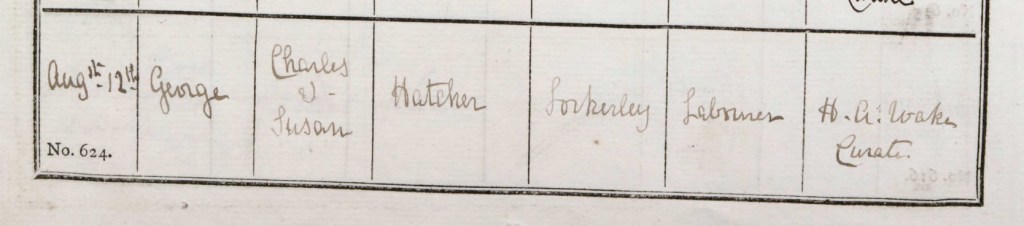
After the ceremony, Curate Wakes wrote the details with careful strokes in the parish register, recording the moment as No. 624:
When Baptized: August 12th

Child’s Christian Name: George

Parents’ Names: Charles & Susan Hatcher

Abode: Lockerley

Quality, Trade, or Profession: Labourer

By whom the Ceremony was performed: H. A. Wakes, Curate.
A small entry in a long book, yet to Susan, it held the weight of destiny.
When they stepped back into the bright warmth of the afternoon, the world seemed newly made. The sun shone golden on the fields, the larks sang overhead, and the gentle summer wind toyed with the ribbons at Susan’s bonnet. Little George slept in her arms, the faintest smile upon his lips, as though the waters of baptism had soothed him into dreams of angels.
Charles slipped his hand into hers.
And together, beneath the wide Hampshire sky, they walked home with their blessing, their future, their son, a child born of summer, of love, of long labour and quiet faith, his name now carried by the church bells, by the parish register, and by the tender, unfaltering heart of his mother.
On the morning of Monday the 14th day of September 1857, the old stones of St Clement’s Church in Fisherton Anger seemed to hold their breath. Dawn had risen softly over Wiltshire, its pale gold light drifting through a thin veil of mist that clung to hedgerows and graveyard grasses. The church bells tolled with a kind of solemn wonder, for never in its long memory had it prepared for a day quite like this, two weddings, bound together not by joy alone, but by secrets, old sorrows, and the complicated tangle of a single family’s fate.
And though Susan herself may not of been present inside those flint-built walls, the story of her sister Christian, known also as Catherine, would later reach her in Lockerley like a whispered storm. Susan would imagine it all with the keen ache of a woman who had lived enough life to understand how love could both bless and break a heart.
Christian Luke, her sister, her childhood companion, the girl who once chased butterflies across Hampshire meadows, was now forty-nine years old. Life had already carved deep stories into her spirit. She had known marriage, motherhood, abandonment, and the grief of watching her world fracture more times than anyone deserved. She stepped into St Clement’s that morning not as a blushing bride, but as a woman weathered by life, choosing, perhaps for the last time, to reach for companionship.
At her side stood John Pitt, thirty-five, a woodman whose hands had shaped forests, whose quiet steadiness may have offered her some fragile sense of peace. But the weight of Christian’s steps was heavier than any bride’s ought to be, for she was still, in the stern eyes of English law, the wife of another man: David Kemish, whom she had married in the very same church on Tuesday the 6th day of June 1843.
And at that very moment, David himself stood only feet away preparing to marry Christian’s own daughter, Ann Collins.
A mother, marrying the man she was not free to wed.
A daughter, marrying the man her mother had never been freed from.
A pair of forbidden vows taking shape beneath the same roof, on the same morning, in the same breath of time.
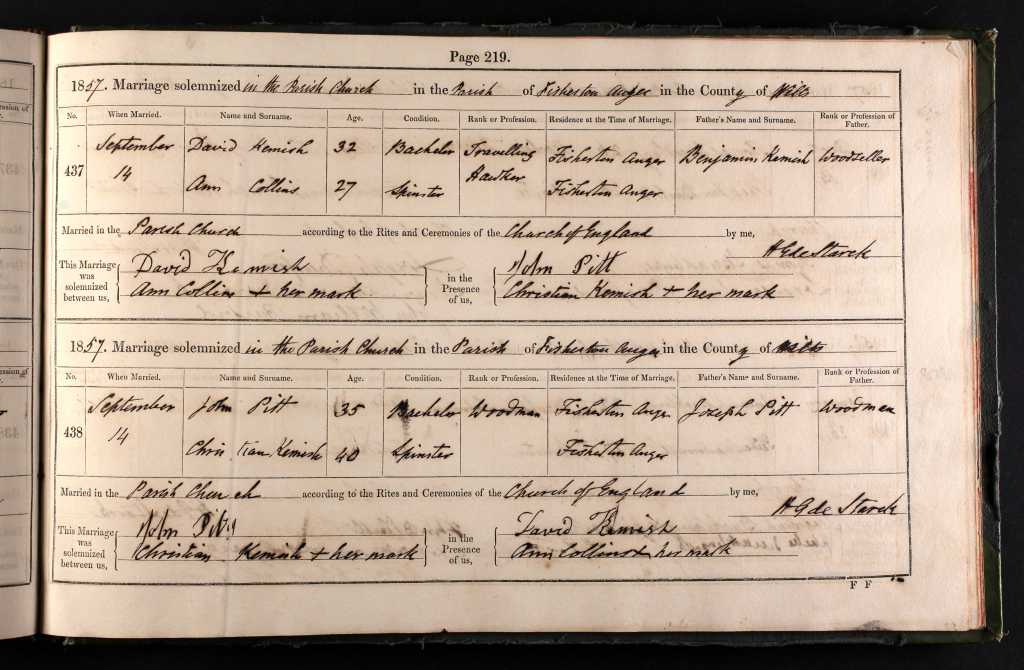
The register tells the tale with cool, unfeeling strokes of ink:
Marriage No. 438

Marriage solemnized in the Parish Church in the Parish of Fisherton Anger in the County of Wilts.

When Married: September 14, 1857

Name and Surname: John Pitt and Christian Kemish

Age: 35 and 40

Condition: Bachelor and Spinster

Rank or Profession: Woodman, —

Residence at the Time of Marriage: Fisherton Anger, Fisherton Anger
Married by H. de St. Croix

This Marriage was solemnized between us:

John Pitt

Christian Kemish X her mark

In the presence of:

David Kemish

Ann Collins X her mark
But no ink, not even the neat hand of Reverend H. de St. Croix, could capture the tremor in the air when Christian placed her mark beside John Pitt’s name. Nor could it reveal the sharp, breath-held silence when David Kemish, her undivorced husband, stepped forward to witness the ceremony. Or the ache Christian must have felt when she then turned around to witness David’s marriage to her daughter Ann, her own trembling X binding her into the strange, sorrowful circle of their shared lives.
It was a double wedding unlike any the parish had ever seen.
One imagines the church bathed in muted morning light, dust motes drifting like tiny stars as the organ played a simple hymn such as “O God, our help in ages past,” its familiar melody rolling through the rafters like a blessing over broken things. The readings chosen were likely the ancient words of Corinthians or the soft promises of Ephesians, verses spoken countless times before but never over such a complicated pair of unions.
Christian, in whatever modest gown she wore, likely felt the linen cling to her skin with the weight of her choices. Ann, her daughter, perhaps in her best bonnet, stood at the altar with the man who had once shared her mother’s life. Both women must have felt the trembling of old wounds beneath the surface of their vows.
And the prayers spoken over them “Those whom God hath joined together…”, must have carried an echo of sorrow for all four souls.
When Susan later heard what had unfolded in Fisherton Anger, perhaps from neighbours or from one of her far-flung siblings, she may have sat quietly by the hearth with her needlework resting still in her lap. She would have closed her eyes and imagined Christian, the sister she loved but had long been parted from, standing beneath the church’s heavy arches, searching for a scrap of hope in a world that had given her so little.
Susan knew how yearning shaped a woman.
She knew how grief could bend a life until it twisted into unrecognizable shapes.
She knew, too, how fiercely the human heart could cling to love even when the world forbade it.
And so, though she was miles away in Lockerley, Susan’s heart must have ached with an understanding deeper than words. Christian had not chosen the easy road, she had simply chosen the only one her bruised heart could bear.
When Christian left the church that day, the autumn air would have felt sharper, almost tender against her cheeks. Behind her lay the vows of two marriages. Ahead of her lay the uncertain road of a life rewritten.
And though the parish register records only two quiet ceremonies, bound by ink and silence, Susan would forever remember them as something far more, two fragile acts of hope, two tangled strands of longing, two women, mother and daughter, stepping into futures shadowed by their pasts yet illuminated, just barely, by the faint glow of love’s impossible courage.
Bigamy, in the England of Susan’s time, was not merely a legal offence, it was a moral shockwave, a quiet scandal that disturbed both the dignity of the church and the delicate order of village life. Yet behind every act of bigamy there was almost always a story of desperation, misunderstanding, or deep-hearted yearning.
In the nineteenth century, English marriage law was strict and unforgiving. Once a man and woman married in the Church of England, the bond was considered lifelong in the eyes of both God and the law. Divorce was almost impossible for ordinary people. Before 1857, it required a full Act of Parliament, an avenue reserved only for the wealthy and titled. For labourers, washerwomen, shepherds, and rural folk like the Lukes, divorce simply did not exist.
Marriage could break, but it could not be undone.
This meant that if a spouse abandoned the family, sailed overseas, was transported to the colonies, vanished into the London fog, or simply walked away and never returned, the one left behind had almost no lawful way to remarry. They remained legally bound, no matter how many empty years passed. There were cases of husbands disappearing into the world, taken by war or work or prison, and wives left behind believing themselves widowed when they were not. There were women like Christian, who had been separated for decades, with no word from the man the law still called her husband.
Bigamy was officially punishable by imprisonment, sometimes with hard labour. But in reality, far more people committed it than were ever charged. The courts often took a strangely human view: if the abandoned spouse remarried after years of desertion, especially to create stability for children, it was sometimes quietly overlooked. Rural communities, too, recognised the truth: life was hard, companionship necessary, and a marriage in name only was no marriage at all.
Yet the stigma remained. To be labelled a bigamist was to be branded reckless, sinful, or deceitful. Clergy whispered. Neighbours watched. Parish records stayed forever unchanged, the ink preserving the crime long after the emotions and circumstances had been forgotten by the living.
But from a human view, bigamy often grew from loneliness, from a yearning to build a family again, from a desire to be something other than abandoned. Many who remarried believed deep in their heart that their missing spouse was truly dead, never imagining they would stand again in the same parish register as a “spinster” or “bachelor.”
Women especially were caught in an impossible bind. A deserted wife could not earn enough to support herself or her children. Marriage offered safety, shelter, and standing. To choose bigamy was often to choose survival.
Villages like Lockerley or Fisherton Anger sensed this complexity. Though tongues might whisper, many hearts understood.
So bigamy in Susan’s world was not simply a crime. It was a crossroads where law, morality, loneliness, and hope all collided. It was the trembling line between what life demanded and what society permitted. And behind every bigamous marriage, just like Christian’s, there was a hidden story, one shaped not by wickedness, but by the fragile, unyielding need to love and be loved in a world where choices for women were painfully few.
In the England of 1857, the law did not soften itself for sorrow.
It did not pause to consider the broken threads of a woman’s life, nor the years of abandonment, nor the quiet suffering hidden behind cottage doors. It saw only the ink on the register, not the ache of the heart.
So when Christian’s secret was uncovered, when the tangled truth of her third marriage rose from whispers into the cold, unsparing light of the law, the judgment was swift.
She was sentenced to six weeks’ imprisonment.
And David Kemish, the man who had stood beside her that morning in St Clement’s Church, was sentenced to two months.
Two lives, already battered by hardship, now struck again by the stern hand of Victorian justice.
For Christian, a woman of forty-nine whose life had been shaped by abandonment and survival, the sentence must have fallen like a final blow. Six weeks in a county gaol, a place of stone walls and echoing footsteps, where the air was thick with damp and the cries of other broken souls. Her days would have been spent in silence, in hard labour, picking oakum until her fingers bled, her body still aching from the years of toil that had come before.
For David, whose choices were tangled in both desire and duty, two months must have stretched like an eternity.
He had witnessed Christian’s marriage even as law still bound them, and then married her daughter Ann with Christian as witness. All four had stood tangled in the same web of choices, and yet it was he who bore the heavier sentence. Two months on prison rations, two months under the cold eye of wardens who cared little for the stories that led a man astray.
Outside the prison walls, life carried on as if nothing had happened.
Carts creaked along the lanes.
Church bells rang.
Fields turned slowly toward autumn.
But in the homes they left behind, in the hearts of their children, their siblings, and most especially in Susan’s heart, silence settled like dust.
Susan would have felt that sentence like a stone inside her.
Not only the shame that the world might whisper about, but the sorrow for her sister’s suffering, for the way life had crushed Christian into choices she had never been taught how to navigate. She would have remembered them as girls running through Lockerley’s lanes, as daughters of Kitty and Moses, as sisters sitting side by side in candlelight.
And now Christian was behind walls.
And Susan, left in the world outside, carried the ache of knowing she could not soften her sister’s bed, could not bring her broth, could not sit with her hand in hand the way sisters long to do when the world turns cruel.
Bigamy was the crime.
But loneliness was the cause.
And grief was the punishment that lasted long after the prison doors opened again.
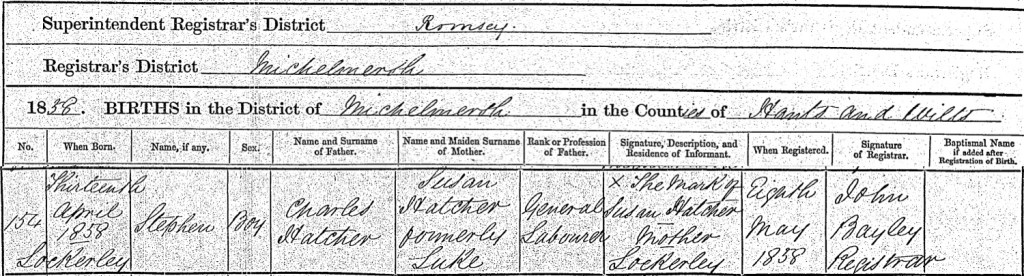
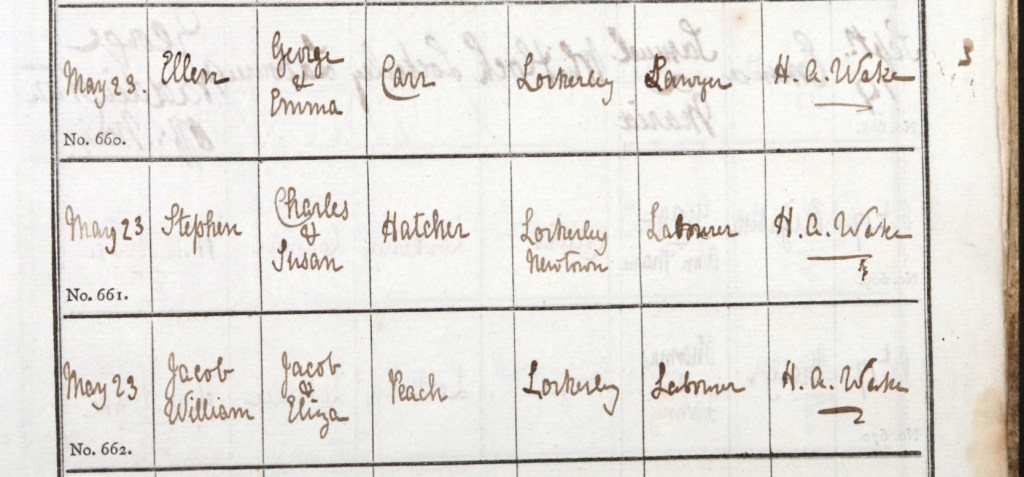
On Tuesday, the 13th day of April 1858, when spring lay tenderly upon Lockerley like a soft green shawl, the world inside the small Hatcher cottage grew tight with expectation. The hedgerows outside were just beginning to feather with new leaf, lambs called across the meadows, and the first primroses trembled in the morning breeze. Yet inside those chalk-and-flint walls, most likely in Butler’s Wood, Newtown, there was no thought for the gentle beauty of the season. All was centred upon Susan.
Thirty-eight-year-old Susan, lay in the dim, warm hush of her labour bed, her breath rising and falling like waves against a shore. Her body had travelled this wilderness before, many times, and yet each journey through pain felt entirely its own. She had birthed children as a girl hardly grown, she had birthed children as a wife steadied by love. But this birth, this child, came at a moment in life when her strength was seasoned, when loss and love had both carved deep places within her.
Her husband Charles, aged forty-three, waited just beyond the doorway, where the dirt floor met the small patch of garden he tended after long days as a general labourer. The air outside smelled of earth and sap and the faint smoke of someone’s early morning fire. Charles’s hands, hands that held nothing lightly, twisted anxiously at his sides. He would have taken Susan’s pain upon himself if he could. But this was the woman’s realm. The realm of blood and agony and miracle.
Within the cottage, the midwife moved quickly but gently, the skirts of her gown brushing softly over the floor. She was a seasoned woman of Lockerley, known to nearly every mother within miles, the same midwife who had delivered many of Susan’s bairns, the same who had once guided Susan’s own mother Kitty through the night. Her payment would be modest, no more than a few shillings, or sometimes a small loaf of bread or fresh butter when coin was scarce. But she did not do the work for coin, she did it because she understood the ancient calling, the way women must lift one another through the valley of birth.
She pressed warm cloths to Susan’s brow, coaxed her to sip water, murmured soft encouragements that fell like feathered prayers. Birth in Lockerley was rarely peaceful, rarely easy. If a doctor was called and he seldom was, it meant danger. The nearest physician lived miles away in Romsey, and a doctor’s visit could cost what a labourer earned in a fortnight, sometimes more. And so the midwife remained the guardian of life’s boundary, steady as an oak, patient as time.
Susan’s older children, Ellen now twelve, Fanny eleven, Mary Ann nine, John six, and little Rose only three, were kept busy in the garden by a neighbour who had come to help. They gathered early dandelions, chased each other around the budding gooseberry bushes, whispered questions about the new baby, and peeked toward the cottage whenever the wind shifted. The adults gently herded them away each time. Children did not belong in the room where life and death brushed shoulders.
As the hours passed, Susan felt herself drifting between worlds, the one she knew, and one she could not yet see. With every tightening of pain, she reached instinctively for memories, her mother Kitty, humming softly as she braided Susan’s hair,
her father Moses lifting her to see over the hedgerow, her sister Charlotte’s laughter, her newborns’ first cries, her quiet evenings beside Charles as the fire glowed low.
These memories held her together as the mountains of labour rose before her.
Then, as the afternoon sun stretched long and golden across the fields, a shift came, sharp, undeniable, ancient. The midwife leaned close, her hands sure and calm, guiding the moment with the wisdom of dozens of births before this one.
And then, through pain that seemed to break the world open, came a cry.
A thin, strong, miraculous cry.
A boy.
A son.
Charles entered only when the midwife nodded him in, his boots hushed by the rushes on the floor. He stopped short at the sight: Susan, pale with exhaustion but radiant with pride, holding a small, red-faced bundle close against her heart. The child’s fists clenched the air as though eager for life, his cry piercing, beautiful, alive.
“Stephen,” Susan whispered, her voice trembling with love she had not known she still possessed.
Charles reached out, touching his son’s cheek with a reverence usually reserved for holy places. In that moment, all the hardship of their world, the long days in the fields, the worry of coin, the ache of lost siblings and parents, fell away. There was only this small, breathing miracle.
On Saturday, the 8th day of May 1858, Susan wrapped herself in her shawl and walked the familiar road to Mitchelmersh, her footsteps slow but steady. She carried not only the memory of birth, but the living proof of it at home. Registrar John Bayley received her kindly, as he had many times before. He opened the thick register, dipped his pen into dark ink, and wrote:
Births in the District of Mitchelmersh in the Counties of Hants & Wilts.

No. 154.

When Born: Thirteenth of April 1858 at Lockerley
Name, if any: Stephen
Sex: Boy
Name and Surname of Father: Charles Hatcher
Name and Maiden Surname of Mother: Susan Hatcher formerly Luke
Rank or Profession of Father: General Labourer
Signature, Description, and Residence of Informant: The mark of Susan Hatcher, Mother, Lockerley
When Registered: Eighth of May 1858
Signature of Registrar: John Bayley, Registrar
Baptismal Name, if added after Registration of Birth: —
Susan, unable to sign her name, placed her familiar, humble X upon the page. That small mark, crossing ink and paper, held more meaning than any elegant script could. It spoke of endurance. Of devotion. Of courage. Of the quiet strength of a woman whose life had been shaped by love and loss, by work and grace, by the simple yet profound calling of motherhood.
Outside the registrar’s office, life carried on. Sparrows darted. A cart creaked along the road. Somewhere, a church bell tolled the hour.
And back in Lockerley, within the small cottage where she had given life yet again, Susan held her son close, breathing in the faint sweet scent of his hair, knowing that in the fragile curve of his cheek and the warmth of his tiny body, the story of her family had begun a new, tender chapter.
Stephen Hatcher, born of spring, born of endurance, born of love. A child of Lockerley. A child of Susan’s heart.
And so his life began.
On a gentle spring Sunday, the 23rd day of May 1858, Lockerley seemed to breathe in soft harmony with the season. The hedgerows shimmered with new green, the meadows stirred beneath a warm, forgiving breeze, and the sun, filtered through drifting white clouds, fell upon the village like a quiet blessing. From St John’s Church, the ancient bell began to ring, each peal drifting over the Hampshire fields like a slow heartbeat calling its people home.
Among the families walking the worn path to the church door came Susan and Charles Hatcher, their children gathered close around them like the petals of a single bloom. Susan, her face still carrying the tenderness and fatigue of Stephen’s birth only weeks before, held her infant son against her chest, her shawl wrapped gently around them both. She walked with that familiar mixture of humility and quiet pride, a woman whose life had been shaped by hardship, yet whose heart remained soft enough to cradle hope.
Beside her, Charles, broad-shouldered and steady, guided their brood with the sure, protective movements of a man who had learned to measure his life not in possessions, but in the small, cherished moments that stitched a family together. Ellen, Fanny, Mary Ann, John, and little Rose toddling along with her siblings, formed a procession of childhood warmth around their parents, each one eager, each one aware in some unspoken way that today was meant for their baby brother.
Inside St John’s, cool stone breathed faint traces of centuries-old incense. Sunlight filtered through the windows in soft, golden shafts that caught the swirling dust in the air, making it shimmer like tiny blessings suspended above the pews. The candles along the chancel flickered gently, steadying themselves for the sacred work of the morning.
Curate H. A. Wakes stood at the baptismal font, its water still as glass until his hand stirred it. His voice, calm and rhythmic, carried through the nave as families gathered close. The Hatchers were not alone in their joy, this was a day of welcome for three children, each born of labouring hands, each raised in cottages filled with love rather than wealth.
There was tiny Ellen Carr, daughter of George and Emma, her father a sawyer whose calloused hands bore the scent of fresh-cut wood. And Jacob William Peach, the child of Jacob and Eliza, another family stitched into the humble fabric of Lockerley life. Their babies, like Stephen, were swaddled in simple cloths, their faces round and wistful, their futures unwritten.
Curate Wakes lifted the first child to the font, and then the second, his voice weaving ancient words into the warm breath of the morning. When at last he turned to Susan and Charles, the church seemed to soften, as though holding its breath for the moment.
Susan stepped forward, her arms tightening gently around Stephen. The child stirred, opening his eyes just as the water touched his brow, a single droplet catching the light like a tiny star. As his name was spoken aloud within the sanctuary, Stephen Hatcher, it felt to Susan as if the walls themselves welcomed her son into a lineage far greater than their humble cottage: into faith, into community, into the long memory of Lockerley.
Curate Wakes completed the entries with his careful hand, his pen scratching softly onto the parchment that would outlast all their lives:
BAPTISMS solemnized in the Parish of Lockerley in the County of Southampton in the Year 1858.
No. 661
When Baptized: May 23
Child’s Christian Name: Stephen
Parents’ Names: Charles & Susan Hatcher
Abode: Lockerley Newton
Quality, Trade, or Profession: Labourer
By whom the Ceremony was performed: H. A. Wakes.
Beside Stephen’s name rested the entries for Ellen Carr and Jacob William Peach, Nos. 660 and 662:
No. 660
When Baptized: May 23
Child’s Christian Name: Ellen
Parents’ Names: George & Emma Carr
Abode: Lockerley
Quality, Trade, or Profession: Sawyer
By whom the Ceremony was performed: H. A. Wakes.
No. 662
When Baptized: May 23
Child’s Christian Name: Jacob William
Parents’ Names: Jacob & Eliza Peach
Abode: Lockerley
Quality, Trade, or Profession: Labourer
By whom the Ceremony was performed: H. A. Wakes.
Three small lives joined forever by the accident of a shared Sunday and the blessing of the same holy water.
As the final prayer drifted into silence, Susan looked down at Stephen cradled in her arms. She felt the soft rise and fall of his breath, smelled the warm, sweet scent of his skin, and understood in her bones that this moment, simple, tender, and fleeting, was the quiet heart of her life. Around her, her children fidgeted and whispered, Charles stood tall and proud, and beyond the heavy doors of St John’s, the summer fields waved gently in the waiting sun.
When the family stepped back into the warm air, the bell began again, its voice rising above the rooftops, fading into the open sky. The day moved on, as all days inevitably do, but for Susan, something sacred lingered. Her son had been named before God. He carried his father’s surname, her strength, and the love of a family made whole by faith and perseverance.
And in that small village of Lockerley, where life was measured by seasons and harvests and the tender milestones of children born and blessed, another chapter in Susan’s story was written in the quiet poetry of ordinary grace.
On a cold and mist-laden Wednesday, the 23rd day of November 1858, when the last of autumn’s colour clung faintly to the hedgerows and winter’s breath pressed quietly through the Hampshire air, Lockerley found itself steeped in sorrow. Dawn broke pale and uncertain, and the fields beyond Butler’s Wood lay still beneath veils of low-lying fog, as though the very earth sensed the grief gathering within one humble cottage.
Inside those worn chalk-and-flint walls, lit only by the dim glow of a dying fire, Susan knelt beside her husband’s bed. Charles, her Charles, only forty-six years old yet already shaped by a lifetime of honest labour, lay struggling for each breath. Pneumonia and bronchitis had tightened their grip over the past week, robbing him day by day of the strength that had once moved axes through timber and lifted children into the air with laughter rumbling in his chest.
The woodman who had known the scent of pine as intimately as another man might know fine books or coin, now lay motionless, his strong frame reduced to fragile stillness. The faint aroma of chopped wood still seemed to cling to him, a scent that had always brought Susan comfort. Today it broke her heart.
She held his hand in both of hers, her thumb gently brushing the calluses she had long admired. How many times had that hand steadied her? How many times had it brushed hair from her brow, or lifted a sleeping child from her arms, or tightened its hold on hers as they walked home through the dusk? Susan drew his hand to her lips now, whispering his name as if her voice alone could tether him to this fading world.
Charles’s breaths grew softer, each one a smaller echo of the man he had been. The room’s silence felt heavy enough to crush her, broken only by the faint ticking of the clock on the mantle and the distant, mournful wind stirring through the trees outside, the same trees he had worked, shaped, and understood better than any living soul.
And then it came,the stillness between breaths that stretched too long, the moment where time held itself perfectly still.
Susan felt it before she fully understood it.
His chest fell…and did not rise again.
The world seemed to shatter, not in a violent burst, but in one long, aching silence. She pressed her forehead to his, tears slipping down her cheeks and onto his cooling skin. Her heart, which had once beat in rhythm with his, now felt lopsided, broken, adrift.
When she could finally move, she remembered her mother’s old wisdom, a wisdom passed quietly from woman to woman in the softest corners of Hampshire cottages: when a soul departs, open the window, so it may find its way home.
With trembling fingers, she unlatched the small wooden sash. The cold November air swept in, sharp and clean, stirring the curtains and brushing gently over Charles’s face. For a fleeting breath, Susan imagined she felt him pass by her, warm and familiar, slipping into the morning mist beyond the hedgerows. She whispered a last goodbye, though her voice barely rose above a breath.
The next morning, her grief still raw and trembling, Registrar John Bayley arrived to record the necessary details, those stark, unfeeling lines that reduce a lifetime to ink:
When and where died: Twenty-third November 1858, Lockerley

Name and surname: Charles Hatcher

Sex: Male

Age: 46 years

Occupation: Woodman

Cause of death: Pneumonia and Bronchitis, 1 week, Certified

Signature, description, and residence of informant: X The mark of Hannah Bell, present at the death, Lockerley

When registered: Twenty-fourth November 1858

Signature of registrar: John Bayley, Registrar.
Though it was Hannah Bell who made her “X” upon the page, it was Susan whose sorrow filled every corner of that cottage. The bed still held the faint impression of his body. The axe by the door leaned silently, never again to rest upon his shoulder. The boots he had worn through every season of their life together stood untouched, their laces loosely falling forward like hands reaching for a master who would never return.
Susan wandered the rooms in a daze, touching the back of the chair where he once sat, smoothing the quilt they had shared through years of cold winters, pressing her fingertips to the window through which she had let his spirit go. Every object in the cottage held some whisper of him. Every breath hurt.
Yet even in her grief, love wove itself quietly through the ruins of her heart. She saw him in the way the morning light spilled onto the floorboards, golden and soft. She heard him in the sigh of wind through the oaks, in the laughter of their children as they tried to make sense of a world missing their father’s steady presence. She felt him in the very rhythm of life, for Charles had become part of the land he worked.
Though no wealth or monument marked his passing, he left behind something far greater, a legacy built from devotion, humility, and the quiet courage of a man who loved his family with every breath he had been given.
And so, in the evenings when Susan sat by the hearth with her mending, the fire flickering low just as it had on the night he died, she would sometimes look toward the open window and feel him there, gentle as the night breeze, steadfast as the earth itself.
For love like theirs does not end.
It simply changes shape and stays in the whisper of the trees, in the stillness of dawn, and in the heart of a woman who once opened a window to set her true love free.
On a grey November morning, Thursday the 25th day of November 1858, the villages of Newtown and Lockerley lay wrapped in a hush of mist and mourning. The hedgerows, bare now of autumn’s last colours, bowed beneath the weight of damp air, and every rooftop glistened with dew that felt strangely like tears. Even the birds seemed reluctant to break the quiet, as though nature herself knew that sorrow had come to dwell among the cottages of Butler’s Wood.
In the cottage that had once echoed with children’s laughter and the low hum of a woodman’s song, Charles Hatcher lay still in his coffin. Only two nights earlier his shallow breaths had filled this very room; now the silence pressed against the walls, heavy and unyielding. Forty-five years of life, of labour, of gentle humour and steadfast love had ended in the cruel grip of pneumonia and bronchitis. He had been a man of the earth, a worker of wood, a husband whose hands knew both hardship and tenderness, but none of that could save him from the illness that swept through him like a bitter winter wind.
Susan sat beside him, her hand resting on the polished wood of his coffin, the same way she had rested it upon his chest during his final hours. Her eyes were hollowed from nights without sleep, from tears that had soaked her pillow and left salt upon her skin. She had held his hand until the very last, whispering his name, whispering her love, whispering prayers she barely remembered how to speak. When he departed, it felt as though the pulse of her own life had been snatched away with him.
The cottage felt too large now, too quiet, every shadow a memory. His boots stood by the door where he had left them, worn from years of walking the woodland paths. His axe, leaned carefully against the wall, still smelled of sap and earth. His coat hung on its peg, faintly carrying the scent of smoke and pine, a scent she would forever associate with safety, with home, with him.
That morning, before the world fully stirred, neighbours came in hushed steps to help lay him out. Ivy and red berries, gathered by small hands from the children who didn’t fully understand the ache in the adults’ eyes, were placed tenderly atop the coffin. The carpenter’s workmanship was simple but honest, just as Charles had been. His folded hands, once strong enough to lift timber and cradle newborns, now seemed small and impossibly still.
By late morning the funeral procession formed outside the cottage. Four village men, likely friends, neighbours, perhaps kin, lifted the hand-bier upon their shoulders. The white shroud covering the coffin fluttered faintly in the cold breeze, almost as if Charles’s spirit were trying to reassure the family who walked behind him.
At the front walked the parish clerk bearing a small wooden cross. Behind him, Reverend H. A. Wake stepped slowly through the lane, his breath rising in pale clouds as he began the familiar words of the Church of England’s Burial Service.
“I am the resurrection and the life…”
Susan walked directly behind the coffin, wrapped in heavy mourning crepe, her shawl pulled tight around trembling shoulders. Her steps faltered often; grief weighed heavier than any winter frost. Her children clustered close, Ellen trying to remain strong, Fanny sobbing quietly, Mary Ann clutching Susan’s skirt, John and Rosa wide-eyed in confusion, and little Stephen too young to understand but sensing the ache in the air.
As the procession wound through Newtown Lane toward St John’s Church, every door they passed opened to reveal bowed heads and removed caps. In Lockerley, a death was not just a private sorrow but a village loss. Charles had worked their land, mended their fences, felled their timber, he was part of them.
Inside St John’s, the cold stone walls echoed with soft footsteps. Candles flickered atop the altar, their light golden against the grey morning. The coffin was set before the chancel, and Susan took her place among the wooden pews where she had once stood for baptisms, for marriage, for the sacred milestones of her life. Today, she was here for its cruel opposite.
The congregation sang gently. Their voices trembled but rose like prayer on the cold air:
“Rock of Ages, cleft for me
Let me hide myself in Thee.”
Later came a hymn that tugged mercilessly at Susan’s heart:
“Abide with me; fast falls the eventide…”
She closed her eyes as she listened, imagining Charles’s strong voice beside her as it once had been. The curate read from the Psalms, “The Lord is my shepherd; I shall not want,” words that floated through the church like soft laments.
Then, in the bitter wind of the churchyard, they stood at the open grave beneath an ancient yew tree. The earth beside it lay in a dark mound, spade-marked and waiting. The bell tolled, each note deep and solemn, rippling through the stillness.
When Reverend Wake spoke the final words,
“Earth to earth, ashes to ashes, dust to dust…”
Susan stepped forward. Her hand shook as she dropped a small clod of earth onto the coffin. The soft thud sounded impossibly final. One by one, the children followed her, each offering their own farewell in the only way they could.
Standing nearby were Charles’s parents, William and Mary Hatcher. Time had bent their backs, and grief bent them further still. To outlive a child is to bear the most unnatural sorrow, and Mary clutched her handkerchief to her face, her sobs almost soundless.
In the vestry afterward, Reverend Wake inscribed the burial entry with measured strokes:
BURIALS solemnized in the Parish of Lockerley in the County of Southampton in the Year 1858.

No. 343.

Name: Charles Hatcher.

Abode: Lockerley.

When Buried: November 25th.

Age: 45 years.

By whom the Ceremony was performed: H. A. Wake.
A few simple lines of ink for a man who had lived a life full of love, of labour, of gentle goodness.
That evening, when the children slept at last, Susan sat alone by the fire. The chair opposite her, the one where Charles had once stretched his weary bones after long days in the woods, stood empty. She could almost hear him there, humming softly as he mended tools, or telling her some small tale of the day. She reached out as if to rest her hand on his knee, then let it fall.
Outside, the wind whispered through the branches. The fields lay quiet beneath the rising moon. And somewhere beyond the veil of night, Susan hoped, prayed, believed that Charles walked once more through woods not touched by winter, not marred by illness, a place where breath came easily and love endured without end.
For though his body now lay beneath Lockerley’s soil, his spirit lingered in every corner of the life they built together:
in the laughter of their children,
in the scent of freshly cut wood,
in the hush of dawn across the Hampshire fields,
and, most of all, in the heart of the woman who would carry his memory for the rest of her days.
When the earth settled over Charles’s grave in November of 1858, the world did not pause for Susan. The bells stopped ringing, the neighbours drifted back to their cottages, and the lanes returned to their everyday silence. But for Susan, the air felt different, as though the heart of her world had fallen out of rhythm. She stood now on the threshold of widowhood, and in 1858, for a woman of her station, the path ahead was steep, shadowed, and lonely.
The first thing she would feel was the sudden, disorienting shift of her place in society. A married woman was held within a man’s protection, defined by his name, his wage, his place in the parish. As a widow, she was neither maiden nor wife, but something in between, someone the village regarded with a mixture of pity, respect, and quiet watchfulness. Her status changed overnight. She would be addressed differently, regarded differently, spoken about differently, never unkindly, but with that gentle, solemn tone reserved for women whose lives had “met with grief.”
Yet the greatest change was not in the eyes of others, it was in the very workings of her daily life. Widowhood in 1858 was not a gentle state. It was hardship. It was negotiation. It was survival.
Without Charles’s wage, the household purse shrank sharply, almost cruelly. A labourer’s earnings had never been much, but they had been steady, a constant drip that kept the family afloat. Now, with seven children still dependent upon her, some nearly grown, some still small enough to cling to her skirts, Susan stood as the sole support of her household. The parish might offer a little relief if she petitioned them, but the guardians of the Romsey Union were reluctant to give too much, believing generosity to be “an encouragement to idleness,” though idleness had never touched Susan’s life.
Work for a widow was limited. She might take in washing for neighbours, long days spent stooped over steaming tubs until her back ached and her fingers reddened. She might go into the woods to gather fallen branches for kindling, or take small gleanings from the fields after harvest with the farmer’s permission. Older children, like Ellen and Fanny, would soon be expected to work in service, and the coins they earned, however tiny, would help keep food on the table. But still, it would be Susan who bore the weight.
As winter came, and winters in Lockerley could be damp, biting, and cruel, she would feel the absence of Charles in every creaking board, every cold draught, every long night. The fire would need tending without his strong hands to chop wood. Repairs that he once handled with quiet competence now became burdensome tasks or things left undone. The sound of the woods outside, once comforting, might now seem lonesome, and the empty space beside her at night a wound that pulsed with memory.
Neighbours in Newtown would do what little they could. A pot of broth when illness came. A loaf of bread left discreetly on her doorstep. A kind word in the lane. But they too were labourers, bound by the limits of their own poverty. Sympathy, though genuine, could not fill a larder.
The parish church would become a place of refuge for her, the hymns and prayers rising like threads of solace on Sunday mornings. The curate, who had buried Charles, would nod gently toward her in the pews, acknowledging her grief without speaking it aloud. Widows were well-known to God’s ear, the scriptures said, and Susan would cling to that thought when her nights grew long and her courage faltered.
There was also the matter of mourning itself. Victorian custom demanded a period of deep mourning for a widow, though the poorer the family, the less elaborate the dress or observance. Susan would wear black for many months, perhaps a simple dyed gown, perhaps an apron sewn from cheaper serge. Such garments were meant not only for grief, but as a sign to the village: here is a woman marked by loss; speak softly to her; tread gently around her sorrow.
Yet for all the struggle, widowhood was not only a state of hardship. It was also a crucible in which Susan’s strength, long underestimated, would burn brighter. She had survived the death of her mother, the passing of her father, the births of children with no man to stand beside her. She had walked the hard road of poverty before, and she would walk it again, but this time, with the memory of the man who had loved her deeply for more than a decade, whose steady labour had built the roof over her head, whose tenderness had carried her through her darkest hours.
And so, as 1858 bled into 1859, Susan would lift herself with quiet determination. Each morning, she would wake in that little cottage at Butler’s Wood, the trees whispering above her, and she would begin again. She would rise for her children. She would rise for the house that still needed tending. She would rise because she had no other choice, and because, beneath the grief, her heart still beat with the stubborn, enduring courage of a woman who had weathered storms all her life.
This was what widowhood meant in 1858: hardship, yes, but also resilience; sorrow, but also survival; the end of one life, and the slow, quiet forging of another.
And for Susan, the next chapter would be the hardest yet, yet also the one that would reveal just how unbreakable she truly was.
The Years She Walked Beside Him.

She wed him in a frost-kissed lane,
a labourer with gentle hands,
and she, a woman made of quiet strength,
carrying bruised years and unspoken hopes.
Their vows were simple, soft as breath,
but oh, how deeply they rooted.

In a cottage hemmed by hedgerows,
they built a life from soil and sunlight,
seven children, laughter sewn between hard seasons,
their days shaped by harvests, hearth-glow,
and the tenderness that rose between them
in glances more than words.

She cooked the bread, she mended clothes,
she soothed small foreheads through fevered nights.
He chopped the winter wood,
walked the forest with purposeful strides,
and when he came home at dusk,
she always knew the rhythm of his boots
before they touched the door.

Through births, through baptisms,
through lean months and generous ones,
they stood like two trees growing from the same root,
weathered, faithful, leaning into one another
when the winds grew fierce.

He fathered the children she bore before him
as though they were written in his blood,
lifting them onto his shoulders
as easily as he lifted the axe.
And she loved him doubly for that,
for the way he expanded himself
to make room for every corner of her life.

Years passed like turning pages.
Her hair silvered at the edges,
his hands grew more lined,
but in the quiet moments before dawn
when she watched him sleep,
she still felt that tender hum of newlywed love,
warm as embers in the hearth.

Then came the November
that stole the breath from the world.
Illness crept in like an unwelcome shadow,
and she held his hand in the lamplight,
feeling him slip from her
like water through trembling fingers.

When he died, the house sighed inward,
as though the very walls understood loss.
She opened the window,
as her mother once taught her,
and let his spirit drift into the cold morning air,
a final act of love for the man
who had given her the sweetest years of her life.

Now she walks the fields alone,
but she feels him still
in every whisper of the yew tree,
in the echo of an axe on distant wood,
in the laughter of the children
who bear his eyes.

For love like theirs does not end.
It settles deep into the earth they worked,
into the breath of the wind,
into the soft spaces between memory and longing.

For twenty-one years
she was his wife, his hearth, his home,
and even in sorrow,
she remains
Mrs. Hatcher,
keeper of a love
that time itself could not dim.
And so ends this chapter of Susan’s life, the years in which she walked beside her Charles, hand in hand through hunger and harvest, winter frost and summer light. From the moment she stood with him before the altar in 1847, until that cold November morning in 1858 when she opened the window to let his soul slip home, their lives were woven together like threads of the same humble cloth, strengthened by labour, softened by devotion, embroidered with the laughter and cries of their children.
These years had shaped her more deeply than any she had known before. They had taken the girl who once walked alone with her illegitimate babies upon her hip and transformed her into a wife, a partner, a matriarch of a growing family rooted in loyalty and love. Together, she and Charles had weathered sorrow and woven joy, building their days with the quiet bravery that working folk carry like a hidden lantern within their hearts.
When death finally parted them, it left Susan not broken, but standing in the doorway of her life’s next chapter, changed, hollowed, yes, but still alive with purpose. She had seven children still needing her warmth, her guidance, her strength. She had a cottage full of memories pressed into every beam and brick, echoes of Charles’s footsteps lingering like a familiar blessing. And she had her own breath, her own beating heart, carrying her forward into the unknown years that awaited her.
Part 2 closes with the soft fall of earth upon Charles’s resting place, the tolling of St John’s church bell fading into the Hampshire mist, and Susan standing by his grave with her shawl pulled tight, the children gathered around her like the remaining branches of a storm-stripped tree. She was a widow now, but still a mother, still a fighter, still a soul full of stories yet to be lived.
And so we turn the page.
For Part 3 awaits, the years of her widowhood, the long stretch of life she would walk alone but never truly lonely, held always by memory, by duty, and by the quiet, enduring courage that had never once abandoned her. And though she could not yet know it, the road that awaited her would test her in ways she had never imagined. The years to come would be the hardest she would ever endure, years that would demand every ounce of courage she possessed. She would face loss, hardship, and choices no woman should have to make. But she would also discover strength she never knew she carried, becoming the quiet, unbreakable matriarch whose echo still reaches you across the centuries.
This is where we leave her now, standing at the threshold of loss and endurance, her heart bruised and broken, the road rising before her like a long, uncharted hymn.
Part 3 will tell how she walked it.
So until next time,
Toodle loo,
Yours Lainey.
I have brought all certificates throughout Intwined,

Please do not download
or use them without my permission.

All you have to do is ask.

Thank you.