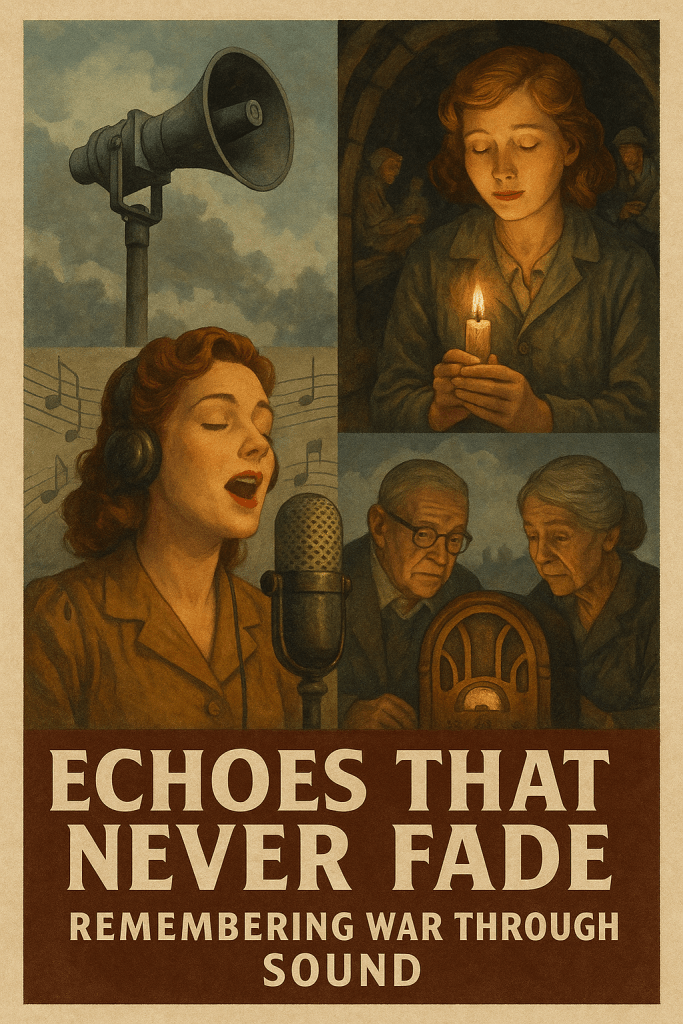
War is often remembered through what we see, photographs browned with age, streets reduced to rubble, uniforms frozen in black and white.
Yet for those who lived through the First and Second World Wars, memory most often arrives through sound. Long after images blur and details soften, the ears remember. War announced itself in sirens and silences, in songs hummed quietly for courage, in radio voices that carried comfort through fear and darkness. Sound shaped terror and tenderness alike, becoming one of the most powerful and invisible forces of wartime life.
In Britain, the First World War did not arrive only in headlines or telegrams. It altered the very music of daily existence. Church bells, once the gentle punctuation of weddings, Sundays and village life, were silenced in many places so as not to guide enemy aircraft. Their absence was deeply unsettling. Silence where sound should have been became a warning, a hollow reminder that the familiar world had shifted. Factories rose in urgency, filling towns with new rhythms, the pounding of machinery replacing birdsong and fieldwork. Even the countryside seemed to listen differently, its stillness broken by trains rushing men toward ports and battlefields, their wheels beating time like an anxious heart.
For soldiers at the front, sound was relentless and consuming. Artillery thunder rolled across the land day and night, shaking earth and nerves alike. Whistles sliced through chaos, sending men forward into danger with a single sharp note. The noise did not end when guns fell quiet. Silence itself became frightening, a held breath, a moment heavy with the expectation of what might come next. Many who returned home carried these sounds within them, echoes that surfaced years later in sleep, in storms, in sudden quiet rooms where memory crept in uninvited.
By the time the Second World War arrived, Britain had learned to listen for danger. The air raid siren became the defining voice of the home front. Its rising wail cut through conversation, sleep and thought, commanding immediate action. Children learned its meaning before they could fully understand the war itself. Hands gathered bags, bodies moved instinctively, hearts raced. And then there was another sound, just as powerful in its own way: the all clear. A long, steady note that loosened shoulders and allowed breath to return. Relief had a sound, and people learned to recognize it instantly.
Between these sirens lay a silence unlike any other. Blackouts wrapped cities in darkness, changing how sound traveled. Footsteps echoed sharply on empty streets. Voices lowered without conscious thought. Even laughter felt subdued, as if the night itself were listening. In shelters, silence could feel heavy or almost sacred, broken by murmured prayers, the rustle of coats and blankets, the distant thud of bombs falling somewhere else. In those close, crowded spaces, people became acutely aware of one another’s breathing, of the fragile closeness created by shared fear.
Yet war was never only noise and dread. It was also song. In both wars, music became a balm and a lifeline. During the First World War, soldiers sang in trenches and on long marches, familiar tunes reshaped with new words that mixed humor, homesickness and sorrow. These songs allowed men to speak of fear and longing when ordinary conversation could not. At home, music halls rang with patriotic anthems and sentimental ballads, giving audiences permission to weep together, to feel less alone in crowded rooms.
The Second World War deepened this bond between music and morale. Songs drifted from factories, canteens and kitchens. Women sang as they worked long shifts, melodies keeping time with repetitive tasks and tired hands. Families gathered around pianos and gramophones, letting music fill rooms made small by worry. Songs spoke of love waiting patiently, of reunions dreamed into being, of home as an idea held close even when it felt distant. They were not naïve. They were acts of courage. To sing was to insist on humanity.
Perhaps no sound was more intimate than the radio voice. Radios became the hearths of a new age, glowing softly in darkened rooms. Families leaned in to hear news from the front, announcements that could change lives in seconds. The BBC’s calm, measured tones brought order to chaos, voices steady even when the news was grim. Broadcasters became companions, their familiar cadence a reassurance simply because it continued. When the King spoke, his voice hesitant yet resolute, it felt as though the nation itself was speaking, imperfect, vulnerable and united.
Radio also carried laughter and escape. Comedy shows, dramas and variety programs offered moments of relief, reminding listeners that imagination could still roam freely even when bodies could not. For evacuees far from home, radio accents became anchors, reminders of belonging. For soldiers overseas, crackling broadcasts from Britain carried comfort across oceans, proof that life continued and waited for them.
Beyond Britain, sound shaped wartime experience everywhere. In occupied Europe, listening itself became an act of quiet defiance, radios hidden and tuned secretly to forbidden broadcasts. In the Pacific, the drone of aircraft and the roar of naval battles became the soundtrack of daily life. Across cities and villages worldwide, marching boots, shouted orders in unfamiliar languages and the sudden silence after violence reshaped the sound of home. Everywhere, people learned to read sound for meaning, to distinguish danger from safety, hope from despair.
When the wars finally ended, sound marked that transformation too. Church bells rang again, flooding the air with joy, disbelief and tears. Crowds sang in streets, voices overlapping in imperfect harmony. Music spilled freely once more. Yet even in peace, echoes lingered. Many found silence unsettling, its emptiness stirring memories they could not quiet. The world sounded different because people were different.
The sounds of war remind us that history is not only something we see or read. It is something we hear and feel vibrating through the body. Sirens taught fear, but also readiness. Silence taught awareness. Songs taught endurance. Radio voices taught connection. Together, they formed an unseen landscape that shaped how people survived, loved and remembered.
To listen back through time is to understand war not simply as a series of battles and dates, but as a deeply human experience carried on the air itself. And perhaps that is why certain sounds still move us so deeply today. They are not merely echoes of conflict. They are the voices of people who listened, endured and found ways to keep one another company through the darkest hours.
Until next time,

Ta ta for now.

Yours Lainey.