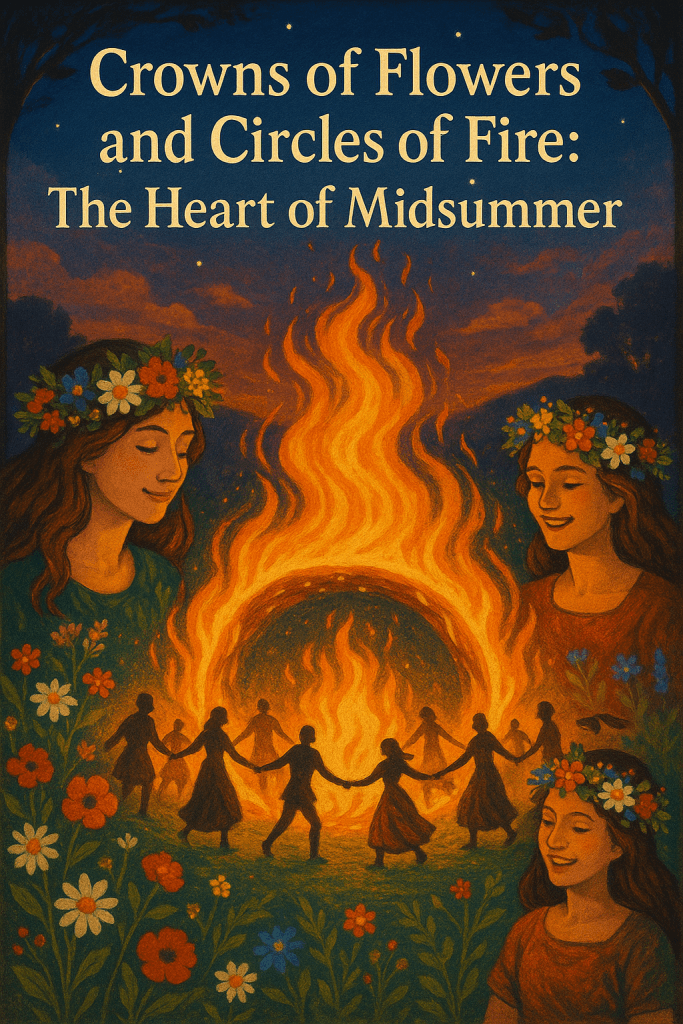
Midsummer arrives like a held breath finally released, a moment when the world seems to pause beneath its own abundance of light. The sun lingers late in the sky, hedgerows hum with life and the air itself feels enchanted, as though something ancient has leaned close to listen. Across Britain and far beyond its shores, the summer solstice has been honored for thousands of years as a turning point not of decline, but of fullness, a celebration of light at its most generous, life at its most alive.
In Britain, the roots of Midsummer stretch deep into the soil of prehistory. Long before written words shaped memory, people marked the solstice with stones, fires and careful observation of the sky. Stonehenge stands as the most famous witness to this devotion, its great sarsens aligned to greet the rising sun on the longest day. When dawn breaks there, bathing the stones in gold, it feels less like an astronomical event and more like a conversation between earth and sky, still spoken in light.
As centuries passed and Celtic traditions shaped the land, Midsummer became a night alive with flame. Bonfires were lit on hilltops and village greens, their sparks lifting into the twilight like scattered stars. Fire was believed to protect, purify and bless. Families leapt over embers for luck, lovers clasped hands as they jumped together, and farmers drove cattle between twin fires to guard them against illness. The smoke curled through fields and homes, carrying with it prayers for health, fertility and good harvests. Fire, like the sun itself, was honored as a life-giver.
Herb magic flourished alongside these flames. Midsummer was thought to be the moment when plants reached the height of their power, brimming with healing and enchantment. In England, people rose before dawn to gather herbs while the dew still clung to leaves, believing this moisture held special virtue. St John’s wort, mugwort, yarrow and vervain were among the most treasured. Hung over doorways, tucked into bedding or brewed into teas, these herbs were used to ward off ill fortune, soothe ailments and invite love. Flowers were woven into garlands and crowns, worn until they wilted, then carefully saved or burned in the fire, releasing their blessings into the air.
Dancing was as essential to Midsummer as fire and flowers. Villages gathered in open spaces where fiddles played and feet stamped in joyful rhythm. Circles formed and reformed, echoing the turning of the year itself. These dances were not performances but expressions of belonging, moments when generations moved together beneath the open sky. Children ran between skirts and sleeves, elders clapped time and laughter rose easily, carried on the warm night air.
As Christianity spread through Britain, Midsummer softened but did not disappear. The festival became entwined with the Feast of St John the Baptist, celebrated on June twenty-fourth. Bonfires still burned, now known as St John’s Fires, and herbs gathered at this time retained their sacred reputation. Churches rang bells to bless the land, and processions wound through towns adorned with greenery. Old beliefs were not erased, only gently folded into new meaning, creating a layered tradition that honored both faith and folklore.
Across Europe, Midsummer bloomed in many forms. In Scandinavia, flower-crowned poles rose in village squares as people danced and feasted through the endless twilight. In Ireland and Scotland, fires continued to glow on high ground, visible from miles away, stitching the landscape together with light. In Eastern Europe, young women floated flower garlands on rivers, watching their movement to divine future love. Everywhere, the solstice invited reflection and joy, a pause to marvel at the world’s fullness before the slow turning toward autumn began.
Beyond Europe, other cultures honored the sun’s height in their own radiant ways. Indigenous peoples of the Americas held ceremonies marking the sun’s strength and the earth’s generosity. In parts of Asia, seasonal festivals celebrated rice growth, water and fertility. Though customs differed, the reverence was shared. Humanity, wherever it lived, recognized the power of this moment when daylight seemed endless and life pulsed strongly through all things.
Within families, Midsummer was often quieter but no less meaningful. Children stayed up later than usual, chasing fireflies or sparks from the bonfire. Homes were decorated with greenery, and simple feasts featured fresh bread, berries and honeyed treats. Stories were told, of fairies dancing in moonlit meadows, of wishes made at twilight, of dreams that felt especially vivid on this night when the veil between worlds was believed to thin. Many believed that if one slept with herbs beneath the pillow on Midsummer’s Eve, dreams would reveal future paths or loves yet to come.
Over time, industrial life dimmed some of Midsummer’s firelit glow, yet the tradition never vanished. Even today, people gather at ancient sites, light fires in gardens, weave flower crowns or simply pause to notice the length of the day. There is something irresistible about this moment, something that calls us back to older rhythms we still carry quietly within ourselves.
The story of Midsummer is not only about the sun’s position in the sky. It is about gratitude. It is about standing at the height of light and saying yes to life as it is, lush and fleeting. Bonfires, herbs, dancing and folklore are expressions of that gratitude, human ways of answering the earth’s generosity with celebration.
And when the sun finally dips lower after its longest reign, Midsummer leaves behind a gentle knowing. Light has been honored. Joy has been shared. The world has been seen in its fullness. And in that remembering, families and communities carry the warmth forward, like embers held carefully, glowing long after the night has passed.
Until next time,

Ta ta for now.

Yours, Lainey.