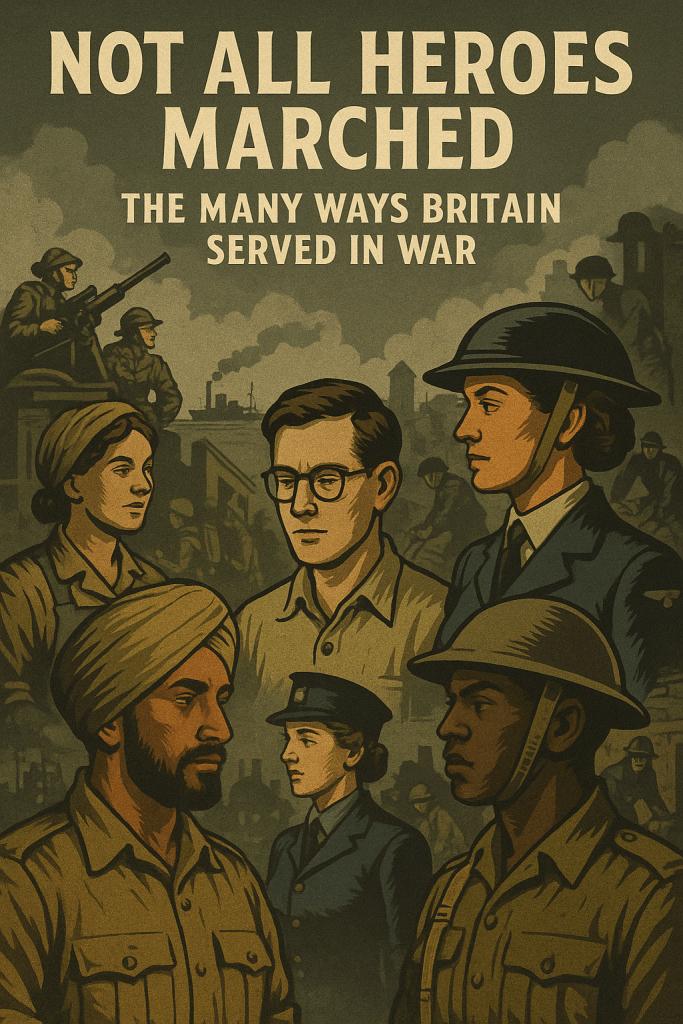
Britain’s wars are often remembered through familiar figures, soldiers in khaki, pilots etched against the sky, names carved into stone and silence. These images matter, yet they tell only part of the story. Beneath them lies a far broader human tapestry, woven from lives that history has too often placed at the margins. Britain’s forgotten heroes did not always wear the same uniforms or march beneath the same flags, but they carried the weight of war all the same. Their service unfolded across continents and convictions, across race and gender, across choices to fight, to heal, to endure or to refuse. Together, they shaped the nation’s survival in ways that deserve tenderness, truth and remembrance.
Across the vast reaches of the British Empire, colonial troops answered a call that was rarely framed as a choice. Men from India, Africa, the Caribbean and beyond travelled unimaginable distances to fight in lands they had never seen. During the First World War alone, more than a million Indian soldiers served overseas, fighting in France, Mesopotamia, East Africa and the Middle East. Many arrived unprepared for bitter European winters, wearing uniforms ill suited to freezing trenches. Language barriers isolated them, and racial prejudice too often diminished their sacrifice. African soldiers marched through jungles and deserts alike, frequently tasked with carrying supplies, building roads and fighting under punishing conditions. Caribbean men crossed oceans to serve in Europe, confronting enemy fire while also enduring discrimination from the empire they defended.
Their courage was immense and their losses profound. Many returned home with injuries and memories that followed them for life, yet with little recognition waiting. Their names were absent from memorials, their stories omitted from textbooks. For some, the war planted a quiet but powerful awareness of injustice. Service had sharpened their sense of dignity and equality, and when peace came, those experiences fed the long, determined movements toward independence and self-rule. In this way, their wartime service reshaped the world far beyond the battlefield, even as Britain struggled to acknowledge its debt.
Closer to home, another kind of service unfolded through refusal rather than combat. Conscientious objectors stood against the tide of expectation, guided by faith, moral conviction or political belief. During both World Wars, they were often met with suspicion, public hostility and harsh punishment. Some were imprisoned, others sent to labor camps, their courage questioned and their patriotism doubted. Yet many refused not service, but violence. They worked as medics, ambulance drivers, farm laborers and civil defense workers, saving lives and sustaining the nation in ways that demanded endurance and resilience. Their bravery lived in steadfast conscience, in the strength required to stand alone and accept suffering rather than betray deeply held beliefs.
Women’s service, too, was richer and more complex than familiar images suggest. Beyond factories and hospitals, women formed entire military units that operated with discipline, skill and determination. The Women’s Army Auxiliary Corps, the Auxiliary Territorial Service, the Women’s Royal Naval Service and the Women’s Auxiliary Air Force filled vital roles across Britain and abroad. They drove vehicles, operated radar, handled communications, repaired aircraft and worked anti-aircraft guns. Many lived close to danger, especially during bombing raids, their work essential to defense yet rarely granted equal recognition.
Some women served in roles wrapped in secrecy. At Bletchley Park and other intelligence centers, thousands labored in silence, decoding enemy messages, tracking movements and shortening the war through intellect and perseverance. Many were young, many were brilliant, and all were sworn to secrecy that lasted decades. Their triumphs were invisible, their victories unspoken, yet their impact altered the course of history and saved countless lives.
There were others whose service defied easy labels. Merchant seamen crossed submarine-infested waters to keep Britain supplied with food, fuel and materials, facing some of the highest casualty rates of the war. Civil defense volunteers stood watch through burning nights, pulling survivors from rubble, extinguishing fires and guiding neighbors to safety. Refugees fleeing persecution often joined Britain’s forces, fighting not only for a country that offered them refuge, but for the hope of a world made kinder.
What binds these forgotten heroes is not uniform, rank or nationality, but devotion. They gave time, strength, safety and often life itself. Many returned to lives quietly altered, carrying memories that settled deep and were rarely spoken aloud. Some were denied pensions, recognition or even gratitude. Their stories survived in family whispers, letters folded carefully in drawers, photographs whose faces were known but whose deeds went unnamed.
To remember them now is an act of care. It widens the story of Britain at war into something truer and more humane. It reminds us that service wears many faces and that courage is not a single shape. It lived in marches through foreign mud, in hospital wards and decoding rooms, in ships crossing dark seas, in farms and fire watches, in refusal rooted in conscience.
Honoring Britain’s forgotten heroes does not diminish those already remembered. It completes the picture. It allows us to see the nation not as a single line of march, but as a mosaic of effort, sacrifice and humanity. Their legacy lives not only in victory, but in the quieter truth that a country survives through inclusion, compassion and shared responsibility.
If we listen closely to history, their voices are still there. They do not ask for grandeur. They ask to be seen. And in seeing them, we allow the past to speak more honestly, and the present to grow a little more generous in response.
Until next time,

Ta ta for now.

Yours, Lainey.
 Intwined