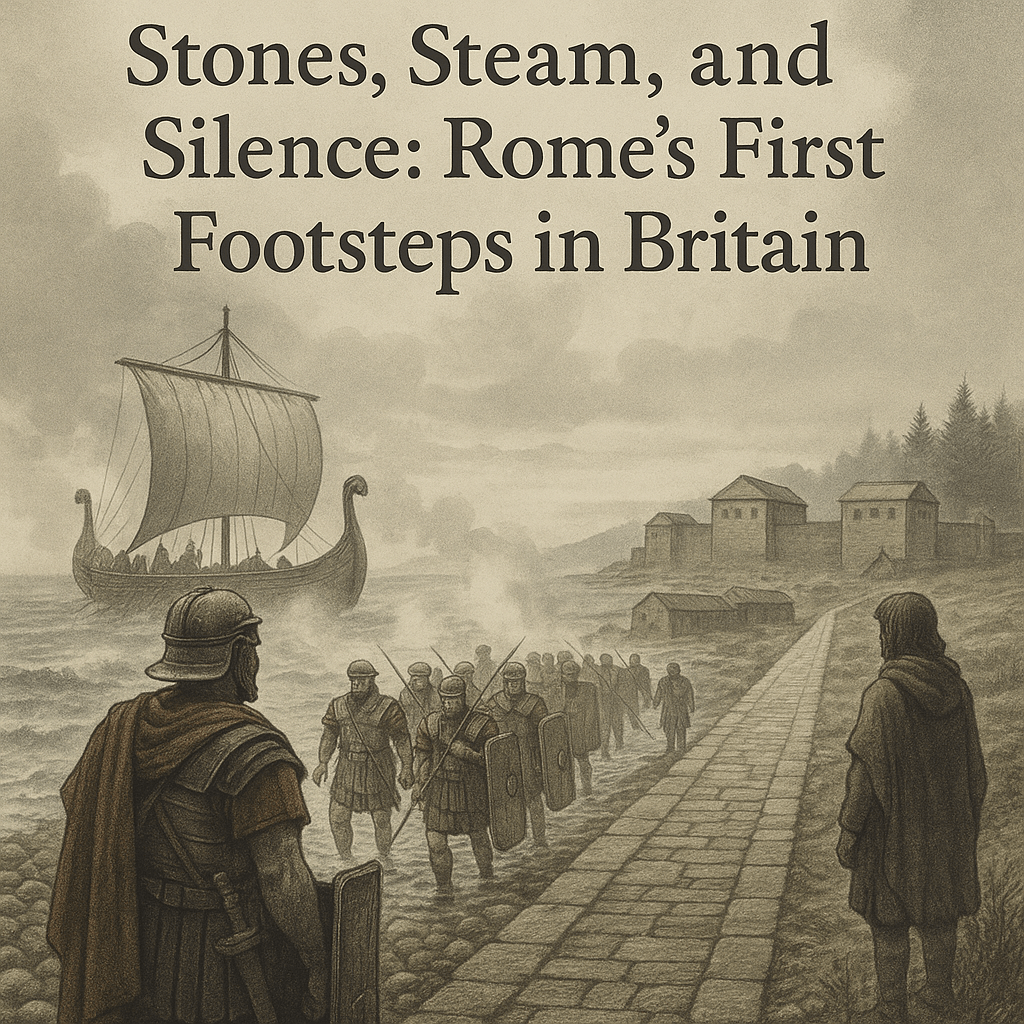
There are moments in history when the ordinary rhythm of life is interrupted by something so immense and unfamiliar that the world tilts on its axis. For Britain, one such moment arrived on a pale, misted shoreline in the year AD 43, when Roman sails emerged from the grey horizon and the island felt the first tremor of a future it had never known.
Before Rome, Britain lived close to the breath of the land. Life unfolded in circular rhythms rather than straight lines. Villages nestled into hills and valleys, their roundhouses shaped from timber, wattle, earth, and smoke. Roofs breathed with the wind, walls shifted with the seasons, and floors were pressed flat by generations of bare feet. Paths were not imposed upon the landscape but negotiated with it, winding gently along ridges, rivers, and memory. Time was measured not by dates, but by sowing and harvest, by feast and famine, by the slow return of familiar stars. Stories passed from mouth to ear by firelight. The land was not owned so much as lived alongside.
Then the Romans came.
They arrived with the unshakable certainty of empire, bringing with them an entirely different understanding of the world. Where Britain curved, Rome straightened. Where paths once wandered, Roman roads advanced with unwavering intent. These roads did not ask permission of hills, forests, or rivers. They cut through them, stone by stone, disciplined and deliberate, binding the island into a vast imperial web. For the first time, journeys that once took days of guesswork became predictable. Distance itself changed meaning. Britain learned what it was to be measured.
With the roads came towns, not grown slowly through generations, but planned, imposed, and realised with astonishing speed. Grids replaced clusters. Forums rose at their hearts, civic spaces where trade, law, and power converged. Stone buildings with tiled roofs stood firm against rain and wind, no longer yielding or flexing like timber homes. Glass windows reflected light in ways that must have felt almost miraculous. To step into a Roman town was to step into a different philosophy of life, one that valued order, permanence, and visibility. Everything had its place, and everyone was meant to know it.
Perhaps nothing embodied Rome’s arrival more vividly than its relationship with water. The Romans did not merely use water. They mastered it, celebrated it, revered it. Aqueducts carried it across valleys. Pipes threaded it into homes. Bathhouses rose as monuments to comfort and communal life. In places like Aquae Sulis, modern Bath, sacred springs once honoured by Celtic worship were enveloped by Roman stone, blending old reverence with new engineering. The baths were warm, steamy sanctuaries in a land shaped by cold rain and raw rivers. Here, people gathered to soak, talk, argue, and connect. Status softened in the steam. News traveled as freely as water. Cleanliness became ritual, leisure became social glue, and Britain learned a new way to inhabit the body.
Yet comfort never came without cost.
Alongside baths and roads came taxation, record keeping, and the steady erosion of anonymity. Coins replaced barter, stamped with the faces of emperors whose authority reached these damp shores without ever touching them. Census lists counted people not as kin or neighbours, but as subjects. Laws were written, fixed, and enforced uniformly, replacing the flexibility of oral tradition and local custom. Britain became legible to power. Governed. Managed. The island was no longer simply home. It was a province.
Still, the encounter was not only one of loss. There was wonder threaded through the disruption. Markets brimmed with goods from across the empire. Wine dark as dusk. Olive oil, figs, spices that carried the warmth of distant suns. Pottery gleamed with refinement unknown before. Latin words slipped into local speech. Writing itself became more common, transforming memory into record. Even belief grew layered. Roman gods stood beside Celtic ones. Shrines multiplied rather than vanished, and for a time, faith expanded instead of shrinking. Britain did not abandon itself entirely. It adapted.
Change, though, always leaves its mark.
Old rhythms frayed. Tribal bonds loosened. Loyalty stretched outward toward Rome. Efficiency replaced intimacy in many corners of life. Where once identity was rooted in land and kin, it now reached toward empire and law. Britain gained infrastructure, comfort, and connection, but lost something quieter, something harder to name. Progress arrived armoured and confident, leaving complexity in its wake.
What lingers most powerfully is not the scale of Rome’s transformation, but the human experience within it. A farmer pausing in his field as legionaries pass, their armour catching the light. A child stepping onto a stone road for the first time, astonished that it does not shift beneath her feet. An elder sitting in a bathhouse, steam curling around memories of colder waters and older songs. Lives unfolding at the seam between what had been and what was coming.
When Rome came to Britain, it did not simply change how people built or traveled. It altered how they thought about time, distance, power, and themselves. Even after the legions withdrew centuries later, their imprint remained. Roads still trace Roman intention. Towns still echo Roman planning. Britain still walks pathways first pressed into the soil by strangers who became, in time, ancestors.
History often tells us what happened. But standing on that shoreline in AD 43, watching sails emerge from the mist, it must have felt like standing at the edge of a story too vast to grasp. Terrifying. Exhilarating. Heartbreaking. Hopeful. Rome did not simply arrive in Britain. It reshaped it. And Britain, forever changed, learned how to live with the echo of that first astonishing step onto its shore.
Until next time,

Ta ta for now.

Yours, Lainey.