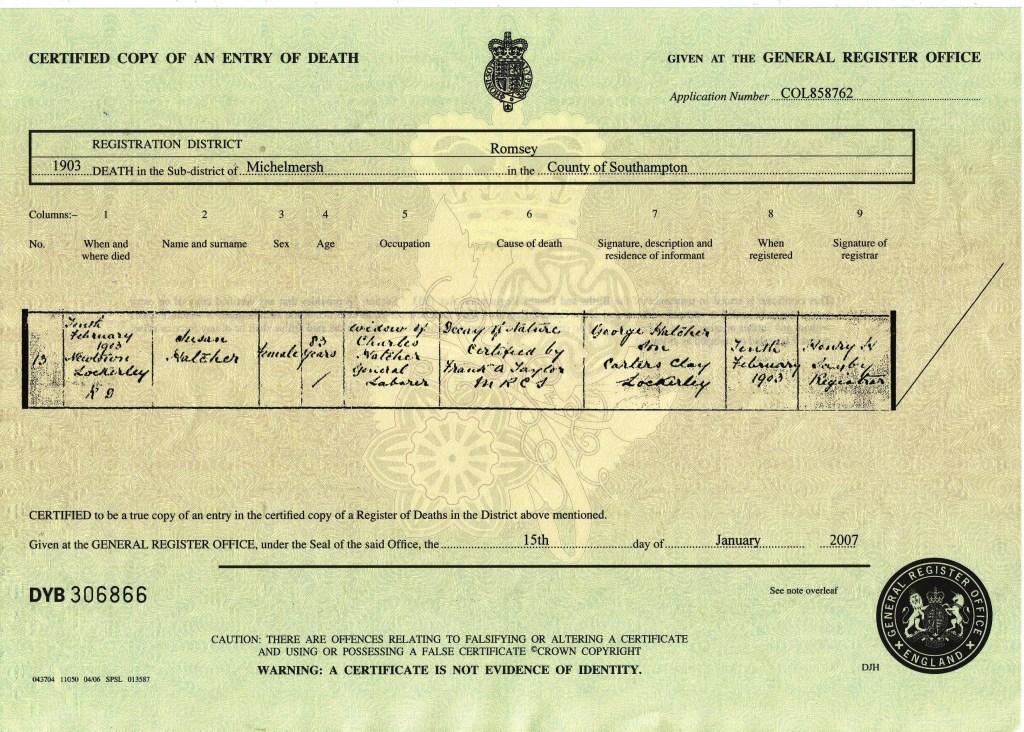
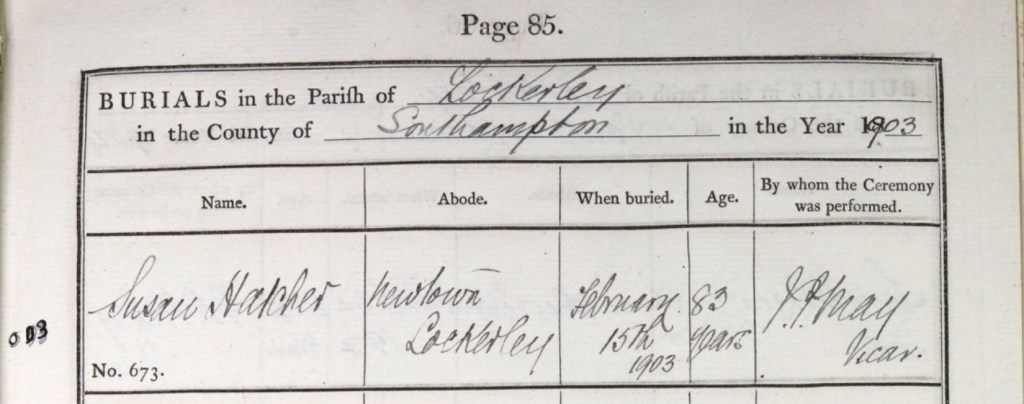
Welcome to Part Three of Susan’s story, a chapter where the light grows thin, where the wind through Lockerley’s hedgerows seems colder,
and where a woman who has already weathered storms, must now learn to walk through the world alone.
When Charles was lowered into the earth in that bleak November of 1858, something in Susan shifted. No wife ever steps into widowhood untouched, but for a woman of her station, in a village as small and watchful as Lockerley, the transformation was as sharp as frost. One moment she was a wife with a place in the world; the next she was a widow with seven mouths to feed and no one to stand between her and the bite of poverty. And though the church bells stopped tolling for Charles, the echo of their grief would follow her for years.
Life had already tested her many times.
Her youth had been marked by whispered judgement, a girl with children but no husband,
navigating that fine, cruel line between survival and shame.
Her sister Sarah had been torn from her arms, carried over oceans.
Her sister Christian also known as Catherine had endured the humiliation of a husband convicted and transported, and later, the scandal of a marriage made unlawful in the eyes of God and the courts.
Her father Moses, her anchor, her teacher in gentleness and strength, had died in her arms.
And now Charles, the one man who had given her dignity, protection, and the kind of love that grows not from comfort but from toil and shared hardship,
lay beneath Lockerley soil.
Her life had been trying already and yet,
God help her,
nothing could have prepared her for what was to come.
For the years ahead would test her in ways she could not yet imagine.
They would bring decisions no mother ever wishes to face,
losses that would stain her heart forever,
and consequences that would mark her family name, in parish whispers for generations.
And still, still through every shame borne not of sin but of circumstance, through every night she lay awake with her children huddled close,
through every cruel word spoken behind doorways and hedges,
Susan would endure.
Because she had always endured.
This is the story of her widowhood,
her darkest years,
her hardest choices,
and the long, slow climb toward the peace she would one day earn.
Welcome to Part Three,
where the woman we have followed from childhood
must now stand alone, and where her courage, quiet but unbreakable, will shine brighter than ever against the gathering storm.
Welcome back to the year 1860, Butler’s Wood, Newtown, near Lockerley, Hampshire, England.
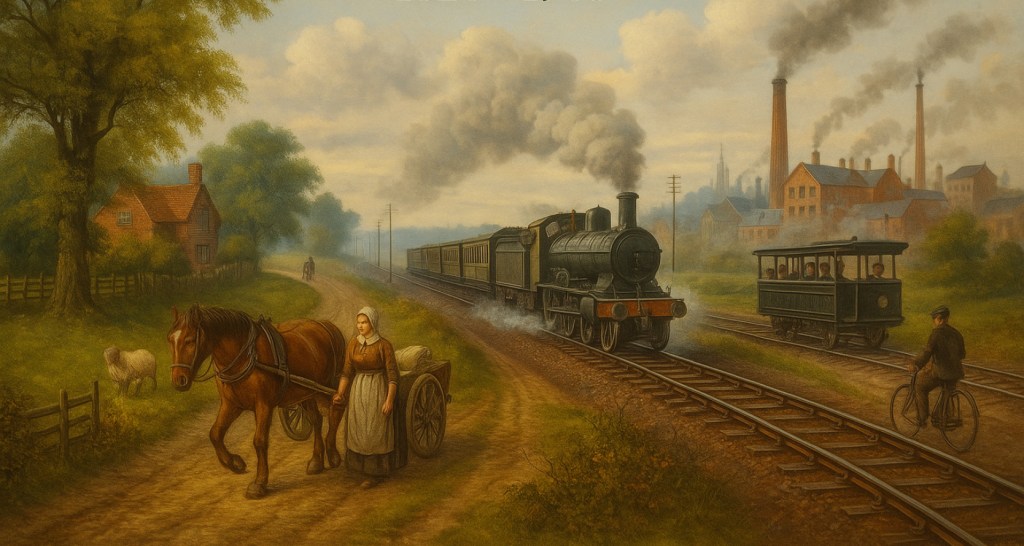
The world you return to is one balanced delicately between the old and the new, a world where horse-hooves still beat the rhythm of daily life, yet distant whispers of industry and invention murmur through even the quietest villages. The air here smells of damp earth, woodsmoke, and mossy bark, for Butler’s Wood stands as both shelter and boundary, a living witness to every footstep taken by those who dwell beneath its canopy.
England in 1860 was ruled by Queen Victoria, whose reign had already stretched more than twenty years. Her face appeared in newspapers and on medals, her presence felt in everything from poorhouses to Parliament. At her side, though unofficially, stood Prince Albert, whose influence shaped education, industry, and the moral tone of the age. The Prime Minister was Lord Palmerston, a fiery statesman whose confidence and wit were spoken of in both London taverns and tiny Hampshire parlours. In the Houses of Parliament, great debates rumbled about reform, empire, education, and the poor, though such matters reached the ears of villagers only as distant echoes, softened through gossip and simplified into what mattered for common lives.
To a woman like Susan, widowed only two years before, the world of monarchs and ministers felt impossibly far away. Her kingdom was her cottage, her children, and the narrow lanes that wound between oak, ash, and field. In 1860 she stood at a crossroads, raising her children alone in a countryside where every change in weather touched their very survival.
Life for the rich of England glimmered with comfort. They moved in rail-carriages, velvet-lined, warm even in winter, while the poor clung to the outside world of boots muddied by frost and labour worn into their bones. Wealthy families in London and great country houses basked beneath gas-lit chandeliers, their evenings bright as artificial daylight. In contrast, the working class of Lockerley relied on tallow candles or the faint orange glow of a modest hearth. Chimney soot, damp straw, and the metallic tinge of cold iron all lingered in the air of labourers’ homes, mingling with the smell of stew or boiled potatoes.
Housing in Butler’s Wood was humble. Cottages were built of flint, chalk, and timber, small rooms with low ceilings, the kind where you could hear every creak of the beams on winter nights. The hearth remained the soul of the home, for without it warmth vanished and illness crept easily into the bones. Windows were small; floors often of worn, uneven stone or beaten earth. Privacy was nearly unknown; the family lived, worked, and slept in close quarters, breath and labour mixed together in one tight domestic world.
Travel remained slow. Villagers walked, rode, or relied on horse-drawn carts. The distant sound of a train passing through larger towns carried a strange awe, for railways promised a world beyond the hedgerows, though few in Lockerley had cause or money to board one. Footpaths wound through farmland like lines in an old story, leading to church, to work, to neighbours, to graves.
Hygiene was a challenge everywhere. Wells served for water; buckets were carried back and forth morning and night. Bathing was rare and difficult, reserved for Sundays or special occasions. Illness spread easily in such close living, and diseases such as consumption, whooping cough, scarlet fever, and cholera stole lives quietly, especially among the very young. In 1860, a winter cough could be a danger, and a fever in a child could turn the whole household into a place of whispered fears and desperate prayers.
Sanitation was little more than earth closets, shared yards, and shallow pits dug and refilled. The air on damp days held the earthy tang of waste, especially in village lanes. Flies buzzed thick in summer; cold suppressed the worst of it, but foul smells were part of daily life for the poor.
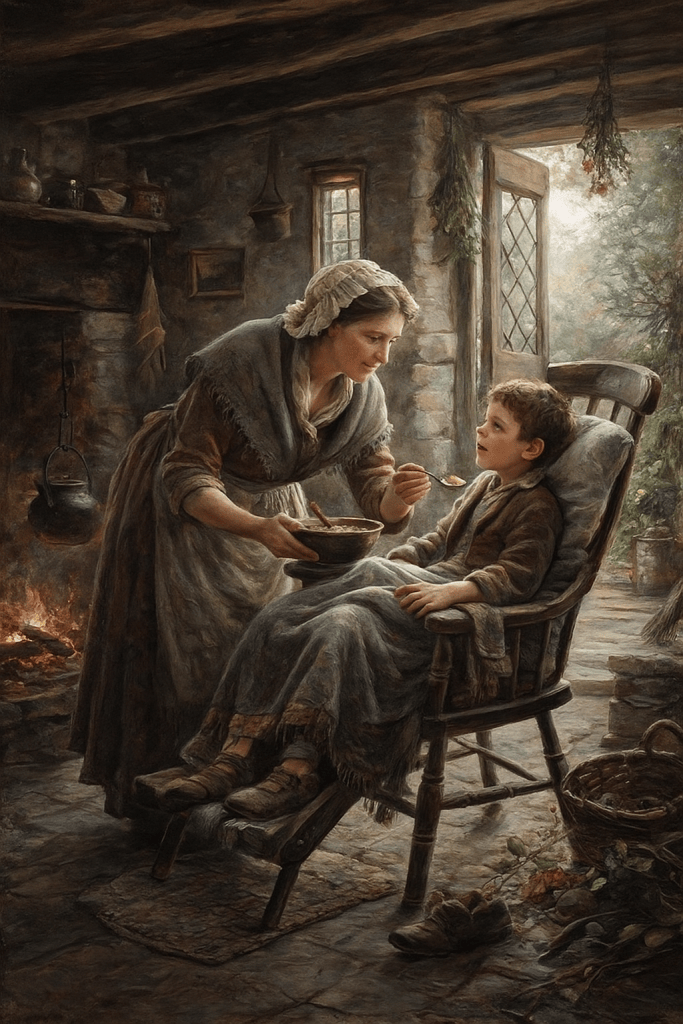
Food was plain but sustaining when luck and wages allowed. Bread, potatoes, bacon if they were fortunate, porridge, cabbage, onions, and sometimes a rabbit snared quietly in the hedgerows. A working widow like Susan stretched every coin, making broth from bones, saving drippings, reusing anything edible. Her children ate before she did. Tea was a blessing, a comfort, and sometimes an indulgence, sipped slowly beside a dimming fire.
Entertainment came in small, precious ways. Songs shared at the hearth, gossip exchanged at the well, a rare visit from a peddler bringing ribbons or pins, the sound of bells on Sunday morning. The church was not just a place of worship but the centre of village life, a place where births, deaths, and whispers of scandal all found their way beneath the same roof. Religion held a firm grasp on conscience, behaviour, and reputation. The vicar’s words were law for many, and judgement, quiet, sharp, and unyielding, often travelled faster than kindness.
Schooling for the poor was limited. Some children attended dame schools or Sunday lessons, learning letters and scripture, but many were kept at home to work, tend siblings, fetch water, or help in the fields. Susan’s children knew both the weight of responsibility and the sweetness of brief freedoms: running barefoot through summer grass, gathering berries at the woodland’s edge, listening to the distant call of rooks at dusk.
The atmosphere of 1860 in Butler’s Wood was one of resilience. Despite poverty, despite grief, despite the narrowness of their world, the families there carved out lives stitched with courage. The sound of the wind through the branches, the crackle of the hearth, the distant lowing of cattle, these were the constants in a world otherwise fragile.
And through it all walked Susan. Her sorrow was fresh but her duties relentless. Each dawn saw her rise to tend the fire, stir the pot, rouse the children, and step once more into a life where love, loss, and labour wove together like threads in a single, enduring cloth.
In the world of 1860, she was a widow, a mother, a survivor, and the quiet beating heart of her little home in Butler’s Wood.
Winter had laid its silent hand upon Sherfield English, soft as breath and cold as fate, when Susan’s father-in-law William Hatcher’s long journey came to its quiet end. The village, small and tucked between fields that slumbered under frost, seemed to move more slowly in those first days of December 1860. The hedgerows glittered with fine ice, each thorny twig holding a pearl of frozen morning. Smoke rose from cottage chimneys in thin grey ribbons that drifted upward and vanished, as though even the air itself understood that something precious was slipping away.
Within one such cottage, humble and timeworn, a life was ebbing gently, hour by gentle hour. William Hatcher, seventy-three years old, farm labourer, husband, father, and the steadfast root of his family’s lineage, lay beneath a blanket worn soft by the years, his breaths thinning like the fading light of a winter afternoon. For decades he had worked the fields with a quiet devotion, his days marked by the turning of seasons, the swing of tools, and the steady ache of honest toil. Every sunrise had found him faithful to his labour, every sunset had found him grateful simply to have provided. Now, those hands, once strong enough to lift the earth itself, rested peacefully upon his chest, their work complete.
It is not known whether Susan was present at the moment of his passing, yet the heart leans gently toward imagining her there, supporting her mother-in-law through the soft collapse of grief. She knew too well the weight of widowhood, the raw and hollow ache that follows the last breath of the man who had shaped one’s life. She had walked that road only two years before. Surely she could not have stayed away when another woman’s world was breaking.
Beside William sat his devoted daughter, Hannah Southwell, her presence the final gift she could offer. Her hands, roughened from a lifetime of labour like her father’s, rested upon his, trembling slightly as she watched the shadows lengthen across his face. It was Hannah who bore witness to the slowing of his breath, to the soft flicker of life dimming like a candle in a cold room. When at last his spirit slipped free, quiet as falling snow, she was the one who bowed her head and whispered goodbye. The register would later say he died of “gradual decay,” a tender Victorian way of naming the body’s surrender to age and toil, but to those who loved him, his passing felt more like the closing of a chapter written in earth and faith.
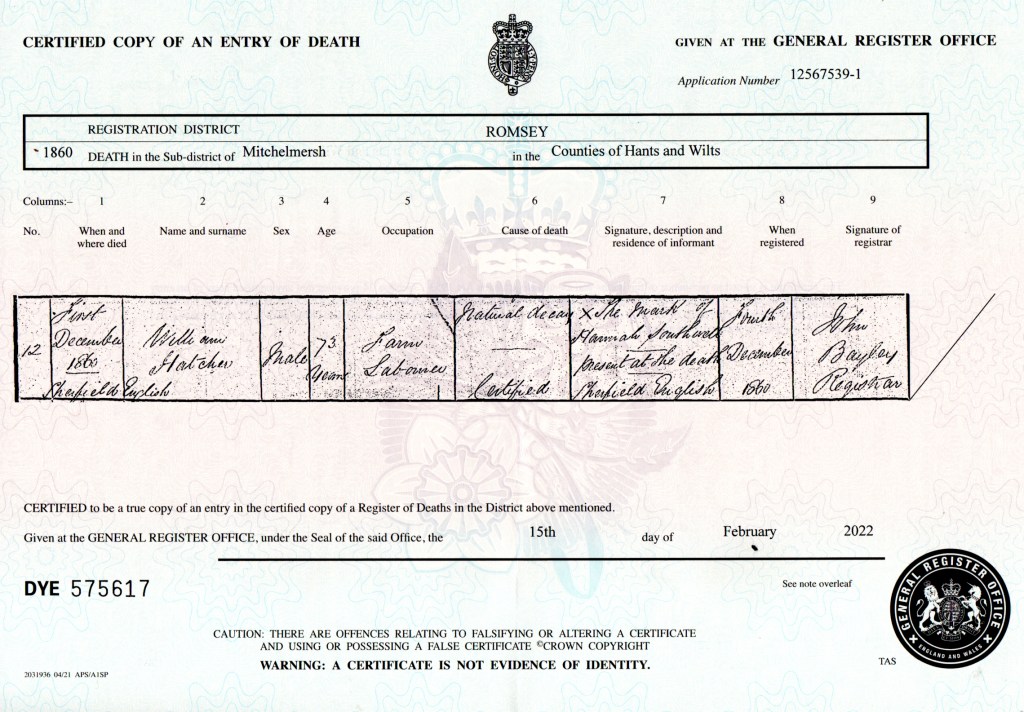
On the next day, with a heart weighted by loss, Hannah walked to the registrar to formalise the truth no daughter ever wishes to speak aloud. There, in the Romsey Registration District, Sub-district of Michelmersh, Registrar John Bayley wrote the details into the great leather-bound book, his pen scratching steadily across paper as though unaware of the sorrow it preserved.
When and where died: 1st December 1860, Sherfield English

Name and surname: William Hatcher

Sex: Male

Age: 73 years

Occupation: Farm Labourer

Cause of death: Gradual decay, Certified

Signature, description, and residence of informant: The mark of Hannah Southwell, present at the death, Sherfield English

When registered: 5th December 1860

Signature of registrar: John Bayley.
Hannah could not write her name, so she placed an X upon the page, her hand quivering as she pressed it into the paper. That small mark, so plain and humble, held all the weight of a daughter’s love and the sorrow of knowing she had watched her father’s final sunrise.
But behind the neat lines of the record lived something the ink could not hold: the story of a man whose life had been written into the very soil of Sherfield English. William’s legacy was not wealth, nor property, nor any earthly monument. It lived instead in the hearts of those who bore his name, in the fields whose furrows had felt the strength of his hands, in the warm memories flickering like embers within the cottage he once called home.
For Mary, his widow, the loss was a shattering of the world she had known for more than half a century. William had been her companion in everything, her seasons of hunger, her seasons of hope, the births of children, the burying of others, the long nights by the hearth where they shared stories, or silence, or simple comfort. To stand beside his still form was to feel as though the ground beneath her had shifted. Her husband, her strength, her steady constant through the wild winds of life, was gone.
When Susan came to Mary’s side, whether the same day or in the days that followed, she came not merely as a daughter-in-law, but as a woman who understood exactly what Mary’s trembling heart felt. Grief recognises grief, and widowhood forms a silent, powerful sisterhood. Perhaps Susan took Mary’s hands in her own, felt the frail pulse of a heart newly broken, and offered no empty words, only presence, warmth, and the soft, steady understanding that only another widow can give.
In the days that followed, the cottage felt unbearably quiet. The chair by the fire where William once sat remained untouched. His boots stood by the door as though waiting for him to return from the fields. Mary moved through the rooms slowly, listening for a voice that would never again call her name.
But though his body rested beneath the earth, William’s spirit lingered in the place he had lived and laboured. It remained in the whisper of wind across the meadows, in the rustle of hay in summer barns, in the echo of his laughter locked forever in memory. He left behind a family shaped by his gentleness, his effort, and the humble nobility of a life lived with integrity.
William Hatcher, labourer of the fields, husband of Mary, father of Susan’s beloved Charles, was gone, but not forgotten. His story lived on, woven into the fabric of the land, carried in the blood of his children and grandchildren, held delicately in the hearts of those who had walked beside him in life.
And for Susan, standing in the cold stillness of that December, the memory of him added another thread to her own unfolding tale, a story marked by shadows and sorrow, yes, but also by love, by resilience, and by the quiet, unbreakable strength of a woman who had weathered more storms than most ever would.
The winter of 1860 settled over Sherfield English like a great, grey sigh, soft yet heavy, the kind of winter that seemed to hush the very heart of the countryside. Frost clung to every hedge like delicate lacework, the meadows slept beneath a thin white veil, and the pale sky hung low as though grieving with those who walked beneath it. On such a day, when the air was still and the world seemed made of breath and silence, Susan found herself standing among family and neighbours to say her final goodbye to a man she had dearly respected, her father-in-law, William Hatcher.
It was Friday, the 7th day of December, when the bells of St Leonard’s tolled their slow, mournful call across the cold fields. Each note drifted over Sherfield English like a ribbon of sorrow, calling those who knew him to gather for the burial of a man who had given his life to the soil of Hampshire. The churchyard, edged with ancient yews whose dark branches whispered in the winter wind, held an open grave waiting for him, William, labourer, husband, father, grandfather, seventy-three years old.
Susan stood with her children close beside her, each of them clutching her skirts or her hands, their breath rising like little ghosts in the icy air. They had all known William’s warmth, his steady presence, his quiet pride. And though grief had already found its place in Susan’s heart after the loss of her own beloved Charles, it struck her anew now, this was the last earthly tie to the father of her children, the man who had raised her husband, the man whose kindness had softened the harsher corners of life.
She watched as Mary, William’s widow of more than fifty years, clung to the arm of their daughter Hannah. Mary’s face, lined with years and softened by love, seemed almost fragile in the cold light. The emptiness beside her, the space where William had always stood, felt enormous. For Mary, this was the end of a shared lifetime, the parting of two souls who had weathered poverty, harvests, births, burials, hunger, hope, and the simple, sacred rhythm of rural life.
The coffin was brought forward by the hands of men who had known William all their lives, neighbours, perhaps kin, perhaps old friends from the fields. It was plain and sturdy, made by a local carpenter, polished only enough to give it dignity. Earlier that morning, Susan and the children had placed small sprigs of winter ivy atop it, their last simple offering.
Curate J. Barton, his breath rising in quiet clouds, stood at the head of the grave. His voice, gentle and solemn, threaded through the cold air as he read the old, holy words that had carried so many before and would carry countless more after:
“I am the resurrection and the life…”
Then came the familiar, trembling cadence:
“Earth to earth, ashes to ashes, dust to dust.”
The first spadeful of soil fell with a soft, hollow sound. Susan felt her chest tighten. Little Stephen, still small enough to cling to her skirts, pressed closer, confused but sensing the sorrow around him. The older children bowed their heads, their eyes damp, their breath shaking. They had lost their father only two years before; now the earth claimed their grandfather as well.
When the service ended, the mourners lingered, their silence a fragile testament to the man being laid to rest. And though others drifted away toward the warmth of home, Susan remained a while longer with Mary and the children. The frost glimmered faintly on the fresh mound of earth. The churchyard seemed to hold its breath. In the stillness, Susan whispered her own farewell, quiet, trembling, deeply felt.
Later, within the vestry, by the glow of a single candle, Curate Barton opened the heavy burial register. His pen moved steadily across the page, recording the stark, unembellished facts that formed Entry No. 221:
Name: William Hatcher

Abode: Sherfield English

When buried: December 7th

Age: 73 years

By whom the ceremony was performed: J. Barton, Curate.
Ink captured what life had now surrendered, yet the truth of William’s story lived far beyond the lines. It lived in the fields he had tended, the family he had raised, the love he had shared with Mary, and the steady integrity with which he had walked every path his life demanded of him.
When Susan finally returned to her home in Newtown, the night had fallen heavy and dark. The air outside bit at her cheeks, but inside her heart, memories warmed her. William’s gentle voice, his quiet laughter, the way he had held her children on his knee, all these lived on. His passing was another stone placed upon the growing cairn of her grief, but also another reminder of the strength she must now carry.
For Susan, widowhood had already carved its mark deeply. Now, standing on the threshold of her own next chapter, she felt the cold weight of loss pressing close once more. Yet she also felt something else, something she would cling to as the years went on.
Love endures.
Memory holds.
And the earth, which takes those we cherish, also keeps them close.
William Hatcher had returned to the soil he had loved, and in the heart of Susan, his spirit would remain, a steady, comforting whisper in the wind that swept through the Hampshire fields where he had lived, worked, and finally rested.
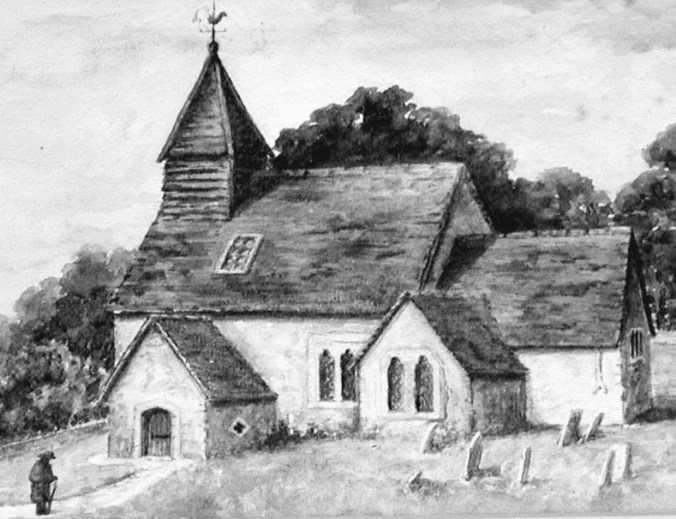
Saint Leonard’s Church in Sherfield English, Hampshire, has a rich history that stretches back over many centuries. The church has been a central part of the village’s religious and community life, and its history reflects the broader development of the area from medieval times to the present. The original Saint Leonard’s Church is believed to have been built in the early medieval period, likely during the Norman era, around the 12th century. The church would have been a simple structure, typical of rural churches of the time. As was common with churches in small villages, it was likely constructed with local materials such as stone and timber, with a simple design reflecting the needs of the local community. The church was dedicated to Saint Leonard, a popular saint during the medieval period who was often invoked for protection and for his association with prisoners and captives. Saint Leonard’s cult was widespread across England, and many churches were named in his honor. The original church at Sherfield English served as a focal point for the small agricultural community, providing a place for worship, social gatherings, and important life events such as baptisms, marriages, and funerals. The church would have also been a place where the villagers came together for communal activities, and it played an essential role in maintaining the spiritual and social fabric of the community. Over time, the church likely underwent several modifications and additions, particularly in the 14th and 15th centuries, as the village expanded and the needs of the local population grew. These changes were likely driven by the growing wealth of the parish as the agricultural economy strengthened. In the 19th century, however, the old church began to show signs of wear and was no longer able to adequately serve the growing population of Sherfield English. By the early 1800s, the church building had become dilapidated and was deemed inadequate for the needs of the parish. At this point, the decision was made to construct a new church to better serve the community. The new Saint Leonard’s Church was built in 1840, a year that saw the completion of many church restoration projects across rural England, driven in part by the Victorian era’s focus on reviving medieval architectural styles. The new church was built on a site adjacent to the old church, though some sources suggest that it may have been on the same footprint or nearby. The architect responsible for the design of the new church was likely influenced by the popular Gothic Revival style of the time, which was characterized by pointed arches, stained-glass windows, and spires. The new church was intended to accommodate the needs of the growing population of Sherfield English, and it was designed to be larger and more architecturally impressive than its predecessor. The construction of the new church was part of a broader trend of church building and restoration during the Victorian period, a time when many rural churches were being rebuilt or restored to reflect the prosperity of the period. The old Saint Leonard’s Church, after the new one was completed, was demolished, as was often the case with churches that were deemed structurally unsound or inadequate for modern use. It is common for older church buildings to be torn down when a new structure is built, particularly if the old building no longer meets the needs of the local population or has fallen into disrepair. It is likely that the materials from the old church were repurposed for the new construction, as was the custom at the time, though no records have definitively confirmed this. Today, Saint Leonard’s Church stands as a beautiful example of Victorian church architecture, with its stained-glass windows, pointed arches, and graceful tower. The church continues to serve the community, offering regular worship services, community events, and providing a space for reflection and connection. The church is also known for its picturesque setting within the village, surrounded by well-kept churchyards and the rolling countryside of Hampshire. The new church, while a product of the 19th century, retains the essence of the old church’s purpose to serve as a spiritual hub for the village of Sherfield English.
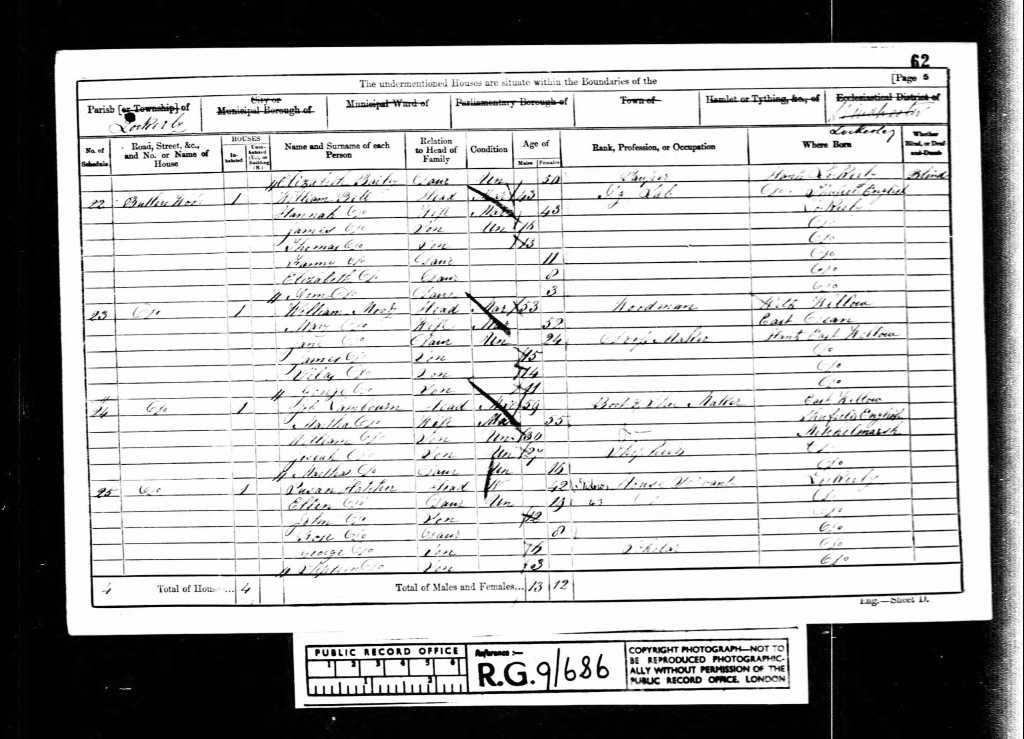
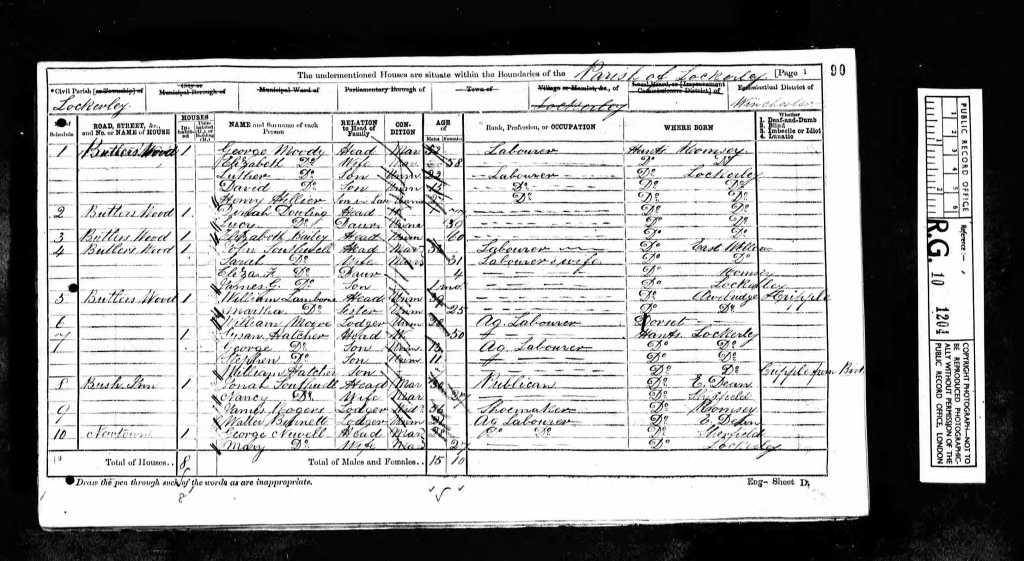
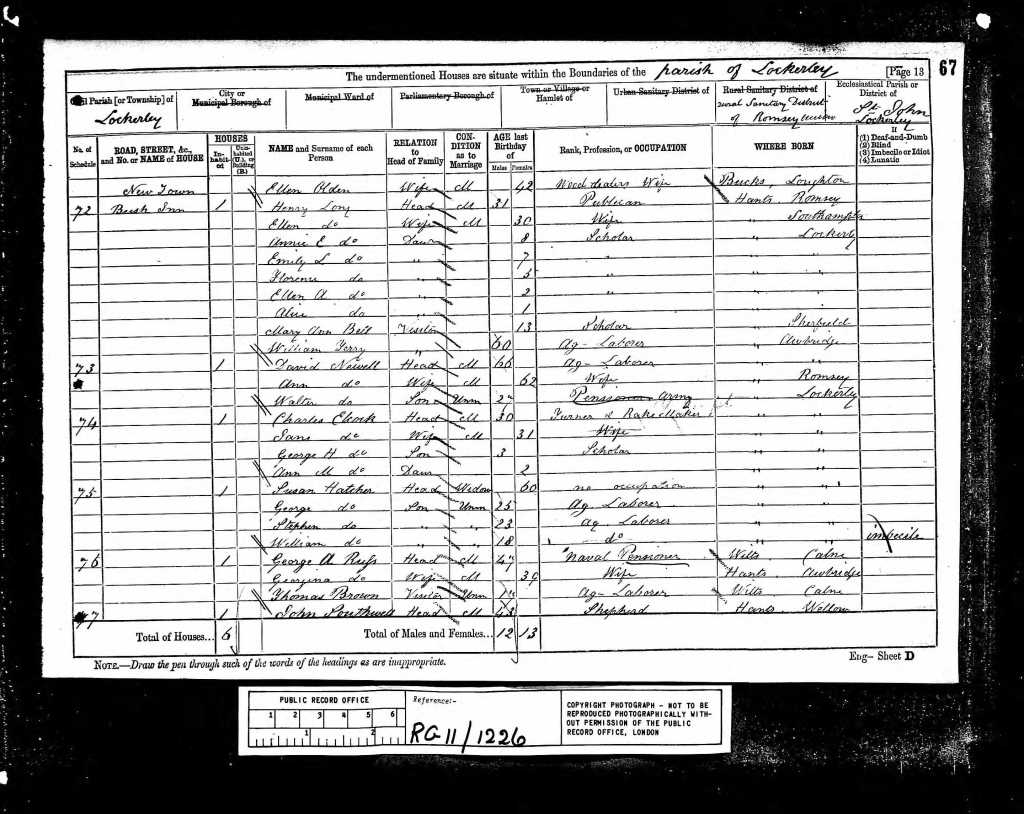
On the cool and quiet evening of Sunday, the 7th day of April, 1861, as the last light faded over the Hampshire fields and the smoke from cottage hearths drifted lazily into the soft spring sky, the world around Butler’s Wood felt wrapped in a gentle stillness. It was census night in England, one of those rare evenings when the government reached, however briefly, into every humble dwelling, every farmhouse and cottage, to record the lives unfolding within.
For Susan, now forty-two years old and two years a widow, this night felt heavier than most. The air carried a faint scent of damp moss and budding leaves, a promise of spring that could not quite warm the hollow place in her heart. She had known hardship before, but these recent years had carved their mark upon her, deep, invisible hollows only a grieving wife and a steadfast mother could bear.
Inside the familiar walls of Butler’s Wood Cottage, a place that had seen her girlhood laughter, her first labours as a young mother, and the heartbreak of Charles’s passing, Susan gathered her children close. The fire crackled low in the grate, casting flickers of amber light across the worn wooden floor.
Ellen, now nineteen and gentle as she was capable, helped her mother tidy the room, folding the day’s labours into quiet order. Together, they worked as widows’ house servants in the village, sewing, laundering, scrubbing, and though the work was hard and the pay small, it kept bread upon the table and a little dignity in their days.
John, twelve years old and already bearing the earnest seriousness of a boy who had become a help to the household, sat near the hearth mending a length of twine. Rose, eight, and George, six, bright-eyed and full of the restless energy of childhood, leaned against each other, whispering little stories in the half-dark. George, proudly attending school, spoke often of his letters, tracing them in the air with his finger as though he were writing his future one swaying line at a time. Little Stephen, just three, lay curled against Susan’s skirts, his breath soft and steady, his small hand warm in hers.
As dusk deepened, the census enumerator made his way along the winding lane. He was likely a local man, perhaps a schoolmaster or a tradesman appointed to the duty for the night. His boots scuffed lightly against the earth as he approached each doorway, carrying with him the heavy ledger in which he would record the names, ages, and occupations of every soul in Newtown and Lockerley.
At Susan’s door, he paused. She greeted him with her usual quiet grace, her shawl pulled tight around her shoulders against the night chill. She answered his questions gently, her voice steady though her heart trembled with the memories this house held, laughter that no longer sounded, footsteps that would never return.
The enumerator wrote with practiced ease, unaware of the stories behind each line he captured, unaware of the courage it took for Susan to speak each name aloud without faltering.
When he finished, he dipped his head politely and made his way to the next dwelling, just next door, the home of the Lambourn family.
Job Lambourn, the village boot and shoemaker, lived there with his wife Martha and their children William, Josiah, and little Martha. Their cottage carried the rich scent of leather and polish, and the rhythmic tap-tap of Job’s hammer was a sound that threaded gently into the life of the hamlet. They were familiar neighbours, sometimes companions in hardship, sometimes the comforting assurance that life, in all its small routines, continued on.
When the enumerator’s footsteps faded into the night and the cottage quieted once more, Susan gathered her children close. The lamp cast a warm glow over their faces, the faces she rose for each morning, the faces she worked for, worried for, prayed over. She watched them, each unique and precious, each carrying a part of Charles within them, and felt a bittersweet ache of love.
Outside, the night deepened. The branches of Butler’s Wood swayed softly in the wind, whispering secrets of seasons past and those still to come. And though Susan’s days were heavy with labour and longing, there was still a gentleness in the way she moved through the world, a quiet strength that held her family together like the roots of an ancient oak.
For on this census night, etched into parchment but lived in the warmth of her humble home, Susan stood as she always had: mother, widow, daughter of the land, and the steady heart of a family doing its best to endure.
In 1861, when the census listed Susan as a “Widow’s House Servant,” it captured only a fragment of what her life truly looked like. The title sounds small on the page, but the work behind it was vast, bone-tiring, and relentless. For Susan, widowed at forty-two with five children still at home, this work was not merely an occupation, it was survival.
Her days began before the sun rose over the fields of Butler’s Wood. She would stir quietly in the dimness, careful not to wake the youngest children as she pulled her shawl over her shoulders and tied her worn boots. There was a particular kind of cold in a Hampshire dawn, the kind that crept into bone and breath alike. Yet Susan stepped into it without hesitation, knowing the hours ahead demanded her strength.
A Widow’s House Servant in 1861 was not a maid in the grand Victorian sense. She did not work in manor houses lined with polished brass and velvet curtains. Susan worked for widows or elderly women living in modest cottages, women who no longer had the strength to keep their homes as once they had. Some were kind, some sharp-tongued with age and loneliness, some quietly grateful. All depended on her.
Her workdays stretched long, often from six in the morning until dusk, though the hours might shorten slightly in winter when darkness settled early. She would have arrived on foot, her pace steady along the muddy paths and narrow lanes. There were no carts reserved for servants, no paid rides. Susan’s feet carried her everywhere, through rain, summer dust, and biting frost.
When she arrived, her tasks began immediately. A house servant’s duties were as varied as they were endless. She scrubbed floors with lye soap until her knuckles cracked. She fetched water from wells or pumps, sometimes walking the same route a dozen times a day with heavy iron-bound buckets straining her shoulders. She beat rugs, aired bedding in the pale sun, cleaned soot from hearths, trimmed oil lamps, polished humble tables until their surfaces shone faintly in the candlelight.
She washed linen by hand in cold water unless the mistress paid extra for heated tubs, an unlikely luxury. Washing days were the hardest. Steam filled the small washhouses or back kitchens, reddening her cheeks, soaking her clothes. In winter, the wet cold clung to her until she shivered for hours afterward. Yet there was dignity in her rhythm, the steady work of hands that knew the meaning of devotion.
Cooking was another task that might have been hers, simple meals of broth, boiled vegetables, baked puddings. She tended gardens, clipped hedges, and gathered wood for the fire. In the warmer months, she might have taken her employer’s clothes into the yard to dry in the wind, her fingers raw from wringing.
Susan’s treatment depended entirely on the widow she served. Many servants were spoken to sharply, expected to endure harsh or impatient words. But often, widows were lonely women, grateful for company as much as labour. A murmured conversation might pass between them as Susan peeled potatoes or laid a fresh fire, small fragments of female companionship woven into the routines of hardship.
The dangers of her work were many. Servants slipped on wet floors, burned their hands on stoves, caught fevers from damp bedding or chilblains from winter cold. A servant’s body was her livelihood, and yet it was constantly at risk, strained backs, swollen joints, breath shortened by damp rooms and coal smoke. There were no laws to protect her, no sick pay if she fell ill, no compensation if she was injured. If Susan faltered, even for a day, her children would feel it.
Her pay was meagre, perhaps one to two shillings a week, sometimes less, sometimes partially in goods such as leftover food or firewood. It was never enough, but she stretched every penny with the artistry of a woman who knew how to feed five mouths on nearly nothing. A loaf of bread, a handful of potatoes, a little pork fat saved for Sunday, all precious.
The seasons shaped her work as surely as they shaped the land around her. In summer, she washed and aired garments in sunlight, battled flies in warm kitchens, and walked home under skies that smelled of hay and wildflowers. In winter, she worked by the dim flicker of oil lamps, her breath misting in cold rooms, trudging home through slush or frozen mud with her skirt hem stiff from frost.
Yet through all of it, Susan carried a quiet strength, the kind born from love rather than circumstance. She sacrificed her hands, her back, her hours, her youth, so her children might have food and a future. Every step she took along the woodland path, every exhausted evening by her own hearth, every tear wiped away in private, was an act of devotion.
To others, she was simply “a widow’s servant.”
But to her children, she was the world.
And to history, when we look close enough, she becomes something more:
a woman of steadfast courage, who rose before the dawn and worked until stars returned, whose life whispered resilience into the Hampshire wind, whose hands held a family together when everything else had fallen away.
In the soft awakening of spring, on Sunday the 3rd day of May, 1863, when the leaves of Butler’s Wood unfurled like tender green prayers, life once again found its way into the small cottage where forty-three-year-old Susan lived and persevered. The world around her was gentle that morning, the air bright with birdsong, the scent of damp earth rising in warm breaths from the forest floor. And within those humble chalk-and-flint walls, a familiar story unfolded, one stitched with pain, endurance, and a love that refused to be broken.
Susan, widowed these four long years, laboured alone but not unheld. Though no husband knelt beside her, though Charles’s boots no longer stood by the door, his memory warmed the very air. The ache in her body was matched only by the ache in her heart, for this child came from a place of deep quiet, after grief, after loneliness, after the world thought it had already taken its fill from her.
And yet here she was, summoning the breath and strength of countless women before her, bringing forth her last child beneath the sheltering boughs of Butler’s Wood.
William came into the world just as dawn settled its soft gold on the cottage floor. His cries were thin and new, echoing faintly through the room like a promise still forming. As Susan cradled him against her breast, her tears warmed his cheek. In that moment, she was not defined by the whispers of neighbours nor by the harsh judgments of a world that seldom softened for poor widows. She was simply a mother, tired, trembling, and profoundly in love.
This child, her seventh, was her fourth born outside of wedlock. Three before her marriage, and now this small boy, conceived in a space of silence, of yearning, perhaps even of loneliness too deep to name. Yet there was no shame in Susan’s heart. Life had been hard, harder than most would ever know, and she had walked through it with a bravery that no church book, no census line, no village gossip could ever truly measure.
For nearly a month she healed and learned the rhythm of this new life. Then came Saturday the 6th day of June, when she once again wrapped her shawl around her shoulders and made the familiar journey to Mitchelmersh, her newborn swaddled close. The road wound softly through fields that had watched her since girlhood, fields where her father Moses once laboured, where her mother Kitty laughed, where sorrow and joy had taken turns shaping her.
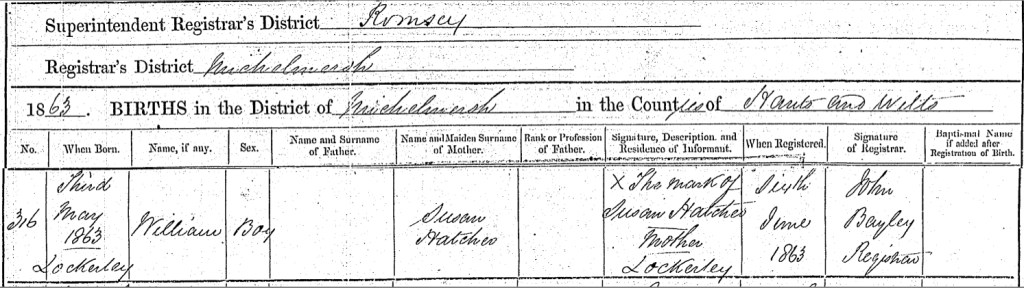
At the registrar’s office, under the steady eye of Registrar John Bayley, Susan gave the simple truth of her son’s birth. There was no father to name, no story to offer. Only the quiet dignity of a mother doing what must be done. When asked to sign, she placed her trembling X upon the page:
The mark of Susan Hatcher, Mother, Lockerley.
A mark she had made so many times before, a humble cross, but one that bore the weight of a lifetime of endurance. It spoke of honesty, of hardship survived, of a love that needed no flourish of ink to be real.
Bayley wrote the details with practiced hand:
When Born: Third May 1863.

Where Born: Lockerley.

Name, if any: William.

Sex: Boy.

Name and Surname of Father: —.

Name and Maiden Surname of Mother: Susan Hatcher.

Rank or Profession of Father: —.

Signature, Description, and Residence of Informant: X The mark of Susan Hatcher, Mother, Lockerley.

When Registered: Sixth June 1863.

Signature of Registrar: John Bayley, Registrar.
The ink dried quickly, but the story behind it would echo through the generations.
For though the record merely said “Lockerley,” William had come into the world in the same cottage where Susan had borne so much, her children, her love, her grief. The fire had crackled softly as she laboured, the table cleared for the midwife’s cloths, the older children sent outside or to neighbours so they would not witness their mother’s pain. Her heart had pounded with fear and strength in equal measure, her breath rising and falling like the wind moving through the trees that held her home in their embrace.
And when she first held William, knowing he would be the last child she ever bore, the world around her seemed to still, just as it had when each of her children came into her arms.
As the soft June light filtered through the cottage window, Susan must have looked upon her newborn and felt the great turning of her life once more, the meeting point of sorrow and blessing. William’s father might never be named, his story never spoken aloud, but his presence would alter her life in ways she could not yet imagine.
For though his birth had come from a place of vulnerability, his life would be shaped by her fierce, unbreakable love, a love that had carried her from her youth at Butler’s Wood through every hardship the world had laid at her feet.
And now, once again, the world had placed a child in her arms, not as punishment, nor as shame,
but as a quiet, holy testament to her ceaseless courage.
Susan’s story was far from finished.
And William, tiny and fragile in her arms,
would be the child who led her into the most difficult chapter of all.
 Yet he would also bring her unexpected grace, a new reason to rise, to endure, to love still, even when the world gave her every reason to stop.
Winter had settled deep into the bones of Hampshire by the time the year turned to 1866. The cold was not sharp, but heavy and lingering, the kind that wrapped itself around the cottages of Sherfield English like a grey woolen shawl. Frost clung to the hedgerows, the fields lay still beneath a pale sky, and silence drifted through the lanes as though the world itself was holding its breath.
Within one such cottage, its roof bowed with age and its hearth burning low, Susan’s mother-in-law, Mary Hatcher, came to the quiet end of her long journey.
It was Tuesday, the 2nd day of January, when seventy-five-year-old Mary slipped from this life. Her passing was not sudden, nor cruel in its swiftness, but slow and tender, the gentle unwinding of a body that had served faithfully for three-quarters of a century. She had endured two long weeks of paralysis, the kind that steals movement little by little, until even the smallest breath feels like a mountain climbed. Yet through every hour of that quiet suffering, Mary was not alone.
Her daughter, Ann Moody, remained steadfast at her side, bathing her forehead, whispering comfort, smoothing her blankets with trembling hands. She watched the light in her mother’s eyes soften day by day, a fading glow she could neither stop nor hasten. Theirs was a love shaped by years of shared labour, grief, and laughter. This vigil, though heartbreaking, was an honour that only a devoted daughter could bear.
And though it is not written in any register nor spoken in any surviving tale, one likes to imagine that Susan, Mary’s widowed daughter-in-law, stood at her bedside as well. With seven children of her own, and burdens enough to crush a weaker heart, Susan still carried loyalty like a lantern. Mary had been her comfort after Charles died, the mother who steadied her when her world fell apart. It is easy to picture Susan standing quietly near the foot of the bed, her rough hands folded, her breath barely stirring the air as she bore witness to the passing of the last link to her beloved husband.
Mary had lived a life stitched together by small, steady acts of love. She had raised her children with little more than courage and toil. She had suffered the loss of her husband William six years before, her heart learning to beat alone in the long quiet of widowhood. She had gathered her family to her like threads in a patchwork quilt, each one held with tenderness even through hardship. And now, with her passing, the hearth she had tended all her life seemed to glow a little dimmer.
When the final breath left Mary’s lips, soft as a feather drifting to earth, the room was utterly still. Ann bowed her head, the tears falling freely. Susan, if she was near, would have pressed her hand to her heart, feeling again the familiar ache of widowhood, the wound reopened by another loss.
Later that same day, Ann found the strength to walk to the register office, her footsteps slow along the frozen path. Her grief must have lain heavy on her shoulders, yet duty, as it always did for the women of Hampshire, guided her onward. There she met Registrar John Bayley, a man who had recorded so many births and deaths in their family that his handwriting was almost part of their story. With trembling hands and a heart worn thin by sorrow, Ann placed her simple X beside her name.
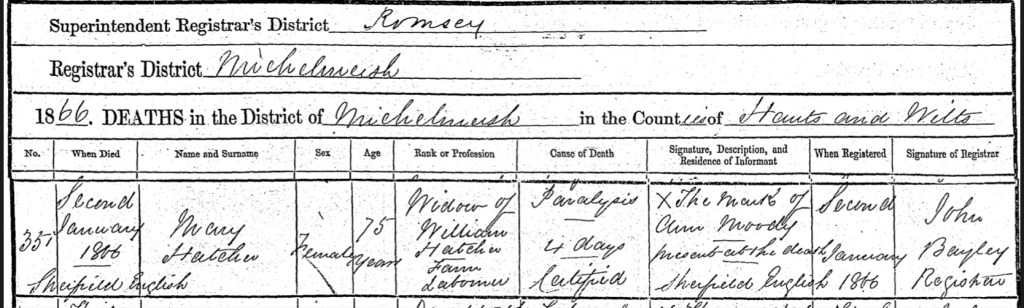
The official record, stark in its brevity, read:
No. 351

When Died: 2nd January 1866

Name: Mary Hatcher

Age: 75 years

Rank or Profession: Widow of William Hatcher, Farm Labourer

Cause of Death: Paralysis, 14 days, Certified

Informant: X The mark of Ann Moody, present at the death, Sherfield English

Registered: 2nd January 1866

Registrar: John Bayley
Yet those tidy lines could never hope to capture Mary’s truth.
They could not speak of her hands, calloused from decades of labour, but gentle when they held her grandchildren.
They could not recall the warmth of her voice, its soft cadence rising like a lullaby in the hush of an evening fire.
 They could not show the love that anchored her through a lifetime of poverty, loss, and unrelenting work.
Nor could they capture Susan’s grief.
For Susan had now lost not only her husband but the woman who had been her last tie to him. Mary had been the keeper of Charles’s childhood memories, the only one left who remembered the boy he had been before he was the man Susan loved. With Mary’s passing, that door quietly closed forever.
And yet, Mary’s story did not end with the drying of the registrar’s ink.
It lived on in the fields of Sherfield English, where she had walked beside William for so many seasons.
It lingered in the soft rhythm of the village, in the voices of her children and grandchildren.
It endured in Susan’s heart, in the lessons of resilience, tenderness, and faith that Mary had quietly taught simply by living.
On that cold January morning, the world may have lost another labourer’s widow, another name in a long leather-bound register, but to those who loved her, Mary was something far greater:

a matriarch,

a shelter,

a keeper of hearth and home,

a woman who weathered life with dignity and grace.
And though the winter wind now whispered through the empty rooms she once warmed, her spirit did not depart with the frost. It remained, softly, in every memory, every gesture of kindness, every echo of love passed from one generation to the next.
Mary Hatcher was gone from the earth,
 but she was not gone from her family.
Such women never are.
Winter lay thick upon Sherfield English on Sunday, the 7th day of January 1866, the kind of winter that hushes the world into stillness. Frost clung to the hedgerows like delicate lacework, and the cold air carried the faint scent of woodsmoke from cottage chimneys. It was on this softened, muted morning that Susan, forty-five years old, widowed, weathered, and quietly steadfast, stood among the mourners to bid farewell to her beloved mother-in-law, Mary Hatcher.
Mary, seventy-five and ready at last to rest, had been a woman woven deeply into the fabric of Susan’s life. After Charles’s death, it was Mary who had offered her comfort, who had spoken gently of better days, who had held Susan’s hand when grief threatened to drown her. In the years since, the two women had shared not only sorrow but a kinship forged by love of the same man, a bond shaped by resilience, hardship, and a tenderness neither had ever needed to name aloud. And now, Mary was gone.
On this cold January morning, Susan walked with her children along the familiar path to Saint Leonard’s Church. She held her shawl tightly around her shoulders, not only against the winter air but against the hollow ache blooming in her chest. Her older daughters walked beside her, their steps slow and reverent, her younger children trailed close, their breaths puffing into the frosty air like tiny ghostly clouds. Today they were not simply mourners, they were saying farewell to the grandmother whose hands had once soothed scraped knees, whose stories had filled their hearth in winter evenings, whose presence had always felt like an anchor in a world that shifted too easily.
Mary’s coffin, plain and honest like the life she lived, was carried by village men who had known her for decades. Their boots crunched softly on the frozen ground as they made their way up the churchyard path. The wind was still, as though even nature bent its head in mourning. The bells of Saint Leonard’s tolled slowly, each note falling like a sigh upon the village.
Inside the church, with its stone walls cool and silent, Curate A. Fragstone stood ready to lead the service. His surplice glowed pale in the winter light that filtered through the coloured glass, casting soft hues across Mary’s resting place. The congregation filled the pews, but it was Susan whose presence felt the most steadfast, her gaze fixed upon the coffin as though willing her love to reach Mary one last time.
Curate Fragstone’s voice rose gently in the chilled air:
“I am the resurrection and the life, saith the Lord...”
The ancient words travelled up into the rafters, mingling with the memories of countless others who had been laid to rest within these walls. As the curate spoke, Susan felt the heaviness of all that Mary had carried in life: the long years of labour beside William, the joy of her many children, the heartbreak of burying her daughter and later her son Charles, and the quiet endurance of her final years after William’s passing.
There were hymns, soft and wavering, sung through trembling breath. Perhaps “Rock of Ages” rose like a whispered plea, followed by “Abide with Me,” its closing verse lingering like a fragile prayer. Each word seemed to cradle Mary’s memory, lifting her gently toward the peace she had long earned.
When the service ended, the mourners followed the coffin out into the crisp air. The grave lay open beneath an ancient yew tree, its dark branches bowed like an old sentinel keeping watch. Susan stepped forward to stand near the edge, her heart aching as she watched the coffin being lowered. The finality of it, the soft thud of frozen earth against the lid, struck her like a blow, for in that sound she heard not only the close of Mary’s life, but the fading echoes of Charles’s too.
As the curate spoke the final blessing, Susan reached down with a shaking hand and released a small handful of earth into the grave. It fell softly, almost lovingly, disappearing into the quiet darkness where Mary now rested. Susan whispered a farewell, no louder than a breath, yet it felt as though the yew tree itself heard her, its branches stirring ever so slightly in the still air.
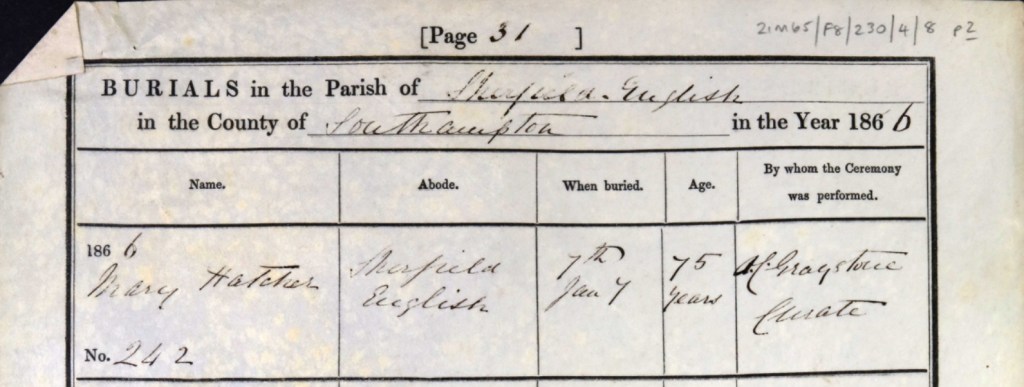
When the last prayer was spoken, and the mourners slowly drifted away, Curate Fragstone returned to the vestry to record the moment in the parish register. The words were simple, cold in their officiality, but behind them lay a life immeasurable by ink:
Name: Mary Hatcher

Abode: Sherfield English

When Buried: 7th January 1866

Age: 75 years

By whom the Ceremony was performed: A. Fragstone, Curate
Burial
No.: 242.
These lines, though formal, were the closing chapter of a woman whose life had shaped the world around her.
Mary was laid beneath the same earth she had walked for decades, the soil that had fed her children, the fields where she had watched the seasons turn beside her husband. Now, reunited at last with William, with her daughter Mary, and with her son Charles, she found gentle rest beneath the winter sky.
For Susan, the walk home from the churchyard felt longer than it ever had before. The weight of grief pressed upon her, yet beneath it lay a strange and tender comfort. Mary, whose companionship had steadied her through her darkest days, had slipped peacefully into eternity. Her spirit, soft as winter dusk, lingered in the air around them, in the rustle of the trees, in the hush of the fields, and in the warm memories held close within Susan’s heart.
Though the world felt quieter without her, Mary’s love endured. In every lesson learned, every kindness shown, every act of quiet resilience, her presence lived on.
And Susan, though bowed by sorrow, carried her forward, in remembrance, in gratitude, in love that did not end with the grave.
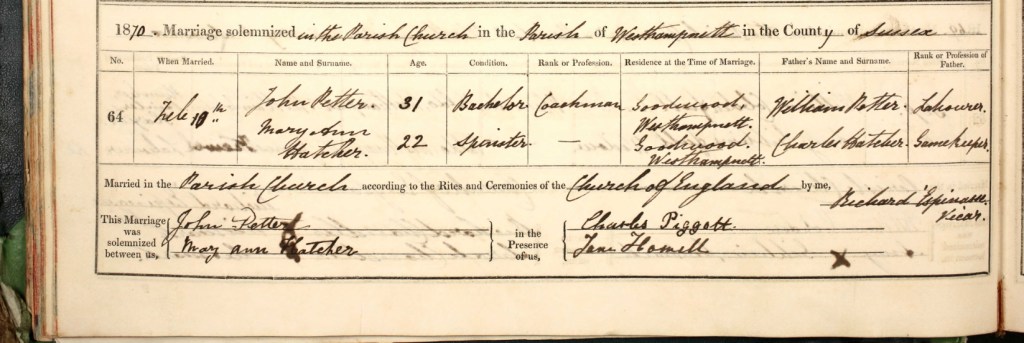
On Friday, the 18th day of February 1870, the quiet parish of Westhampnett in Sussex awakened beneath a pale winter sky, the soft sunlight filtering through bare branches as though the day itself wished to offer its own gentle blessing. Within the ancient stone walls of St Peter’s Church, a story of love, hope, and new beginnings unfolded, one that reached far beyond Sussex, all the way to the heart of Butler’s Wood, Newtown, Lockerley, where Susan lived out her quiet, steadfast days.
It was on this day that twenty-two-year-old Mary Ann Hatcher, daughter of Susan and the late Charles Hatcher, stood before the altar to wed John Petter, a thirty-one-year-old bachelor and coachman of Goodwood. The church, with its weather-worn pews and centuries-old air, felt almost alive that morning, as though it remembered every vow ever whispered beneath its beams.
The parish register preserved the moment in steady ink:
1870. Marriage solemnized in the Parish Church in the Parish of Westhampnett in the County of Sussex.
No. 64.
When Married: February 18th 1870.
Name and Surname: John Petter, Mary Ann Hatcher.
Age: 31, 22.
Condition: Bachelor, Spinster.
Rank or Profession: Coachman, —.
Residence at the Time of Marriage: Goodwood, Westhampnett; East Lavant, Westhampnett.
Father’s Name and Surname: William Petter, Charles Hatcher.
Rank or Profession of Father: Labourer, Gamekeeper.
Married in the Parish Church according to the Rites and Ceremonies of the Church of England by me, Richard E. Innes, Vicar.
This Marriage was solemnized between us:
John Petter,
Mary Ann Hatcher.
In the presence of us:
Charles Pigott,
Ann Howell.
But paper and ink could never capture the full breath of that day.
The wedding would have begun in the late morning, when the church bell called the parish to witness the joining of two lives. Inside, the air smelled faintly of damp stone, beeswax polish, and winter roses placed upon the small wooden altar. The vicar, vested in his white surplice, stood ready beneath the chancel arch. A small group of neighbours, friends, and servants from Goodwood gathered quietly, their breath visible in the crisp air.
Mary Ann likely wore a gown of pale wool or simple cotton, for the custom of white was only just beginning to take hold among ordinary folk. Her dress would have been modest, perhaps adorned with lace at the cuffs and collar, her hair smoothed and pinned beneath a bonnet tied with ribbon. John, the coachman, would have stood proudly in his best attire, likely a dark frock coat and waistcoat, his boots polished with care. His hands, well-used from reins and stable-work, trembled slightly as he waited for his bride.
When the vicar spoke the familiar words,
“Dearly beloved, we are gathered together here…”
 the church seemed to hush to a reverent stillness.
Popular hymns of the time such as “The King of Love My Shepherd Is” or “O Perfect Love,” though not yet a wedding staple, may have filled the rafters in soft, heartfelt tones. The readings, often from Corinthians or the Gospel of John, spoke of patience, fidelity, and enduring love, passages that must have stirred memories deep within Mary Ann’s heart.
For she stood there without the comforting presence of her mother, Susan.
Whether Susan made the long journey from Lockerley, by cart to Romsey, coach to Southampton, and then by train to Sussex, can never be known. Perhaps she was there, in the quiet crowd, her shawl pulled close, her eyes shining with pride. Or perhaps she remained home, her heart travelling the miles her body could not. But whether present in the pews or only in spirit, Susan’s love hovered gently over her daughter that day.
For Susan had shaped Mary Ann in every quiet act of motherhood, the mornings stoking the fire before dawn, the evenings mending dresses by candlelight, the whispered prayers over sleeping children, the courage and tenderness of a woman who had walked through sorrow and still chosen to love.
As Mary Ann spoke her vows,
“To have and to hold… till death us do part”
her voice must have carried echoes of her mother’s resilience, the strength of the Hatcher women who had weathered storms the world never fully saw.
When the vicar bound their hands with the stole and pronounced them husband and wife, the congregation offered gentle smiles, and the bells of St Peter’s rang out across the Sussex countryside. Outside, cold sunlight shimmered on the frost-kissed grass, and the newly married couple stepped into their shared future, the sound of the bells following them like a blessing.
Somewhere far away, perhaps as the bells rang, the wind stirred through Butler’s Wood. It rustled the leaves, brushed against Susan’s window, and whispered of change, of a daughter stepping bravely into her own life, of a mother’s love stretching across counties, steadfast as the roots of the trees that had sheltered their family for generations.
And though Susan’s name would never appear in the register, her presence lived within everything that happened that day. It lived in Mary Ann’s steady hands, her poised smile, her hopeful heart. It lived in the vows spoken beneath Sussex skies. It lived in the quiet pride of a mother who had endured hardship, loss, and loneliness, yet raised a daughter strong enough to build her own story.
The page in the register captured only the facts.
But the truth, the love, the hope, the legacy, was written in the hearts of mother and daughter,
across a distance bridged not by roads,
but by love enduring as faithfully as the English countryside itself.
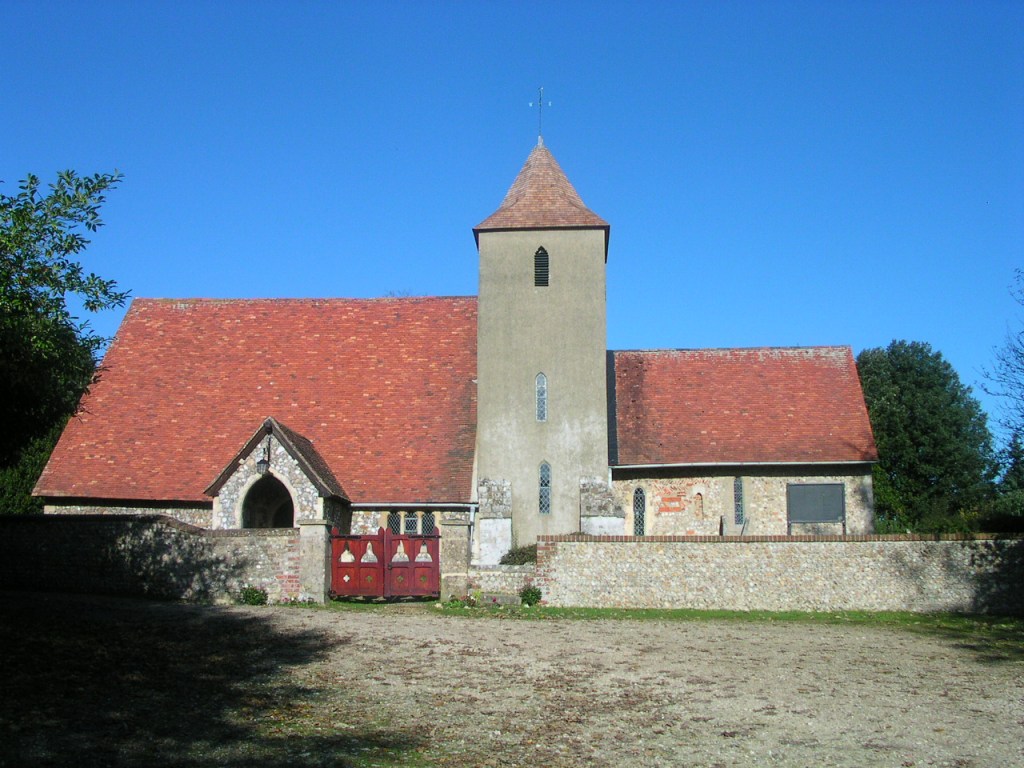
St Peter’s Church at Westhampnett stands beside the line of the old Roman road to London, Stane Street, and it has guarded this corner of Sussex since the early Anglo-Saxon period. A stone church is thought to have been on the site from about the year 710, soon after St Wilfrid’s mission evangelised the South Saxons, and the present fabric still preserves that deep antiquity. In the chancel you can see Saxon herring-bone masonry and a blocked Saxon window, and the builders even recycled Roman material from nearby Chichester, the old city of Regnum, so that courses of Roman brick run through the flintwork like a memory of an older world.
Through the centuries the church was altered and enlarged. It is recorded in the Domesday Book, and medieval work of the thirteenth century joined the earlier chancel; later restorations followed the usual Victorian zeal for repair, with major nineteenth-century work giving the nave and fittings much of their present character. The church is now listed Grade II* for its special interest, with Historic England noting the medieval fabric and later phases in the surviving building.
Step inside and the layered history comes into focus. Slender lancets light the small interior; the quiet nave leads the eye to the chancel arch, and monuments tell parish stories in stone. On the north side is a fine sixteenth-century memorial to Richard Sackville and his wife Elizabeth Thetcher of Westhampnett Place, their effigies dressed in Tudor finery, a reminder that this was once a parish of some wealth and standing. In the churchyard the headstones are unusually elaborate for a rural place, plain and Celtic crosses among them, reflecting prosperous congregations in past centuries. The bells have long called the village to worship, with two of them dated 1581 and 1632.
The parish around the church has its own deep past. Westhampnett lay within a Saxon settlement that passed to Norman lords after 1066. Medieval hospitals once stood nearby, including a leper house founded in Henry I’s reign, and the wider parish later became the centre of a Poor Law Union. In the twentieth century the airfield at RAF Westhampnett, now part of Goodwood, added a modern chapter of wartime service to the parish story.
As for tales of haunting, St Peter’s does not have a well-attested body of ghost stories in the way that some ancient churches do. Parish and heritage sources emphasise the building’s archaeology and monuments rather than apparitions. Any whispers of spectral presence seem to live at the level of village lore rather than documented tradition, and there are no widely reported investigations or accounts tied specifically to this church. That quietness is part of its character: the place feels old and watchful, more a keeper of memory than a stage for drama.
If you visit, stand by the south wall and look closely at the masonry, where the Roman bricks lie among the flints and the herring-bone courses catch the light; you are looking at more than a thousand years of worship layered into a few square feet of stone. The building still serves its parish with regular services and shares its ministry with St Paul’s, Chichester, a living church whose story began before England itself had taken shape.
When word of her brother Moses’s passing finally reached Susan, it did not arrive like ordinary news. It drifted toward her like a cold valley mist rising from the Test, creeping into every quiet corner of her cottage at Butler’s Wood. Perhaps it came on a neighbour’s hurried breath, cheeks flushed with the weight of the message. Perhaps it came folded inside a crumpled note carried from Mottisfont by a weary traveller. Or perhaps it came as a slow, deliberate knock upon her wooden door, the kind that makes a widow pause mid-step, already knowing the world is about to tilt.
However it reached her, the truth settled upon her heart with a chilling certainty:
Moses Luke, her steadfast older brother, the gentle anchor of her childhood, had died on Monday the 7th of March, 1870, in Mottisfont. He was seventy-eight.
Moses, whose hands had once guided hers as a child, whose laughter had softened their mother Kitty’s sternness, whose steady strength had held the Luke family together through hunger, hardship, and heartbreak. Moses, whose quiet presence she had always believed would simply go on, like the turning of the seasons or the whisper of the woods.
In his final hours, he had not been alone.
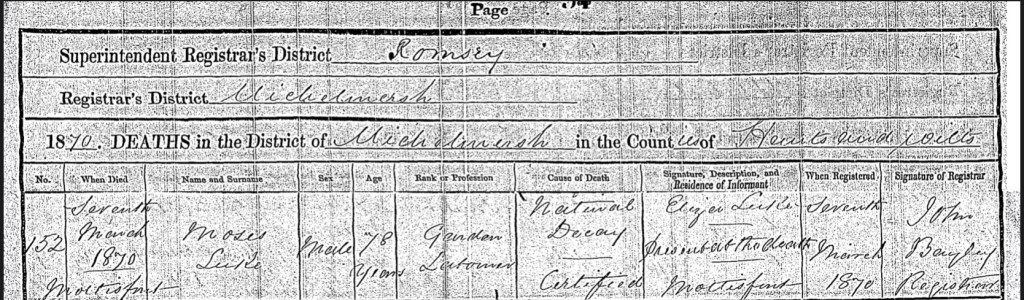
At his bedside sat Eliza Little, offering tenderness in the place of kin, her presence a balm as Moses slipped gently out of this world. And with the same quiet dignity that had marked his life, Eliza made her way to the registrar’s office that very day, carrying the weight of representing him in his final earthly task.
Registrar John Bayley, with his familiar hand and solemn duty, entered the details into the great book of the District of Romsey, Sub-district of Michelmersh, just as he had done so many times before for the Luke and Hatcher families.
The record stood plain and humble, like Moses himself:
No. 132

When Died: Seventh March 1870

Name and Surname: Moses Luke

Sex: Male

Age: 78 Years

Rank or Profession: Garden Labourer

Cause of Death: Natural Decay, Certified

Signature, Description, and Residence of Informant: Eliza Little, present at the death, Mottisfont

When Registered: Seventh March 1870

Signature of Registrar: John Bayley, Registrar.
A few brief lines of ink to mark the end of nearly eight decades of labour, love, and quiet endurance.
But for Susan, the news was no neat entry in a ledger.
It was a blow straight to the heart.
Whether she had stood near in those final days, or whether she learned of his passing only after his spirit had already taken flight, the moment the words reached her was the moment time seemed to still. The hearth beside her crackled on, indifferent to her grief; the children’s voices, if they were home, seemed distant, muted, as though the world itself softened to make space for her sorrow.
Her mind flooded with memories, fragile, shimmering pieces of a childhood long buried beneath the weight of life. She saw Moses leading her along the dusty lanes of Lockerley, his hand warm in hers. She heard him calling her name across the fields. She remembered him standing beside their father Moses and mother Kitty, solid and gentle, a quiet guardian in a world that offered little safety.
They had weathered so much together.
 Losses that would have broken others.
Hard winters. Empty cupboards. The deaths of loved ones. The scattering of siblings.
And now, another thread of her past had been cut.
In that small cottage in Butler’s Wood, surrounded by the soft sigh of the trees and the fading light of a cold March evening, Susan felt the weight of this new emptiness settle over her. A chapter had closed, silently, without ceremony, in Mottisfont. A good man had gone. A brother she had loved since girlhood was now beyond reach.
Yet even in her grief, something of Moses lingered.
In the soil of Lockerley where he had once walked,
in the rhythm of the seasons he had tended,
in the quiet strength he had instilled in her, the strength she would need more than ever in the years to come.
For loss had shaped her life, but it had also shaped her courage.
And though the world felt colder that day,
she carried Moses with her still,
woven into the deepest part of her heart.
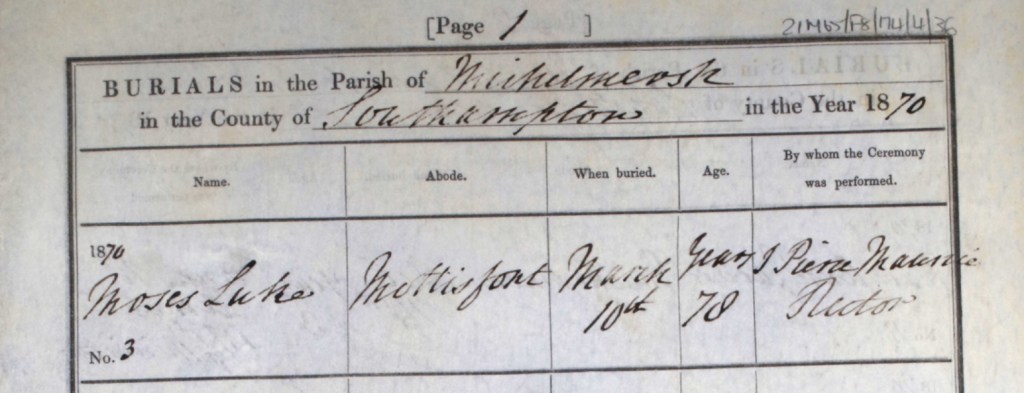
On the quiet morning of Thursday, the 10th day of March 1870, when a tentative spring light glowed pale over Michelmersh as though unsure whether to stay or fade, Susan walked behind her brother’s coffin with a heart that felt heavier than the earth itself. The air was cool and faintly sweet, carrying the smell of damp moss and turning soil, the scent of early spring that seems to whisper of beginnings even as it accompanies an ending.
The burial register recorded the moment with its usual restraint, its quiet lines indifferent to the ache of human grief:
BURIALS in the Parish of Michelmersh in the County of Southampton in the Year 1870

Name: Moses Luke

Abode: Mottisfont

When Buried: March 10th

Age: 70 years

By whom the Ceremony was performed: J. Pierre Maurice, Rector

No. 3.
But for Susan, nothing about this day was plain or routine. Every step she took behind her brother’s coffin felt like walking through the memories of her own childhood, each footfall echoing the distant laughter, the shared chores, the whispered fears and comforts of two siblings who had survived so much together beneath the Hampshire sky.
The path to St Mary’s Church wound gently through a landscape that had shaped them both, fields where Moses had once worked, lanes where they had walked as children, the very earth that had held their family for generations. As neighbours and kin gathered, their murmured condolences trailing in the cold air, Susan kept her gaze low, her grief too deep and raw for words.
The churchyard awaited them, its leaning stones softened by lichen, its ancient yew tree standing watch like a guardian older than memory. The March wind slipped through its branches with a low sigh, brushing against Susan’s cheek like a familiar touch, the kind Moses himself might have given in some long-ago moment of comfort.
When the coffin was set down beside the open grave, Susan stepped closer, her gloved hand trembling as she rested it upon the cold wood for the last time. She remembered him as a boy chasing her along the lanes of Lockerley, as a young man strong and sure in the fields, and later as the quiet, steady presence who remained after the family’s many storms had passed. Moses, who spoke little but meant much. Moses, who had been a constant thread through the fabric of her life.
Rector J. Pierre Maurice began the ancient words of committal, his voice steady and low:
“I am the resurrection and the life…”
The syllables drifted upward, mingling with the soft cooing of pigeons perched among the church rafters and the rustle of early primroses stirring in the grass. As the words faded into the quiet morning, the men lowered Moses into the earth, into the same soil that had known the tread of his boots and the labour of his hands since he was a boy.
Susan dropped a small handful of earth upon the coffin, the soil breaking apart softly, its sound like a whispered farewell. Around her, others did the same, but she heard nothing but the thrum of her own heartbeat, tight and painful in her chest.
With that single gesture, something within her shifted irrevocably. This was not only Moses’s burial, it was the peeling away of one more layer of her own past, the loss of a brother, yes, but also the loss of someone who had known her since she was small enough to be lifted into their mother’s arms. Someone who had remembered her father’s voice, her mother’s smile, the days when the Luke family was whole.
As the final prayers fell into silence and the grave was covered, Susan lingered, her tears slipping quietly down her cheeks, unnoticed beneath her mourning veil. The earth at her feet was cold, but she felt the warmth of her memories rising in her like a fragile flame. Moses had lived simply, had worked honestly, had loved quietly. There was no grandeur in his story, only truth, and that truth lived now in her heart alone.
She walked away from St Mary’s slowly, her steps small and uncertain, the world around her softened by grief. But even in her sorrow, she carried something gentle with her, the certainty that Moses had returned to the land he had long belonged to, and the quiet belief that the bond between them, shaped in the tender soil of childhood and weathered through the years, would never truly be broken.
For Moses was gone, but in the deepest chambers of her heart, in the place where memory becomes something holy, Susan knew he would walk beside her still.
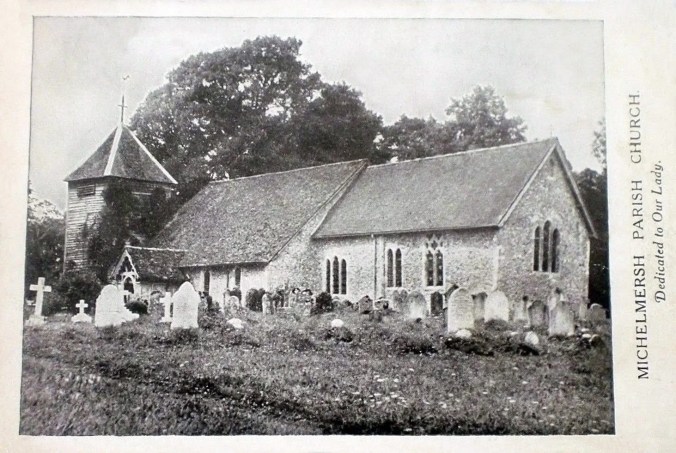
St. Mary’s Church in Michelmersh, Hampshire, is a beautiful and historic parish church that has played a central role in the spiritual and community life of the village for many centuries. Located in the peaceful countryside of Hampshire, St. Mary’s Church serves as an important landmark and is deeply connected to the village’s history and its people.
The history of St. Mary’s Church dates back to medieval times, with the first references to the church appearing in documents from the 12th century. The church was likely built during the Norman period, though there have been many modifications and restorations over the centuries, reflecting the changing architectural styles and the needs of the community. Like many churches in rural England, St. Mary’s would have served not only as a place of worship but also as a central gathering point for the village, hosting baptisms, marriages, and funerals.
The architecture of St. Mary’s Church is an example of the typical styles seen in rural churches of this era. The building is constructed from local stone, and its design has been influenced by both Romanesque and Gothic architectural styles. The church features a simple yet elegant structure, with a nave, chancel, and tower. The tower, which would have served as a symbol of the church’s prominence in the village, is an important feature of the church’s exterior. Over the centuries, the church has undergone various renovations and extensions to meet the needs of the growing population, but its fundamental design has remained faithful to its original structure.
One of the key periods in the history of St. Mary’s Church came in the 19th century when many churches were restored or rebuilt under the guidance of architects and scholars of the time. During this period, St. Mary’s underwent significant restoration work, likely driven by the Victorian-era passion for restoring medieval churches. This restoration would have focused on preserving the architectural integrity of the church while adding new elements to accommodate the expanding congregation. The addition of stained-glass windows, the improvement of the interior furnishings, and the enhancement of the church’s acoustics were likely part of this restoration process, reflecting the era's fascination with Gothic Revival architecture.
The churchyard surrounding St. Mary’s Church is also an integral part of its history. Like many rural churches in England, the churchyard is the final resting place for many generations of the village’s residents. The graves and memorials found in the churchyard are a testament to the people who lived in Michelmersh throughout the centuries, offering a glimpse into the village’s past. Some of the gravestones are centuries old, and their inscriptions and symbolism provide valuable insights into the local history and the families who lived in the area. The churchyard also serves as a peaceful place for reflection and a reminder of the deep connection between the village and its church.
St. Mary’s Church has continued to play a central role in the life of Michelmersh. The church still holds regular services, including Sunday worship, weddings, baptisms, and funerals, serving as a focal point for the spiritual life of the community. The church is not only a place of worship but also an important cultural and social center for the village. It is a place where the community gathers for events, celebrations, and activities that bind the people together. The church has also hosted special events, such as concerts and festivals, which have helped bring the community together and allow people to celebrate their shared heritage.
In terms of local folklore and rumors of hauntings, St. Mary’s Church, like many historic churches, has been the subject of occasional ghost stories. While there are no widely documented or well-known accounts of hauntings, it is common for older buildings, particularly churches, to inspire tales of supernatural occurrences. The church’s long history and its connection to the lives of the people of Michelmersh provide a natural backdrop for such stories. The churchyard, with its centuries-old graves, might contribute to an eerie atmosphere, especially in the stillness of the early morning or evening. However, these tales are generally passed down through generations and are part of the local folklore rather than established facts.
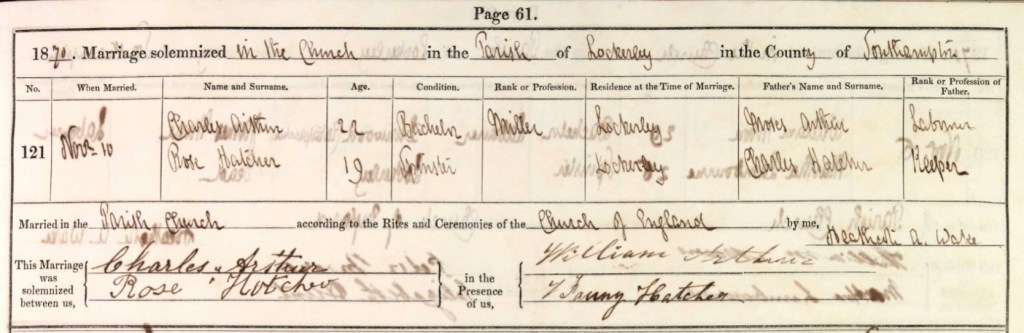
On Thursday the 10th day of November 1870, when the last leaves of autumn clung trembling to the branches above Lockerley, the old Parish Church of St John’s stood quiet beneath a grey-washed sky. The scent of wet earth and fallen leaves drifted in from the churchyard, mingling with candle wax and the faint musk of hymn books worn by generations of village hands. Inside, the air held a reverent stillness as the bell tolled across the Hampshire fields, calling the faithful, and the hopeful, into its stone embrace.
It was on this morning that young Rosa Hatcher, whom was known as Rose, just nineteen years old, stepped into that sacred space to bind her life to another’s. With the calm authority of faith and tradition, the Reverend Heathcote A. Wake, presided over the ceremony, his voice echoing gently through the nave as he guided two lives into union.
The parish register, faithful, precise, and unfailingly neutral, captured the moment in its neat, unwavering script:
1870 Marriage solemnized in the Church in the Parish of Lockerley in the County of Southampton.

No. 121

When Married: November 10th 1870

Name and Surname: Charles Arthur, Rose Hatcher

Age: 22, 19

Condition: Bachelor, Spinster

Rank or Profession: Miller, —

Residence at the Time of Marriage: Lockerley, Lockerley

Father’s Name and Surname: James Arthur, Charles Hatcher

Rank or Profession of Father: Labourer, Keeper

Married in the Parish Church according to the Rites and Ceremonies of the Church of England by me, Heathcote A. Wake, M.A.

This Marriage was solemnized between us:

Charles Arthur

Rose Hatcher

In the presence of us:

William Arthur

Fanny Hatcher.
Yet the ink, faithful though it was, could never hold the quiet tide of emotion that swelled within Susan as she sat in one of the back pews, her hands clasped tightly in her lap.
By 1870, Susan had lived a lifetime’s worth of hardship and devotion. She had buried her husband, Charles Hatcher, the steadfast gamekeeper of Butler’s Wood, long before his time, and had journeyed through widowhood with the quiet, bone-deep strength of those who endure because they must. She had raised her children among the whispering woods and narrow lanes of Lockerley, her days filled with work, worry, and the fierce, unspoken love of a mother who carries the world on her own shoulders.
And now here was Rose, her youngest daughter, her wildflower child, standing at the very altar where Susan herself once vowed her heart to Charles. Rose stood straight and luminous, her face softened by the golden spill of autumn light filtering through the stained glass, her voice steady as she pledged herself to Charles Arthur, a miller of twenty-two years who waited beside her with earnest eyes.
As the vows were spoken, Susan’s heart swelled and ached all at once. She saw not just the young woman before her, but the barefoot girl who once darted through the mossy paths of Butler’s Wood, gathering primroses in her skirts and skipping behind her father’s long strides. She heard echoes of past laughter, felt memories brush against her like a soft hand at her cheek. There was sorrow, yes, the sorrow of letting go, of watching a child step beyond the reach of her arms, but there was pride too, deep and shining.
When the final blessing was given and the young couple stepped out into the crisp November air, the church bells rang with a bright, hopeful clarity. Their peals floated over the thatched cottages, over the hedgerows glittering with dew, over the very woods that had held the Hatcher family through every joy and trial.
Susan followed her daughter out into the chill, her breath mingling with the mist. Perhaps she drew her shawl tighter, perhaps she allowed herself the briefest smile as Rose turned to look back at her, a look that held gratitude, love, and the unmistakable shimmer of new beginnings.
And somewhere far beyond the churchyard walls, deep within the familiar rustle of Butler’s Wood, nature itself seemed to murmur a blessing. The branches swayed, the leaves whispered, and the air carried a tenderness that felt like Charles’s unseen hand resting upon Susan’s shoulder.
For though her life had been shaped by loss and hardship, and though she had carried burdens few could see, Susan Hatcher stood that day not bowed but quietly shining, knowing she had brought her daughter safely to this threshold. Knowing that love, fragile, fleeting, miraculous, would carry Rose into the next chapter of her life.
And as mother and daughter walked home along the winding lane, the cold air turning their breath to silver, Susan felt the warmth of something long-enduring rise within her.
Hope.
Love.
And the knowing that, even in a world that had taken much from her, she had given her children everything she could, and more.
On the soft, muted evening of Sunday the 2nd day of April 1871, as dusk settled like a lavender shawl over the quiet folds of Butler’s Wood in Newtown, Lockerley, a gentle knock echoed upon the door of Susan Hatcher’s cottage. It was the census man, a travelling enumerator appointed by the Registrar General, his leather satchel heavy with forms, his lantern casting a pool of amber light upon the threshold. He carried with him the task of recording every life within the parish, moving from cottage to farmhouse, inn to workshop, gathering names and stories with the steady hand of duty.
When Susan, now fifty years old, opened her door, the familiar scents of woodsmoke, bread, and damp timber spilled softly into the evening air. Inside the cottage, humble, worn by years, and warmed by the embers of the hearth, her three youngest sons lingered close. George, aged thirteen, tall for his years and already bearing the early stoop of an agricultural labourer, stood near his mother, his hands still rough with the day’s work in the fields. Stephen, eleven, glanced shyly from behind the table, his dark eyes bright with curiosity. And little William, just seven, sat quietly in the corner, his frail legs curled beneath him. Crippled from birth, he moved with difficulty, but his spirit, gentle, observant, and luminous, filled the room like a small, steady flame.
The enumerator stepped inside just enough to scribble the details in his ledger, the nib of his pen scratching softly across the page as Susan provided each answer with quiet dignity. Her voice was gentle but sure, shaped by years of hardship and the unbreakable resolve of a mother who had weathered storms few could see.
Yet what the census could not record was the tenderness woven into the walls of that cottage. It could not measure the weight of absence where Susan’s husband Charles once stood, nor capture the warmth of her hands as she tucked blankets around her boys each night. It could not know how often she rose before dawn, stoked the hearth, and whispered a prayer for the strength to carry her family through another day.
Outside, the world of 1871 unfurled quietly around them. Through the trees beyond their home lived familiar neighbours whose voices often drifted through the hedgerows, reminders that Susan and her children were not alone in their small corner of Hampshire.
Next door, the rhythmic tapping of the shoemaker’s tools could often be heard from the home of Job Lambourn. Job and his wife Martha tended to their work with the steady hum of industry, their lodger, agricultural labourer William Moore, adding another pair of boots to the daily march of life in the village.
A short way further, where the lamps glowed warm in the gathering dark, stood the Bush Inn, overseen by publican John Southwell and his wife Nanny. Their lodgers, shoemaker James Rogers and agricultural labourer Walter Burnett—brought laughter, gossip, and the scent of ale into the passing breeze, blending easily into the ancient pulse of Lockerley life.
But in Susan’s cottage, the evening was different, softer, more fragile, yet filled with a fierce, protective love. As the census man thanked her, tipped his hat, and moved on to the next household, the stillness returned. Only the faint crackle of the fire and the wind whispering through the trees remained.
Susan looked at her sons, George with his growing strength, Stephen with his questions, and sweet William with his quiet courage and felt the familiar ache of both burden and blessing. She had lived through loss, carried the weight of shame imposed by a society far harsher toward women than men, and worked tirelessly to keep her family whole. Yet, despite everything, she stood rooted in love, anchored by the determination that none of her children would ever feel abandoned or unseen.
And so, as the evening deepened into night, the faint scent of moss and cool earth drifting through the open crack of the door, Susan gathered her little household close. Their names had been written in the census ledger, but their lives, messy, tender, fragile, and beautiful, beat far beyond the ink.
For in Butler’s Wood, beneath the quiet breath of the Hampshire sky, Susan Hatcher continued to weave her days from the threads of endurance, hope, and a mother’s unwavering heart.
Life for Susan in 1871, in the deep, quiet tangle of Butler’s Wood in Newtown, Lockerley, would have been a tapestry woven from hardship, resilience, and a mother’s unyielding devotion. By then she was a woman of fifty, a widow for more than a dozen years, her days shaped by the demands of survival and the tender, exhausting labour of raising her three youngest children alone. Yet nothing defined her daily life more than the care she gave to her youngest son, William, the child born crippled from birth.
In that remote woodland corner of Hampshire, far from the comforts of larger towns, her existence was carved out of necessity. The cottage was humble, draughty in the winter and dim beneath the shadow of trees, its light falling in soft shafts through small panes. Its floors were trodden earth or cold, uneven boards, its walls breathed the scent of smoke, damp wool, and woodland leaves caught on boots and hems. Every morning Susan rose before the sun, often while the mist still clung like a shawl to the hedgerows. The fire was coaxed back to life with flint and breath. Only then did the day truly begin.
Her greatest care was always William. At seven years old, he was small and frail, his legs weak, perhaps twisted or undergrown. His disability meant he could not run with other boys or tread the woodland paths his brothers took for granted. Susan carried him often, lifting him with arms strengthened by years of labour, her body aching by nightfall but never failing him. On days when her arms trembled with fatigue, she would steady herself against the wall before gathering him again, whispering encouragement, for in her heart he was no burden but a precious, vulnerable part of her.
His world was the cottage, the small yard, the patches of sunlight that broke through the trees. Susan made these spaces gentle and safe. She placed him near the hearth in winter, wrapped in shawls or blankets she had mended again and again. In summer she set him by the doorway where he could smell wild garlic or hear birds weaving their songs above the canopy. She shared stories, small comforts, and her quiet presence, his world was limited in distance but not in love.
Susan’s days were long and heavy with work. She scrubbed, swept, mended clothing threadbare from use. She cooked simple meals, bread she had baked herself, scraps of bacon when she could afford it, broth simmered with root vegetables, and porridge thickened with only what the parish wages or her own meagre earnings could stretch to. She washed clothes in cold water carried from the well or nearby stream, wringing them out with hands cracked from labour and winter frost. She gathered kindling and wood, often accompanied by Stephen, while William watched from the doorway, longing to help but unable.
There was no social welfare as we know it today. If Susan received help, it would have been from the parish overseers of the poor, and only sparingly. A small allowance from the Parish Relief might have been granted, meagre coins that barely eased the strain. The church sometimes offered charity in the form of bread, perhaps coal at Christmas, and the occasional piece of used clothing. If she needed more, truly needed, she would have had to swallow pride and visit the overseer or parish relieving officer, a journey most widows made with dread. Asking for aid meant scrutiny, judgement, and the fear of being deemed incapable. But Susan had weathered many storms; she knew how to stand tall even when her heart was breaking.
Her eldest children, now grown, helped where they could, but they had families and burdens of their own. George, still a boy, worked long hours as an agricultural labourer, his wages small but a lifeline. Stephen helped about the cottage, doing small tasks William could not. Every coin George brought home was stretched until it nearly tore.
For Susan, loneliness sat beside her in the long hours after the children slept. The woodland, so peaceful by day, became a quiet sentinel at night, the owls calling from its darkened canopy. She had known companionship once, Charles’s laughter, his steady presence, but now it was memory alone that warmed her. Grief never truly left her, it softened, shifted shape, but still lived in the empty chair by the hearth.
Yet there were moments of grace. The kindness of a neighbour passing with a loaf still warm from the oven. A wildflower picked by Stephen and placed gently in William’s hands. The golden hush of a summer evening settling over the trees like a blessing. The simple joy of hearing William laugh, bright and unguarded, even if his world was small.
Through all this, Susan endured. She was not a woman of wealth or education, but a woman of depth, of enormous quiet strength. Each day she stitched her family’s survival together with patience and love. The hardships were many, but her will was greater. And in that cottage beneath the broad sky and ancient woods, her children grew in the warmth of a mother whose heart never faltered, even when the world around her asked too much.
For William, she was not simply a mother, but the hands that lifted him, the voice that soothed him, the world that held him gently. And for Susan, he was a reminder that love, even in the hardest of lives, could still bloom tenderly, like a wild primrose pushing through cold spring soil.
In the early months of 1873, when winter still lingered over the Southampton district and the first shy buds of spring had only begun to stir beneath the cold earth, a new chapter unfolded in the life of Susan’s daughter, Fanny Luke Hatcher. She was twenty-nine years old now, no longer the barefoot girl who once danced through the mossy paths of Butler’s Wood, but a woman shaped by the quiet resilience of her mother and the memory of the father she had loved and lost.
Somewhere in Southampton, in a church where the stone walls had heard countless vows before hers, Fanny stood beside Henry Bound, a widower who carried both past sorrow and the fragile hope of a second beginning. Their marriage was recorded in the January to March quarter of 1873, tucked into the great web of civil registers, its details small and plain, yet its meaning profound. For Fanny, this union marked not just the start of a new home, but the mending of a heart that had weathered the storms of loss and labour.
One can imagine the ceremony in gentle shades, the soft murmur of gathering guests, the organ’s tremble as a hymn filled the nave, perhaps “Love Divine, All Loves Excelling,” or “O Perfect Love,” songs that echoed in so many Victorian churches during moments of new promise. Fanny may have worn a simple gown, cream or dove-grey, fashioned from the fabric she could afford, her hair pinned neatly, her hands trembling as she held them before her. Henry, solemn and hopeful, would have stood at her side, the light through the stained glass catching the edges of his coat.
Somewhere far away in Butler’s Wood, or perhaps even in the pews if she had made the journey, Susan would have felt a swell of pride, tinged with that familiar bittersweet ache. She had known hardship as intimately as breath, widowhood, poverty, loss and yet here she was, watching another of her children step forward into a life she herself had once dreamed of.
Though the record of their marriage is preserved only in brief lines of ink, behind it lies a world of feeling, two lives intertwined, two families joined, and the quiet, steady heartbeat of hope.
You should know, that I regret deeply, with the rising cost of genealogy certificates that closes these fuller details from our grasp, i just can not warrant buying every single marriage certificate. If I could place every document in your hands, and every story in your heart, I would. But family history like life itself, must sometimes be pieced together with love rather than paper. If ever you wish to secure the marriage certificate yourself, it can be obtained with the following GRO reference:
Gro Reference:
Marriages, March Quarter 1873

Name: Fanny Luke Hatcher

Spouse: Henry Bound

District: Southampton

Volume: 2c

Page: 56
And though the certificate may yet lie unopened in an archive, Fanny’s story continues to unfold in the threads woven by her mother before her, threads of endurance, humility, and the quiet beauty of a life lived with love.
As spring settled softly over the Isle of Wight, on Saturday the 12th day of April 1873, another thread of Susan Hatcher’s life was quietly loosened from her keeping and woven into a new tapestry. Her daughter, Ellen Luke Hatcher, thirty years old and long since tempered by the same winds of hardship and hope that had shaped her mother, stood beneath the stone arches of St Mildred’s Church in Whippingham to take her vows.
The church itself, regal yet tender in its simplicity, seemed to cradle the moment. Light filtered through coloured glass in soft ribbons, settling upon Ellen’s face like a blessing. The bells, high in the tower, rang out across the Solent, their notes scattering like petals upon the breeze. There she stood, the daughter Susan had once rocked to sleep in a cottage at Butler’s Wood, now a bride with steady hands and a brave, hopeful heart.
Beside her was twenty-two-year-old William Bull, the son of William and Maria Bull, a young man whose life had unfolded along the island lanes and wharves, far from the deep woods and quiet labouring fields of Lockerley. Yet on this day, their worlds met as one, bound by vows spoken in the ancient cadence of the Church of England, vows that echoed softly beneath the vaulted roof of St Mildred’s.
One cannot know if Susan herself made the long journey across the water to witness her daughter’s marriage, but it is easy to imagine her heart travelling there all the same. Whether she stood in the church’s shadow, hands clasped tightly, or waited at home with quiet anticipation, Susan would have felt the familiar ache of a mother’s pride mingled with a mother’s sorrow. Ellen, once her tiny babe born in uncertain times, now stepped boldly into the next chapter of her life, a chapter shaped not by struggle, but by promise.
The record of the day is preserved in the official GRO index, a neat entry that offers only the barest bones of a moment so full of feeling:
Gro Reference

Marriages, June 1873

Hatcher, Ellen Luke

Bull, William

I. Wight

Volume 2b,
Page 947
Yet behind those dry lines lies a story of lineage and love, of a daughter raised through hardship by a mother who had given everything she had. Ellen’s wedding was not merely a union of two young hearts, but the flowering of Susan’s long years of sacrifice. It was proof that even a life shaken by loss and shadowed by sorrow could still yield beauty, hope, and joy.
As Ellen and William left St Mildred’s as husband and wife, the early spring breeze rustled through the budding trees, carrying the faintest whisper across the island and over the sea, all the way to Lockerley, a whisper that spoke of new beginnings and of a mother’s love that reached far beyond distance, water, or time.
St Mildred’s Church at Whippingham on the Isle of Wight stands as one of the most historically significant and visually striking parish churches in southern England. Set amid peaceful parkland near the River Medina, it was the private church of Queen Victoria and Prince Albert, closely connected with their nearby residence at Osborne House. Its story stretches back many centuries, yet it is best known today for its nineteenth-century rebuilding under royal direction, making it both a house of worship and a memorial to the Victorian royal family.
There has been a church at Whippingham since at least the Saxon period. The earliest records suggest that the site was a small and simple chapel serving the local farming community, which grew up along the river before the Norman Conquest. Medieval references show that the original church was dedicated to St Mildred, a popular Anglo-Saxon saint associated with Kentish monastic life, known for her piety and generosity. The medieval structure stood until the mid-nineteenth century, though by then it had become small, old, and ill-suited for the growing royal estate at Osborne.
When Queen Victoria and Prince Albert purchased Osborne House in 1845 as a family retreat, Whippingham Church became their parish church. Prince Albert, who took a keen interest in architecture and design, decided that it should be rebuilt to reflect the royal family’s devotion, taste, and sense of heritage. He personally drew up plans for the new church, and the architect Albert Jenkins Humbert carried them out. Work began in 1854, and the new St Mildred’s Church was consecrated in 1862. The style is a striking mixture of Gothic and continental Romanesque, influenced by German and Flemish forms that appealed to the Prince Consort’s sense of culture and symbolism.
The church’s exterior is instantly recognisable by its tall, slender campanile-like tower, which rises high above the trees and can be seen from the River Medina. Its flint and stone walls gleam in the sunlight, and the interior, with its vaulted ceilings and carved stonework, feels both regal and reverent. The royal influence is everywhere, the pews are carved with crowns, the stained glass windows are filled with Christian symbols and dedications, and the colours of the interior, soft stone, gold, and muted reds, reflect the aesthetic taste of the mid-Victorian court.
St Mildred’s is also a place of royal burial. Prince Henry of Battenberg, husband of Princess Beatrice, Queen Victoria’s youngest daughter, was buried here in 1896 after dying while serving with the British forces in Africa. His tomb, along with that of Princess Beatrice herself, lies in the Battenberg Chapel, a richly ornamented section of the church designed to serve as a private royal mausoleum. The chapel contains mosaics, marble, and gilt decoration, as well as a sculpted recumbent effigy of Prince Henry by the artist Sir Alfred Gilbert. The royal family’s connections to the church continued well into the twentieth century, and members of the modern royal family still occasionally attend services here.
As with many ancient and sacred sites, whispers of haunting and ghostly presence surround St Mildred’s. Visitors have spoken of a sense of calm yet strange watchfulness, particularly in the Battenberg Chapel and the older parts of the churchyard, where time seems to stand still. Some claim to have heard the soft sound of footsteps or quiet singing when the building is empty, and there are local tales that the spirit of a long-ago church warden or verger still lingers, making his rounds after dark. Others speak of a gentle female presence sometimes associated with Princess Beatrice herself, who spent much of her later life on the island and took great care of the church. None of these stories are verified, and they live more in local memory than written record, but they lend an air of quiet mystery to the place.
The churchyard is a fascinating space in its own right. It contains graves of soldiers, sailors, and islanders, some dating back several centuries. The peaceful setting among yews and oaks makes it one of the most tranquil places on the island, with views across the Medina estuary. The church’s proximity to Osborne House means that many of those who worked in royal service are also buried here, creating a community of remembrance that ties local and royal history together.
Inside, the church remains remarkably well preserved. The stained glass, much of it installed in the late nineteenth century, depicts scenes from the life of Christ as well as symbols associated with the royal family. The font, lectern, and pulpit are richly carved, and the organ, originally installed during Queen Victoria’s reign, has been restored several times to maintain its deep, sonorous tone. The nave’s arches and ribbed vaulting give the interior a sense of height and harmony that is both intimate and grand.
Today St Mildred’s Church is still an active parish church, open for regular worship as well as visitors who come to explore its royal connections. Its association with Queen Victoria and Prince Albert gives it a unique place in British history, standing as a reflection of their family life, faith, and aesthetic ideals. The building itself, with its blend of medieval tradition and Victorian design, seems to bridge the old England of quiet parish churches and the modern monarchy that helped shape the nation’s identity.
For all its grandeur, St Mildred’s retains a warmth and simplicity that feels deeply human. The echoes of prayers, the whispers of stories, and the stillness of its churchyard combine to make it a place where history, devotion, and mystery live side by side.
When the news found its way into the quiet seclusion of Butler’s Wood, drifting along the narrow lanes of Newtown, Lockerley like a whispered sorrow carried on the winter wind, the world around Susan seemed to pause. Even the branches of the great beech and oak that guarded her cottage held themselves still, as if they too understood that something precious had shifted, something old and familiar had slipped beyond reach.
Her brother, John Luke, her childhood companion in the fields of Lockerley, the boy who had run beside her along the chalk paths and laughed beneath the same Hampshire sky, had died far away in London. Not in a cottage warmed by firelight, not in the presence of kin, but in the vast and echoing corridors of the London Hospital, a place she had never seen, a world away from the soft earth of their upbringing.
Susan held the news like a fragile, bitter thing in her hands. She read the sparse lines captured by a registrar’s pen, each one colder than the last:
No. 399

When and where died: Fourth January 1874, London Hospital

Name and surname: John Luke

Sex: Male

Age: 78 years

Rank or profession: Gardener

Cause of death: Exhaustion from abscess, certified

Signature, description, and residence of informant: M. Parry, present at the death, London Hospital, Whitechapel

When registered: Fifth January 1874

Signature of registrar: Wm. Bagby, Registrar.
This was all the world had chosen to remember of him, the briefest outline of a man who had once mattered deeply to her. There was no mention of his gentle smile, his soft-spoken humour, or the strength of his hands as he coaxed life from the soil. No record of the kindness he carried, the memories he shared, the years that had shaped him.
Susan closed her eyes and breathed his name into the cold morning air, letting memory soften what the record had rendered stark. She could almost see him, not as the worn, weary man who met his end in a whitewashed ward, but as the boy who once chased butterflies through meadow grasses, the young man who tended gardens with patient joy, the brother who had stood beside her through the small triumphs and quiet heartbreaks of their early years.
How cruel, she thought, that his final hours had unfolded beneath the harsh lamps of a London hospital, surrounded by strangers and the distant clatter of a city that did not know his name. Someone called M. Parry had been there, offering the mercy of presence, a kindness in the vast loneliness of his last night. For that, Susan felt a quiet, aching gratitude, even as sorrow pressed heavily upon her chest.
She stepped outside her cottage, letting the winter air bite gently at her cheeks. The woods around her were silent save for the faint rustle of a robin hopping across frost-tipped leaves. The sky above was the same muted grey that had watched over their childhood, and for a moment she imagined John walking toward her along the narrow path, his hands soil-stained, his smile soft and familiar.
But the path remained empty.
In that stillness, Susan understood that she was now the keeper of his memory. His story, unmarked by grand deeds or wealth, lived on in her heart, in the laughter of their youth, the hardships they weathered, the unspoken bond that had held them through life’s many trials.
Though she could not stand beside him as he slipped from this world, she stood for him now, beneath the spreading branches of Butler’s Wood, offering a sister’s farewell carried upon the cold Hampshire wind.
And in that tender moment, the miles between London and Lockerley seemed to dissolve, leaving only love, grief, and the fragile, eternal thread that binds siblings across all distance, all silence, and even death.
At present, John’s burial and final place of rest are lost to history, held only in the soft cradle of memory and the love that once carried him through childhood.
London Hospital, Whitechapel, known for most of its history simply as The London, stands as one of the oldest and most storied institutions in the East End, a place where compassion and suffering, hope and despair, science and sorrow have lived side by side for centuries. Its foundations reach back to the year 1740, when it was established as the London Infirmary before later settling permanently in Whitechapel in 1757. From the moment its doors opened, it became a place where the poor, the sick, and the desperate of London’s East End sought mercy, often arriving with little more than their breath and their fear.
The hospital was a marvel of its time, built to bring formal medical care to a part of London that had long been forgotten. In Whitechapel, where poverty pressed heavily upon families, where overcrowded tenements groaned with illness, and where the streets were thick with the cries of the struggling, The London stood as both refuge and witness. Within its wards, the air held a mixture of carbolic, candle smoke, damp wool, and human frailty. Its long corridors echoed with the footsteps of nurses and surgeons, some among the finest in Britain, and also with the hushed murmurs of those too weak to cry out.
By the mid-nineteenth century, when Susan’s brother John Luke drew his final breaths there in January 1874, the London Hospital was a sprawling institution. Its brick wings stretched outward like steadfast arms, embracing more than a thousand patients each year. Doctors trained there in anatomy, surgery, and the emerging science of antisepsis. Students crowded around operating tables in theatres lit by tall windows, long before electric light softened the brutality of the room. It was a place where infants were born, limbs were saved, fevers were fought, and lives slipped away, sometimes peacefully, sometimes not.
The hospital’s history holds within it a darker thread as well, woven into the very walls of Whitechapel. In the late nineteenth century, the same streets just beyond its doors would become synonymous with fear when the shadow of Jack the Ripper fell upon the East End. The victims of those infamous crimes were taken to the London Hospital morgue, their bodies examined by the very physicians who had tended generations of the sick and the poor. Even today, stories linger of cold corridors, of unseen presences in the old wards, of footsteps where there should be none. Nurses have whispered of strange encounters in the older wings, as if the souls of those who died there, some peacefully, some in terror, some alone, still wander the place where their stories ended. Whether born of imagination or memory, these tales cling to the building like the London fog.
Beyond the hauntings, the hospital’s history is filled with moments that shaped modern medicine. It was here that Joseph Merrick, the man known as the Elephant Man, found refuge in the 1880s, treated with dignity and compassion after a life of cruelty and spectacle. He walked the same halls, slept within the same walls, that had once received John Luke and countless others who arrived seeking nothing more than care and a gentle hand.
The London Hospital was not a silent place; it was alive with contrasts. There were the cries of newborns mingling with the coughs of the dying, the laughter of nurses breaking through the groans of pain, and the constant, steady rhythm of hope battling despair. In winter, when John Luke lay there, the wards were bitterly cold despite the coal fires, and the breath of the sick rose like mist in the dim light. Sheets were coarse, blankets thin, and beds crowded close together, separated not by walls but by whispers. Yet, even in such hardship, there was humanity. A stranger, M. Parry, stood witness as John passed into the next world, offering the solace of presence that Susan could not give in person.
The London Hospital, with all its sorrow and triumph, remains a monument to the countless lives that crossed its threshold. It has known suffering, courage, mercy, fear, and grace. It has been a sanctuary to the forgotten and a battleground where illness and hope met head-on. Within its walls, stories like John Luke’s unfolded quietly, unrecorded in any book but preserved in the hearts of those who loved him and in the history of the hospital that received him in his final hour.
And though his resting place may be lost to time, the London Hospital holds a fragment of his story still. In the great river of lives that passed through its doors, his was one small ripple, yet to Susan, it was everything.
In the lingering warmth of late summer, on Sunday the 29th day of August 1875, another of Susan Hatcher’s children stepped quietly into adulthood, carrying with him the strength and tenderness he had learned at his mother’s side. Her son, John Hatcher, twenty-six years old and seasoned already by the honest labour and humble rhythms of Hampshire life, took the hand of twenty-two-year-old Matilda Hart, daughter of Frederick Charles and Matilda Hart. Their union was solemnised within the district of Southampton, Hampshire, far from the woodland lanes of Lockerley, yet never beyond the reach of Susan’s enduring love.
The record in the civil index tells their story in sparse, factual lines:
Marriages Sep 1875

Hart, Matilda
Hatcher,
John Henry

Southampton

Volume 2c,
Page 4.
But life is never lived in ink alone. What the register could not reveal was the quiet trembling of a mother’s heart as she watched her son, for whom she had sacrificed so much, step into his own future.
John had grown from a boy running barefoot through the moss of Butler’s Wood into a young man shaped by hardship, duty, and compassion. He had been only twelve when his father, Charles, died, and from that moment he had become Susan’s steady right hand. In him she saw the echoes of his father’s gentleness, the same calm gaze, the same hands that worked without complaint. To see him now as a groom, shoulders squared with pride, must have washed her in a bittersweet warmth.
Matilda, soft-voiced and hopeful, came from a family with its own stories carved through years of labour and love. Her parents, Frederick Charles and Matilda Hart, had raised her amid the humbler quarters of Southampton, where ships groaned in the harbour and the scent of salt and timber drifted along narrow streets. She carried that world with her, a gentleness, a determination, a readiness to build something new with John.
Whether Susan travelled to Southampton that day or remained in the quiet of her Lockerley home, the moment would have lived powerfully within her. Perhaps she pictured the church where they wed, its stone walls cool even in August, sunlight filtering through the windows to rest upon their joined hands. Perhaps she imagined the hymns rising softly through the rafters or the tremor in John’s voice as he spoke the sacred vows that bound him to his young bride.
For a mother who had seen so much loss, this union would have felt like a blessing, a fragile yet radiant spark of hope, reminding her that her children, despite the hardships that shadowed their early years, were finding their own paths, carving their own joys, stepping boldly into lives shaped by promise rather than sorrow.
John and Matilda’s marriage marked another turning in the long, winding story of Susan’s family, a thread woven not only through records and certificates but through the heart of a woman who had carried her children through storms and seasons with unwavering love.
Far across oceans and continents, in a land where the skies burned brighter and the earth held the scent of eucalyptus instead of English oak, Susan’s sister Sarah Collins, born Sarah Luke of Lockerley, drew her final breath. It was Wednesday, the 19th day of December 1877, when she slipped peacefully from this world at her daughter’s home in Auburn, South Australia. She was eighty-one years old, her long life folding softly into its last quiet chapter beneath a foreign sun.
To those around her, Sarah was a gentle relic of another world, a woman whose voice still carried the cadence of Hampshire fields, whose memories reached back to hedgerows and chalk lanes, to the soft English rain and the hum of bees in Lockerley meadows. Yet she had lived for decades on distant shores, building a new life after the heartbreaks and hardships that had carried her from England’s embrace.
Her daughter’s home in Auburn had become her sanctuary. There, in rooms filled with warmth and the muted murmur of family life, Sarah found peace in her final years. On that December morning, as the light brushed softly through the shutters and the heat lay still beneath the eaves, she breathed her last with quiet dignity. No struggle, no fear, only a gentle yielding to the long journey that had brought her there.
When word of Sarah’s passing reached Butler’s Wood, carried across the world by ship and time, it must have struck Susan like the echo of a distant bell, one rung half a world away yet felt deep within the marrow. Her sister, the child who once ran beside her through Hampshire fields, the young woman who had held her hand through girlhood sorrows, the soul who had vanished into the great unknown of Australia, was gone.
Susan would never know the exact details of her sister’s final days. She would not know the sound of the room, the words whispered at her bedside, or the quiet way her daughter tended her. But she would picture it in her heart, Sarah resting in the soft Australian heat, her silver hair brushed back, her hands folded upon her chest, her breath at last easy after eighty-one years of living, striving, loving, and enduring.
She had lived a life marked by oceans crossed, losses borne, and courage quietly stitched into every year. And now she rested, far from Lockerley, yet forever woven into the story of the Luke family, a daughter of Hampshire who found her ending beneath southern skies, but whose memory travelled back across the world to the sister who had never ceased to love her.
In her small cottage tucked within the trees of Butler’s Wood, Susan would have bowed her head and whispered a prayer for Sarah, sending her love outward into the vast distance between them. For though death had drawn a line between their worlds, the bond of sisters, deep, old, and unbroken, remained, stretching across land and sea like a thread spun from memory, longing, and eternal kinship.
Susan’s sister, Sarah Collins, was laid to rest beneath the vast Australian sky on Friday the 21st day of December 1877, in the quiet solitude of Auburn Cemetery along Moores Road. Her grave, set into plot 70, rests in a land so different from the soft, green cradle of Hampshire that once shaped her childhood. Yet, even there, beneath the sunburnt earth of South Australia, her story remained forever intertwined with the Luke family whose roots lay deep in English soil.
Her burial, coming two days after her peaceful passing, would have unfolded with the gentle rituals of colonial life. The December heat would have lain heavy upon the mourners, the sky wide and unbroken, the cicadas buzzing their ancient hymns while the red dust settled quietly upon the coffin’s polished wood. Those who stood at the graveside were her children, her grandchildren, and neighbours who had grown to know her not as a stranger from across the sea, but as a woman of quiet grace and English steadiness.
But for Susan, half a world away in Butler’s Wood, Newtown, Lockerley, her sister’s burial might as well have happened on another planet. She could not stand by the grave. She could not scatter a handful of soil, nor feel the press of her sister’s family around her. She could not hear the minister’s voice, steady and low, offering words of comfort in a place she had never seen.
And yet her heart was there.
In her mind’s eye, Susan would have pictured the burial as though she herself had walked behind the coffin. Perhaps she imagined the smell of eucalyptus drifting through the air, the distant cry of kookaburras breaking the solemn hush, the shadows of gum trees stretching long and thin across the cemetery ground. She would have imagined Sarah’s name spoken with tenderness, the coffin lowered with care, the earth of a foreign land embracing her sister for all eternity.
Plot 70 would become more than a resting place, it was the final chapter of a life lived with courage on unfamiliar soil. It held the remains of a woman who had once run barefoot through Lockerley lanes, who had whispered secrets with Susan beneath the hedgerows, who had endured hardship, loneliness, and hope far from everything she had once known.
And though Susan would never stand before her grave, never trace her name upon the stone, she knew exactly where her sister lay. She carried that knowledge close, as one carries a cherished photograph: folded gently, worn softly, but never forgotten. Across the oceans, across years, across the silence left by death, Susan’s love reached all the way to Moores Road, Auburn.
There, in plot 70, under skies her sister had grown to call home, Sarah found her final peace, a peace that whispered all the way back to Hampshire, to the sister who would mourn her for the rest of her days, yet honour her memory with a tenderness no distance could ever dim.
Auburn Cemetery, resting quietly along Moores Road in Auburn, South Australia, is one of those places where the past seems to breathe just beneath the surface of the earth. Its origins stretch back to the early days of colonial settlement in the mid-19th century, when Auburn was still young—little more than a cluster of stone cottages, dusty roads, and the hopeful dreams of settlers who had ventured far from England, Scotland, Ireland, and beyond.
By the 1850s, as the population grew and families began to put down roots, the community acknowledged the need for a place of rest, a sanctuary where loved ones could be laid into the warm ochre soil with ceremony and dignity. Auburn Cemetery slowly took shape on the gentle rise of ground outside the township, its plots carefully spaced beneath the broad, unbroken sky of the Clare Valley. The earliest graves belonged to pioneers whose names now echo through the valley’s history; shepherds, miners, farmers, and mothers who had braved the rugged land and its long distances.
By the time Sarah Collins (née Luke) was laid to rest there in December 1877, the cemetery had already become woven into the fabric of the settlement’s life. The graves were marked with simple stone, slate, or timber crosses, though many early markers have since weathered away under Australian sun, wind, and time. The land itself holds the memory of those lost, even when the stones no longer stand.
The cemetery is peaceful rather than grand. The long grass sways like a slow tide, the gums stand sentinel with their pale arms stretched skyward, and the birds, magpies, rosellas, and the ever-mischievous kookaburras, offer the only hymns most days. The air is dry, fragrant with eucalyptus, and the earth hums with a stillness that belongs only to old resting grounds.
Yet for all its serenity, many locals speak of Auburn Cemetery with a kind of reverent hush, as though it holds secrets that the living can sense but never fully understand. South Australia is a land rich with ghost stories, and every old cemetery has its whispers, though Auburn’s tales are gentle rather than frightening, as if the spirits there are simply reluctant to leave the valley they once loved.
Some claim that on very warm nights, when the wind is still and the moonlight pools across the graves, a faint scent of old English lavender drifts through part of the cemetery, odd, because lavender does not grow wild there. Old-timers say it belongs to a woman long buried, a settler who planted lavender outside her cottage to remind her of “home.” A handful of locals believe it may be Sarah herself or someone of her generation, an Englishwoman carrying memories across oceans, refusing even in death to let them fade.
Others speak of a figure occasionally glimpsed at dusk, walking slowly between the rows. Always a woman. Always in old-fashioned dress. She never speaks, never turns her head, simply moves with a soft, dreamlike determination toward the older section of the cemetery, before dissolving into the lengthening shadows. Some say she is searching for someone. Others say she is keeping company with the lonely. None speak of fear, only of melancholy and a strange, fragile comfort.
There is no official record of haunting, no grand legend etched into local history books. But cemeteries like Auburn do not need dramatic tales. Their stories are whispered in the rustle of dry grass, in the shifting light across stone, in the names of those long gone whose descendants still live in the valley. Auburn Cemetery’s haunting, if it may be called that, is one of tenderness rather than terror, the lingering presence of ordinary people who lived quiet, difficult, hopeful lives on a far shore from their beginnings.
As dusk settled gently over Newtown on Sunday the 3rd day of April 1881, the cool spring air drifted softly through the trees of Butler’s Wood, carrying with it the faint, familiar scent of moss, earth, and distant bluebells. Inside a modest cottage worn smooth by decades of laughter, labour, and sorrow, sixty-year-old Susan sat with her three grown sons, George, Stephen, and William, unaware that the simple rhythm of their evening would soon be captured forever in the quiet ink of the census.
The enumerator, likely a local man appointed by the parish, a schoolmaster, a churchwarden, or a trustworthy labourer with a steady hand, walked from door to door as twilight fell, noting names and ages, lives and occupations with the same small, solemn care given to scripture. When he reached Susan’s cottage, he glanced up at the familiar chimney smoke, the faint glow behind the window, and felt the hush of a family long tempered by hardship.
Inside, Susan rose from her chair, her movements slower these days, though still marked by the dignity and resilience that had seen her through widowhood, heartbreak, and the endless toil of raising children alone. Her hands, thin and work-worn, folded gently before her as she answered the man’s quiet questions. Though she was no longer working, the traces of a life spent in service, to employers, to her home, but most of all to her children, still lingered in the soft stoop of her shoulders, the calm steadiness of her voice.
Her sons stood behind her, tall now, grown men shaped by the land that had raised them. George, twenty-five, sturdy and dependable, with the same steady gaze his father once had. Stephen, twenty-three, gentle and thoughtful, his hands marked by days in the fields. And William, sweet William, eighteen years old, listed by the enumerator as “Imbecilo,” a cold, clinical word that could never capture the truth of him. To Susan, he was simply her boy, born differently, moving through life with a vulnerability that pulled at the deepest strings of her heart. His brothers worked beside him when they could, shielding him from the world’s harsher edges, just as their mother had done all his life.
All three worked as agricultural labourers, bound to the turning seasons and the demands of the land. Their boots by the door were caked in the honest mud of Hampshire fields, and the faint smell of hay and cold air clung to their clothes. They inhabited the whole premises, just the four of them, a little island of family bound together by love and endurance. No luxury, no comfort beyond the simple warmth of one another.
Outside, their neighbours lived out their own stories. To one side of the cottage, tanner and rake-maker Charles Elcock, his hands likely stained with bark and tannin, lived with his wife Jane and their children George and Ann. The earthy scent of treated hide often drifted from their yard, mingling with the woodsmoke from Susan’s hearth.
On the other side lived naval pensioner George Rufs and his wife Georgina. A man who had once heard the roar of the sea and the crack of sails now lived quietly among the hedgerows and fields of Lockerley, his pension sustaining a modest life. A visitor, Thomas Brown, stayed with them that night, perhaps a friend, perhaps a traveller seeking a warm bed.
But in Susan’s cottage, the enumerator’s footsteps soon faded as he moved on to the next dwelling, leaving behind the tender stillness of a family bound tightly by its own history. And when the sun finally set over Newtown, and the lamps were lit, Susan may have looked at her sons with both pride and aching tenderness. She had brought them this far. Through storms. Through hunger. Through the long shadow of loss.
The census captured them in ink, but between those lines lived something far richer, a mother’s endurance, a family’s quiet loyalty, and the hush of a humble home deep in the heart of Butler’s Wood, where love persisted even when the world had little else to give.
Life for Susan in 1881, deep within the quiet cradle of Butler’s Wood in Newtown, Lockerley, would have unfolded in a slow, earthy rhythm, shaped by the seasons, by poverty, by perseverance, and by the frail yet cherished presence of her youngest son, William. She was sixty years old, her body softened by age and hardened by labour, her heart strong from decades of loving fiercely in the face of hardship. Each day was a small act of devotion, a quiet testament to endurance, and her life at this time was woven from the simplest fibres of rural existence, woodsmoke, cold mornings, the breath of the forest, the toil of the fields, and the fragile hope that tomorrow would not be harsher than today.
The cottage they lived in was humble, likely built of rough timber and chalk cob, with a roof of weathered thatch and a hearth that was the centre of their world. At dawn each morning, when birds stirred in the branches and a faint silver light touched the mossy ground, Susan would rise first, wrapping her shawl close against the morning chill. Her steps across the earthen floor would be careful, quiet; she always checked on William before anything else. Though he was eighteen in the census book, he was more childlike in spirit, his mind and body bound by the unnamed condition that had marked him since birth. There were days when he understood the world around him, days when he drifted inwards, and days when the simplest tasks left him exhausted. But he was gentle, affectionate, and utterly dependent upon the steady tenderness of his mother.
She would light the fire with kindling collected the day before, coaxing the warmth back into the room. Once the kettle hissed over the flames, she would rouse her older sons, George and Stephen, young men of strong limbs and stronger patience, who cared for William with a brotherly devotion that needed no words. They worked the land, hired by nearby farms to dig, sow, cut, harvest, whatever the season demanded. In spring they would plough the damp, waking soil, in summer they would sweat beneath the relentless sun; in autumn they would reap, haul, thresh, in winter they would mend hedges, prune trees, clear ditches. For William, it was different. The census recorded him as an agricultural labourer, but the truth behind those words was softer, more fragile. He could not plough, could not lift heavy sacks, could not walk as far or as steadily as other men. But he could help in small ways, the kinds of quiet, simple tasks that the farms, knowing the family’s poverty, allowed him to do alongside his brothers. He could glean fallen stalks after harvest, carry light bundles of brushwood, sit and scare away birds from the fields, or help watch over sheep grazing at the forest edge. Some days he managed more, some days far less, but he always tried, always leaned on the steady presence of George or Stephen.
Susan would pack what little food she had for her sons, coarse bread, perhaps a slice of cold potato, maybe lard or cheese if fortune had been kind, and send them into the fields with a soft blessing. Once they had gone, her day truly began. She tended the cottage as best she could, though age and hardship slowed her movements. Her chores were endless in their repetition, patching threadbare clothes, mending worn shoes, collecting water from a nearby well, gathering winter fuel from the forest floor. If the season was warm, she would wash their garments by the stream, if cold, she would scrub them inside by the hearth until her fingers stung.
Caring for William filled the hours between chores. She kept him close, guiding him gently when he struggled to walk, comforting him when his mind became clouded and confused, watching him with the vigilance known only to mothers of the vulnerable. The world could be unkind to those who were different, but within the cottage walls, William was safe. She spoke softly to him, sang sometimes the old tunes her own mother once sang, helped him eat when his hands trembled, and warmed his feet by the fire when winter crept through the cracks in the walls. When weather allowed, she took him outside to sit among the trees of Butler’s Wood, where sunlight filtered through the leaves in gold and green patterns, and the air felt kinder, gentler, than the narrow judgments of the world beyond their home.
The seasons shaped her life in ways unspoken but deeply felt. In spring, the world smelled of damp earth and hope, flowers glimmering through the cold ground like small promises. In summer, the heat grew thick in the cottage, bees humming at the window while the forest shimmered in green abundance. In autumn, the woods glowed with copper light, and Susan would gather fallen leaves and branches, her skirts brushing through the undergrowth as William followed slowly at her side. In winter, the world shrank to the small circle of firelight, and the struggle to stay warm overshadowed every other task. Her greatest fear in those months was illness, for William’s weakened body was so easily undone by cold.
Support from the parish was uncertain, often meagre. As a widow with sons who worked, Susan fell in a grey space, needing help, yet often considered just above the threshold for relief. Some winters they may have received a small parish allowance: a few shillings, a loaf of bread, perhaps coal if charity allowed. More often, they managed alone, relying on the forest to warm them and Susan’s quiet ingenuity to feed them. The church at Lockerley watched over her in its distant way, but it was her own endurance, not parish generosity, that kept her family afloat.
Her days were humble, hard, and unmarked by luxury, but they were also filled with small, shining threads of love: the way William’s face lit when she placed a warm hand on his cheek, the sound of her sons returning at dusk, boots heavy with earth; the peace that came when the fire crackled low and the house settled into night.
By 1881, Susan had lived through heartbreak, widowhood, and poverty, yet she remained quietly unbroken. Her life was not large or loud, but it was full, full of devotion, sacrifice, and the fierce, steady light of a mother’s love. In the stillness of Butler’s Wood, where the trees whispered through every season, she built her world around her sons, and in doing so, carved a legacy far deeper than any record could show.
On Thursday, the 18th day of December, 1884, winter lay gently upon Sherfield English, its fields dusted with a silver hush, its hedgerows stiff with frost that glittered beneath the pale morning sun. The smoke that curled from cottage chimneys drifted slowly into the still air, as though the whole village had paused, holding its breath for something tender and new. And within the old flint walls of Saint Leonard’s Church, warmed by candlelight and softened by centuries of prayer, there unfolded a moment that touched not only the young couple before the altar, but the heart of an aging mother whose life had known more hardship than ease.
That morning, twenty-five-year-old Stephen Hatcher stood at the chancel rail, a labourer of Lockerley with roughened hands and a heart both steady and unsure. His bride, twenty-two-year-old Dulcie Jane Kemish of Sherfield English, stood beside him, her breath trembling in the winter air, her gloved fingers clasped tightly before her. She wore her best dress, likely wool, dark and modest, with a shawl drawn close to her shoulders to guard against the December chill. A small posy, ivy, holly, and perhaps a sprig of winter jasmine, may have been pinned to her bodice, its pale bloom a defiant whisper of hope amid the cold.
Before them, beneath arches that had echoed with centuries of vows and farewells, Reverend Robert Lewes Dashwood, Curate in Sole Charge, opened his prayer book. His voice, gentle yet steadfast, filled the quiet space between stone and shadow as he guided them through the familiar words of the Church of England marriage rite. The ceremony unfolded with that humble reverence so deeply rooted in rural life: the reading of Corinthians or perhaps the sweet comfort of the Song of Solomon, the prayer for unity, for strength, for God’s blessing upon this new household. Hymns rose softly from the gathered few, their notes drifting through the rafters “O Perfect Love” or “The Voice That Breathed O’er Eden” timeless melodies that wrapped themselves around every trembling vow.
In the parish register, the moment was preserved with care:
1884 Marriage solemnized after Banns in the Parish of Sherfield English in the County of Southampton.

No. 101.

When Married: December 18th, 1884.

Name and Surname: Stephen Hatcher, Dulcie Jane Kemish.

Age: 25, 22.

Condition: Bachelor, Spinster.

Rank or Profession: Labourer, —.

Residence at the Time of Marriage: Lockerley, Sherfield English.

Father’s Name and Surname: Charles Hatcher, Robert Kemish.

Rank or Profession of Father: Labourer, Blacksmith.

Married in the Parish Church according to the Rites and Ceremonies of the Church of England by me, Robert Lewes Dashwood, Curate in Sole Charge.
This Marriage was solemnized between us:
Stephen Hatcher,

The mark X of Dulcie Jane Kemish.

In the Presence of us:
Sidney Kemish,
Kate Kemish.
Stephen signed his name in the steady hand of a man used to responsibility; Dulcie, in quiet humility, made her mark, an X, simple yet full of earnest promise. Behind them, Sidney and Kate Kemish stood as witnesses, the ink on the page capturing not only their presence but the intertwining of two families in the heart of a winter morning.
And there, perhaps near the back of the church, wrapped in her dark shawl, sat Susan Hatcher.
At fifty-four, her life had been carved by hardship: the loss of her husband Charles more than two decades before, her years of toil in the cottages of Butler’s Wood, the burdens of raising her children alone, and the quiet ache of watching each of them step into the world and away from her hearth. Yet she had never faltered. Her love had been her sustenance, her strength forged from sorrow and stitched into every inch of her children’s lives.
As she watched Stephen stand before the altar, her son, born into the warmth of a late spring morning long ago, her breath caught not from the chill but from the swell of emotion. She saw in him the echo of his father, the humility of the Hatcher line, the resilience she herself had fought so fiercely to preserve. She thought of the years she had tended him through sickness and seasons, fed him from meagre cupboards, guided him with a mother’s firmness and a widow’s weary wisdom. Now, before her eyes, he was promising his heart to another.
When the vows were spoken and the ring slipped upon Dulcie’s finger, Susan’s heart must have tightened with that bittersweet ache only a mother can fully understand: pride braided with loss, joy laced with memory. And as the newlyweds walked hand in hand down the aisle, bathed in the pale December light, Susan likely dipped her head in silent prayer, gratitude for their happiness, hope for their future, and a quiet plea that life might be kinder to them than it had sometimes been to her.
Outside, the bells of Saint Leonard’s tolled across the frost-kissed fields, their sound carrying toward Lockerley, toward Butler’s Wood, toward every path Susan had ever walked. And for a moment, as she stepped into the crisp air, her breath forming clouds that drifted like soft prayers toward the sky, she felt not the weight of widowhood or the weariness of years, but the fragile, shimmering sweetness of life renewed.
For though the world had taken much from her, it had given her this moment: her son’s hand joined with another’s, love blooming even in the heart of winter.
On the soft and golden morning of Saturday, the 3rd day of April, 1886, Newtown, Hampshire, awoke as though wrapped in a breath of springtime grace. A pale mist rose from the hedgerows, trembling like a silver veil before lifting into the warming light. The scent of damp earth and the first blossoms drifted through the fields, and all of nature seemed to pause, poised gently upon the threshold of a day that would shape the lives of the Hatcher family.
The humble Primitive Methodist Chapel, with its whitewashed walls and timbered simplicity, stood quietly upon the lane. Inside, the wooden pews slowly filled with neighbours, kin, and familiar faces, all drawn together by affection and anticipation. And in one of those pews, hands clasped tightly around a frayed handkerchief, sat Susan, now sixty-five, her heart stirring with a mix of pride, memory, and quiet worry.
For beside her, leaning softly against her arm, sat her son William, now eighteen years old. Born crippled and gentle of mind, he depended more on her than on the changing world around him. She had helped him into his coat that morning, brushed his hair smooth, and guided him slowly to their seat, whispering her hope that he would manage the long ceremony with ease. His breathing was soft against her shoulder, his gaze drifting toward the flickering candles, the warm glow of the chapel soothing him into stillness. Susan’s hand rested protectively atop his, her thumb brushing lightly over his knuckles again and again, an unconscious mother’s prayer.
At the front of the chapel stood George, her strong, quiet son of twenty-eight, his hands folded before him. His coat was his best, brushed carefully the night before, his boots polished though still faintly kissed by the earth that had shaped him. His face, though steady, held the tender tension of a groom awaiting his bride.
And then lovely Fanny Pearce entered, stepping through the soft April light as though spring itself had come to stand beside George. Her gown was simple, likely cream or soft grey, stitched with her own hands. No grand veil, only a modest shawl around her shoulders and a sprig of hawthorn blossom, a symbol of hope, tucked in her hair. She was twenty-two, raised in the fields of West Wellow, where life was shaped by hard work and humble joys. She walked with grace, her cheeks flushed not from vanity but from sincerity of heart.
Susan’s breath caught at the sight of her. Such sweetness, she thought, and such goodness for my George.
The ceremony began with a hymn beloved by Methodists throughout the countryside:
Love Divine, All Loves Excelling.
Its notes rose gently into the chapel beams, the congregation singing in voices both worn and reverent. Even William, who rarely found words easily, hummed softly, a trembling sound that made Susan’s throat tighten with emotion. His head rested lightly against her arm, and she offered a silent plea that he might remain calm and content through this sacred moment.
Reverend John P. French, the minister in charge, stood with his worn Bible open before him. His voice carried warmly across the room as he read from Corinthians, verses on love that had eased so many hearts before:
“Love suffereth long, and is kind…
Beareth all things, believeth all things, hopeth all things, endureth all things.”
George spoke his vows with a clear, steady strength, while Fanny’s voice trembled with soft emotion. Susan watched them with pride swimming in her eyes. She had worked her whole life to raise her children through sorrow, through labour, through days when the cupboard was thin and her heart even thinner. And now here was her son, building a future with a woman who cherished him.
Registrar Alfred Martin Elcombe recorded the union in the great register, thick, leather-bound, and heavy with the stories of the parish.
No. 68.

When Married: Third April 1886.

Name and Surname: George Hatcher, Fanny Pearce.

Age: 28 years, 22 years.

Condition: Bachelor, Spinster.

Rank or Profession: Labourer, [blank].

Residence: Lockerley, Romsey; West Wellow, Romsey.

Father’s Name and Surname: Charles Hatcher (deceased), William Pearce.
Rank or Profession of Father: Labourer, Labourer.

Married in the Primitive Methodist Chapel according to the Rites and Ceremonies of the Primitive Methodists by Certificate by me, John P. French, This Marriage was solemnized between us:
George Hatcher,
Fanny Pearce
In the Presence of us:
William Pearce,
Esther Doswell
Registrar: Alfred Martin Elcombe.
George signed with firm strokes, while Fanny, her hand nervous, penned her name with delicate care. Behind them, William Pearce and Esther Doswell added their signatures, anchoring the moment in official ink.
The register captured the facts plainly, yet the truth of the day, the trembling joy, the flickering candles, the rise and fall of William’s breath beside his mother, lived only in memory.
A final prayer was spoken, perhaps The Lord Bless Thee and Keep Thee, and then one last hymn rose like a warm wind through the chapel:
All Hail the Power of Jesus’ Name.
When the ceremony ended and the doors opened to the bright April air, the bells rang across the budding countryside. Susan guided William carefully down the chapel steps, the sun warming their faces. She lifted her eyes to the sky for a moment, feeling the weight of time, the sweetness of the hour, and the presence of those she had lost, her dear Charles among them, gathering quietly around her.
Outside, George and Fanny stood hand in hand, radiant in the soft sunlight. Susan watched them with a heart full to brimming. William pressed closer to her side, shy of the growing crowd, and she bent to kiss the top of his head.
“This,” she thought, “is what all the years have been for.”
Later, after the modest celebration, after bread and ale were shared, after laughter warmed the small rooms of whichever cottage had opened its door to joy, Susan and William walked home together, slowly, gently, beneath the early stars. The branches above them rustled in the evening wind, whispering blessings across the lane.
And as mother and son returned to their quiet home, Susan carried with her the glow of the day, a warmth she would treasure through all the remaining seasons of her life.
The Primitive Methodist Chapel in Newtown, near Lockerley, Hampshire, holds a significant place in the local religious history. Established in 1867, it was part of the broader movement of Primitive Methodism that sought to provide accessible worship spaces for communities in rural areas. This chapel was particularly notable for its adaptability, it was constructed as a movable building, allowing it to be relocated as needed to serve the spiritual needs of the community. The decision to build a movable chapel was influenced by previous challenges faced by the movement, including opposition from local landowners and religious authorities, which had led to the closure of earlier preaching houses.
The chapel served as a vital center for worship and community gatherings in Newtown until its closure in 1991. During its operational years, it was a hub for religious activities, including services, Sunday schools, and community events. The building's design and construction reflected the values of the Primitive Methodist movement, emphasizing simplicity and functionality to accommodate the needs of its congregation.
After its closure, the chapel underwent various changes. The building was eventually repurposed for commercial use, reflecting the evolving needs and development of the area.
The Methodist Circuit is made up of around 1,000 Methodist Christians who worship in fifteen churches in this part of Hampshire and Wiltshire. They have worshipping communities in farming areas, in towns and cities and on the edge of the port city of Southampton.
They include the ancient cathedral city of Winchester, the expanding community of Eastleigh, the market town of Romsey, famous as the home of Lord Louis Mountbatten, and a section of the New Forest National Park, once including Newtown.
On the quiet evening of Sunday, the 5th of April 1891, as the last light of early spring slipped gently behind the trees of Butler’s Wood, an air of stillness settled over Newtown, Lockerley. The census night had arrived once more, that once-a-decade ritual when the nation paused to take a quiet breath and place its people upon the page, men and women, children and elders, workers and widows, all captured in a moment of ink and truth.
Inside the four humble rooms of Number 2, Butler’s Wood, a cottage weathered by wind, rain, and time itself, sat seventy-two-year-old Susan Hatcher, her life carved by hardship, endurance, and a love that had stretched across more than seven decades. The fire burned low in the hearth, casting its soft amber glow across the cracked floorboards and the familiar faces of those gathered beneath her roof.
With her lived her sons:
George, thirty-three, sturdy, soil-worn, and steadfast, an agricultural labourer like generations of Hatchers before him;
and William, twenty-six, gentle in body and mind, his spirit forever childlike. The parish now supported him, for he could not support himself. His condition, described bluntly by the times as “imbecile,” was something Susan always met not with shame, but with tenderness, patience, and a fierce, quiet protection. He sat close beside her even now, his head leaning lightly against her shoulder, soothed by the warmth of her presence and the soft crackle of the fire.
George’s young family filled the cottage with the soft, sweet sounds of life.
His wife, Fanny, only twenty-five, moved gently around the room, her skirts brushing the floor in soft sweeps as she tended to their children.
Little Florence, four years old with eyes curious and bright, sat near her grandmother’s feet, humming to herself as she folded a scrap of cloth into her small hands.
And tiny Ernest, just one year old, slept in a cradle near the hearth, his breath rising and falling like a small, steady tide.
Though cramped, the cottage pulsed with the simple richness of family, warmth, closeness, and the unspoken understanding that love was their chief wealth.
Outside their door, the stillness of Butler’s Wood hung like a blanket over the land. The trees whispered softly in the evening breeze, their shadows dancing across the moonlit earth. Beyond the boundary of their modest dwelling, neighbours carried on their own lives:
on one side, Farmer George Moody with his wife Elisabeth, their son David, and their lodger Ernest Hillier;
on the other, George and Georgina Russ, simple labouring folk like so many who worked from dawn till dusk to hold hunger at bay.
The census taker, likely a man trudging from cottage to cottage with cold fingers and a tired lantern, knocked upon Susan’s door and stepped into the warmth. He took down each name, each age, each occupation with the solemn care of one who knew that these fragile details were the threads from which history would someday be stitched.
Yet the truth of Susan’s life that night was far deeper than what ink could hold.
She had lived through poverty, loss, the early death of her beloved Charles, the birth of children within and without wedlock, the stigma that followed, the ache of burying sons, brothers, and siblings scattered across villages and oceans. She had carried William in her arms as a baby, and still carried him now in ways unseen, guiding him through a world he could never fully navigate alone. She had warmed countless winters at that hearth, folded her grief into daily bread, and called on strength she never knew she possessed.
And still, she loved, she endured, she hoped.
As the census taker closed his ledger and stepped back into the night, Susan looked around her small cottage. She saw her son George leaning over the cradle, adjusting Ernest’s blanket with careful hands. She saw little Florence nestled against Fanny’s skirts. She felt William’s head sink against her shoulder as sleep pulled gently at him.
Here, in these four rooms, lay the whole of her world.
Outside, the night deepened, and the fields of Lockerley breathed in the starlight. Inside, the fire glowed on, steady and warm, illuminating the soft lines of Susan’s face, the face of a woman who had lived, loved, lost, and kept going.
And though history would capture only a few lines about her on that April night, the truth of her life was far richer:
a mother’s courage,
a widow’s endurance,
a heart shaped by sorrow yet still capable of boundless love.
In Butler’s Wood, in the quiet of 1891, Susan’s story lived on, woven through her children, whispered through the trees, and recorded, just for a moment, in the census pages of England.
In the waning years of the century, in 1891, the world around Butler’s Wood, Newtown, Lockerley had changed in ways large and small, but inside the little weather-worn cottage where seventy-two-year-old Susan lived, life still moved in the familiar, fragile rhythm of love, labour, and endurance. The census taker had knocked upon her door on Sunday, the 5th of April, and found her there with those who remained closest to her heart: her son George, steady and dependable; his young wife Fanny, gentle-eyed and practical; their children, little Florence and baby Ernest; and beside her always, her last dependent child, William, now twenty-six, still marked in the cruel language of the time as an “imbecile,” a word that bruised her heart each time she heard it whispered, written, or implied.
For Susan, caring for William in 1891 was no mere duty but the lifelong thread of her motherhood, one that had started the moment she first held him against her breast and knew, without ever needing to be told, that he would require her strength for as long as breath remained in her body.
Life in Butler’s Wood had never been easy, but now, at seventy-two, each task seemed a little heavier, each dawn a little steeper to climb. Still, when the light began to lift behind the skeletal trees and the blackbirds called across the glistening moss, Susan rose, as she always had, with purpose stitched quietly into her bones.
Her mornings began not with her own needs, but with listening, listening for William.
Some days he awoke singing softly to himself, lost in some distant, innocent joy only he could reach. On others, confusion clouded him, and he called for her with the voice of a frightened child trapped in a man’s body. She moved to him, her step slow but sure, smoothing his tangled hair, guiding him into his clothes piece by careful piece, murmuring comforts in a tone she had perfected over nearly three decades.
Her body ached, her hands stiffened in the cold, her breath shortened with age, but she carried on, for who else would do it?
The cottage that now housed three generations wrapped itself around them like an old woollen shawl. The walls were thin, the floors uneven, but inside there was warmth, especially now that George’s younger family filled the rooms with gentle life. Little Florence would peek in on her grandmother’s work, clutching her rag doll, watching with wide, solemn eyes as Susan coaxed William into calm. Baby Ernest would gurgle from his mother’s lap, unaware of the quiet weight that pressed upon the household.
Yet despite this warmth, the hardships had sharpened with Susan’s age.
William required constant watchfulness. A pot left too close to the fire, a forgotten latch on the door, even the small pond by the woods could spell danger. His body, though grown to a man’s size, still faltered with the uncertainty of a toddler’s balance. His mind could carry him into sudden storms of fear or laughter without warning. And as Susan’s strength waned, the risks only grew.
The seasons shaped their struggles with a rhythm that never changed:
In winter, cold crept like a living thing beneath the door, numbing Susan’s hands and stiffening her joints until even lifting the kettle was an exercise in will. She worried endlessly that William would wander into the frost-blackened woodland, lose his footing, or simply sit down and forget how to rise again.
In spring, the mud was treacherous and the rains unpredictable; William slipped often, splashing himself and shivering while Susan, breathless and weary, hurried to steady him.
In summer, sunlight softened their days. William smiled more, wandered less, and seemed soothed by the hum of insects and the rustle of green canopies overhead. Susan treasured these months with a gratitude that bordered on prayer.
In autumn, the world darkened early and the fallen leaves hid the uneven ground. Susan’s heart tightened each time William ventured toward the door, for she knew that one misstep could send him tumbling.
The family lived now on parish relief, a fact that carried both necessity and shame. Relief money kept William fed, clothed, sheltered, but it marked him, and her, with a stigma that hovered like a shadow. Susan had long grown accustomed to rising above the judgments of others, yet each time she accepted the few small coins allocated to them, she felt society’s quiet, unkind verdict: poverty, disability, widowhood, these were burdens the world rarely met with compassion.
Help was scant. Perhaps the parish offered a little coal in the darkest winters. Perhaps the curate stopped by with kind words or a prayer. But no one relieved Susan’s arms when they trembled with fatigue; no one stood beside her in the night when William cried out in confusion; no one knew how fear gnawed at her when she lay awake wondering what would become of him when she was gone.
Yet there were moments of grace, small and luminous as wildflowers on the forest floor.
William’s sudden, inexplicable laughter, pure, bright, and startling.
His head resting against her shoulder, just as he had done when he was five.
His fascination with birdsong, with the flickering fire, with the soft curl of fern fronds.
And Susan, despite all life had taken from her, held these moments close, storing them like warmth within her chest.
For in 1891, Susan’s life was not defined by hardship alone, it was shaped by a love so enduring, so unwavering, that it had carried her through widowhood, poverty, and the burdens of age. And though her world had grown smaller, bound now to the care of her last and most vulnerable child, the tenderness that filled her little cottage in Butler’s Wood was vast.
Her days were quieter now. Harder, yes, tinged with worry, ache, and exhaustion, but also filled with a deep, quiet purpose.
For William needed her, as he always had.
And she, even in her twilight years, still answered that need with a heart as steadfast as ever, loving him fiercely through every season, every hardship, every fragile step on the winding path that remained to them both.
When Susan’s sister Christian slipped away on Friday the 12th day of July 1895, in the quiet fold of Newtown, Lockerley, a sorrow unlike any she had known settled gently, yet unbearably, upon her heart. It was not the sharp grief of sudden loss, but a slow, aching hollowing, the kind that comes when someone who has always been there, woven through your days like a second breath, finally leaves the world behind.
For nearly eight decades, Susan and Christian had lived their lives side by side, their cottages nestled near one another like two aging sisters leaning close for warmth. Their footsteps had worn the same paths through Butler’s Wood, their laughter had once mingled on summer evenings, and even in age, when their bodies grew frail and their days quieter, the comfort of knowing the other was close had been a balm against loneliness.
No record tells us whether Susan stood at Christian’s bedside as her final hours curled softly toward dusk. But the nearness of their homes, and the nearness of their hearts, whispers a truth deeper than ink: Susan was almost certainly there. Perhaps she sat in the familiar wooden chair beside Christian’s bed, her hands, thinned by time yet warm with sisterly devotion, resting upon Christian’s trembling fingers. Perhaps she whispered her sister’s name as the July sunlight filtered through the curtains, turning the room to gold. Perhaps she simply watched, breathing in all the moments that had shaped them from childhood to old age, letting memory wrap itself around the silence that had begun to deepen.
Yet when Christian’s final breath passed, it was her grandson Benjamin who bore witness officially, faithful and steady, as his place in the family demanded.
The register captured the moment with Victorian simplicity, the kind that holds no space for tenderness:
No. 128

When and where died: Twelfth July 1895, Newtown, Lockerley, Hants R.D.
Name and surname: Christian Pitt

Sex: Female

Age: 87 years

Rank or profession: Wife of John Pitt, General Labourer

Cause of death: Hemiplegia, Natural Decay, certified by Frank Taylor M.R.C.S.

Signature, description, and residence of informant: Benjamin Kemish, Grandson, in attendance, Woodington, East Wellow, Hants

When registered: Thirteenth July 1895

Signature of registrar: E. M. A. Saxby, Deputy Registrar.
But ink is a poor vessel for grief.
Behind the official lines lived a story far older and more intricate, the story of two sisters who had weathered the storms of life together. They had buried siblings, endured scandals, survived heartbreaks, births, widowhoods, and the long toll of poverty. They had held one another through losses that would have broken lesser women. They had loved richly, though quietly, in that unspoken way rural women of their generation did.
Christian’s passing was not only the end of a life, but the soft dimming of a lantern that had lit Susan’s path since childhood. When Christian closed her eyes for the last time, something in the world shifted for Susan, subtly, tenderly, but irrevocably. The fields seemed a little emptier. The woods breathed a little quieter. Even the summer air felt changed, aching with absence.
That night, in her small cottage, Susan would have sat beside the fire, its glow catching the silver threads in her hair, and felt the weight of memory settle around her. She might have whispered Christian’s name into the stillness, letting the sound drift like smoke into the rafters. She might have thought of their mother, their father, their lost childhood home, all the brothers and sisters now lying beneath foreign soil or Hampshire earth. One by one, time had taken them, and now Christian too had stepped gently into the other world.
But in Susan’s heart, her sister did not simply vanish. She lived on in every shared memory, every path walked together, every whispered secret carried from girlhood into the long years of womanhood. And as the night gathered around her, Susan must have known that though the world had grown quieter, she was not entirely alone.
For love, especially the love between sisters, does not end with death.
It lingers, soft as a breath, warm as a familiar hand,
in the very place where heartache and gratitude meet.
On Tuesday, the 16th day of July 1895, the quiet parish of Lockerley lay drowsy beneath the warm breath of midsummer, the hedgerows full and fragrant, the lanes dusted with sunlight. Yet within that gentle July morning, a sorrowful stillness hung in the air, for it was the day Susan Luke would lay her sister Christian to rest, her lifelong companion, the echo of her childhood, the tether to all she had once been.
Christian’s body had rested for two days in the small cottage at Newtown, dressed in the simple dignity reserved for village funerals. Her hands were folded neatly upon her chest, her white cap smoothed lovingly by the same neighbours who had tended her in life. The coffin, plain pine softened by the touch of familiar hands, had been set upon trestles in the front room, the curtains half-drawn against the heat, a jug of sweet herbs placed nearby to sweeten the air in the old country way.
Susan had sat beside her many times since her passing, touching her cooling hand, smoothing her sleeve, whispering quiet reminiscences into the stillness. Though Christian’s grandson Benjamin had attended her at her death, Susan’s presence lingered just as surely, her heart unwilling to stray far from the sister she had loved for nearly eight decades.
When the hour came, the coffin was carried from the cottage by four men of the parish, two Kemish relatives, perhaps, and two neighbours whose families had interwoven with the Pitt and Luke names for generations. They lifted the bier carefully, stepping slowly along the lane that wound from Newtown to St John’s. The air shimmered with July warmth, bees droning lazily in the nearby hedgerows, while somewhere in the distance a cow lowed in a meadow as if offering a soft, earthly benediction.
At the churchyard gate, the Reverend J. H. May, vested in his white surplice, met the procession with the familiar, timeworn words:
“I am the resurrection and the life…”
The sound of his voice drifted up into the arches of ancient yew branches, mixing with the startled flutter of a blackbird lifting briefly from its perch. Susan walked just behind the coffin, her steps slow, her black shawl pulled close despite the warmth. William, her grown son, frail of mind but gentle of heart, sat quietly beside her in the pew, fidgeting in the stiff silence, and Susan prayed silently that he might remain calm, just long enough to honour Christian’s memory.
Inside the cool stone church, the ceremony unfolded as it had for countless souls before. The hymns were not grand, but tender: “Rock of Ages” sung in wavering village voices, followed by “O God, Our Help in Ages Past,” the notes drifting upward like small offerings of grief. The scripture was familiar, the words of Corinthians and the Twenty-Third Psalm echoing with the soft authority of centuries.
Susan listened with bowed head, her fingers twisting the edge of her handkerchief, each word piercing her with the sweet ache of memory. She saw, in her mind’s eye, two little girls running barefoot across Lockerley fields, whispering secrets beneath hawthorn branches, sharing crusts of bread and stolen smiles during hard years. She saw Christian as a young bride, as a mother, as a woman forged in hardship yet softened by devotion. She saw her as she had been only days before, old, fragile, fading, and she felt her heart fold around every version of her sister at once.
When the coffin was carried out once more into the sun, the July air felt strangely changed, lighter and heavier all at once. The grave awaited near the edge of the churchyard, not far from the resting places of others the sisters had loved. The rope-bearers lowered the coffin slowly, the thud of earth against wood beginning with the vicar’s words:
“Earth to earth, ashes to ashes, dust to dust…”
Somewhere above them, a warm breeze stirred the long grass, brushing gently against Susan’s cheek, a tender touch that felt almost like a farewell.
The burial register would later capture the facts with quiet precision:
Burials in the Parish of Lockerley, 1895

No. 630

Name: Christian Pitt

Abode: Lockerley

When buried: July 16th

Age: 87 years

By whom the ceremony was performed: J. H. May, Vicar.
But the register did not record the tremble in Susan’s hands as she sprinkled her own handful of soil upon her sister’s coffin. It did not show the soft collapse of her shoulders as the final hymn was sung. It did not speak of the silent vow she made to carry Christian’s memory with a gentleness as steady as the summer sun.
When the service ended and the mourners drifted away in quiet clusters, Susan lingered. She placed her palm upon the mound of newly turned earth, feeling its warmth, its finality, its peace. Then, gathering William’s hand in hers, she turned back toward the lane, the bright world of July waiting around her.
She walked slowly through the churchyard, her heart heavy yet glowing faintly with gratitude, for the years shared, for the love that had endured, for the memories that death could not steal.
Christian’s earthly journey had ended, but Susan carried her forward like a lantern, glowing softly within the twilight of her own long life.
On the cold, quiet evening of Sunday, the 31st day of March 1901, as the last pale light of early spring slipped behind the bare branches of Butler’s Wood, the census taker made his way along the familiar lane toward a small, timeworn cottage hidden beneath the hush of Lockerley’s trees. Within that humble three-room dwelling lived eighty-year-old Susan, her hair now silvered, her hands softened by age yet marked by a lifetime of toil, and her steadfast, gentle son William, now thirty-eight, whose mind had never grown beyond childhood’s soft borders.
The cottage creaked faintly in the evening breeze, its walls bearing the weight of decades of laughter, grief, and endurance. Though simple, it was home, warm in its memories, tender in its silences, and sacred in its constancy. Yet life within its rooms had grown harder with the years. Both Susan and William were recorded on that census page as living on Parish relief, the stark truth of old age and lifelong disability laid bare in the cold ink of government accounting. It was not charity they sought, only survival, yet the words stung with the quiet shame that poverty pressed upon the proud.
When the enumerator knocked upon their crooked wooden door, Susan answered slowly, her gait unsteady but dignified. She stood in the doorway with William hovering shyly behind her, his familiar presence a comfort she had grown to depend upon as much as he depended upon her. The official questions were asked with brisk efficiency, yet behind each answer lay a lifetime, the widowhood that had shaped her, the children she had raised, the sorrows she had endured, the love she had given without reserve. Susan’s voice trembled only slightly as she gave their names, their ages, their condition. William watched her with wide, trusting eyes, unaware of the world beyond the threshold.
Outside their home, life hummed on in the cottages tucked among the trees.
To one side lived Henry Finch, a plate-layer on the railway, forty-five years old, his back strengthened and bent by the endless rhythm of hammer upon rail. His wife, sturdy and steadfast at forty, managed a bustling household of children, James with his fourteen years of earnest youth, Alfred at ten, Maud at four, little Amy at two, Francis also two, and tiny Edward, only three months old. Their cottage was alive with the clamour of childhood, with the clatter of boots and laughter, with the constant turning of life’s new pages.
On the other side dwelt George and Georgina Russ, familiar as old oak roots in the soil of Lockerley. George, an agricultural labourer like so many generations before him, carried in his face the stories of harvests and winters, of sweat and sunburn and the quiet pride of honest work. Georgina’s soft voice often drifted across the hedge, offering a word of kindness, a bit of news, or a neighbourly greeting.
Between these lively homes, Susan’s cottage sat in quieter shadow. The days were slow now, marked by the crackle of the hearth, William’s soft murmurings, and Susan’s careful steps. Her world had grown small, yet it pulsed with an unspoken love that filled even the narrowest of spaces.
Though the parish ledger saw only need, the census only numbers, the neighbours only an old widow and her grown, disabled son, the truth was something far more tender:
In that three-room dwelling, tucked beneath the protective canopy of Butler’s Wood, lived a mother who had spent a lifetime loving without measure, and a son who found his entire world in the gentle constancy of her presence.
And on that census night, as the moon hung pale above the sleeping village, Susan closed the door behind her, returned to William’s side, and carried on, quietly, faithfully, just as she always had.
Life in 1901 for eighty-one-year-old Susan Hatcher was not simply difficult; it was an unending test of devotion, endurance, and quiet, aching courage. By then she had lived through a century of loss, her parents, her siblings one by one, her husband Charles decades earlier, and the scattering of her children as they married or sought work in other parishes. Yet the heaviest part of life remained with her, day after day, in the form of her son William, who, though approaching forty, moved through the world with the innocence and confusion of a child.
Her cottage at Butlers Wood was small and worn, tucked against the edge of the woodland that had once echoed with her children’s laughter. Now its rooms were still, save for William’s uneven footsteps and Susan’s gentle coaxing voice. Age had bent her spine, clouded her eyes, weakened her strength, but not her sense of duty. Long ago she had vowed to care for her children in sickness or in health, and motherhood, to her, was as sacred as scripture.
It was a vow she kept long after the world expected her to.
Each morning she rose before the sun, though dawn offered little comfort. Winters were bitterly cruel. The cottage walls wept with damp, frost clung to the inside of the windows like pale lace, and the fire, her only defence against the cold, was difficult to coax into life. Her fingers, stiff with age, fumbled with sticks and flint. Some mornings she sat shivering beside the hearth, praying for the fire to catch before William awoke.
For if he rose in darkness, confused and frightened, she had to calm him gently, speaking in the soothing tones of a mother lulling a restless child. She could no longer pick him up when he stumbled; her body would not allow it. Instead, she steadied him with a hand on his arm, guiding his steps with patience worn but not broken.
The seasons shaped her days as much as her age.
In summer, light stayed long in the woods, drifting gold through the leaves. On good days, William found comfort in sitting outside, listening to birdsong or running soil through his fingers as though it grounded him. The warmth eased Susan’s joints, and for a few months each year she almost felt like herself again.
But autumn was another matter. Leaves turned slick with rain. The air grew raw. The early darkness frightened William, who became restless and wandered more easily. Susan had to keep him close, often sitting up long into the night, listening, waiting, hoping exhaustion would not overtake her before he finally slept.
Winter, though, was the greatest adversary. Firewood was precious, and the parish offered only the smallest charity. Their relief allowance reduced life to survival: enough to keep them from starvation, but never enough to keep them warm. Susan rationed food and fuel with the carefulness of a woman who had known hunger for years. There were days she went without meat so William might have a little more strength. Nights she lay awake listening to the wind howl through the trees, fearing the cold would seep too deeply into his fragile bones.
Parish relief, though necessary, carried a sting of humiliation. Neighbours knew who depended on it; the relieving officer kept written accounts of the smallest details of their poverty. Some villagers pitied her. Others judged silently. Yet no judgment could sway Susan from her duty. She had known shame before, bearing children out of wedlock, walking the long road of widowhood, but she had survived it all with dignity. What mattered now was William. Everything else faded beside that truth.
There were dangers everywhere for him.
The fire he might accidentally tumble into.
The stream that ran beyond the hedgerow, deceptively shallow but enough to drown a frightened man.
The woodland paths he might wander down, unable to find his way back.
Sharp tools left by neighbours, the passing railway line, even the farm animals that roamed freely, each one a silent hazard.
At eighty-one, Susan’s mind had to remain sharper than her eyes, her instincts quicker than her hands. Exhaustion became her constant companion. There were moments, brief, secret moments, when she laid her face in her hands and allowed herself to weep in silence, overwhelmed by the weight of her life. She had given so much, lost so much, endured so much. And still, every morning, she rose again for William.
Yet amidst hardship, light existed too.
There were mornings when William laughed, pure, unexpected laughter that brought warmth to the cottage quicker than any fire. Days when he helped gather twigs, or sat beside her humming tunelessly while she mended their clothes. Moments when he leaned his head against her shoulder and she felt, with bittersweet certainty, that he still knew her as “Mother,” in all the ways that mattered most.
Religion held her upright when her strength failed. She prayed daily, not with grandeur but with the humility of a woman who had lived close to the land and closer still to sorrow. The small church at Lockerley had seen her through baptisms, burials, and more grief than its stone walls could hold. She could not walk there as often now, her legs protested the journey, but she kept faith like a candle burning low yet steady in her heart.
The community, too, though not always giving, was not cruel. Neighbours nodded kindly, offered news, shared a little broth when sickness came. And everyone in Butler’s Wood knew Susan’s story, the old widow with the grown child who was “never right in the mind,” the mother who never abandoned him, even when her own body began to falter.
Her days ended as they began, with watching over William.
Tucking him into bed.
Listening for his breaths.
Praying for one more peaceful night.
Life was narrow now, bounded by the walls of her cottage and the limits of her strength, yet within that narrowness lived something profound: a quiet, enduring love, the kind that survives when everything else has fallen away.
By 1901, Susan was nearing the final chapter of her long, weathered life. Yet in those dimly lit rooms at Butlers Wood, surrounded by the soft murmur of the trees and the familiar creak of the old cottage, she continued to give all she had left. Not because duty demanded it, but because love, pure, simple, stubborn love, had always been the truest measure of who she was.
And so she carried on, one careful day after another, holding fast to William’s hand, moving through the last years of her life with the same quiet strength that had carried her through every hardship she had ever known.
In the deep hush of December 1901, when frost clung like lace to the hedgerows of Lockerley and the trees of Butler’s Wood stood bare and dark against a washed-grey sky, a heaviness had already begun to settle over 81-year-old Susan. It was a heaviness she could not name, only feel, a quiet tightening in her chest whenever she paused in her doorway and looked toward the distant lanes that led to Romsey. Winter has a way of whispering truths before they arrive, and Susan, who had lived a long life shaped by grief and endurance, sensed that sorrow was walking toward her.
When the news finally came, whether carried by a neighbour stamping the frost from his boots, or by a parish official with a soft, practiced voice, or by a letter marked with the solemn seal of the Romsey Workhouse, it came with the quiet devastation that only old age can deliver. Her brother Henry Luke, the steady presence who had shared her childhood in Lockerley’s fields and lanes, the boy who once chased her through bracken and laughed beneath sunlit branches, had died.
The record that bore this truth was stark, unembellished, and mercilessly plain:
No. 269.

When and where died: Sixteenth December 1901, The Workhouse, Romsey R.D.

Name and surname: Henry Luke.

Sex: Male.

Age: 85 years.

Rank or profession: General labourer, formerly of the Parish of Romsey Extra.

Cause of death: General decay, certified by Edward Brickell L.R.C.P.
Informant: Mary Newington, Matron, present at the death.

When registered: Eighteenth December 1901.

Registrar: Henry Bedford.
To the world, it was a simple entry in a government ledger.
To Susan, it was the closing of an entire chapter of her life.
The words “General decay” struck her like a cold wind.
Her brother, once so proud of his strength, once so quick with a joke, once so full of the fierce energy of youth, had faded away within the institutional stone walls of the Workhouse. No soft quilt. No familiar face. No hand to hold but that of the matron, kind perhaps, but not kin.
For a moment, standing in her doorway as the winter wind curled around her skirts, Susan felt the world blur. The woods behind her sighed with cold, and she pressed a hand to the doorframe to steady herself. She was 81 now, and every sorrow felt heavier than the last.
Her memories unspooled with painful clarity,
Henry as a little boy, running barefoot down the Lockerley lanes.
Henry as a young man, cheery and sun-browned from the fields.
Henry’s laughter at the harvest suppers.
Henry’s quiet advice when their parents died.
Henry walking beside her after Susan’s own husband, Charles, was laid to rest.
Time had carried them in different directions, poverty scattering the Luke siblings across hamlets, parishes, and lives of labour. There had been too many years when she had not seen him, too many seasons where duty kept them apart, too many winters where she simply prayed he was warm enough.
And now he was gone.
The thought that he had died without family beside him, that no familiar voice had whispered comfort, that no sister’s hand had rested on his brow, cut through her like an icy blade. She bowed her head, the tears slipping silently down her weathered cheeks, falling upon the cold threshold stones of the cottage she had called home for so long.
Outside, the woods of Butler’s Wood stirred. A gust of wind lifted the last of the dead leaves, swirling them gently across the path. Susan closed her eyes and whispered his name into the cold stillness:
“Henry… my dear brother.”
The sound drifted upward, toward the bare branches, toward the pale winter sky, as though carrying her love to wherever Henry’s spirit now rested.
He may have died in the Workhouse, but he did not die forgotten.
 Not to Susan.
 Never to Susan.
In her heart, his memory warmed like the last ember in a fading fire, fragile, but fiercely precious, glowing softly against the long winter night that was now gathering around her.
On Friday the 20th day of December 1901, under a winter sky pressed low with the promise of snow, 81-year-old Susan Luke made her slow, steady way into Romsey Cemetery, Botley Road, her shawl pulled tight against the biting cold. The morning light was thin, the kind that silvers every gravestone and sharpens the breath of mourners into drifting ghosts. And though her steps were small and cautious, she moved with the quiet determination of a woman who had loved long, endured much, and now came to lay one more piece of her heart into the Hampshire earth.
Her brother Henry, aged 85, had died just four days earlier in the Romsey Workhouse, a truth that weighed on her far more heavily than the winter frost. In the brittle silence of December, she felt the knowledge settle deep into her bones, he had slipped away from the world without family beside him, with no familiar hand to hold, no childhood voice to soothe him. Yet she was here now, doing what the world had not allowed her to do at his bedside, standing with him as he crossed into the final quiet.
The parish register recorded his passing with the steady hand of formality:
Burials in the Parish of Romsey in the County of Southampton in the year One thousand Nine hundred and One.

No. 773.

Name: Henry Luke.

Abode: Romsey.

When Buried: December 20.

Age: 85 years.

By whom the Ceremony was Performed: R. A. Sidebottom.
But those few lines, neat and unemotional, could never capture what the day truly held, not for Susan, who had shared his earliest roads, his childhood laughter, his struggles, his silences, nor for the small cluster of villagers who joined the procession out of respect for a man whose life had been hard, humble, and quietly faithful.
That morning, Henry’s coffin, modest, pine, unvarnished, had rested within the workhouse mortuary chapel through the night, as was customary for pauper burials. No candles, no family vigil, no hymns whispered through the dark. Only the matron’s quiet kindness and the simple dignity of a sheet laid gently over him.
At first light, a workhouse cart, solemn and unadorned, carried him along the road toward the cemetery. There were no plumes, no velvet-draped hearse; the parish, obliged to bury its poor, provided only the necessities. Yet the men who walked beside the cart, two workhouse porters, one parish labourer, moved with the respectable reverence owed to any soul leaving this world.
When the cart reached Romsey Cemetery, it was met by Reverend R. A. Sidebottom, the curate assigned to officiate burials for the pauper dead. The coffin was lifted down gently. Though no family members had been required to act as bearers, a few local men stepped forward, out of kindness, out of duty, perhaps out of quiet recognition of a life that had known too few honours. They carried the coffin across the crunching frost, toward the open grave waiting beneath the bare branches of winter trees.
And there, on the fringe of the gathering, Susan stood.
Her figure was small now, fragile even, wrapped in her old shawl and leaning slightly upon her stick. Beside her, her breath drifted into the cold air, fading like a prayer unspoken. The wind tugged gently at her skirts, stirring memories of Henry as a boy, barefoot in the summer dust, cheeks flushed with laughter, running ahead of her along Lockerley lanes now long vanished to time.
The service began with the familiar hush of Anglican ritual. No organ played in the open air, yet the mourners murmured the opening hymn, the one most often sung at gravesides in the late Victorian years:
“Abide with me; fast falls the eventide.”
Their voices were roughened by cold, but each word carried with it a tenderness for the man laid before them. Reverend Sidebottom opened his Book of Common Prayer, his voice steady as he read the rites that had echoed across English churchyards for centuries:
“I am the resurrection and the life, saith the Lord.”
The reading from Corinthians followed “For now we see through a glass, darkly” fitting for an old labourer whose life had been marked by toil, hardship, and quiet dignity. And then, the great and solemn moment:
“We therefore commit his body to the ground;
earth to earth, ashes to ashes, dust to dust.”
Susan bowed her head as the soil fell, soft as snowfall upon the coffin lid. Each handful seemed to strike her heart in slow, deliberate beats. The grief did not overwhelm her, her life had taught her endurance too well, but it settled into her with the ache of something irrevocably final. She had outlived so many: her parents, her beloved Charles, most of her brothers and sisters. Now Henry, her childhood companion, her link to the earliest days of her life, was gone.
The burial ended as quietly as it had begun, with the Lord’s Prayer spoken through chattering breaths and the final blessing drifting away on the winter wind. The small group of mourners dispersed across the frozen grass, their footsteps leaving shallow marks in the brittle earth.
But Susan lingered.
She stepped forward slowly, painfully, and let her hand rest upon the cold edge of the fresh earth. Her fingers trembled, not only with age but with the tenderness of farewell. She whispered something, too softly for anyone to hear. Perhaps his name. Perhaps a prayer. Perhaps a memory.
Then she turned away, walking back toward Butler’s Wood, her steps slow but steady, her heart carrying the echo of her brother’s life like a fading lantern held against the dark.
For Henry Luke lay now at peace beneath the winter sky of Romsey.
And Susan, though frail and nearing her own twilight, carried him still,
in memory, in longing, in love that neither hardship nor time had ever dimmed.
The winter of 1903 lay hushed over Newtown, Lockerley, as though the season itself stood still in reverence. Frost feathered the hedgerows, turning every briar and twig into lace beneath a sky the colour of old pewter. The woods surrounding Butler’s Wood, once alive with birdsong and summer laughter, were now quiet, their branches bare, their shadows long upon the cold earth. And within a small weather-worn cottage, one whose walls had known generations of the Hatcher family’s joys and sorrows, Susan Hatcher, née Luke, felt her long journey drawing gently to its close.
It was Thursday, the 5th day of February 1903, when her breath began to grow soft, as delicate and fleeting as frost melting on a windowpane. She was eighty-three years old, her life stitched together from hardship and love, whispered prayers and the steady, endless work of a mother who gave more than she ever received. The cottage held the echoes of her decades: the laughter of her children, the crackle of hearthfire, the soft murmur of her voice as she soothed a frightened child in the night, the steady rhythm of her husband Charles’s boots upon the floorboards, sounds now long past, softened to memory.
Her hands, once strong and sure, now rested lightly atop the blanket, their skin parchment-thin, the blue veins branching like rivers carrying the stories of her years. Those hands had washed linens by the river, kneaded dough at dawn, smoothed the brows of fevered children, and tended to the frail body of her son William for nearly four decades. They had held the world together for her family, quietly, tenderly, with a grace that expected nothing in return.
And she was not alone as she drifted toward the silence. Beside her sat her son George, now 45, the boy who had once trailed mud into the kitchen after playing in the woods, the young man whose shoulders grew broad with labour, the dutiful son who stayed near even as the others married or moved away. His hand, roughened by years of working Hampshire soil, enclosed hers. He watched her with the reverence of a child who understands that he is witnessing the dimming of his life’s northern star.
Her final breaths passed like a soft sigh, more peace than pain, her spirit loosening gently from the weary vessel of her body. It was a passing of tremendous quiet, like snowfall settling at dusk, like the hush that follows the last toll of a distant bell.
The record of her death was written with the cold precision of official ink, unable to grasp the magnitude of the life it captured:
1903 Death in the Sub-district of Michelmersh in the County of Southampton.
Registration District: Romsey

No.: 13

When and Where Died: Fifth February 1903, Newtown, Lockerley, R.D.
Name and Surname: Susan Hatcher
Sex: Female
Age: 83 years
Occupation: Widow of Charles Hatcher, formerly General Labourer
Cause of Death: Decay of Nature, Certified by Frank A. Taylor, M.R.C.S.
Signature, Description, and Residence of Informant: George Hatcher, Son, Carters Clay, Lockerley
When Registered: Tenth February 1903
Signature of Registrar: Henry H. Saxby, Registrar.
But these lines said nothing of who she truly was.
To George, she was the warmth that had shaped him, the soft voice in the night, the hands that mended everything, clothes, wounds, fears, broken hearts. When he stood in the registrar’s office on that cold February morning, he did not speak merely her name; he gave voice to his own sorrow, steadying himself as she had once steadied him. Each letter he confirmed, each question he answered, was a final act of love.
And for William, the child forever caught in the fragile web of a mind that never grew old enough to protect itself, Susan’s death was the collapsing of the only world he had ever known. To him, she had been everything, his shelter, his guide, his comfort, his constant. Without her, the rhythms of daily life unraveled. Just weeks later, the parish carried him to the Romsey Poor Law Institution, the old workhouse with its stone walls and echoing corridors, a place that could feed him and house him, but never recreate the quiet tenderness of the only home he had ever understood.
It was a grief George carried silently, the loss of the mother he adored, and the knowledge that William, gentle, confused, vulnerable William, would now face life without the only person who had ever truly understood how to care for him.
And so passed Susan, daughter of Lockerley fields, keeper of a humble hearth, bearer of more sorrow than most would survive, giver of more love than most could fathom. Her name might fade in the ink of old registers, but her life, her quiet endurance, her fierce maternal devotion, her unbroken faith, lives on.
It lives in the memory of George, who carried her strength into every day that followed.
It lives in the echo of her footsteps through Butler’s Wood.
It lives in the blood of her descendants, in every gentle act, every whispered prayer, every sacrifice made for love.
And it lives, too, in the soft February dusk that settled over her cottage the day she left it,
a light as fragile and beautiful as the woman who once made it home.
On a still, pearly morning, Sunday, the 15th day of February 1903, the village of Lockerley stirred beneath a winter sky pale as worn silk, a sky that seemed suspended between breath and silence. Frost clung to the hedgerows, the fields gave off the faint, sweet scent of thawing earth, and the yews surrounding St John’s Church stood dark and solemn, as though guarding the moment when one of their own would be carried to rest.
Within her small cottage at Newtown, where the walls had gathered the memories of more than eighty years, of childbirth, of whispered prayers, of laughter, of winter hardships, of love enough to fill a lifetime, Susan Hatcher, born Luke, had taken her final breath just ten days before. Now, the village had come to lay her gently into the soil of the parish that had shaped her life from beginning to end.
Victorian tradition held that the coffin would rest in the family’s cottage for a day or more, giving neighbours and kin time to stop at the doorway, remove their hats, bow their heads, and speak soft remembrances. So it may have been with Susan. Her simple wooden coffin, likely pine, lined with muslin, perhaps adorned with a spray of winter greenery from Butler’s Wood, would have rested in the front room, candles flickering at its sides, their warm glow softening the harsh edge of parting. The scent of beeswax, evergreen, and cold winter air seeped together in the dim room where her children had once played at her feet.
When the morning of the burial came, the coffin was carried out through the low doorway, perhaps with a final brush of her son George’s fingertips along its edge, a silent promise of love and remembrance. Traditionally, four men of the village, often kin or old neighbours, would bear the coffin to the church, strong, slow steps along the lane that Susan herself had walked countless times, the wheels of the hand bier murmuring over the cold ground, or perhaps carried by shoulder if the distance was short. Every turn in the lane must have whispered her name.
At the gate of St John’s, the vicar, J. P. May, awaited the procession, prayer book in hand. The bell tolled gently, one long solemn note for every decade of her life, echoing across the frost-quiet fields, slipping between the bare branches, drifting toward Butler’s Wood, where her children once ran and where she had worked, toiled, hoped, and prayed.
The parish register captured the moment in its steady, unembellished script:
Name: Susan Hatcher

Abode: Newtown, Lockerley

When Buried: February 15th, 1903

Age: 83 years

By whom the Ceremony was performed: J. P. May, Vicar

Entry Number: 673.
But in truth, her burial unfolded with far more tenderness than ink could show.
Inside the church, the congregation stood as her coffin was carried down the aisle, George at the front, hat clutched tight in trembling hands, William absent now in body but not in spirit, his memory woven into the folds of her last years. The service would have begun with a hymn beloved of village funerals:
“Rock of Ages, cleft for me,
Let me hide myself in Thee.”
Voices rose softly, wavering with emotion, each note a thread connecting Susan to the generations who had sung the same words in this same stone church.
Vicar May read the familiar passages of comfort:
“I am the Resurrection and the Life…”
and the psalm that had soothed countless souls before her:
“The Lord is my shepherd; I shall not want…”
The air inside the church was cool, carrying the faint smell of damp stone, pine pews, and extinguished candle smoke. Outside, as the coffin was lifted again and carried into the churchyard, the robins flitted from bough to bough, their red breasts bright against the grey morning, as though nature itself had come to bear witness.
Her grave, now marked OD3, lay beneath the quiet watch of the ancient yews. The ground around it was dark and soft where the earth had been opened, and the early light caught the breath of those gathered, turning sorrow to silver.
As the coffin was lowered, earth thudded gently upon the lid.
Earth to earth, ashes to ashes, dust to dust.
Each handful of soil seemed to hold a lifetime:
the laughter of her children,
the warmth of her hearth,
her steady hands tending the weak and the weary,
her steps along the lanes of Lockerley,
her whispered prayers rising into the dusk.
George stood closest, shoulders bowed beneath grief and love. Perhaps tears slipped quietly down his cheeks as the final hymn rose over the grave:
“Abide with me; fast falls the eventide…”
When the service concluded, the parishioners drifted away in slow steps, leaving George to linger. He may have touched the fresh mound tenderly, as though it were her hand he held for the last time. The winter wind stirred through the yews, brushing against his coat like a blessing, or a farewell.
And so Susan Hatcher, daughter of Hampshire earth, mother of many, carrier of burdens and giver of quiet grace, was laid to rest in the soil she had known all her life. Her story did not end there. It lingered in the rustle of the hedgerows, in the quiet strength of her son, in the memories woven into the cottages and fields of Newtown and Lockerley.
For in the village where she had lived, worked, and loved, the echo of her life remained, soft as the winter wind, steady as the tolling bell, eternal as the land she now peacefully embraced.
The Lasting Light of Susan Luke.

She was born where the Hampshire hedgerows breathe,
where the wind moves soft through the woodland eaves,
where lanes lie drowsy beneath summer sun,
and childhood is shaped by the fields one runs.
In Lockerley’s hush, in the fold of the trees,
her life began gently, a whisper on the breeze.

She grew like a wildflower, rooted and free,
her heart stitched close to her family.
In the soft murmur of evenings, in laughter and tears,
she learned the slow language of village years.
Yet fate, ever watchful, carved hardships in stone,
and soon she found strength she had never known.

Love came to her not with riches or gold,
but in the warm hands of a man who was bold,
a labourer of earth, a keeper of wood,
whose quiet devotion she understood.
With Charles she walked where the tall pines grew,
their love as steady as morning dew.

Children were laughter, were hunger, were grace,
were tiny palms pressed to her tired face.
She worked by the firelight, by moon and by sun,
a mother of many, her battles hard-won.
And when sorrow found her, too early, too soon,
and widowhood fell like the dimming of noon,
she gathered her courage like embers of light
and carried her family through one more long night.

The years moved gently, though heavy with care,
for one fragile son needed all she could spare.
With hands worn thin by decades of toil,
she sheltered his spirit from life’s harsh soil.
Her days were a rhythm of giving and grace,
her love the hearth-glow that warmed their small place.

Seasons turned over her, winter and bloom,
yet still she endured in the shadow of gloom.
Neighbours would marvel how softly she spoke,
how kindness clung to her like woodsmoke.
For though she knew sorrow deeper than most,
she carried her losses as one carries a ghost,
with tenderness, patience, and quiet refrain,
never bitter, never hardened by pain.

Her siblings grew older, then older again,
and she buried those she had loved since then.
With each passing year she was rendered apart,
yet kept them alive in the depth of her heart.
Until she remained, in her final dusk light,
the last of her childhood, the last of her flight.

One February morning, cold, breathless, and still,
the valley lay quiet beyond Butler’s Hill.
Her son at her bedside, her labour now through,
she slipped from this world as soft as the dew.
A sigh, a whisper, a candle blown low,
her spirit released like the hush of new snow.

Beneath Lockerley’s yews, where the shadows dream,
and the winter sun casts a pale gold gleam,
they carried her gently, with reverence and care,
her story now folded into Hampshire air.
The bells tolled slowly, the earth opened wide,
and Susan was laid where her loved ones reside.

She left no fortune, no grandeur, no fame,
yet the village still holds the warmth of her name.
Her legacy lingers in hedgerow and hearth,
in the quiet resilience she sowed into earth.
A life not of splendour, but courage unsaid,
a lantern of kindness in all that she did.

O Susan, dear Susan, your journey was long,
your heart was a cradle, your love was a song.
And though your footsteps have faded from view,
the story of Lockerley still carries you.
For a life such as yours, humble, faithful, and true,
is the kind that eternity holds close and anew.
Life in Hampshire between 1820 and 1903 changed so profoundly that, had Susan been able to step from one end of her lifetime to the other in a single breath, she might scarcely have recognised the world around her. What began as a rural, candle-lit, horse-drawn age of small villages and parish-bound lives slowly unfolded into a world of railways, industry, telegraphs, empire, and laws that reshaped society. Yet for those like Susan who lived humbly among the fields and woodlands of Newtown and Lockerley, the great sweep of history reached them not in thunderclaps, but in slow, persistent ripples that touched their days in quiet, undeniable ways.
In Susan’s early years, around 1820, Hampshire was a county still shaped almost entirely by agriculture. Life was paced by the seasons: sowing, harvesting, lambing, the hayfields, the long winters. Labourers rose before dawn; children helped in the fields; women worked from hearth to washhouse. The Napoleonic Wars had ended only five years earlier, and their long shadow still lay over England. Bread had been dear, wages low, and many parish families, including those in Lockerley, relied on poor relief to survive. Transportation was mostly by foot or horse; roads were rough and mud-bound in winter, and most people never travelled beyond the neighbouring parishes.
By the time Susan reached young womanhood, change had begun to stir. The year 1834 brought the New Poor Law, a harsh reform that reshaped the fate of the poor, now they were expected to seek relief only within the newly built workhouses. This deeply affected families like the Lukes and the Hatchers. Poverty carried a sharper sting now; dignity was harder to keep. Parish allowances grew rarer, and fear of workhouse walls became a quiet ache beneath the surface of everyday life.
Religious life changed too. The rise of nonconformist chapels, Methodist, Primitive Methodist, Baptist, began to spread through the villages. Their hymns, fervent and heartfelt, carried new warmth into the countryside. Though the ancient parish church still stood at the heart of Lockerley, families like Susan’s found themselves touched by the stirrings of revival, of sermons preached in barns and open fields, of faith more personal than ceremonial.
The 1840s and 1850s brought the advent of the railway. Though Lockerley itself remained rural and unconnected by station until later, the very presence of the railways changed life, markets grew livelier, goods travelled faster, and the outside world pressed closer to the village hedgerows. Newspapers grew cheaper, literacy spread; news of the queen, the empire, and faraway events reached Hampshire hearths sooner than ever before.
Queen Victoria ascended the throne in 1837, and Susan lived almost her entire adult life under her reign. Hampshire saw soldiers marching through on their way to foreign wars, the Crimea in the 1850s, conflicts in India and Africa, though these distant battles arrived as whispers in the village or lines in a newspaper passed from hand to hand. Southampton flourished as a port, sending ships across the world and receiving others back with goods, ideas, and sometimes disease. The cholera pandemics of the mid-century haunted England, though rural villages like Lockerley suffered less than crowded cities.
The agricultural depression of the 1870s and 1880s changed Hampshire villages profoundly. Prices fell; wages dropped; young men left for cities, docks, or the army. Machines began replacing labourers. The countryside grew quieter as families drifted away. For widows like Susan, living in a small cottage deep in Butler’s Wood, the struggle became heavier. Parish relief was still meagre. Respectable poverty was still cloaked in silence. And yet, community ties remained strong; neighbours helped where they could, and the church bell still marked the rhythm of life.
By the 1880s and 1890s, even villages like Lockerley felt the pull of modernity. The telegraph wires ran across Hampshire fields like threads of a new age. The railways brought goods, letters, and even seaside holidays to those who could afford them. Education Acts ensured that children, Susan’s grandchildren included, attended school rather than work. The world grew faster, louder, and more connected.
Yet for all these changes, the heart of rural Hampshire remained recognisable. The fields still followed their timeless cycle. The lanes still wound through hedgerows thick with hawthorn and blackberry. The church still tolled for baptisms, marriages, and burials, each name entered in ink as it had been for centuries.
When Susan died in 1903, the world was tipping toward the twentieth century. Electricity had begun to glow in city streets, bicycles were whirling along country roads, telephones were arriving in post offices, and Queen Victoria had died just two years earlier. But in her little cottage in Newtown, warmed by firelight and surrounded by the woods she had known since girlhood, life must have felt much as it always had: shaped by simplicity, by family, by endurance, and by the quiet, unrecorded acts of love that had defined her long journey.
Her lifetime, spanning from 1820 to 1903, mirrors the transformation of England itself: from horse to railway, candle to electric light, parish-bound lives to a nation stepping boldly into modernity. Yet amid all this, the essence of Susan’s world never truly vanished. It lived in the land, in the footsteps of her children, and in the echoes of a rural life now preserved only in memory, story, and the gentle marks she left upon her small corner of Hampshire.
Rest in Peace,
Susan Hatcher nee Luke,
1820–1903.
May your spirit, shaped by quiet courage and a lifetime of love, find eternal gentleness beneath the Hampshire sky you walked for eighty-three years. Though your hands are now stilled and your voice folded into the hush of time, the echoes of your kindness linger in every life you touched, in every child you carried through hardship, in every small act of devotion that stitched beauty into the simplest days. Your journey, woven through fields, sorrow, faith, and deep, unyielding strength, does not end in silence, but continues in the memories of those who still walk where you once walked, feeling the warmth of your legacy like sunlight through the trees.
Rest softly now, dear Susan.
You are remembered,
cherished,
and held forever in the quiet grace
of history’s gentle embrace.
And so the story of Susan Luke, later Hatcher, draws to its soft, reverent close, not with fanfare or grand monument, but with the enduring grace that marked every step of her eighty-three years upon this earth. Hers was a life woven quietly into the fabric of Hampshire’s fields and woodlands, stitched with love, endurance, sorrow, and the simple, steadfast strength of a woman who bore more than her share of life’s weight, yet carried it with dignity that never faltered.
From the humble paths of Butler’s Wood to the tender shadows of Newtown’s cottages, Susan lived in rhythm with the land that had cradled her since birth. She knew hardship as an old companion: poverty, loss, widowhood, the struggles of raising children alone, the care of her vulnerable son William, and the long list of loved ones she laid to rest before her own time came. Yet through each season, cruel winters, tender springs, golden harvests, she moved with the quiet courage that only the unseen, the uncelebrated, and the deeply loving possess.
Her story is not written in great historical books, nor marked by grand events. It is written instead in the soft places of memory: in the hands she held when children cried, in the prayers whispered by firelight, in the way she steadied her son’s uncertain steps, in the gentle bending of her back over washlines and cradle boards, and in the silent strength of a heart that never once gave up on the life entrusted to her.
When Susan left this world in February 1903, she left behind no wealth, no grand possessions, no legacy wrought of stone or silver. But she left something infinitely more precious, the quiet inheritance of love and endurance, passed down through generations who may never know her face but carry her spirit nonetheless. It lingers still in the Hampshire lanes she walked, in the blood of her children and their children after them, and in the tender truth that the greatest lives are often the gentlest, lived far from the world’s applause.
Her story, revived now through records and remembrance, stands as a testament to every woman who lived humbly, loved fiercely, and endured silently, whose worth was measured not in riches but in the hearts she shaped.
And as her journey closes, we return her to the land she knew so well, to Lockerley’s churchyard, to the whisper of the yews, to the soil that cradles her still. Her long life, marked by both hardship and grace, has become a part of the quiet history of Hampshire.
In the end, Susan’s life reminds us that the truest legacies are not loud, they are lasting. And her light, though soft, will not fade. It glows still in every story told of her, in every page preserved, in every memory revived by those who walk her path anew.
This, then, is her final chapter, not an ending,
but a tender settling of her spirit into the peaceful earth,
where love endures,
and her story lives on.
Until next time,
Toodle loo,
Yours Lainey.
I have brought all certificates throughout Intwined,

Please do not download
or use them without my permission.

All you have to do is ask.

Thank you.