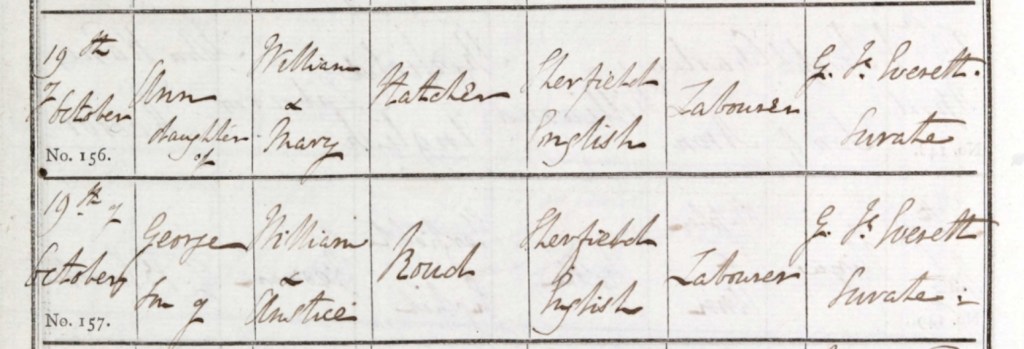
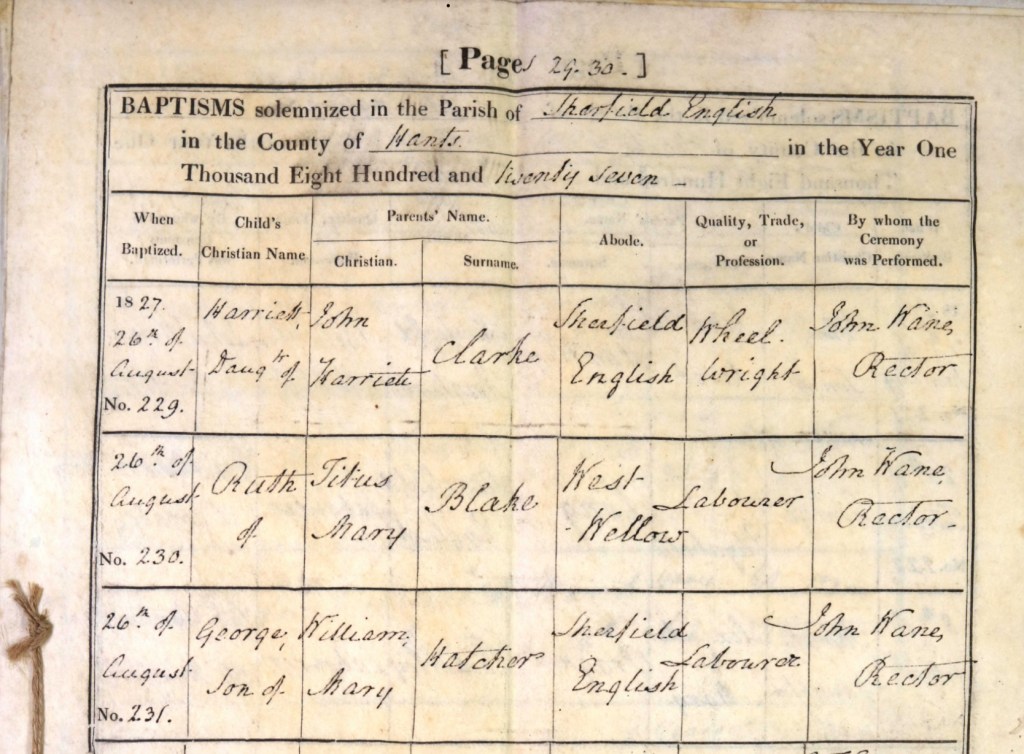
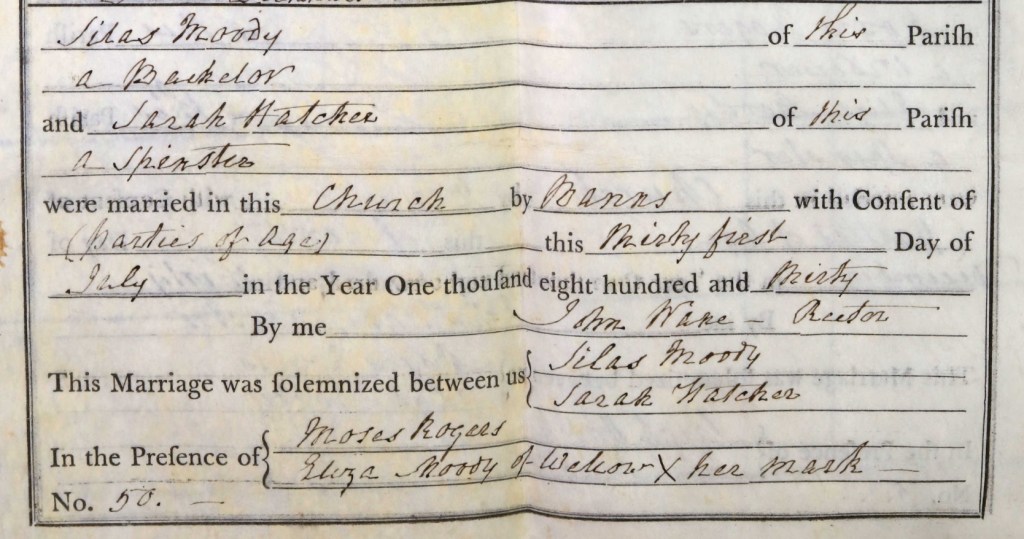
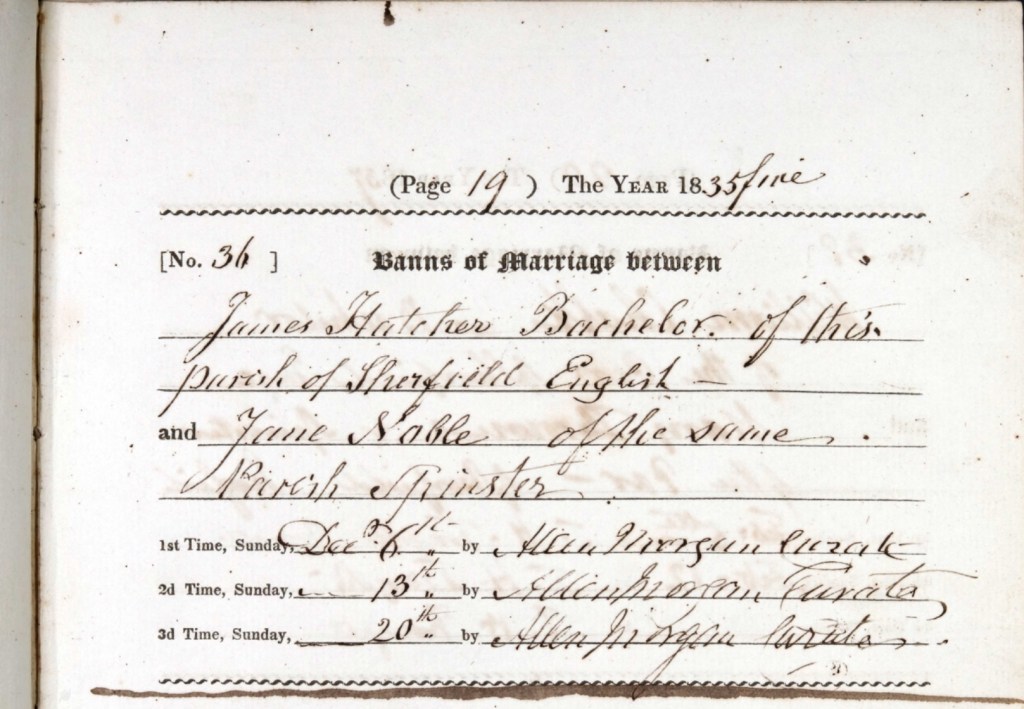
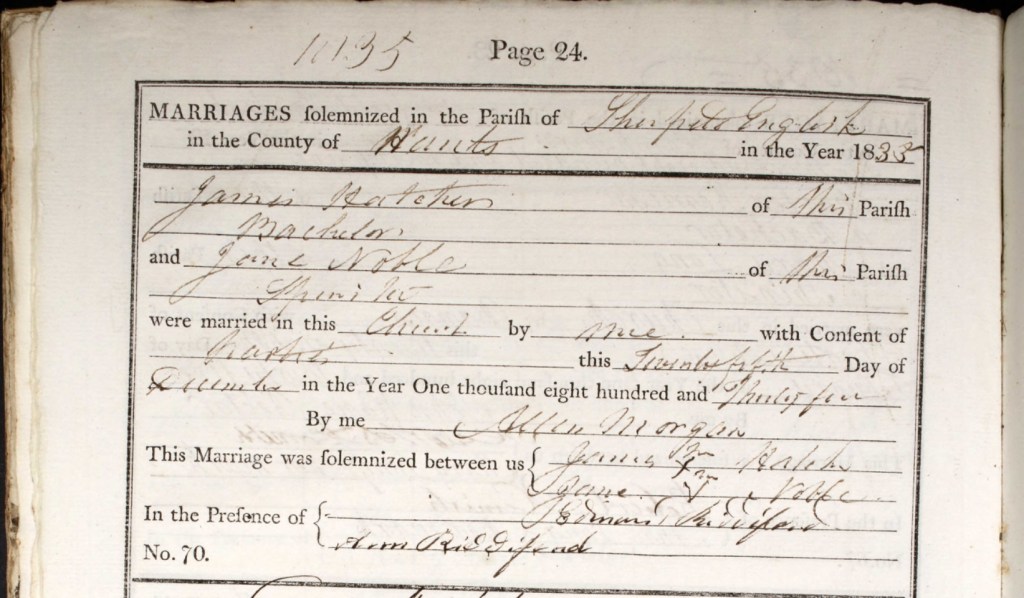
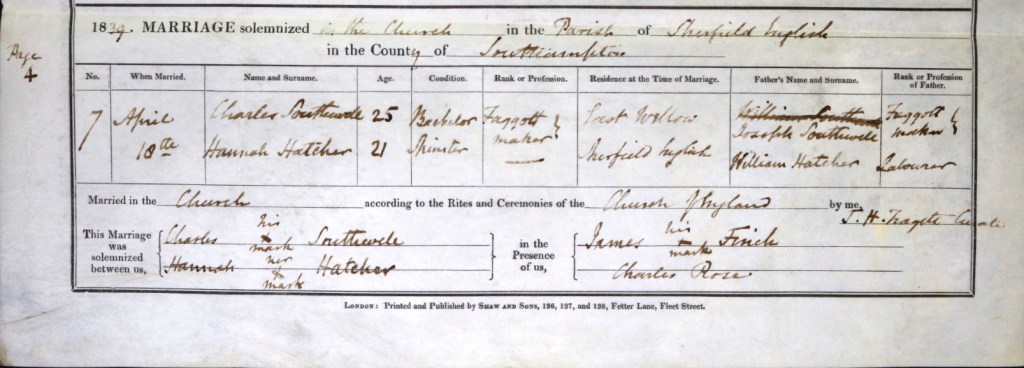
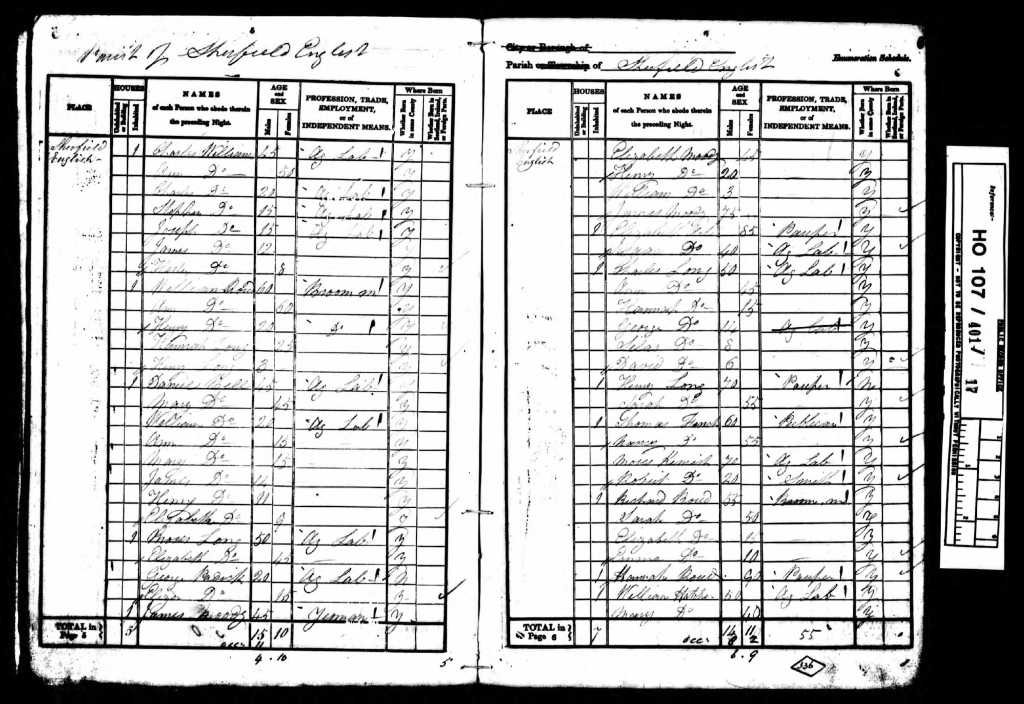
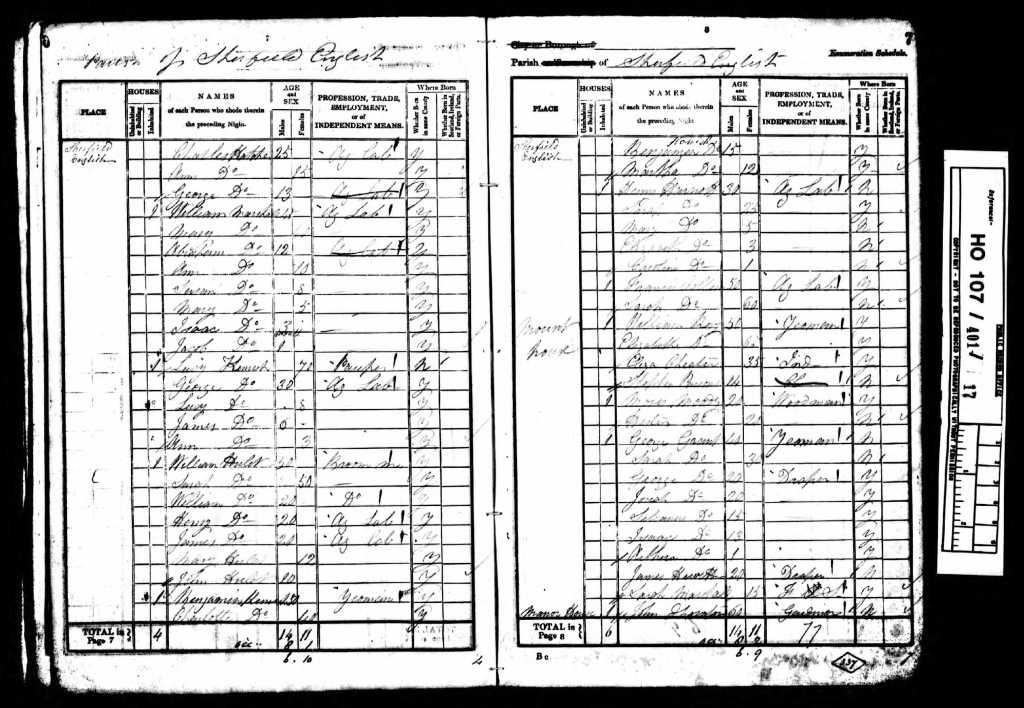
There are stories that whisper through the veins long before they are written down. They live in the marrow, murmured by the past, waiting for someone, some curious descendant, to lean close enough to listen. So begins my journey into the life of Charles Hatcher, my paternal third great-grandfather, a man whose existence flickers between ink-stained parish pages and the soft blur of memory long faded.
To uncover Charles’s story is to walk through the misted dawn of history itself, a time before the steady order of censuses and the neat declarations of birth, marriage, and death certificates. Back then, the record of a life was fragile and easily lost, pressed between the margins of parish ledgers where ink bled, pages crumbled, and handwriting wavered like the ghosts of the souls it sought to preserve. Each discovery feels like rescuing a heartbeat from the silence of centuries.
How strange and wondrous it is, to trace the fingerprints of one’s own spirit across such distant time. To realise that the same blood that once coursed through Charles’s hands, perhaps calloused by labor or trembling with hope, still hums quietly within me. In every document, every brittle scrap of history, I glimpse the rhythm of a man who lived, loved, worked, and dreamed within a world that had not yet learned to record its people with care.
This is not merely research, it is resurrection. A gathering of lost voices. A tender stitching-together of generations. For in seeking Charles, I seek not only him, but myself, the echoes of who I am, and who I come from.
And so, we begin…
Welcome back to the year 1814, Sherfield English, Hampshire, England. You find yourself in a world governed by King George III (though for many years his son the Prince Regent has carried out many of the royal functions, owing to the King’s ill health). The Prime Minister at this time is Robert Jenkinson, 2nd Earl of Liverpool, who has held office since 1812. In Parliament the political life is dominated by Tory leadership, war and peace, and concerns about social order after years of upheaval.
Social divisions are stark. The rich live in genteel comfort, often owning estates in the countryside, employing servants and enjoying access to goods and fashions from London and overseas. They dine on meats, game, imported wines, and fruits, and their homes are furnished with fine fabrics, china, and decorative objects. The working class, which includes agricultural labourers, artisans, and craftsmen, lives more modestly. Their food is simpler, bread, porridge, occasional meat or fish, vegetables, and maybe a small treat when they can afford it. Their clothes are practical, coarse fabrics, homespun cloth, sturdy boots or shoes, and every stitch matters. The poor, those without steady work or land, struggle by. They live in the most meagre dwellings, often in overcrowded and poorly built cottages or hovels, where hunger, cold, and disease are constant threats.
Fashion among the well-to-do is elegant but restrained by war and economic constraints. Men wear tailcoats, waistcoats, breeches or smallclothes (or the newer pantaloons for some), fine shirts, cravats, tight collars, and boots or shoes with buckles. Women’s dresses have high waists (the Regency style), light muslins, flowing skirts, simple lines, sometimes with shawls or spencers for warmth. Hats, gloves, and parasols are essential accessories when venturing outdoors. For the working and poor classes, fashion is more limited, durable woollen garments, homespun linen, cloaks or shawls, simple bonnets, and sturdy shoes.
Transportation is still largely by horse, carriage, cart or wagon, and on foot. Rural lanes may be muddy or rutted, making journeys slow and uncomfortable. In some parts of the country turnpike roads exist, maintained by tolls, improving connectivity. Canals and navigable rivers are vital for moving bulk goods such as coal, timber, grain, and building materials. The steam engine is emerging in industry, but railways are not yet pervasive.
Housing in Sherfield English and similar villages consists of cottages, farmhouses, perhaps a manor house. Thatched roofs are common, walls may be of timber, brick or cob, and rooms are few and often small. Floors might be packed earth, stone, or simple boards. There is no central heating; in the wealthier homes there are fireplaces in major rooms, with hearths of brick or stone and chimneys carrying smoke away. The working households and poor rely entirely on fireplaces, sometimes only one room heated, and much of the home is cold in winter.
Lighting is by candlelight, tallow candles for many, perhaps better-quality beeswax or spermaceti candles in wealthier homes. In very rare cases oil lamps may exist, but they are expensive and fragile. After sunset, homes are dim, and people limit tasks to essential reading or family duties by hearthlight.
Hygiene is rudimentary. Baths are rare; many go days, even weeks, without full washing. People wash their faces, hands, and some parts of the body using basins of water. Laundry is done with washboards, boiling water, lye, and soap made from animal fat and alkali. Sanitation is minimal. Cesspits, privies, or simple earth closets are used; waste is frequently dumped into rivers or ponds or into cesspits that may overflow. In villages like Sherfield English, foul smells plague some lanes, especially after rain.
Food is heavily seasonal and local. Fresh vegetables, pulses, grains, root crops, whatever grows locally. Meat is more a privilege, pork, beef, mutton, poultry when available. Fish where rivers or coasts are nearby. Bread, often coarse wholemeal or mixed, is a staple. Dairy, butter, cheese, eggs are common if one owns animals or rents from farms. Potatoes, cabbages, carrots, turnips, leeks, onions help fill out the diet. Preserving food by salting, smoking, pickling, drying is essential for the leaner months. Gardens, orchards, and hedgerow foraging supplement diets.
Entertainment is modest in a village. Locals gather for church, Sunday services and sermons often the central weekly event. People tell stories, sing hymns or ballads, sometimes host small dances or socials, visit neighbors, share news and gossip around the hearth. Literacy is not universal but increasing; those who can read might borrow a book or read pamphlets, letters, or religious tracts. Local fairs or markets are occasions for social gathering, barter, and talk.
Disease is ever-present. Smallpox, consumption (tuberculosis), typhus, fevers, dysentery, cholera (though outbreaks are more frequent later in the century) are dangers. Child mortality is high; many children die young from infections or poor nourishment. Medical knowledge is limited; surgeons and apothecaries offer remedies, bleeding and herbal cures are common, but many illnesses remain incurable. The life expectancy is low, many do not survive to old age.
The environment is rural and green. Fields, hedgerows, woodland and pasture define the landscape. Yet deforestation, enclosure of common lands, increased ploughing, sheep and cattle grazing change land use and ecology. Smoke from hearths drifts, and in towns the smell of tanneries, breweries, and trade may dominate. Rivers may be used for waste disposal, leading to local pollution.
Gossip is a vital social currency. News of births, marriages, misfortunes, discipline, local disputes, and behavior of the gentry or landowners is shared in the local alehouse, at church, by travelers. Because formal news media is less frequent in rural districts, rumors and word-of-mouth carry much weight.
Schooling is limited. Some villages have small schools or “dame schools” run by a literate local woman or teacher. Children learn basic reading, writing, arithmetic, and religious instruction (catechism). Many children must help in fields or at home and attend sporadically. For those with means, education in a nearby town or boarding school is possible.
Religion plays a central role. The Church of England is the established church; parish church services on Sundays are key social occasions. Churchyards, baptisms, marriages, burials, and seasonal festivals mark the year. Dissenting Protestant groups, Methodists, Baptists, Independents, are active in many parts, attracting those seeking more fervent worship or alternative fellowship. Faith is woven into everyday life: prayer, scripture, moral conduct are expected from all social classes.
Life in 18114 in Sherfield English is one of quiet rhythms and stark contrasts. People rise with morning light and toil in fields, tend barns, animals, gardens, cook by fire, pray, rest, and sleep early. The modern world is stirring beyond, as industrial machinery, science, and new ideas begin to alter the slow, traditional pattern of rural existence, but in many places, life still moves much as it did in centuries past.
It was the late spring, perhaps early summer, of the year 1814, when the gentle hills of Sherfield English, Hampshire, England, were embroidered with wildflowers and the air hummed with the promise of harvests to come. Inside a modest cottage, nestled among the hedgerows and meadows, Mary Hatcher, née Roud, prepared once more to bring forth new life. She was but twenty-two, her husband William Hatcher around twenty-seven, a steady man of the soil, his hands roughened by honest work, his heart anxious yet hopeful.
Mary had known childbirth before, her arms had already cradled Sarah and James, their laughter now echoing softly in the next room as William tended to them, but no experience could ever make labour easier. For in those days, birth was not a matter of science or sterile precision, but of courage, endurance, and the sacred sisterhood of women.
The room would have been dim, the shutters drawn to shield her from the curious light, the air scented with rushes and the faint smoke of the hearth. Around her, the women of her family and the neighbouring cottages gathered, midwife, sisters, perhaps her own mother, each offering murmured prayers, cool cloths, and hands to grip when the pain surged like a tide. There were no doctors, no instruments of comfort beyond faith and familiarity, only the rhythm of breathing, the whispered words of encouragement, and the sound of new life waiting to be heard.
And then, through pain and prayer and persistence, he came.
A baby boy, soft and wailing, his cry piercing the heavy air like sunlight breaking through clouds.
He was named Charles, a name that would carry through generations, down to me, his descendant, two centuries later.
The exact date of his birth has slipped quietly into the mists of time, lost among the unrecorded hours of village life. But the fragments that remain, the parish entries, the census returns, whisper to us what we can know.
In 1841, the record speaks of a man born around 1816 in Hampshire;
by 1851, it tells us more precisely, born in Sherfield English, about 1815.
So, somewhere between those gentle English summers of 1814 and 1815, Charles Hatcher took his first breath.
To imagine that moment is to glimpse a scene both fragile and profound, a mother’s courage, a father’s silent devotion, and a humble cottage that witnessed the beginning of a life that, generations later, would still be remembered.
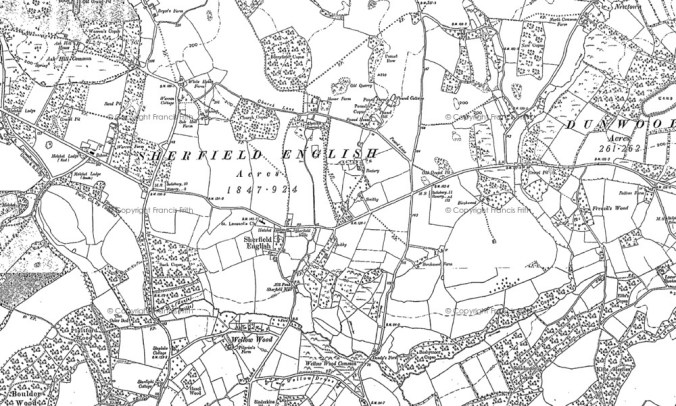
Sherfield English is a small village located in the Test Valley district of Hampshire, England. It lies just a few miles northwest of Romsey and is set within the picturesque Hampshire countryside, surrounded by farmland and natural beauty. The village has a rich history that spans several centuries and is deeply connected to the rural landscape of southern England.
The name "Sherfield" likely comes from Old English, where "scear" refers to a slope or hill and "feld" means open land or field, suggesting the village was established in an area with a prominent geographical feature. The addition of "English" to the name occurred later, distinguishing it from other similarly named places following the Norman Conquest of 1066.
Sherfield English's development can be traced back to the medieval period, when it was primarily a farming community. The village's history reflects the broader agricultural heritage of Hampshire. It grew slowly but steadily, with most residents engaged in farming and agricultural work, a typical occupation for rural England at the time. The village’s centerpiece was the parish church, St. Leonard’s Church, which has served as a spiritual and social center for the community for many centuries. The church, with its origins dating back to the 12th century, is a key focal point of the village and reflects its long religious history.
In the 19th century, Sherfield English, like many rural areas, began to see changes brought on by population growth and the rise of industrialization. While the village remained largely agricultural, the expansion of transportation networks, particularly railways, brought new opportunities for trade and communication. This period also saw the construction of several cottages and houses in the village, leading to an increase in population.
The architecture of Sherfield English retains much of its historic character, with a mix of old cottages and larger homes. Despite the growth of nearby towns, the village has managed to maintain its rural charm and peaceful atmosphere, remaining a quiet, residential area. Its location, just a short distance from Romsey, offers a blend of tranquility and accessibility.
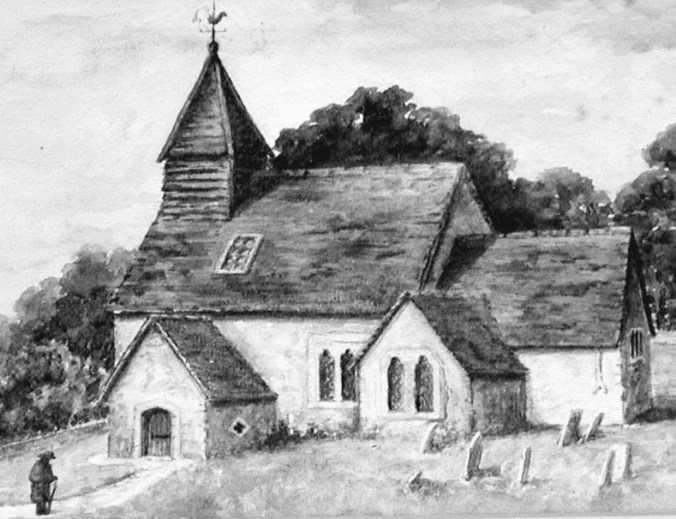
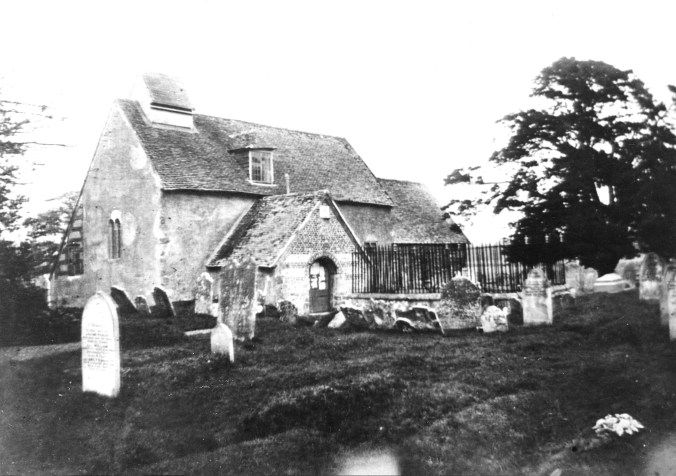
St. Leonard’s Church, at the heart of Sherfield English, has been integral to the community since its establishment. It was built in the 12th century, with subsequent renovations and expansions reflecting changing architectural styles and the evolving needs of the congregation. The church is dedicated to St. Leonard, the patron saint of prisoners and the mentally ill, and its role in the community has been central to the village's spiritual life. The churchyard around St. Leonard’s Church contains numerous gravestones, many of which date back several centuries, and the church remains an active site for worship, weddings, and other community events.
Sherfield English is also steeped in local folklore, and like many historic English villages, it has its share of ghost stories and rumored hauntings. St. Leonard’s Church, with its long history, is often the focal point of these tales. Some locals have reported strange occurrences in and around the churchyard, such as the sensation of being watched or hearing unexplained sounds like distant footsteps or murmurs. There are also stories about church bells ringing at night without anyone in the building to ring them, adding to the eerie reputation of the church. While these accounts remain largely anecdotal, they contribute to the village’s sense of mystery and intrigue.
In addition to the church, other old buildings in the village, such as historic houses and inns, are also said to be associated with ghostly activity. Some residents have claimed to see shadowy figures in certain rooms or have experienced cold drafts in areas of these older properties. These stories, while not officially documented, persist as part of the village's folklore and add to the character of Sherfield English.
Today, Sherfield English remains a picturesque and peaceful village, with a small but active community. The surrounding countryside offers opportunities for outdoor activities such as hiking, cycling, and birdwatching, making it an attractive location for those seeking a rural lifestyle while still being close to Romsey and other nearby towns. The village's historical charm, combined with its natural beauty and connection to local traditions, continues to make it a unique place to live and visit.
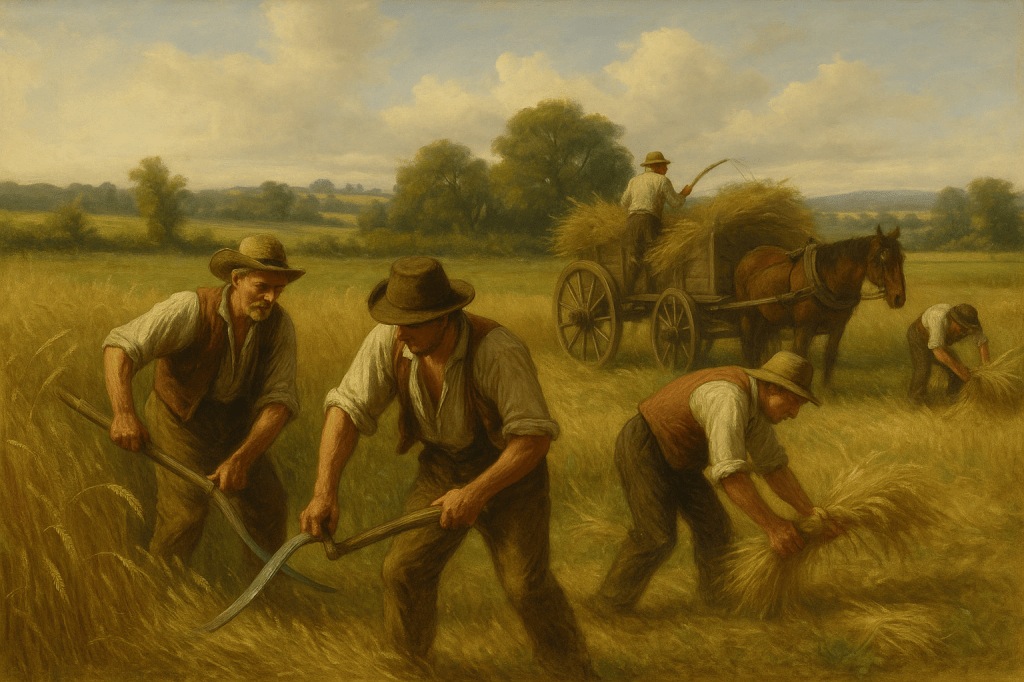
Life in the quiet Hampshire village of Sherfield English moved with the unhurried rhythm of the seasons, a rhythm that pulsed through every field, every cottage, every heart that called the land home. The summer of 1814 was warm and fragrant, the scent of cut hay mingling with woodsmoke, the low murmur of bees threading lazily through the wildflowers that bowed in the hedgerows. It was a world held in harmony, the living and the eternal woven together in quiet grace.
On Sunday, the 3rd day of July, the bells of Saint Leonard’s Church broke through the stillness, their tones soft yet sure, calling the faithful to worship. The sound drifted across meadows and thatched rooftops, settling like a benediction upon the little Hatcher home. Inside that humble cottage, Mary gathered her infant son Charles, close to her heart, wrapping him in the finest cloth they owned, perhaps a simple shawl passed down through her family. Her husband William, steady and proud though marked by the rough work of his hands, stood ready to walk beside her.
That morning, the couple made their way along the worn lane toward the church, the same path generations had walked before them for christenings, weddings, and burials. The church itself, St. Leonard’s, was centuries old even then, its stones cool and pitted with age, its interior faintly perfumed with beeswax and damp earth. Sunlight streamed through small, colored panes, dancing across the ancient font, the vessel that had welcomed countless souls into the fold of faith.
The baptism was no grand affair, no lavish ceremony with gowns or gilded vessels. It was a simple Sunday service, shared with neighbours and kin, yet it bore the profound weight of continuity, of belonging. The Reverend John Wane, familiar to the Hatchers and Rouds, stood before the congregation, his voice steady with the cadence of ritual:
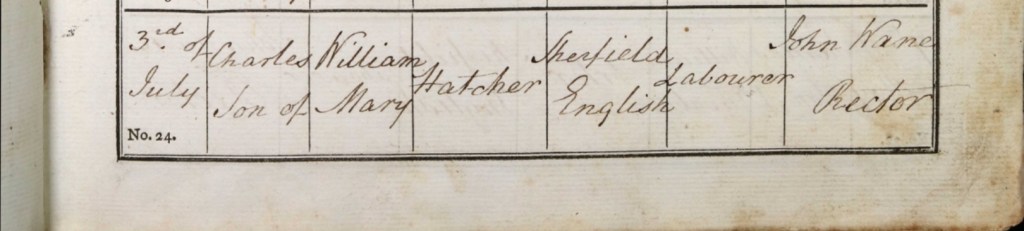
“Charles, son of William and Mary Hatcher, of Sherfield English, labourer.”
The words echoed softly through the nave, inscribed not only in the parish register but into the very heart of family memory. In the register of baptisms for 1814, the record remains:
When Baptised: 3rd July — No. 24

Child’s Christian Name: Charles

Parents’ Names: William and Mary Hatcher

Abode: Sherfield English

Quality, Trade, or Profession: Labourer

By Whom the Ceremony Was Performed: John Wane, Rector.
How modest the entry appears on the page, and yet how deeply it speaks. That single word, “Labourer,” carried the story of a man who worked the soil, who rose with the dawn and rested when the light failed, who gave what strength he had to his family and his faith. To Mary, that day marked not just the naming of her son but the sacred offering of his life into the care of God, a moment of grace and of surrender.
The cool touch of holy water upon Charles’s brow would have been followed by a hush, a shared breath between heaven and earth. A candle flickered. The font’s water rippled. And in that fleeting instant, a soul was bound to both the eternal and the earthly, a covenant written not only in ink but in love.
Though Charles was born into modest means, he began his life surrounded by abundance of a different kind, faith, family, and belonging. His baptism was his first step into the unbroken rhythm of his parish, the same rhythm that beats, still, in the hearts of those who remember him.
More than two centuries later, that simple record, Entry No. 24 speaks across the ages. It is more than a line in a ledger, it is a heartbeat, faint yet enduring. It tells me that once, on a soft July morning in 1814, a young mother cradled her child beneath the ancient bells of Sherfield English, and through her hands, through her love, began a story that would one day lead to mine.
Saint Leonard’s Church in Sherfield English, Hampshire, has a rich history that stretches back over many centuries. The church has been a central part of the village’s religious and community life, and its history reflects the broader development of the area from medieval times to the present. The original Saint Leonard’s Church is believed to have been built in the early medieval period, likely during the Norman era, around the 12th century. The church would have been a simple structure, typical of rural churches of the time. As was common with churches in small villages, it was likely constructed with local materials such as stone and timber, with a simple design reflecting the needs of the local community. The church was dedicated to Saint Leonard, a popular saint during the medieval period who was often invoked for protection and for his association with prisoners and captives. Saint Leonard’s cult was widespread across England, and many churches were named in his honor. The original church at Sherfield English served as a focal point for the small agricultural community, providing a place for worship, social gatherings, and important life events such as baptisms, marriages, and funerals. The church would have also been a place where the villagers came together for communal activities, and it played an essential role in maintaining the spiritual and social fabric of the community. Over time, the church likely underwent several modifications and additions, particularly in the 14th and 15th centuries, as the village expanded and the needs of the local population grew. These changes were likely driven by the growing wealth of the parish as the agricultural economy strengthened. In the 19th century, however, the old church began to show signs of wear and was no longer able to adequately serve the growing population of Sherfield English. By the early 1800s, the church building had become dilapidated and was deemed inadequate for the needs of the parish. At this point, the decision was made to construct a new church to better serve the community. The new Saint Leonard’s Church was built in 1840, a year that saw the completion of many church restoration projects across rural England, driven in part by the Victorian era’s focus on reviving medieval architectural styles. The new church was built on a site adjacent to the old church, though some sources suggest that it may have been on the same footprint or nearby. The architect responsible for the design of the new church was likely influenced by the popular Gothic Revival style of the time, which was characterized by pointed arches, stained-glass windows, and spires. The new church was intended to accommodate the needs of the growing population of Sherfield English, and it was designed to be larger and more architecturally impressive than its predecessor. The construction of the new church was part of a broader trend of church building and restoration during the Victorian period, a time when many rural churches were being rebuilt or restored to reflect the prosperity of the period. The old Saint Leonard’s Church, after the new one was completed, was demolished, as was often the case with churches that were deemed structurally unsound or inadequate for modern use. It is common for older church buildings to be torn down when a new structure is built, particularly if the old building no longer meets the needs of the local population or has fallen into disrepair. It is likely that the materials from the old church were repurposed for the new construction, as was the custom at the time, though no records have definitively confirmed this. Today, Saint Leonard’s Church stands as a beautiful example of Victorian church architecture, with its stained-glass windows, pointed arches, and graceful tower. The church continues to serve the community, offering regular worship services, community events, and providing a space for reflection and connection. The church is also known for its picturesque setting within the village, surrounded by well-kept churchyards and the rolling countryside of Hampshire. The new church, while a product of the 19th century, retains the essence of the old church’s purpose to serve as a spiritual hub for the village of Sherfield English.
The surname Hatcher is of English origin and carries with it a long and fascinating history that dates back to the Middle Ages. It is primarily an occupational or locational name, deriving from the Old English word “hæcc” or “hacca,” meaning a gate, hatch, or wicket, combined with the suffix “-er,” which denotes a person associated with a place or occupation. In this case, a Hatcher would likely have been a keeper of a gate or someone who lived near a hatch gate, often a type of gate across a river or drainage channel used to control water flow. This origin ties the name to the rural and agricultural life of medieval England, when land, water, and farming shaped both livelihoods and identities.
The earliest recorded forms of the surname appear in southern England, particularly in counties such as Wiltshire, Hampshire, and Somerset. One of the earliest known references to the name is found in the 13th century, when individuals bearing the name “le Hatcher” were recorded in various tax and manorial rolls. The name appears in several forms through history, including Haccher, Hatchar, and Hachere, before settling into the modern spelling of Hatcher. It is possible that some bearers of the name also came from villages with “Hatch” in their names, such as West Hatch in Somerset or Hatch in Wiltshire, making it partly locational as well.
As families began to establish themselves, the Hatchers became more prominent in Hampshire and neighboring counties. During the 16th and 17th centuries, records show Hatcher families involved in farming, trade, and later in parish and civic roles. By the time of the 19th century, the name had spread more widely across England and beyond, particularly to the United States, where several early settlers named Hatcher arrived in Virginia and New England during the colonial period. Many of these emigrants were from southern English counties, carrying their family name and traditions across the Atlantic.
The English Hatcher family crest and coat of arms reflect the symbolism common in heraldry of the gentry and freeholders of the late medieval and early modern periods. The most widely recognized Hatcher coat of arms depicts a shield featuring three hatches or bars arranged across its surface, often rendered in silver and black or red, representing strength, protection, and steadfastness. Some versions of the arms include a chevron, symbolizing protection and faithful service, or a lion, representing courage and loyalty. Above the shield, the crest commonly features a bird, often a falcon or dove, denoting peace and resolve. The family motto associated with certain branches of the Hatcher family is sometimes given as “Ad Finem Fidelis,” which translates as “Faithful to the end,” a phrase that encapsulates the steadfast nature of the family’s heritage.
Heraldic designs varied slightly depending on branch and region, as coats of arms were often granted to specific individuals rather than to entire surnames. However, all versions of the Hatcher arms share a sense of dignity and craftsmanship typical of English heraldry of the period.
In summary, the surname Hatcher is an old English name rooted in agricultural and rural traditions, likely born from the role of gatekeepers or those living near hatch gates. It has been present in southern England for over seven centuries, particularly in Hampshire, Wiltshire, and Somerset. The Hatcher coat of arms, with its heraldic imagery of strength and loyalty, stands as a visual symbol of an enduring English lineage tied closely to the land and its communities.
The forename Charles has a distinguished and ancient lineage, tracing its origins deep into the early history of Europe. It derives from the Old High German name Karl or Carl, which means “man” or “free man.” The meaning carried strong connotations of independence, courage, and strength, qualities highly prized in early Germanic and Frankish societies. From these roots, the name spread widely across the continent through the influence of one of history’s most famous rulers, Charlemagne (Charles the Great), who lived from 742 to 814. As King of the Franks and later Emperor of the Holy Roman Empire, Charlemagne united much of Western Europe under his reign and became a symbol of Christian kingship and imperial authority. His Latinized name, Carolus Magnus, gave rise to forms of Charles in many languages and ensured the name’s enduring association with leadership and nobility.
In England, the name Charles came into greater prominence after the Norman Conquest of 1066, as Norman culture and naming traditions began to influence the Anglo-Saxons. However, it was not until the Stuart dynasty that the name became truly royal and widely fashionable. Charles I, who reigned from 1625 until his execution in 1649, and his son Charles II, restored to the throne in 1660, brought the name to the forefront of English public life. Charles II, known as the “Merry Monarch,” was a particularly charismatic and well-loved figure, and his reign helped to give the name a lasting popularity among the English people.
Throughout the centuries, Charles has been borne by many monarchs, nobles, writers, and thinkers across Europe. In France, the name became almost synonymous with kingship, with numerous monarchs named Charles, including Charles V and Charles IX. In Scotland and Ireland, it carried Jacobite associations through Charles Edward Stuart, the “Bonnie Prince Charlie,” whose romantic but ill-fated attempt to reclaim the throne in 1745 left a lasting mark on British history and culture.
The name Charles has remained consistently popular through the centuries. Its shortened forms, such as Charlie, Chas, and Chuck (the latter particularly in American English), have given it an easy familiarity that coexists with its regal associations. The feminine form, Charlotte, also became widely used, especially in royal and aristocratic families.
In literature and the arts, Charles has often been the name of notable figures and fictional characters, lending it a sense of stability and intellect. Charles Dickens, one of England’s greatest novelists, gave the name an enduring literary dignity, while figures like Charles Darwin brought it scientific prestige.
The name’s appeal lies partly in its versatility. It is both simple and dignified, equally suited to kings and commoners. Its meaning, “free man,” reflects a timeless ideal of personal independence and moral strength, and its long association with leadership, faith, and culture has kept it alive across languages and generations.
Today, Charles remains one of the most classic and enduring of English names, carried by King Charles III of the United Kingdom, whose accession in the twenty-first century continues a royal legacy stretching back over a thousand years. The name’s combination of strength, tradition, and warmth ensures that it retains its place among the most respected and well-loved given names in the English-speaking world.
The year 1816 dawned cold and silver across the Hampshire countryside. Frost clung to every hedgerow, each blade of grass glimmering like glass beneath a pale winter sun. The land seemed hushed, caught between breath and prayer, a stillness that would soon cradle both sorrow and remembrance.
In the quiet parish of Mitchelmersh, a gentle soul took her final rest. Charles’s grandmother Tabitha Hatcher (née Gardiner), aged sixty-five, the beloved wife of Joseph Hatcher and mother to seven children, slipped from this world in the early days of January. She had weathered many seasons of life, both harsh and tender, and her heart had known its share of ache and endurance. Two of her children, Joseph and little Tabitha, had preceded her into the silence of the grave, losses that no mother’s heart can ever quite heal from. Yet through her grief, she had carried on with grace, tending to her home, her husband, and the living with steadfast love.
The details of her final days are lost to time, no record of illness, no physician’s words, no cause inked upon the parish page. But her absence would have been felt in every corner of that small Hampshire village. The familiar rhythm of her footsteps, the soft murmur of her prayers, the warmth of her presence by the hearth, all would now live only in memory.
To her grandson Charles Hatcher, then just a child of barely two years, she would have been a quiet figure of comfort and kinship, though he may not have remembered her in later years. Yet something of her spirit, her resilience, her deep-rooted steadiness, must have passed into him, for such qualities do not vanish with the body. They travel, unseen, through the generations, folded into blood and bone, carried in the heartbeat of every descendant.
Tabitha’s life, though lived in modest obscurity, was part of the great, invisible fabric that binds one life to another. She was born of the old England, the one of candlelight and spinning wheels, of faith unshaken by hardship. And in her passing, she left behind more than a family, she left a legacy of endurance, a quiet strength that would one day echo in the life of her grandson Charles, and in those who would follow him.
The frost that covered the fields that winter may have melted with the turning of the sun, but the memory of Tabitha Hatcher endures, not in monuments or records, but in the living breath of those descended from her. Through them, she still walks the lanes of Hampshire, eternal and remembered.
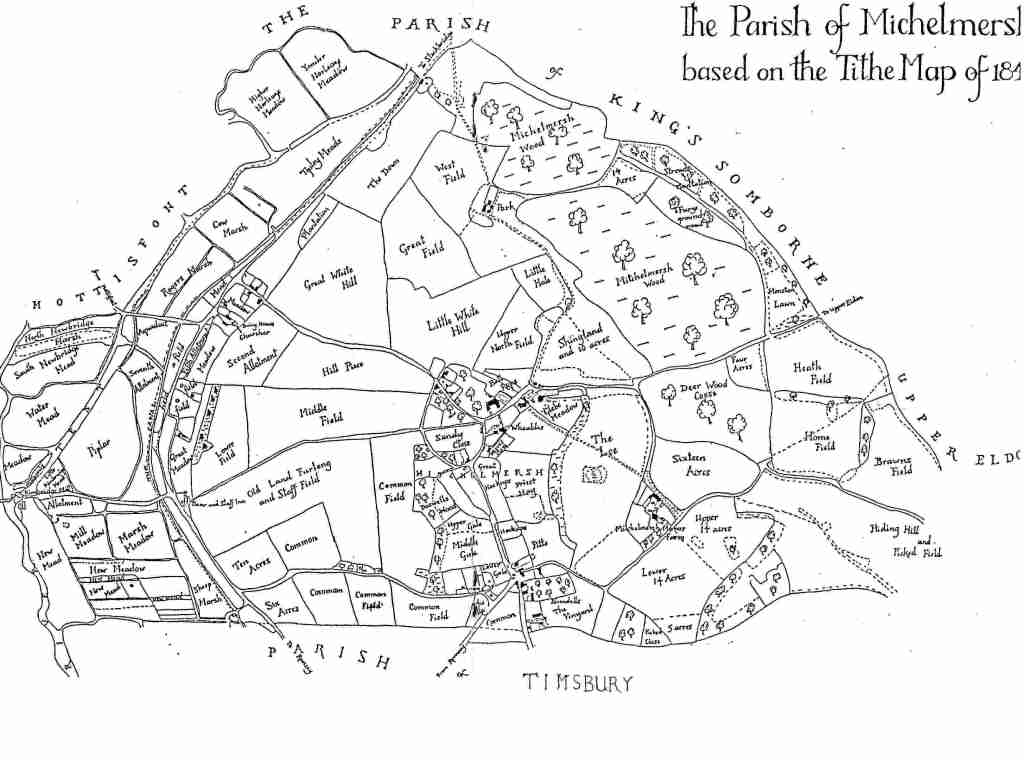
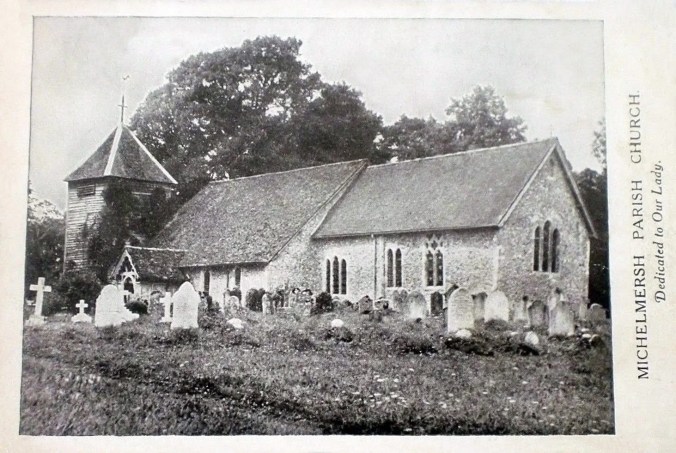
Michelmersh, a small village located in Hampshire, England, lies in the picturesque Test Valley, an area known for its rural charm and natural beauty. The village is steeped in history, and its development has been closely tied to the agricultural heritage of the region. Though it is now a quiet village, Michelmersh’s roots go back to medieval times, and its story is one of gradual transformation from a rural settlement to a part of the modern Hampshire landscape.
The origins of Michelmersh can be traced to the Saxon period, when it was likely a small agricultural settlement. The name "Michelmersh" is believed to derive from Old English, with "Michel" meaning "great" and "mersc" referring to a marsh or wetland area. This suggests that the village may have been originally located near marshy ground or a significant water source, an aspect that likely influenced its early settlement and development.
During the medieval period, Michelmersh was part of a larger manor system that was prevalent in England. The village was connected to the wider network of agricultural estates that characterized much of England at the time, with its economy largely based on farming, particularly the cultivation of crops and the raising of livestock. The presence of a local church, St. Mary’s Church, would have been central to village life during this period, serving as both a spiritual center and a communal gathering place.
In the Domesday Book of 1086, which recorded a detailed survey of England commissioned by William the Conqueror, Michelmersh is mentioned as part of the land held by the Norman lords. The records from this time show that the village, like many others, was a small yet thriving agricultural community, though it would have been under the control of a local lord. Over the centuries, the land would pass through the hands of various noble families, contributing to the shaping of the village's future.
During the 16th and 17th centuries, Michelmersh, like much of rural England, experienced significant changes as the English economy shifted. The rise of enclosed farming and the increasing importance of trade and commerce during the early modern period altered the social and economic fabric of many rural communities. Michelmersh saw the construction of larger homes and farmsteads, and as agriculture remained a cornerstone of village life, there was a growing emphasis on improving farming methods and land management.
The 18th and 19th centuries brought further transformations to Michelmersh, particularly with the onset of the Industrial Revolution. While the village itself remained largely agricultural, nearby towns like Romsey began to experience industrial growth. The arrival of the railway in Romsey, for example, contributed to changes in trade and transportation, which in turn affected rural areas like Michelmersh. During this period, the village remained a peaceful and rural community, though it likely saw an increase in population as people sought work in nearby towns or on larger farms.
The 20th century brought more changes to Michelmersh, especially as rural communities like it began to adapt to the demands of modern life. Agriculture continued to be an important part of the local economy, but the development of modern roads, schools, and social services allowed for better integration into the growing town networks. The construction of new homes and the expansion of residential areas saw Michelmersh become a part of the broader Romsey area, although it retained its character as a small village.
Today, Michelmersh is a quiet residential area that still holds much of its historical charm. Many of the original buildings, including the church, have been preserved, and the village is surrounded by farmland and open countryside, contributing to its appeal as a rural retreat. The local population is small, but the community remains active and engaged, with many residents valuing the village's historical connections and its peaceful surroundings.
Michelmersh’s location in the Test Valley ensures that it continues to benefit from the natural beauty of the area, with the River Test flowing through the region and providing opportunities for outdoor activities such as walking, cycling, and fishing. The village’s historical roots in agriculture continue to be a significant part of its identity, even as it has become more residential in character.
Winter lay heavy upon the Hampshire countryside. Frost glistened upon the hedgerows like lacework spun by invisible hands, and the hush of January seemed to still even the song of the blackbirds. Along the narrow lanes of Sherfield English, friends and kin made their way beneath a pewter sky, their breath rising like faint prayers in the cold morning air. They came to say farewell to honour one who had walked among them in quiet grace and steadfast faith.
On Sunday, the 7th of January 1816, within the hallowed grounds of Saint Leonard’s Church, the earth opened to receive another of its own. Tabitha Hatcher, aged sixty-five, grandmother to young Charles, was laid to rest. Though her abode was recorded as Michelmersh, a neighbouring village nestled amidst the fields and winding brooks of Hampshire, her final journey brought her home to Sherfield English, the place where, it seems, so many of her life’s chapters had been written.
Little remains beyond the inked lines of the parish register, her name, her age, her dwelling, the date of her burial. Yet even these few words breathe of a woman who endured much and gave more. To have lived sixty-five years in a world where so few saw half that number was itself a quiet triumph. One imagines her as a woman of resilience and faith, a mother of seven, who had known both joy and sorrow, having buried her own children Joseph and Tabitha before her time came. Through war and peace, through harvest and hunger, she would have stood steady, shaped by the same earth her family tilled, her days bound to the rhythm of prayer, labour, and love.
Presiding over her final farewell was Reverend John Wane, the same faithful rector who had marked the baptisms, marriages, and departures of so many Hatchers and Rouds before her. His voice, solemn and familiar, rose beneath the ancient beams of Saint Leonard’s, carrying the words of committal into the still winter air. The parchment bears his careful hand:
BURIALS in the Parish of Sherfield English, in the County of Hants, in the Year One Thousand Eight Hundred and Sixteen

Entry No. 11

Name: Tabitha Hatcher

Abode: Michelmarsh, Hants

When Buried: January 7th, 1816

Age: 65

By Whom the Ceremony was Performed: John Wane, Rector.
A simple record, yet within its restraint lies a profound story, of endurance, of faith, of quiet belonging. Entry No. 11 was the final benediction for a life lived honestly and humbly, a life that had helped shape the generations to come. Beneath the old tower of Saint Leonard’s, where moss crept over weathered gravestones and the yew trees whispered to the wind, Tabitha found her rest.
There, in that sacred Hampshire soil, her story became one with the land itself, her love, her labour, her laughter now part of the parish she once walked. Perhaps little Charles, not yet two years old, was held in his mother’s arms that morning, unaware of the farewell unfolding around him. And yet, in the unseen ways that blood remembers, something of Tabitha’s spirit, her quiet courage, her gentle endurance, would take root within him, flowing through time and lineage until it reached me.
Tabitha Hatcher’s grave may bear no grand monument, no carving to tell her tale, but her legacy endures in the pulse of those who follow. Beneath the grey January sky of 1816, as the final clods of earth fell softly upon her resting place, the story of the Hatcher family deepened, and through that story, her memory continues to live.
St. Mary’s Church in Michelmersh, Hampshire, is a beautiful and historic parish church that has played a central role in the spiritual and community life of the village for many centuries. Located in the peaceful countryside of Hampshire, St. Mary’s Church serves as an important landmark and is deeply connected to the village’s history and its people.
The history of St. Mary’s Church dates back to medieval times, with the first references to the church appearing in documents from the 12th century. The church was likely built during the Norman period, though there have been many modifications and restorations over the centuries, reflecting the changing architectural styles and the needs of the community. Like many churches in rural England, St. Mary’s would have served not only as a place of worship but also as a central gathering point for the village, hosting baptisms, marriages, and funerals.
The architecture of St. Mary’s Church is an example of the typical styles seen in rural churches of this era. The building is constructed from local stone, and its design has been influenced by both Romanesque and Gothic architectural styles. The church features a simple yet elegant structure, with a nave, chancel, and tower. The tower, which would have served as a symbol of the church’s prominence in the village, is an important feature of the church’s exterior. Over the centuries, the church has undergone various renovations and extensions to meet the needs of the growing population, but its fundamental design has remained faithful to its original structure.
One of the key periods in the history of St. Mary’s Church came in the 19th century when many churches were restored or rebuilt under the guidance of architects and scholars of the time. During this period, St. Mary’s underwent significant restoration work, likely driven by the Victorian-era passion for restoring medieval churches. This restoration would have focused on preserving the architectural integrity of the church while adding new elements to accommodate the expanding congregation. The addition of stained-glass windows, the improvement of the interior furnishings, and the enhancement of the church’s acoustics were likely part of this restoration process, reflecting the era's fascination with Gothic Revival architecture.
The churchyard surrounding St. Mary’s Church is also an integral part of its history. Like many rural churches in England, the churchyard is the final resting place for many generations of the village’s residents. The graves and memorials found in the churchyard are a testament to the people who lived in Michelmersh throughout the centuries, offering a glimpse into the village’s past. Some of the gravestones are centuries old, and their inscriptions and symbolism provide valuable insights into the local history and the families who lived in the area. The churchyard also serves as a peaceful place for reflection and a reminder of the deep connection between the village and its church.
St. Mary’s Church has continued to play a central role in the life of Michelmersh. The church still holds regular services, including Sunday worship, weddings, baptisms, and funerals, serving as a focal point for the spiritual life of the community. The church is not only a place of worship but also an important cultural and social center for the village. It is a place where the community gathers for events, celebrations, and activities that bind the people together. The church has also hosted special events, such as concerts and festivals, which have helped bring the community together and allow people to celebrate their shared heritage.
In terms of local folklore and rumors of hauntings, St. Mary’s Church, like many historic churches, has been the subject of occasional ghost stories. While there are no widely documented or well-known accounts of hauntings, it is common for older buildings, particularly churches, to inspire tales of supernatural occurrences. The church’s long history and its connection to the lives of the people of Michelmersh provide a natural backdrop for such stories. The churchyard, with its centuries-old graves, might contribute to an eerie atmosphere, especially in the stillness of the early morning or evening. However, these tales are generally passed down through generations and are part of the local folklore rather than established facts.
The year was 1816, and though winter still lingered upon the fields of Sherfield English, there was warmth within the humble cottage of William and Mary Hatcher. The hearth glowed softly, its flame flickering against the rough-hewn beams, while outside, the countryside stirred beneath a sky of pale pewter. Life moved in steady rhythm, the lowing of cattle, the whisper of wind through bare branches, and the quiet faith of those who called this place home.
It was in this tender stillness that Charles’s mother Mary brought forth another life into the world, her fourth child, a daughter they would name Hannah. At twenty-seven, Mary had known both the pain and the miracle of birth before, yet each new child felt like the first, a wonder all its own. As she cradled her newborn daughter against her breast, she felt that familiar swell of love, fierce and protective, mingled with gratitude. Around her, the comforting hum of the women who helped, perhaps a sister, a neighbour, or the village midwife, filled the room with quiet purpose.
By her side stood Charles’s father William, now about thirty-one, his roughened hands folded, his eyes softened by pride. He was not a man of wealth or grandeur, merely a labourer, as the records would one day write, but within that title lay the story of devotion, of sweat given freely for the sake of those he loved. Together, Mary and William had already built a small world of their own, Sarah, their eldest, James, lively and curious, and Charles, still only a child, perhaps toddling by the hearth when his sister’s first cry filled the air.
Though Hannah’s exact date of birth has slipped quietly into the folds of history, her baptism in 1816 stands as a gentle marker of her arrival, a moment preserved in ink, even as time blurred the edges. The census records that followed tell us fragments of her truth:
In 1841, her birth is listed as around 1821,
In 1851, she is said to have been born in 1815,
And in 1861, 1881, and 1891, her birthplace remains faithfully recorded as Sherfield English, her birth year hovering somewhere between 1815 and 1821.
These small inconsistencies, those shifting numbers across the decades, are the echo of human memory, the soft imprecision of a world before paperwork defined our stories. Yet through them, we glimpse the constancy of place, the steadfast root that anchored the Hatcher family to this Hampshire soil.
For Mary and William, the birth of Hannah was a renewal of joy, another bright thread woven into the growing tapestry of their family. Their home, though humble, would have been alive with laughter and life: children’s voices tumbling through the air, the smell of fresh bread mingling with the smoke from the hearth, and the quiet prayers of a mother who asked for little more than health, warmth, and the safety of her brood.
As the years unfolded, Hannah would grow up among the hedgerows and fields of Sherfield English, her bare feet chasing the same paths her father once walked to work, her laughter mingling with the same church bells that rang the hour of her birth. She would learn the virtues that defined the Hatchers, hard work, faith, and quiet perseverance, and carry them through her own life.
Though the precise moment of her first breath has been lost to time, the essence of that morning remains, a mother’s love, a father’s pride, and a new heartbeat joining the chorus of generations. And through that moment, long ago in 1816, another thread was spun into the great fabric of Hatcher history, a fabric that still warms the hands of those who reach back, even now, to remember.
The village of Sherfield English was stirring gently into summer, the air sweet with the scent of meadows and the hum of bees drifting lazily over the hedgerows. On Sunday, the 2nd day of June, 1816, beneath a tender sky brushed with early warmth, the Hatcher family made their way along the familiar path that led to Saint Leonard’s Church. The soft tolling of its ancient bell carried through the Hampshire air, a sound as constant as the seasons, calling its people home to prayer.
There walked William and Mary Hatcher, steady and devout, their small procession a portrait of humble grace. At their sides were the children, Sarah, bright-eyed and growing fast, James, curious and restless, and little Charles, now a spirited boy of two, clinging to his mother’s skirts as the family neared the church steps. In Mary’s arms rested their newest blessing, their newborn daughter, Hannah, swaddled in cloth and drowsy from the morning’s warmth. Her tiny heart beat softly against her mother’s breast, unaware that this day, this sacred act, would bind her name to history.
The stone walls of Saint Leonard’s, cool and timeworn, had witnessed the Hatchers many times before, at their vows, at baptisms past, and in the quiet rhythm of worship that marked the turning of their lives. Within those ancient walls, beneath beams darkened by centuries of smoke and song, Mary and William stood once more before the baptismal font. The air smelled faintly of beeswax, wood polish, and damp stone, the scent of faith made tangible.
Here, their daughter Hannah was brought forward, a child of simple birth, yet rich in the inheritance of love and lineage. Her father, William, listed in the parish register as a Labourer of Sherfield English, stood tall and silent, the weight of his calling visible in his hands, roughened by the soil and seasons. Her mother, Mary, radiant in quiet endurance, held the infant close before gently surrendering her to the font, a mother’s first act of faith, entrusting her child to God’s keeping.
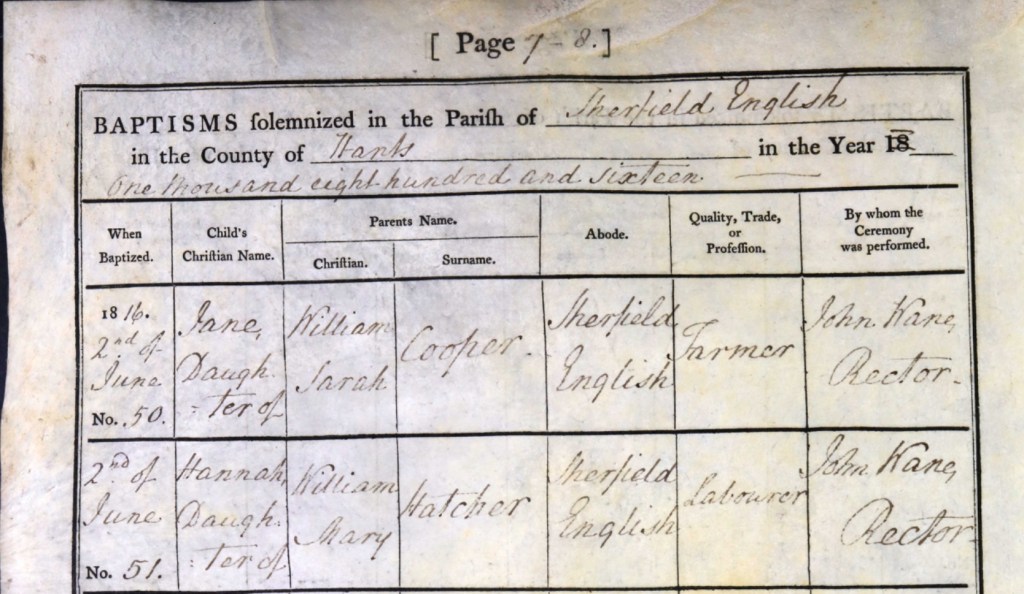
The ceremony was performed by Reverend John Wane, the steadfast Rector whose ink had long traced the milestones of this village’s people, their births, unions, and farewells. On this early summer day, his calm voice filled the church, reading the names that would endure upon the page. Hannah’s baptism followed that of another child, Jane Cooper, daughter of a local farmer, and for a moment the lives of labourer and landholder were united in sacred equality, both daughters, both beloved, both received as one in the eyes of Heaven.
From that day’s service, the register was carefully inscribed in Reverend Wane’s steady hand:
BAPTISMS solemnized in the Parish of Sherfield English in the County of Hants in the Year One Thousand Eight Hundred and Sixteen
Entry No. 50

When Baptized: 2nd of June, 1816

Child’s Christian Name: Jane

Parents’ Names: William & Sarah Cooper

Abode: Sherfield English

Quality, Trade, or Profession: Farmer

By whom the Ceremony was performed: John Wane, Rector
Entry No. 51

When Baptized: 2nd of June, 1816

Child’s Christian Name: Hannah

Parents’ Names: William & Mary Hatcher

Abode: Sherfield English

Quality, Trade, or Profession: Labourer

By whom the Ceremony was performed: John Wane, Rector.
Two families, side by side upon the page, their names separated only by a single line, their lives perhaps intertwined by village paths and shared harvests. And there, within that inked inscription, Hannah’s story began, her name preserved in the quiet dignity of the parish ledger, a testament to beginnings both ordinary and divine.
For little Charles, the ceremony would have been a blur of candlelight and murmured voices, yet this moment was part of his own unfolding story, the growing tapestry of his family’s faith. The same font that had blessed him now blessed his sister; the same church bells that had sung over his baptism now rang for hers. In those echoes, the rhythm of the Hatcher family continued, child by child, blessing by blessing, their lives stitched together by ritual, resilience, and love.
Though centuries have passed since that June morning, the record endures, a quiet witness to the Hatchers of Sherfield English. Hannah’s name, neatly penned by the rector’s hand, is more than a date or an entry; it is a whisper from the past, a fragment of a life that began in faith and grew in the tender soil of family and devotion. And in remembering her, we remember them all, the Hatchers who built their world one small grace at a time, their legacy still alive in the blood that carries their name forward.
In the early days of July in the year 1819, when summer lay heavy upon the fields of Sherfield English, and the air shimmered with the quiet hum of bees and the soft murmur of wind through ripening grain. Yet amidst the warmth and brightness of that season, a shadow of sorrow fell gently upon the Hatcher family, for the patriarch Joseph Hatcher, Charles’s grandfather, aged seventy-eight, had taken his final rest.
His was a long life, bound to the soil and to the steady pulse of the Hampshire countryside. He had walked the same paths his grandchildren now played upon, had known the turning of seasons and the rhythm of harvests, had laboured with his hands and prayed with his heart. Through the long decades of his life, England had changed beyond recognition, he had lived through the echoes of wars that shook the land, through the rumble of change as old ways gave way to new. He had seen the rise of machines where men once stood shoulder to shoulder in the fields, and yet he himself had remained constant, rooted as deeply as the oaks that bordered the village lanes.
Though the details of his passing are lost to time, his absence would have been felt in every corner of the Hatcher home. The air would have grown stiller, the days quieter, that peculiar silence that follows when a familiar voice is gone forever. His wife Tabitha had preceded him in death just three years before, and now, perhaps, his heart had grown weary of walking without her.
For William and Mary, his passing would have brought both grief and reflection. They had lost not only a father but a living link to their own beginnings, a man whose wisdom, patience, and presence had shaped their lives and home. In those times, when families were woven tightly together, the death of an elder was more than an event, it was the turning of a page in the great, unwritten book of lineage.
And there was Charles, then only five years old. Too young to truly understand the finality of death, yet not so young as to escape its shadow. Perhaps he remembered the hushed tones of the adults, the sound of quiet weeping, the black crepe hung upon the cottage door. Perhaps he saw his father’s eyes dimmed with sorrow, his mother’s hands still and folded in prayer. He may not have known what it meant to lose a grandfather, but even a child can feel when love has gone from a room.
For Joseph’s passing marked the end of an era, the last breath of a generation that had tilled the same soil for a lifetime, that had known the land not as possession, but as kin. With his death, another story was folded gently into the earth, another heartbeat added to the long history of the parish that had both cradled and claimed him.
And yet, though his name now rests only in the church’s records, Joseph’s legacy lived on, in the children and grandchildren who bore his blood, in the quiet virtues he had sown into their hearts, endurance, humility, devotion, and the simple faith that whatever the world took away, the land and love, would always remain.
For young Charles, though he could not yet know it, this loss would become part of the invisible inheritance passed down to him, the understanding that life, like the seasons, must give and take, and that every ending roots itself in the promise of what endures.
It was Tuesday, the 13th of July, 1819, and the village of Sherfield English stirred beneath the warmth of midsummer. The air shimmered softly over the ripened fields, and the scent of hay and wild thyme lingered along the hedgerows. The gentle hum of bees, the distant bleating of sheep, and the rhythmic toll of Saint Leonard’s church bell wove together a hymn of farewell. That day, the people of the parish gathered in solemn reverence to lay to rest one of their own, Joseph Hatcher, aged seventy-eight, the grandfather of young Charles.
For nearly eight decades, Joseph had lived in step with the land that raised him, through seed and harvest, hardship and grace. His was a life that had known the turning of centuries, the changing breath of England itself. He had seen the nation tremble through wars and rise again in quiet resilience, yet in Sherfield English, the rhythm of his days had remained unbroken: labour, prayer, family, and faith.
Now, his final journey brought him once more to the heart of that life, Saint Leonard’s Church, the spiritual hearth of the parish. Beneath its weathered tower and ancient yew trees, he was carried through the same doorway where he had once stood in happier times, at baptisms, weddings, and the farewells of others he had loved. This time, it was the villagers who gathered for him. The murmured prayers, the soft rustle of linen and straw hats, the rusted clink of the spade meeting earth, all marked the closing of a long, honest life.
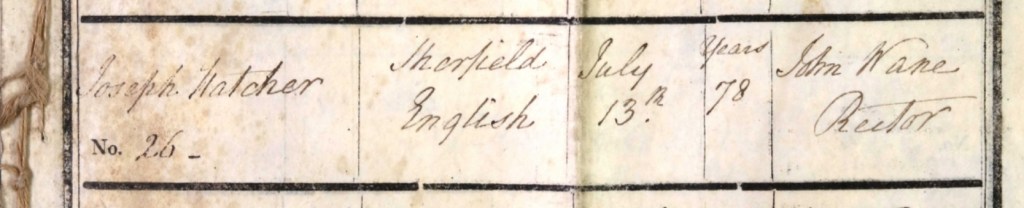
In the parish register, his passing was recorded with care, the entry written in the steady hand of Reverend John Wane, the faithful rector who had long shepherded the Hatchers through their moments of joy and loss.
BURIALS in the Parish of Sherfield English, in the County of Hants, in the Year One Thousand Eight Hundred and Nineteen
Entry No. 26

Name: Joseph Hatcher

Abode: Sherfield English

When Buried: July 13th, 1819

Age: 78 years

By whom the Ceremony was performed: John Wane, Rector.
A brief record on a page and yet between those few lines lies the breadth of a man’s existence. Joseph Hatcher was the quiet strength of generations. A husband, a father, a labourer, who bent his back to the earth and found contentment in the honest labour of his hands. His was a life marked not by grandeur but by endurance, by love, and by the deep peace of belonging to one’s place and people.
The bells of Saint Leonard’s rang softly that day, echoing across the meadows and over the clustered cottages of Sherfield English. Beneath the shade of ancient trees, the earth received him, a man returned to the soil that had sustained him all his years. Though time has since carried away the old church and weathered the gravestones into anonymity, Joseph’s presence endures, not in marble or inscription, but in the blood and memory of his descendants. His name may be hidden from sight, but it still lives in the rhythm of their hearts, in the whispered stories passed from parent to child.
Whether young Charles, then but five years old, stood beside his parents that summer day, we cannot know. Perhaps he was there, small hand clasped in his mother’s, watching the solemn gathering, not yet understanding the weight of loss but sensing it all the same, the stillness, the hush, the reverent sorrow that clings to such moments. In the years that followed, as he grew, his father William may have told him stories of the grandfather he barely knew, of Joseph’s steady ways, his patience, his devotion to family and land.
And so, though the stones may have crumbled and the church itself faded into memory, Joseph Hatcher remains. He rests not just in the earth of Sherfield English, but in every telling of his name, in every descendant who seeks to know from whom they came. For it is through remembrance, through Charles, through all of us, that his spirit still walks the fields of Hampshire, eternal and unforgotten.
The year was 1820, and the fields of Sherfield English still glowed with the gold of late summer. The harvest was nearly gathered, sheaves of wheat standing in gentle rows beneath a sky soft with heat and light. The air was full of life, the creak of wagon wheels along dusty lanes, the murmur of neighbours calling across the fields, and the distant toll of Saint Leonard’s bell, marking the hours of a season’s close.
Within this world of sunlight and labour, Charles’s mother Mary was heavy with child once more. Her belly, round with promise, was a familiar sight to her husband William, now about thirty-three, and to her children Sarah, James, Charles, and Hannah, who played quietly nearby, sensing that something sacred and important was soon to unfold. The Hatchers’ cottage, modest and timeworn, nestled deep within the heart of the village, was alive that day with warmth and anticipation.
The scent of freshly baked bread mingled with the earthy aroma of harvest dust carried in through the open door. A pot simmered gently on the hearth, tended by a neighbourly hand, for this was the way of things in rural Hampshire, when one woman went into labour, others came to her side. Childbirth, in those days, was not a private matter but a communal act of courage, shared by mothers, sisters, friends, and midwives who had all, at one time or another, faced the same long, trembling hours of pain and hope.
As Mary’s labour began, the women around her moved with quiet purpose, damp cloths cooling her brow, gentle hands steadying her, murmured prayers rising in the dim light of the room. Beyond the walls, the rhythm of life continued, the rustle of trees, the clatter of harvest carts, the laughter of children at play, but within that cottage, the world grew still, reduced to breath and heartbeat, pain and faith.
For Mary, the hours must have seemed endless. She had brought several children into the world before, and though she knew the course well, the path was never easier. Yet she was strong, shaped by the same endurance that had sustained generations before her, women who had laboured not just to give life, but to hold it steady in the face of hardship.
And then, at last, in that small, candle-lit room, beneath the thatched roof that had witnessed so much of her life, a new cry pierced the air, thin, fragile, and beautiful. Her travail had ended, her reward lay in her arms. A baby girl, perfect and breathing softly, was placed upon her chest. The relief was immediate, the love overwhelming.
At twenty-eight, Mary looked down upon her daughter, her face flushed with exhaustion and joy, while William, steady and tear-eyed, reached to touch the tiny hand of the child who bore her mother’s name. They called her Mary, perhaps in honour of lineage, the passing of strength from mother to daughter, name to name, but also as an affirmation of love and continuity.
Though the exact date of her birth has been lost to time, the baptismal records tell us that she came into the world before September of 1820. Her arrival may not have been marked by grandeur, yet it was a moment of profound significance, the quiet miracle of life renewed within the circle of a family that had already known both joy and loss.
In that humble home, amidst the scent of bread and woodsmoke, with harvest fields stretching beyond the cottage door, the Hatcher family grew once more.
For young Charles, then six years old, this new sister would become part of the fabric of his earliest memories, a small, swaddled presence who cooed in the crook of their mother’s arm, the living symbol of home and love.
Outside, the village of Sherfield English hummed with the sounds of labour and life, the land itself holding the memory of every child born beneath its skies. And so, as the summer of 1820 waned and the harvest drew to a close, Mary’s birth became another thread in the rich tapestry of family, a testament to faith, endurance, and the timeless rhythm of generations bound by the soil and by love.
Though her story begins quietly, it endures, whispered through the years, carried in blood and memory, one more heartbeat in the long, beautiful story of the Hatchers of Sherfield English.
The first Sunday of September, the 3rd, 1820, dawned with a soft light that filtered gently through the late-summer haze. The fields surrounding Sherfield English still wore their golden hue, the scent of cut hay lingering in the air like a farewell to the season just passed. Within the village, the familiar toll of Saint Leonard’s Church bell drifted over the rooftops and meadows, a call to prayer, to reverence, to the quiet rhythm of faith that shaped every life in the parish.
That morning, the Hatcher family made their way once more along the worn path to the church they knew so well, the same stone sanctuary where vows had been exchanged, and where, in turn, each of their children had been carried to the font. This time, they came to present their newest blessing: Mary, the infant daughter of William and Mary Hatcher, and the youngest sister to Sarah, James, Charles, and Hannah.
The morning air would have been cool beneath the shade of the ancient yews that framed the churchyard. Inside, Saint Leonard’s stood timeless, its flagstones smooth beneath generations of parishioners’ feet, its wooden pews worn by prayerful hands, its air heavy with incense and memory. Here, amidst the dim, dust-speckled light filtering through narrow windows, the Hatchers took their place, humble folk of the land, but rich in spirit and devotion.
Mary, her face still tender from recent childbirth, cradled her baby close. The child was likely wrapped in a simple shawl, perhaps one passed down from her elder siblings, a cherished token of continuity and care. Beside her stood William, his roughened hands folded solemnly, his Sunday coat smelling faintly of earth and sun. A labourer, as the parish books would always name him, yet more than that, a man who found dignity in work, faith in simplicity, and pride in the family that bore his name.
Before the altar, Curate John Jenvey awaited them, a calm, familiar presence who had long served the parish with gentle constancy. His voice, echoing softly through the nave, carried the sacred words of dedication. The ritual was brief, but its meaning profound, a child’s name spoken aloud for the first time in holy space, a mother’s whispered prayer, a father’s bowed head.
In the parish register, the moment was recorded with deliberate care:
BAPTISMS solemnized in the Parish of Sherfield English, in the County of Hants, in the Year One Thousand Eight Hundred and Twenty
Entry No. 106

When Baptized: 3rd September

Child’s Christian Name: Mary

Parents’ Names: William & Mary Hatcher

Abode: Sherfield English

Quality, Trade, or Profession: Labourer

By whom the Ceremony was performed: John Jenvey, Curate.
A plain entry, inked by a steady hand, yet within those few words lies an entire world. It speaks of faith and perseverance, of humility and love, of a family anchored to their land and their church.
As the baptismal water touched the child’s brow, it was more than a ritual, it was a quiet vow. A promise that she would be raised in the enduring rhythm of Hampshire life: in the cycles of work and rest, of prayer and play, of harvest and home. Her name, Mary, bound her to the generations before and after, to the mother who bore her and the soil that sustained them all.
For Charles, barely six years old, this moment would have glowed at the edges of memory, the cool air of the church, the sound of his mother’s voice, the gentle flicker of candlelight upon the font’s water. Though he could not yet understand the significance, this baptism, like his own before it, was part of the sacred tapestry of his childhood, a quiet stitching together of love, faith, and belonging.
And so, on that gentle Sunday the 3rd of September, as the church bell tolled once more and the congregation stepped out into the sunlight, another Hatcher name was woven into the parish’s long history.
That moment, a mother’s tear, a father’s pride, a child’s first blessing, still lingers, carried forward through the years. In the hush of that old church, long since changed by time, one can almost hear the echo of the promise made that day, that love endures, that faith remains, and that every child born beneath the Hampshire sky carries a piece of eternity within them.
As autumn unfurled her russet cloak across the fields of Sherfield English, the air grew soft with the scent of fallen leaves and ripened grain. The land, still warm from summer’s touch, seemed to sigh as it turned toward rest. Yet, while the earth prepared to sleep beneath its blanket of gold and amber, sorrow awoke in one humble cottage at the heart of the village, a sorrow so deep it would echo through generations.
It was early September of 1822, just over two short years since the joy-filled day when Mary and William Hatcher had welcomed their daughter Mary into the world. That same small cottage, once filled with the laughter and new life of a growing family, now became a place of heartbreak and quiet devastation. Within those familiar walls, where bread once baked on the hearth and children’s voices danced through the air, two-year-old Mary, slipped gently from life, her brief flame extinguished before it could truly burn.
The records tell us little, only that she died in the village of her birth, surrounded by her family. Yet what the pages of history cannot say, the heart can imagine. One can almost see Mary, the mother, her hands trembling as she gathered her child to her chest for the final time, her tears falling like rain upon the soft curls of her daughter’s hair. Perhaps she whispered prayers through broken sobs, begging the heavens for mercy, clinging to the weight of the small body that had once kicked and cooed and smiled so easily.
William, too, would have been undone, a father’s grief carried silently, his strength tested against a sorrow no labour could ease. A man who spent his days working the land, he would have known the cycles of nature well, seed and harvest, birth and death, yet no rhythm of the soil could prepare him for this. The fields might yield again, the sun might rise, but within his heart a piece of the world had darkened beyond repair.
In 1822, the loss of a child was heartbreakingly common, yet no statistic or shared sorrow could dull the pain of it. To lose a child was to lose more than a life, it was to lose a future unseen, the promise of laughter, of footsteps yet to be heard, of hands that might one day have worked beside his own. Their little girl’s name, Mary, had been a thread of love and continuity, a bridge between generations. Now, that thread was broken, leaving only silence where once there had been song.
For young Charles, then eight years old, the house must have felt inexplicably changed. He may not have understood death in its full cruelty, but he would have known absence, the stillness in his mother’s gaze, the heaviness in his father’s step, the way the evenings grew quieter, their prayers longer. The sound of his baby sister’s laughter, once so bright and constant, had vanished from the air, leaving behind a hollow that time itself could never quite fill.
As the season turned, and the leaves began to fall upon the churchyard of Saint Leonard’s, life in the village carried on, as it must. Carts still creaked along the lanes, fires still burned in the hearths, and the bell still tolled on Sundays. Yet for Mary and William, each familiar sound carried a dull ache, each day began and ended with the shadow of what had been lost.
Though time may have softened the edges of their grief, it could never erase the memory of her, the warmth of her small hand, the light of her fleeting smile. Her spirit remained, woven into the very fibres of their lives, a tender reminder of love both fragile and eternal.
And so, in the story of the Hatcher family, the name Mary shines with quiet poignancy, not just as a record in a register, but as a heartbeat across centuries. Her short life, though measured in years too few, became part of the family’s living soul, a reminder that even the briefest life leaves an indelible mark.
In the autumn of 1822, as the Hampshire countryside glowed in gold and crimson, a mother wept, a father bowed his head, and a family’s story deepened. Little Mary Hatcher, though gone, became part of the land itself, her memory folded gently into the turning seasons, her name forever whispered in the wind that passes through Sherfield English.
The morning of Wednesday, the 18th day of September, 1822, dawned under a veil of gray. A soft drizzle hung in the air, blurring the distant hedgerows and cloaking the quiet village of Sherfield English in sorrow. Autumn had begun its slow descent upon the land, tinting the leaves in gold and rust, yet that beauty felt hollow, for grief had come to the Hatcher family.
In the heart of the village, beneath the mournful toll of Saint Leonard’s Church bell, Charles’s parents Mary and William, stood side by side, their hearts heavy with unspeakable pain. Before them lay a small coffin, their youngest daughter, Mary, only two years old, whose laughter had once filled their cottage like sunlight, now stilled forever.
Just two Septembers before, within these same ancient walls, the Hatchers had stood as proud parents at her baptism, their hearts brimming with joy and faith as the water had touched her brow. Now they returned, not in celebration, but in farewell. The same font that had welcomed her into the world of grace now stood as silent witness to her parting.
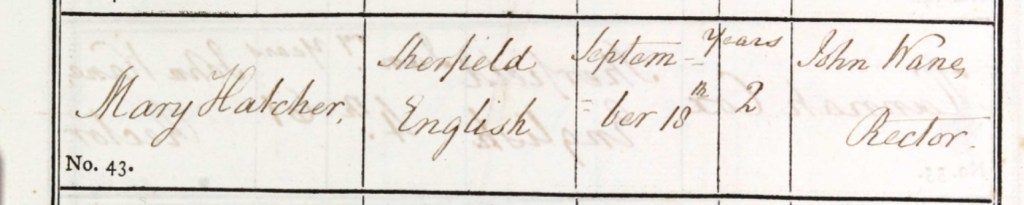
The parish register tells her story in the barest of words, a few lines of ink written in the familiar hand of Reverend John Wane, who had long served the Hatcher family in times of both joy and sorrow:
BURIALS in the Parish of Sherfield English in the County of Hants in the Year One Thousand Eight Hundred and Twenty-Two
Entry No. 43

Name: Mary Hatcher

Abode: Sherfield English

When Buried: September 18th

Age: 2 years

By whom the Ceremony was performed: John Wane, Rector.
So little written, and yet between those lines lies the weight of a world.
For William, a man of the earth, whose hands were calloused from years of labour, the sorrow must have felt like an unending ache. He, who had worked so tirelessly to provide for his family, now faced a task no father should endure: to watch his child lowered into the cold soil of the churchyard. The same ground that held his father, his kin, and his faith, now claimed his daughter too.
And for Mary, her mother, there were no words to describe the desolation. The arms that had once soothed fevers and cradled soft dreams were now empty. She had likely kept vigil through long nights, whispering prayers, singing lullabies through tears, hoping for a miracle that never came. Now, the silence of her child’s absence would fill every corner of their home, every heartbeat.
Perhaps Charles, only eight years old, stood nearby, clutching his mother’s hand, his wide eyes trying to understand a world that could take away something so precious. He might not have grasped the permanence of death, but he would have felt its weight, the heaviness of the air, the tremor in his mother’s breath, the way his father’s shoulders seemed to carry both sorrow and the sky.
Little Mary was laid to rest in the churchyard of Saint Leonard’s, the same sacred earth that had held her family for generations. Around her, the graves of the Hatchers and Rouds stood in quiet testament to the passage of time, names weathered by rain and years, yet never forgotten. But for her parents, that ground must have felt unbearably cold. Their daughter, once so full of life, now slept beneath the soil of the village that had both given and taken her.
As the final prayers were spoken and the earth fell softly upon the coffin, the bell of Saint Leonard’s tolled once more, its deep, echoing sound rolling over the fields, mingling with the sigh of the wind. It marked not just the end of a child’s short life, but the breaking of two hearts.
In the weeks and months that followed, grief would settle quietly within the Hatcher home, not in loud cries, but in soft silences. Yet each Sunday, after the service, Mary and William would have stood at her grave, hands entwined, their surviving children beside them. And perhaps Charles, as he grew, carried the memory of that small mound of earth, the resting place of the sister he barely knew, in the tender part of his soul where sorrow and love are one.
Though her life was brief, Mary was not forgotten. Her name, preserved as a single line in the parish book, was once a mother’s lullaby, a father’s pride, a brother’s wonder. She was a fleeting light, yes, but one that burned with pure, enduring love.
And even now, though the old church of Saint Leonard’s has long since vanished, and its gravestones have faded beneath moss and time, her story endures, carried in the blood of those who came after, whispered through the generations. In every autumn breeze that sweeps across Sherfield English, one can almost hear her laughter, soft and eternal, a reminder that love, once kindled, never dies.
The year was 1823, and the first cool breath of autumn had begun to move softly across the fields of Sherfield English. The hedgerows were dusted with gold, the evenings rich with the scent of woodsmoke and damp earth. The harvest was in, the barns filled, and a quiet peace had settled upon the Hampshire countryside, a peace that belied the quiet stirring of new life within one humble cottage at the heart of the village.
Just over a year had passed since sorrow last shadowed the Hatcher family. The memory of little Mary’s passing still lingered like a soft ache in the air, a loss too deep for words, but carried gently within their hearts. Yet life, in its tender mercy, offered them renewal. In the early days of autumn 1823, Charles’s mother Mary, aged about thirty-two, once again felt the pangs of labour, surrounded by the steady comfort of home and the quiet strength of her husband, William, now about thirty-six.
The walls of their small cottage had witnessed both joy and heartbreak. Perhaps as the first cries of their newborn daughter filled the air, the weight of grief that had so long hung heavy began, just a little, to lift. They named her Ann, a name simple and sweet, carrying with it the promise of new beginnings and the blessing of hope restored.
Her birth, though unrecorded in exact date, is known through the fragments of history that remain. The census of 1841 places her birth around 1826, noting only that she was born in Hampshire. A decade later, the 1851 census tells us more precisely, 1824, in Sherfield English. In the years that followed, through 1861, 1871, 1881, and 1891, her records continued to echo the same truth, even as the years varied slightly, she was of Sherfield English, a child of that quiet, steadfast village whose fields had cradled her family for generations.
These small inconsistencies in the records, a year gained, a year lost, are no mystery of history, but rather the tender imperfection of human memory, of aging minds recalling the passage of time not by numbers, but by seasons. Yet together, they form a portrait, Ann Hatcher, born in the early autumn of 1823, in the same modest home where her siblings had first opened their eyes to the Hampshire light.
For Charles’s parents Mary and William, her arrival must have felt like a healing, a gentle reminder that love could still bloom, even in the shadow of loss. The tiny infant, soft and warm against her mother’s chest, became a living testament to endurance, to faith, to the unbroken rhythm of life that carried them onward.
And for Charles, now nine years old, Ann’s birth marked another chapter in his growing understanding of the world, a world that could hold both sorrow and renewal, both endings and beginnings. Perhaps he would remember the sound of her cry mingling with the autumn wind, or the way his mother’s eyes, weary but bright, seemed to shine with something like peace.
In that small cottage, surrounded by fields that turned slowly from green to gold, another Hatcher child was welcomed into the world. Her story, like those of her siblings before her, began humbly, yet it became another thread in the enduring tapestry of a family bound by love, by faith, and by the ever-turning wheel of the Hampshire seasons.
Though the ink of the records may waver and dates may blur, Ann’s place in the story remains sure, a daughter born from sorrow into hope, her first breath carried on the same wind that whispered through the fields her family had long called home.
It was a golden autumn Sunday, the 19th day of October, 1823, and the village of Sherfield English stirred beneath a mellow sun. The air was crisp, carrying the scent of woodsmoke and fallen leaves. Trees along the lanes had begun their quiet surrender, letting go their amber and crimson treasures, each leaf a whispered prayer drifting toward the earth. Within the weathered stone walls of Saint Leonard’s Church, the people gathered as they did each Sabbath, seeking warmth not from the chill air, but from the steadfast comfort of faith and fellowship.
That morning, the church bells tolled softly, echoing across the thatched rooftops and resting upon the fields where generations had toiled. Inside, the flicker of candles cast gentle light upon faces bowed in devotion, and the familiar hymn rose like breath itself. But this Sunday carried a special sweetness, for two children were to be brought before the font, to be welcomed into the great circle of life, love, and God’s grace. Among them was Ann Hatcher, the infant daughter of William and Mary Hatcher, and the little sister of Charles.
Their father William, the steady village labourer, came forward not with riches but with a wealth far greater, the quiet dignity of an honest man, his hands marked by the soil, his soul rooted in faith. Beside him stood Mary, his devoted wife, who carried in her arms their newest blessing. Her face, touched by the soft light that filtered through the stained glass, revealed both tenderness and sorrow, for this moment was not only one of joy but of remembrance. Barely any time had passed since she had stood here before, cradling another child, little Mary, whose life had been heartbreakingly brief.
Now, as she held Ann, she held more than a daughter, she held hope reborn. Wrapped in a well-worn but cherished shawl, the baby blinked up at the vaulted ceiling, her small fingers curling around her mother’s own. For Mary, this baptism was a quiet healing, a declaration that even after loss, life endures, that love continues its gentle rhythm beneath the eternal gaze of heaven.
At the font stood Curate G. F. Everett, a figure both solemn and kind, who spoke the ancient words that had echoed within these stone walls for centuries. And in that moment, Ann Hatcher was baptised, her name spoken aloud in faith, her place in the world affirmed.
Yet this day held a rare poetry, for Ann did not stand alone in her blessing. At her side, another child was presented, George Roud, her cousin, the son of William and Anstice Roud (née Long). Bound by blood and memory, the two infants shared their first sacred milestone together, their names inked side by side in the parish’s great ledger.
In the careful hand of Curate Everett, the record was written:
BAPTISMS solemnized in the Parish of Sherfield English in the County of Hants in the Year One Thousand Eight Hundred and Twenty-Three
Entry No. 156

When Baptized: 19th October 1823

Child’s Christian Name: Ann

Parents’ Names: William & Mary Hatcher

Abode: Sherfield English

Quality, Trade, or Profession: Labourer

By whom the Ceremony was performed: G. F. Everett, Curate.
Entry No. 157

When Baptized: 19th October 1823

Child’s Christian Name: George

Parents’ Names: William & Anstice Roud

Abode: Sherfield English

Quality, Trade, or Profession: Labourer

By whom the Ceremony was performed: G. F. Everett, Curate.
Two names. Two families. Two lives just beginning. Between those lines lies the thread of kinship, of roots that ran deep through Hampshire soil, binding the Hatchers and Rouds in a shared legacy of endurance and grace.
For Charles, now a boy of nine, this day would have lingered in his young heart, the hymns, the rustle of skirts, the echo of the font’s water as it touched his baby sister’s brow. Perhaps he stood close to his mother, feeling her hand rest gently upon his shoulder, sensing that this was not merely ceremony, but something sacred, the weaving of memory and faith into the story of his family.
And so, on that golden October morning, within the cool, sacred hush of Saint Leonard’s, the Hatchers once again found solace in the ancient rhythm of their parish. Ann’s baptism was a moment of renewal, of life reclaimed from grief, a promise whispered through generations.
Her name, written in dark ink upon the fragile page, was a declaration of resilience and love, a mother’s faith made tangible, a father’s devotion quietly spoken, and a family’s story continuing to unfold beneath the same Hampshire sky that had watched over them all.
Though centuries have passed, the memory of that morning still stirs within the soul of time, the soft toll of the church bell, the shimmer of candlelight, the tender echo of hope reborn in the heart of Sherfield English.
The summer of 1827 unfurled like a hymn over Sherfield English. The fields shimmered beneath the golden weight of ripening grain, and the air was thick with the hum of bees weaving between wildflowers. Chickens clucked in the dusty yards, cows grazed lazily beneath the hedgerows, and the songs of distant shepherds drifted like lullabies across the Hampshire hills. A soft wind threaded its way through the open cottage windows, carrying with it the scent of meadowsweet and the murmured blessings of the land.
It was in this tender season, when earth and sky seemed bound in peace, that Charles’s parents Mary and William welcomed their seventh child into the world, a son, a brother for Charles, a new light for their growing family. They named him George, a name strong and timeless, born of the soil and suited to the quiet endurance of those who worked it.
His birth, like that of his siblings before him, took place within the familiar warmth of the Hatcher cottage, nestled at the heart of the village. The home, with its low beams and hearth fire ever burning, had become a vessel for both joy and sorrow, laughter and prayer, a sanctuary for life in all its fragile beauty. That day, it pulsed with expectation, alive with the whispers of children and the rhythm of labour.
Mary, now about thirty-six, felt again the deep ache of motherhood, the pain and the wonder intertwined. Around her, the women of her household moved with calm assurance: fetching water, folding cloths, murmuring words of comfort. Her eldest daughter, Sarah, now blossoming into womanhood, stood faithfully at her mother’s side, her young hands learning the ancient rituals of care. She dabbed her mother’s brow, fetched fresh linens, and watched in quiet awe as the miracle of life unfolded before her.
Beyond the chamber door, William, steady and patient, did what fathers often did in those times, he waited. His roughened hands, so used to the certainty of plough and tool, could do nothing now but hold still. He kept the younger children, Sarah, James, Charles, Hannah, and Ann, occupied with soft games and whispered reassurances, their curious faces turned toward the door each time a new sound broke the stillness. The hours must have stretched like an eternity, the air thick with both anxiety and hope.
And then, at last, it came, that first cry, sharp and pure, cutting through the hush like the toll of a distant bell. A son. Another heartbeat added to the music of their family. Mary, exhausted but radiant, gathered her newborn into her arms, pressing her lips to his downy head. In that moment, all the labours and losses of her years seemed to fall away, replaced by the simple, infinite grace of holding new life once more. William, when told the news, likely smiled through tears, his heart swelling with pride and gratitude.
Though George’s exact date of birth remains hidden from time’s grasp, the echoes of history offer us glimpses of his beginning. The 1841 census places his birth around 1828 in Hampshire; the 1851 census lists him as born in 1836, in Lockerley, a neighbouring village. Later censuses, 1861, 1871, 1881, 1891, and 1901, all agree upon Lockerley as his birthplace, though the years shift like the turning of pages. These small contradictions, so common in the records of rural families, tell us not of error, but of memory, of lives measured in seasons rather than dates, of time marked by harvests, not calendars.
Yet one truth remains steadfast, George Hatcher was born of Sherfield English, of its soil, its rhythm, and its love. His arrival marked another chapter in the story of a family whose roots ran deep through the heart of Hampshire.
For Charles, now twelve, the birth of his baby brother must have filled him with wonder. Perhaps he crept quietly to his mother’s side, peering at the small, wrinkled face of the infant swaddled in cloth. Perhaps he traced his tiny fingers, marvelling at the mystery of life renewed. In that moment, he could not have known that this new brother would grow to share the same air, the same toil, the same quiet faith that had bound their family for generations.
Outside, the summer fields ripened under the same sun that had watched over his ancestors. The church bell of Saint Leonard’s tolled softly across the valley, its sound mingling with the cry of a newborn child, a harmony of heaven and earth. And within the humble Hatcher cottage, love was rekindled once again: a mother’s arms full, a father’s heart at peace, and a family’s story continuing to unfold beneath the warm and watchful sky of Sherfield English.
Though the years would blur the details, and the records would disagree on the numbers, the essence of that day remains, the laughter, the relief, the first fragile breath of a boy who was, above all else, a Hatcher, born of faith, family, and the land.
The summer of 1827 was drawing gently toward its close, the fields of Sherfield English shimmering beneath a sky ripened by the harvest sun. The air carried the mingled scents of hay and honeysuckle, the sweet fatigue of the earth after months of labour. Along the narrow lanes, the villagers made their way toward Saint Leonard’s Church, their Sunday best brushed and pressed, their hearts lifted by the soft peal of the church bells echoing across the Hampshire fields.
It was Sunday, the 26th day of August, a day of celebration and renewal, a day when new life would be blessed and welcomed into the arms of faith. Within the cool stone walls of the church, sunlight filtered through the small, coloured panes of the windows, scattering warm fragments of light across the flagstones. Beneath the ancient beams, three families gathered before the font, their infants held close, their names soon to be inscribed into both the parish register and the quiet memory of the village itself.
Among them was the Hatcher family, William and Mary, humble labourers of Sherfield English, and their youngest child, George, a baby boy cradled in his mother’s arms. The family’s faces were familiar to the parish, their footsteps had long echoed through this sacred space, for it was here that they had stood in both joy and grief: at vows and baptisms, at farewells and blessings.
William, listed in the register simply as Labourer, bore no title of prestige, yet he brought with him something far greater, the dignity of work, the faith of endurance, the love that bound his family through seasons of hardship and grace. His hands, calloused from the fields, were folded in quiet reverence as he watched Mary, his steadfast wife, now in her late thirties, lift their son toward the light. She had known the weight of motherhood in all its forms: the laughter of children, the ache of loss, the quiet, unyielding hope that life insists upon despite sorrow. Now, she held that hope anew, George, their seventh child, a gift born of patience, faith, and love.
At the font stood Reverend John Wane, the same rector who had guided the Hatchers through years of baptisms and burials. His voice, steady and resonant, filled the church as he spoke the timeless words that bound the living to the eternal. And as the cool water touched George’s brow, another soul was folded into the story of the parish.
The moment was carefully preserved in the parish book, in the firm, deliberate strokes of Reverend Wane’s pen:
BAPTISMS solemnized in the Parish of Sherfield English in the County of Hants in the Year One Thousand Eight Hundred and Twenty Seven
Entry No. 231

When Baptized: 26th August 1827

Child’s Christian Name: George

Parents’ Names: William and Mary Hatcher

Abode: Sherfield English

Quality, Trade, or Profession: Labourer

By whom the Ceremony was performed: John Wane, Rector.
But George’s baptism was not a solitary moment. It was shared, as many sacred moments were in village life, with two other children, each brought forth by loving hands. Just above his name in the register, Entry No. 229 recorded Harriet Clarke, daughter of John and Harriett Clarke, a family of the same parish, her father a wheelwright, skilled in the turning of wood and wheel, crafting the very things that carried the rhythm of rural life. And Entry No. 230 bore the name of Ruth Blake, daughter of Titus and Mary Blake of West Wellow, her family, too, listed simply as Labourer.
Three children, born of different homes, but united that day in water, prayer, and belonging. Beneath the stone roof of Saint Leonard’s, they were joined in the same blessing, their futures as yet unwritten, their souls bound to the same earth and faith that had cradled generations before them.
For the Hatcher family, this day carried a quiet depth of meaning. It was not only a baptism, it was an act of thanksgiving, of healing, of continuity. Just five years before, Mary had stood here mourning her two-year-old daughter, also named Mary. Now she returned, not in grief, but in gratitude, to dedicate another child, to affirm that love endures, that life, like the turning of the seasons, begins anew.
And for Charles, now twelve, it was another thread woven into his memory. Perhaps he stood in the pews beside his siblings, watching the soft light touch the font’s water, listening to the murmur of his father’s voice in prayer. Perhaps he felt the weight of belonging, to his family, his church, his village, without yet knowing that this very sense of place would shape his understanding of the world.
As the final hymn rose through the air, its melody mingling with the scent of wax and harvest dust, the congregation stepped out once more into the sunlight. The fields awaited, the day’s labour yet to come, but for a moment, there was stillness, a collective breath shared by all.
For George Hatcher, this was the beginning, his name written in ink, his soul bound in faith, his life set gently upon the same timeless current that had carried his kin for generations. And though the years ahead would scatter these children into the wide unknown, that Sunday in August 1827 would remain their shared beginning, a moment when the Hampshire sun fell kindly upon their faces, and hope, once again, took root beneath the watchful eyes of Saint Leonard’s Church.
It was a warm summer’s day, Saturday, the 31st day of July, 1830, when the quiet village of Sherfield English stirred to life beneath a soft, golden sun. The fields beyond the church swayed in gentle motion, ripened wheat whispering in the breeze, and the scent of wild honeysuckle drifted down the lanes. The bell of Saint Leonard’s Church rang with a clear, hopeful tone, calling neighbours and kin to witness the joining of two hearts, the marriage of Charles’s sister, Sarah Hatcher and Silas Moody.
Beneath the weathered stone arches of the little parish church, cool and timeless, Sarah, dressed simply but beautifully, stood before the altar, her heart steady, her eyes bright with both joy and trembling anticipation. A spinster of the parish no longer, she was a daughter of the soil, born of the same Hampshire earth that had nourished her ancestors for generations. The faint light filtering through the leaded windows bathed her face in warmth, as if heaven itself had paused to bless her.
Beside her stood Silas Moody, a bachelor of the same parish, a man whose life, too, had been shaped by the rhythm of the land, by the slow grace of harvests and the steadfast labour of honest hands. His expression was one of quiet determination, his heart surely echoing the solemn words that bound them together in love and promise.
The ceremony was by banns, read openly for the village to hear, a declaration of consent and community. Reverend John Wane, the devoted curate who had long tended the Hatchers through baptisms and burials alike, now stood before them once more, his familiar voice carrying the sacred words of union through the still air of the church.
And then, with careful penmanship, he recorded their vows in the parish book, the moment preserved forever in ink:
MARRIAGES solemnized in the Parish of Sherfield English in the County of Hants in the Year One Thousand Eight Hundred and Thirty.
Silas Moody of this parish, a Bachelor,
and Sarah Hatcher of this parish, a Spinster,

Married in this Church by Banns with Consent (Parties of age)
 this thirty-first day of July in the Year 1830.
By me: John Wane, Curate.
This Marriage was solemnized between us:

Silas Moody

Sarah Hatcher (X her mark)
In the presence of:
Moses Rogers,

Eliza Moody of Wellow (X her mark)
No. 50.
There it was, the beginning of a new life, captured not in grand ceremony, but in quiet reverence. The names in the register, Sarah’s mark, an X, simple yet profound, told the story of countless rural women before her, women who, though they could not write their names in ink, left indelible marks upon the world through love, devotion, and endurance. Her trembling hand, guided perhaps by the rector, pressed that mark upon the page not with hesitation, but with courage, with the grace of one raised in humility and faith, who understood that love was not written with pen but with heart.
Beside her, Silas, steady and true, stood as her equal, not a man of wealth, but a man of promise, of belonging. And watching them, standing proudly among the pews, was William Hatcher, her father, his weathered face touched by both pride and bittersweet ache. He had walked his daughter down the aisle, each step a quiet prayer, each breath a letting go. His hands, accustomed to the weight of tools and toil, had felt the soft tremor of his daughter’s arm resting in his, a memory that would never leave him.
Mary, her mother, stood close by, her eyes bright with tears that caught the candlelight. In her heart was a mix of love and longing, the joy of seeing her daughter step boldly into her own life, and the ache of knowing that the house would feel a little emptier come morning.
And somewhere among the gathered family, Charles, now a young man on the edge of adulthood, watched with pride swelling quietly in his chest. His sister, the girl who had once held his hand when he was small, who had soothed him after long days and shared laughter by the hearth, was now a bride. As he watched his father give her away, he felt a stirring of emotion he could not yet name, pride, admiration, and the faint melancholy of change. For though her laughter would still echo in the village, it would no longer fill their home each evening.
Outside, the church bells rang again, jubilant and full, their sound rolling over the Hampshire fields like a blessing carried on the wind. Villagers smiled as the newlyweds emerged hand in hand, sunlight gilding their faces. The day was simple, humble, but radiant, filled with the unspoken poetry of rural life, where love was celebrated not in grandeur but in community, where every union was a thread woven into the enduring tapestry of the parish.
For Sarah Hatcher, that day marked the beginning of a new story, her name now joined with Silas Moody’s, her heart stepping forward into the unknown with courage and grace. And for Charles, standing in the crowd, it was a moment of awakening, a reminder that time moved swiftly, that childhood faded softly into memory, and that even amidst change, love, like the Hampshire fields, endured season after season.
And so, on that sunlit day in July 1830, within the stone walls of Saint Leonard’s Church, a daughter of Sherfield English took her vows, a father’s heart swelled with pride, a mother’s tears glistened, and a brother, quiet, observant, and full of feeling, began to understand what it meant to watch the people you love step into the beautiful, inevitable tide of life.
As the year 1835 drew gently to its close, the village of Sherfield English lay quiet beneath a pale winter sky. Frost silvered the hedgerows, and the fields, bare after harvest, stretched wide and still under the low sun. The faint smoke from cottage chimneys curled lazily into the cold air, carrying with it the scent of peat and hearthfire, the perfume of home and endurance.
Within the heart of the village, the parish church of Saint Leonard’s stood steadfast as ever, its stone walls weathered but welcoming, its bell marking the slow, steady rhythm of the passing seasons. And as Advent candles burned low upon the altar, the familiar words of Curate Allen Morgan echoed through the nave, ringing clear in the hush of December’s stillness:
“I publish the banns of marriage between James Hatcher, bachelor of this parish, and Jane Noble, spinster of this parish…”
So began the first reading, on Sunday, the 6th day of December, followed again on the 13th day, and once more on the 20th day, as tradition required, three successive Sundays of hope and proclamation.
The Year 1835

[No. 36]

Banns of Marriage between James Hatcher, Bachelor, of this parish of Sherfield English,
and Jane Noble, of the same parish, Spinster.

1st Time, Sunday, Dec 6th, by Allen Morgan, Curate

2nd Time, Sunday, Dec 13th, by Allen Morgan, Curate

3rd Time, Sunday, Dec 20th, by Allen Morgan, Curate
The words, read aloud before the gathered congregation, were more than formality, they were a public promise, a declaration of intent made before God and neighbour alike. In those days, the reading of the banns was not simply a clerical act, but a moment of collective witness. The whole parish leaned in to hear, to nod, to smile knowingly. These names, James Hatcher and Jane Noble, were not strangers to the ears that heard them. They were familiar, beloved, woven into the very fabric of the village.
James Hatcher, Charles’s elder brother, had grown into a man much like his father William, steady, reliable, with hands shaped by honest work and a quiet humility that earned respect. He was of the land, his life measured not in wealth but in rhythm, of dawn and dusk, of seed and harvest, of duty and devotion.
Jane Noble, the woman soon to bear the Hatcher name, was herself a daughter of the parish, a woman of grace and quiet strength, known perhaps for her gentle manner and steadfast faith. Her life, too, had been bound to the seasons of Hampshire, her hands familiar with the labours of the home, her heart with the constancy of village life. Together, their union would not only join two souls, but two histories, two families whose roots had long intertwined beneath the same skies.
As each Sunday passed, the banns were heard once more, December 6th, 13th, and 20th, their repetition becoming almost a refrain in the village’s Advent song. Parishioners would murmur their approval as they left the pews, perhaps recalling the young couple walking side by side after service, or exchanging shy smiles across the market green. The banns carried with them not only announcement, but warmth, a shared joy, a quiet anticipation that another home would soon rise among their own.
For Mary and William Hatcher, this moment must have been both familiar and bittersweet. It had been five years since they had watched their eldest daughter, Sarah, walk down the aisle of this very church to become Sarah Moody. Now another of their children was preparing to step forward into his own life. As the banns were read, Mary’s heart may have swelled with pride, her eyes glistening in the candlelight as she thought of the boy she had raised now standing on the threshold of manhood. William, too, would have listened quietly, his mind perhaps wandering to the turning of years, to the steady passage of time that carried his children from cradle to altar, from home to homes of their own.
And Charles, now in his early twenties, may have sat a few pews behind them, listening to the banns with a mix of fondness and reflection. He had shared his boyhood with James, had run the same fields, worked beside him in the same soil, laughed under the same roof. To hear his brother’s name read aloud before the parish must have filled him with pride, and perhaps with a quiet ache, too, knowing that life was shifting once again, that another branch of their family tree was spreading outward into the world.
Outside, the winter light slanted through the bare trees, casting long shadows across the churchyard where generations of Hatchers already rested. The air was cold, but within the stone walls of Saint Leonard’s, there was warmth, the warmth of community, of tradition, of love enduring through time.
And as the final Sunday of Advent passed, the banns complete and the new year approaching, Jane Noble’s name began its gentle transformation, from maiden to wife, from Noble to Hatcher, her life soon to be joined with James’s beneath the same enduring roof of faith and Hampshire sky.
For the Hatchers, it was not only a union of two hearts, but a renewal of all that anchored them, faith, family, and the quiet, steadfast rhythm of life in Sherfield English.
It was Christmas Day, Friday, the 25th day of December, 1835, and the village of Sherfield English lay hushed beneath a blanket of frost. The air was sharp and still, carrying the faint scent of woodsmoke and pine from hearths where fires had burned since dawn. Along the winding lane leading to Saint Leonard’s Church, footprints pressed softly into the whitened ground as villagers made their way to the morning service, a celebration of birth, of hope, and, for one family, of love.
Within the ancient, candlelit sanctuary of Saint Leonard’s, the world felt smaller, holier. Candles flickered against the worn stone walls, their golden light casting soft halos upon faces bowed in reverence. The familiar chill of winter clung to the air, yet the warmth of faith and festivity filled the space, the scent of beeswax mingling with the evergreen boughs that adorned the altar.
At the front of the nave, before the same altar where he had once been baptised as an infant, Charles’s brother, James Hatcher stood tall, his heart steady but full. A bachelor of the parish, son of William and Mary Hatcher, he carried within him the quiet strength of his lineage, generations of men who had worked this land, prayed in this church, and walked these same stone floors in boots caked with the soil of Hampshire. He had likely passed beneath this arch countless times before, as a boy holding his mother’s hand, as a young man at Sunday service, but today, the moment felt different. This time, it was his name that would be spoken, his vow that would echo through the nave, his life that was about to change.
Beside him stood Jane Noble, his bride, a woman of calm grace and gentle dignity, her cheeks softly coloured from the winter air. She, too, was a child of Sherfield English, her roots tangled with his in the fabric of this small, steadfast parish. Her gown was likely simple, her hands perhaps trembling as they met his, but her eyes, filled with trust and affection, told of a love that needed no grandeur to be real.
As Curate Allen Morgan, a familiar and comforting presence in the village, began the ceremony, his voice rose and fell in the ancient rhythm of the marriage rite, words spoken countless times before, yet never quite the same. The candles shimmered, the congregation held their breath, and as James and Jane joined hands, time itself seemed to pause.
1835 – Page 24

MARRIAGES solemnized in the Parish of Sherfield English in the County of Hants in the Year 1835
James Hatcher, Bachelor, of this Parish, and Jane Noble, Spinster, of this Parish,
 were married in this Church by Banns with consent of the parties this twenty-fifth day of December in the Year One Thousand Eight Hundred and Thirty-Five.
By me, Allen Morgan, Curate.
This Marriage was solemnized between us:

James Hatcher

Jane Noble
In the Presence of:

Edward Betteridge

Emma ? (Name Unclear)
No. 70.
The signatures, firm and uncertain alike, stood as silent witnesses to the moment. Edward Betteridge and Emma, whose name faded and blurred through time’s wear, had stood close by, lending their presence, their blessing, their ink, to a day that bound two souls together in love and community.
For James, this was no mere formality, it was the fulfillment of quiet years of labour and longing, the reward of a life lived with steadiness and faith. In that sacred instant, as he spoke his vows and placed his trust in the woman before him, he was no longer simply a son or a brother. He was a husband, a protector, a partner, the keeper of a new hearth, a new promise, a new beginning.
And among the congregation, seated perhaps a few pews back, Charles Hatcher watched with swelling pride. His brother, the one who had shared his youth, his laughter, his chores in the fields, now stood transformed by love. Charles’s heart stirred with warmth and wonder, though perhaps also with the faint ache of change. He would remember his father William’s steady presence, his hands folded solemnly, eyes glistening as he watched his son step into manhood; and his mother Mary, her lips moving in prayer, her face lit with both joy and tenderness. The Hatchers had gathered here so many times, for baptisms, for burials, for the cycles of life itself, but this moment, this Christmas morning, felt especially blessed.
As the final words were spoken and the vows sealed, Saint Leonard’s bells rang out across the frosted fields, their peal blending with the joyful chorus of Christmas. Outside, the pale winter sun broke through a veil of cloud, gilding the church tower in gold. The villagers smiled as the new couple stepped into the cold air, their breath rising like smoke, their fingers entwined.
In that instant, a man and woman walking hand in hand into their new life, their family watching from behind, the story of the Hatcher family turned another beautiful page. Faith, labour, and love continued their quiet, unbroken rhythm beneath the vast Hampshire sky.
For Charles, that image, of his brother James leading his bride into the winter light, would remain with him all his days. A reminder that even in the coldest season, love has the power to warm the heart and light the path ahead.
It was a gentle spring morning, Thursday, the 18th day of April, 1839, when Saint Leonard’s Church once again opened its weathered doors to welcome another chapter in the story of the Hatcher family. The hedgerows along the lanes of Sherfield English were dusted with blossom, and the air carried the soft hum of awakening life, birds calling, lambs bleating, and the faint whisper of a breeze stirring through the fresh green fields.
Inside the small stone church, cool and still beneath its timbered roof, Hannah Hatcher, just twenty-one years old, stood at the altar, her heart steady but full. The daughter of William Hatcher, a humble labourer of the parish, Hannah carried in her bearing the quiet strength of the working class, the kind of grace born not of privilege, but of perseverance. Her life, like that of her parents before her, had been shaped by the land, by long days, steady faith, and the unspoken poetry of endurance.
Beside her stood Charles Southwell, twenty-five, a faggot maker from East Wellow, his hands calloused by the work of binding brushwood for hearth and home. He was the son of Joseph Southwell and Hannah Long, herself sister to Anstice Roud (née Long), making this union one that bound together two branches of kinship already intertwined by time and place.
The ceremony was modest, as most were in those quiet parishes, no grand attire, no music beyond the faint rustle of the congregation and the distant tolling of the church bell. But what it lacked in splendour, it carried tenfold in sincerity. Curate J. H. Jragitt, the parish’s gentle shepherd, presided over the vows, his voice low and measured as he led the couple through the sacred rite that had joined countless souls before them.
James Finch and Charles Rose stood witness, neighbours, perhaps friends, men of the same community, whose presence affirmed the union with the weight of honest testimony. For in villages like Sherfield English, marriage was more than a promise between two hearts, it was a bond that rippled outward, touching every household, every familiar face in the pews.
When the vows had been spoken and Curate Jragitt pronounced them husband and wife, a stillness seemed to fall, that solemn, tender hush that follows holy words. Outside, the sunlight broke through the stained glass, scattering shards of colour across the stone floor, as if heaven itself had offered its quiet blessing.
Afterward, the curate led Hannah and Charles to the small wooden table beside the altar, where the great marriage register lay open, waiting. Neither could write their names, but they each took the quill in trembling hands and made their marks,  two simple crosses, one beside the other. They were not letters of learning, but symbols of faith, each stroke pressed into the parchment with all the devotion of two souls bound not by ink, but by love and trust.
Marriage solemnized in the Church in the Parish of Sherfield English in the County of Southampton
No.: 7

When Married: 18th April 1839

Name and Surname: Charles Southwell, Hannah Hatcher

Age: 25, 21

Condition: Bachelor, Spinster

Rank or Profession: Faggot Maker, [no profession listed]

Residence at the Time of Marriage: East Wellow, Sherfield English

Father’s Name and Surname: Joseph Southwell, William Hatcher

Rank or Profession of Father: Faggot Maker, Labourer
Married in the Church according to the Rites and Ceremonies of the Church of England by me, J. H. Jragitt, Curate.
This Marriage was solemnized between us:

Charles Southwell (his mark)

Hannah Hatcher (her mark)
In the presence of:

James Finch (his mark)

Charles Rose.
The register’s ink may have faded with the passing years, yet in those lines lies the unspoken poetry of ordinary lives, lives of work and weather, of prayer and patience, of love rooted deeply in the Hampshire soil.
Somewhere among the gathered kin, Charles Hatcher, now in his mid-twenties, likely stood quietly, his heart stirred by the familiar mingling of pride and melancholy. He had watched his sisters one by one step from the family hearth into lives of their own, first Sarah, and now Hannah. He had seen his father, William, escort another daughter down the aisle, his back still strong though his hair had begun to grey; and his mother, Mary, watching with folded hands, her eyes shimmering with both joy and remembrance.
For them all, this wedding was not merely a moment, it was a thread in the tapestry of a family’s story, one woven through with resilience, faith, and love that endured through time’s turning seasons.
And as Hannah and Charles Southwell stepped out from the shadowed doorway into the soft April light, the bells of Saint Leonard’s rang above them, their music rising like a blessing over the fields and hedgerows. The newlyweds, hand in hand, walked toward their future, their laughter mingling with birdsong, their hearts light with hope.
For the Hatchers, it was another day of letting go, and of holding on in faith. And for Charles, it was another memory etched deep within him: the sound of his sister’s laughter echoing against the Hampshire sky, a reminder that life, however humble, was always rich with love, grace, and the quiet beauty of beginnings.
The evening light of early summer lingered softly over Sherfield English, gilding the fields and cottages with the last warmth of day. The year was 1841, and across England, a quiet, methodical ritual was unfolding, the taking of the national census, a new and ambitious undertaking designed to capture, in a single moment, the living fabric of a nation.
In every parish and hamlet, enumerators, local men chosen for their literacy and trusted standing, walked the lanes with ink-stained fingers and sturdy boots, knocking gently upon cottage doors. They carried with them sheets of crisp paper, columns waiting to be filled with names, ages, and occupations, the small but enduring details that together painted the portrait of a people. The process was simple yet monumental: on this night, Sunday, the 6th day of June, 1841, every soul present under an English roof would be written down, counted, and remembered.
In a modest cottage nestled amid the gentle undulations of the Hampshire countryside, one such family was among those recorded, the Hatchers of Sherfield English.
There, by the fading glow of the hearth, twenty-five-year-old Charles Hatcher sat beside his father, William, a man of fifty, his face weathered by years of labour and devotion. Both men were listed as agricultural labourers, their lives defined by the rhythm of dawn and dusk, by the turning of soil and season. Their hands, though roughened by work, were the hands that sustained not only their family but the very land that fed their village.
At the small wooden table, Mary Hatcher, Charles’s mother, forty years of age and the quiet heart of the household, likely tended to the evening’s bread or mended a tear in a garment as the enumerator’s pen scratched softly across the page. Though her name would appear there simply as Mary, her role was far greater than ink could convey, she was the keeper of warmth in their humble home, the steady light that softened the hardships of a labourer’s life.
Beside her were her two youngest children: Ann, aged fifteen, already growing into a young woman, perhaps helping her mother with the household duties; and George, just thirteen, his hands likely beginning to learn the work of his father and elder brother. Together they formed a family circle, close, unpretentious, and bound by love more than by means.
The census taker, perhaps pausing to warm his hands by their fire, noted the family carefully before stepping back into the cooling evening, his lantern flickering against the twilight. The record he left behind would endure long after their voices faded, a single line of history preserving the memory of who they were and where they belonged on that quiet June night.
1841 Census – Sherfield English, Hampshire
Date Taken: Sunday, 6th June 1841
Residents:
William Hatcher – 50 – Agricultural Labourer
Mary Hatcher – 40
Charles Hatcher – 25 – Agricultural Labourer
Ann Hatcher – 15
George Hatcher – 13
Residence: Sherfield English, Hampshire – Entire household occupying one dwelling
Their cottage stood amid fields that had seen generations of Hatchers before them, their roots sunk deep into the Hampshire earth. Life was not easy, but it was honest, and it was theirs, a patch of England they could call home.
Next door, time had slowed even further. Living quietly in the neighbouring cottage was Charles’s grandmother, ninety-year-old Hannah Roud, Mary’s mother, now recorded as a pauper. Once the matriarch of her own bustling household, she now lived her twilight years in modest solitude, sustained by the charity of parish relief and the care of those who loved her. Though her body had grown frail, her spirit, seasoned by the storms of nearly a century, remained strong, her presence a living link to a world that was already fading from memory.
And just beyond her cottage lived Charles’s uncle, Richard Roud, with his wife Sarah and their daughters, Elizabethand Emma, kin whose lives intertwined daily with the Hatchers’. The lanes between their homes were paths of laughter and lending, of shared meals and shared burdens, of greetings exchanged over hedgerows and farewells whispered at dusk.
So it was that the Hatchers, the Rouds, and the generations entwined between them were all captured upon that single census page, their names aligned neatly in ink, their lives immortalised in government record, yet their true stories alive only in memory and blood.
For Charles, now twenty-five, this was a time of quiet strength and expectancy. The fields he had worked since boyhood stretched before him still, but life, unpredictable and full of unseen turns, was waiting beyond their borders. He could not yet know what paths lay ahead, nor that within less than two decades, his name too would become part of the parish’s sacred record of births, marriages, and deaths.
But on that summer evening in 1841, as the stars began to kindle over the darkening fields, Charles Hatcher was simply a son, a brother, a man of the land, sitting in the home his family filled with love, unaware that history, with a quiet pen, had just written his name among the living of Sherfield English.
The year was 1841, and twenty-five-year-old Charles Hatcher awoke each morning to the soft breath of dawn drifting across the Hampshire fields. His life, like that of his father before him, was measured not by clocks or calendars but by the rising and setting of the sun, by the calls of rooks in the hedgerows, and by the slow turning of the seasons upon the land.
In the quiet village of Sherfield English, nestled between gentle meadows and winding lanes, Charles lived by the rhythm of the soil, a labourer in a world that asked much and gave little, yet one where beauty could still be found in the scent of earth after rain, in the gold of ripened corn, and in the quiet satisfaction of an honest day’s work.
Charles’s working life began before the first light crept over the horizon. In summer, he was often in the fields by five in the morning, his breakfast eaten quickly by candlelight, coarse bread, perhaps a crust of cheese, and a mug of weak ale or water drawn fresh from the well. In winter, when the world was still dark and cold, the hours began a little later, but the work was no less heavy. His days were long, twelve to fourteen hours of steady toil from dawn until the evening shadows stretched over the fields. Sunday was his only day of rest, a day for church, for family, and for the quiet reflection that faith allowed.
For his labour, Charles earned no more than eight to ten shillings a week, paid either in coin or in kind — a measure of grain, a pail of milk, perhaps a bundle of firewood. It was enough to keep the family fed but little more. His mother Mary’s thrift and care stretched every penny to clothe and feed the household. Life was a balance of endurance and necessity.
The work itself shifted with the seasons. In spring, Charles turned the soil, breaking clods with a heavy hoe and spreading manure from the farmyard to rouse the fields back to life. He sowed wheat and barley, planted beans, and mended fences that had been battered by winter winds. His hands were blistered and raw, his back bent to the plough or the spade.
Summer brought the busiest and hardest days of all. The air grew thick with heat and dust as the crops ripened, and the work of haymaking and harvest began. Charles would rise with the sun and labour until it fell, swinging his scythe in long rhythmic arcs, cutting swath after swath of golden hay. His father William worked beside him, the two men silent but bound by shared purpose. Sweat darkened their shirts, their muscles burned, but in their quiet endurance there was a kind of pride. Around them, voices carried over the fields, the songs of women and men keeping pace with the scythe, the laughter of children running with bundles of hay.
Autumn was the season of reaping and threshing. Charles worked in the barns, wielding the flail from dawn until dusk, separating grain from husk, his arms aching from the effort. The air was filled with the dry scent of straw and chaff. And when winter came, and the fields lay bare and frozen, there was hedge-laying, ditching, repairing tools, and tending livestock. The work was cold, often miserable, and some labourers were laid off altogether in these months, surviving on odd jobs or the charity of the parish. But Charles, still living under his father’s roof, shared the work and warmth of his family home.
The dangers of his trade were constant. A slip of the sickle could slice the flesh; a startled horse could crush a man beneath its hooves. There was no doctor near, no time to rest, and injuries healed poorly or not at all. But the greater danger was quieter, the exhaustion that wore down the body over years, the slow grind of poverty that made strength itself a kind of currency.
Charles’s employer was likely a local farmer renting his land from one of the great estates of Hampshire. The relationship between master and labourer was one of dependence and distance. The farmer expected obedience and diligence; the labourer gave both, with little thanks expected in return. Occasionally there was a kind word, a mug of ale at harvest, or a nod of approval, but never equality. Charles’s worth lay in his endurance, in the steadiness of his work, and in this he never failed.
And yet, for all the hardship, there was dignity in his days. The land was both his master and his companion, harsh and unforgiving, but alive and eternal. It gave him purpose, and though it often took more than it returned, it bound him to something greater than himself.
Each year unfolded like a hymn, spring bringing hope, summer toil, autumn reward, and winter patience. Charles lived in step with it all, moving as the fields moved, feeling the pulse of the land in his own body. As dusk fell each day, he would walk home along the narrow lanes, his boots heavy with soil, his muscles aching, yet his heart steady. Ahead, the faint smoke from the Hatcher cottage curled into the evening sky. Inside, his mother’s voice might murmur softly as she prepared the evening meal, his brother George’s laughter rising above the crackle of the hearth.
These were the small mercies that gave meaning to the endless labour, the comfort of family, the warmth of a shared fire, the knowledge that his hands had helped sustain those he loved.
In 1841, the world beyond Hampshire was beginning to change, machines rumbling to life in distant towns, railways spreading like veins across the countryside. But for Charles, life remained rooted in the same soil his ancestors had tilled for generations. He was a man of the earth, bound to its rhythm, shaped by its seasons, and made whole by its quiet constancy.
And when night settled over Sherfield English and the stars shimmered above the dark hedgerows, Charles Hatcher lay down to rest, his body weary, his spirit peaceful, the scent of soil still upon his hands, the day’s toil fading into dreams of golden fields and morning light.
It was a soft, sun-warmed morning on Thursday, the 1st of September, 1842, when the Parish Church of Saint Leonard’s in Sherfield English once again opened its ancient wooden doors to the rhythm of footsteps and the murmur of hushed excitement. The air was sweet with late-summer scent, hay drying in nearby meadows, honeysuckle curling over garden gates, the faint smoke of early hearth fires rising into the sky.
Inside the church, light fell gently through the tall, narrow windows, illuminating the familiar stone floor where generations of Hatchers had knelt before. The small congregation gathered, their voices subdued but warm with anticipation. On this day, another daughter of the village would stand before God, before her kin, and before her community to bind her life to another.
At the altar stood Charles’s sister, Ann Hatcher, only just a minor in age, yet already tempered by the quiet hardships and enduring grace of rural life. The daughter of William Hatcher, a humble labourer whose hands had long worked the Hampshire soil, she carried with her not finery or fortune, but the gentle dignity of her upbringing, honesty, faith, and strength born of endurance. Her life, though modest, had been one of purpose, shaped by the steady rhythm of the land and the loving bonds of her family.
Beside her stood William Moody, her groom, a labourer of full age, the son of John Moody, himself a labourer. His face, bronzed by the sun, bore the look of a man used to toil and weather, yet his eyes held the quiet tenderness of one who understood both hardship and hope. Together, they stood as equals in spirit if not in circumstance, two souls united by shared roots, common labour, and a mutual longing for stability and companionship.
The ceremony was performed by Reverend Edmund May, whose calm voice filled the modest nave with solemn grace. He had seen many such unions, couples whose love was not adorned with luxury, but fortified by faith and constancy. To the village, these marriages were not grand spectacles but sacred affirmations, small yet shining moments that wove together the threads of community life.
When the vows had been spoken and the blessings given, Reverend May led Ann and William to the side table where the marriage register lay open, its pages already thick with the stories of generations. With quiet reverence, they each took the quill. Neither could write their names, but with trembling hands they made their marks, each a simple “X,” the same mark used by so many before them. These were not the signatures of the learned, but of the faithful, symbols of devotion, pressed into parchment with sincerity and courage.
Marriage solemnized by Banns in the Parish of Sherfield English in the County of Hants

Year: 1842

No.: 15

When Married: September 1st

Name and Surname: William Moody, Ann Hatcher

Age: Full Age, Minor

Condition: Bachelor, Spinster

Rank or Profession: Labourer, —

Residence at the Time of Marriage: Sherfield English, Sherfield English
Father’s Name and Surname: John Moody, William Hatcher

Rank or Profession of Father: Labourer, Labourer

Married in the Parish Church according to the Rites and Ceremonies of the Church of England by me, Edmund May, Curate.

This Marriage was solemnized between us:

William Moody (his mark)

Ann Hatcher (her mark)

In the Presence of:

Silas Moody (his mark)

Hannah Moody (her mark).
Silas and Hannah Moody, the groom’s kin, stood nearby, both of them marking the register with the same modest “X.” Their presence was more than duty; it was an act of love and solidarity. They stood not as mere witnesses to a contract, but as family anchoring family, a reminder that even in the humblest corners of Hampshire, no one ever truly began alone.
For Ann, the moment must have shimmered with a thousand emotions, nervousness, joy, and the quiet ache of leaving the family hearth that had been her world since birth. She entered the church as a daughter, with her father’s guidance still steady in her heart, and she would leave it as a wife, stepping into an uncertain but hopeful future. Her father, William, might have stood in the shadows near the door, his face weathered and proud, watching his young daughter take her place among the married women of the parish. Her mother, Mary, perhaps dabbed at her eyes, knowing this was both an ending and a beginning, the rhythm every mother knew too well.
And Charles, now in his mid-twenties, would have felt the familiar tug of pride and loss. He had watched his sisters, one by one, walk the same path, their laughter and presence slowly leaving the family cottage, replaced by silence and memory. He might have smiled at Ann’s radiant face as she took her vows, but deep within, he would have felt the soft ache of farewell, that quiet, wordless emotion only a brother can know when watching his sister step beyond childhood into her own life.
When the final hymn rose, mingling with the scent of candle wax and wildflowers, and the couple turned to walk down the aisle, the light from the open doorway fell upon them like a blessing. Outside, the village waited, friends, family, and neighbours, ready with smiles and modest cheer. The church bell rang joyfully across the fields, echoing through the hedgerows and meadows that had borne witness to so many such moments before.
For Ann and William Moody, this day was the first of their shared journey. For the Hatchers, it was another thread woven into their long and humble tapestry, a story of faith, of love, and of lives quietly lived beneath the wide, tender sky of Sherfield English.
And as the sun dipped lower that evening, Charles might have paused on the lane home, looking back toward the church tower bathed in gold, thinking of his sister’s laughter carried on the breeze, a sound both joyous and fleeting, yet forever part of the song of their family.
On Sunday, the 23rd day of October, 1842, beneath a sky of soft grey and drifting autumn mist, the quiet village of Sherfield English bid farewell to one of its oldest souls. Within her modest cottage, warmed by the faint scent of the hearth and the hush of falling leaves outside, Hannah Roud, Charles’s grandmother, breathed her last at the age of ninety-three.
She had lived almost a century, a span of time that had seen kings, wars, harvests, and heartbreaks come and go. And through it all, she had remained steady, her life rooted deeply in the Hampshire soil, in the small village that had known her from cradle to grave.
The parish knew her simply as Hannah Roud, widow of William Roud, but to her family, she was far more, a mother, a grandmother, a quiet matriarch whose hands had shaped generations. Her late husband William, a broom maker by trade, had worked with the humble materials of their world, willow, birch, hazel, straw, crafting something useful and enduring from the simplest of things. Together, they had built their life from the land and its offerings, weathering the lean years with faith and fortitude, raising children in a home that knew hardship, yes, but never lacked in love.
Hannah’s passing was tenderly witnessed and reported by Elizabeth Roud, likely her granddaughter, who had been by her side as the old woman slipped from this world into the next. It was a quiet death, the kind that comes not from illness or tragedy but from the simple completion of time, her life having run its full course, her spirit gently released.
The official record, entered by William Green, Deputy Registrar, reads with the simplicity of all government ledgers, yet beneath its lines lies the heartbeat of a life lived in full.
REGISTRATION DISTRICT: Romsey
 1842 — Death in the Sub-district of Mitchelmersh, in the County of Southampton

No.: 343

When and Where Died: Twenty-third of October 1842 at Sherfield English
Name and Surname: Hannah Roud

Sex: Female

Age: 93 years

Occupation: Widow of William Roud (Broom Maker)

Cause of Death: Old Age

Signature, Description, and Residence of Informant: The mark of Elizabeth Roud, in attendance, Sherfield English

When Registered: Twenty-third October 1842

Signature of Registrar: William Green, Deputy Registrar.
It is a brief entry, a handful of words that attempt to contain the span of ninety-three years, yet within that brevity lies a quiet majesty. Hannah had lived long enough to see her children raise children of their own, to hold great-grandchildren in her frail arms, to witness the slow but certain march of time reshaping the very parish she called home.
She had been born in an age when candles lit the night and messages traveled no faster than a horse’s pace, and she departed in a world that was already stirring with change, railways whispering across the land, factories darkening city skies. But Hannah’s world had always been smaller, simpler, truer. It had been the world of Sherfield English, of parish bells and village fairs, of Sunday sermons and hedgerow blossoms, of laughter by the fire and tears quietly shed beneath the same low roof.
For Charles, her grandson, the news of her passing must have carried a still, deep sorrow. She had lived next door to his family for as long as he could remember, her small cottage a constant presence at the end of the lane. As a boy, he would have run to her doorstep for a sweet or a story, and as a man, he would have nodded respectfully each morning as he passed by on his way to the fields. Her age had made her almost timeless, a living link to all that had come before, his mother’s childhood, his grandfather’s toil, the old ways of the village itself.
Now, that link was gone. Yet in her absence, she left something enduring, not in possessions or property, but in memory and blood. Her strength ran quietly through all who came after her, through Mary, her daughter, through Charles, her grandson, and through the countless descendants who would one day trace their line back to this very moment in time.
Hers was not a story of wealth or fame, but of endurance and grace, the quiet courage of a woman who had known life in all its simplicity and all its sorrow, who had loved and laboured and lived fully within her means and her faith.
Though her name now rests in the neat lines of an old register, Hannah Roud remains alive in the story of her family, her life a steady flame that continues to glow, carried forward in every heartbeat, every prayer, every act of love from those who descended from her.
And so, on that October day in 1842, as the village carried on its quiet rhythm, the ploughs in the field, the church bell tolling softly over the hills, the Hatcher and Roud families paused in remembrance. One life had ended, yes, but her spirit lingered still, woven into the very air of Sherfield English, where her story began and where, even now, it seems to whisper through the rustle of autumn leaves.
On a crisp autumn Wednesday, the 26th day of October, 1842, the soft breath of wind moved through the village of Sherfield English, stirring the golden leaves that carpeted the lanes and churchyard. Beneath the quiet boughs of Saint Leonard’s Church, the earthly journey of Hannah Roud came gently to its close. She was ninety-three years old, a woman whose life had stretched across the breadth of nearly a century, a century of harvests and heartaches, of faith and endurance, of England changing around her while she remained steadfast within it.
Hannah had lived through the reign of kings, through wars and peace, through seasons of scarcity and seasons of plenty. Her hands had known both labour and tenderness, her heart both loss and love. To the world, she was simply a villager, the widow of William Roud, the broom maker whose craft had kept their family clothed and fed. But to those who knew her, her children, grandchildren, and great-grandchildren, she was the very spine of the family, the quiet strength that had held them all together through the turning years.
Her final journey brought her home to Saint Leonard’s Churchyard, the same sacred ground where so many of her kin had already been gathered. The burial was conducted by Reverend Edmund May, Curate of Whiteparish, whose steady voice and gentle words carried through the still air. He recorded her passing with care in the parish register for BURIALS in the Parish of Sherfield English, County of Southampton, 1841/1842, writing each word with reverence:
No.: 140

Name: Anna Roude

Abode: Sherfield

When Buried: October 26th

Age: 93 years

By whom the ceremony was performed: Edmund May, Curate of Whiteparish

Note in margin: Returned to Registrar.
There it is,  the bare record of a long and extraordinary life, reduced to ink upon parchment. Yet within those few words lies almost a century of human story, a life of simple faith, steady work, and boundless love.
The villagers, perhaps a small gathering of family and neighbours, would have stood quietly as her coffin was lowered into the earth. The church bell may have tolled softly over the fields she once walked, its echo mingling with the sighing of the autumn wind. And though the entry in the register spells her name as “Anna Roude”, those who had loved her knew her by the truth of her presence, by her laughter, her wisdom, her care. She was Hannah, mother, grandmother, great-grandmother, the beating heart of a family rooted deeply in Hampshire soil.
If ever there had been a headstone to mark her grave, it has long since vanished, just as the old church itself has crumbled back into the earth. Yet her resting place, though unmarked, is no less sacred. Beneath the fields and hedgerows of Sherfield English, her spirit endures, entwined with the land that shaped her and that she, in turn, helped shape with her hands and heart.
For me, her descendant, her fifth great-grandchild, there is quiet comfort in knowing that she lies not far from where I now walk. The very lanes she once trod with her husband William, the same paths they followed home at dusk after long days of labour, still curve gently through the countryside around me. When the light falls softly across the fields, and the wind carries the scent of earth and woodsmoke, it feels as though they are both still here, their lives imprinted upon the land, their love woven into its fabric.
Hannah’s story did not end with her burial; it lives on in those who came after her. Her blood runs in the pulse of every descendant who calls this corner of Hampshire home. The same fields where she once laboured, the same skies she gazed upon, remain unchanged in their quiet beauty, holding her memory as the soil holds her bones.
And so, when I walk the lanes of Sherfield English, I walk not alone. I walk with Hannah, with William, with all those who came before, their footsteps faint beneath mine, their strength still guiding me. Theirs is a legacy not written in stone, but sown in the living earth, a legacy of endurance, faith, and love that time itself cannot erase.
Even now, when the evening light falls golden over the fields and the sound of the church bell echoes faintly across the hills, I imagine her spirit there, resting, at peace, a part of the land she cherished, forever at home.
In the small, snow-dusted village of Lockerley, on Monday, the 6th day of February, 1843, a fragile cry rose into the stillness of a winter morning. The air outside was sharp, the fields pale beneath a thin veil of frost, but inside a modest cottage, a new warmth flickered into being. A baby girl, Ellen Luke, came into the world beneath the patient gaze of February skies, her first breath drawn among the familiar scents of woodsmoke and hearth fire.
Her mother, Susan Luke, only twenty-three years old, cradled her tiny daughter in weary, trembling arms, a woman unwed, yet steadfast in her love. The world beyond her cottage walls might have met her situation with whispers or pity, but within that small space, it was only love that mattered, a mother’s fierce, instinctive devotion, her heart already bound to the child she had brought into being.
The official record of Ellen’s birth was made nine days later, on Wednesday, the 15th day of February, in the District of Mitchelmersh, which bridged the rolling lands of Hampshire and Wiltshire. William Cole, the local registrar, wrote her arrival neatly into the book, each letter deliberate and formal, yet beneath the quiet formality of ink and paper lay an entire story of tenderness and endurance.
Births in the District of Mitchelmersh in the Counties of Hants & Wilts

No.: 96

When Born: Sixth of February 1843 at Lockerley

Name, if any: Ellen

Sex: Girl

Name and Surname of Father: —

Name and Maiden Surname of Mother: Susan Luke

Rank or Profession of Father: —

Signature, Description, and Residence of Informant: The mark of Susan Luke, Mother, Lockerley

When Registered: Fifteenth of February 1843

Signature of Registrar: William Cole, Registrar

Baptismal Name, if added after Registration of Birth: —
The space for the father’s name was left bare, an empty line where society demanded certainty, but where life, in its quiet complexity, left only silence. Yet that silence speaks. Whispers carried through family memory and time’s soft murmur suggest that Charles Hatcher, twenty-eight years of age, may have been the man whose affection, brief or lasting, tender or complicated, had led to Ellen’s conception.
Charles, then in the fullness of his working years, lived and laboured not far from Lockerley, among the fields and hedgerows that connected one Hampshire parish to the next. He would have known Susan, perhaps from a neighbouring village, perhaps from shared circles of family and friends who crossed paths at harvest time, at market, or at Sunday service. Their worlds were small but intertwined, shaped by the same soil and sky, by the same poverty and perseverance.
And so, Ellen’s story began, not with grandeur, but with courage. Her mother, unable to write her own name, placed instead “the mark of Susan Luke, Mother” beside the official entry. It was a simple cross, no more than a few strokes of ink, yet it carried the weight of a mother’s love, a symbol of faith, defiance, and devotion. In that humble mark lies the truth of countless women of the age, those who, without education or privilege, still carried entire worlds within their hearts.
Though the name of Ellen’s father was not written, his presence lingered in the shape of her story, in the shared blood that flowed quietly through generations. And so, the child of Susan Luke, and perhaps of Charles Hatcher, was woven softly into the fabric of 1843, her life beginning amid the frost of February, her name preserved in careful script and the trembling hand of her mother.
Outside, the winter sun might have broken through the clouds, falling in pale light upon the thatched roofs of Lockerley. The world carried on, the farmers in the fields, the tolling of the church bell, the turning wheel of village life, unaware that within one humble cottage, a story of love and lineage had just begun, one that would ripple quietly through the generations.
And though centuries would pass, and the ink upon that register would fade to sepia, the name of Ellen Luke remains, not just as an entry in a government book, but as a whisper of life, of love defying convention, and of the tender courage of those who lived and loved quietly, beneath the watchful Hampshire sky.
In the gentle spring of 1843, when the hedgerows of Lockerley began to stir with the first soft buds of green, and the fields shimmered faintly under the tender warmth of returning sunlight, a quiet and sacred moment unfolded within the modest stone walls of St John’s Church.
It was Sunday, the 19th day of March, and the church bell tolled softly over the village, its sound carrying across ploughed fields and through the thin veil of morning mist. Inside, the air held that faint chill of early spring, mingled with the scent of damp stone, beeswax, and old prayer books.
There, in the stillness of the nave, Susan Luke, a spinster of Lockerley, stepped forward, her baby daughter Ellen nestled close to her heart. Just six weeks old, the infant stirred lightly in her mother’s arms, her breath warm against the cool air, her small face drowsy with the peace of the moment.
Susan’s path to this day had not been an easy one. In a world where convention weighed heavily upon a woman’s shoulders, she stood with quiet courage. She came not adorned in fine garments or accompanied by family pride, but clothed in faith, in strength, and in the tender love only a mother could bear. The villagers, gathered in the pews, may have watched with a mixture of compassion and curiosity, some with kind eyes, others with judgment restrained behind polite silence. But Susan did not falter. Her purpose was pure, to have her child blessed, to claim for her daughter the grace and protection of the Church, to give her a name that heaven itself would know.
At the stone font beneath the worn arches of St John’s, Curate Edmund Duroford lifted his voice, the sacred words falling softly through the cool air like petals upon still water. The infant was baptised “Ellen,” and the holy water shimmered briefly upon her brow, catching the spring light that spilled through the old leaded windows. It was a moment at once ordinary and eternal, one child among many, yet a life unlike any other.
After the blessing, Curate Duroford returned to his desk and, with careful hand, filled the parish register, another small life inscribed in the enduring memory of the parish:
BAPTISMS solemnized in the Parish of Lockerley in the County of Southampton in the Year 1843.

No. 92

When Baptized: March 19th

Child’s Christian Name: Ellen

Parents’ Names: Susan Luke

Abode: Lockerley

Quality, Trade, or Profession: Spinster

By whom the Ceremony was performed: Edmund Duroford, Curate.
The space for the father’s name was left bare. Yet in that empty space, one could almost feel the pulse of unspoken truths, of love unrecorded but not forgotten. Love filled the silence, the steadfast devotion of Susan Luke, who had brought her daughter before God with humility and grace, and perhaps too, the ghost of another’s presence, hovering unseen.
It is not known whether Charles Hatcher, then twenty-eight years old, sat beside her that morning, or among the congregation in quiet anonymity, or if he lingered outside among the yews, listening to the faint echo of the curate’s voice through the church’s thick walls. Perhaps he was not there at all, bound by duty, fear, or circumstance. Yet one can imagine the pull within his heart, the awareness of a child, a bond both tender and fragile, shaped by the brief meeting of two lives in the hush of rural England.
When the service ended and the last hymn faded into silence, Susan stepped out once more into the pale March light, her child wrapped securely in her shawl. The lane from the church wound gently between cottages and hedgerows just beginning to bloom, the air filled with the distant caw of rooks and the scent of thawing earth. Life went on, fields to tend, hearths to warm, prayers to whisper at day’s end.
But within that ordinary morning lay something timeless, the courage of a mother, the innocence of a child, and the faint, unbroken thread of connection stretching through generations, a thread that, even now, still hums softly through the bloodlines of those who remember.
Though the register tells only what was written, names, dates, and duties faithfully performed, the truth of that day lives elsewhere. It lives in the warmth of Susan’s embrace, in the soft breath of her child, in the sacred hush of St John’s beneath its old oak beams. It lives, too, in the quiet mystery of what may have passed between Susan and Charles, the unspoken story that time has not erased, only softened.
And so, beneath the budding branches of Lockerley, in the spring of 1843, Ellen Luke was baptised, not merely into faith, but into history itself. The water on her brow, the mark of her mother’s love, and the faint echo of possibility that surrounded her birth would ripple gently through the ages, reaching even now, through the hearts and hands of those who trace her name.
St. John’s Church in Lockerley, Hampshire, is a charming and historic church that has served the local community for centuries. Located in the heart of the picturesque village of Lockerley, which lies in the Test Valley, the church is an important part of the area’s history, culture, and spiritual life.
The history of St. John’s Church dates back to the medieval period, though the current structure reflects several stages of development over the centuries. The original church was likely built around the 12th century, though records from that time are sparse. The church’s dedication to St. John the Evangelist indicates its religious association with the Christian tradition, particularly with the apostle John, one of the most prominent figures in the New Testament. The church’s early history is tied to the broader religious and agricultural practices of the village, which has been a rural community for much of its existence.
Over the centuries, St. John’s Church was subject to several expansions and renovations. The original Norman structure would have been relatively simple, reflecting the needs of a small rural community. However, as Lockerley grew and developed, particularly during the medieval and post-medieval periods, the church was modified to accommodate a larger congregation and to reflect the changing architectural styles of the time. One of the most notable periods of change came in the 19th century, when the church was rebuilt in the Victorian era.
The current building of St. John’s Church was constructed in 1889–90 under the direction of the architect J. Colson, in a style that blends both Gothic and Perpendicular Gothic elements. This period saw significant growth in the Test Valley, and Lockerley, with its proximity to the town of Romsey, benefitted from an expanding population and increased prosperity. The design of the church reflects the period's architectural tastes, with soaring arches, intricate stained-glass windows, and the use of local materials that give the church a distinctive character.
St. John’s Church is a relatively large and impressive building for a rural village church. The structure features a chancel with an outshot, a nave with transepts, and a southwest tower that adds a sense of grandeur to the village’s skyline. The church’s stained-glass windows, depicting various scenes from the Bible, are particularly beautiful, and they provide a striking contrast to the stonework of the building. The wooden roof of the nave, designed with king-post trusses on arch-braces, is another notable feature of the interior, displaying the craftsmanship of the period.
Over the years, St. John’s Church has been at the center of life in Lockerley, hosting regular religious services, weddings, baptisms, and funerals. The churchyard is the final resting place for many of the village’s residents, with gravestones marking the passage of time and offering a sense of continuity to the village’s history. The church continues to play an important role in the spiritual life of the community, offering a space for worship, reflection, and prayer.
In addition to its role as a place of worship, St. John’s Church has also served as a venue for significant community events. The church is a place where people come together to mark important milestones, both religious and personal. Many of the village’s residents, both past and present, have been married, baptized, or buried in the church, giving it a special place in the collective memory of Lockerley.
The churchyard itself is a peaceful and tranquil space, with the graves of local families dotting the landscape. These graves serve as a reminder of the long history of Lockerley, and they provide a connection to the past. The churchyard is not only a site of historical importance but also a beautiful setting for reflection, surrounded by the natural beauty of the Hampshire countryside.
As for rumors of hauntings, like many historic churches, St. John’s has been the subject of local legends and ghost stories. However, there are no widely documented or substantiated paranormal occurrences associated with the church. Given the long history of the building and the village, it is not unusual for local folklore to suggest the presence of spirits or supernatural events. In many cases, such stories are passed down through generations, often becoming part of the cultural fabric of a place. While there may be occasional whispers or tales shared by the community about unexplained occurrences, there is no firm evidence to suggest that the church is haunted.
The year was 1843, and winter had laid its pale hand across the village of Lockerley. Frost clung to the hedgerows, the fields were silvered with ice, and smoke curled from cottage chimneys into the still, white air. On Friday, the 8th day of December, in one such cottage nestled near the heart of the village, a soft, trembling cry broke the silence of the morning.
A child, Fanny Luke, had come into the world.
Her mother, Susan Luke, only twenty-three years old, was already a woman acquainted with both hardship and grace. Once merely a girl of the parish, she was now the mother of two, a figure of quiet endurance whose love seemed to grow stronger with every trial placed before her. Though unwed and unsupported by the conventions that blessed other homes, she met her circumstances with a steady courage that needed no witness.
Outside, the winter wind pressed gently against the thatch, and the distant toll of St John’s Church bell marked another hour passing in the life of the village. Inside, by the dim light of the hearth, Susan held her newborn close, wrapping the infant in cloths warmed by the fire. The air smelled faintly of ash, damp wool, and the sweetness of birth, that mingling of pain and miracle that had, for a moment, made the world stand still.
Twelve days later, on Wednesday, the 20th day of December, Registrar William Green formally recorded Fanny’s arrival in the District of Mitchelmersh, within the Counties of Hampshire and Wiltshire. Her name was inscribed carefully into the birth register, another small yet significant mark in the eternal rhythm of life and loss, beginnings and farewells.
Births in the District of Mitchelmersh in the Counties of Hants & Wilts

No.: 290

When Born: Eighth of December 1843 at Lockerley

Name, if any: Fanny

Sex: Girl

Name and Surname of Father: —

Name and Maiden Surname of Mother: Susan Luke

Rank or Profession of Father: —

Signature, Description, and Residence of Informant: The mark of Susan Luke, Mother, Lockerley

When Registered: Twentieth of December 1843

Signature of Registrar: William Green, Registrar

Baptismal Name, if added after Registration of Birth: —
Susan, unable to write her name, placed instead “the mark of Susan Luke, Mother, Lockerley” beside the entry, a small, humble cross, drawn with care and trembling pride. In its simplicity lay a world of meaning: love that defied judgment, strength that required no approval, and courage that could not be taught.
The column for the father’s name remained blank, a silence that speaks across the years more powerfully than any written word. But within that blank space lives the lingering suggestion of another name, another soul entwined in this quiet chapter of life. For though no record could prove it, time and tenderness suggest that twenty-nine-year-old Charles Hatcher, labourer, son, and brother from nearby Sherfield English, was likely the man whose presence shaped the beginning of Fanny’s small, fragile life.
If that was true, then Fanny Luke carried within her not just her mother’s steadfast heart, but also the bloodline of the Hatchers, a lineage of soil and endurance, of hands hardened by work and hearts softened by faith.
The world in which Fanny was born was a humble one, cottages scattered like seeds among fields asleep beneath frost, the cry of crows echoing in the cold stillness. Yet her arrival, though quiet and unheralded, brought a spark of warmth into that winter morning. A small flame of hope, burning gently against the wind.
For Susan, this new child was both a burden and a blessing. She knew the road ahead would not be easy, that whispers might follow her, that sympathy might wear the mask of pity, yet she faced it with the same steady grace that had guided her through every other trial. In her arms, Fanny stirred softly, her tiny hands curling into fists of life, her breath a promise of continuity and love.
And somewhere, perhaps only a few miles away, Charles Hatcher went about his daily work, tilling the frozen soil, mending fences, or walking the cold lanes between Sherfield English and Lockerley. Whether he knew of the child’s birth, whether he allowed himself to feel the weight of her existence, no record can tell. Yet it is not difficult to imagine him, in some quiet moment, pausing to look out over the frost-covered fields, feeling a strange stirring in his chest, something unspoken, something like longing.
The records are sparse, but the story they veil is rich with life. Beneath the official ink and parchment of the 19th century, the registrar’s steady hand, the measured formality of names and dates, lies the beating heart of a woman’s love, and the soft beginning of a child’s journey.
Fanny Luke, born of winter’s stillness and a mother’s strength, entered the world without fanfare or fortune, but with something far more enduring: the legacy of quiet resilience and the unspoken tenderness of two souls whose paths, however briefly entwined, left a mark that time itself could not erase.
It was a cold winter’s morning, Thursday, the 22nd day of January, 1846, when the quiet village of Lockerley lay wrapped beneath a blanket of frost. The hedgerows stood still beneath their silver crowns, and the breath of the land rose in thin veils of mist over the meadows. Inside a small cottage warmed by the faint glow of a hearth, a woman laboured against the rhythm of the cold and the silence, her breath rising in gasps that mingled with the faint crackle of firelight.
There, within those humble walls, a child was born, Mary Ann Luke, the third daughter of Susan Luke, a twenty-six-year-old spinster whose strength had already been tested by life’s quiet cruelties and small mercies. By this time, Susan was no stranger to the pain and wonder of birth. She had already held two daughters in her arms, Ellen and Fanny, each child a testament to her courage, each a reminder that love, though unacknowledged by law or letter, could still shine fiercely in the hearts of the poor.
Outside, the village carried on in its winter hush. The blacksmith’s forge smoked faintly, the church bell marked the passing hours, and the crows moved like scraps of night against the pale sky. Yet within Susan’s small home, time seemed to stand still as she gathered her newborn to her chest, her tired hands cradling a life newly come into the world.
Two weeks later, on Wednesday, the 4th day of February, Registrar William Green recorded the child’s birth in the great official ledger of the District of Mitchelmersh, which spanned the Counties of Hampshire and Wiltshire. His careful handwriting joined another entry to the long chain of lives that made up the quiet history of the parish.
1846 Births in the District of Mitchelmersh in the Counties of Hants & Wilts
No.: 90

When Born: Twenty-second of January 1846 at Lockerley

Name, if any: Mary Ann

Sex: Girl

Name and Surname of Father: —

Name and Maiden Surname of Mother: Susan Luke

Rank or Profession of Father: —

Signature, Description, and Residence of Informant: The mark of Susan Luke, Mother, Lockerley

When Registered: Fourth of February 1846

Signature of Registrar: William Green, Registrar

Baptismal Name, if added after Registration of Birth: —
Once again, Susan’s mark, a simple, trembling “X” stood in place of a written name. It was not the sign of ignorance, but of truth; not of shame, but of perseverance. That small cross was the symbol of countless women like her, women who bore the weight of society’s judgment and yet met it with quiet dignity. Through that humble mark, she gave her daughter not only identity, but love, protection, and belonging.
The space beside the word “Father” remained blank, yet it is there, in that silence, that one can almost hear the whisper of another presence. Though no record bears his name, it is most likely that thirty-one-year-old bachelor Charles Hatcher, labourer of Sherfield English, was the man whose affection and humanity had intertwined with Susan’s life.
If Charles was indeed Mary Ann’s father, then she was born not only of love unspoken, but of two worlds quietly touching, his shaped by the hard soil and long hours of field labour, hers by the courage of a woman who stood alone against convention. Perhaps he knew, perhaps he did not. Perhaps he carried her memory in the quiet corners of his heart, unvoiced but enduring, like the steady beat of a plough horse beneath the morning frost.
For Susan, the arrival of her third child was both a joy and a burden, but above all, it was a continuation, another life to nurture, another hope to cling to in a world that often offered so little. Her small cottage, once filled with silence, now echoed with the soft coos of infancy, the murmur of bedtime lullabies, and the laughter of her growing daughters.
In that simple home in Lockerley, life went on. The seasons turned, the fields thawed and bloomed again, and the parish carried on in its endless rhythm. Yet within Susan’s arms, the flame of love and survival burned steady.
For little Mary Ann Luke, her story began not in grandeur or comfort, but in grace, born on a frost-bitten morning to a mother whose strength defied the cold, whose love needed no approval, and whose every breath was a quiet act of devotion.
And though the parish register records only dates and names, the truth of that moment lies not in ink, but in the heartbeat of a mother and child, two lives bound together by courage, tenderness, and a story that would echo softly through the generations to come.
On a crisp winter’s morning, Monday, the 18th day of January, 1847, the village of Lockerley awoke beneath a veil of frost. The fields, bound in silence, glittered like glass beneath the pale sun, and the churchyard stones shimmered with the thin lace of ice that clung to them. Smoke rose slowly from the cottage chimneys, curling into the still air, and the village went about its quiet rhythm, a rhythm that had long shaped the lives of those who lived by the land.
Within the small stone church of St John’s, where the breath of winter lingered even among the pews, the warmth of human hearts began to stir. The bell tolled softly across the frost-bitten fields, calling the faithful to witness a moment of gentle significance, not one of pomp or grandeur, but of quiet devotion.
There, before the worn altar and beneath the ancient beams, Charles Hatcher, a bachelor and labourer of the parish, stood ready to take his vows. His hands, calloused by years of toil, trembled slightly as he waited beside Susan Luke, a spinster of full age, the woman who had long carried his heart and shared his humble hopes.
They were not people of wealth or learning, but of endurance, souls shaped by the honest rhythm of Hampshire life. Charles, the son of William Hatcher, a fellow labourer of Sherfield English, came from a lineage of men who worked the soil, their sweat mingling with the very earth that sustained them. Susan, the daughter of Moses Luke, also a labourer, was a woman of quiet grace and unwavering resolve, one who had weathered judgment and hardship with dignity and faith.
Their lives had already been entwined by years of unspoken understanding and shared struggle. Together, they had faced the whispered disapproval of their time, the heavy gaze of convention, and the responsibilities of love that had come before the blessing of marriage. Now, beneath the gaze of their neighbours and the blessing of the church, they stood ready to bind their lives openly, solemnly, and forever.
The ceremony was conducted by Minister John Jenvey, his voice calm and resonant as he recited the sacred words of the Church of England’s marriage rite. The sound echoed softly through the nave, mingling with the faint crackle of the candles that flickered against the chill. The air was thick with reverence and perhaps, too, with the unspoken sighs of those who knew the weight of such moments in their own lives.
When the time came to record their union, Minister Jenvey turned to the great marriage register, turning to page thirty-six, and in careful script, inscribed the details of their vows:
Marriage solemnized at the Church in the Parish of Lockerley in the County of Southampton

When Married: January 18th, 1847

Name and Surname: Charles Hatcher, Susan Luke

Age: Full, Full

Condition: Bachelor, Spinster

Rank or Profession: Labourer, (blank)

Residence at the Time of Marriage: Lockerley, Lockerley

Father's Name and Surname: William Hatcher, Moses Luke

Rank or Profession of Father: Labourer, Labourer

Married in the Church according to the Rites and Ceremonies of the Established Church of England by me, Minister: John Jenvey

This Marriage was solemnized between us:

The X Mark of Charles Hatcher

The X Mark of Susan Luke

In the Presence of:
David Kemish

The X Mark of Catherine Kemish.
Neither Charles nor Susan could write their names, yet the simple “X” each placed upon the page carried more meaning than the most elaborate signature. Those humble marks were not signs of limitation but of truth, tokens of devotion, of labour, of endurance. In them was written the story of two hearts that had known both struggle and tenderness, now joined in the sanctity of marriage.
Standing beside them were David and Catherine Kemish, their witnesses, who too left their marks beside their names, a gesture of kinship and quiet support, the affirmation of a community that, in its own way, understood the courage of such love.
As the final words of blessing fell from the minister’s lips, the frost outside began to melt beneath a brief shaft of sunlight. The couple stepped out from the church’s shadow, hand in hand, into the cold brilliance of a winter’s noon. The air bit at their cheeks, but the warmth between them was steadfast. They walked past the headstones and the yew trees, past the iron gate dusted in frost, and back toward the lanes of Lockerley, their new life already unfolding before them.
Their union was not born of riches or ambition, but of shared endurance and the sacred ordinariness of love. It was the kind of marriage upon which generations are built, a partnership of patience, resilience, and quiet joy. In time, their story would become the root of many others, stretching forward through the years, whispering through bloodlines and memories, all the way to now.
Charles and Susan Hatcher, my paternal third great-grandparents, stood that day not merely before a priest, but before history itself. They left no fortune behind, no grand monument in stone, yet what they did leave endures far more powerfully, a legacy of courage, humility, and devotion. Their marks, pressed into the pages of the register, echo still, soft but indelible, like the faint tolling of a church bell across the Hampshire fields.
And so, on that cold January morning, a love once whispered became a promise spoken, and two humble lives were bound together in faith, a promise that would ripple through centuries, until one day, it would find its way to me.
In Hampshire’s heart, where meadows dream,
And silver mists through hedgerows stream,
A child was born one tender morn,
As spring awoke and life was sworn.

Beneath the eaves of Sherfield’s sky,
Where rooks and swallows wheel and cry,
He drew his breath, a labourer’s son,
The humble tale of life begun.

The church bells rang at Saint Leonard’s door,
Their echoes blessing field and moor,
And Mary wept, and William smiled,
As faith was poured upon their child.

Through candlelight and cottage air,
He grew with soil beneath his care,
His hands soon hardened, brown with earth,
His heart still soft with home and hearth.

He learned the hymn of rural days,
Of sunlit toil and harvest praise,
Of winter’s frost, of hunger’s test,
Of love unspoken, labour blessed.

He watched his kin both rise and fall,
The tolling bells would mark them all,
A sister gone, a mother’s tears,
A boy made man through passing years.

By sweat and silence, faith and ground,
He shaped his world without a sound,
And though no riches marked his name,
He found in work a quiet fame.

Then love, like dawn through morning haze,
Came softly to his working days,
A woman strong, with steady grace,
Susan Luke, of Lockerley place.

They met where fate and courage blend,
Where scandal fades and hearts can mend,
And through the whispers, through the years,
Their bond was forged in joy and tears.

And so, one frosted January mornp,
‘Neath St John’s roof, their vows were sworn.
Two marks upon the page were laid,
Two hearts as one, no more afraid.

No gilded rings, no silken bands,
Just calloused, trembling, faithful hands,
Yet in those hands the future lay,
The generations of today.

For Charles, though poor in worldly store,
Was rich in all that matters more,
In love, in labour, in the song,
That binds the weak, that makes us strong.

From Sherfield’s fields to Lockerley’s lane,
Through loss, through love, through joy and pain,
His early years, both rough and fair,
Are whispered still in Hampshire air.

And though his mark was but a cross,
No ink, no script, no gilded gloss,
That mark became his testament,
To faith, to life, to love’s intent.

For history keeps no finer art
Than the quiet beating of a heart.
And through the centuries, his name
Still burns, a small, enduring flame.

Charles Hatcher, son of soil and sky,
Whose story time will not let die,
Your life so far, from birth to vow,
Still breathes within these fields somehow.

And as your tale through time is spun,
Your blood still flows, your work’s not done.
For in the hearts of those you made,
Your spirit walks, and will not fade.
And so, the first chapter of Charles Hatcher’s life closes where a new one begins.
From his birth in the quiet parish of Sherfield English, where the bells of Saint Leonard’s first tolled his name, to his marriage beneath the winter light of St John’s, Lockerley, his journey through those early years was one of simple endurance and quiet grace. His was not the life of noble titles or grand possessions, but of soil and spirit, a life measured not in wealth, but in love, labour, and the unbroken rhythm of the Hampshire land.
He was born into a world of candlelight and parish records, where the smallest mark of ink, a baptism, a burial, a marriage bann, carried the weight of eternity. His childhood was shaped by the turning of seasons, by the call of rooks over the fields, by the ache of loss and the strength of family. He watched the land change with the weather, and with it, his own heart learned patience, the slow, steadfast patience of those who live by the mercy of the earth.
He had known sorrow, the early passing of little Mary, the quiet burials beneath the yew trees of Sherfield English, the tolling bell for his grandmother and grandfather. Yet he had also known love, the laughter of siblings, the gentleness of a mother’s hand, the strong, grounding presence of his father. From those humble beginnings, he learned that life’s truest wealth was not gold, but belonging, to land, to family, to faith.
As he grew into manhood, Charles took his place among the labourers of his parish. Day after day, beneath the Hampshire sky, he worked the fields, his hands roughened by harvest, his back bent by duty, his spirit quietly steadfast. His life was tied to the pulse of the soil, his story written in the furrows he turned, the hedges he mended, the paths he walked home at dusk.
And then, when the long years of youth had ripened into maturity, love found him, quiet, unassuming, but enduring. In Susan Luke, he discovered not grandeur, but companionship; not perfection, but understanding. Their paths had crossed through hardship, through whispered scandal and whispered faith, through the shared courage of two souls who had known the world’s judgment yet still dared to love.
On that cold January morning in 1847, when the frost lay heavy on the churchyard stones, Charles stood before the altar and placed his mark beside hers, a simple X, small in form, vast in meaning. With that mark, he sealed not only a marriage, but a legacy. Two lives, once separate, now intertwined forever in the unbroken thread of family and time.
If you listen closely, you can still hear the echo of their vows in the stillness of Hampshire’s fields, the soft murmur of promises spoken in faith, in hope, in love. The earth that bore witness to their lives still carries the memory of their footsteps, and the blood that once flowed in their veins flows still, centuries later, in those who walk beneath the same sky.
Charles’s early years were years of becoming, the quiet shaping of a man whose story would ripple forward through generations unseen. From the soft cry of his birth in 1814 to the firm clasp of his hand in marriage in 1847, his was a life that began in simplicity and unfolded in grace.
And though time has weathered the stones, and the church where he first drew breath may no longer stand, his story endures, in records inked by careful hands, in the soil of Sherfield English and Lockerley, and in the hearts of those who remember.
For Charles Hatcher was more than a name in a parish book.
He was a son, a brother, a labourer, possibly a father, a husband, and through his quiet life, he gave rise to the generations that follow,
to the bloodline that endures.
Until next time,
Toodle pip,
Yours Lainey.
I have brought all certificates throughout Intwined,

Please do not download
or use them without my permission.

All you have to do is ask.

Thank you.