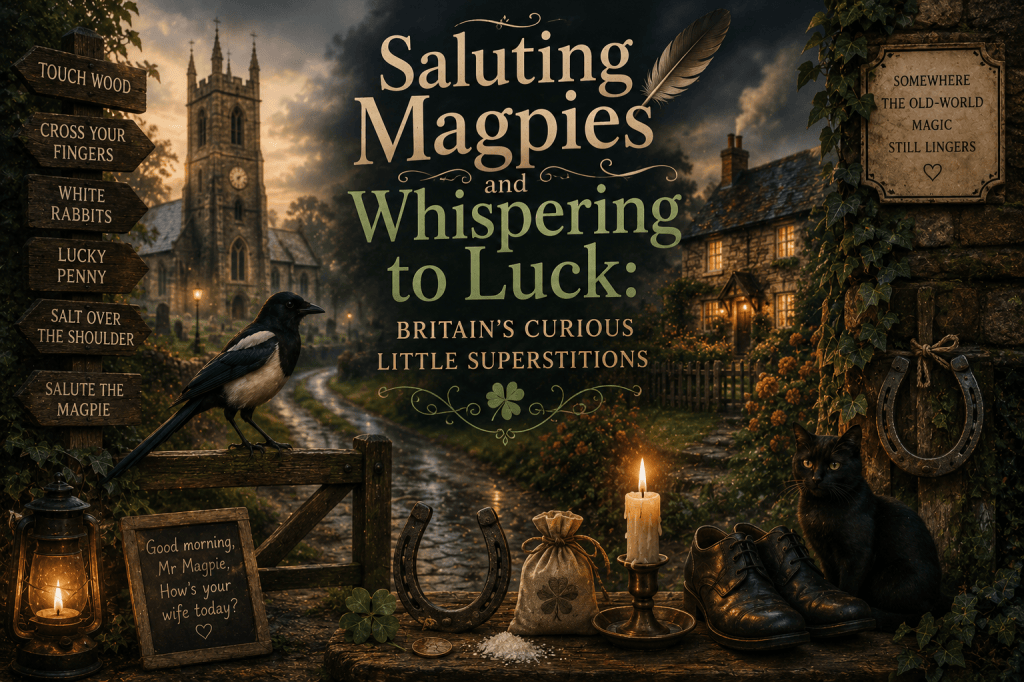
There is an older Britain hiding beneath the modern one.
You can sometimes feel it when the evening mist settles low across the fields, softening hedgerows and swallowing distant trees until the countryside seems to belong to another century. It lingers in crooked country lanes where the branches meet overhead, around old stone churches whose bells have marked births, marriages and deaths for hundreds of years, and beside cottages where ivy curls around windows that once glowed with nothing more than firelight and candle flame.
It is there in ancient woods when the wind moves through the leaves.
In the sudden cry of an owl after dark.
In the robin watching from the garden fence.
And, of course, in the black-and-white flutter of a solitary magpie landing beside the road.
Because no matter how modern Britain becomes, we have never quite managed to leave our old superstitions behind.
We carry them with us like tiny pieces of invisible luggage handed down from one generation to the next.
We touch wood.
We cross our fingers.
We avoid walking beneath ladders.
We hesitate before opening an umbrella indoors.
We feel slightly uncomfortable when the thirteenth day of the month happens to fall on a Friday.
And perfectly sensible grown adults can still find themselves walking along a pavement, spotting a single magpie and immediately raising a hand.
“Good morning, Mr Magpie. How’s your wife?”
Then we continue walking as though stopping to enquire after the marital wellbeing of a wild bird is an entirely normal British custom.
Perhaps it is.
Today I thought we might wander away from the kings, queens, battles and great events that normally fill the pages of history and instead follow a quieter path.
A path through moonlit woods, old cottages, village lanes and forgotten beliefs, in search of Britain’s curious superstitions and the wonderfully peculiar things many of us still do because somebody, somewhere, once told us we should.
We may laugh at them.
We may insist that we do not believe in them.
But then a magpie appears.
And up goes the hand.
Just in case.
Long before electric lights pushed back the darkness, night must have felt very different.
Imagine standing outside a small cottage hundreds of years ago as the final traces of daylight disappeared beyond the fields. There were no streetlights glowing in the distance. No cars passing along the road. No television flickering through neighbouring windows. No phone waiting in your pocket to answer every strange question that entered your mind. There was simply darkness.
Real darkness.
Beyond the candlelight of home lay woods, fields, marshes and lonely roads where familiar shapes became strange beneath the moon.
Branches moved when there was no obvious wind. Owls called from somewhere unseen. Foxes screamed in the night. Mist rose from the ground and drifted across lanes like pale ghosts. And people told stories. Stories of spirits and fairies. Stories of witches and omens. Stories of strange lights dancing over marshland and mysterious creatures wandering ancient woods. Nature itself seemed filled with messages.
The arrival of a particular bird might mean something. A strange dream could be a warning. A sudden death might require an explanation. A good harvest could feel like a blessing. A ruined crop might seem like punishment.
Life was uncertain, and when the world cannot be controlled, human beings have always looked for ways to bargain with fate. Perhaps if we hang something above the door, evil will stay outside. Perhaps if we say the right words, luck will remain. Perhaps if we avoid certain signs, misfortune will pass us by. And perhaps, if a lone magpie appears, we had better be polite to him.
Few British birds have gathered quite as much folklore around themselves as the magpie. With its long tail, clever eyes and beautiful black-and-white feathers shimmering with hints of blue and green, it is hardly surprising that people noticed it. Generations of children grew up knowing the familiar rhyme.
One for sorrow, two for joy, three for a girl and four for a boy.
The verses that follow vary from place to place and family to family, but that first line has always been the troublesome one.
One for sorrow.
Nobody wants sorrow.
And so somewhere along the way we discovered a solution.
Salute the magpie.
Some simply raise their hand. Others greet him politely.
“Good morning, Mr Magpie.”
And some go one step further.
“Good morning, Mr Magpie. How’s your wife?”
Perhaps Mrs Magpie is simply hidden behind the hedge. Perhaps she is sitting in a nearby tree. Perhaps asking after her is our way of turning one for sorrow into two for joy. Does it make any logical sense? Not particularly. But logic seems strangely unimportant when you have just passed a solitary magpie and forgotten to salute him. You can walk another hundred yards telling yourself that you are a rational adult living in the twenty-first century. Yet somewhere inside your mind, a tiny voice whispers: You should probably go back.
There are some battles reason simply cannot win.
Touching wood carries the same peculiar power. We do it almost without thinking.
“The car has never broken down, touch wood.”
“I’ve never lost my passport, touch wood.”
“We’ve been really lucky with the weather…”
Touch wood immediately.
There is something wonderfully ancient about reaching for wood when we fear that our words may have tempted fate.
The true origins of the tradition are uncertain and probably far more complicated than the neat explanations that have grown around it, but trees have held powerful places in human belief for thousands of years.
Long before Britain’s landscape was divided by motorways and towns, great forests covered much of the land.
Trees lived longer than people.
Some stood for centuries.
Imagine how extraordinary that must have seemed.
A child might shelter beneath an oak whose branches had shaded their grandparents when they were young.
That same tree might still be standing when the child became an old man or woman.
It is easy to understand why trees became symbols of strength, protection and something almost eternal.
And somehow, after all these centuries, we are still reaching for them.
Not necessarily the ancient oak anymore.
Sometimes it is simply the kitchen table.
But perhaps the instinct is the same.
Do not tempt fate.
Protect the happiness you have just spoken aloud.
Touch wood.
Crossing our fingers is gentler.
There is something hopeful about it.
We cross them while waiting for exam results.
For hospital news.
For a telephone call.
For sunshine on a wedding day.
For someone we love to arrive home safely.
“Fingers crossed.”
Sometimes there is nothing else we can do.
Perhaps that is why these little rituals survive.
Hope needs somewhere to go.
Sometimes it becomes a prayer whispered into darkness.
Sometimes it becomes a wish made beneath the stars.
And sometimes it simply curls one finger around another.
Mirrors, however, belong to the darker side of superstition.
Break one and folklore warns that seven years of bad luck may follow.
Seven years seems rather harsh for accidentally knocking something off the dressing table, but mirrors have always possessed something slightly mysterious.
Imagine seeing a reflection hundreds or thousands of years ago, before anyone could explain precisely how it worked.
There you were.
And there was another you.
Moving when you moved.
Watching when you watched.
Across different cultures, reflections became tangled with beliefs about identity, spirits and souls.
A broken reflection could therefore become something far more unsettling than broken glass.
Even now, when science has removed the mystery, smashing a mirror somehow feels worse than breaking an ordinary household object.
Perhaps some tiny fragment of those old stories remains inside us. Or perhaps we are simply imagining seven years of finding glass in the carpet.
Salt carries its own ancient whispers. Today it sits quietly beside the pepper and is scattered generously across chips, but once it was precious.
It preserved food through the cold months and held importance in customs and ceremonies.
To spill it was wasteful.
And unlucky.
Fortunately, tradition offered a remedy.
Take a little of the spilled salt and throw it over your left shoulder.
According to one wonderfully dramatic explanation, the Devil may be lurking behind you, and the salt will fly directly into his eyes.
I cannot help feeling slightly sorry for him.
Imagine waiting centuries for somebody to surrender their soul only to be repeatedly blinded because they are terrible at seasoning their dinner.
Still, should the salt spill, I am not taking any chances.
Over the shoulder it goes.
The same applies to shoes on a table.
There are British homes where placing new shoes upon the table will cause an immediate reaction.
“Get those off there!”
Why?
Bad luck.
Why is it bad luck?
Nobody seems entirely certain.
There are stories connecting the custom with death and working communities, while other explanations have appeared over the years.
But perhaps that uncertainty makes it more fascinating.
Superstitions rarely have neat beginnings.
They are not born on a particular Tuesday afternoon and carefully written down for future generations.
They drift.
They change.
They are whispered.
A mother tells her daughter.
A grandfather tells his grandson.
Children tell one another in playgrounds.
Neighbours repeat what their mothers once told them.
Eventually nobody remembers who started it.
Only that you absolutely must not put new shoes on the table.
Black cats have wandered through our folklore in much the same way.
Their reputation has changed depending upon time and place. Sometimes feared because of their association with witchcraft, they have also been considered wonderfully lucky in parts of Britain.
Sailors and their families once associated black cats with good fortune and protection.
So when a black cat crosses your path, you may be incredibly lucky.
Or terribly unlucky.
British folklore has rather helpfully provided both possibilities.
The cat itself, meanwhile, is probably heading home for its tea.
Horseshoes have hung above doors for centuries, guarding homes and inviting good fortune inside.
Iron itself was once believed to possess protective qualities against troublesome supernatural beings, particularly fairies and spirits.
A horseshoe therefore became more than something worn by a horse.
It became protection.
But, naturally, humans managed to make even good luck complicated.
Should the horseshoe point upwards so that it holds the luck inside?
Or should it point downwards so the luck pours upon everyone passing underneath?
Both traditions exist.
Which means you can hang a lucky horseshoe above your door and immediately begin worrying that you have installed your luck incorrectly.
Perhaps the safest option is simply to have two.
One each way.
Then there are lucky pennies.
“See a penny, pick it up, and all day long you’ll have good luck.”
There is something charming about the idea that fortune might leave tiny treasures scattered along our path.
A little copper coin glinting on wet pavement.
A small reward noticed only because we happened to look down at precisely the right moment.
Perhaps the penny itself is not important. Perhaps it is the feeling that, just for a second, the universe has winked at us.
The first morning of a new month brings another little ritual.
“White rabbits.”
Or perhaps “rabbit, rabbit.”
Or simply “rabbits.”
The exact instructions depend entirely upon which family raised you.
For some, the words must be spoken before anything else.
Before good morning.
Before asking what time it is.
Before complaining that the alarm has gone off.
Your first words must be rabbits.
Why rabbits?
Why the first of the month?
Why does everybody seem to know slightly different rules?
That is the beauty of folklore.
It does not particularly care about consistency.
It simply wants to survive.
Even chimney sweeps somehow found their way into our collection of lucky symbols.
Once covered in soot and performing one of the dirtiest and, historically, most dangerous jobs imaginable, the chimney sweep became associated with good fortune, particularly at weddings.
Even today, some British couples invite a chimney sweep to appear on their wedding day.
There he stands beside the bride and groom, a living echo of an older Britain.
And perhaps that is what all our superstitions really are.
Echoes.
Little whispers from people who came before us.
We often think of history as something enormous.
Kings upon thrones.
Armies marching into battle.
Ships crossing oceans.
Empires rising and falling.
Names carved into monuments.
But most people who ever lived never appeared in history books.
They lived quieter lives.
They woke in the morning.
They lit fires.
They baked bread.
They worked.
They worried about money.
They fell in love.
They raised children.
They buried parents.
They watched seasons change.
They hoped tomorrow would be kinder than today.
And somewhere among all those ordinary moments, they passed down these strange little beliefs.
Perhaps a grandmother stood in a candlelit cottage and told a child never to put shoes upon the table.
Perhaps a father walking along a muddy lane pointed towards a bird and taught his little boy the magpie rhyme.
Perhaps a nervous young bride smiled when she saw a chimney sweep.
Perhaps someone waiting desperately for a loved one to return home crossed their fingers and whispered a prayer.
Perhaps a horseshoe was nailed above a cottage door by someone who simply wanted the people sleeping beneath that roof to remain safe.
When we look at superstition that way, it suddenly feels less foolish.
Because underneath almost every superstition is something deeply human.
Fear.
Love.
Hope.
Grief.
The desire to protect the people who matter to us.
The wish that tomorrow will bring good fortune rather than sorrow.
Our ancestors could not control storms, disease, death or destiny.
Neither, despite all our technology, can we.
So perhaps we are not as different from them as we sometimes imagine.
We still make wishes.
We still look for signs.
We still whisper “please” to a universe that cannot answer us.
We still touch wood when life feels almost too good to say aloud. And occasionally we still raise a hand to a bird sitting upon a fence.
There is something comforting in knowing that another hand may have made exactly the same gesture two hundred years ago.
Perhaps on the same road.
Perhaps beneath the same old oak.
Perhaps after seeing the distant spire of the same village church rising above the trees.
The person is long gone.
Their cottage may have disappeared.
Their name may survive only faintly upon an old record, if it survives at all.
But their little superstition remains.
Passed from hand to hand.
Voice to voice.
Generation to generation.
And that, perhaps, is the real magic hiding inside these peculiar British traditions.
Not that a horseshoe can truly hold luck.
Not that spilled salt summons disaster.
Not that a magpie carries sorrow beneath its wings.
But that these tiny rituals connect us to people we will never meet.
People who walked beneath the same rain.
Watched the same moon.
Heard owls calling from the same dark woods. And looked towards tomorrow with the same mixture of hope and uncertainty that we do today.
So perhaps Britain has not entirely lost its old magic after all.
It is still there.
Hidden beneath the noise of modern life.
Sleeping in ancient woods.
Curling through the mist.
Lingering beside old stone walls and churchyard gates.
Whispering through stories told by grandparents.
Waiting in a lucky penny upon the pavement.
Hanging in a horseshoe above a cottage door.
And occasionally sitting upon a garden fence dressed in beautiful black-and-white feathers.
Watching. Waiting. Wondering why another perfectly sensible human being has suddenly raised their hand.
“Good morning, Mr Magpie. How’s your wife?”
Perhaps he knows. Perhaps somewhere in those bright, clever eyes he remembers all the generations who greeted his ancestors before him. Or perhaps he simply thinks we are a very strange bunch.
Either way, I shall continue to salute him.
Because some traditions are simply too lovely to lose.
And although I am quite certain that forgetting to salute a magpie cannot possibly alter the course of my day….
Well.
I’m touching wood as I write that.
Just in case.
Until next time,
Toodle pip,
Yours, Lainey.

