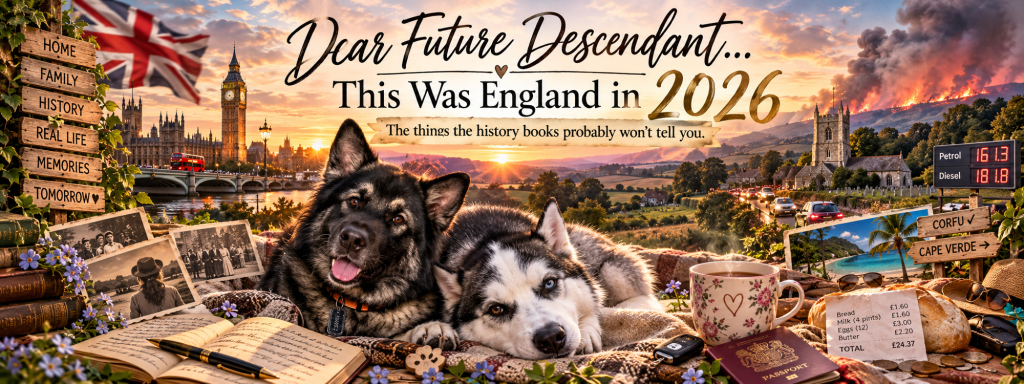
If you are reading this in fifty or perhaps even a hundred years from now, then I imagine 2026 is simply history to you.
A date. A line on a timeline. Perhaps something you once studied at school.
There will be records telling you who was Prime Minister, what was happening politically, how many people lived in Britain and what was happening around the world.
There will be newspaper archives, government records, statistics, photographs and television footage.
You will be able to discover how many people crossed the English Channel in small boats.
You will be able to read about wars, governments, elections, artificial intelligence, climate change and the economy.
You might even be able to discover what the weather was doing on the very day I sat here writing this.
But none of those things will necessarily tell you what I really want you to know.
What did it actually feel like to be alive in England in 2026?
What did we worry about? What frightened us? What made us angry? What made us laugh? What did we talk about around the dinner table? What did it cost to fill the car? How much was a loaf of bread? What was happening outside our front doors?
And amongst all those enormous events that will eventually become history, what were the little things happening inside one completely ordinary family?
Because that is the history I am always searching for when I research our ancestors.
Not simply when they were born and when they died.
I want to know what they worried about.
What made them laugh.
What they ate for dinner.
What they complained about.
What frightened them.
Who they loved.
What they dreamed about.
What ordinary life actually felt like.
And of course, they didn't know I would come looking for them.
But I know that perhaps one day, you might come looking for me.
So, future descendant of mine, pull up a chair.
Because I was here.
And bloody hell...
What a year.

I am writing this in October 2026, so technically the year hasn't even finished yet.
Quite frankly, I think it has done enough.
I have already found myself wanting to grab 2026 firmly by the shoulders and say: Could you please just stop now?
This has been one of those years that seems determined to leave fingerprints all over you.
Some years drift quietly through our lives. We remember a holiday, a birthday, perhaps a Christmas, but otherwise they disappear into the collection of ordinary years behind us.
I don't think 2026 will ever disappear for me.
It has hurt too much.
This was also a year in which our family experienced the heartbreak of losing somebody we loved.
And with that loss came an empty space that hadn't been there before.
Of course, grief is different for everyone. We all have our own relationships, our own memories and our own ways of carrying the sadness that comes when somebody is no longer here.
And perhaps that is something statistics will never record properly.
A death certificate can tell you that somebody died.
It cannot tell you about the silence they leave behind, the memories that suddenly become more precious or the little moments when their absence is unexpectedly felt.
It cannot explain how somebody can be woven so naturally into the fabric of a family, becoming part of its stories, celebrations and everyday moments, until one day they are no longer there.
And somehow, life must find a way to carry on.
Grief is peculiar like that.
Life continues with extraordinary rudeness.
Bins still need putting out. Washing still needs doing. People still ask what you fancy for dinner. Dogs still need feeding. The kettle still boils. The sun has the audacity to rise the following morning.
And somewhere amongst all that normality, a family is learning to live with somebody missing.
Not everyone feels that absence in the same way, or carries it with the same weight.
But the love, the memories and the place that person held within the family remain part of its story.
And surely, that is something worth remembering.

England Felt Unsettled.
Outside our own little family world, England felt unsettled too.
I don't know how the history books will describe Britain in 2026.
Perhaps, looking backwards, everything will seem obvious.
History has a wonderful way of tidying things up after the event.
Living through it isn't tidy.
Immigration, particularly people arriving across the English Channel in small boats, remained one of the biggest and most divisive subjects in Britain.
There were arguments about borders, asylum, immigration, hotels, housing, public services and what the government should or shouldn't be doing.
Everybody seemed to have an opinion.
Including me.
I worried about illegal immigration and whether our borders were properly controlled.
I worried about ordinary British families who were already struggling and felt forgotten.
I worried about the direction our country was travelling in.
I became frustrated with the government.
I sometimes felt as though the concerns of ordinary people weren't being properly heard.
But behind all those political arguments were human beings.
That mattered too.
Some people were frightened about what was happening to the country they loved.
Others had fled countries where they themselves had been frightened. It was complicated.
And perhaps that is something that gets lost when history is reduced to headlines.
You could be concerned about immigration policy and border control without losing your humanity towards the individual people caught up in it.
Mostly, I think I wanted ordinary people's concerns to be listened to rather than dismissed.
There seemed to be so much shouting in 2026.
And not nearly enough listening.

And Then There Was the Fear of War.
There was another shadow hanging over 2026.
War.
For much of my life, a major war directly involving Britain had felt like something belonging to my grandparents' generation and the history books.
By 2026, it didn't always feel quite so remote.
War continued in Ukraine. Conflict and instability elsewhere in the world filled our television screens. Governments talked increasingly about defence, military preparedness, hostile states and threats to European security.
Suddenly conversations about whether Britain was prepared for war didn't sound quite as unimaginable as they once had.
Imagine reading words like that while looking at your children.
Because politicians can talk about defence strategies, military spending and national security.
A mother hears something different.
A mother hears:
Could my children one day be asked to go to war?
That frightened me.
I didn't want somebody else's argument to become my children's battlefield.
I didn't want another generation of mothers standing at doors saying goodbye to their sons and daughters without knowing whether they would ever walk back through them.
Every generation believes humanity has finally learned.
And then history reminds us that perhaps we haven't.
I desperately hope that by the time you are reading this, war feels as distant to you as I once believed it did to me.

A New Kind of Fear: Artificial Intelligence.
There was something else happening in 2026 that I suspect will make this blog particularly fascinating to you.
Artificial intelligence.
And here's the strange thing.
I used AI myself.
I used it creatively.
It helped bring music to lyrics I had written when I didn't have the musical ability to perform them myself.
It helped turn ideas into pictures.
It could be absolutely extraordinary.
But I could also see the frightening side of it.
AI was developing so quickly that sometimes I wondered whether humanity actually understood what it was creating before racing ahead to create the next version.
By 2026, deepfakes, AI-generated or manipulated photographs, video and voices capable of making somebody appear to do or say something they never did, had become enough of a concern that the UK government was researching how to detect them, while acknowledging that detection technology itself was still at an early stage.
There were worries about scams.
Misinformation. Jobs. Privacy. Cyberattacks. Manipulation.
What would happen when ordinary people could no longer tell whether the photograph they were looking at was real?
Or whether the voice they were hearing actually belonged to the person speaking?
Or whether a video showed something that had ever happened at all?
And beyond those immediate problems were much bigger questions about increasingly capable artificial intelligence and how safely humanity could control the technology it was developing. The UK government was commissioning substantial research into AI security and its potential vulnerabilities by 2026.
That contradiction fascinated me.
I could sit at home in England using AI to bring one of my songs to life...
while simultaneously wondering:
Where on earth is all this going?
Perhaps you are laughing as you read this.
Maybe AI is completely normal in your world.
Perhaps you have an AI living in your house.
Perhaps AI has cured diseases we couldn't cure.
Perhaps it has transformed education, medicine and science.
Or perhaps you're reading this and thinking:
Oh, Lainey. You really had absolutely no idea what was coming.
And you're right.
I didn't.
That is precisely why I am writing it down.
In October 2026, we were living through an extraordinary technological change without really knowing where it would eventually lead.

Watching Sacred Places Being Attacked.
Another thing that deeply saddened me was seeing reports of Christian churches and sacred places across Europe being vandalised, desecrated and, in some cases, deliberately set on fire.
That devastated me.
Whatever somebody's religion or whether they have any religion at all, a place where generations have worshipped, married, baptised their babies, mourned their dead and buried their families feels as though it should be respected.
These buildings aren't simply bricks and stained glass.
They contain people's history.
They contain weddings and funerals, Christenings,
Generations of whispered prayers.
For somebody like me, who spends so much time searching for ancestors in parish records, wandering through old churchyards and trying to reconnect names on pieces of paper with the places where those people actually lived, these buildings have another meaning too.
A church can be one of the last surviving places on Earth that you know your ancestor once stood inside.
That matters to me.
But 2026 was also a time when we had to become increasingly careful about what we believed online.
Real acts of vandalism, desecration and arson happened.
But false or misleading stories could travel around social media just as quickly.
That was another strange reality of our time.
Terrible things genuinely happened.
False stories travelled alongside them.
And increasingly, working out which was which became part of simply being alive.

When the Countryside Around Us Burned.
Then there were the fires.
That summer, England seemed frighteningly dry.
We heard about wildfires and grass fires in different parts of the country, but when something happens somewhere far away, however awful it is, there is inevitably a little distance between you and it.
Then the New Forest caught fire.
And suddenly there was no distance at all.
This was home.
The New Forest has always felt like one of those places that is simply there.
Ancient.
Beautiful.
Almost permanent.
Ponies wandering freely.
Heathland stretching into the distance.
Old trees that have watched generations of people come and go.
And in August 2026, we watched part of it burn.
A vehicle fire on the A31 spread into the surrounding countryside and developed into a huge wildfire.
Firefighters came from across the country.
Smoke hung across the landscape.
Roads were affected.
Crews battled the fire in extraordinary heat.
This wasn't some distant photograph on the television.
These were roads we knew.
Places we recognised.
A landscape that belonged to our everyday world.
Watching somewhere so familiar burn was frightening.
There is something deeply unsettling about seeing flames move through a landscape you have always regarded as permanent.
Trees can outlive us.
Woodland can feel eternal.
And then suddenly fire reminds you how fragile everything actually is.

And Then Tytherley Burned.
As if the New Forest fire wasn't close enough to home, another fire frightened me for a completely different reason.
On 9 August, a huge fire broke out just down the road from our home, in the next village, West Tytherley.
Approximately 40 hectares of straw and grass were involved. More than 50 firefighters from Hampshire worked alongside crews from Dorset and Wiltshire, while local farmers used agricultural machinery to create firebreaks and help prevent the blaze from spreading. The fire was eventually extinguished at around nine o'clock that evening, with crews returning afterwards to deal with hotspots.
But to me, West Tytherley isn't simply another Hampshire village on a map.
My history is there.
My paternal ancestors are buried there.
Their church and churchyard are part of the landscape through which I have been piecing together the story of the people who came before me.
And that fire got far too close to that church for my liking.
I remember that horrible feeling of knowing what was happening and thinking about those graves.
It might sound strange to somebody who doesn't share my obsession with family history.
After all, the people buried there have been gone for generations.
But they are my people.
Their graves are among the few physical things still connecting me to lives lived long before mine.
Names carved into stone.
A church they would have known.
Ground they once walked upon.
Places where their families stood and mourned them.
When you spend years researching people who can no longer tell you their stories, places become enormously important.
A church isn't simply a building.
A grave isn't simply a stone.
They are anchors.
Proof that somebody was here.
So watching fire getting dangerously close to somewhere containing part of my own family history genuinely frightened me.
Thankfully, firefighters, farmers and local people worked together and stopped that fire spreading further.
And I was enormously grateful.

Fire After Fire.
The frightening thing was that these weren't isolated incidents.
The hot, dry conditions meant fires could spread frighteningly quickly.
And suddenly all those conversations about extreme weather and changing climates didn't feel quite so abstract.
It was happening around us.
Perhaps by the time you are reading this, summers like ours in 2026 are normal.
I desperately hope they aren't.
Maybe humanity got its act together.
Maybe technology changed everything.
Maybe you look back at our generation and wonder why we didn't move faster.
I don't know. All I can tell you is what it felt like from here. It felt unsettling.
War was happening in Europe.
Politics at home felt increasingly divided.
Immigration dominated conversations.
Artificial intelligence was advancing at a speed that was both astonishing and frightening.
Sacred places were being attacked.
The cost of simply living keep climbing.
And then, during that extraordinarily hot, dry summer...
even the countryside around us started burning.
There were moments in 2026 when I genuinely wondered what on earth was happening to our world.
But there was another side to those fires that I want you to know about too.
People came running towards them.
Firefighters worked through exhausting heat.
Crews travelled from other counties.
Farmers climbed into their machinery and created firebreaks.
Communities helped one another.
And perhaps that is another little piece of 2026 worth preserving.
Because when I look back at this year, it would be very easy to remember only the frightening things.
But whenever something terrible happened, there were almost always ordinary people quietly appearing to help.
Maybe that's humanity in a nutshell.
We make an extraordinary bloody mess of things sometimes.
And then somebody turns up with a tractor and tries to put it right.

What Did It Actually Cost to Live in 2026?
Now, future descendant, this bit is especially for you.
Because whenever I research our ancestors, I find myself wondering about the ordinary things.
What did their shopping cost?
What did they earn?
Was food expensive to them?
How much did it cost to keep their home warm?
Those tiny details somehow make another time feel real.
So I'm leaving some of ours behind.
Prices varied depending on the shop, brand, size and whatever special offer happened to be running that week, but an ordinary loaf of bread could easily cost somewhere around £1.40 to £1.80.
Four pints of milk could be around £1.50 to £1.70.
A dozen eggs could easily be £3 or more.
A block of butter could be around £2 or more.
And a supermarket trolley that didn't appear to contain anything particularly exciting could produce a total at the checkout that made you wonder whether you'd accidentally purchased part of the building.
Food and non-alcoholic drink prices were still rising too. Official figures showed them 1.3% higher in August 2026 than a year earlier.
But then there was fuel.
Oh, fuel.
In August 2026, the official UK average was 161.3 pence per litre for petrol and 181.8 pence for diesel. Fuel prices had risen sharply that month, and transport costs were one of the biggest forces pushing inflation higher.
Think about that for a moment, future descendant.
We bought fuel by the litre.
And filling a car could swallow a frightening amount of the weekly budget.
Heating and electricity were another worry.
In August 2026, electricity, gas and other fuel prices were 6% higher than a year earlier, while housing and household services were up 4.3%.
We noticed.
You thought about whether the heating really needed to go on.
You noticed the supermarket bill.
You noticed when the car needed filling.
You noticed insurance renewals.
You noticed council tax.
You noticed electricity.
You noticed everything.
It sometimes felt as though every ordinary part of being alive had acquired another bill.
Perhaps by the time you're reading this, paying for things with actual money seems terribly old-fashioned.
Maybe nobody drives cars anymore.
Maybe you have some sort of implant in your hand.
Maybe Athena would have had a robotic dog walker.
Actually, no.
Athena would absolutely have refused to go anywhere with a robotic dog walker.

But Now for Something Wonderful.
Because 2026 wasn't just grief, politics, wildfires, money, war and worrying about whether the robots were eventually going to take over.
There was love too.
And as I sit here writing this, something very special is approaching.
My hubby's 50th birthday.
My love will be fifty in less than a month.
How did that happen?
To celebrate, we have something wonderful ahead of us.
We're going to Cape Verde.
And while we're there, we're going to spend a day helping at a dog and cat rescue.
I genuinely cannot wait.
Dog rescue is something I am enormously passionate about.
There is something about animals who have been abandoned, neglected or simply born into circumstances they never chose that gets right underneath my skin.
If I could save them all, I probably would.
Actually, knowing me, I'd attempt it.
And then my hubby would come home to discover approximately 147 dogs living in the house.
So spending even one day of our holiday giving our time to dogs and cats who need some kindness feels incredibly special to me.
It isn't glamorous.
It isn't some fancy excursion.
But I suspect it may become one of my favourite memories from the whole holiday.

Fifty Deserves More Than One Celebration.
We actually started celebrating Mark's 50th a little early.
We had a week in Corfu.
And it was wonderful.
Most importantly, it gave us something that becomes more precious the longer you are together:
time.
Proper time.
Time away from ordinary life.
Time to talk.
Time to laugh.
Time to simply be us.
Unfortunately, because apparently 2026 hadn't quite finished testing me, I was very unwell while we were there.
That definitely put a dampener on things.
I was so disappointed because I had wanted the trip to be perfect for him.
But despite being ill, I treasure that week.
Because we were together.
And sometimes that is enough.
Now I'm crossing absolutely everything that Cape Verde gives us what Corfu couldn't quite manage:
pure joy and adventure.
No illness.
No disasters.
Just sunshine, laughter, animals, exploring and celebrating the man I love turning fifty.
Please, 2026.
You owe me this one.
Two Holidays for the Love of My Life
And future descendant, there's something else I want you to know.
Those holidays didn't simply happen.
I saved extremely hard for them.
I wanted Mark's 50th year to be special.
So I saved.
And saved.
And probably saved some more.
Because sometimes love looks like romance and grand declarations.
Sometimes it looks like holding someone's hand.
Sometimes it looks like staying beside them through the worst moments of their life.
And sometimes...
love looks like quietly putting money away month after month because the person you adore is turning fifty and you want to give them memories instead of things.
That's what these holidays were about for me.
Not luxury.
Not showing off.
Memories.
After everything 2026 had thrown at us, I wanted something beautiful to look forward to.
I wanted adventures with my love.
Because if this year has taught me anything, it is that time is not guaranteed.
So while we have it...
I want us to use it.

And Then There Were Athena and Obito.
Of course, ordinary life at home continued under the strict supervision of two extremely important family members.
Athena and Obito.
Future descendant, should you ever find photographs of an extraordinarily beautiful Siberian Husky looking as though she considers herself considerably more sophisticated than the humans around her...
that's Athena aka Princess Miss Pants.
Elegant, stubborn and apparently convinced that wet grass is a personal insult.
And if beside her you find an enormous Alaskan Malamute looking like he has just discovered either food or trouble...
that's Obito aka Mr Toe Beans aka Baby Bear or Lord Beans.
Completely ridiculous. Completely adored.
Animals have a wonderful way of dragging you back into the present.
The world can feel as though it is falling apart, politicians can be arguing, war can be threatening, wildfires can be burning frighteningly close to home, AI can be advancing at an extraordinary speed and your heart can be carrying grief...
and then a dog steals a sock.
Suddenly, for thirty seconds, everything is all right again.

My Boys were Growing Up.
That was another strange thing about this part of my life.
My children weren't really children anymore.
When you become a mum, nobody warns you that one day the little people whose entire world once fitted inside your arms will become adults with lives, homes, relationships, dreams and heartbreaks of their own.
And apparently you are expected to cope with this.
I would like it officially recorded that I object.
In 2026 I discovered again that when your child's heart breaks, yours doesn't remain conveniently intact.
You cannot fix it.
You cannot take the pain away.
You cannot climb inside their chest and carry it for them, however desperately you might want to.
You simply love them through it.
And sometimes being a mother to an adult child means standing nearby while they hurt and resisting every instinct you've had since the day they were born to make everything better.
That was one of the hardest lessons of this year.

And I Kept Writing.
Through all of it, I wrote.
Goodness, did I write.
Blogs.
Family histories.
Book reviews.
Songs.
Thoughts.
Memories.
Things that made perfect sense.
Things that probably only made sense to me.
I disappeared into records belonging to people who had lived long before me.
Birth certificates, Marriage certificates, Census returns, Graves, Names written in beautiful old handwriting.
Tiny fragments of lives scattered through archives.
I followed Susan Luke through nineteenth-century Hampshire.
I wrote about Charles Hatcher.
William Hatcher.
The Willats family.
The Greens.
The Butts.
People who could never have imagined that generations later, one slightly obsessive descendant would be sitting in England in 2026 trying desperately to put their lives back together.
And somewhere along the way, something occurred to me.
One day, I will be one of them.
One day somebody might search for me.
They might find my birth, my marriage, my children, where I lived.
Perhaps they'll find photographs.
Perhaps they'll find Intwined.
Perhaps...
they'll find this.
And that changed something in me.
Because I realised I didn't only want to research my ancestors.
I wanted to leave something for my descendants.
I wanted to write myself into history.
Not because I believed my life was particularly important, it’s for from that.
But because I have spent years discovering that supposedly ordinary lives are anything but ordinary.

The Things I Want You to Know.
So here are the things no census will tell you.
I loved deeply.
Probably too deeply sometimes.
I worried far too much.
I laughed until I couldn't breathe.
I cried over people.
I cried over dogs.
I cried over books.
Actually, judging by 2026, I cried over practically bloody everything.
I loved disappearing into an audiobook.
I loved genealogy because bringing forgotten people back into the light felt a little like defeating time.
I loved my family fiercely.
I loved my dogs ridiculously.
I wrote song lyrics even though I couldn't sing them myself.
I dreamed.
I got things wrong.
I occasionally swore.
All right...
I frequently swore.
I wondered what the hell was happening to the world.
I worried about England.
I worried about war.
I worried about my children.
I worried about technology moving faster than humanity's ability to understand it.
I worried about the countryside around me burning.
I worried about history disappearing.
I worried about the future.
And despite all of that...
I still believed there was goodness in people.

Ordinary Life Was Still Beautiful.
This is perhaps the part I most want you to understand.
When you read history, enormous events swallow everything else.
Governments.
Wars.
Elections.
Migration.
Economics.
Technology.
Wildfires.
Deaths.
Crises.
But those things aren't actually what most of life feels like while you're living it.
Life happens in between them.
Life is somebody putting the kettle on.
A dog asleep in a ridiculous position.
Your husband making you laugh when you're trying to be cross.
Saving for months so you can take the man you love somewhere beautiful for his 50th birthday.
A message from somebody you love.
Getting lost in an audiobook.
Finding an ancestor after hours of searching and announcing their discovery as though you've personally solved one of history's greatest mysteries.
Standing beside a grave and quietly saying hello to somebody who died long before you were born.
A photograph.
A song.
A family dinner.
A holiday countdown.
A memory suddenly returning because of a smell.
Laughing when you really thought you had forgotten how.
That was life in England in 2026 too.
And I don't want the big things to erase the little ones.
So, What Was 2026 Really Like?
It was difficult.
It was uncertain.
It was noisy.
Britain often felt divided and frustrated.
Personally, our family knew grief.
There were days when the news made the world seem frightening.
There were days when the flames were frighteningly close to places I loved.
There were days when my own little world hurt enough without worrying about the rest of it.
There were moments when I genuinely wanted to ask:
2026, haven't you taken enough?
But it didn't take everything.
That's the bit I want history to remember.
There was still love.
There was still family.
There was still laughter.
There was Corfu.
And hopefully, very soon, there will be Cape Verde.
There were still dogs stealing things they absolutely knew they weren't allowed to have.
There were still animals waiting for somebody to show them kindness.
There were firefighters running towards flames while the rest of us hoped and prayed they'd be safe.
There were farmers using their machinery to protect their communities.
There were still books waiting to be read.
Ancestors waiting to be found.
Stories waiting to be written.
Songs waiting for words.
Places waiting to be visited.
There were still tomorrows.
I sometimes wonder whether my ancestors felt exactly the same.
Perhaps Susan Luke stood somewhere in Hampshire almost two hundred years before me, worrying about her children and wondering what on earth the world was coming to.
Perhaps somebody in every generation has.
Maybe one of my paternal ancestors walked through that churchyard at Tytherley and worried about the things happening in their world.
They could never have imagined that generations later, one of their descendants would be sitting here worrying as fire came far too close to the place where they were laid to rest.
And they certainly couldn't have imagined artificial intelligence.
The scenery changes.
The politicians change.
The clothes change.
The technology becomes almost unrecognisable.
But people?
Maybe we aren't so different.
We love.
We worry.
We lose people.
We carry on.
We find reasons to laugh.
And we hope the people who come after us will have things a little easier.
So if you are one of those people...
Hello.
I'm Lainey.
I was here.
This was my England.
This was my family.
This was 2026.

And we still put the kettle on when life got difficult.
Because some things in England apparently never change.

History isn't only kings, governments, wars and dates.
History is ordinary people buying milk on a Tuesday morning.
It is putting petrol in the car.
It is wondering whether to turn the heating on.
It is smelling smoke in the air and wondering how close the fire is.
It is worrying about a churchyard because people you never met, but somehow love, are buried there.
It is saving for a holiday.
It is walking the dogs.
It is making a cup of coffee.
It is loving your children.
It is celebrating your husband's 50th birthday.
It is spending a day of your holiday helping an animal who has nobody else.
It is missing somebody who should still be sitting at the table.
It is being frightened about tomorrow...
and booking the holiday anyway.
2026 hurt me.
It frightened me.
It made me angry.
It made me question where the world was heading.
But it also made me understand something.
Life is happening now.
Not when the world becomes peaceful.
Not when politicians finally sort themselves out.
Not when/if everything becomes affordable.
Not when grief disappears.
Not when we stop worrying.
Now.
So I am going to Cape Verde with my love.
I am going to celebrate his fifty years on this earth.
I am going to cuddle some rescue dogs.
Probably cry over them.
Almost certainly want to bring several home.
And I am going to keep making memories.
Because after everything this year has taught me, perhaps that is my little act of defiance against 2026.
You can frighten me.
You can hurt me.
You can make me angry.
You can make me worry about the world my children and their children will inherit.
But you don't get to stop me loving it.
And if you remember nothing else about me after reading all these words I've left scattered across the internet, remember this:
I loved my people with everything I had.
I loved my animals.
I loved my history.
I loved my Hubby.
I loved my boys.
I loved this complicated, beautiful, frightening little life of mine.
And even in one of the hardest years of my life...
there were still little pieces of beautiful everywhere.
Until next time,
Toodle pip,
Lainey.
🌼🌼🌼

