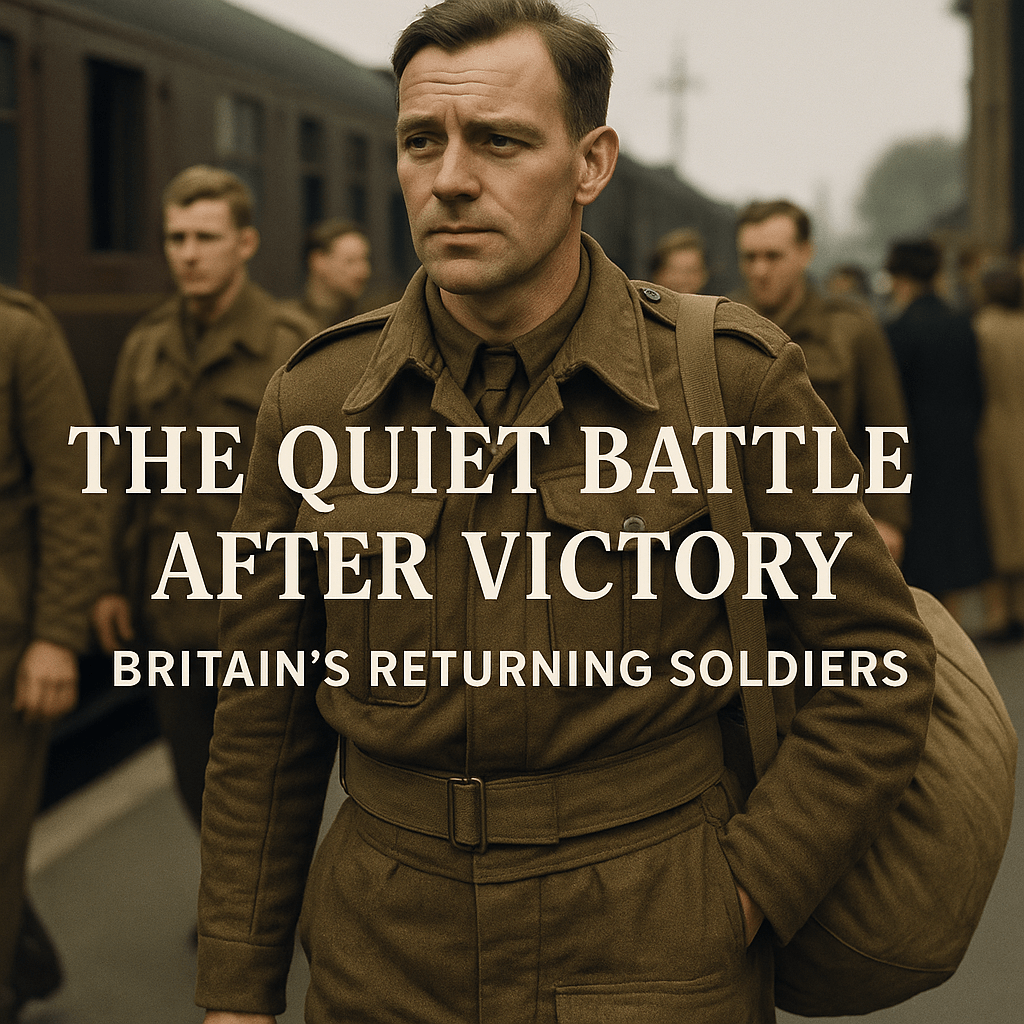
The journey home was meant to be the ending everyone dreamed of. Trains slowing into familiar stations, steam curling into the air, arms opening, doors finally unlocked. Yet for many British veterans of the First and Second World Wars, homecoming was not a simple return to what had been left behind. It was the beginning of another struggle, quieter but no less demanding, a battle fought without bugles or banners, where wounds were often invisible and courage had to be found anew each day.
The first reckoning was often physical. Men returned with bodies forever changed by war. Some carried wounds that announced themselves immediately, missing limbs, damaged lungs, faces reshaped by shrapnel and flame. Others bore injuries less obvious but no less relentless, chronic pain, weakened hearts, hands that trembled, joints stiffened by cold and damp. Medical care existed, but understanding was limited and uneven. Prosthetic limbs were heavy and awkward, more functional than kind. Rehabilitation was brief and practical, rarely gentle. Many veterans learned to navigate the world again through trial and quiet endurance, masking daily discomfort behind politeness and restraint.
Yet the deepest wounds were those no one could see. What we now recognise as trauma was then called shell shock, a phrase spoken carefully or avoided altogether. Men startled at sudden sounds, froze at backfiring engines, woke drenched in sweat from dreams they could not name. Silence became a refuge when language failed. Some could not sit with their backs to doors, could not rest without listening for danger. The war lingered in their nerves, in their breathing, long after uniforms were folded away. Families noticed changes but lacked the words or knowledge to bridge the distance. Love remained, but it had to learn new shapes.
Work, once imagined as a return to normality, often proved another test. Britain needed rebuilding, yet the labour market was strained. Jobs were scarce, skills had shifted, and bodies were not always able to meet old demands. Some employers hesitated, unsure how broken a man might be. Veterans moved from position to position, carrying frustration quietly. Pride made it difficult to ask for help. Identity, once anchored in service, structure and comradeship, felt suddenly unmoored. The clarity of wartime purpose was replaced by uncertainty, and for many, that loss cut deeply.
Perhaps most painful was the disappearance of wartime belonging. At the front, life had been stripped to essentials. Bonds were forged in shared danger, loyalty sharpened by survival. Back home, life felt scattered and strangely small. Decisions about shops, schedules and conversations seemed trivial compared to the immediacy of life and death. Friends and family listened kindly but could not truly understand. Stories were shortened, softened, then left untold. Silence grew not from indifference, but from too much memory.
Home itself was no longer quite the same. Streets had been rebuilt or bore scars. Neighbourhoods had shifted. Children had grown taller, more independent. Wives had learned to manage households alone, to make decisions, to carry responsibility with quiet competence. Reunions were joyful but delicate. Couples had to renegotiate space, authority and expectation. Love endured, but it had been reshaped by absence and survival. Some relationships deepened through patience and tenderness. Others strained beneath unspoken grief and the weight of what could not be shared.
And still, there were moments of grace. Many veterans found comfort in routine, in gardens turned carefully with familiar tools, in workshops, allotments and quiet walks. Veterans’ organisations offered belonging when the wider world felt distant. Groups like the British Legion, founded after the First World War, became lifelines, places where shared experience required no explanation. A glance, a joke, a pause said everything. Humour returned cautiously, often dark, but deeply human. Service to others, through mentoring, volunteering or community work, offered renewed purpose and a way forward.
The nation itself struggled to receive its returning soldiers fully. Monuments were raised, medals awarded, parades held. These gestures mattered, but daily support often lagged behind ceremony. Pensions were modest, mental suffering poorly understood, and many veterans felt expected to be grateful simply to have survived. Recognition did not always translate into care. Stories were carried privately, shared only with those who had been there. This silence shaped families for generations, echoing in habits of thrift, emotional restraint and fierce self-reliance.
As years passed, some veterans found their voices at last, sharing memories with children or grandchildren. Others never spoke, their experiences expressed instead through behaviour, values and quiet reactions to sound or sudden change. Their families inherited fragments of those stories, sensing them in pauses, in the way peace was cherished, in the seriousness with which freedom was treated.
Returning home after war was not a single moment, but a long, uneven journey, sometimes lasting a lifetime. It required courage of a different kind, the courage to live with memory, to build meaning from survival, to love again in a world that felt both familiar and strangely altered.
To remember Britain’s returning soldiers is to honour not only what they endured abroad, but what they carried home. Their struggle to rebuild life was not weakness, but testament. It reminds us that the end of war is never the end of its impact, and that healing is rarely swift or simple. Sometimes it is quiet, patient and ongoing, lived out in ordinary days shaped by extraordinary pasts.
In acknowledging that journey, we offer something long overdue. Compassion for the return. Understanding for the distance between who someone was before the war and who they became after. And gratitude not only for their service in battle, but for the bravery it took to keep living when the fighting was over.
Until next time,

Ta ta for now.

Yours, Lainey.