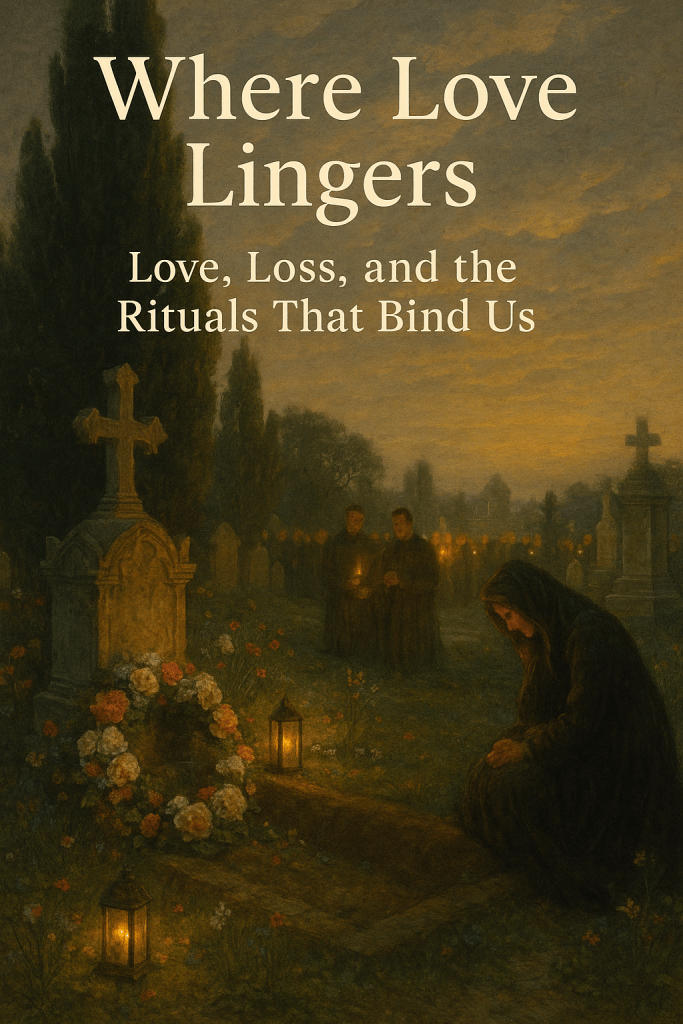
Funerals have always been the quiet crossroads where love and loss meet, where the living pause their daily rhythms and gather with soft voices to honor a story that has reached its final chapter. Across centuries, in England and throughout the world, burial rituals have changed in appearance, yet the tender instinct behind them has remained unwavering. The history of funerals is not simply the history of death. It is the story of humanity reaching across the veil, of love refusing to vanish, of people finding ways to hold one another up when the heart is heaviest. It is the poetry of farewell.
In early medieval England, funerals unfolded with a simplicity shaped by closeness to earth and kin. The dead were buried near family, or beside the humble churches that anchored villages against winter winds. Neighbors dug the graves with their own hands, each shovelful a gesture of devotion. The body was wrapped in linen or wool, the same simple fabrics that had accompanied life’s work and rest, before being returned to the soil. Church bells tolled from stone towers, not to sound despair, but to mark a passage, a guiding note to help the soul journey safely onward. Flowers, gathered from hedgerows and meadows, were placed upon the mound as a final kindness, for people believed the natural world should escort the departed, just as it had sheltered them in life.
With the rise of Christianity, funerals became encircled with prayers and sacred ritual. Priests recited Latin rites that echoed beneath timbered beams, and incense curled like whispered petitions toward heaven. The community walked behind the coffin along worn paths through fields or muddy lanes, their footsteps a quiet merging of grief and faith. Mourning was never solitary. It belonged to the village as much as the family, a woven act of compassion where sorrow was shared and softened.
Beyond England’s shores, burial customs blossomed into their own rich forms. In ancient Egypt, the dead were wrapped in careful layers of linen and placed into tombs painted with scenes of both earthly delight and eternal promise. In Japan, Buddhist rites created harmony between the living and the departed, with chanting and incense soothing hearts. In West Africa, funerals often became vibrant celebrations, filled with music and dance that honored both the sorrow and the glory of a life lived. In Indigenous American cultures, graves were lined with sacred objects and protective symbols, honoring the belief that death was a continuation of the journey rather than an ending. Though these customs differed in practice, they all reflected the same ancient truth: tenderness must accompany the dead.
As England moved from the medieval world into the Tudor and Stuart eras, funerals began to reflect the social tapestry of the time. Wealthier households draped their homes with black cloth, while mourners in formal attire joined solemn processions through village lanes or bustling city streets. Coffins grew more ornate, crafted by skilled carpenters in polished wood. Yet beneath these touches of grandeur, the old heart of the ritual remained. The church stood steady. Communities gathered. The land received the dead with its customary patience. Grief, whether wrapped in velvet or plain wool, felt the same.
The eighteenth century brought funerals that were not only solemn but deeply social. Neighbors arrived with gifts of food, offering sustenance as a balm. Sharing bread or ale became an unspoken language of comfort. Mourning clothes became customary, and craftsmen honed their skill in creating coffins that expressed both sorrow and respect. Elegy, poetry and letter-writing flourished, as people sought to name their grief with words that might steady their hearts.
The Victorian era transformed mourning into a sweeping ritual of devotion. When Queen Victoria lost Prince Albert in 1861, her long grief influenced a nation. Mourning attire became an art, with black crepe and jet jewelry forming a symbolic vocabulary understood by all. Funeral processions grew elaborate, with horses draped in ebony feathers pulling glass-sided hearses. Cemeteries transformed into beautiful, garden-like sanctuaries. Highgate Cemetery in London, with its ivy-draped tombs and winding paths, became a place where the living wandered not only to mourn but to remember, to reflect, to find serenity among angels carved in stone. Even sorrow carried a certain beauty in Victorian Britain, shaped by ritual and the belief that remembrance was a sacred duty.
Around the world, funerals blossomed in their own evolving traditions. Mexico’s Día de los Muertos adorned graves with bright marigolds and candlelight, celebrating the joyful proximity of living and dead. Tibet’s sky burials returned bodies to the open world, a gesture of humility and ecological reverence. Polynesian funerals blended sea breezes, chants and ancestral honor into ceremonies that echoed across generations. Each culture sang a different farewell, yet each carried the same refrain: a life is worthy of celebration, and the dead remain part of us.
In the twentieth century, English funerals grew quieter and more intimate. The 1902 Cremation Act made cremation increasingly common, offering families new ways to say goodbye. Mourning attire softened as modern fashion shifted, and rituals loosened, allowing families to shape funerals according to their own hearts. Yet the tenderness remained. People still gathered. Hands were still held. Memories were still shared in kitchens, gardens, chapels and sunlit parlors. Even as the world modernized, the instinct to honor the dead with gentleness did not fade.
Today, funerals are as varied as the lives they celebrate. Some take place in ancient churches where countless generations have whispered prayers beneath the same wooden beams. Others unfold in woodland burial grounds, where bodies return to the earth wrapped in natural fibers, accompanied by birdsong. Some families scatter ashes along hillsides or rivers that held meaning. Others gather for celebrations of life, where music, photographs and stories create a tapestry of remembrance. Grief has become personal again, allowed to take the shape it needs.
Across all these ages, all these customs, all these shifting rituals, one truth shines through: a funeral is an act of love. To gather at a graveside, to place flowers upon a coffin, to light a candle, to sing a hymn, to speak a name aloud, is to declare that this person mattered. Their life touched the world. Their absence is felt. Their presence is cherished still.
Funerals teach us what it means to love with courage. Burials remind us that the bonds between people run deeper than time. And history whispers gently that the end of a life is never the end of its light. Love lingers in memory, in story, in the quiet places of the heart, illuminating the path forward just enough for the living to keep walking.
Until next time,

Ta ta for now.

Yours, Lainey.