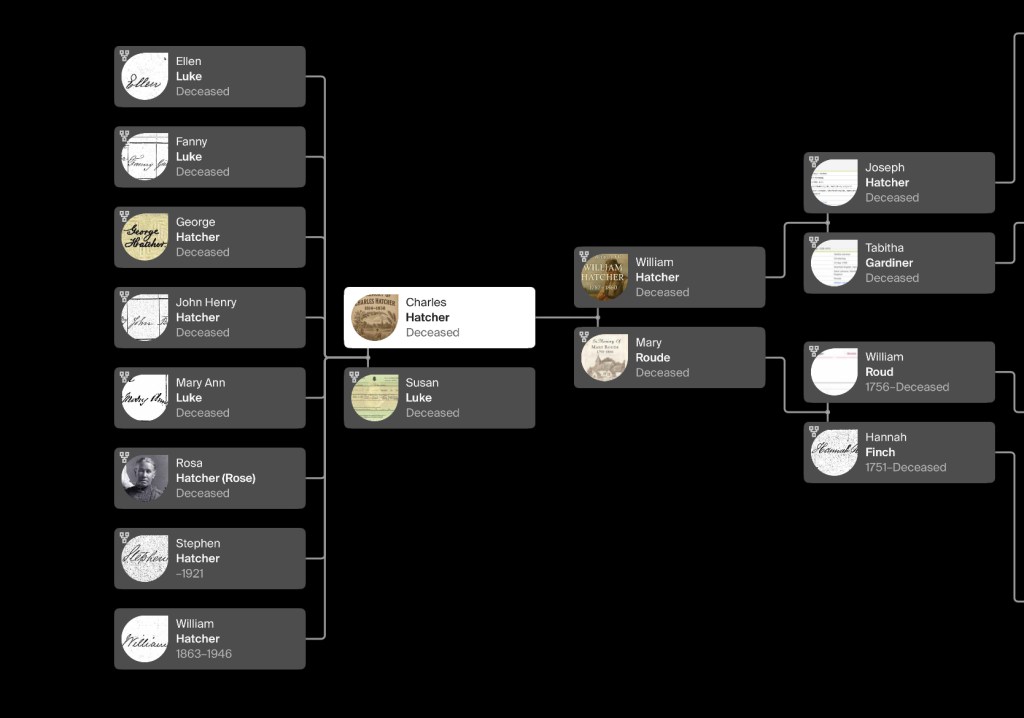
The frost had barely lifted from the fields of Lockerley when Charles and Susan Hatcher began their life as husband and wife. The echo of their vows still lingered in the rafters of St John’s Church, carried by the January wind across the hedgerows and open fields that had witnessed every chapter of their lives so far. The ink in the parish register was scarcely dry, their humble “X”s still glistening faintly on the page, small, trembling marks that bound their hearts more surely than any ring could.
Their marriage, though simple and unadorned, was a quiet triumph of endurance over circumstance, a union not forged by wealth or expectation, but by shared courage, faith, and the steady pulse of love born from hardship. For years, their connection had existed in the soft margins of village life, whispered between seasons, hidden in the tender silence of understanding. But now, before God and their community, it had been made whole.
As newlyweds, they returned not to comfort, but to work, to the same fields and lanes that had shaped them both. Their cottage, modest and weathered by time, became the heart of their world, a place where laughter mingled with the sound of the hearth, where the cries of children softened the rough edges of daily labour, and where each sunrise brought not leisure, but purpose.
Charles, like his father before him, toiled as a labourer, his hands calloused by years of tilling, binding, and mending. The rhythm of his days followed the ancient cadence of the land, sowing, tending, harvesting, his body an instrument of survival, his will an unspoken prayer. Susan, steadfast beside him, balanced motherhood with the quiet diligence of a woman who understood that love was measured not in words, but in endurance.
Together, they built a life in the shadow of the church where they had been wed, a life bound by the constancy of work and the unbreakable thread of faith. Though the world beyond Hampshire was stirring, the Industrial Revolution reshaping cities and fortunes, for Charles and Susan, time remained tethered to the seasons. Their world was one of earth and sky, of birth and death, of the intimate cycle that defines the lives of those who live close to the soil.
In those years that followed their marriage, their story would deepen, marked by joy and sorrow, by the laughter of children and the hush of loss, by the slow, steadfast companionship that only a lifetime of shared struggle can bring.
Charles’s hands would continue to serve the land that had raised him, his name would appear again and again in the quiet records of Lockerley and Sherfield English, each entry a fragment of a larger story, baptisms, burials, census lines, threads of ink that together would weave the portrait of a life both ordinary and extraordinary.
And though he could never have known it, the love and endurance that defined his days would echo far beyond his own time. For through every hardship, every breath of cold dawn air, every seed sown into the Hampshire soil, Charles Hatcher was not merely living, he was building a legacy, one that would ripple quietly through generations, reaching even to the present.
This is the story of those years, the years of marriage and making, of work and worship, of love tested and love proved.
It is the story of Charles and Susan Hatcher,
and of the life they built together, a life humble in its beginnings, sacred in its endurance, and eternal in the hearts of those who remember.
Welcome back to the year 1849, Lockerley, Hampshire, England.
The air is cool and damp with the scent of woodsmoke and turned earth. A faint mist lies across the fields at dawn, settling over the hedgerows that divide the farmland and curling softly through the narrow lanes that wind into the heart of the village. Life here moves slowly, marked not by the ticking of clocks but by the rhythm of the seasons, the tolling of church bells, and the steady pulse of human labour.
On the throne of England sits Queen Victoria, now in the twelfth year of her reign. She is a young mother and already a symbol of strength and respectability to her people, ruling alongside her beloved husband, Prince Albert. In London, the Prime Minister is Lord John Russell, a Whig reformer whose government wrestles with the growing pains of an industrial nation. Parliament debates the questions of progress and poverty, of railways and reform, but in the small Hampshire village of Lockerley, such distant voices carry little weight. The concerns here are simpler, closer to the soil and the soul: the harvest, the weather, the health of one’s children, the price of bread.
The divide between rich and poor is stark and unyielding. The wealthy few landowners, clergy, merchants, live in comfort, their homes warmed by coal fires and adorned with furniture of fine oak and velvet. They travel by carriage, their boots clean and their hands soft. For the working class, life is a continual struggle to earn enough to survive. Agricultural labourers like Charles Hatcher rise before dawn to work from first light until the fading of the day, their pay scarcely enough to feed a family. The poor, those without steady work or home, drift from parish to parish, sometimes ending in the dreaded workhouse, where dignity is stripped away as surely as comfort.
Fashion tells the story of class more clearly than words ever could. The gentry wear silks, satins, and tailored coats, the women in wide skirts supported by crinolines, their hair pinned neatly beneath bonnets. Among the labouring folk, clothing is practical and often patched many times over. Men wear coarse shirts, corduroy trousers, and waistcoats darkened by years of toil. Women dress in simple wool or linen gowns, aprons tied at the waist, hands stained with work and care. In winter, shawls and hand-me-down cloaks are wrapped tightly against the cold, and boots are prized possessions to be mended until the leather gives way.
Transportation in 1849 is slowly changing the shape of England. The railway, once a marvel, is now spreading like a steel web across the country, linking towns that had long seemed distant. Yet Lockerley remains a rural outpost, where horses and carts are still the chief means of travel, and most villagers live and die within a few miles of where they were born. The roads are rough and muddy, the inns few but friendly, and the thought of the railway coming this far is still more curiosity than reality.
Housing for working families is humble. Small cottages with thatched roofs and walls of brick or flint line the lanes. The rooms are few, often just two or three, with floors of packed earth or worn boards. Smoke curls through the air from open hearths where wood or coal burns low, the only source of heat and cooking. Windows are small, draughts constant, and privacy rare. Yet within these walls, families huddle close, laughter mingles with hardship, and love survives in the flicker of candlelight.
Heating and lighting are simple but precious. A small fire in the hearth is the heart of every home, its glow the only warmth against the chill of an English winter. Candles made from tallow or beeswax light the evenings, their flames soft and wavering. Oil lamps, when they can be afforded, burn more cleanly but are a luxury in poor homes. When darkness falls, work ends, and families gather by the fire, mending clothes, sharing stories, or simply sitting in the gentle hush of night.
Hygiene and sanitation are rudimentary at best. Water is drawn from wells or streams, often shared by many households, and waste is carried to cesspits or thrown into open drains. Soap is used sparingly, and bathing is an infrequent luxury. Illness spreads easily, especially in crowded cottages where damp lingers and fresh air is scarce. Outbreaks of cholera and typhus still haunt the country, and in 1849, as the last great cholera epidemic sweeps through parts of England, fear runs deep even in quiet villages like Lockerley.
Food is plain but sustaining. Bread, potatoes, porridge, and seasonal vegetables form the staple diet of working families. Meat is a rare treat, saved for Sundays or special occasions, often stretched into stews to make it last. Milk, butter, and eggs come from nearby farms, and fruit is gathered when the hedgerows are kind. The rich dine on roasts, puddings, and imported delicacies, but for most, a full stomach and a warm loaf are blessings enough.
Entertainment is found in simplicity. On Sundays, after church, the villagers talk in the lanes or share ale at the local inn. In the long evenings of summer, songs are sung, fiddles played, and stories told by the fire. There are fairs and markets, the annual harvest celebrations, and the quiet joys of courtship and kinship. Life is hard, yet there are moments of light, a baby’s laughter, a neighbour’s kindness, the first scent of spring after a harsh winter.
The environment of 1849 England is one of contrasts. The cities, now thick with smoke and soot, groan under the weight of industry, while in the countryside, the air still holds the purity of meadow and rain. Lockerley, nestled among its woods and fields, remains a place of green beauty, though even here, the signs of change creep in, the distant sound of train whistles, the rumours of machines that might one day replace men in the fields.
Gossip moves faster than the wind in a small village. The news of births, marriages, and deaths passes from doorstep to doorstep; the affairs of neighbours are woven into the fabric of everyday talk. Reputation is everything. The church, standing at the centre of life both spiritual and social, is where all are seen, judged, and remembered.
Schooling is sparse but growing. The young children of the poor may attend a parish school when not needed in the fields, learning their letters from a single Bible or slate. Many will leave by the age of ten to work, but even a little learning is prized. For those of means, private tutors and grammar schools offer a world of opportunity far beyond the reach of the labouring class.
Religion shapes every thought, every custom. The Sabbath is sacred, the church the heart of the community. Weddings, baptisms, and burials all pass through its doors, each a moment recorded in neat ink by the curate’s hand. Faith gives structure to lives otherwise marked by toil, a promise that the suffering of this world might find peace in the next.
Such was the year 1849 in Lockerley, Hampshire. A world of contrast, of beauty and burden, hardship and hope. For the Hatchers and others like them, life was not a tale of grand events but of small, enduring acts of love and labour. The world beyond their village was changing fast, but here, time still moved with the measured grace of the seasons, and the greatest wealth was found not in gold or grandeur, but in the steadfast beating of a human heart.
On Friday, the 9th day of February, in the year 1849, as winter lingered gently over the fields of Lockerley, a cry rose from a small cottage nestled among the hedgerows, the first breath of a child named John Hatcher. Outside, the frost still clung to the grass, glistening beneath a pale morning sun, while inside, the air was heavy with warmth, hope, and the quiet miracle of new life.
His mother, Susan Hatcher, just twenty-nine years old, gathered her newborn son to her breast, the weariness of labour softened by love’s first gaze. His father, Charles Hatcher, aged thirty-four, stood near, his hands still rough from toil, his heart softened by the sight before him. He was a man of the soil, a labourer who measured time not in days, but in harvests, in the steady turning of seasons, and now, another season of his own life had begun.
Their home was humble but full of heart. The faint scent of woodsmoke lingered in the air, mingling with the earthy scent of linen and life. Perhaps outside, the old church bell at St John’s marked the hour, ringing softly across the frozen fields, a sound that had witnessed every joy and sorrow of this small Hampshire village. For the Hatchers, that sound carried a new meaning now. It was the peal of beginnings.
A month later, on Friday, the 9th day of March, 1849, the child’s arrival was carefully recorded by Registrar William Green in the District of Mitchelmersh, within the Counties of Hants and Wilts, as entry number 493, a small, official mark upon the vast ledger of life.
1849. Births in the District of Mitchelmersh in the Counties of Hants & Wilts
No.: 493

When Born: Ninth of February 1849 at Lockerley

Name, if any: John

Sex: Boy

Name and Surname of Father: Charles Hatcher

Name and Maiden Surname of Mother: Susan Hatcher formerly Luke

Rank or Profession of Father: Labourer

Signature, Description, and Residence of Informant: The mark of Susan Hatcher, Mother, Lockerley

When Registered: Ninth of March 1849

Signature of Registrar: William Green, Registrar.
When the time came to register his birth, Susan made her mark with a trembling hand, not written in elegant script, but with a simple cross, “The mark of Susan Hatcher, Mother, Lockerley.” It was the mark of a woman who could not write her name, but who would shape a child’s life with strength far greater than words. That single mark held all the love, endurance, and quiet courage of a mother’s heart.
Charles, the proud father, carried the weight of both provider and protector. His life was not one of ease, but of honest toil, long days in the fields, his breath turning to mist in the cold dawn, his back bent beneath the will of the land. Yet within that hardship was a deep and steady pride. He was building something that no wealth could measure, a legacy rooted in love, in work, in faith.
And so, John entered the world not into grandeur, but into something far purer, a family stitched together by resilience, a home warmed by devotion rather than comfort. The winter of 1849 cradled them gently, the firelight flickering against the low beams of their cottage, as Susan whispered her son’s name into the quiet night.
John Hatcher, born of winter, born of labour, born of love. A son of Lockerley, his life beginning as his father’s had, humbly, faithfully, beneath the same soft Hampshire sky.
In him, the blood of generations stirred, the enduring pulse of the Hatchers, carried forward into a new season of life. And though he was but an infant swaddled in coarse cloth, he was already part of a larger story, one written not only in ink and registry, but in the beating hearts of those who came before him.
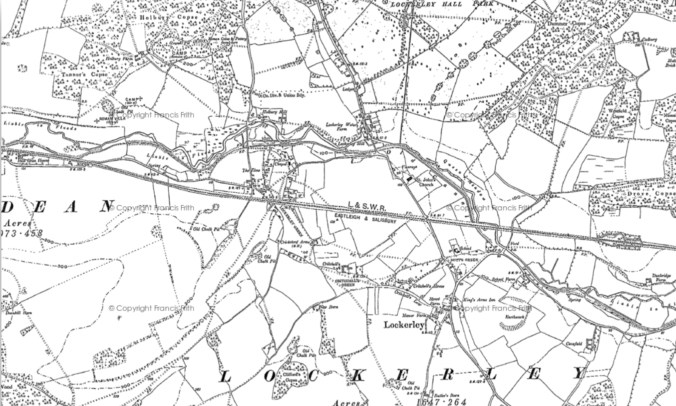
Lockerley is a village and civil parish in Hampshire, England, located on the southern bank of the River Dun, about two miles upstream from its junction with the River Test. The village is situated approximately 16 miles from Winchester, Salisbury, and Southampton, with Romsey, located around 8 km to the south-east, being the nearest town.
The history of Lockerley can be traced back to the medieval period, with evidence of its existence as early as the 12th century. In the Domesday Survey of 1086, Lockerley is recorded as a manor held by Hugh de Port. The village was part of the landholdings of Romsey Abbey, a significant influence in the area until the dissolution of monasteries during the 16th century. At the time of the Domesday Survey, the village consisted of one hide of ploughland, six acres of meadow, and woodland for three pigs. However, the ploughland was later absorbed into the King's forest by William I.
Architecturally, Lockerley is home to St. John the Evangelist Church, a building constructed in 1889–90 by architect J. Colson. The church is designed in a blend of Decorated and Perpendicular Gothic styles, featuring squared grey limestone with brown limestone dressings. The church includes a chancel with an outshot, a nave with transepts, and a southwest tower with a porch beneath. Inside, the church contains a marble reredos depicting the Last Supper, stained-glass windows, and a boarded roof with ribbed detailing. The church also boasts a stone pulpit, font in the Perpendicular style, and a carved screen in the north transept behind the organ.
In addition to the church, Lockerley is home to Lockerley Camp, an Iron Age hillfort located to the east of the village. This hillfort, covering approximately five acres, is a significant archaeological site, though much of it has been reduced by ploughing. A small area to the north remains within a coppice, where the earthworks are more discernible.
In the 19th century, Lockerley Hall was built by Frederick Dalgety, a wealthy merchant. The hall was used as a place to house soldiers during the First World War, and in the Second World War, it became a massive storehouse for the US Army in preparation for the Invasion of Europe. The site included 15 miles of sidings and 134 covered sheds.
Today, Lockerley is a vibrant community with a population of approximately 827 people. The village offers various amenities such as a shop, garage, and Lockerley C of E Primary School. It also has a Baptist chapel, and the Wessex Main Line railway crosses the parish with nearby stations at Dunbridge and West Dean.
The village is home to several local social groups and clubs, contributing to a strong sense of community. Among these groups are the Acorn Club, ArtSeen, Bell Ringers, Choir, Garden Club, Lockerley Silver Band, Women's Institute, and many others that provide opportunities for social engagement and cultural activities. These groups play a significant role in maintaining the active social life of the village.
While Lockerley is rich in history and community life, there are no widely documented myths or hauntings associated with the village. The absence of such stories may be attributed to the relatively modern development of the area and its continued use as a residential and agricultural community, which can sometimes prevent the development of folklore and ghostly legends.
Today, Lockerley continues to thrive, preserving its historical legacy while fostering a vibrant community life. The village is a reflection of rural England’s enduring spirit, with its mix of ancient heritage and modern growth shaping its identity.
In the year 1849, Charles rose each morning before the sun. The faint light of dawn would barely brush the frost from the hedgerows when he stepped out into the cold Hampshire air, his breath forming clouds that drifted into the stillness. The world around Lockerley stirred slowly, a cockerel’s call, the whisper of the wind through the bare trees, the distant sound of a cart upon the lane. For Charles, these were not just the sounds of morning, they were the steady pulse of life itself.
He worked the land because that was what life demanded. His hands, thickened by callus and toil, told the story of generations before him who had done the same. To be an agricultural labourer in mid-nineteenth-century England was to live by the rhythm of the earth, by its giving and its withholding, and Charles knew that rhythm well.
When the first light crept across the fields, he would already be at work, perhaps alongside other men from the village, hired by the local farmer who owned the land. There was little choice in the matter of work, you took what was offered and gave your strength to it without complaint. The hours were long, stretching from dawn until dusk, often twelve, sometimes fourteen hours a day, depending on the season and the weather.
In spring, Charles’s days began with the sowing of barley, oats, and wheat. The earth, damp and heavy, clung to his boots as he walked the furrows, scattering seed by hand from a sack slung over his shoulder. It was slow, careful work, demanding a steady pace and a patient heart. The farmer’s eyes were always upon him, measuring effort, judging output, for a labourer’s worth was not weighed in words but in what his hands could achieve.
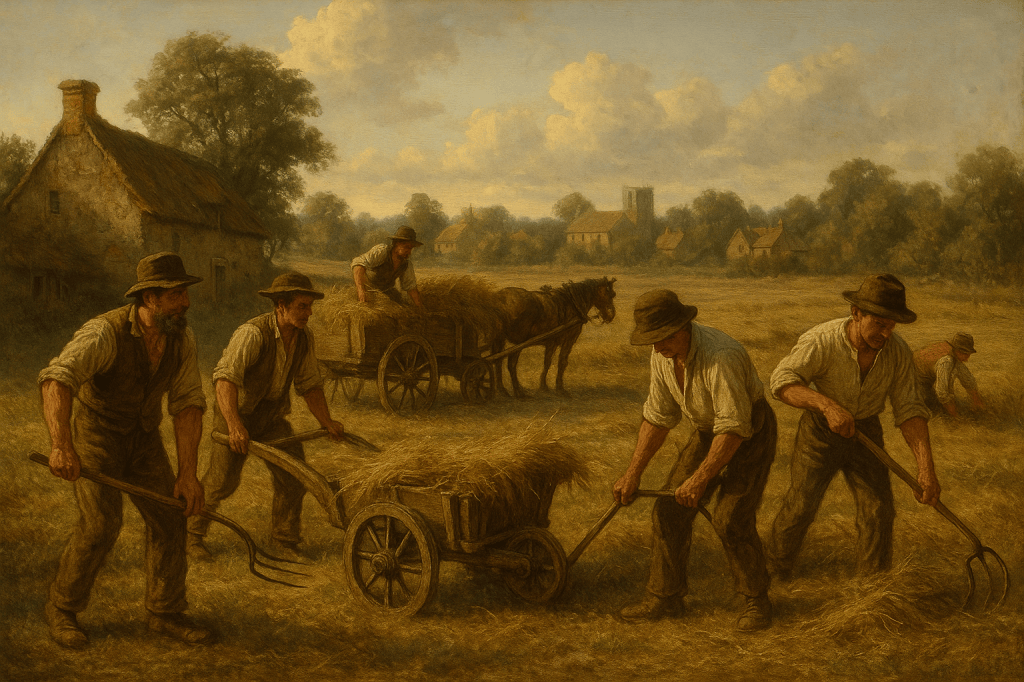
In summer, the long days brought the heat of the harvest. Charles, along with his fellow labourers, men, women, and even older children, would swing their sickles through the ripened grain beneath the wide Hampshire sky. The fields echoed with the sound of cutting, binding, and stacking. Sweat poured down their backs, the sun biting at their skin, and yet there was pride in the harvest. It was the culmination of all they had sown and tended, a momentary reward for months of back-breaking effort.
In autumn, when the air turned crisp and the fields glowed gold and brown, came the threshing, separating grain from chaff, often by hand, with flails that beat in rhythm like a slow, steady drum. Charles’s arms would ache, his body weary, but still he worked on, knowing that winter would bring hunger if the year’s yield was poor.
And then came winter, the hardest season of all. The fields lay bare and cold beneath grey skies, and work became scarce. Some days were spent repairing hedges, cutting wood, tending livestock, or draining the land, but often the pay was irregular and uncertain. For men like Charles, winter brought both hardship and fear. The wages that might have sustained them through summer were thin now, and the promise of steady work vanished with the frost. It was during those months that families drew close around the fire, rationing bread and hope in equal measure.
His pay, when the work was good, rarely exceeded ten shillings a week, sometimes less, barely enough to keep a roof overhead and food upon the table. Payment might come in coin or kind, perhaps with a few vegetables from the farmer’s store or a measure of grain. There was no guarantee, no security. Illness or injury could end a man’s livelihood in a single day. The work was unforgiving, and the dangers were many, the heavy wagons that might crush a foot, the blade of a scythe that could slip in exhaustion, the machinery of the new threshing machines that chewed through both straw and flesh without mercy.
Yet Charles endured. He did not complain. He was a man of few words, as many labourers were, his pride not in what he said, but in what he did. His employer likely saw him as steady, loyal, and strong, but there was little room for sentiment in such relationships. The farmers gave the orders, the labourers obeyed. At the end of each week, Charles might queue with the others at the farmhouse door to collect his wages, bow his head in thanks, and return home, his pockets light but his spirit determined.
In the evenings, when the fields had fallen silent and the light had faded from the sky, he would make his way home to Susan and their children. The warmth of the hearth greeted him, the smell of broth simmering, the crackle of the fire, the soft murmur of his wife’s voice as she soothed their infant son. His clothes were heavy with the scent of the land, earth, sweat, smoke, and hay, and when he sat, it was with the slow, aching satisfaction of a man who had given all that he could.
There was little leisure in such a life, and yet it was not without its quiet joys. A Sunday spent in church, the gentle hum of hymns filling the air. A walk through the fields at dusk, hand in hand with Susan, the sky painted in soft colours of fading day. The laughter of children outside the cottage door, chasing each other through the long grass. These were the moments that gave meaning to the hardship.
As 1849 unfolded, Charles’s world was one of endurance and routine, of labour bound by love. He worked not for riches or praise, but for survival and for those he held dear. Each dawn that rose over Lockerley found him the same, a man of the land, steady and unyielding, his strength tied to the soil beneath his feet.
And though the records would one day remember him simply as a “labourer,” those words scarcely hold the truth of his life. For within that humble title lived the spirit of a man who gave his every hour to the earth, who loved without measure, and whose quiet perseverance laid the foundation for generations yet to come.
In the heart of Hampshire, amid the turning of the seasons, Charles Hatcher lived out his days in rhythm with the world that had birthed him, a world of toil and tenderness, hardship and grace, and in every furrow he ploughed, every seed he sowed, there was the unspoken poetry of a life well-lived.
On a tender spring Sunday, the 25th day of March, 1849, the village of Lockerley stirred beneath a sky washed pale with morning light. The air was soft and fragrant with the promise of the season, damp earth, budding hedgerows, and the faint sweetness of primrose drifting through open doors. From the church of St. John’s, its flint walls silvered by time, the bells began to chime, their sound rolling out across the Hampshire fields in a slow, joyful rhythm. It was a sound that carried both reverence and renewal, echoing through the valleys and into the hearts of all who heard it.
Within those familiar walls, Charles and Susan Hatcher stood side by side, their infant son cradled in his mother’s arms. The child, John, born on a cold February morning just weeks before, now slept softly beneath the flicker of candlelight and the murmur of whispered prayers. His parents, humble folk of Lockerley, had known the weight of labour, the ache of survival, and the quiet pride of endurance, yet in that moment, as the curate’s words filled the sacred space, they knew only tenderness and grace.
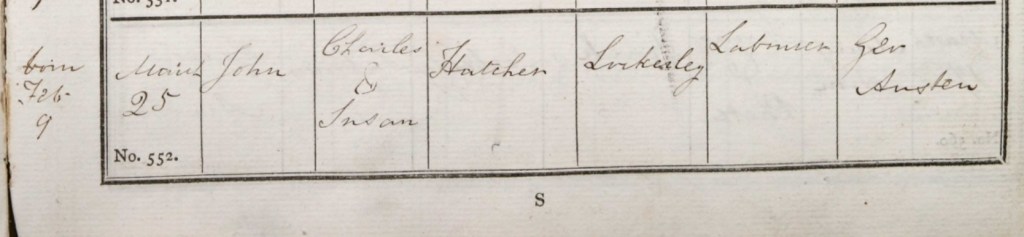
The ceremony was simple, as all baptisms were in this small parish, a bowl of clear water, a few sacred words, a promise made before God. Curate George Austen, a man of gentle manner and steady hand, recorded the event with careful precision in the parish register for Baptisms solemnized in the Parish of Lockerley in the County of Southampton for the Year 1849, marking it Entry No. 552:
When Baptized: March 25

Child’s Christian Name: John

Parents’ Names: Charles and Susan Hatcher

Abode: Lockerley

Quality, Trade, or Profession: Labourer

By whom the Ceremony was performed: Geo. Austen.
As the water touched the child’s brow, it caught the light from the high windows above, clear, holy, and fleeting, a glimmer of purity amidst the worn beauty of the church. The air was still except for the faint rustle of Susan’s gown, the shifting of Charles’s boots upon the stone floor, and the steady cadence of the curate’s voice, solemn yet kind.
For Charles, this moment was the quiet triumph of love over hardship. His hands, roughened by the plough and spade, were hands made for work, not ceremony, yet now they trembled slightly as they rested upon his son’s blanket. He had spent his life bound to the land, sowing, harvesting, enduring, and in that child’s soft breath, he heard the continuation of everything he had ever laboured for.
Susan, weary yet radiant, stood beside him with that serene courage only a mother knows. She had carried John beneath her heart through the long winter months, through cold mornings and uncertain days, her hope a quiet fire that never dimmed. To see her child baptised beneath the same rafters where she herself had once knelt as a babe must have filled her with a sense of belonging, of life turning full circle.
The curate’s hand, steady and sure, traced the sign of the cross upon the child’s brow. The congregation, neighbours, friends, perhaps a few kin, watched in reverent silence. Outside, the bells began again, their sound spilling over the countryside like a benediction.
When it was done, and the entry made, the Hatchers stepped out into the spring sunlight. The air was bright, the ground soft beneath their feet. Around them, the fields of Hampshire stretched in quiet majesty, still bare but stirring with the first signs of green. In the distance, a plough turned the soil, the same soil Charles would return to the very next morning, yet today, the world seemed gentler, the burdens lighter.
John Hatcher, their child, their hope, had been named and blessed. His life, like his father’s and his mother’s, was now tied to this land, to its rhythms, its faith, and its enduring beauty. Though they could not know what lay ahead, Charles and Susan carried home that day with hearts full of quiet joy, the echoes of the church bells following them down the lane like a whispered promise:
That even the humblest lives, rooted in love and toil, are known by Heaven and cherished by time.
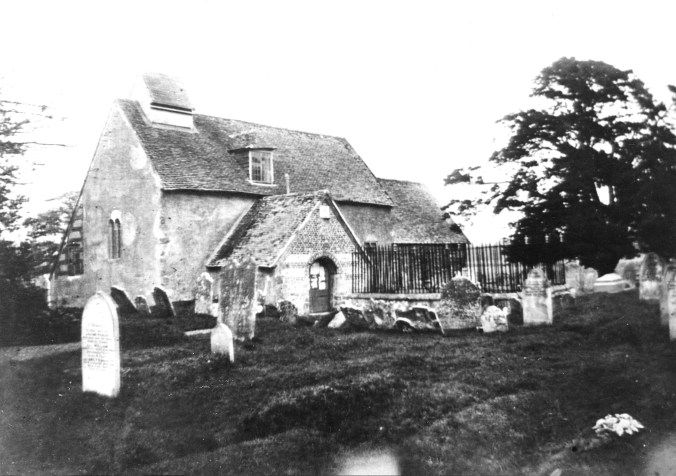
St. John’s Church in Lockerley, Hampshire, is a charming and historic church that has served the local community for centuries. Located in the heart of the picturesque village of Lockerley, which lies in the Test Valley, the church is an important part of the area’s history, culture, and spiritual life.
The history of St. John’s Church dates back to the medieval period, though the current structure reflects several stages of development over the centuries. The original church was likely built around the 12th century, though records from that time are sparse. The church’s dedication to St. John the Evangelist indicates its religious association with the Christian tradition, particularly with the apostle John, one of the most prominent figures in the New Testament. The church’s early history is tied to the broader religious and agricultural practices of the village, which has been a rural community for much of its existence.
Over the centuries, St. John’s Church was subject to several expansions and renovations. The original Norman structure would have been relatively simple, reflecting the needs of a small rural community. However, as Lockerley grew and developed, particularly during the medieval and post-medieval periods, the church was modified to accommodate a larger congregation and to reflect the changing architectural styles of the time. One of the most notable periods of change came in the 19th century, when the church was rebuilt in the Victorian era.
The current building of St. John’s Church was constructed in 1889–90 under the direction of the architect J. Colson, in a style that blends both Gothic and Perpendicular Gothic elements. This period saw significant growth in the Test Valley, and Lockerley, with its proximity to the town of Romsey, benefitted from an expanding population and increased prosperity. The design of the church reflects the period's architectural tastes, with soaring arches, intricate stained-glass windows, and the use of local materials that give the church a distinctive character.
St. John’s Church is a relatively large and impressive building for a rural village church. The structure features a chancel with an outshot, a nave with transepts, and a southwest tower that adds a sense of grandeur to the village’s skyline. The church’s stained-glass windows, depicting various scenes from the Bible, are particularly beautiful, and they provide a striking contrast to the stonework of the building. The wooden roof of the nave, designed with king-post trusses on arch-braces, is another notable feature of the interior, displaying the craftsmanship of the period.
Over the years, St. John’s Church has been at the center of life in Lockerley, hosting regular religious services, weddings, baptisms, and funerals. The churchyard is the final resting place for many of the village’s residents, with gravestones marking the passage of time and offering a sense of continuity to the village’s history. The church continues to play an important role in the spiritual life of the community, offering a space for worship, reflection, and prayer.
In addition to its role as a place of worship, St. John’s Church has also served as a venue for significant community events. The church is a place where people come together to mark important milestones, both religious and personal. Many of the village’s residents, both past and present, have been married, baptized, or buried in the church, giving it a special place in the collective memory of Lockerley.
The churchyard itself is a peaceful and tranquil space, with the graves of local families dotting the landscape. These graves serve as a reminder of the long history of Lockerley, and they provide a connection to the past. The churchyard is not only a site of historical importance but also a beautiful setting for reflection, surrounded by the natural beauty of the Hampshire countryside.
As for rumors of hauntings, like many historic churches, St. John’s has been the subject of local legends and ghost stories. However, there are no widely documented or substantiated paranormal occurrences associated with the church. Given the long history of the building and the village, it is not unusual for local folklore to suggest the presence of spirits or supernatural events. In many cases, such stories are passed down through generations, often becoming part of the cultural fabric of a place. While there may be occasional whispers or tales shared by the community about unexplained occurrences, there is no firm evidence to suggest that the church is haunted.
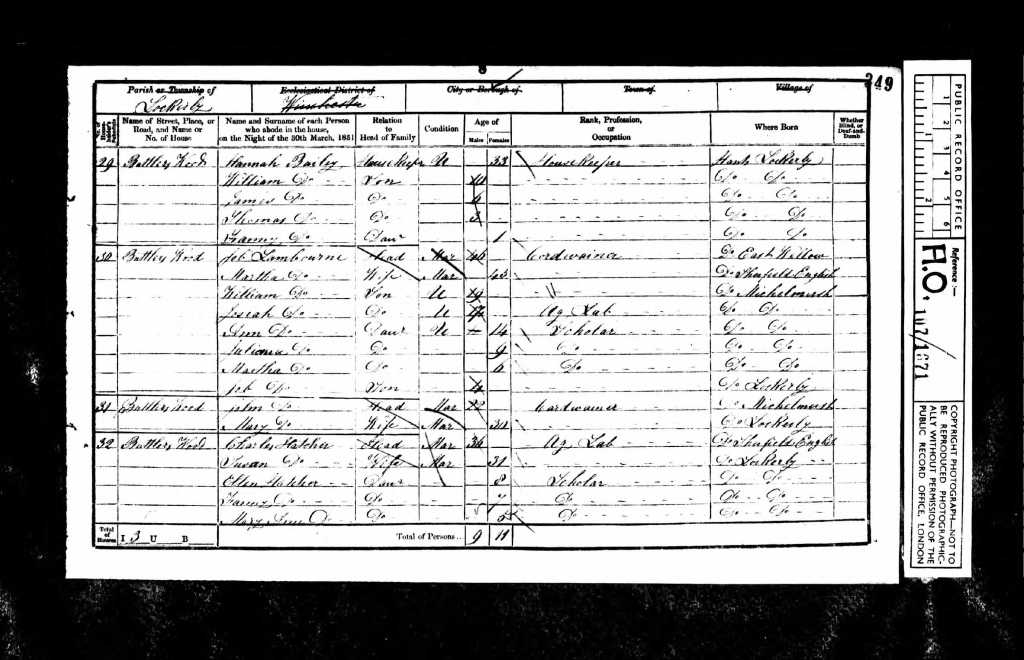
On the still, silvery evening of Sunday, the 30th day of March, 1851, as the last blush of daylight faded over the quiet fields of Lockerley, the Hatcher family sat together within the small, weathered walls of their cottage at Butlers Wood, Newtown. Outside, the hedgerows whispered with the first murmurings of spring, and the smell of woodsmoke lingered in the air, curling softly from the chimney into the darkening Hampshire sky. The world, so vast and shifting beyond their village, was drawing itself neatly into lines and lists, for this was the night of the Great Census, the counting of souls that stretched across all of England, Wales, Scotland, and Ireland, a grand attempt to capture in ink the living breath of a nation.
It was a task overseen by the General Register Office under the direction of Registrar General William Farr, a man who believed that within the plainest details, a name, an age, a trade, could be found the story of an entire people. Enumerators, men appointed for the duty, rode or walked through town and country alike, their hands clutching folded forms and well-worn pencils, knocking on cottage doors and farmhouse gates to gather the histories of those who might otherwise go unnoticed by time.
That evening, one such enumerator would have arrived at Butlers Wood, his boots damp with dew, his coat smelling faintly of rain and ink. The knock upon the Hatchers’ door might have startled the younger children, though such visits were expected in those days, a brief intrusion of officialdom into lives otherwise untouched by the pen of government. Inside, Charles Hatcher, then thirty-six years old, stood ready to answer. His hands were rough from the plough and spade, his face browned by weather and work, yet he greeted the man with quiet respect.
His wife, Susan, aged thirty-one, stood beside him, her calm presence filling the small room with a gentle steadiness. Around her feet clustered their children, Ellen, Fanny, Mary Ann, and John, each one representing a chapter of hope, each a living testament to the endurance and love that bound this humble family together.
The enumerator, likely a man from the nearby parish, asked his questions with the precision taught for the occasion.

Name of Head: Charles Hatcher.

Age: 36.

Occupation: Agricultural Labourer.

Wife: Susan Hatcher, aged 31.

Children: Ellen, 8; Fanny, 7; Mary Ann, 5; John, 2.

Residence: Butlers Wood, Newtown, Lockerley, Hampshire.

The ink dried upon the page, a single family now frozen in the great tapestry of England’s people.
Charles was recorded as an agricultural labourer, his life’s calling inscribed in one unadorned word. To the enumerator, it was a simple fact; to Charles, it was the story of every dawn he had risen before light, of every furrow turned, every field sown and reaped beneath the unchanging sky. His body bore the testament of his trade, strength, patience, and the silent pride of a man who worked not for glory, but for sustenance and love.
Three of his daughters, Ellen, Fanny, and Mary Ann, were marked as scholars, a small yet luminous detail in the record. In a time when the education of working-class children was neither guaranteed nor expected, their attendance at the village school spoke of hope, of parents who wished for their children a life beyond the confines of toil. One might imagine Charles, upon seeing their small fingers clutching slates and chalk, feeling both pride and wistful wonder, as if glimpsing a brighter world just beyond his reach.
Their neighbours, John and Mary Lambourne, lived nearby, sharing in the same rhythm of rural life, fields, faith, and the steady cycle of the seasons. Beyond them, one house stood uninhabited, its windows dark, its hearth long cold, a quiet reminder that not all homes were filled with laughter or light.
As the enumerator took his leave and the sound of his footsteps faded down the lane, the Hatchers returned to their evening. The fire glowed low, casting amber light upon the children’s faces. Perhaps Susan mended a shirt by candlelight, while Charles sat nearby, his weary hands resting on his knees, listening to the muffled crackle of the fire and the faint rustle of the trees outside.
Unbeknownst to them, their names, their ages, their occupations, all the humble details of their existence, were now inked into history. Yet no line in that census could capture the softness of Susan’s voice as she soothed her youngest to sleep, nor the pride in Charles’s chest as he looked upon his family, nor the quiet love that filled that little home at Butlers Wood.
The census, in its precision, saw only what could be written, but behind each word was a life, a story, a heartbeat. And among them all, there stood Charles Hatcher, steadfast and unassuming, a man whose days were shaped by earth and duty, whose legacy lived not in wealth or name, but in the enduring spirit of his kin.
That spring night of 1851, while the world beyond Hampshire buzzed with the stirrings of progress and empire, Charles’s life was measured not in grandeur, but in grace. The fields he tended, the children he raised, the love that lit his modest home, these were his kingdom. And though the enumerator’s ink would one day fade, the life it recorded still breathes softly in time, carried forward in memory, in story, and in the blood of those who came after him.
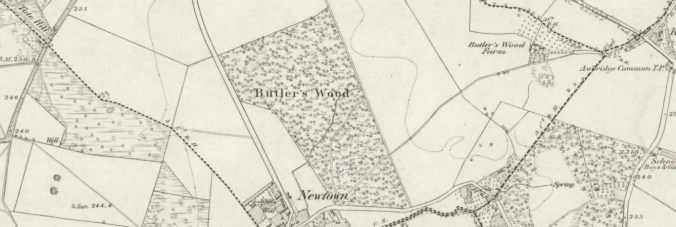
Butler’s Wood, situated near Newtown in Lockerley, Hampshire, is a historic woodland with deep roots in the region's agricultural and social history. The wood was enclosed in July 1815 under the Inclosure Act of 1811, which aimed to consolidate and privatize common lands for more efficient farming practices. This enclosure marked a significant shift in land use and ownership in the area.
The landscape surrounding Butler’s Wood was predominantly agricultural, with crops like wheat, barley, oats, and turnips being cultivated. The subsoil consisted of gravel, and the soil was a mix of chalk and clay, which influenced the types of crops that could be grown and the farming methods employed.
In the 19th century, the area experienced significant changes. The construction of the railway line through Lockerley in the mid-1800s facilitated the transport of goods and people, leading to increased development and urbanisation in the region. This development included the establishment of new farms, residential areas, and infrastructure, transforming the rural landscape.
On Friday, the 31st day of October, 1851, as autumn’s golden breath whispered through the Hampshire fields, Charles Hatcher returned home to Lockerley with the weight of the day’s labour still upon his shoulders and the scent of turned soil clinging to his clothes. The air was cool, filled with the faint perfume of fallen leaves and the distant crackle of hearth fires being lit across the village. The year was gently dying into winter, and yet, for Charles, it was the beginning of something new.
Inside their small cottage, dimly lit by the soft glow of the hearth, the stillness was broken by the sweetest sound a man could hear, the tender cry of his newborn daughter. Rosa had come into the world that morning, her voice carrying through the quiet air like birdsong after rain.
Her mother, Susan, just thirty-one, lay weary but radiant, her face pale yet peaceful, her eyes glistening with joy and exhaustion. She had borne three daughters and a son before, but this moment, as with every new life, felt sacred and new. The midwife, a familiar village woman whose hands had delivered half of Lockerley, wrapped the child in linen and placed her into Susan’s waiting arms.
Charles knelt beside them, his rough, work-worn fingers trembling as he reached out to touch the downy softness of his daughter’s cheek. He had spent a lifetime in service to the land, shaping it with his hands, bending to its will. Yet here was life’s true harvest, this small, perfect child, born not from earth and toil, but from love and hope.
He whispered her name, Rosa, tasting its sweetness, feeling its quiet strength. To him, she was a promise in human form: delicate as a petal, yet destined to grow strong and enduring, like the women who had come before her.
Two weeks later, on Friday, the 14th day of November, 1851, her birth was recorded in the District of Mitchelmersh, within the Counties of Hants and Wilts, by Registrar Charles Gouldard. The record, numbered 350, was simple and factual, as such things always were, yet it held a story far greater than its lines could tell:
When Born: Thirty-first of October 1851 at Lockerly

Name, if any: Rosa

Sex: Girl

Name and Surname of Father: Charles Hatcher

Name and Maiden Surname of Mother: Susan Hatcher formerly Luke

Rank or Profession of Father: Labourer

Signature, Description, and Residence of Informant: The mark of Susan Hatcher, Mother, Lockerly

When Registered: Fourteenth of November 1851

Signature of Registrar: Charles Gouldard, Registrar.
When it came time to sign, Susan made her mark, a small, trembling cross beside her name: “The mark of Susan Hatcher, Mother, Lockerley.” Though she could not write the letters herself, the meaning behind that mark was clear and everlasting. It was the signature of love, of endurance, of a mother who had faced hardship with quiet grace and now held in her arms the fruit of that faith.
Charles stood beside her as the registrar dipped his pen and sealed the record. To others, it was one of hundreds, a formality, a duty done. But to Charles, it was sacred, a moment that bound his name and hers together, father and daughter, forever recorded in the chronicles of England.
That night, he returned home through the crisp air, the stars bright above the sleeping village. The fields stretched out around him, bare now after the harvest, the soil dark and still beneath the moonlight. He thought of all the years he had spent upon that land, the aching work, the meagre pay, the blisters and the cold, and yet, none of it felt heavy now. Every cut of the plough, every dawn he had risen before the light, every hardship endured, it had all led him to this moment.
Inside, the cottage was warm with firelight. Susan sat rocking little Rosa by the hearth, the glow painting her face in gold and shadow. Their older children, Ellen, Fanny, Mary Ann, and John, slept nearby, the soft rise and fall of their breathing a lullaby of its own.
Charles stood in the doorway for a long while, watching them. He said nothing, but in his heart, he offered up a prayer, not spoken aloud, but felt in every fibre of his being. He prayed for Rosa to grow strong and kind, for Susan’s strength to hold, and for the days to come to bring peace enough to carry them through.
In the hush of that autumn night, with the wind whispering through the thatch and the crackle of the fire soft in his ears, Charles Hatcher, labourer, husband, father, felt the quiet fullness of his life. He owned no land, no riches, no title, but he had this: love, work, and the eternal rhythm of the land that held him.
And as he looked upon his newborn daughter, sleeping soundly in her mother’s arms, he felt something stir within him, the simple, sacred knowing that this, too, was his legacy. Not the furrows he had carved into the earth, nor the calluses that lined his hands, but the lives he had helped to bring into the world. The Hatchers of Lockerley, born from toil and tenderness, would endure, as steadfast as the soil beneath their feet, and as timeless as the Hampshire sky above.
On a crisp winter’s morning, Sunday the 7th day of December, 1851, a tender quiet settled over the village of Lockerley. Frost traced lace upon the hedgerows, the earth lay hushed beneath a silver sheen, and smoke rose in gentle ribbons from thatched rooftops as hearths were stirred to life. Inside St. John’s Church, the heart of the parish, warmth bloomed softly against the chill, the scent of beeswax candles mingling with the cold breath of stone. It was a morning of grace and remembrance, a morning that would bind a family’s story forever in ink and in faith.
At the baptismal font stood Charles and Susan, a husband and wife whose lives were woven from the humble threads of labour, love, and quiet endurance. Charles, aged thirty-seven, a man of the soil, stood with his broad, work-worn hands clasped before him, hands that had built, tilled, and carried all that his family possessed. Beside him, Susan, thirty-one, her expression serene yet touched by emotion, held their youngest child close. The faint light from the church’s windows fell upon her face, catching the glimmer of tears, not of sorrow, but of something purer, the quiet, deep ache of a mother watching her children blessed before God.
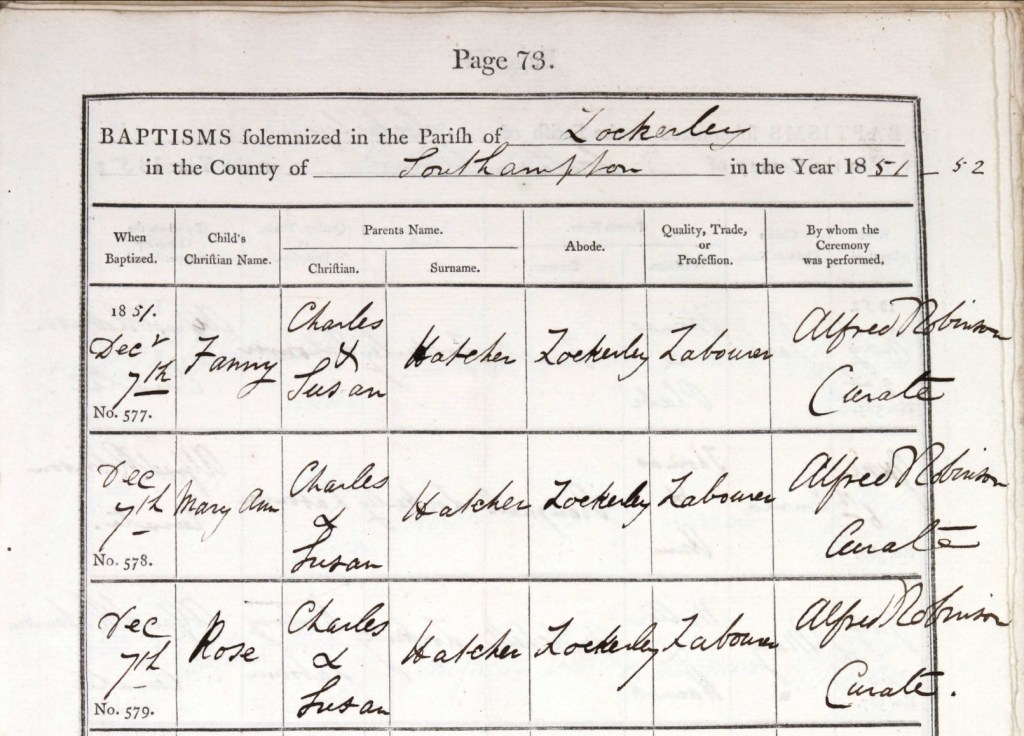
That morning, three of their children, Fanny, Mary Ann, and Rose, were brought to the font together, to receive the holy waters of baptism. The Curate, Alfred Robinson, stood before them, his voice low and melodic as he recited the familiar words that had echoed through these ancient walls for generations.
“I baptize thee in the name of the Father, and of the Son, and of the Holy Ghost.”
With each name spoken, water shimmered beneath the candlelight, catching the flicker of flame like small fragments of heaven.
Fanny, lively and bright-eyed, was the first, her small curls dampened by the sacred touch, her life marked anew. Then came Mary Ann, solemn and curious, her gaze lifting to the vaulted ceiling as if she could already sense the weight of the moment. And finally little Rose, the baby of the family, her skin soft and flushed with winter’s chill, blinked as the water touched her brow, her first blessing falling like a promise.
Each child’s name was then carefully inscribed in the parish register, entries 577, 578, and 579, their place in both the earthly and heavenly records forever secure.
BAPTISMS solemnized in the Parish of Lockerley in the County of Southampton in the Year 1851

No. 577

When Baptized: Dec 7th 1851

Child’s Christian Name: Fanny

Parents’ Names: Charles & Susan Hatcher

Abode: Lockerley

Quality, Trade, or Profession: Labourer

By whom the Ceremony was performed: Alfred Robinson, Curate
No. 578

When Baptized: Dec 7th 1851

Child’s Christian Name: Mary Ann

Parents’ Names: Charles & Susan Hatcher

Abode: Lockerley

Quality, Trade, or Profession: Labourer

By whom the Ceremony was performed: Alfred Robinson, Curate
No. 579

When Baptized: Dec 7th 1851

Child’s Christian Name: Rose

Parents’ Names: Charles & Susan Hatcher

Abode: Lockerley

Quality, Trade, or Profession: Labourer

By whom the Ceremony was performed: Alfred Robinson, Curate.
But beneath the simple script of the record lay a story deeper still, one that spoke of forgiveness, of unity, of the healing power of love.
For Fanny and Mary Ann, the two eldest of the three baptised that day, had entered this world under tender but complicated beginnings. They were Susan’s daughters, born before her marriage to Charles, recorded in the old birth registers as “illegitimate.” In the hard eyes of society, it was a mark of shame but in the soft heart of Charles Hatcher, it was no burden at all.
For though the law might have called them by another name, Charles called them his own. And now, before the altar of God, he claimed them openly and fully, their names written beside his in the parish book, his title of “Father” inked upon the page as both truth and testament. Perhaps, even before this day, he had been father in every way that mattered, the one who guided their steps, who mended their shoes, who worked long hours so that their small hands might hold bread instead of want.
It is easy, now, to imagine him standing there in his worn coat, his boots dusted with the earth of Hampshire fields, his gaze fixed upon the font. To Charles, this day was more than ceremony, it was redemption. It was the binding of all he held dear, not just by marriage or blood, but by faith, by love, and by the sanctity of forgiveness.
As the final prayers were spoken, the church fell silent save for the distant toll of the bell, marking another hour in the life of Lockerley. Outside, the world was still, the crisp scent of frost in the air, the fields bare and waiting for spring. Inside, within those flint and timber walls, the Hatchers’ small family stood bathed in candlelight, their hearts full and their names freshly blessed.
When the service was done, Charles and Susan gathered their children close and stepped back into the winter morning. The sky hung pale above the thatched roofs, and the sound of their footsteps echoed softly along the lane. In his arms, Charles carried little Rose, her breath a faint warmth against his chest. At his side, Fanny and Mary Ann clutched their mother’s skirts, their laughter bright in the cold air, no longer just Susan’s daughters, but his too, in every way that mattered.
That day, was more than a baptism, it was a quiet act of devotion, a moment when a man of humble means and steadfast heart gathered his family beneath the watchful eye of heaven and gave them his name, his protection, and his love.
And though centuries would pass, and the ink upon the register fade, the spirit of that moment, the warmth of a father’s heart on a winter’s morning, still lingers in the air of Lockerley, whispering softly through the pews of St. John’s, where once, the Hatchers stood together, and love became their truest blessing.
In the gentle warmth of summer, on Sunday, the 8th day of July, 1855, the quiet village of Lockerley lay wrapped in a hazy stillness. The hayfields shimmered under the golden sun, and the air hung thick with the scent of grass and wildflowers. Within a small, timeworn cottage near the edge of the village, its walls of chalk and flint cool against the heat of the day, Charles’s beloved wife Susan, thirty-five years old and heavy with child, laboured through the long hours of morning and into the tender hush of afternoon.
Her husband, Charles, forty-one, waited nearby, pacing the narrow strip of earth outside the cottage door, his hands rough and restless, his heart trembling with both fear and hope. He was a man used to labour, to the slow endurance of the fields, to the rhythm of the plough and the bite of the wind, but no work, no hardship, had ever demanded of him the helpless patience of this waiting. Inside, the sounds of Susan’s pain came in waves, the muffled cries, the low murmur of the village midwife’s voice, the soft rustle of cloths being warmed by the hearth.
The midwife, a weathered woman who had delivered generations of Lockerley’s children, moved with quiet skill, her hands steady as she whispered words of encouragement to Susan. The room smelled of smoke and linen, of water boiling gently on the fire, of life itself in the making. The air grew heavy, the hours long. Outside, the sun drifted westward, pouring its last light through the hedgerows where sparrows sang and the scent of elderflower lingered.
Charles, unable to sit still, took to small, silent tasks, fetching fresh water from the well, tending the fire, rubbing his hands over his face as if to will time forward. In those hours, every memory of Susan came rushing back to him, the day they wed beneath the frost of 1847, the children born before, the small joys and great struggles that had shaped their years together. He thought of her courage, her quiet laughter, her faith that somehow, even in the poorest of seasons, they would endure. And so he prayed, not with words, but with the simple faith of a man who loved deeply, that she and the child might be kept safe through the perilous passage of birth.
Then, as the light began to soften and a cooling breeze slipped through the open window, the cries within changed, no longer those of pain, but of life. A thin, trembling wail rose into the summer air, piercing and beautiful. The midwife’s voice followed soon after, calm and certain: “It’s a boy.”
Charles stood still, the sound washing over him like the breaking of dawn. When he stepped inside, the cottage glowed in the fading light, Susan pale but smiling, her eyes glistening with exhaustion and love. In her arms, wrapped in a coarse but clean linen cloth, lay their son. The tiny curve of his mouth, the faint pulse beneath his temple, all of it felt like a miracle to Charles, who reached out with a trembling hand to touch the child’s cheek.
“George,” Susan whispered softly, naming him as if she were breathing life into the word itself.
Thus, George Hatcher was born, the son of a labourer and his steadfast wife, a child of soil and summer, of sweat and prayer and the quiet courage that marked the Hatcher line.
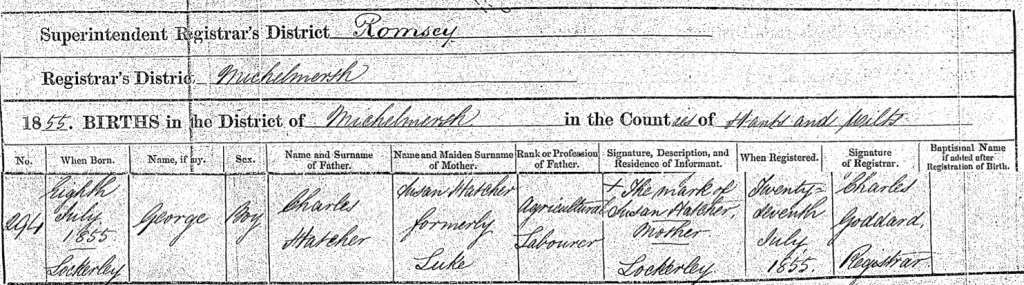
Nineteen days later, on Friday, the 27th day of July, 1855, the event was officially recorded in the great ledger of life. The record, written in Registrar Charles Goddard’s careful hand, was entered as No. 294 in the Births in the District of Mitchelmersh, in the Counties of Hants and Wilts:
When Born: Eighth of July 1855 at Lockerly

Name, if any: George

Sex: Boy

Name and Surname of Father: Charles Hatcher

Name and Maiden Surname of Mother: Susan Hatcher formerly Luke

Rank or Profession of Father: Agricultural Labourer

Signature, Description, and Residence of Informant: The mark of Susan Hatcher, Mother, Lockerly

When Registered: Twenty-seventh of July 1855

Signature of Registrar: Charles Goddard, Registrar
When it came time to register the birth, Susan made her mark upon the page, a simple X, beside the words “The mark of Susan Hatcher, Mother, Lockerley.” She could not sign her name, but she needed no penmanship to express what her heart already wrote in full: love, truth, and devotion. Charles Goddard, the registrar, added his name in ink, sealing this humble miracle within the records of England.
Outside the registrar’s office, the world went on as it always had, the creak of cartwheels on the lane, the soft bleating of sheep, the smell of rain upon hay. Yet for Charles and Susan, everything had changed. That night, as the family gathered by the small fire, the older children peering curiously at their baby brother, Charles sat quietly, holding George close against his chest. The child’s breath was warm and even, the faint rise and fall against his father’s heart steady as the rhythm of the land itself.
For a man like Charles, who owned no property, no wealth, no title, this, his family, was his kingdom. His fields were the laughter of his children, his harvest the moments of peace shared in the glow of the hearth. And as the fire crackled softly, he looked toward Susan, her face lit by the flicker of flame, and he felt the weight of his gratitude, for her strength, for the life they had built, for the fragile miracle of a newborn’s cry in the quiet of a Hampshire summer.
Thus began the life of George Hatcher, my 2nd great-grandfather, a child born beneath the broad English sky, his roots sunk deep into the tender earth of Lockerley. His life began not with riches or splendour, but with love, steadfast and pure, the kind of love that endures through generations, written not only in the ink of records, but in the beating heart of family.
On a warm summer’s day, Sunday, the 12th day of August, 1855, the village of Lockerley awoke beneath a sky brushed with soft gold and the song of larks rising over the meadows. The bells of St John’s Church called across the fields, their chime carrying through the still air, summoning the faithful to worship. The sound rolled gently over hedgerows and thatched roofs until it reached a modest cottage where Charles and Susan Hatcher prepared their family for this sacred morning, a day unlike any other, for it was to be the baptism of their newest son, George.
The summer sun spilled through the cottage window as Susan, her hands still tender from caring for her infant, wrapped little George in a clean white shawl she had carefully kept aside for the occasion. Charles, his rough hands washed and his hair neatly combed, stood near the door in his best linen shirt, the one reserved for Sundays and holy days. Though he was a man of few words, the weight of this day rested deeply in his heart. For all his years of labour, the ploughing, the reaping, the endless toil beneath the open sky, it was moments like this that gave his life its true meaning.
The family made their way along the narrow lane leading to St John’s, the church rising quietly among its ancient yews, its flint walls cool and dappled with sunlight. The door stood open, and from within drifted the faint scent of beeswax and old hymnals, the murmur of voices, the gentle tuning of faith.
As they stepped inside, they were greeted by the familiar hush of sacred space, the rustle of skirts, the shuffle of boots upon flagstone, the low whispers of the villagers who had gathered. The congregation that morning would have been a patchwork of Lockerley’s souls, farmhands and their wives, weary from the week’s work; children wriggling beside their mothers; the elderly sitting upright in the pews they had occupied for decades.
The morning service would have begun with the ringing of the vestry bell and the first notes of a hymn, perhaps “All Things Bright and Beautiful” or “There is a Green Hill Far Away,” their simple, soaring melodies filling the church with warmth. The Curate, Reverend H. A. Wakes, led the prayers in a clear, steady voice, his words echoing softly against the timbered rafters. The familiar verses of the Book of Common Prayer would have followed, each phrase a thread connecting the living to those who had knelt here before them, parents, grandparents, and generations of the faithful.
When the time came for the baptism, the curate’s voice called through the still air, summoning Charles and Susan Hatcher to the font. All eyes turned toward them as they stepped forward, Susan cradling baby George close to her breast, his small face half-hidden in the folds of linen. The sunlight, filtering through the stained-glass window above the altar, fell in gentle hues across them, gold upon Charles’s brow, soft blue and rose upon the child’s blanket.
Reverend Wakes began the baptismal rite, his voice both solemn and tender as he asked the age-old questions of faith. Then, with careful hands, he poured the clear water over George’s brow. The droplets gleamed like pearls against the baby’s skin, and for a moment, time seemed to hold still, even the birds outside paused in their song.
“I baptize thee in the name of the Father, and of the Son, and of the Holy Ghost. Amen.”
The words echoed like a blessing carried on the summer air. Charles bowed his head, and a quiet prayer rose unspoken within him, a plea for his son’s safety, for his happiness, for a future gentler than his own. Beside him, Susan wiped her eyes with the corner of her shawl, her heart full beyond measure.
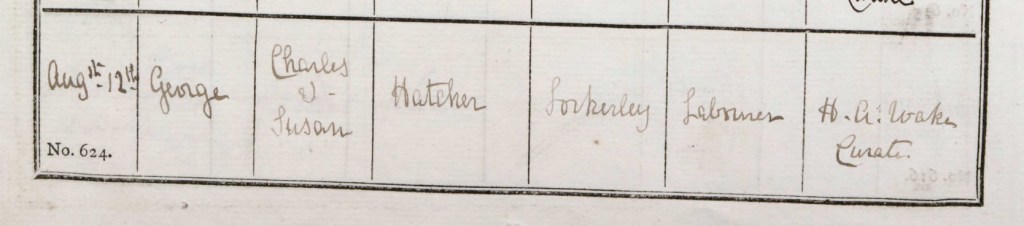
After the rite was complete, Curate Wakes lifted his pen to the parish register and inscribed the moment that would forever mark their child’s beginning:
BAPTISMS solemnized in the Parish of Lockerley in the County of Southampton in the Year 1855

No. 624

When Baptized: August 12th

Child’s Christian Name: George

Parents’ Names: Charles & Susan Hatcher

Abode: Lockerley

Quality, Trade, or Profession: Labourer

By whom the Ceremony was performed: H. A. Wakes, Curate.
As the ink dried upon the page, the congregation lifted their voices once more in song, perhaps “O God, Our Help in Ages Past,” its verses rising through the nave and spilling out into the sunlit churchyard. The melody, mingling with the rustle of leaves and the murmur of summer wind, seemed to carry the new child’s name heavenward, joining the chorus of all who had ever been baptized beneath that ancient roof.
When the service drew to a close, the Hatchers lingered for a moment by the lychgate, greeting neighbours and friends. There were smiles, nods of approval, and whispered blessings. The church bells began their slow toll once again, and the family turned for home, walking together along the winding lane that cut through fields of ripening grain.
Charles walked a little apart, his gaze drifting over the land he knew so well, the hedges alive with bees, the hum of summer stillness all around. His heart swelled with pride and quiet gratitude. In his world of hard work and humble means, there were few grand moments, yet this, the sight of his wife beside him, their newborn son safe in her arms, the distant sound of church bells fading behind them, this was joy in its purest form.
And so, beneath the high blue sky of Hampshire, George Hatcher, the son of Charles and Susan, took his first steps into the story of faith and family, his name bound not only in the pages of a parish book, but in the eternal rhythm of love, labour, and hope that shaped the lives of the Hatchers of Lockerley.
On Tuesday, the 13th day of April, 1858, as dawn broke softly over the Hampshire village of Lockerley, a new cry joined the tender chorus of spring. The hedgerows were dusted with blossom, the meadows alive with dew, and through the gentle hush of the morning, a labourer’s cottage stirred with the miracle of new life. Within its chalk-white walls, Susan, aged thirty-eight, brought forth her child, a baby boy named Stephen, her seventh, born into the warm, work-worn hands of love.
Outside, the village still slept, save for the faint calls of crows and the steady rhythm of the fields waking to another day. But within that modest home, time seemed to hold its breath. Charles, now forty-three, stood close by, his heart full and his rough, calloused hands trembling as he heard his son’s first cry. He had seen many seasons come and go, had toiled through years of hardship, his body shaped by the rhythm of the land. Yet no field he had sown nor harvest he had gathered could compare to this, the fragile, perfect harvest of life itself.
The air inside the cottage was warm, heavy with the scent of hearth smoke and boiled linen. The midwife, an elderly woman from the village, her hands gentle and sure, moved quietly around the room, tending to mother and child with the practiced grace of one who had guided countless lives into the world. Susan, her hair damp with effort, lay pale but radiant, her eyes glistening as she looked down at the small bundle resting against her chest. The infant’s tiny fingers curled instinctively around her own, his breath soft and steady, his presence both fragile and eternal.
Charles, standing near the window, turned his gaze outward for a moment, across the small patch of garden, to the fields beyond. The plough waited where he had left it, and the land, ever patient, stretched into the horizon. How many more days would he spend beneath its sun, he wondered, working to keep bread on the table and his children clothed? Yet in that moment, none of the weight mattered. His heart swelled with pride. He had a son, another life to nurture, another voice to carry the Hatcher name into the years yet to come.
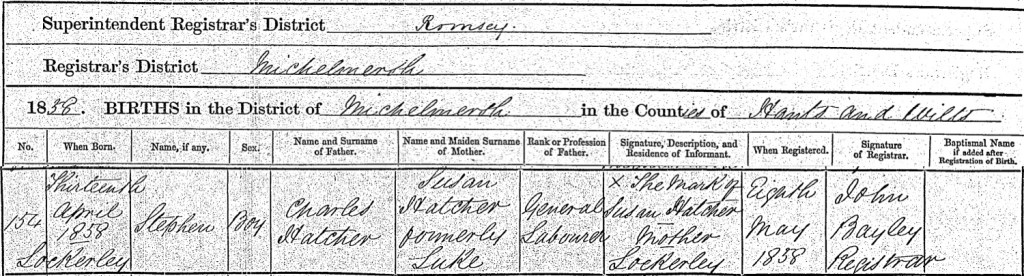
Weeks later, on Saturday, the 8th day of May, 1858, the event was formally inscribed in the register of the District of Mitchelmersh, within the Counties of Hants and Wilts. Registrar John Bayley dipped his pen and carefully wrote the details into the great book of births, his neat hand preserving the moment for generations to come.
When Born: Thirteenth of April 1858 at Lockerley

Name, if any: Stephen

Sex: Boy

Name and Surname of Father: Charles Hatcher

Name and Maiden Surname of Mother: Susan Hatcher formerly Luke

Rank or Profession of Father: General Labourer

Signature, Description, and Residence of Informant: The mark of Susan Hatcher, Mother, Lockerley

When Registered: Eighth of May 1858

Signature of Registrar: John Bayley, Registrar.
When it came time to record the birth, Susan made her mark upon the page, a simple, unadorned X, beside the words “The mark of Susan Hatcher, Mother, Lockerley.” She could not write her name, but the love behind that mark carried more meaning than any flourish of penmanship ever could. In that small cross lay her courage, her faith, and the story of every woman who had ever borne life into humble circumstance and called it blessed.
John Bayley, the registrar, added his signature in firm, careful strokes, sealing the moment in ink and time, No. 154 in the book, but the beginning of a chapter far greater than the record alone could tell.
Beyond the pages, life in Lockerley continued much as it always had. The scent of cut hay drifted across the fields, and the rhythm of village life rolled steadily on, church bells, the chatter of market days, the laughter of children playing in the lane. Within the Hatcher home, little Stephen grew strong, lulled by the sound of his father’s voice in the evenings and the gentle hum of the countryside that had cradled generations before him.
To Charles, each child born beneath his roof was a reminder of all he laboured for, not coin, nor comfort, but continuity. His world was small, marked by parish boundaries and seasons, yet within that smallness lay something eternal. He had tilled the same soil his father once worked, walked the same lanes his mother had walked, and now he watched his own children take their first steps upon that same ancient earth.
And so, in the soft bloom of spring 1858, a new branch was added to the Hatcher family tree, Stephen, a son born not to riches, but to love, not into splendour, but into steadfastness. His life began in a cottage warmed by firelight, surrounded by the quiet grace of the Hampshire fields, a life rooted deeply in faith, endurance, and the humble poetry of the everyday.
For the Hatchers, it was not the grand moments that defined them, but the gentle ones, the turning of the seasons, the prayers whispered at a bedside, the inked mark of a mother’s love upon a page. And in that tender truth, Stephen’s story, and Charles’s legacy, found its beginning, carried forward on the breath of the same wind that rustled the fields of Lockerley that April morning.
On a gentle spring Sunday, the 23rd of May, 1858, the Hampshire air hung sweet with blossom and birdsong. The lanes of Lockerley were alive with the hum of bees and the murmur of families making their way toward St John’s Church, its flint walls warmed by the morning sun. The bells began to toll, soft, steady, and familiar, their echoes drifting across the meadows and through the open windows of cottages where life stirred in the quiet rhythm of a village long at peace with its seasons.
Among those answering the call that morning were Charles and Susan, carrying in their arms their newest son, Stephen, born only weeks before in the gentle heart of spring. Their home, in Newtown, Lockerley, was modest and time-worn, the kind of place where each creak in the floorboards spoke of years of laughter, labour, and love. Charles, his hands roughened by the plough and the scythe, had washed carefully that morning, the faint scent of soap and the sharp tang of the fields still upon him. Beside him walked Susan, her face serene though her body still carried the traces of childbirth, her arms cradling the child that had renewed her world.
As they entered St John’s, the air was cool and still, filled with the scent of candle wax, damp stone, and spring flowers gathered from the churchyard by the vicar’s wife. The light through the stained-glass windows fell in soft ribbons of colour across the nave, touching the wooden pews where generations of Hatchers, Lukes, and Roude kin had once knelt. The Curate, Reverend H. A. Wakes, stood at the font, a figure of calm familiarity, his voice measured and kind, the same voice that had prayed over so many of Lockerley’s sons and daughters.
The service that morning was unhurried, following the well-worn cadence of the Book of Common Prayer. The congregation’s voices lifted together in hymns perhaps of “O Jesus, I Have Promised” or “Come Down, O Love Divine”, their sound rising to the high timbered beams and blending with the soft rustle of spring wind at the church door. Children fidgeted beside their mothers, a cart rolled faintly outside, the whole of Lockerley, it seemed, breathed in rhythm with the service.
When the time for baptism came, Reverend Wakes called forth three families, three infants, each wrapped in linen and love. First came Ellen Carr, the daughter of George and Emma Carr, her father a sawyer whose days were spent among the echoing woods nearby. Then Charles and Susan Hatcher stepped forward with their son Stephen, and last came Jacob and Eliza Peach, another family of the soil, their son Jacob William squirming in his mother’s arms.
Together, they stood at the ancient stone font, their children bound not by kinship of blood, but by the greater kinship of faith and the quiet endurance of village life. The curate dipped his fingers into the cool water, his movements steady and reverent.
“Stephen,” he said, his voice gentle but clear enough to reach the rafters. “I baptize thee in the name of the Father, and of the Son, and of the Holy Ghost. Amen.”
The drops fell upon the baby’s brow like pearls of light, and Susan closed her eyes for a moment, whispering a prayer only a mother’s heart could speak. Beside her, Charles bowed his head, feeling the deep solemnity of the moment, this humble rite that bound his son not only to the church, but to generations before and those still to come.
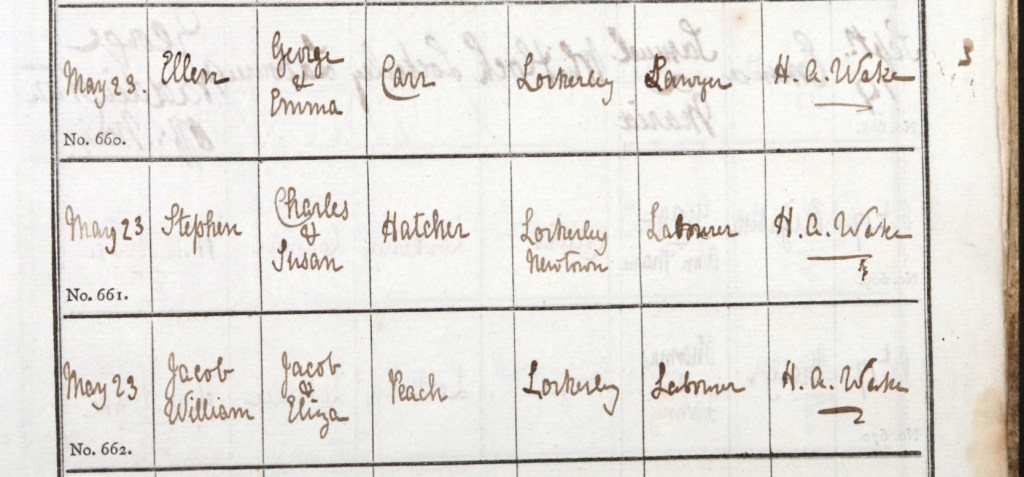
When all three baptisms were complete, the curate turned to his small wooden desk and, with careful penmanship, recorded the events in the parish register, his ink capturing what hearts already knew to be sacred.
BAPTISMS solemnized in the Parish of Lockerley in the County of Southampton in the Year 1858

No. 660 — Ellen, daughter of George & Emma Carr, of Lockerley. Father’s trade: Sawyer.

No. 661 — Stephen, son of Charles & Susan Hatcher, of Lockerley Newton. Father’s trade: Labourer.

No. 662 — Jacob William, son of Jacob & Eliza Peach, of Lockerley. Father’s trade: Labourer.
All baptisms performed by H. A. Wakes, Curate.
Each line, each name, carried the weight of generations, ordinary families, perhaps, yet sacred in their simplicity. Outside, the sunlight filtered through the churchyard trees, scattering dappled light upon the grass where the ancestors of these very children lay at rest.
As the final hymn filled the church, perhaps “Praise, My Soul, the King of Heaven,” the voices of rich and poor alike joined as one. For in that small Hampshire parish, there was no division in the eyes of faith. The same water that touched the brow of a sawyer’s child also blessed the son of a labourer. And as the bells began to toll once more, their sound folding gently into the breeze, the people of Lockerley stepped back into their world, fields waiting, hearths cooling, children stirring in mothers’ arms, hearts lifted by the quiet joy of the morning.
For Charles, as he walked home beside Susan, the weight of the world seemed lighter. His son, Stephen, had been named, blessed, and welcomed into the faith that had sustained the Hatchers for generations. The sound of the church bells still echoed faintly behind them, mingling with the hum of bees and the call of a distant lark, a hymn of the land itself, carrying forward the eternal rhythm of life, labour, and love.
And so, beneath the gentle Hampshire sky, another chapter began, a baptism not just of water, but of hope, marking the life of a child and the heart of a father who found meaning in the simplest, most sacred moments of all.
On a cold and mist-laden Wednesday, the 23rd day of November, 1858, the quiet village of Lockerley fell beneath a pall of sorrow. The autumn fields lay still beneath a pale grey sky, and the breath of winter crept through the hedgerows as if the earth itself was holding its breath. Within a humble cottage near the woods he had so long worked, Charles, a man of strength, grace, and quiet endurance, drew his final breaths. He was only forty-six years old, yet his life had been filled to its brim, with labour, with laughter, and with love.
For a week he had struggled, his body weakened by pneumonia and bronchitis, the cruel breath of illness tightening its grasp with each passing day. Still, he bore it with the same quiet dignity that had carried him through every trial of his life. The woodman who once swung his axe with steady rhythm, who had known the song of the forest and the warmth of honest work, now lay still upon his bed. The fire in the hearth burned low, and the scent of pine lingered faintly in the air, a final whisper of the woods that had shaped him.
At his side sat Susan, his beloved wife, his anchor, his solace, his truest companion through all the seasons of his years. Her hand, worn yet tender, clasped his, their fingers entwined in the same simple way they had done since their courting days. She whispered his name softly, her voice trembling like a candle flame in the stillness. The light from the window fell gently upon his face, tracing the lines of a man who had lived faithfully, who had loved deeply, and who had worked until the land itself seemed to know his name.
Charles’s breaths grew shallow, the rise and fall of his chest slowing until the silence between them deepened. Susan felt the moment as one feels the hush before dawn, that delicate pause between one world and the next. She held him close, pressing his hand to her heart as if to keep him there forever, to keep the warmth from fading. And when his final breath escaped him, quiet as the fall of a leaf, she knew, her world had shifted. The room seemed to still, even the ticking of the clock fading into reverent quiet.
With trembling hands and tears blurring her sight, Susan rose and opened the window. It was a simple act, one known to women of her time, a gesture as old as faith itself, to let the soul go free. The cold November air rushed in, crisp and clean, stirring the curtains and brushing her face like a final farewell. For a moment, she swore she felt him there, his presence gentle, almost smiling, and then it was gone, carried softly into the wide Hampshire sky.
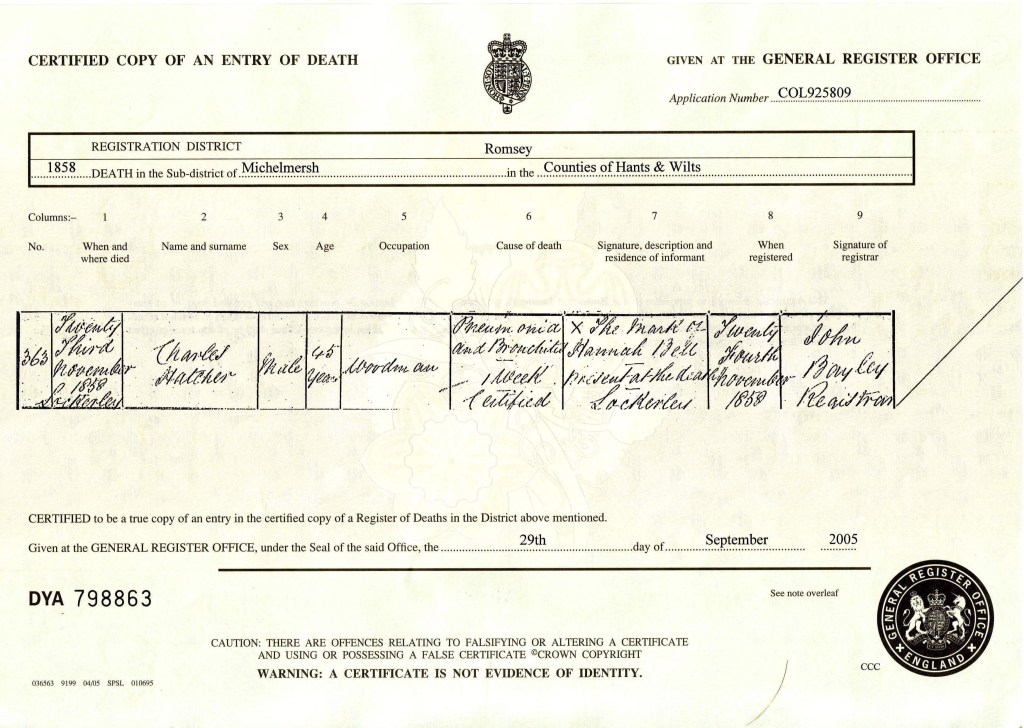
The next morning, Registrar John Bayley came to record what must be recorded, though no ink could capture the truth of the loss. In the District of Romsey, Sub-district of Michelmersh, he carefully filled the lines:
When and where died: Twenty-third November 1858, Lockerley

Name and surname: Charles Hatcher

Sex: Male
Age: 46 years

Occupation: Woodman

Cause of death: Pneumonia and Bronchitis, 1 week, Certified

Signature, description, and residence of informant: X The mark of Hannah Bell, present at the death, Lockerley

When registered: Twenty-fourth November 1858

Signature of registrar: John Bayley, Registrar.
A woman named Hannah Bell, present at his passing, bore witness with a simple “X” her mark trembling upon the page, a small, human symbol of love and grief. But though her name would appear in the ledger, it was Susan’s sorrow that filled the home. The bed still held the impression of his body, the fire no longer seemed to warm the room as before. His boots by the door stood silent, their laces untouched. The woods beyond the window, once his world, now echoed with the hollow absence of his footsteps.
For Susan, the days that followed blurred into one long ache. The man she had walked beside through twenty years of life, through births and baptisms, harvests and hunger, laughter and loss, was gone. He had been her steadfast companion, her heart’s twin, the father of her children and the keeper of her peace. To wake without him was to wake into silence itself.
Yet even in her grief, she carried him still. Each time the wind stirred the trees, she heard his voice in their sighing, each time her children’s laughter filled the room, she felt the echo of his smile. And when she sat by the hearth in the evenings, her hands folded in her lap, she would sometimes look toward the open window, and know, deep within her soul, that he was not gone, only changed.
For love such as theirs does not die with the body. It lingers, in the scent of cut wood, in the warmth of a home built by shared hands, in the blood of children who carry his name. Charles Hatcher, the woodman of Lockerley, left behind no wealth, no monument, but something far greater, the enduring legacy of a love that weathered every season and, even in death, refused to fade.
And in that quiet cottage, long after the world had turned and time had moved on, his spirit remained, in the whisper of the wind through the trees he once worked, in the flame that burned low but steady in the hearth, and in the heart of the woman who had opened the window to set his soul free.
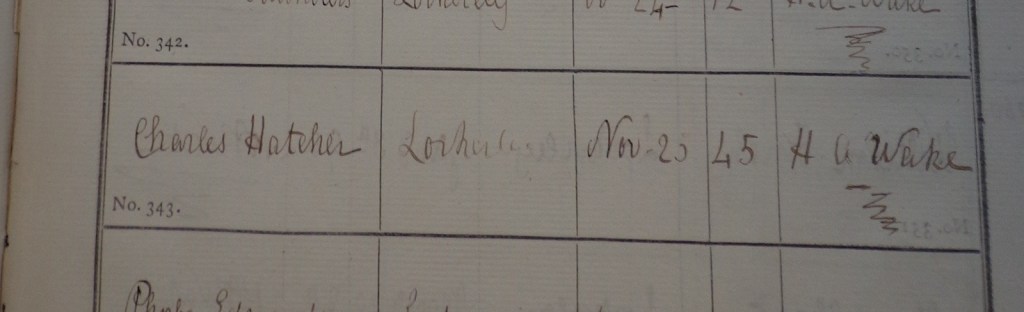
On a grey November morning, Thursday, the 25th day of November 1858, the villages of Newtown and Lockerley lay wrapped in mist and mourning. The damp chill of late autumn settled upon the hedgerows and cottages like a veil, and the church bell tolled, slow, solemn, and unrelenting, marking the passing of Charles Hatcher, a man of the soil, a husband, a father, a son.
He had been only forty-five years old, but his life had been one of unbroken labour and quiet grace. The steady rhythm of his work, the swing of the axe, the turn of the earth, the breath of the wind through Lockerley’s woods, had once been the heartbeat of his days. Now, that rhythm had ceased. And as the bell’s echo drifted over the frost-silvered fields, the villagers knew that another of their own was being laid to rest beneath the Hampshire sky.
Inside their small cottage at Butler’s Wood, Newtown, Lockerley, the morning began in stillness. The air was heavy with the scent of beeswax and cut pine. Charles’s body had lain through the night within the home, the same walls that had echoed with the laughter of his children and the soft murmur of his wife’s prayers. The coffin, crafted by a local carpenter, stood upon two wooden trestles in the main room, its polished surface adorned with a simple spray of ivy and late autumn berries gathered by the children. His hands, once so strong, were folded across his chest, and upon his face rested a peace that only those who have toiled well in life are granted in death.
Susan, his beloved wife, sat close by, her hand resting gently upon the lid, unable to let go. Around her, the children watched in silence, wide-eyed, confused, some too young to grasp the finality of what was unfolding. The small hearth burned low, its glow reflecting in Susan’s tear-filled eyes. She had spent days at his bedside, holding his hand as illness took him, and now she must do the unthinkable, release him. He had been her anchor, her hero, her saviour, her laughter, her comfort in all seasons. The father of her seven children. The only man she had ever loved.
Before noon, the funeral procession formed outside the house. The coffin, draped in a plain white shroud, was lifted onto a hand-bier by four village men, perhaps family, neighbours or fellow labourers who had known Charles from the fields and lanes. At the head of the procession walked the parish clerk, carrying a small wooden cross, followed by Reverend H. A. Wake, the curate of St John’s Church. Behind them came Susan, dressed in black mourning crepe, her shawl pulled tightly around her shoulders, her steps slow and unsteady as though the ground itself resisted each movement forward.
The path from Newtown, Lockerley to St John’s Church was familiar, a narrow lane bordered by hedges, winding gently toward the walls of the church. Along the way, neighbours paused in their doorways, removing their caps or bowing their heads as the procession passed. It was a mark of respect, one the villagers always gave to their own, for in a place so small, every loss was shared.
When the mourners reached the churchyard gate, the curate began to read the opening words of the Church of England’s Burial Service, his voice carrying softly through the crisp air,
“I am the resurrection and the life, saith the Lord: he that believeth in me, though he were dead, yet shall he live.”
The words, drawn from John 11:25, were the same that had been spoken at countless Hampshire funerals before, ancient, familiar, and comforting. Inside the church, the wooden pews were filled with family and villagers. The children sat close to Susan, their small hands clasped tightly together. The air was cool, scented faintly with damp stone and candle wax.
The service was simple, as befitted the life of a working man. The coffin was carried to the front of the nave, where Reverend Wake stood waiting, his surplice white against the dim light filtering through the coloured glass. The congregation sang softly, hymns that had been sung for generations in these same walls:
“Rock of Ages, cleft for me,
Let me hide myself in Thee.”
and later, as the tears came quietly,
“Abide with Me; fast falls the eventide.”
Their voices, though trembling, filled the church with a kind of humble beauty, echoing against the high-beamed roof. The curate read from the Book of Psalms “The Lord is my shepherd; I shall not want.” Then came the final prayer, a plea for comfort to those who mourned and rest for the soul of the departed:
“We therefore commit his body to the ground; earth to earth, ashes to ashes, dust to dust; in sure and certain hope of the resurrection to eternal life.”
The words lingered in the stillness as the mourners followed the coffin out through the arched doorway and into the churchyard, where the open grave waited beneath an old yew tree. The church bell, heavy and resonant, tolled once more, each note falling like a heartbeat against the silence.
Reverend Wake stood at the graveside, his breath clouding in the cold air as he spoke the final blessing. Susan stepped forward, her gloved hand trembling as she released a small handful of earth upon the coffin. It fell softly, a quiet sound against the wood, final yet tender. Around her, the children followed her example, their small gestures of farewell marking the first steps of grief they would ever know.
Standing a little apart were William and Mary Hatcher, Charles’s parents. Their faces were etched with years of labour and loss, their bodies bent not only with age but with the unbearable sorrow of burying yet another child. Mary clutched a small handkerchief to her lips, her shoulders shaking as she watched the earth begin to cover her son. No parent ever expects to see such a day, to outlive the life they once brought into the world.
When the last prayer was spoken, the curate turned to the great leather-bound register within the vestry and recorded the solemn entry that would preserve this moment for generations to come:
BURIALS solemnized in the Parish of Lockerley in the County of Southampton in the Year 1858.

No. 343.

Name: Charles Hatcher.

Abode: Lockerley.

When Buried: November 25th.

Age: 45 years.

By whom the Ceremony was performed: H. A. Wake.
And so, as the final spade of soil fell and the mourners drifted away, the earth of Lockerley gently embraced one of its own, a man who had lived close to it, worked it, and now returned to it.
That night, the cottage felt unbearably quiet. Susan sat by the fire, her eyes fixed upon the empty chair where Charles had once sat, his laughter mingling with the crackle of the hearth. The children slept, their soft breathing a fragile comfort. Outside, the wind moved through the trees, whispering through the branches like a ghostly hymn.
For Susan, the world had shifted. The man she had loved since youth, the father of her children, her partner in every hardship, the steady light of her days, was gone. Her heart was hollowed, her hands restless for the feel of his. And though time would one day soften the edges of her grief, that November would forever live within her, the season when the love of her life was laid to rest beneath the Hampshire soil.
Yet even in sorrow, something eternal remained. In the laughter of her children, in the murmur of the woods where Charles had once worked, in the whispering of the church bells through the mist, his spirit endured. The land he had loved so deeply now held him, and his soul, freed by love, drifted gently above the village he had called home, where the fields still remembered the sound of his steady, faithful hands.
Beneath Hampshire skies of whispering grey,
In fields where larks would rise and play,
A boy named Charles first drew his breath,
A child of earth, of life and death.

Born where the hedgerows twist and lean,
Where wildflowers stitched the meadows green,
He grew beneath the church bell’s chime,
A son of toil, a friend to time.

His hands were rough, his heart was kind,
He bore the weight of heart and mind,
Through frost and summer’s golden haze,
He gave his strength to endless days.

With axe and plough, with back and bone,
He shaped a world he’d call his own,
A humble man, yet rich in grace,
With soil and sweat upon his face.

Then love, like dawn upon the land,
Came softly, gently, took his hand,
Susan, fair and steadfast soul,
The keeper of his heart made whole.

Together they built their quiet nest,
In Lockerley’s calm, by fields caressed,
Seven children, laughter, tears, and song,
A family’s thread, both frail and strong.

Through sickness, sorrow, harvest, rain,
He laboured on through joy and pain,
A father’s care, a husband’s will,
His love unspoken, steadfast still.

Each morning’s light, each setting sun,
Bore witness to the work he’d done,
No marble marks his resting place,
But nature’s breath and time’s embrace.

For when the chill of illness came,
And winter whispered Charles’s name,
He met it not with fear or pride,
But Susan’s hand close by his side.

Her tears fell soft as autumn rain,
Her heart broke once, and once again,
She held his hand till breath was gone,
Then opened the window, to let him go.

The wind slipped through, both cold and kind,
And carried the soul he left behind,
Over fields he’d ploughed, through woodland deep,
Where Hampshire’s soil now holds his sleep.

His parents wept, his children cried,
As bells of St John’s softly sighed,
And Susan knelt in grief so wide,
Her world had dimmed, her sun had died.

But though the years have long since passed,
And seasons changed and shadows cast,
The name of Charles still hums and hums,
In roots and rain and beating drums.

In every tree that bends with age,
In every plough that tills the stage,
In every child who bears his name,
His gentle soul still burns its flame.

So here’s to Charles, whose humble grace,
Still lingers in that Hampshire place,
A life of earth, of love, of care,
A spirit free, still breathing there.

And when the evening air grows still,
And dusk rolls softly o’er the hill,
One might yet hear, through wind and pine,
His voice in whispers “She was mine.”
Rest in Peace

Charles Hatcher

1814–1858
Sleep now, dear Charles, beneath the quiet Hampshire sky, where the fields you once tended still breathe your name through the whispering grass. The soil that bore your toil now cradles your rest, gentle and eternal. Though your hands no longer labour and your voice has faded into the hush of time, your spirit lingers, in the soft turn of the plough, in the morning mist that drifts over Lockerley’s meadows, in the tender hearts of those who came after you. You lived not for grandeur, but for love, for Susan, your steadfast companion, for the children who carry your legacy, and for the earth itself, which remembers your every step. Rest now, beloved soul, your work complete, your story written in roots, in rain, and in remembrance. The world is quieter without you, yet somehow fuller still, for your life remains woven into its very heart.
And so, the story of Charles Hatcher comes gently to its close, not with grandeur or acclaim, but with the quiet dignity that marked his every day upon this earth. From his first breath in the rolling fields of Sherfield English to his final sigh beneath the same Hampshire sky, Charles’s life was one of endurance, devotion, and simple, steadfast love.
He was a man of the soil, his hands calloused, his back bent by labour, yet his heart unyielding in its gentleness. He loved deeply and quietly, in the way of men whose affections are written not in words but in deeds, in the steady rhythm of the plough, the laughter of his children, the glance shared with his beloved Susan across a humble hearth. Through hardship and harvest, loss and renewal, he lived a life stitched seamlessly into the fabric of his land and family.
When his time came, the village mourned, the fields fell still, and the wind carried his name softly through the hedgerows. Though his grave bears no grand inscription, his memory lives in the living, in every dawn that breaks over Lockerley’s meadows, in every generation that follows the quiet thread he began.
Charles’s story is not one of kings or conquerors, but of something far greater, a man who loved, worked, and gave his all to those who shared his world. His legacy endures not in monuments, but in hearts, in soil, and in the whispered prayer of time itself.
Rest now, 3rd great-grandfather Charles. Your journey is done, but your story will never fade, for it lives on in every breath of wind that moves through the fields you once called home.
Until next time,
Toodle pip,
Yours Lainey.
I have brought all certificates throughout Intwined,

Please do not download
or use them without my permission.

All you have to do is ask.

Thank you.