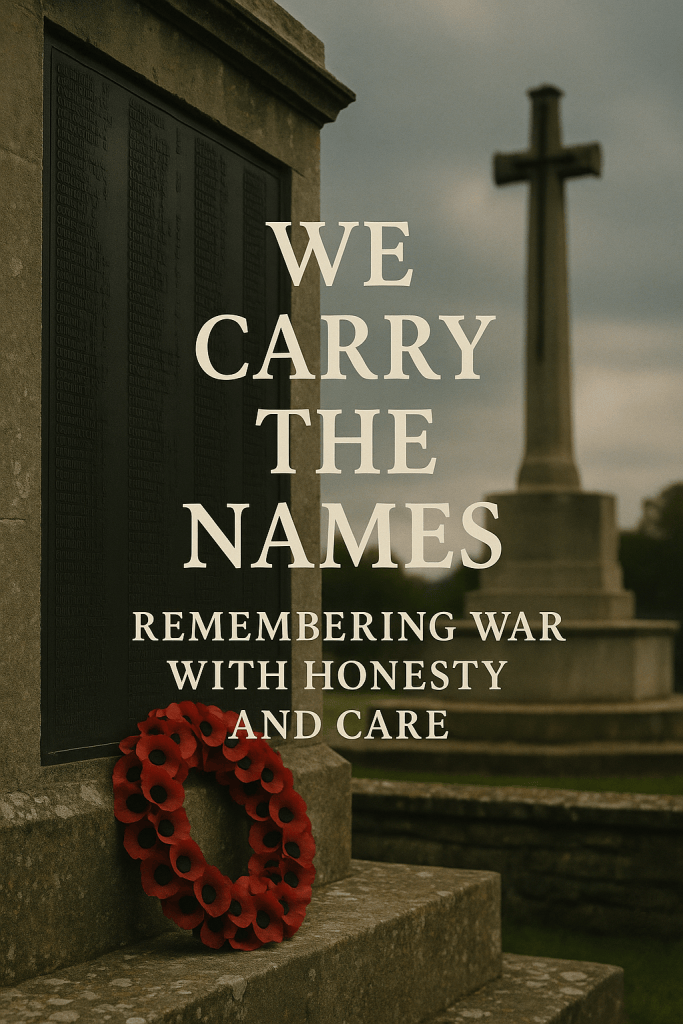
Britain remembers its wars with a particular tenderness, a careful gravity shaped by long experience. Not with constant fanfare or easy declarations of victory, but with pauses that stretch just a little longer than expected, with poppies worn close to the heart, with names carved into stone and spoken softly across generations. There is an understanding, deeply rooted and quietly shared, that remembrance is not the same as celebration. To remember is to hold weight, to accept complexity, to honour without pretending that war was ever simple or glorious. We remember not to admire war, but to face its cost with open eyes and steady hearts.
Across Britain, memory first takes shape in monuments that rise gently from everyday places. Stone crosses stand on village greens where children play and dogs are walked. Names line church walls, their letters worn smooth by time and touch. Each name once belonged to a life woven into ordinary days, someone called home for supper, someone expected to return. These memorials do not shout their meaning. They stand quietly, enduring rain, frost and sunlight, inviting reflection rather than pride. Many list only surnames and initials, a stark and humbling reminder of how many stories ended before they could fully unfold. People pause before these stones, sometimes finding a family name, sometimes lingering over one they do not know, imagining a life that might have been. Their power lies in restraint. They do not explain. They ask us to remember.
Yet remembrance in Britain lives just as deeply beyond stone and ceremony. It settles into silence. For many families, the wars were spoken of sparingly, if at all. Grandparents carried memories they did not wish to pass on too heavily. Veterans returned and folded their experiences away, believing it kinder to let children grow without the burden of fear. Silence became a form of protection, an act of love shaped by endurance. But silence is never empty. It tells its own story. It speaks of pain too vast for easy telling, of memories that refused neat endings.
As years passed, that silence began to soften. Stories emerged slowly and often unexpectedly. A remark offered over tea. A photograph lifted carefully from a drawer. A memory stirred by the sound of a plane overhead or the smell of damp earth after rain. These moments were rarely dramatic. They were intimate, halting and deeply human. Through them, children and grandchildren learned that war was not only battles and dates, but waiting, hunger, fear, tenderness and loss. They learned that courage often looked like endurance rather than heroics.
Family storytelling has become one of Britain’s most powerful forms of remembrance. Across kitchen tables and living rooms, people piece together histories from letters written in careful script, from medals tucked away in boxes, from ration books, identity cards and faded photographs with names pencilled on the back. These stories resist simple hero narratives. They speak instead of people doing what they had to do because there was no alternative. They speak of resilience rather than conquest, of care rather than triumph. They reveal survival as something shared, sustained by communities and relationships, not solitary glory.
Education has slowly shifted to reflect this broader truth. While battles and leaders still have their place, there is now growing space for voices once overlooked. Civilians enduring bombings, children shaped by evacuation, colonial soldiers who fought far from home, conscientious objectors who served without bearing arms, and women whose labour and intelligence sustained the nation are increasingly woven into the story. This widening of perspective does not weaken remembrance. It deepens it. It acknowledges that war touched everyone differently, and that understanding those differences is part of honouring the past with integrity.
Commemoration itself reflects this careful approach. Remembrance Day ceremonies are solemn, thoughtful and restrained. Silence is central. Poppies symbolise sacrifice rather than victory, loss rather than conquest. The words “lest we forget” carry a warning as much as a promise. Forgetting risks repetition. Forgetting smooths over suffering. Remembering keeps truth alive, even when it is uncomfortable or complex.
There is a quiet wisdom in Britain’s way of holding war in memory. It resists spectacle. It makes room for grief. It understands that to glorify war is to misunderstand it entirely. The nation remembers not because war made it proud, but because war changed it forever.
And remembrance is not fixed in time. Each generation reshapes it with new questions and deeper empathy. Younger voices ask not only how wars were fought, but why, and at what cost. They listen for stories once sidelined. They seek connection rather than conquest, understanding rather than myth. In doing so, they keep remembrance alive, not as ritual alone, but as moral responsibility.
To remember without glorifying is an act of courage. It chooses honesty over comfort. It honours those who lived through war by refusing to romanticise their suffering. It recognises that bravery does not require conflict to exist, and that peace is not passive, but something built deliberately through understanding, care and vigilance.
Britain tells its war stories gently but firmly because it knows what forgetting can do. Memory becomes an act of stewardship. A way of saying that lives lost mattered, that pain endured was real, and that the future deserves greater compassion.
We carry the names because they once carried hopes, friendships and love. We remember not to relive war, but to learn from it. Not to praise it, but to prevent its return. In remembrance, Britain holds its history with care, passing it forward not as a tale of glory, but as a reminder of humanity itself, fragile, resilient and always worth protecting.
Until next time,

Ta ta for now.

Yours, Lainey.