In the quiet corners of history, amidst the echoes of bygone days, there exists a tapestry woven with the threads of ordinary yet remarkable lives. Among them stands Francis Herbert Butt, a man whose life, though lived decades ago, resonates with timeless lessons and profound moments that shape our understanding of resilience, creativity, and the human spirit.
Born in 1883, Francis Herbert Butt traversed an era marked by transformation and tumult. His journey unfolds against the backdrop of the early 20th century, a period of innovation and upheaval, where the world was both shrinking and expanding in unprecedented ways. Through his eyes, we glimpse not just one man's story, but a mosaic of an era, its challenges, its triumphs, and its enduring legacy.
And now, all these years later, his story has unexpectedly blended with my son’s, linking past and present in a way that feels both profound and deeply personal.
Join me as we unravel the life of Francis Herbert Butt, exploring the passions that stirred his heart, the challenges that tested his resolve, and the contributions that left an indelible mark on those who knew him. Through his journey, I hope to uncover not just the past, but the ways in which it continues to shape our present and future.
Beyond the dates and events lies a narrative waiting to be told, a narrative of perseverance, of dreams pursued, and of a life lived with purpose.
In honoring his memory, we celebrate not only the life he lived but also the universal truths that bind us across time, our capacity to endure, to create, and to find meaning in the tapestry of our own stories.
so without you, I give you,
The Life of
Francis Herbert Butt
1883–1948
Through Documentation

Welcome back to the year 1883, Romsey, Hampshire, England.
The world around you is one of quiet countryside and bustling change, where cobbled streets echo with the clatter of horse hooves and the distant whistle of steam trains. Queen Victoria sits upon the throne, well into the later years of her reign, a steadfast figure presiding over an empire that stretches across the globe. In Parliament, Prime Minister William Gladstone leads the Liberal government, his policies shaped by a vision of reform, free trade, and moral responsibility. Yet, beneath the grandeur of monarchy and governance, everyday life in Romsey, and England as a whole, is filled with stark contrasts, from the comforts of the upper classes to the struggles of the working poor.
Socially, England is a nation bound by rigid class divisions. At the top sit the aristocracy and the wealthy industrialists, their grand homes filled with ornate furnishings and new technological wonders such as indoor plumbing and gas lighting. Below them, the growing middle class, shopkeepers, professionals, and skilled workers, seek respectability, emulating the manners and fashions of their social superiors. The working class, however, toils long hours in factories, fields, and domestic service, while the poorest struggle to survive in squalid conditions, often at the mercy of workhouses and charitable institutions.
Fashion reflects this divide. Wealthy men dress in tailored frock coats and silk cravats, their neatly trimmed beards a mark of distinction, while women wear elegant, high-necked gowns with bustles, their corsets pulled tight to achieve the ideal silhouette. In contrast, the working class wear practical, often threadbare clothing, flat caps and sturdy boots for men, simple dresses and aprons for women, their garments repaired and re-used until they fall apart.
Getting around Romsey in 1883 depends largely on one's means. The well-to-do travel by carriage or even the railway, which links the town to the wider world, while most people walk wherever they need to go. Bicycles, though still a novelty, are gaining popularity among the more adventurous. Steamships and trains are revolutionizing long-distance travel, making journeys that once took days achievable in mere hours.
At home, heating and lighting are primitive by modern standards. Coal fires warm homes, though only the affluent can afford to heat multiple rooms. Gas lighting flickers in wealthier households and along some city streets, but many still rely on oil lamps and candles. The air, especially in industrial cities, is thick with coal smoke, staining buildings and choking the lungs of those who live and work in the smog-filled streets. In places like Romsey, the air is cleaner, but the damp chill of winter creeps through draughty homes nonetheless.
Sanitation remains a challenge. While advances in sewer systems are improving conditions in cities, many rural areas and poorer districts still rely on cesspits and open drains. Disease is an ever-present threat, with outbreaks of typhoid and tuberculosis cutting lives short. Clean water is a luxury in some areas, and the link between hygiene and health is still not fully understood by the general population.
Food varies dramatically depending on class. The wealthy enjoy roast meats, fresh vegetables, and exotic fruits imported from across the empire, their meals prepared by servants in well-stocked kitchens. The middle classes dine on bread, cheese, and preserved meats, while the poor survive on a monotonous diet of bread, gruel, and potatoes. A hot meal is a rare treat for many, and hunger is a daily reality for the destitute.
Despite these hardships, entertainment flourishes. Music halls draw lively crowds with bawdy songs and comedic acts, while novels by writers like Charles Dickens and Thomas Hardy captivate readers rich and poor alike. Theatres put on grand productions, though for many, simple pleasures,folk music, storytelling, and the convivial atmosphere of the local pub, are the main sources of amusement.
Gossip and scandal ripple through society, from the drawing rooms of the elite to the factory floors. The newspapers are filled with tales of crime, political intrigue, and sensational court cases. One story gripping the nation is the trial of Kate Webster, a maid accused of murdering her employer and disposing of the body in a gruesome manner. The case horrifies and fascinates Victorians in equal measure, reinforcing the era’s obsession with crime and morality.
The difference between the rich, working class, and poor is stark. The wealthy live in comfort, insulated from the struggles of daily existence, while the working class endure long hours and harsh conditions with little security. The poorest live in slums, facing disease, hunger, and the ever-present threat of the workhouse. Social reform movements are gaining momentum, but change is slow, and for many, life is a daily battle for survival.
Against this backdrop of inequality, industrial progress, and strict social order, history continues to unfold. The year 1883 witnesses the explosion of the Krakatoa volcano, sending shockwaves across the world and affecting global climate for years to come. In England, reforms in education and workers’ rights signal the slow march toward a more equitable society, though the rigid structures of class and tradition remain firmly in place.
This is the world into which Francis Herbert Butt is born, a world of contrasts, of progress and hardship, of privilege and poverty. His life will be shaped by the forces of his time, yet in many ways, his experiences will echo those of countless others navigating the complexities of Victorian England.
It was a early spring day on Saturday, the 24th of March, 1883, when Francis Herbert Butt entered the world. Born at the family home on Middlebridge Street in the historic market town of Romsey, Hampshire, he arrived into a life shaped by the rhythms of Victorian England. Outside, the quiet hum of the town continued, shopkeepers setting up their stalls, the scent of freshly baked bread drifting from the bakery, and the occasional clatter of a horse-drawn cart making its way along the cobbled streets. Inside the Butt household, however, all attention was fixed on this tiny new life.
His father, Arthur Butt, was a butcher, a respected trade in a town where the market played a vital role in daily life. His mother, Fanny Butt (formerly Kemish), had just given birth in the familiar surroundings of their family home a common practice in those days when hospitals were reserved for the desperately ill, not for the natural process of childbirth.
The registration of a birth was an important legal formality, and it was Arthur himself who undertook the duty. On Saturday, the 5th of May, 1883, he made his way to the registrar’s office in Romsey, where George Withers, the registrar, officially recorded his son's arrival. He carefully noted down the details: the father, Arthur Butt, a butcher by trade; the mother, Fanny, who had taken on her husband’s name but carried with her the lineage of the Kemish family. Their residence was firmly established, Middlebridge Street, a place that would be young Francis’s first world, where he would take his earliest steps, hear his first stories, and begin the life that would shape him.
Francis’s birth was more than just a date on a certificate, it was the beginning of a journey. The Romsey he was born into was a town of tradition and quiet industry, where the past and future met in a delicate balance. His childhood would unfold against the backdrop of a changing England, where gas lamps still flickered in the evenings, the clatter of horse-drawn carriages filled the streets, and the great industrial age loomed ever larger. But in those first precious days of spring 1883, all that mattered was the warmth of home, the security of family, and the promise of a life just beginning.

Middlebridge Street, Romsey, Hampshire, has long been a significant part of the town’s history, with its roots stretching back centuries. The street takes its name from its position near one of Romsey’s key crossings over the River Test, a vital waterway that has shaped the town’s development since medieval times. As Romsey grew into a thriving market town, Middlebridge Street became an important thoroughfare, connecting the town centre to surrounding rural areas and serving as a home for skilled tradespeople, merchants, and craftsmen.
During the medieval and early modern periods, Middlebridge Street was lined with timber-framed buildings, some of which still stand today, preserving the architectural character of bygone centuries. Many of these properties would have housed families who worked in Romsey’s flourishing wool and cloth trade, which brought prosperity to the town from the Middle Ages through to the 18th century. As commerce shifted in the 19th century, Middlebridge Street became home to various other trades, including butchers, blacksmiths, and bakers, reflecting the town’s continued reliance on skilled artisans and shopkeepers.
By the Victorian era, when Francis Herbert Butt and his family lived there, Middlebridge Street was a bustling and industrious part of Romsey. Butchers, such as the Butt family, played a vital role in the local economy, providing fresh meat to residents at a time when refrigeration did not exist, making daily access to butchers essential. The street would have been alive with the sights and sounds of trade, carts carrying supplies, the calls of merchants, and the chatter of townspeople going about their daily routines.
The River Test, which runs parallel to Middlebridge Street, added to the area’s importance, with mills and small-scale industries making use of the water’s power. The river also contributed to the lush surroundings of Romsey, providing a contrast to the busy marketplace and offering a sense of natural beauty amid the town’s industry. However, being close to the water also meant that Middlebridge Street, like other low-lying areas of Romsey, was at times vulnerable to flooding, particularly before modern drainage systems were implemented.
Throughout its history, Middlebridge Street has remained a key part of Romsey’s identity. Even as the town has modernised, it has retained much of its historic charm, with many of its older buildings still standing, offering a glimpse into the past. For families like the Butts, who lived and worked there in the late 19th century, Middlebridge Street was not just an address, it was a place where livelihoods were built, traditions were carried on, and the town’s enduring legacy was shaped.
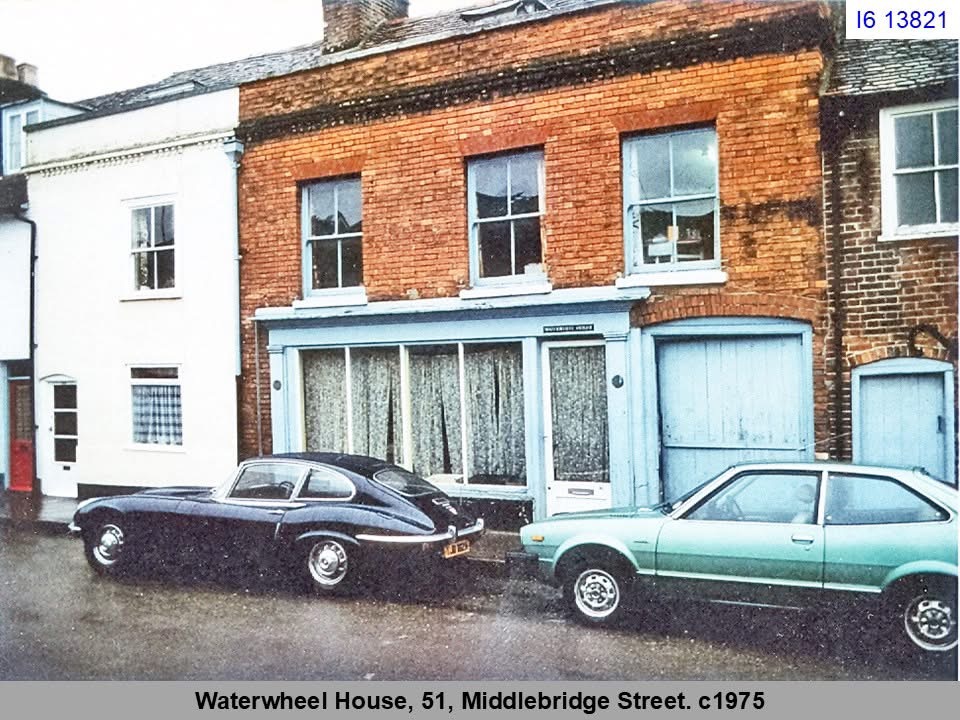
was formerly Mr. Arthur Butt and families
home and butcher’s shop,
with yard, slaughterhouse, and bacon drying loft.
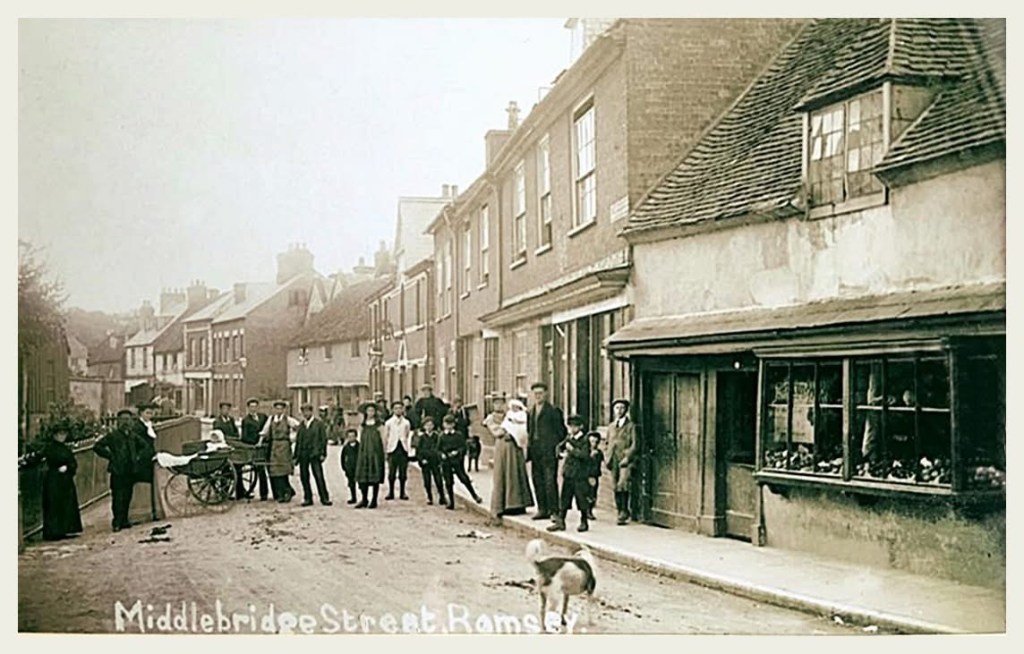
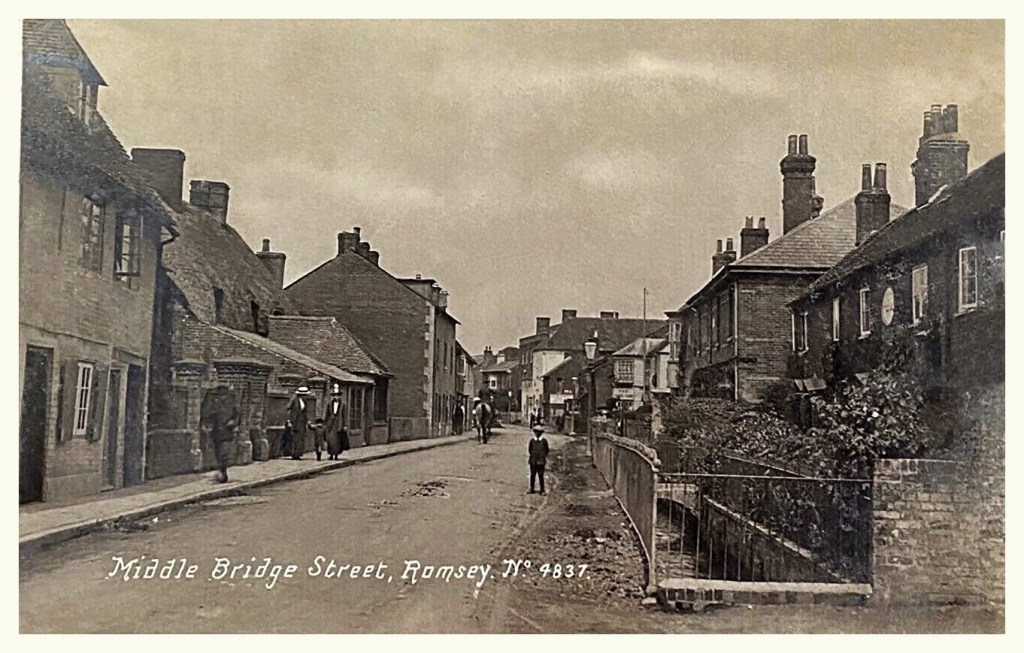

Just over a year after Francis Herbert Butt took his first steps into the world, the small home on Middlebridge Street, Romsey, was once again filled with the cries of a newborn. OnWednesday, the 2nd of July, 1884, Leonard George Butt was born, another son to Arthur and Fanny Butt (née Kemish)
By now, the family had settled into a familiar rhythm, Arthur busy with his work as a butcher, Fanny managing the household, and little Francis, just fifteen months old, perhaps too young to fully grasp what was happening. The summer of 1884 in Romsey would have been alive with the usual bustle of market days, the steady flow of the Test River winding its way past the town, and the scent of freshly cut hay drifting in from the surrounding countryside.
Six weeks after Leonard's birth, onThursday, the 14th of August, 1884, Arthur once again made his way to the registrar’s office in Romsey. There,George Withers, the same registrar who had recorded Francis’s birth the year before, carefully inscribed Leonard George’s details into the official records. This time, Arthur’s full name, Arthur Henry Butt, was recorded, his trade still listed as a butcher, and their home still firmly in Middlebridge Street.
With four small boys in the house, the Butt family was growing, their home filled with the sounds of infancy, cooing, crying, and, in time, the shared laughter and mischief that only brothers can bring. As Francis adjusted to his new role as an older sibling, Leonard’s arrival marked the beginning of a lifelong bond between the two, their early years shaped by the same Romsey streets, the same family traditions, and the same home that had now welcomed them both into the world.

On Monday, the 24th day of August, 1885, the Butt family home in Middlebridge Street, Romsey, was blessed with the arrival of Edith Maria Butt. The family was living above the premises of their butcher’s business, a bustling and practical arrangement that provided a foundation for both work and family life, which also had a yard, slaughterhouse, and bacon drying loft. Edith’s arrival would have been a joyful occasion, as the family, already growing with Ernest, Horace, Sydney, Francis and Leonard, welcomed a daughter into their fold.
The streets of Romsey would have carried the usual hum of everyday life, horse-drawn carts making their way through the town, the local market vendors setting up their wares, and the sounds of children playing in the cobbled streets. In their home, the birth of Edith brought with it a fresh sense of energy. With four older brothers now sharing the household, Edith was the first girl, and her arrival would have brought a new dynamic to the family, one that would continue as the years went by.
Arthur Henry Butt, Edith’s father, was busy with the family butcher’s business, no doubt a vital part of his daily routine. His wife, Fanny Butt (formerly Kemish), had borne him four sons before Edith, and now, as a mother to a daughter, her responsibilities in both the home and business grew. It was a demanding life, but one that was not uncommon for working-class families of the time, especially those whose businesses were integrated into their homes.
On Wednesday, the 7th of October, 1885, Arthur registered Edith’s birth at the Romsey Registrar’s office. Once again, the familiar name of George Withers was responsible for recording the details. Arthur listed his full name, Arthur Henry Butt, and his occupation as a butcher, confirming the family’s residence in Middlebridge Street, Romsey. Fanny’s maiden name was also recorded, Fanny Kemish, cementing her family’s connection to the local community.
Edith’s birth, like those of her brothers, marked an important chapter in the story of the Butt family, a family rooted in tradition, shaped by the rhythms of a small market town and a butcher’s trade. As the years went by, she would grow up alongside Francis and Leonard, and together, they would witness the changes of a rapidly evolving England, from the days of horse-drawn carts to the rise of new technologies and the advent of the 20th century.

On Wednesday, the 14th of September, 1887, Amy Lilian Butt was born at the family home and butcher’s premises on Middlebridge Street, Romsey, Hampshire. She was the seventh child of Arthur Henry Butt and Fanny Butt (née Kemish), joining a household already filled with the laughter, chatter, and footsteps of her older brothers and sister, Ernest, Horace, Sydney, Francis, Leonard, and Edith.
By the time Amy arrived, the Butt family had firmly established themselves in Romsey. Their butcher’s shop was not only the source of their livelihood but also the very heart of their home, where the children grew up amidst the sights, sounds, and scents of their father’s trade. Arthur Henry Butt, a hardworking butcher, spent his days tending to the shop, while Fanny, now a mother of seven, managed the bustling household with unwavering dedication.
Six weeks after Amy’s birth, on Friday, the 28th of October, 1887, Arthur made his now-familiar journey to the Romsey Registrar’s office. There, George Withers, the registrar who had already recorded the births of Amy’s older siblings, carefully noted down the details. As before, Arthur’s occupation was listed as a butcher, and their home and business remained at Middlebridge Street.
With seven children now under one roof, the Butt household must have been a place of constant movement and energy. Ernest, the eldest, likely took on a protective role, while Horace and Sydney might have been mischievous playmates for Francis and Leonard, who were still little boys themselves. Edith, at just two years old, was no longer the youngest, now sharing that place with baby Amy. Their days were most likely shaped by the rhythms of a Victorian childhood, playing in the narrow streets of Romsey, watching their father at work in the shop, and helping their mother with small tasks around the house.
Outside their home, the world of 1887 Romsey carried on as usual. Horse-drawn carts rattled along the cobbled streets, market stalls brimmed with fresh produce, and the warm glow of gas lamps illuminated the town in the evenings. The Butt family, with their deep roots in the local butcher’s trade, played an essential role in the community, ensuring that families and businesses alike had fresh meat on their tables.
For Amy, being born into such a large and hardworking family meant that she was never alone, always surrounded by older siblings to guide and tease her, a loving mother to care for her, and a father whose dedication to his trade kept the household running. As she grew, she would carve out her own place among her brothers and sister, shaped by the same home, the same traditions, and the ever-present hum of Middlebridge Street, where the Butt family thrived.

On Thursday, the 14th of August, 1890, Florence Fanny Butt was born at the family home on Middlebridge Street, Romsey, Hampshire. She was the eighth child of Arthur Henry Butt and Fanny Butt (née Kemish), completing the family’s four boys and four girls, adding balance to the bustling household.
Six weeks later, on Friday, the 26th of September, 1890, Arthur H. Butt went to the Romsey Registrar’s Office to register Florence’s birth. The registrar, Henry Bedford, recorded that Arthur’s occupation was Master Butcher, a title that marked his reputation in the town. The family’s residence remained at Middlebridge Street, where their home doubled as the butcher’s shop. The registrar also noted that Florence’s mother was Fanny Butt (formerly Kemish).
Interestingly, the entry includes a special note under Section 10: Baptism Name. While Florence was listed officially as Florence Fanny Butt, her certificate of naming revealed that she had been named Minnie Fanny at her baptism. This dual naming tradition was not uncommon at the time, reflecting either a family preference for a more informal or familiar name or perhaps a way of honoring relatives or significant figures. Florence would eventually be known by the name Minnie, but the registry preserved both names for posterity.
With the addition of Florence, the Butt family now had eight children, a dynamic household filled with the sounds of bustling activity as siblings played, helped with the shop, and grew in the warmth of their close-knit family. Florence’s arrival completed the second generation of the Butt family, a household firmly rooted in Romsey and known for its bustling butcher’s business.

The Census of Sunday, 5th April 1891 provides a detailed glimpse into the daily life of the Butt family, still firmly rooted in their home and butcher's business on Middlebridge Street, Romsey, Hampshire. The family was living in a large, bustling household, with Arthur Henry Butt and Fanny Butt (née Kemish) at the helm, their eight children filling every corner of their home. The census shows that alongside their children, Ernest W., Horace A., Sidney H., Leonard G., Edith M., Amy L., and Florence (known as Millie), the family was also supported by a 19-year-old servant, Rose Mitchell, who helped manage the ever-growing household.
Arthur, now a skilled butcher, was working from the family premises, which was both home and shop. The house included a shop, a yard, a slaughterhouse, and a bacon drying loft, all essential components of their butcher’s business. The family’s livelihood was deeply tied to this trade, with Arthur overseeing the operations, while his eldest son, Ernest, worked as an assistant butcher. Ernest’s role in the business marked his early integration into the family’s trade, while his younger brothers, Horace, Sidney, Leonard, and Francis, were likely too young at this stage to take on such responsibilities, though they were surely learning from their father and older siblings in the process.
At the time of the census, all of the Butt children, except for Ernest, were still attending school. This would have been a time of education and play for Francis, Leonard, Edith, Amy, and Millie, as they spent their days learning, developing, and playing in the streets of Romsey. The presence of a servant, Rose Mitchell, suggests that Fanny, the mother of many young children, relied on help to maintain the household, providing care for the children and managing domestic tasks while Arthur ran the business.
The home, with its shop, yard, and additional spaces, was more than just a residence; it was a working establishment where business and family life were intertwined. The census entry captures a family at a pivotal moment, where traditional ways of life were meeting the pressures of an expanding and evolving world. Their butcher’s shop was a focal point of their daily routine, with customers coming in for cuts of fresh meat and the constant cycle of work in the yard and slaughterhouse.
Despite the hard work and busy days, the family would also have enjoyed the warmth of a close-knit home. The sounds of children playing, the occasional squabble, and the everyday bustle would have filled the rooms. Francis, now eight years old, was perhaps beginning to feel the weight of responsibility as the older brother, while Edith and Amy, at six and four, would have been increasingly involved in the daily life of the home, assisting their mother and learning about the world around them.
In 1891, the Butt family was fully immersed in the rhythms of small-town life in Romsey, balancing work, family, and education. Their butcher’s business was thriving, and despite the challenges of a large family and the demands of running a home and business, the family was well-supported by their close-knit community and each other.

On Saturday, the 16th of January, 1892, Isabel Lucy Butt was born at the family home on Middlebridge Street, Romsey, Hampshire. She was the ninth child of Arthur Henry Butt and Fanny Butt (née Kemish), completing the family with five girls and four boys—a lively, growing household that now included Ernest, Horace, Sydney, Francis, Leonard, Edith, Amy, Florence (Millie), and Isabel.
Her birth was registered over a month later on Saturday, the 27th of February, 1892, by Arthur H. Butt at the Romsey Registrar’s Office. The registrar, Henry Bedford, recorded that Arthur’s occupation was Master Butcher, reflecting his established trade and reputation in the town. The family’s residence was still in Middlebridge Street, where their home and butcher’s shop formed the heart of their lives.
The Butt family’s life at this point was well-rooted in Romsey, balancing family, business, and the constant bustle of a growing household. With Isabel's arrival, the family now had nine children, a testament to the hardworking nature and deep family bonds that defined their way of life.

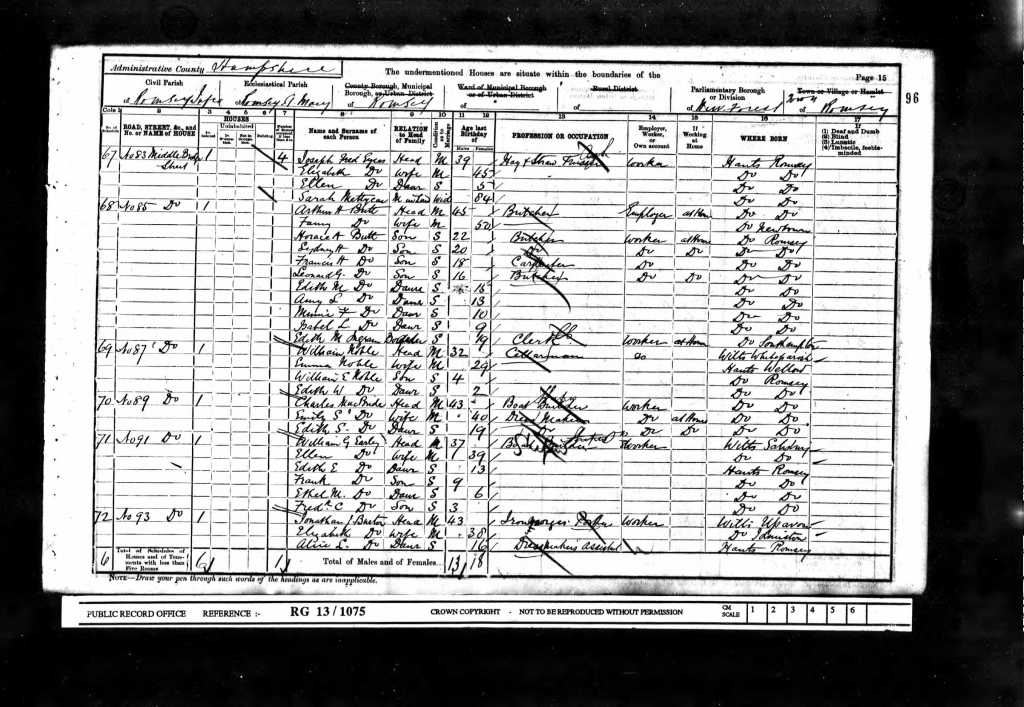
On Sunday, 31st March 1901, the Butt family was still living at Number 85 Middlebridge Street, Romsey, Hampshire. Arthur Henry Butt and Fanny Butt were the parents of eight children: Horace A. Butt, who was 22, Sydney H. Butt, aged 20, Leonard G. Butt, aged 16, Edith M. Butt, aged 15, Amy L. Butt, aged 13, Minnie F. Butt, aged 10, Isabel L. Butt, aged 9, and Francis Butt, who was 18 years old at the time. The family continued to reside in the same house where their butcher’s shop operated, with Arthur continuing to work as a Master Butcher and an employer.
By this point, the family’s butcher shop had grown, and Horace, Leonard, and Sydney were all working alongside their father in the business, following the tradition of their family. They helped maintain and expand the operations that had sustained the family for years. Francis, however, had chosen a different path. At 18, he was working as a carpenter, marking a departure from the butcher trade and showing that his interests lay elsewhere, perhaps in construction or a different form of craftsmanship.
Also living in the household at this time was a 19-year-old boarder named Edith M. Ingram, who worked as a clerk. She was not a family member but had taken up residence with the Butts, likely in need of accommodation as she worked in the town. Her presence in the home may have provided some extra hands with household responsibilities, though it also suggests that the Butt family had become well-established enough to offer room and board to others.
At this point, the younger children in the family, Minnie, Isabel, and Amy, were still in school or assisting with chores around the house. The family was balancing the challenges of a growing business, the care of younger children, and the need to adapt to a world that was changing rapidly, as the Butts tried to keep their traditions alive while also facing the opportunities and pressures of modern life in Romsey.
The Butt family’s dynamics were shifting as each of the children approached adulthood. The household was a blend of hard work in the family business, the pursuit of individual interests, and the shared experience of growing up in a busy, tight-knit family. It was a time of transition for everyone, from the older children stepping into roles as butchers to Francis forging his own path as a carpenter, while the younger siblings would eventually begin to find their place in the world.
As they all moved forward, the influence of their parents and the foundation of their home in Middlebridge Street would continue to shape their lives, even as the Butt family adapted to the evolving world around them.
Heartbreakingly, on the 3rd of July, 1903, Fanny Butt (née Newman), the 52-year-old wife of Arthur Henry Butt, and mother of nine children, passed away at the family home at Number 85, Middlebridge Street, Romsey. Fanny’s death was attributed to Albuminuria Ascites, a condition that causes fluid retention and is often linked to kidney failure. Her passing was certified by Frank A. Taylor, M.R.C.S., a local medical professional.
The loss of Fanny would have been a devastating blow to the family, as she had been the heart of their home and a steady presence in their lives. The registrar for the Romsey district, Henry Bedford, recorded the death on the 6th of July, 1903, though it was Margaret E. Butt, Fanny’s sister-in-law, who was present at the time of Fanny’s passing and took the responsibility of registering it. Margaret lived at Number 45, Hope Street, Landport, Portsmouth, a considerable distance from the family home in Romsey, but she was there when Fanny needed her most.

The death of Fanny marked a profound shift in the Butt family. She had been a central figure, and her absence would have left a gap that could never be filled, affecting not only her husband, Arthur, but also her children, who had grown up under her care and guidance. The family, already navigating the challenges of running a butcher business and transitioning into adulthood, would now face the task of coping with the deep sorrow and practical challenges of life without her.

Losing his mother would have been a profound and devastating experience for Francis. At the time of her passing in 1903, Francis was just 20 years old, a young man still navigating his way through adulthood. As the second eldest son in a large family, he would have felt the weight of the loss not just as a son, but as someone who had a close bond with the woman who had shaped his early life.
Fanny Butt was likely the emotional cornerstone of the family, especially in a household as bustling and busy as theirs. Withnine children to raise, Fanny’s nurturing presence would have been vital in keeping the family together, ensuring that the household ran smoothly despite the demands of running a butcher’s business. For Francis, losing his mother meant the loss of that steady, guiding influence in his life. She had been there through his childhood, watching him grow, helping him navigate the challenges of growing up. And now, she was gone.
At 20 years old, Francis was on the cusp of adulthood but had yet to fully step into a role where he might have been prepared to assume the responsibility of taking care of his family. It’s likely that he had been somewhat shielded by his mother’s presence, perhaps feeling a certain comfort in the knowledge that she was always there, managing the day-to-day struggles of the household. Now, without her, Francis would have to grapple with the sudden realization that he was no longer the boy who could rely on his mother’s care and guidance.
The loss of Fanny would have also meant the loss of an emotional anchor for the family. Arthur, Francis’ fatherp, would have had to shoulder the burden of running the family business and supporting the children, while Francis and his siblings would have felt the need to step up in their own ways, though none of them could fully replace the role that their mother had played. For Francis, this would have been an incredibly challenging time. It was not just about the grief of losing his mum but also the emotional and practical weight of filling a gap that no one could truly fill.
In the midst of his grief, Francis was likely still adjusting to his carpenter’s apprenticeship and his role in the family’s life. The demands of growing up, coupled with the emotional upheaval of losing his mother, would have been a heavy burden to bear. Yet, through all the sorrow, it is possible that this loss pushed him toward maturity. It would have forced him to face the reality of life’s fragility, and the need to find his own way in a world that had shifted beneath his feet.
Losing Fanny would have changed Francis in ways that are hard to fully capture. The loss of a mother at such a young age often leads to a profound reshaping of one’s identity, as it forces the person to navigate the world with the awareness that one of life’s most fundamental relationships is no longer there.
On Monday, the 6th of July, 1903, Francis and his siblings stood solemnly by their father Arthur’s side as they laid their beloved mother, Fanny Butt, to rest. The weight of grief must have been heavy upon them as they gathered at Romsey Old Cemetery, Botley Road, surrounded by family, friends, and members of the community who had known and loved Fanny.
For Francis, just 20 years old, the loss would have been immeasurable. He and his siblings had known their mother’s unwavering care and presence throughout their lives, and now, they were saying their final goodbye. The Butt familyhad always been close, bound together by their home and business on Middlebridge Street, and this moment would have only strengthened their bond, even in sorrow.
As they stood at Grave E451, the reality of her absence would have truly settled in. The comforting sounds of her voice, the warmth of her presence in their home, the way she had kept the family together, all of it now only a memory. Their father, Arthur, a strong and hardworking man, would have carried his grief differently, but Francis and his siblings would have known that, despite his composure, he was just as heartbroken.
With the final prayers spoken, and as the earth was laid over her resting place, Francis, must have felt a shift within him, a part of his childhood now truly over. The home at 85 Middlebridge Street would never be the same without Fanny, but in that moment, as they stood together in their grief, Francis and his family knew that they would have to carry on, not just for themselves, but for the mother who had given them everything.


On Tuesday, the 14th day of July, 1903, Ernest William Butt, a 25-year-old bachelor stood at the altar of The Parish Church of Romsey to marry Elizabeth Rose Nethaway, a 25-year-old spinster from Number 1, Pretoria Villas, Winchester Road, Romsey. It was a significant day for the Butt family, as Ernest embarked on a new journey, joining with Elizabeth to begin their married life together.
The ceremony was officiated by F. W. H. Davy, assistant priest, and as the details were recorded in the marriage register, it was noted that Ernest followed the family tradition of being a butcher, a profession that had defined his father, Arthur Henry Butt, for many years. Elizabeth’s father, Henry Nethaway, had passed away, and he had been a plumber by trade.
The marriage was witnessed by Thomas Fremorgen and Robert White, who signed the register to mark the occasion. For Francis, Ernest’s younger brother, the event would have been a meaningful one. As the family gathered to witness Ernest and Elizabeth’s vows, it must have been both a celebration and a reminder of the changes in their lives, with the Butt family growing and evolving through love and commitment.
In the midst of the grief from the loss of  Fanny just a few months earlier, Francis would have felt the bittersweetness of this marriage, but also the promise of hope and new beginnings as his brother Ernest started a new chapter with his new wife. It was a day of joy for the family, despite the shadows of loss that still loomed over them.

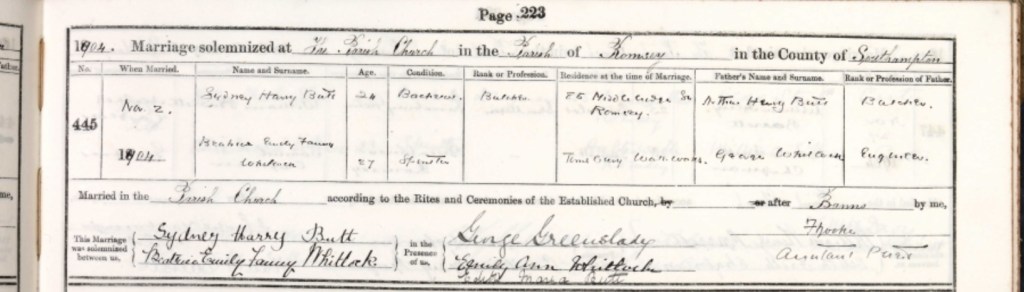
On Wednesday, the 2nd of November, 1904, Sydney Harry Butt, a 24-year-old bachelor, stood at the altar of The Parish Church of Romsey, ready to begin a new chapter in his life. By his side was Beatrice Emily Fanny Whitlock, a 27-year-old spinster, who had come from Tomsbury Waterworks to marry the young butcher from Middlebridge Street.
The ceremony was officiated by F. Booke, assistant priest, and as the marriage register was signed, it was recorded that Sydney, like his father before him, was a butcher, following in the well-established Butt family trade. His father, Arthur Henry Butt, was named in the records as a Master Butcher, a role that had defined their household for decades. Beatrice’s father, George Whitlock, was an engineer, a profession that likely brought a different perspective to the union of these two families.
The couple was surrounded by loved ones on their special day. George Greenslady, along with Edith Maria Butt, Sydney’s younger sister, and Emily Ann Whitlock, Beatrice’s relative, stood as witnesses, signing their names to mark the occasion.
For Francis, watching his elder brother marry must have been a bittersweet moment. Still adjusting to life without their mother, Fanny, the wedding would have been a joyful occasion, but one tinged with the sadness of her absence. As Sydney and Beatrice exchanged vows, it was a reminder that life moves forward, that even in the shadow of loss, there was still love, family, and the promise of new beginnings.
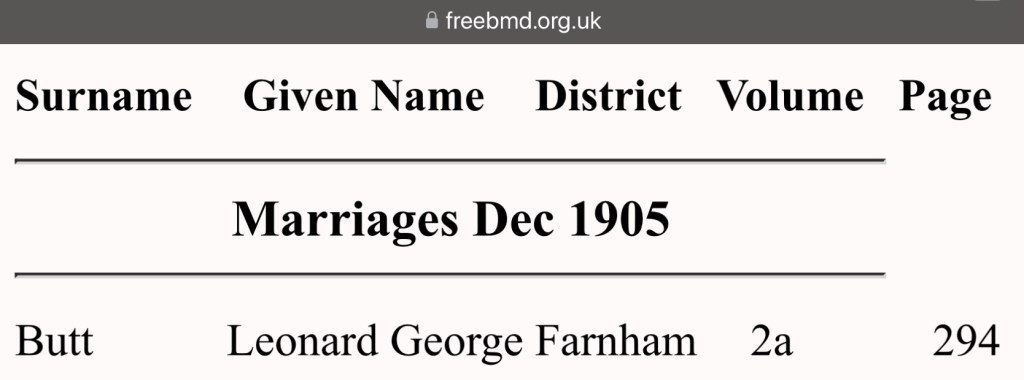
Francis’s brother, Leonard George Butt, married Rose Helena Ricketts in the final quarter of 1905, in the district of Romsey, Hampshire, England. Their union was recorded in the October to December quarter, and their marriage certificate can be found with the following GRO reference: Marriages, Dec 1905, BUTT, Leonard George, RICKETTS, Rose Helena, Farnham, Volume 2a, Page 294. This marks yet another chapter in the family’s rich history, weaving new bonds and continuing the legacy that Arthur Henry Butt had begun.
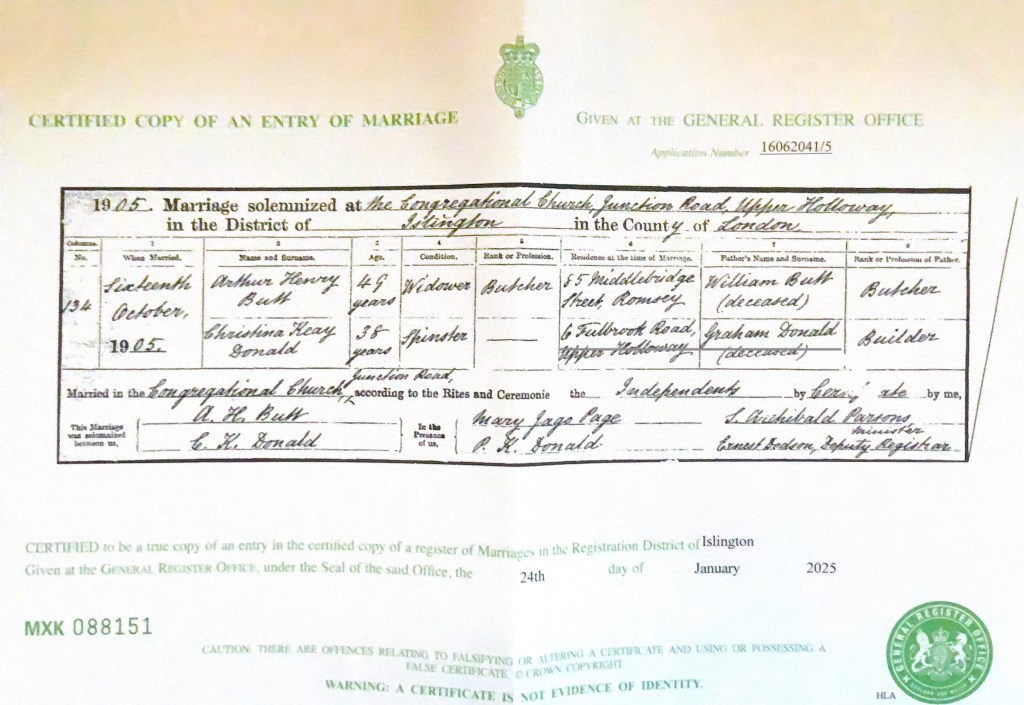
After two years of sorrow and solitude following the loss of his beloved Fanny,  Francis’s father, Arthur Henry Butt, a 49-year-old widower, found love once more. On Monday, the 16th day of October, 1905, he stood in the Congregational Church on Junction Road, Upper Holloway, Islington, London, ready to begin a new chapter with 38-year-old Christina Keay Donald, a spinster, who had also known life’s hardships and joys.
The ceremony was conducted by Minister S. Archibald Parsons, with Deputy Registrar Ernest Dodson ensuring every moment was formally recorded. As Arthur exchanged vows with Christina, it marked not only a new beginning for the couple but also the blending of two lives shaped by history and experience.
Arthur was listed in the Marriage Registry as a butcher, residing at Number 85, Middlebridge Street, Romsey, Hampshire, the very home where he had built his life with his late wife, Fanny. He was the son of the late William Butt, a former butcher, proving that the trade had been deeply rooted in the family for generations. Christina, residing at Number 6, Fulbrook Road, Upper Holloway, was the daughter of the late Graham Donald, a builder, a man whose craft had quite literally shaped the world around him.
Standing beside them as witnesses were, Mary Jago Page and P.K. Donald, undoubtedly dear friends or family members who had gathered to celebrate their union.
For Arthur, this marriage was not about replacing the past but rather embracing the future. It was about companionship, hope, and the promise that love, though different the second time around, could still be just as profound and enduring.
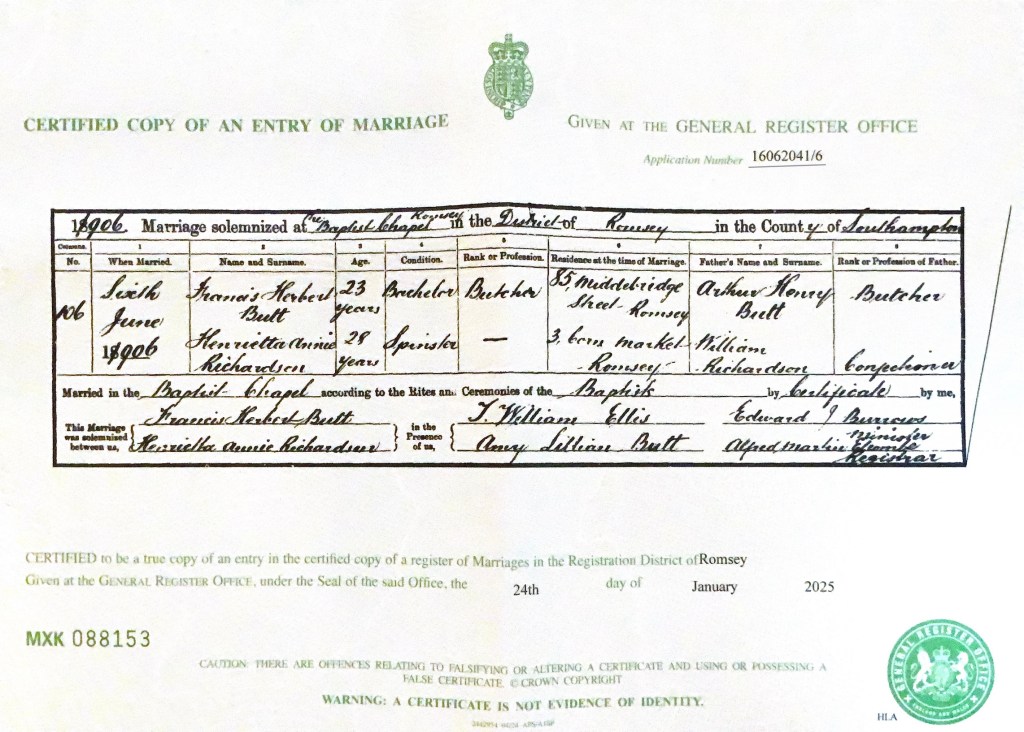
On Wednesday, the 6th day of June, 1906, in the heart of Romsey, Francis Herbert Butt and Henrietta Annie Richardson, stood side by side at the Baptist Chapel on Bell Street, ready to begin their lives together as husband and wife.
Francis, a 23-year-old bachelor, was living at Number 85, Middlebridge Street, Romsey, and had followed in his father’s footsteps as a butcher. His father, Arthur Henry Butt, was also still trading as a butcher, a trade deeply rooted in the Butt family. Henrietta, at 28-year-old, resided at Number 3, Corn Market, Romsey. Her father, William Richardson, was a confectioner, a profession that no doubt filled her childhood with the sweet scents of baked goods and sugar.
The couple exchanged their vows under the solemn and watchful guidance of Rev. Edward J. Burrows, the minister who officiated the ceremony. Alongside him was registrar Alfred Martin Elcombe, ensuring that every detail of their union was carefully recorded in the marriage registry.
Standing beside them as witnesses were William Ellis and Amy Lillian Butt, Francis’s beloved sister, both of whom shared in the joy of the occasion.
Their marriage was the blending of two families, two legacies, and two lives intertwined by love and devotion. The chapel in Bell Street, the very place where Francis and Henrietta spoke their vows, would remain a part of their story for years to come, marking the beginning of a journey filled with love, family, and tradition.
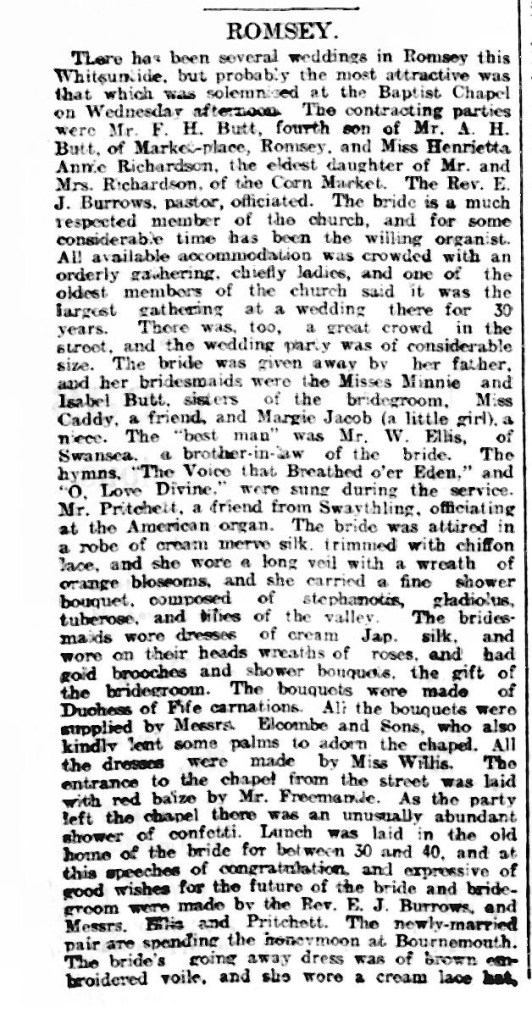
Francis and Henrietta’s wedding was featured in the Hampshire Advertiser, on Saturday, 9th June 1906. The article described the ceremony, which took place at the Baptist Chapel in Romsey on Wednesday afternoon. It was considered one of the most attractive weddings in Romsey that Whitsunside.
Francis H. Butt, the groom, was the fourth son of Mr. A. Butt of Market Place, Romsey. His bride, Miss Henrietta Annie Richardson, was the eldest daughter of Mr. and Mrs. Richardson of the Corn Market. The ceremony was conducted by the Rev. E.J. Burrows, the pastor. Henrietta was well-respected within the church, having served as the organist for a considerable time.
The chapel was filled to capacity, with an audience mainly consisting of ladies, and one of the oldest church members remarked that it was the largest wedding gathering there in 30 years. A large crowd also gathered outside in the street to witness the event. The bride was given away by her father, and her bridesmaids were Minnie and Isabel Butt, sisters of the groom, Miss Caddy, a friend, and Margie Jacob, a young niece. The best man was Mr. W. Ellis of Swansea, the bride’s brother-in-law.
During the service, the hymns "The Voice that Breathed o'er Eden" and "O, Love Divine" were sung, with Mr. Pritchett, a friend from Swaythling, playing the American organ. The bride wore a cream merve silk gown, trimmed with chiffon lace, complemented by a long veil and a wreath of orange blossoms. She carried a stunning shower bouquet of stephanotis, gladiolus, tuberose, and lilies of the valley.
The bridesmaids were dressed in cream jap silk, with wreaths of roses adorning their heads. Each carried a shower bouquet of Duchess of Fife carnations and received gold brooches as gifts from the groom. All the floral arrangements, including the bouquets, were supplied by Messrs. Elcombe and Sons, who also provided palms to decorate the chapel. The dresses were made by Miss Willis, and the entrance to the chapel was laid with red baize by Mr. Freemande.
As the newlyweds left the chapel, they were showered with an abundance of confetti. A wedding luncheon was held at the bride’s family home, attended by 30 to 40 guests. Toasts and speeches of congratulations were given by the Rev. F.J. Burrows, Mr. Ellis, and Mr. Pritchett.
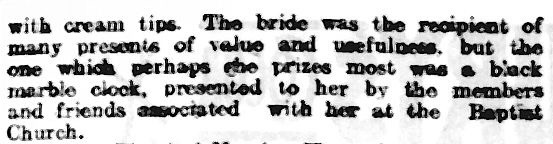
For their honeymoon, the couple traveled to Bournemouth. Henrietta’s going-away outfit consisted of a brown embroidered voile dress with a cream lace hat adorned with cream tips. Among the many gifts she received, the one she cherished most was a black marble clock, presented to her by members and friends from the Baptist Church.
The article reads as follows,

ROMSEY.
Tlere has been several weddings in Romsey this Whitsunside, but probaby the most attractive was that which was solemnised at the Baptist Chapel
on Wednesday afternoon The contracting parties were Mr. F. H. Butt, fourth son of Mr. A. Butt, of Market -place, Romsey, and Miss Henrietta Annie Richardson, the eldest daughter of Mr. and Mrs. Richardson, of the Corn Market. The Rev. E.J. Burrows, pastor, officiated. The bride is a much-respected member of the church, and for some considerable time has been the willing organist.
All available accommodation was crowded with an orderly gathering, chiefly ladies, and one of the oldest members of the church said it was the
largest gathering at a wedding there for 30 years.
There was, too, a great crowd in the street, and the wedding party was of considerable size. The bride was given away by her father, and her bridesmaids were the Misses Minnie and Isabel Butt, sisters of the bridegroom, Miss Caddy, a friend, and Margie Jacob (a little girl), a niece. The "best man" was Mr. W. Ellis, Swansea. a brother-in-law of the bride.
The hymns. "The Voice that Breathed o'er Eden," and "O, Love Divine," were sung during the service.
Mr. Pritcheit, a friend from Swaythling, officiating at the American organ. The bride was attired in a robe of cream merve silk. trimmed with chiffon lace, and she wore a long veil with a wreath of orange blosoms, and she carried a fine shower bouquet, composed of stephanotis, gladiolus, tuberose, and lilies of the valley.
The bridesmaids wore dresses of cream Jap, silk, and wore on their heads wreaths of roses, and had gold brooches and shower bouques, the gift of the bridegroom. The bouquets were made of Duchess of Fife carnations. All the bouquets were supplied by Messrs Elcombe and Sons, who also kindly lent some palms to adorn the chapel. All the dresses were made by Miss Willis. The entrance to the chapel from the street was laid with red baize by Mr. Freemande. As the party left the chapel there was an unusually abundant shower of confetti. Lunch was laid in the old home of the bride for between 30 and 40, and at this speeches of congratulation and expressive of good wishes for the future of the bride and bridegroom were made by the Rev. F. J. Burrows, and Messrs. Ellis and Pritchett. The newly-married pair are spending the honeymoon at Bournemouth.
The bride's going away dress was of brown embroidered voile, and she wore a cream lace hat, with cream tips. The bride was the recipient of many presents of value and usefulness, but the one which perhaps she prizes most was a black marble clook, presented to her by the members and friends associated with her at the Baptist Church.
As we close this first chapter of The Life of Francis Herbert Butt (1883–1948), we pause to reflect on the journey that brought him to this moment his marriage to Henrietta Annie Richardson in April 1906, Through the pages of history, we have followed Francis from his birth in the heart of Romsey, through the joys and hardships of childhood, the deep bonds of family, and the sorrow of losing his beloved mother. We have seen him grow from a young boy in a bustling household above the family butcher’s shop into a hardworking young man, carving out his own path. Life had already tested him in ways he could never have imagined, but as he stood at the altar of the Baptist Chapel, taking Henrietta’s hand in his, he was stepping forward with hope, love, and the promise of a future yet to be written. The echoes of his past, his mother’s kindness, his father’s hard work, his siblings’ companionship, would have shaped the man he had become, and now, they would guide him as he built a life of his own.
Until next time,
Toodle pip,
Yours Lainey.
🦋🦋🦋

