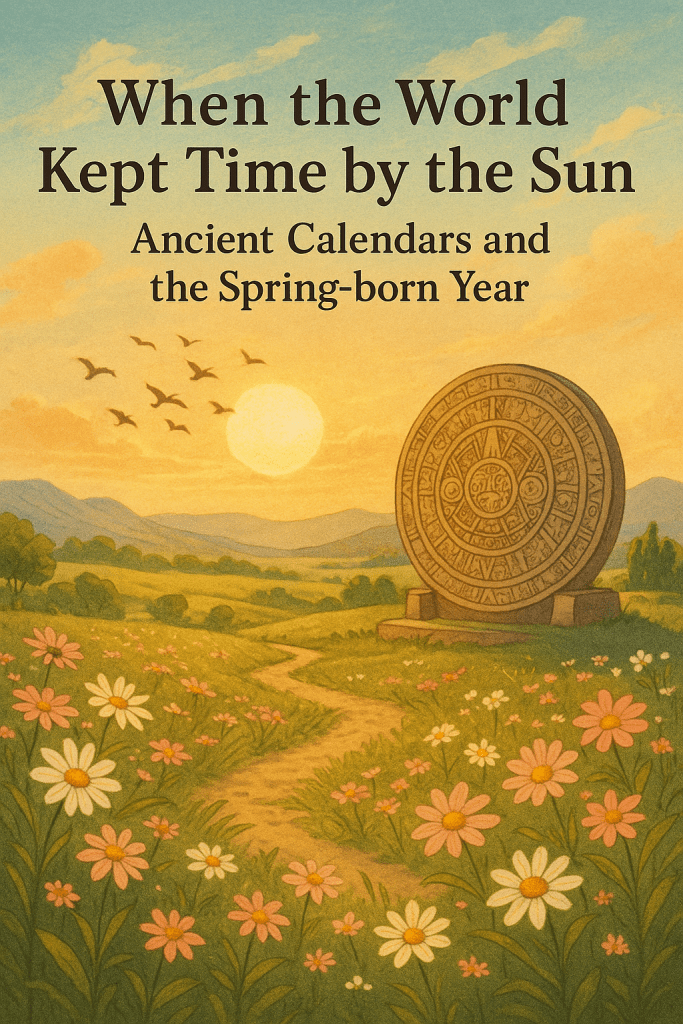
Long before clocks began their tireless ticking and calendars sliced our lives into tidy little boxes, time lived not on our walls or in our pockets, but in the world itself. It glowed in the throat of the dawn, shimmered along riverbanks, and drifted through the rise and fall of seasons. Ancient people did not simply observe time, they dwelled inside it, letting its rhythms move through them the way wind moves through grass. To them, the world was a giant, breathing clock, and every sunrise, migrating flock, and blossoming tree was a hand sweeping across its face.
Seasons were the earliest storytellers. Winter carried wisdom in its quiet, speaking of endings that were not truly ends but necessary pauses. Its long nights were blankets spread gently across the earth, an invitation to rest, reflect, and gather strength for the journeys ahead. Spring, ever the optimist, burst into the world with its arms full of wildflowers and promises. Summer sang with warm confidence, a golden season of generosity and growth. And autumn, with its copper winds and gentle letting-go, whispered that beauty often reaches its greatest brilliance just before it transforms. To the ancients, these were not mere temperature changes or horticultural cycles; they were chapters in a vast cosmic story where the earth itself turned the pages.
Across continents and centuries, people lifted their eyes to the sky to understand their place in this story. The Babylonians watched the heavens with such devotion that their careful star readings became the backbone of some of the earliest calendars. The Egyptians waited with reverent anticipation for the heliacal rising of Sirius, the star whose reappearance foretold the life-bringing floods of the Nile. And the Maya, with their magnificent stone-carved calendars, treated time as a sacred language, one that spiraled rather than marched, looping endlessly through eras like a divine heartbeat. For them, endings were never final, they were thresholds, doorways opening into new cycles.
What we often forget, surrounded as we are by digital reminders and internationally synchronized time zones, is that the New Year itself was once a springtime child. In the ancient world, the new year did not tiptoe in during winter’s hush. It strode in with budding branches in its hair. Many cultures celebrated the year’s beginning in March, the month when the natural world awakened. The Romans originally began their year with Martius, named for Mars, the god of vitality, courage, and new beginnings. As the frost retreated and fields softened, life felt ready to begin again. Even armies, recently pinned indoors by snow, could march once more, hence the month’s martial namesake.
A March new year wasn’t simply a date; it was a feeling. Imagine celebrating beginnings not in the deep stillness of winter, but in the sweet-limbed moment when birds returned, rivers thawed, and the earth exhaled warmth for the first time in months. Even long after the Romans reformed their calendar and shifted the new year to January, many European regions continued to honor the older rhythm, celebrating near the spring equinox well into the medieval and early modern eras. It made sense to them, why would one not begin anew in a season bursting with life?
There is something profoundly tender in this ancient way of keeping time. It suggests that beginnings should feel like beginnings, like sap rising quietly inside trees or buds daring to open against soft rain. Time, for the ancients, was not an enemy to outrun or a resource to manage. It was a companion, a guide, a story they trusted. Seasons were the feelings of the earth. Endings were soft pauses. Renewals were not calculated dates, but the moment when the world itself leaned toward the light again.
Learning how ancient people understood time feels like discovering a forgotten love letter addressed to all of us. It reminds us that time is not only measured by seconds and days but felt in the warmth of afternoon sunlight, the scent of the first rain after winter, the moment a memory arrives for no reason other than that the air has shifted. The ancients did not need clocks to know these things. They watched, they listened, they allowed the world to teach them when to rest and when to rise.
And perhaps, if we pause long enough, if we look up from our screens and step outside into the hush of a morning, we can feel that older rhythm stirring again. The rhythm that begins not in January, but in March, when the first green shoots break through cold soil and the year announces itself not with fireworks but with petals, sunlight, and the quiet rebirth of hope.
In that moment, we become a little more like our ancestors, listening to the earth, trusting its seasons, and remembering that every ending is only the beginning of another, gentler turning.
Until next time,
Toodle pip,
Yours Lainey.